| Hometown | Civilian Occupation |
| Wilmington, Delaware | Laborer |
| Branch | Service Number |
| U.S. Army | 32205322 |
| Theater | Unit |
| European | Company “I,” 104th Infantry Regiment, 26th Infantry Division |
| Military Occupational Specialty | Campaigns/Battles |
| 745 (rifleman) | Rhineland campaign |
Author’s note: This article incorporates some text from my previous article, Technician 5th Grade Harold T. Hitchens (1915–1944), another member of the same regiment.
Early Life & Family
Jacob Israel Silver was born Israel Jacob Silver on the evening of November 30, 1915, at his parents’ residence, 202 North King Street in Wilmington, Delaware. He was the seventh and youngest child of Nathan David Silver (a salesman, c. 1867–1947) and Ida Silver (née Mufson, c. 1874–1943), Jewish immigrants from the Russian Empire. He had four older brothers, one of whom died as a young child prior to Silver’s birth, and two older sisters.
Silver was recorded in the census in January 1920 as Israel Silva, living with his parents at 202 King Street. He was still living at that address when he was 10. On what must have been a slow news day, June 23, 1926, one of his escapades made the front page of the Wilmington Morning News:
Little Silver was the cause of much agitation in the neighborhood the other night when he clambered into a sewer in search of a ball, and after managing to squeeze himself in half way, found he could neither advance or retreat, whereupon he set up a lusty clamor that soon attracted a large crowd to the scene.
The youngster was soon extricated by a venturesome passerby, who removed the manhole and pushed him out feet first into the arms of his mother, still crying but more frightened than hurt.
The Silver family was not recorded on any known indexed record in Delaware during the census taken in April 1930. Another family was listed living at 202 King Street at the time of the next census in April 1930, suggesting the Silver family had moved. However, the 1930 Wilmington directory listed a Matson D. Silver—apparently a typo that should have been Nathan D. Silver—living at 202 North King Street. Nathan Silver was also listed at that address in the 1932, 1934, and 1938 directories. It is unclear if Silver lived with his father for their entire period.
Interestingly, 1930 census does record a 14-year-old boy named Israel Silver living on Seymour Avenue in Newark, New Jersey, with his mother, Ida, and two older sisters whose names and ages are consistent with the Silver from Delaware. That entry described Ida Silver as a widow, a common deception on census records when a couple was separated or divorced. If the entry does pertain to the correct Israel Silver, something by no means certain, it appears that his parents subsequently reconciled.
Journal-Every Evening reported that Silver “was active in the Y. M. H. A. [Young Men’s Hebrew Association] athletic program” in Wilmington.
Silver’s personnel file survived the 1973 National Personnel Records Center fire, albeit with significant damage that rendered some portions illegible. His induction report stated that he dropped out of school after completing the 8th grade, and served in the Civilian Conservation Corps. He reported working as a laborer for three years, earning $19 per week (about $400 in 2026 dollars) baling animal hair. Curiously, his brother, Dr. B. Harry Silver (1897–1951), told the Public Archives Commission that Silver’s occupation was salesman like his father.
When Silver registered for the draft on October 16, 1940, he was unemployed and living at 809 Adams Street. The registrar described him as standing about five feet, 10½ inches tall and weighing 178 lbs., with black hair and brown eyes. His address changed back to his parents’, 202 King Street, before he entered the service.
Journal-Every Evening reported: “While here he made his home with his brother [Joseph Silver] and also was employed by his brother at Diamond Chemical and Supply Company here.”
Military Career
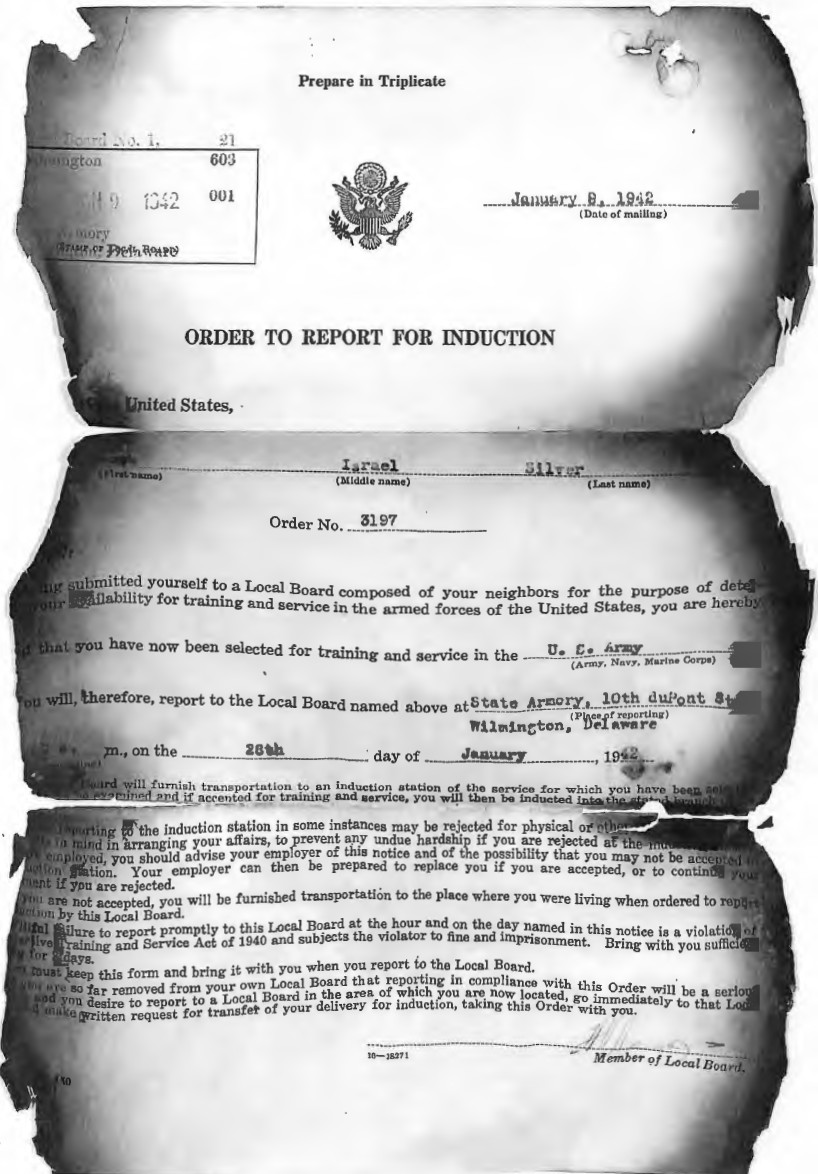
On January 8, 1942, Local Board No. 1, Wilmington, mailed Silver an order to report to the armory at 10th and duPont Steets for induction on the morning of January 28. He reported as instructed and was transported to Fort Dix, New Jersey, where he was inducted in the U.S. Army and attached unassigned to Company “I,” 1229th Reception Center.
Silver’s military records stated that upon induction he stood five feet, 10¼ inches tall and weighed 202 lbs., with brown hair and eyes, with a scar on his chin. The physician noted he had a mild case of pes planus (flat feet).
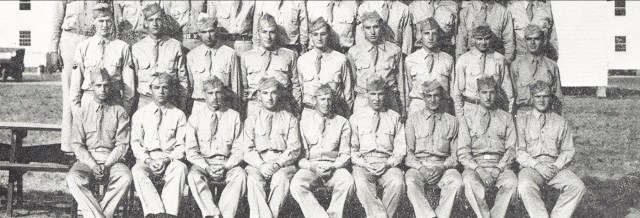
On February 2, Private Silver was dispatched by rail to the Branch Immaterial Replacement Training Center, Fort McClellan, Alabama. The same shipment included two other Delawareans destined to lose their lives serving in the 104th Infantry Regiment: Harold T. Hitchens (1915–1944) and Joseph J. Kwiatkowski (1920–1944). At Fort McClellan, Silver attended basic training attached to Company “C,” 9th Training Battalion.
After completing basic training, Private Silver was dispatched to Camp Edwards, Massachusetts, on Cape Cod. On April 13, 1942, Private Silver and 60 other men joined Company “I,” 104th Infantry Regiment, 26th Infantry Division. A roster listed their specification serial number as 521, basic, indicating that although they had completed basic training, none had qualified in any military occupational specialty (M.O.S.). The 104th Infantry was originally part of the Massachusetts National Guard. After entering federal service, draftees flowed into the unit beginning with local conscripts and then, after the attack on Pearl Harbor, those from further afield, like Silver.
Company “I” was a rifle company in 3rd Battalion. Silver and the other new infantrymen continued training with their new unit, including field exercises performing tactical problems. A morning report for the May 7, 1942, proudly announced that during an early morning exercise, Company “I” had taken “20 prisoners by catching outposts asleep[.]”
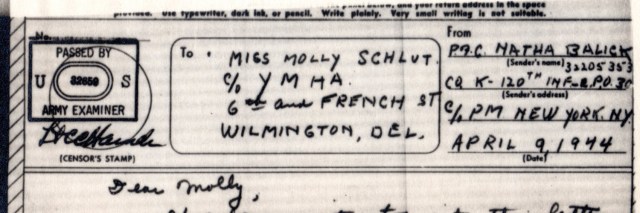
On May 5, 1942, Silver wrote his first letter to a Wilmington woman, Mollye Sklut (1906–2006), who was the principal figure in a network of communication connecting Delaware’s Jewish servicemembers worldwide with the home front. He told her:
I got a nice suntan in Ala. and am cooling it off now in Camp Edwards Mass. There are lots of Jewish fellows up here. I know my eleven general orders by heart. I am well noted for having a good memory. I also recite some poetry and the soldiers enjoy it very much. In Alabama I received a thunderous applause from the assembly for reciting Edgar Allen Poe’s Annabelle Lee.
Silver wrote: “They have dancing up here at the service club and [there] are very beautiful girls I enjoy dancing and laughing with[.]” He added, “I am in the infantry and enjoy long hikes and the obstacle course. I also enjoy the theatres here.”
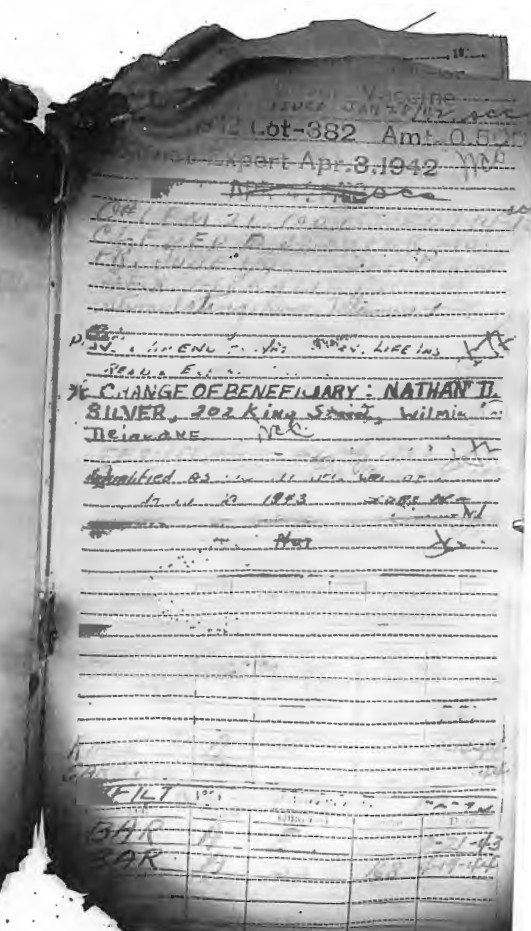
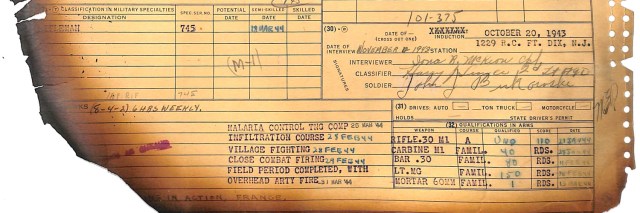
According to his personnel file, Silver qualified as M.O.S. code 745, rifleman, and 504, ammunition bearer. However, damage to his service record booklet from the 1973 fire obscured the dates of those classifications. A morning report stated his last M.O.S. was rifleman. In a rifle squad, ammunition bearers were armed with the M1 Garand rifle, and their experiences were similar to ordinary riflemen.
During the spring of 1942, the 104th Infantry was scattered across the southeastern United States, patrolling the coastline from Florida to North Carolina. Despite the paranoia that followed the attack on Pearl Harbor, the Germans lacked the amphibious capacity to successfully cross the English Channel, much less the Atlantic Ocean. German submarines could land spies or saboteurs but that happened only rarely.
On the afternoon of May 17, 1942, Company “I” departed Camp Edwards by train, arriving in Homestead, Florida, on the morning of May 20. They transferred to trucks for the remainder of their journey to Pigeon Key, arriving at 1330 hours that afternoon. There were certainly worse places for a soldier to be stationed than a tiny island in the Florida Keys. When not guarding bridges, the men of Company “I” passed the time “training, swimming and fishing[.]”
A morning report dated May 26–27, 1942, noted that the company had an unexpected benefactor, George LaVigne (1897–1943). LaVigne, a resident ”of Miami and Key West formerly of Pittsfield[, Massachusetts] and a member of old Co ‘F’ now ‘I’ Co. donated $100 dollars to canteen for benefit of the men. Each man received cigars, cigarettes[,] beer, soda and candy.”
Around June 1, 1942, Company “I” moved to the Camp Trout, Miami, Florida, and then to nearby Camp Bell Haven on June 11. Later that month, in a letter postmarked June 29, 1942, Silver wrote to Mollye Sklut again, reflecting on the death of Sergeant Harry Fineman (1916–1942), the first soldier from Delaware and the first member of Wilmington’s Jewish community to be killed in action during the war, referencing a popular song from the era: “I was very sorry to hear about Harry Finemans death. We will avenge his aggressors in time. Always remember there ell [sic] be blue birds over the white cliffs of Dover. Give my regret to his parents.”
Switching to his own experiences, Silver wrote:
I enjoy my work here, and during my leisure hours enjoy theatre going and dancing a tremendous around more. Let my friends know it is a great honor fighting for Uncle Sam and also a beautiful privilege. I hope my buddies feel the same way about it. The orchestra is playing so I will go in and dance.
On July 11, 1942, Silver and his company moved to Camp Higgins, Palm Beach, Florida, where they patrolled beaches. Naturally, there was little activity. The most notable event was on July 20, when a patrol “picked up a man at Delray Beach with a radio metal locator. He was placed under arrest and turned over to the F.B.I.”
Two days later, on July 22, 1942, Silver wrote: “I am getting along very well and enjoy my work which is more like pleasure. I ride in a jeep and do little walking. Somebody else drives the jeep while I sit back and take it easy.”
On August 3, 1942, Silver wrote Sklut again:
I am now in W. Palm Beach writing to you. Radio police cars roll by my camp every hour and take the soldiers to town free which is only 6 miles away. I once got a ride in a rich mans motor boat from Camp Higgins to W. Palm with a few of my buddies and got quite a thrill out of it. There is a pine smell and other luscious odors in the trees and meadows as one passes by walking or riding in a car. It is pretty warm up to 5 o’clock P. (afere [sic]) after that time it gets refreshing cool. The victrolas sounding out with classical songs[.] They are my favorite tunes.
The work, however routine, was not without danger. A tragedy struck Silver’s company on the morning of August 11, when a vehicle carrying a group of eight men on beach patrol duty went off a bridge at Titusville, Florida, and into the water, killing six: four from Company “I” and two attached to the company.
Company “I” returned to Camp Bell Haven on August 30, 1942. On October 25, the company and attachments “participated in Navy Day Parade and exercises at Orange Bowl, Miami, Fla.”
By this point it was clear that there was no Axis threat to the continental United States and with American forces now in ground combat, it was difficult to justify committing large numbers of troops to beach patrol. According to the regimental history book, History of a Combat Regiment 1639–1945, “In January, 1943, the regiment was withdrawn from patrol duty and reassembled on the 27th of the month at Camp Blanding, Florida, for conditioning and amphibious training.” Similarly, Company “I” morning reports state that the unit departed Camp Bell Haven on the evening of January 24, 1943, arriving at Camp Blanding the following day.
Private Silver went on furlough on April 2, 1943, returning to duty on April 16. Two days later, his unit moved to Camp Gordon, George, by rail, rejoining the rest of the 26th Infantry Division. Silver’s mother died on April 17, though it appears that it may have taken a few days for the news to reach him at his new duty station. Silver went on emergency furlough on April 25, returning to duty on April 30.
In September 1943, the 26th Infantry Division began moving to Camp Campbell, Kentucky. On December 15, Private Silver and five other men from Company “I” transferred to Headquarters Company, 3rd Battalion, 104th Infantry.
From January to March 1944, the 104th Infantry participated in exercises in the Tennessee Maneuver Area. The regiment had now been training for three years. Although the 26th Infantry Division was stripped of manpower several times to provide overseas replacements or cadremen for new units, there was still no sign that it would be sent overseas. History of a Combat Regiment 1639–1945 stated:
Tennessee Maneuvers were “rough.” The problems, with the accompanying rain, snow, and mud, were executed so realistically that men of the 104th later agreed that the only difference between maneuvers and combat was that there was no “hot lead” flying around.
They suffered losses, as they had in Florida. On the night of March 22, 1944, 21 men, the majority from Company “B,” including another Delawarean, John J. Paisley (1920–1944), drowned in the Cumberland River when their boat capsized during the last exercise of the maneuvers. An engineer from another unit, who was manning the boat, was also killed. With the exercises over, Private Silver transferred back to Company “I” on March 25.
Company “I” departed Tennessee by road on the morning of March 29, arriving the following day at Fort Jackson, South Carolina. Training continued there, including testing in multiple categories necessary for soldiers to be awarded the new Expert Infantryman Badge. In practice, this proved more difficult to earn than the coveted Combat Infantryman Badge that infantrymen received for performing satisfactory in battle.
The section of Silver’s service record booklet dealing with weapon qualifications was severely damaged in the 1973 fire. He qualified at the Expert level with the bayonet on April 3, 1942. It appears that in 1943 and 1944 he shot for qualification with the M1 rifle and the M1 carbine, and qualified with at least one of them. He also shot for qualification with the Browning Automatic Rifle in 1943 and again in mid-April 1944. It appears that during the latter course he qualified at the Sharpshooter level with a score of 168, depending on whether he fired with or without bipod, which had different scoring schemes.
Shortly before going overseas, almost the entire company was able to go on one last furlough. Silver’s turn came on April 25, 1944. He returned to duty on May 8. Training continued with marches, field exercises, and lectures by combat veterans.
On May 23, 1944, Silver completed a night infiltration course. A note in his personnel file stated that he was favorably considered for the Good Conduct Medal, but there is no indication he was ever awarded it. The entire company got a three-day pass from 1800 hours on June 22, until 1800 on June 25.
Combat in the European Theater
On August 18, 1944, Private Silver and his unit departed Fort Jackson by train, arriving the following day at Camp Shanks, New York. He and the rest of the 104th Infantry shipped out from the New York Port of Embarkation aboard S.S. Argentina on August 27, 1944, arriving in Cherbourg, France, on September 7.
The 104th Infantry did not immediately enter combat. The regimental history book, History of a Combat Regiment 1639–1945, stated:
On September 15th the regiment was temporarily broken up for the first time since coastal-patrol days when three provisional truck companies and a headquarters company of 180 men each were formed to join the “Red Ball Express” — the emergency truck line established to rush vital supplies from the ports to the rapidly advancing front lines. All of these men returned to the regiment by the end of September.
Silver was not among the men from his company selected for that assignment, which was emblematic of the problems the Allies faced in northwest Europe. After the breakout from Normandy in July 1944 and the landings in the South of France the following month, German forces went into headlong retreat. In September, however, as Allied supply lines lengthened, the front lines stabilized.
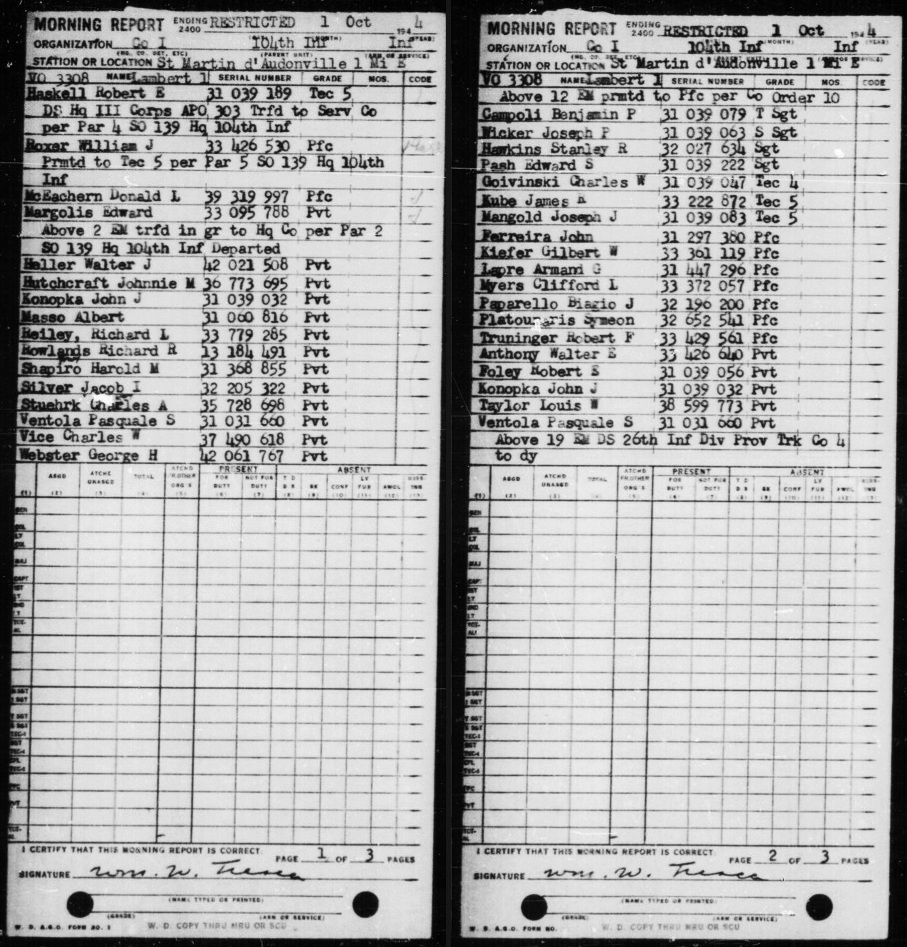
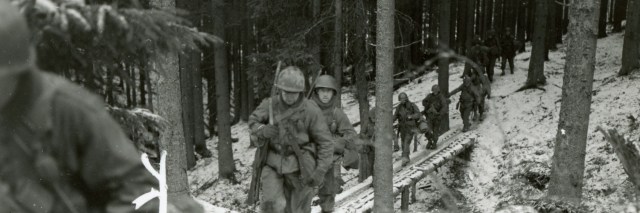
According to morning reports, Silver was promoted to private 1st class on October 1, 1944. The 104th Infantry began moving east by truck on October 4. Two days later, Company “I” arrived at the front in Lorraine. On October 8, Silver and his company assumed defensive positions near Réchicourt-la-Petite, France. Initially there was little activity aside from patrolling. Company “I” took its first casualties on October 17, when two men were wounded by mortar fire. During the next few days, the company was occasionally shelled but suffered few casualties. On the afternoon of October 21, 3rd Battalion had a front row seat when American P-47 Thunderbolts bombed and strafed the German positions facing them.
On October 22, 1944, 1st Battalion, 104th Infantry passed through 3rd Battalion’s lines on the attack into Moncourt Woods, meeting heavy resistance. The following morning, 2nd Platoon, Company “I,” reinforced 1st Battalion, while 3rd Platoon evacuated 1st Battalion casualties. Extant documents do not reveal which platoon Silver was a member of. Morning reports record the company as suffering two dead and 16 wounded, mostly members of 2nd Platoon struck by enemy artillery.
Silver was awarded the Combat Infantryman Badge per General Orders No. 9, Headquarters 104th Infantry, dated October 24, 1944. Two days later, Company “I” moved a short distance by road and relieved Company “A,” 328th Infantry near Juvrecourt. The area was generally quiet, though early on October 29 one man was wounded in a clash with an enemy patrol, and the company was briefly shelled the following three days.
On November 3, 1944, Silver and his company were relieved by 2nd Battalion, 101st Infantry, and went into reserve. They attended a meeting with famed U.S. Third Army commander Lieutenant General George S. Patton, Jr. (1885–1945). A morning report noted that the following day, “Co received duffle bags at 1500 and proceeded to make a change into clean clothes for the first time in over a month[.]” Their bags went back to storage the following day, but the company “went for showers and a show to the town of Serries at 1100 and returned at 1630[.]” The 26th Infantry Division did assault training in preparation for their next mission, an attempt to break defenses close to the German border. The regimental history book stated:
The regiment, as part of the Third Army’s XII Corps, along with the 80th Division, 35th Division, 4th and 6th Armored Divisions, and the rest of the 26th had the mission of establishing bridgeheads on the Saar River. The ultimate plan was to continue driving northeast all the way to the Rhine, seizing key cities and carrying out the destruction of the German forces on the west side of that river.
The 26th Division was to attack with three infantry regiments abreast, the 104th on the left, the 101st in the center, and the 328th on the right. While protecting the XII Corps and Third Army right flank, the division was to take a series of towns and heavily defended positions, and finally its first main objective, Benestroff.
The 104th was deployed with the 1st Battalion on the right, 2nd Battalion on the left, and 3rd Battalion in regimental reserve.
H-Hour was set for 0600 on November 8, 1944. 1st Battalion, 104th Infantry advanced on Vic-sur-Seille, facing heavy resistance. Silver’s 3rd Battalion did not remain in reserve for long. The regimental history stated:
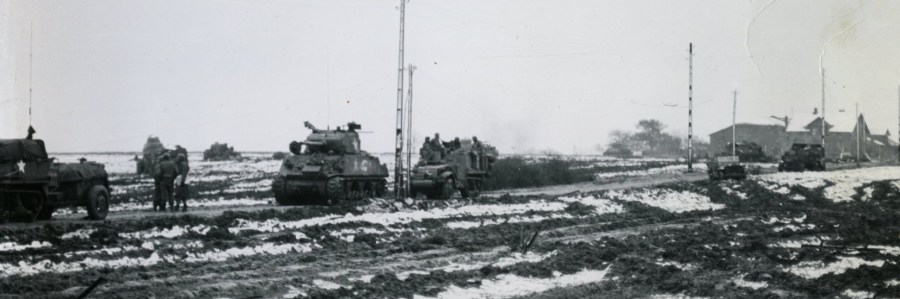
At 0900, the 3rd Battalion was committed to reinforce the 1st’s attack on the town. Crossing the canal by foot bridge, they clambered over a railroad embankment, advanced over rising terrain through plowed fields, orchards, and tangled vineyards, and drove in under a storm of artillery and mortar fire from the left. Capt. W. W. Tresca, CO [commanding officer] Co. I, was seriously wounded near the bridge. While 1st Battalion and Co. L fought in town, the rest of the 3rd Battalion, against heavy sniper fire, took the high ground beyond, riflemen of Co. I wiping out a German artillery observation post that had commanded all the surrounding territory.
Company “I” took heavy casualties on the first day of the offensive. Morning reports recorded three men killed in action or died of wounds, and 29 men wounded. Three other men were reported missing in action, of whom two were dead and one wounded.
On November 9, 1944, the 101st and 104th Infantry Regiments continued their advance. Company “I” reported another 15 men wounded and one non-battle casualty, along with three missing, though it appears that all three eventually returned to duty. The 104th Infantry history stated:
Companies I and K, with tank support, attacked Morville and moved to the high ground northeast and east of that town, where elements of Co. I were pinned down in an open field by “88” [mm gun] and machine-gun fire from a camouflaged German tank. […]
By Friday, November 10, the regiment had broken through the frontline defenses of the enemy and all three battalions moved northeast through Hampont, the German divisional supply depot, Dedeling and Chateau Voue. For defense, Jerry relied on strong points commanding roads and flat terrain between the hills. His real strength lay, however, not in pillboxes or stationary positions, but in a mobile striking force of armor and infantry that backed up the rearguard action and could lash out at any moment in vicious counterattack…and frequently did.
Company “I” reported three men wounded on November 10, 1944, plus one non-battle casualty, a harbinger of what was to come. Cold, wet weather—compounded by inadequate clothing—soon led to multiple cases of trench foot.
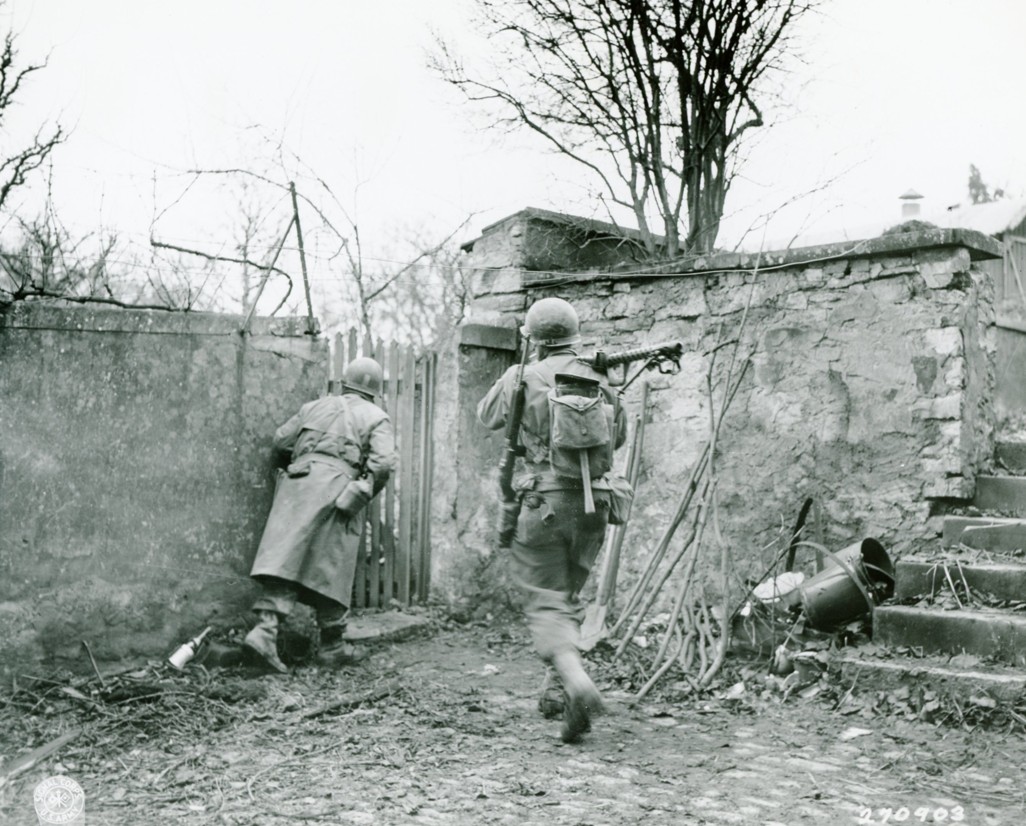
Armistice Day, November 11, 1944, saw no letup in the fighting, as the men of the 26th Infantry Division continued their advance. A German counterattack directed at 1st Battalion, 104th Infantry withered under American artillery fire. Company “I” reported one man killed, one wounded, and seven non-battle casualties.
The fighting was even fiercer on November 12, 1944. Silver’s Company “I” was initially in reserve while the rest of 3rd Battalion took Rodalbe, France. Though that action carried the advance only just short of Bénestroff, it also left 3rd Battalion holding a vulnerable salient into German-occupied territory, which the enemy wasted no time in exploiting, as the regimental history explained:
During the late afternoon of November 12, German tanks and panzer infantry encircled the town and laid down a heavy artillery barrage. Co. I, in battalion reserve, started up from Conthil with less than 40 men to relieve pressure on other elements of the battalion but was driven back by concentrated shell fire. Having cut off the town, the German tanks roared in, swarming with yelling infantry and firing “88’s” point blank at the defenders by sticking the gun muzzles into cellar doors and windows.
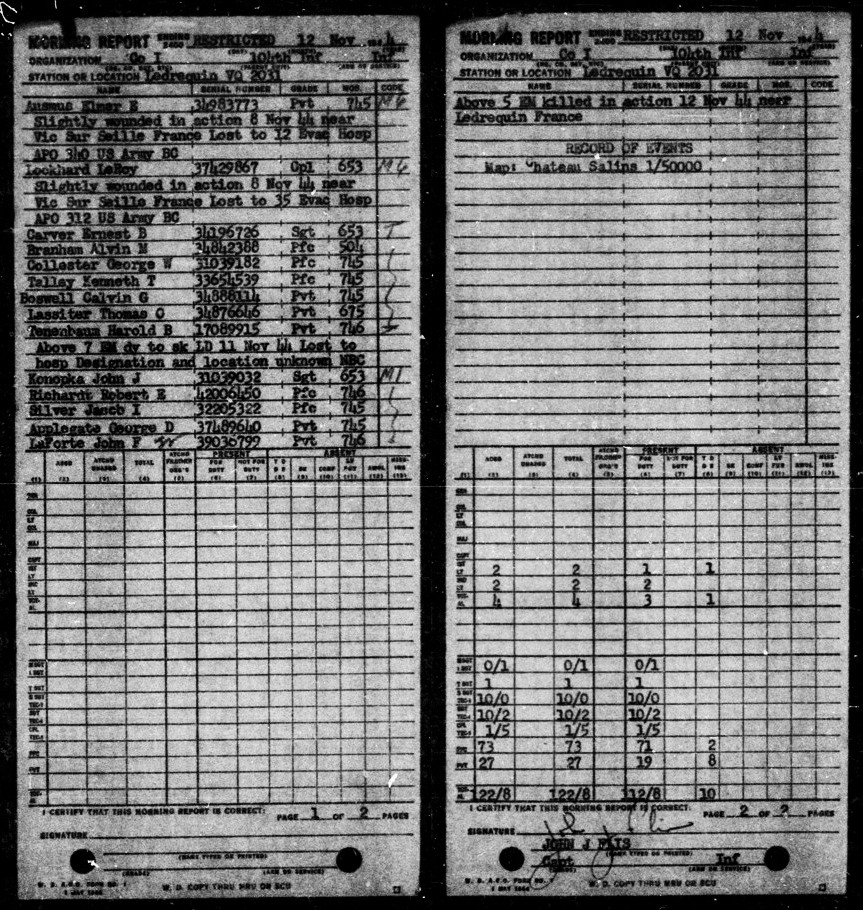
Though a handful of men broke out of the encirclement that night, 3rd Battalion was “almost wiped out” during the battle for Rodalbe. Based on details in the regimental history, Silver must have been killed during the abortive attempt to rescue the rest of 3rd Battalion. Company “I” morning reports record five men killed, including Silver, and two wounded. According to his burial report, Silver suffered a fatal compound fracture to his right femur, presumably due to the enemy artillery fire mentioned in the history. Journal-Every Evening reported his death on November 28, 1944.
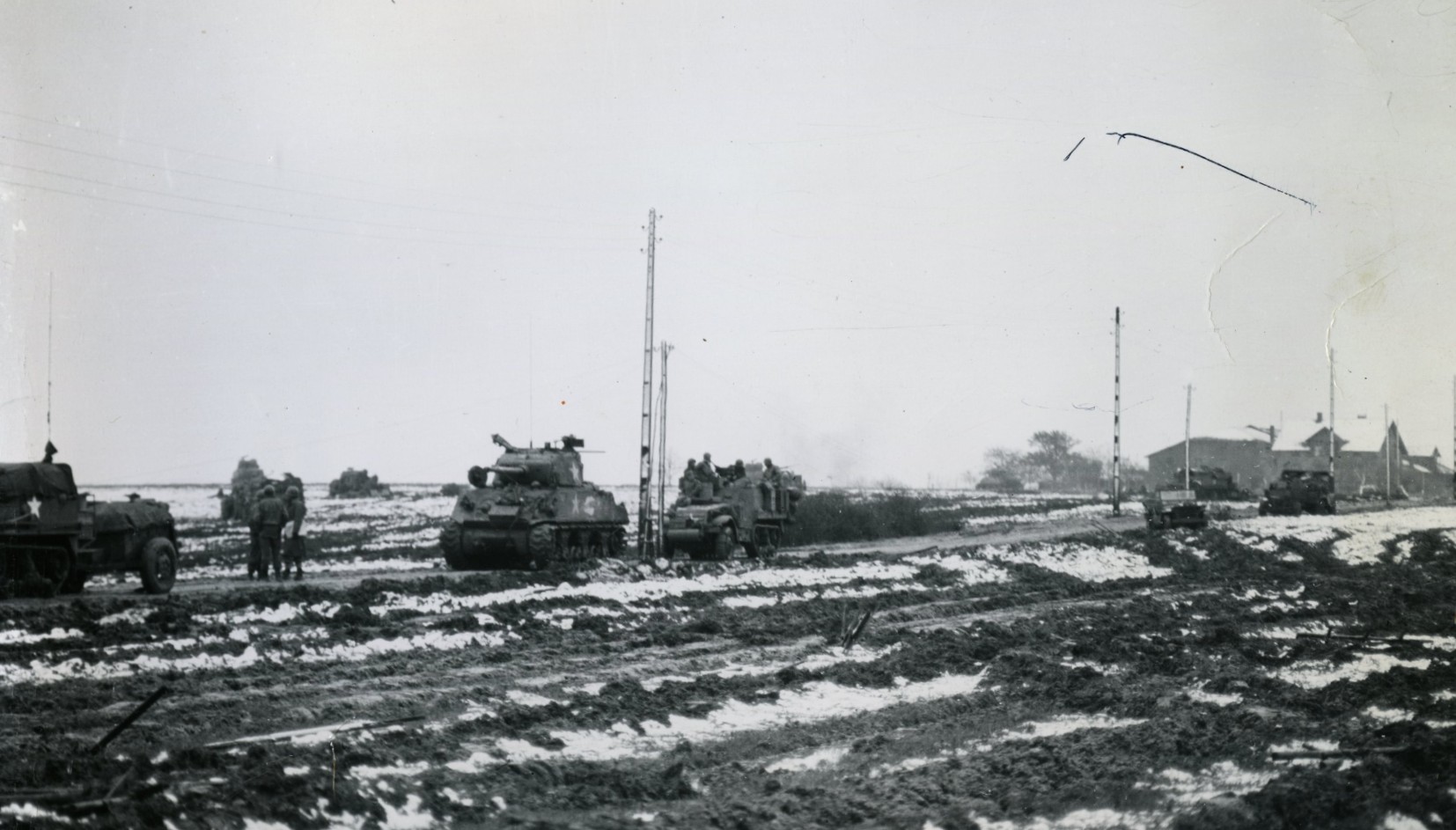
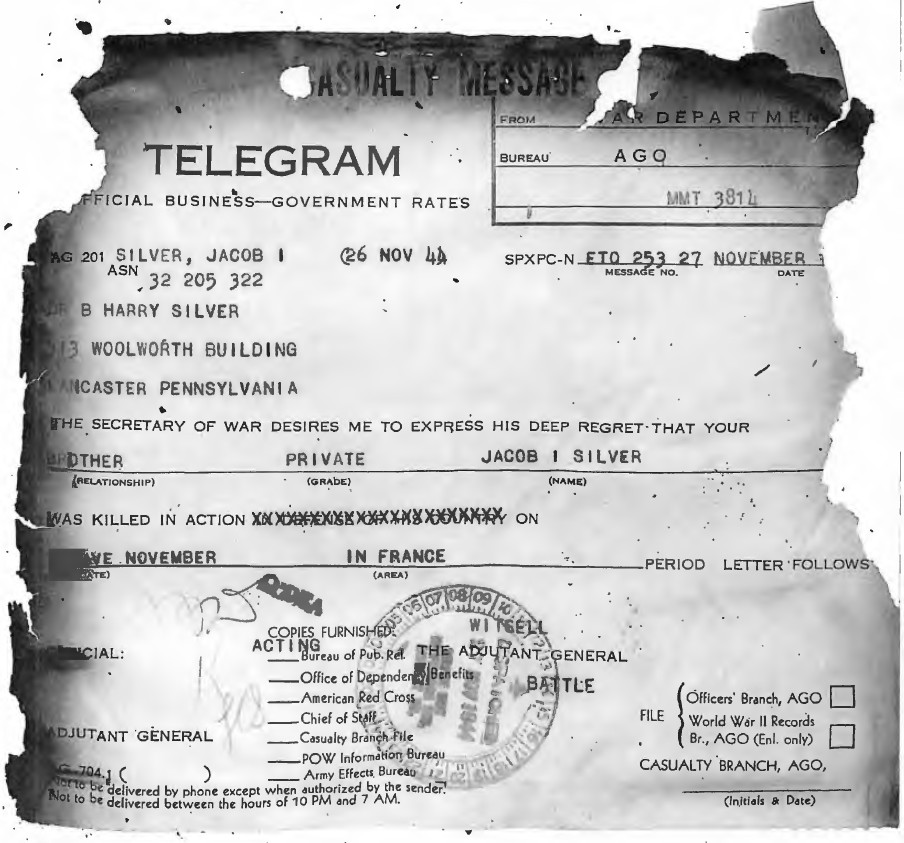
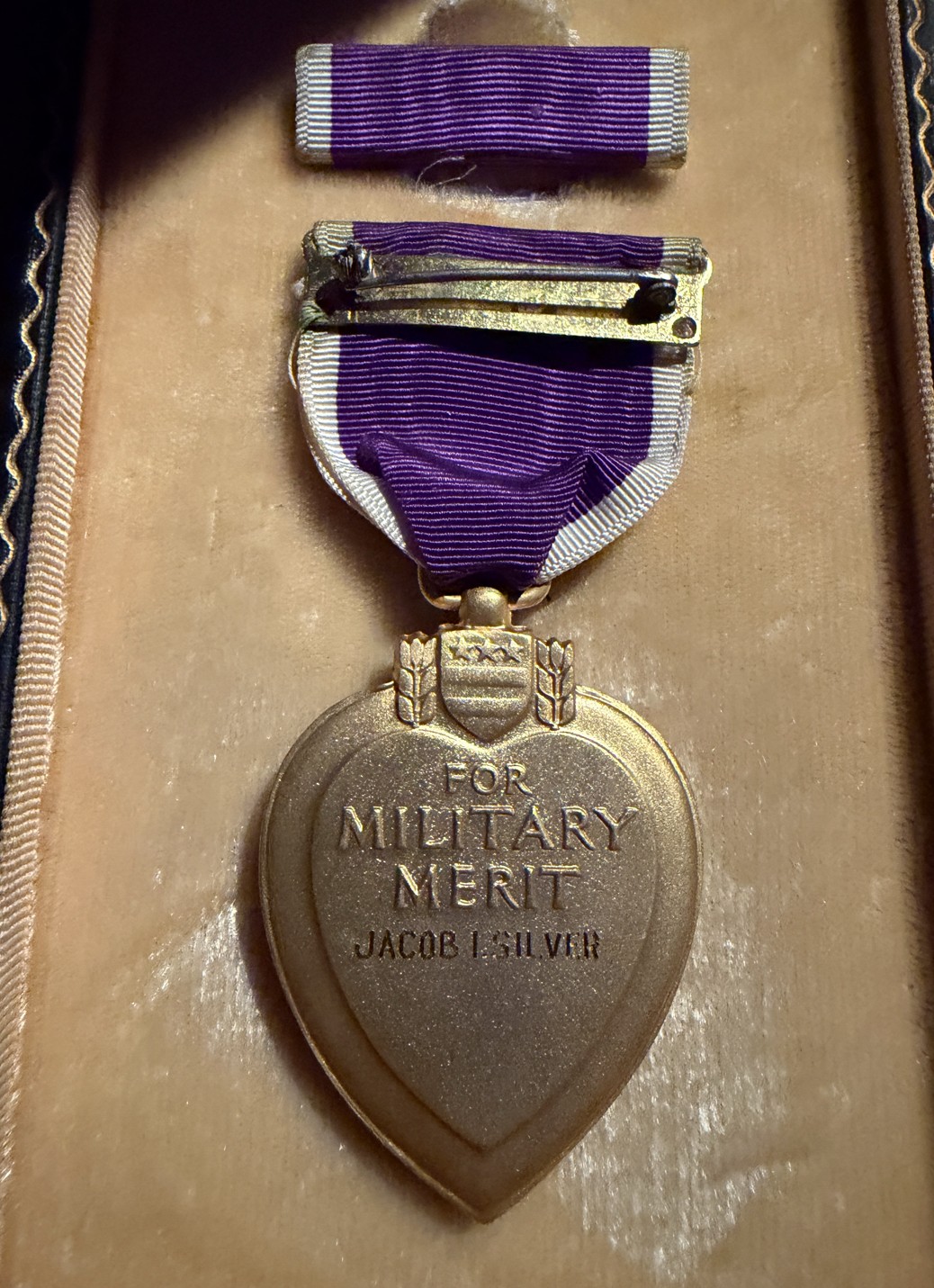
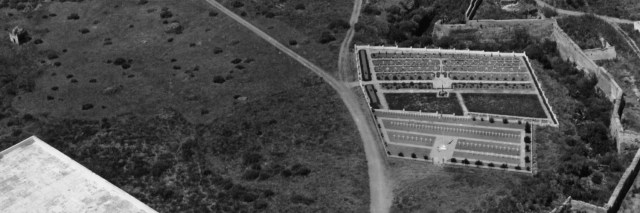
Silver was posthumously awarded the Purple Heart. He was initially buried at Limey, France, on the afternoon of November 15, 1944. After the war, in 1948, Dr. B. Harry Silver requested that his brother’s body be buried at a permanent overseas cemetery. On March 19, 1949, Silver was buried for the final time at Saint-Avold, France, at what is now known as the Lorraine American Cemetery.
Under Army Regulations No. 615-5 dated June 30, 1943, Silver’s company commander had the authority to promote him to the grade of private 1st class, with no need for higher authority to authorize or confirm it. For unknown reasons—there is no record of Silver being demoted in company morning reports—his burial report and Adjutant General’s Office death report listed him as a private rather than private 1st class. As a result, his headstone also refers to him as private.
Silver’s name is honored at a monument in the Jewish Community Cemetery in Wilmington and at Veterans Memorial Park in New Castle, Delaware.
Notes
Date of Birth & Name
Silver’s birth certificate, the Wilmington birth register, in his personnel file, and his individual deceased personnel file all give his date of birth as November 30, 1915. Curiously, his draft card recorded it as December 30, 1915. The birth certificate was filed on December 11, 1915, which rules out that possibility.
Silver’s birth certificate listed his name as Israel Jacob Silver. This could have been an error, but the 1920 census and 1926 newspaper article also referred to his first name as Israel, indicating he later inverted his first and middle names.
Acknowledgments
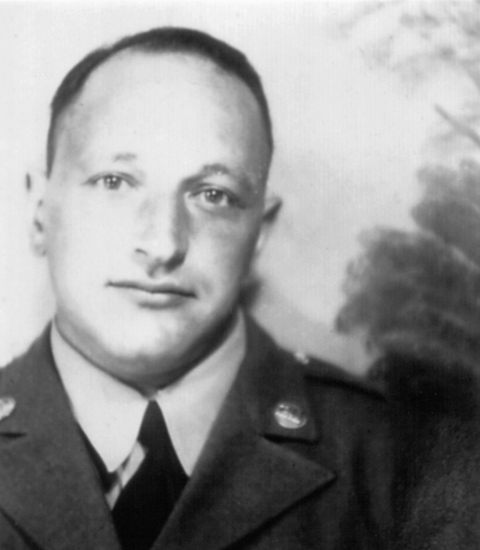
Special thanks to the Jewish Historical Society of Wilmington for the use of their photo and letters.
Bibliography
“Action Against the Enemy Report 1 – 30 November 1944.” Undated, c. December 1944. World War II Operations Reports, 1940–48. Record Group 407, Records of the Adjutant General’s Office. National Archives at College Park, Maryland. War Department Archives. https://www.wdarchives.com/archives/record/5242/
“Action Against the Enemy Report, 1 – 31 October 44.” November 17, 1944. World War II Operations Reports, 1940–48. Record Group 407, Records of the Adjutant General’s Office. National Archives at College Park, Maryland. War Department Archives. https://www.wdarchives.com/archives/record/5243/
“Army Regulations No. 615-5: Enlisted Men Appointment and Reduction of Noncommissioned Officers and Privates, First Class.” June 30, 1943. War Department Archives. https://www.wdarchives.com/archives/record/11531/
“Boy, Retrieving Ball, Stuck in Sewer Inlet.” June 23, 1926. Wilmington Morning News. https://www.newspapers.com/article/205400123/
Census Record for Israel Silver. April 10, 1930. Fifteenth Census of the United States, 1930. Record Group 29, Records of the Bureau of the Census. National Archives at Washington, D.C. https://www.ancestry.com/imageviewer/collections/6224/images/4660895_00812
Census Record for Joseph Fried. April 7, 1930. Fifteenth Census of the United States, 1930. Record Group 29, Records of the Bureau of the Census. National Archives at Washington, D.C. https://www.familysearch.org/ark:/61903/3:1:33S7-9R4C-NZV
Census Record for Israel Silva. January 14, 1920. Fourteenth Census of the United States, 1920. Record Group 29, Records of the Bureau of the Census. National Archives at Washington, D.C. https://www.familysearch.org/ark:/61903/3:1:33S7-9R6W-SF9
Certificate of Birth for Israel Jacob Silver. 1915. Record Group 1500-008-094, Birth Certificates. Delaware Public Archives, Dover, Delaware. https://www.familysearch.org/ark:/61903/3:1:S3HY-6SP7-53Y
Deed Between Nathan D. Silver and Ida Silver, Parties of the First Part, and James Caverin and Olive Caverin, Parties of the Second Part. March 23, 1928. Delaware Land Records, 1677–1947. Record Group 2555-000-011, Recorder of Deeds, New Castle County. Delaware Public Archives, Dover, Delaware. https://www.ancestry.com/imageviewer/collections/61025/images/31303_257019-00416
Draft Registration Card for Jacob Israel Silver. October 16, 1940. Draft Registration Cards for Delaware, October 16, 1940 – March 31, 1947. Record Group 147, Records of the Selective Service System. National Archives at St. Louis, Missouri. https://www.familysearch.org/ark:/61903/3:1:3Q9M-CSMG-XSW7-1
Enlistment Record for Jacob I. Silver. January 28, 1942. World War II Army Enlistment Records. Record Group 64, Records of the National Archives and Records Administration. National Archives at College Park, Maryland. https://aad.archives.gov/aad/record-detail.jsp?dt=893&mtch=1&cat=all&tf=F&q=32205322&bc=&rpp=10&pg=1&rid=2849041
“George LaVigne Funeral Services Monday At 11.” July 16, 1943. Miami Daily News. https://www.newspapers.com/article/205129337/
History of a Combat Regiment 1639–1945 104th Infantry. Undated, c. 1945. Publisher unknown. World War II Operations Reports, 1940–48. Record Group 407, Records of the Adjutant General’s Office. National Archives at College Park, Maryland.
Hospital Admission Card for 32205322. November 1944. U.S. WWII Hospital Admission Card Files, 1942–1954. Record Group 112, Records of the Office of the Surgeon General (Army), 1775–1994. National Archives at College Park, Maryland. https://www.fold3.com/record/704721110/silver-jacob-i-us-wwii-hospital-admission-card-files-1942-1954
Individual Deceased Personnel File for Jacob I. Silver. 1944–1949. Army Individual Deceased Personnel Files, 1942–1970. Record Group 92, Records of the Office of the Quartermaster General, 1774–1985. National Archives at St. Louis, Missouri. Courtesy of U.S. Army Human Resources Command.
Morning Reports for Company “I,” 104th Infantry Regiment. April 1942 – July 1943. U.S. Army Morning Reports, c. 1912–1946. Record Group 64, Records of the National Archives and Records Administration. National Archives at St. Louis, Missouri. https://catalog.archives.gov/medialz/partners/st-louis/rg-064/85713825-wwii/85713825_1940-01-thru-1943-07/85713825_1940-01-thru-1943-07_Roll-1672/85713825_1940-01-thru-1943-07_Roll-1672-27.pdf, https://catalog.archives.gov/medialz/partners/st-louis/rg-064/85713825-wwii/85713825_1940-01-thru-1943-07/85713825_1940-01-thru-1943-07_Roll-1672/85713825_1940-01-thru-1943-07_Roll-1672-28.pdf, https://catalog.archives.gov/medialz/partners/st-louis/rg-064/85713825-wwii/85713825_1940-01-thru-1943-07/85713825_1940-01-thru-1943-07_Roll-1672/85713825_1940-01-thru-1943-07_Roll-1672-29.pdf
Morning Reports for Company “I,” 104th Infantry Regiment. December 1943. U.S. Army Morning Reports, c. 1912–1946. Record Group 64, Records of the National Archives and Records Administration. National Archives at St. Louis, Missouri. https://catalog.archives.gov/medialz/partners/st-louis/rg-064/85713825-wwii/85713825_1943-12/85713825_1943-12_Roll-0338/85713825_1943-12_Roll-0338-06.pdf
Morning Reports for Company “I,” 104th Infantry Regiment. March 1944 – November 1944. U.S. Army Morning Reports, c. 1912–1946. Record Group 64, Records of the National Archives and Records Administration. National Archives at St. Louis, Missouri. https://catalog.archives.gov/medialz/partners/st-louis/rg-064/85713825-wwii/85713825_1944-03/85713825_1944-03_Roll-0379/85713825_1944-03_Roll-0379-29.pdf, https://catalog.archives.gov/medialz/partners/st-louis/rg-064/85713825-wwii/85713825_1944-04/85713825_1944-04_Roll-0354/85713825_1944-04_Roll-0354-19.pdf, https://catalog.archives.gov/medialz/partners/st-louis/rg-064/85713825-wwii/85713825_1944-04/85713825_1944-04_Roll-0354/85713825_1944-04_Roll-0354-20.pdf, https://catalog.archives.gov/medialz/partners/st-louis/rg-064/85713825-wwii/85713825_1944-05/85713825_1944-05_Roll-0241/85713825_1944-05_Roll-0241-28.pdf, https://catalog.archives.gov/medialz/partners/st-louis/rg-064/85713825-wwii/85713825_1944-06/85713825_1944-06_Roll-0200/85713825_1944-06_Roll-0200-18.pdf, https://catalog.archives.gov/medialz/partners/st-louis/rg-064/85713825-wwii/85713825_1944-07/85713825_1944-07_Roll-0094/85713825_1944-07_Roll-0094-06.pdf, https://catalog.archives.gov/medialz/partners/st-louis/rg-064/85713825-wwii/85713825_1944-08/85713825_1944-08_Roll-0053/85713825_1944-08_Roll-0053-22.pdf, https://catalog.archives.gov/medialz/partners/st-louis/rg-064/85713825-wwii/85713825_1944-08/85713825_1944-08_Roll-0053/85713825_1944-08_Roll-0053-21.pdf, https://catalog.archives.gov/medialz/partners/st-louis/rg-064/85713825-wwii/85713825_1944-08/85713825_1944-08_Roll-0053/85713825_1944-08_Roll-0053-22.pdf, https://catalog.archives.gov/medialz/partners/st-louis/rg-064/85713825-wwii/85713825_1944-08/85713825_1944-08_Roll-0399/85713825_1944-08_Roll-0399-14.pdf, https://catalog.archives.gov/medialz/partners/st-louis/rg-064/85713825-wwii/85713825_1944-08/85713825_1944-08_Roll-0511/85713825_1944-08_Roll-0511-32.pdf, https://catalog.archives.gov/medialz/partners/st-louis/rg-064/85713825-wwii/85713825_1944-09/85713825_1944-09_Roll-0545/85713825_1944-09_Roll-0545-06.pdf, https://catalog.archives.gov/medialz/partners/st-louis/rg-064/85713825-wwii/85713825_1944-10/85713825_1944-10_Roll-0520/85713825_1944-10_Roll-0520-15.pdf, https://catalog.archives.gov/id/575851625?objectPage=2328
Morning Reports for Company “I,” 1229th Reception Center. January 1942 – February 1942. U.S. Army Morning Reports, c. 1912–1946. Record Group 64, Records of the National Archives and Records Administration. National Archives at St. Louis, Missouri. https://catalog.archives.gov/medialz/partners/st-louis/rg-064/85713825-wwii/85713825_1940-01-thru-1943-07/85713825_1940-01-thru-1943-07_Roll-2854/85713825_1940-01-thru-1943-07_Roll-2854-07.pdf, https://catalog.archives.gov/medialz/partners/st-louis/rg-064/85713825-wwii/85713825_1940-01-thru-1943-07/85713825_1940-01-thru-1943-07_Roll-2854/85713825_1940-01-thru-1943-07_Roll-2854-08.pdf
Official Military Personnel File for Jacob I. Silver. 1942–1945. Official Military Personnel Files, 1912–1998. Record Group 319, Records of the Army Staff. National Archives at St. Louis, Missouri.
Polk’s Wilmington (Delaware) City Directory 1930. 1930. R. L. Polk & Company, Publishers. https://www.ancestry.com/imageviewer/collections/2469/images/16214903
Polk’s Wilmington (Delaware) City Directory 1932-33. 1932. R. L. Polk & Company, Publishers. https://www.ancestry.com/imageviewer/collections/2469/images/16085684
Polk’s Wilmington (New Castle County, Del.) City Directory 1934-35. 1934. R. L. Polk & Company, Publishers. https://www.ancestry.com/imageviewer/collections/2469/images/16084274
Polk’s Wilmington (New Castle County, Del.) City Directory 1938. 1938. R. L. Polk & Company, Publishers. https://www.ancestry.com/imageviewer/collections/2469/images/16150160
Silver, B. Harry. Individual Military Service Record for Jacob Israel Silver. April 16, 1946. Record Group 1325-003-053, Record of Delawareans Who Died in World War II. Delaware Public Archives, Dover, Delaware. https://cdm16397.contentdm.oclc.org/digital/collection/p15323coll6/id/20835/rec/2
Silver, Jacob I. Letter to Mollye Sklut. August 3, 1942. Dear Mollye Letters. Courtesy of the Jewish Historical Society of Delaware.
Silver, Jacob I. Letter to Mollye Sklut. July 22, 1942. Dear Mollye Letters. Courtesy of the Jewish Historical Society of Delaware.
Silver, Jacob I. Letter to Mollye Sklut. May 5, 1942. Dear Mollye Letters. Courtesy of the Jewish Historical Society of Delaware.
Silver, Jacob I. Letter to Mollye Sklut. Undated, c. June 29, 1942. Dear Mollye Letters. Courtesy of the Jewish Historical Society of Delaware.
Silverman, Lowell. “Technician 5th Grade Harold T. Hitchens (1915–1944).” November 8, 2024. Updated January 7, 2026. Delaware’s World War II Fallen. https://delawarewwiifallen.com/2024/11/08/technician-5th-grade-harold-t-hitchens/
“Six Soldiers Lose Lives In Army Truck Crash.” August 12, 1942. St. Petersburg Times. https://www.newspapers.com/article/205132469/
“Three Dead On Casualty List of State.” November 28, 1944. Journal-Every Evening. https://www.newspapers.com/article/205094377/
Last updated on October 19, 2026
More stories of World War II fallen:




To have new profiles of fallen soldiers delivered to your inbox, please subscribe below.

