| Hometown | Civilian Occupation |
| Wilmington, Delaware | Welder or flame cutter (burner) |
| Branch | Service Number |
| U.S. Army | 12133700 |
| Theater | Unit |
| Mediterranean | Company “B,” 31st Signal Construction Battalion, sank with H.M.T. Rohna |
Author’s note: This piece incorporates some text from my previous article, Sergeant Paul E. Hayden (1911–1943), who lost his life in the same incident.
Early Life & Family
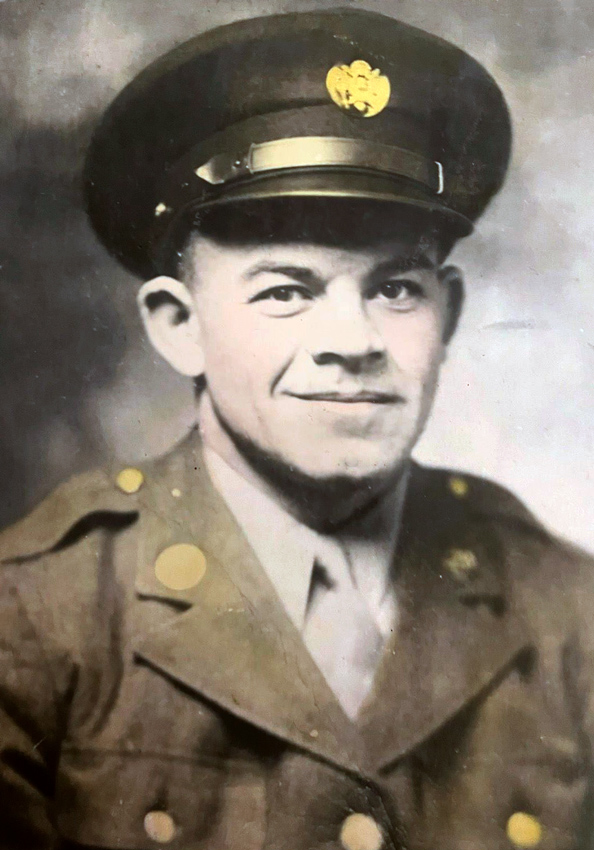
William Alexander Rittenhouse was born in his parents’ home, 803 West 3rd Street in Wilmington, Delaware, late on August 17, 1917. He was the third child of a shipyard riveter, George Rittenhouse (1888–1968), and Pearl Anna Rittenhouse (née Walls, c. 1893–1927). He had two older sisters, Virginia Pearl Rittenhouse (later Carden, 1912–1998) and Georgia Rittenhouse (1915–1938). The Rittenhouse family was still living at 803 West 3rd Street when the census was taken in January 1920.
By the time Rittenhouse was 10, his family had moved to 531 East 8th Street in Wilmington. Tragedy struck the family when, on November 22, 1927, Rittenhouse’s mother succumbed to tuberculosis at the family home, about a year after she was first diagnosed.
The Rittenhouse family was not recorded on any known indexed 1930 census records, though other census records state he was living in Wilmington as of April 1, 1935. All his known addresses from 1935 onward were south of the Christina River in Wilmington, known today as Southbridge.
Rittenhouse’s home of record was Commerce Street in Wilmington when he married Eleanor Laura Haas (1918–2018) in Wilmington on December 12, 1935. At the time, he was working for the Civilian Conservation Corps (C.C.C.). The couple had two sons and three daughters, the youngest daughter born around the time he went overseas.
On June 23, 1938, Rittenhouse lost his older sister, Georgia, also to tuberculosis.
Rittenhouse was recorded on the next census in April 1940 living with his wife and three children at 615 Church Street. His occupation was described as a laborer for the Pullman Company.
The 1940 census recorded that Rittenhouse dropped out of school after completing the 8th grade. Similarly, his enlistment data card stated that his highest completed level of education was grammar school.
When Rittenhouse registered for the draft on October 16, 1940, he was living at 615 Church Street. His employer was listed as the Pyrites Company on Christiana Avenue in Wilmington. The registrar described him as standing about five feet, 6½ inches tall and weighing 174 lbs., with brown hair, hazel eyes, and a “Scar across bridge of nose[.]” On the other hand, according to his military paperwork, Rittenhouse stood five feet, 4¾ inches tall and weighed 165 lbs., with brown hair and hazel eyes. An undated alteration to Rittenhouse’s draft card indicated that he moved to 315 Bradford Street. Curiously, his father also told the Public Archives Commission that Rittenhouse’s prewar address was 1237 Lobdell Street.
Rittenhouse’s occupation was recorded as welder or flame cutter on his enlistment data card and burner on his father’s statement for the Public Archives Commission.
Military Training
Early in the war, American men who had been fathers at the time of the attack on Pearl Harbor were deferred from conscription. Had Rittenhouse not chosen to volunteer for the U.S. Army, he would not have been drafted until November 1943 at the earliest. Nonetheless, he voluntarily enlisted. Rittenhouse’s father told the Public Archives Commission that his son joined the U.S. Army in Wilmington on November 5, 1942. On the other hand, his enlistment data card stated that he joined the Army in Camden, New Jersey, on November 6, 1942.
Many records pertaining to Rittenhouse’s military career have been lost. What remained of his personnel file after the tragedy that claimed his life was destroyed in the 1973 National Personnel Records Center fire. However, morning reports, rosters, and unit histories make it possible to partially reconstruct his career.
Private Rittenhouse was briefly attached unassigned to Company “A,” 1229th Reception Center, Fort Dix, New Jersey. By November 8, 1942, he had been classified as semiskilled, with the specification serial number code most closely matching his civilian work experience recorded as 341, shop maintenance mechanic. That did not necessarily mean that the Army intended to use him in that capacity. A set of orders came down that day dispatching him by rail the following day to join the 31st Signal Construction Battalion at Camp Atterbury, Indiana. In the same group was a fellow Delawarean who had enlisted on the same day, Donald Blair Ellis (1922–1943).
Documentation is little unclear, but it appears that Rittenhouse and Ellis were in a group of 198 men from the 1229th Reception Center who joined Company “B,” 31st Signal Construction Battalion, on either November 10 or 12, 1942. The battalion had been activated at Camp Atterbury on August 17, 1942, and fillers were still flowing into the unit. During World War II, it was not uncommon for men to have their basic training directly with their future units under the direction of experienced cadre rather than first attending training at a replacement training center. Some of the men in the battalion were reservists who in civilian life worked for the Chesapeake & Potomac Telephone Company.
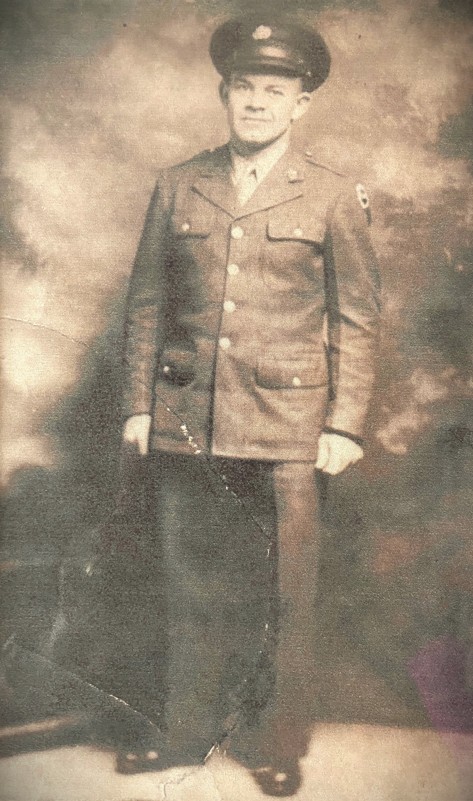
Signal construction battalions placed poles and wires to provide vital communications between command posts and other installations behind the lines. Under the table of organization, a private or private 1st class in such a unit could have been assigned one of several duties: chauffeur, cook’s helper, orderly, or lineman. Lineman—officially “Lineman, pole, telephone and telegraph”—was the most common duty in the company, performed by 140 of the 255 enlisted men, including 80 of the privates.
Rittenhouse was promoted to private 1st class on January 4, 1943. He was hospitalized on January 11, which a document in his individual deceased personnel file (I.D.P.F.) indicates was due to a dental issue. He returned to duty on January 19.
Life for families on the home front was never easy, but Rittenhouse’s wife had a particularly traumatic experience. On the night of February 9–10, 1943, a burglar broke into her home at 615 Church Street and armed himself with a butcher knife from her kitchen. She struggled with the intruder, suffering a laceration to her hand before her terrified screams and those of her children caused the suspect to flee.
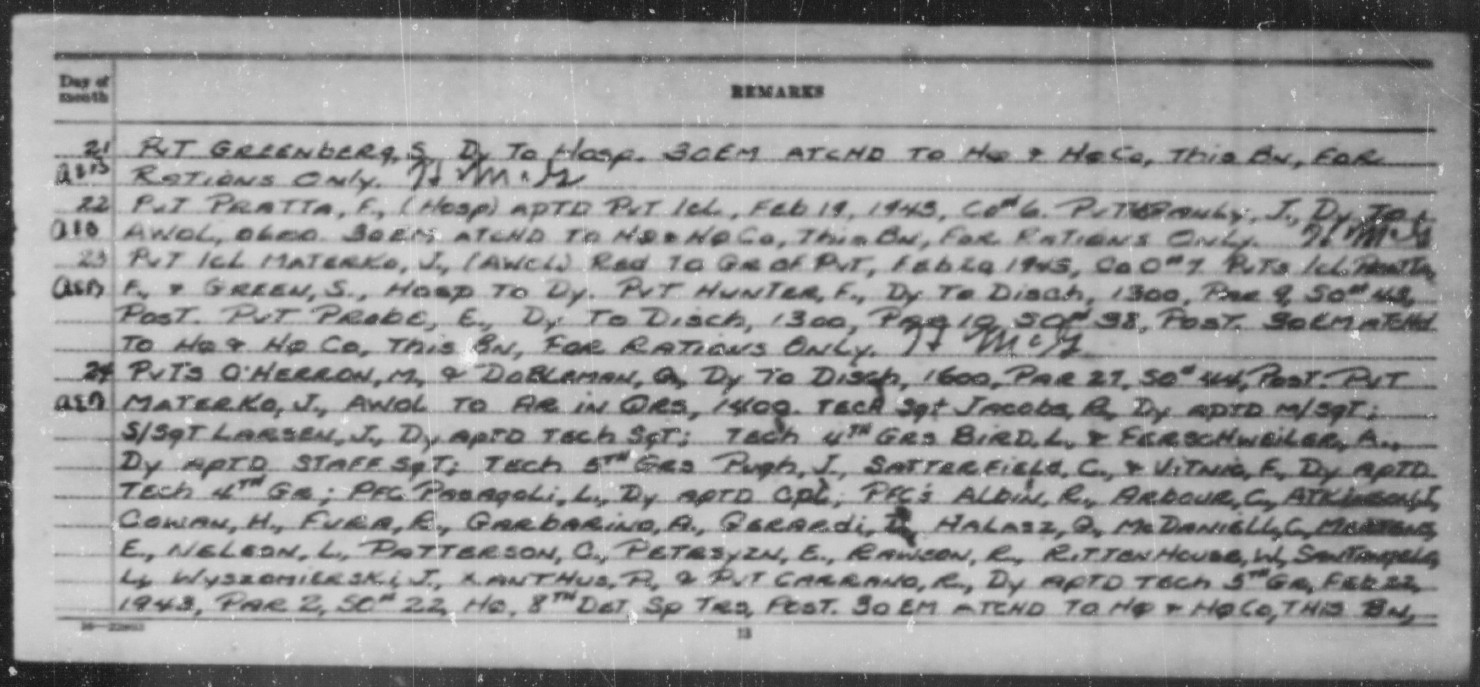
Rittenhouse was promoted to technician 5th grade on February 22, 1943, the same pay grade as corporal. The table of organization suggests that Rittenhouse would have performed one of the following duties after his promotion: automobile mechanic, chauffeur, general clerk, supply clerk, cook, telephone and telegraph draftsman, earth-borer operator, lineman, or utility repairman. Again, with 36 tech 5s performing the duty of lineman, it was the most common job held by that grade. On February 27, 1943, his unit departed Camp Atterbury to participate in Second Army Maneuvers. After an overnight stop at Fort Knox, Kentucky, they arrived in Lebanon, Tennessee, on February 28. During his time in the Tennessee Maneuver Area, Rittenhouse was promoted to technician 4th grade on April 14. A tech 4 in a construction company was supposed to perform the duty of automobile mechanic, cable splicer, cook, or lineman.
Rittenhouse and the other men in his unit remained in the Tennessee Maneuver Area until June 24, 1943, when they headed back to Camp Atterbury with an overnight stop at Fort Knox.
A set of movement orders came down on August 4, 1943, ordering a number of units, including the 31st Signal Construction Battalion, to prepare to go overseas as part of Shipment 5198.
On August 9, 1943, Rittenhouse was appointed to the grade of sergeant, which was at the same pay grade as technician 4th grade. Under the table of organization, there were only supposed to be five buck sergeants in the company: a supply sergeant and four with the title of chief lineman, pole. Based on his promotion history, it is likely that Rittenhouse trained as a lineman and advanced rapidly through the ranks with that military occupational specialty, but it is unlikely that there are any surviving documents that would confirm or refute that theory.
On August 28, 1943, the battalion began a 25-mile road march as part of a Second Army physical fitness test. They got an early start at 0400, finishing at noon.
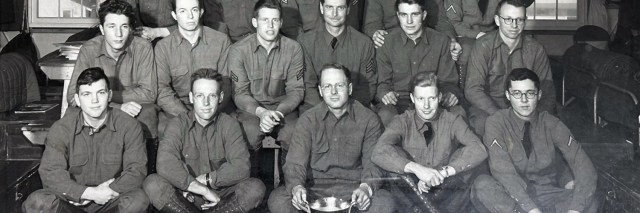
On September 22, 1943, the battalion departed Camp Atterbury by train, arriving the following day at Camp Patrick Henry, Virginia, to enter staging before going overseas. A morning report recorded that on October 1, Company “B” was “presented with cup for winning bn softball championship[.]”
Overseas Service
The 31st Signal Construction Battalion was split up for shipment overseas. At 1630 hours on October 2, 1943, Company “B” and a detachment of medical personnel entrained at Camp Patrick Henry, arriving at Newport News, Virginia, 45 minutes later. At 1745 hours, they boarded S.S. Andrew Hamilton, which departed the pier at 1930 hours and anchored at Lynnhaven Roads to the east. Their voyage began in earnest at 0700 hours on October 5 when the transport joined a transatlantic convoy, UGS-20. Portions of the convoy were bound for Port Said, Egypt, though some vessels were scheduled to go into intermediate ports (Oran, Algeria, in the case of Andrew Hamilton).
The 31st Signal Construction Battalion was bound for the China Burma India (C.B.I.) Theater. Far from the public eye, at the end of tortuously long supply lines, and with a fraction of the American personnel deployed to Europe, the Mediterranean, or the Pacific, the C.B.I. was nonetheless vital to the war effort. Enormous numbers of Japanese troops were tied down fighting and occupying China. If China collapsed, those troops could be moved to the Pacific, threatening the Allied island-hopping campaign.
After over two weeks at sea, land finally came into view around noon on October 21, 1943. A few hours later, UGS-20 passed through the Strait of Gibraltar into the Mediterranean Sea. Andrew Hamilton docked at Oran at 2000 hours on October 22. Around 0950 hours the following morning, Company “B” disembarked and moved to a nearby bivouac site known as Staging Area No. 2. The main body of the 31st Signal Construction Battalion shipped out October 13 aboard S.S. John Harvey, arriving safely in Algeria on November 2.
Although both parts of the battalion were in the same staging area, they were assigned to different ships to continue their journey to the C.B.I. At noon on November 23, 1943, Sergeant Rittenhouse and Company “B” departed their staging area by truck, arriving at 1330 hours at Mers-el-Kébir, Algeria, a port near Oran. Around 1530, they boarded the British transport H.M.T. Rohna. That same day, the main body of the 31st Signal Construction Battalion boarded another ship, H.M.T. Rajula, but they would not ship out for a week.

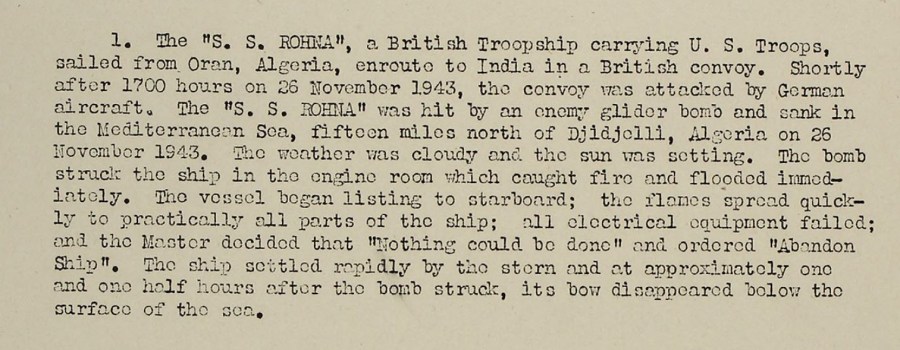
Completed in 1926, the Rohna had been converted from a passenger liner to a troopship in 1940. On the afternoon of Thanksgiving Day, November 25, 1943, Rohna departed Oran with about 2,201 aboard, including about 1,988 American soldiers and Red Cross workers. Rohna joined an eastbound convoy, KMF-26, which was traveling from Scotland to Egypt. The convoy consisted of 17 merchant ships with 10 escorts.
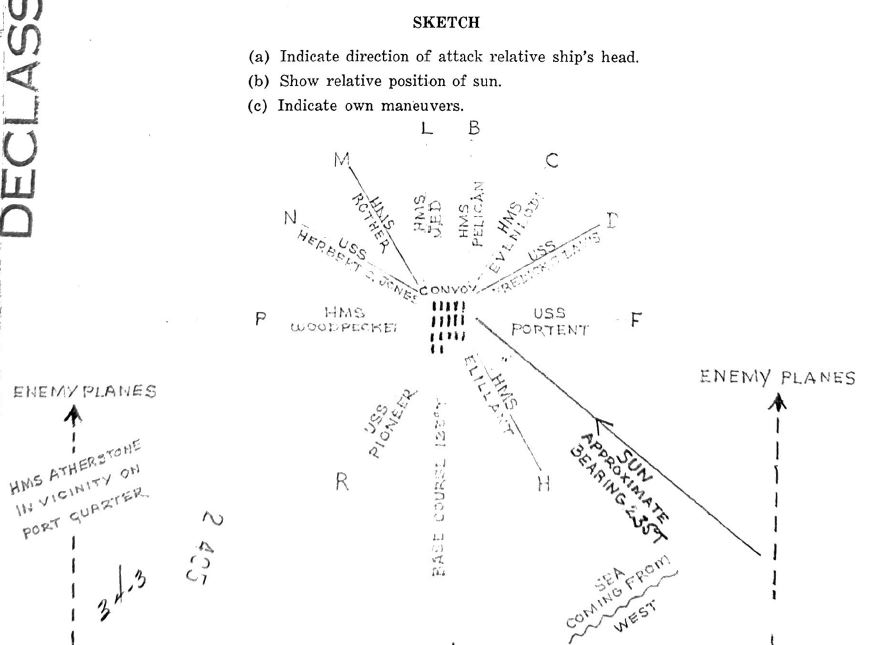
On the morning of November 26, 1943, KMF-26 was discovered by German reconnaissance aircraft flying out southern France. That evening, the convoy was sailing at 12 knots in the Mediterranean Sea north of Djidjelli (Jijel), Algeria, when it came under attack from about 35 German bombers. The attackers came in two waves beginning at 1640 hours. Eight Allied fighters were on patrol in the vicinity of the convoy and Allied controllers scrambled additional aircraft from fields in North Africa, but they were unable to fully blunt the attack.
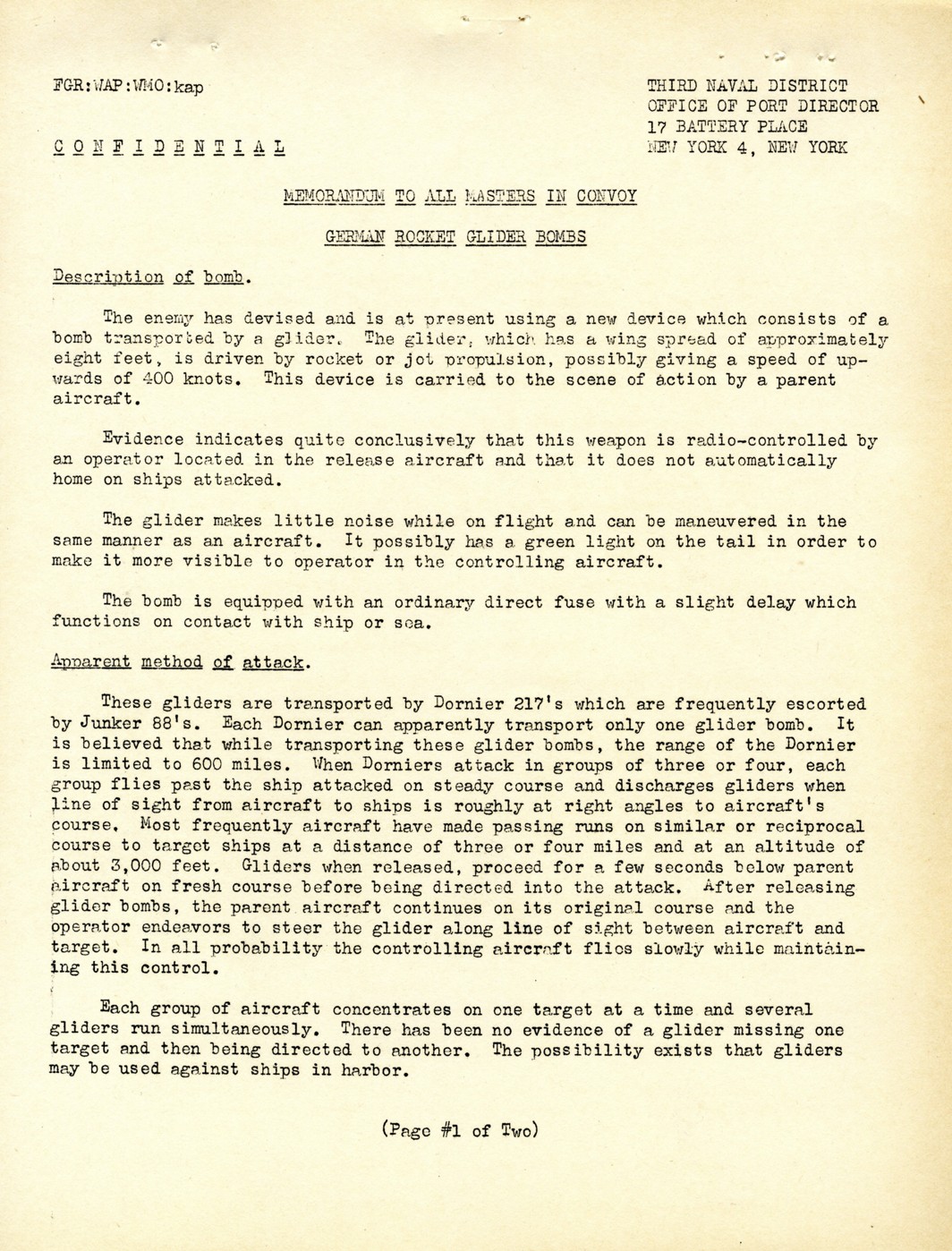
Among the attacking aircraft were Heinkel He 177s armed with a deadly new weapon, the Henschel Hs 293 guided bomb. The Hs 293 was dropped from the attacking aircraft and briefly engaged a rocket motor. The rocket only had enough fuel for 10 seconds, after which the bomb glided towards the target, controlled by radio from the launching bomber. The weapon was known to the Allies and during the attack, the convoy’s escorts attempted to jam the radio signals guiding the weapons.
In the face of fierce resistance from both Allied aircraft and antiaircraft fire from the convoy—and possibly, the jamming—most of the German ordnance missed. Only one Hs 293 found its mark. This single bomb, however, which exploded in Rohna’s engine room around 1715 hours, during the second wave, was sufficient to cause tremendous loss of life.
In their book, Soldiers Lost at Sea: A Chronicle of Troopship Disasters, James E. Wise, Jr. and Scott Baron wrote:
As Second Officer Willis recorded in his statement, “The bomb struck the engine room on the port side, just above the waterline. The No. 4 bulkhead collapsed.” The bomb explosion caused extensive damage blowing holes in both sides of the ship so large that one survivor recalled, “you could drive a truck through them.” Fires broke out, and power was lost, resulting in no lights, no communication, and no water pressure. An estimated three hundred men died in the initial explosion. Powerless in the dark, and with no other options, Captain [T. J.] Murphy ordered the ship to be abandoned, though lack of power prevented his order from being broadcast throughout the ship.
Rohna slipped beneath the waves around 1830 hours. Wise and Baron added: “The rescue effort was hampered by failing light, high seas, and the loss of a significant number of lifeboats, both from the initial explosion and subsequent mishandling by troops and crewmen.”
According to a contemporary battalion history, “All personnel from Company B got safely off the ship into the water. Survivors, after being in a rough sea for one-half (½) to eight (8) hours, were picked up by allied rescue ships.”
Most of the details of what Sergeant Rittenhouse and his comrades experienced after their ship was hit are forever lost to history, although those of Private 1st Class James Willis Pope (1920–1995) give some idea of the chaos. A commendation in General Order No. 3, Headquarters 31st Signal Construction Battalion, stated that he came to the rescue of Technician 4th Grade William H. Wasp (1924–1990), who had lost his lifebelt:
[Wasp] was unable to swim and after calling to those in the water that he could not swim he dropped into the water. Private First Class Pope dove, caught hold of T/4 Wasp, and swam with him to a lifeboat. When the boat became overcrowded and capsized, Private First Class Pope again took T/4 Wasp in tow and swam with him toward the rescue ship **************. After covering part of the distance Pfc Pope found a life preserver which he placed about T/4 Wasp and continued to tow him to the rescue ship which was reached after being in the water about one hour.
Pope was later awarded the Bronze Star Medal. Few other stories pertaining to Rohna had such a happy ending.
129 men from Company “B” and two men attached from the battalion medical detachment were killed in the sinking, including Sergeant Rittenhouse and Technician 4th Grade Ellis. Another Delawarean was also killed, Sergeant Paul E. Hayden (1911–1943). Approximately 1,149 personnel were lost in the sinking, including about 1,015 American soldiers. (Some sources indicate that 35 Americans died of their wounds after rescue, but it is unclear if those men are included in the figures.)
Other ships from the convoy, most notably the minesweeper U.S.S. Pioneer (AM-105), rescued hundreds of survivors. A preliminary count reported that of the 259 men in Company “B” embarked aboard Rohna, Pioneer had rescued 84 men, the British destroyer H.M.S. Atherstone (L05) rescued 16 men, and S.S. Clan Campbell rescued another 10, a total of 110 survivors. Based on the final company fatality figure, it appears that another 18 men were eventually located alive, some of them wounded.
The Rohna incident represents the greatest loss of American soldiers due to the sinking of any troopship in history. In terms of American losses aboard ships in World War II, Rohna was exceeded only by the loss of the battleship U.S.S. Arizona (BB-39) during the attack on Pearl Harbor and the sinking of the Japanese hellship Arisan Maru.
A summary of an American investigation included in Sergeant Rittenhouse’s I.D.P.F. noted:
An investigation of the circumstances surrounding the sinking of the “S. S. ROHNA” reveal the contributing factors in the extreme loss of life, and the unusual proportion of unrecovered remains, to be:
- The terrific effect of the explosion.
- The poor condition of the ship’s equipment and the conduct of its crew.
- The difficulties encountered in the rescue operations.
The Germans achieved few subsequent successes with their guided antiship ordnance. Historian Steven J. Zaloga has argued this largely due to increasing Allied air superiority, which suppressed German airbases before their bombers could even take off and either shot down or drove off others before they could attack. Allied intelligence coups, such as capturing a pair of Hs 293s, may have also played a role.
Sergeant Rittenhouse was initially held as missing in action, which Journal-Every Evening reported on January 17, 1944. With no indication that he could have survived or been taken prisoner, he was declared dead on May 5, 1944. On June 21, 1944, Journal-Every Evening announced that Rittenhouse, “formerly reported missing, was killed in the sinking of a troopship last November in the Mediterranean area.”
The scope of the Rohna tragedy was not publicly disclosed until June 13, 1945, when a War Department press release announced that 3,604 American soldiers had been killed by Germany and Italy in attacks against transport ships. The press statement disclosed that 2,687 soldiers, almost 75% of the total, were lost in just four sinkings: H.M.T. Rohna, S.S. Léopoldville, S.S. Paul Hamilton, and S.S. Dorchester. The statement added:
The sinking which involved the largest loss was that of the ROHNA, a British troopship sunk by enemy air attack on November 26, 1943, off Djidjelli, Algeria. The ship sank within one-half hour after being hit. Bomb damage, supplemented by heavy seas and darkness which hampered rescue work, resulted in a loss of 1,015 men, more than half the total 1,981 American military personnel aboard.
Many other details of the sinking would not come out for decades afterward.
Sergeant Rittenhouse was posthumously awarded the Purple Heart. His reconstructed personnel file (R-file) also states that he was awarded the Good Conduct Medal.
On June 7, 1949, a board of officers concluded that Sergeant Rittenhouse’s body was non-recoverable. His name is honored on the Tablets of the Missing at the North Africa American Cemetery in Tunisia and at Veterans Memorial Park in New Castle, Delaware.
Eleanor Rittenhouse remarried on May 5, 1946, to William Henry Massey (1913–1956). The couple had three children before divorcing.
One of Rittenhouse’s sons, William Alexander Rittenhouse, Jr. (1938–1954), enlisted in the Delaware National Guard as a teenager and was killed in a tragic car crash, aged 16. Another son, George, served in the U.S. Army and Air National Guard.
Notes
Year of Birth
Rittenhouse’s birth certificate establishes that he was born on August 17, 1917. It was filed that same month, meaning there is little doubt of its accuracy. This is supported by the 1920 census, which described him as two years and three months old as of January 1, 1920, and his marriage license, which described him as being 18 years old as of December 12, 1935.
However, Rittenhouse’s draft card and subsequent military records gave his date of birth as one year earlier, August 17, 1916. The Social Security Death Index uses the 1917 date while the Social Security Applications and Claims Index uses the 1916 date. Such discrepancies in year of birth are surprisingly common for the World War II generation and appear to only rarely be due to intentional deception (e.g., to enlist underage).
Acknowledgments
Special thanks to the Rittenhouse family for the use of their photos and to Matt LeMasters for obtaining payroll records that establish when Rittenhouse was promoted to technician 4th grade.
Bibliography
“2 City Guardsmen Die As Car Rams Into Tree.” July 31, 1954. Journal-Every Evening. https://www.newspapers.com/article/196797956/
“3 Casualties Are Reported.” January 17, 1944. Journal-Every Evening. https://www.newspapers.com/article/196798132/
Census Record for William A. Rittenhouse. January 10 and 12, 1920. Fourteenth Census of the United States, 1920. Record Group 29, Records of the Bureau of the Census. National Archives at Washington, D.C. https://www.familysearch.org/ark:/61903/3:1:33S7-9R6C-CZF
Census Record for Wm Rittenhouse. April 12–26, 1940. Sixteenth Census of the United States, 1940. Record Group 29, Records of the Bureau of the Census. National Archives at Washington, D.C. https://www.familysearch.org/ark:/61903/3:1:3QSQ-G9MR-MSNZ
Certificate of Birth for William Alexander Rittenhouse. August 1917. Record Group 1500-008-094, Birth Certificates. Delaware Public Archives, Dover, Delaware. https://www.familysearch.org/ark:/61903/3:1:S3HT-DTMW-7SH
Certificate of Death for Georgia Rittenhouse. June 23, 1938. Record Group 1500-008-092, Death Certificates. Delaware Public Archives, Dover, Delaware. https://www.familysearch.org/ark:/61903/3:1:939L-9R1B-7
Certificate of Death for Pearl A. Rittenhouse. November 22, 1927. Record Group 1500-008-092, Death Certificates. Delaware Public Archives, Dover, Delaware. https://www.familysearch.org/ark:/61903/3:1:3Q9M-C91F-3SQ4-K
Certificate of Death for William Massey. October 13, 1956. Record Group 1500-008-092, Death Certificates. Delaware Public Archives, Dover, Delaware. https://www.familysearch.org/ark:/61903/3:1:33SQ-GYQM-QKHB
Certificate of Marriage for William Henry Massey and Eleanor Laura Rittenhouse. May 5, 1946. Record Group 1500-008-093, Marriage Certificates. Delaware Public Archives, Dover, Delaware. https://www.familysearch.org/ark:/61903/3:1:S3HT-XSMQ-6B
Certificate of Marriage for William Rittenhouse and Eleanor Haas. December 12, 1935. Record Group 1500-008-093, Marriage Certificates. Delaware Public Archives, Dover, Delaware. https://www.familysearch.org/ark:/61903/3:1:S3HY-6PTQ-P9
“Convoy UGS.20.” Arnold Hague Convoy Database. https://www.convoyweb.org.uk/ugs/index.html?ugs.php?convoy=20!~ugsmain
“Dads Given Preliminary Draft Tests.” November 2, 1943. Journal-Every Evening. https://www.newspapers.com/article/196813304/
Draft Registration Card for William Alexander Rittenhouse. October 16, 1940. Draft Registration Cards for Delaware, October 16, 1940 – March 31, 1947. Record Group 147, Records of the Selective Service System. National Archives at St. Louis, Missouri. https://www.familysearch.org/ark:/61903/3:1:3Q9M-CSMG-X8DK
“Eleanor L. Massey.” August 19, 2018. The News Journal. https://www.newspapers.com/article/196809832/
Enlistment Record for William A. Rittenhouse. November 6, 1942. World War II Army Enlistment Records. Record Group 64, Records of the National Archives and Records Administration. National Archives at College Park, Maryland. https://aad.archives.gov/aad/record-detail.jsp?dt=893&mtch=1&cat=all&tf=F&q=12133700&bc=&rpp=10&pg=1&rid=573078
Individual Deceased Personnel File for William A. Rittenhouse. 1944–1955. Army Individual Deceased Personnel Files, 1942–1970. Record Group 92, Records of the Office of the Quartermaster General, 1774–1985. National Archives at St. Louis, Missouri. Courtesy of U.S. Army Human Resources Command.
Morning Reports for Company “B,” 31st Signal Construction Battalion. August 1943 – November 1943. U.S. Army Morning Reports, c. 1912–1946. Record Group 64, Records of the National Archives and Records Administration. National Archives at St. Louis, Missouri. https://s3.amazonaws.com/NARAprodstorage/lz/partners/st-louis/rg-064/85713825-wwii/85713825_1943-08/85713825_1943-08_Roll-0170B/85713825_1943-08_Roll-0170B-16.pdf, Sept, https://s3.amazonaws.com/NARAprodstorage/lz/partners/st-louis/rg-064/85713825-wwii/85713825_1943-10/85713825_1943-10_Roll-0602/85713825_1943-10_Roll-0602-24.pdf, https://s3.amazonaws.com/NARAprodstorage/lz/partners/st-louis/rg-064/85713825-wwii/85713825_1943-11/85713825_1943-11_Roll-0700/85713825_1943-11_Roll-0700-17.pdf
Morning Reports for Company “B,” 31st Signal Construction Battalion. November 1942 – February 1943. U.S. Army Morning Reports, c. 1912–1946. Record Group 64, Records of the National Archives and Records Administration. National Archives at St. Louis, Missouri. https://s3.amazonaws.com/NARAprodstorage/lz/partners/st-louis/rg-064/85713825-wwii/85713825_1940-01-thru-1943-07/85713825_1940-01-thru-1943-07_Roll-2548/85713825_1940-01-thru-1943-07_Roll-2548-24.pdf
Official Military Personnel File for William A. Rittenhouse. 1983–2026. Official Military Personnel Files, 1912–1998. Record Group 319, Records of the Army Staff. National Archives at St. Louis, Missouri.
“One Delaware Soldier Killed, Two Injured.” June 21, 1944. Journal-Every Evening. https://www.newspapers.com/article/99189347/
Rittenhouse, George. Individual Military Service Record for William Alexander Rittenhouse. October 30, 1944. Record Group 1325-003-053, Record of Delawareans Who Died in World War II. Delaware Public Archives, Dover, Delaware. https://cdm16397.contentdm.oclc.org/digital/collection/p15323coll6/id/20521/rec/2
Rittenhouse, George. Phone interview. June 14, 2026.
“Police Hunting Night Prowler.” February 10, 1943. Journal-Every Evening. https://www.newspapers.com/article/196813834/
“Ship Sinkings in War Against Germany and Italy Cost 3,604 American Lives.” Undated, released June 13, 1945. Administrative History Collection, Transportation – General. Record Group 498, Records of Headquarters, European Theater of Operations, United States Army (World War II). National Archives at College Park, Maryland. https://www.fold3.com/image/291168451/341b-transportation-general-page-18-us-wwii-european-theater-army-records-1941-1946
Silverman, Lowell. “Sergeant Paul E. Hayden (1911–1943).” May 4, 2024. Delaware’s World War II Fallen website. https://delawarewwiifallen.com/2024/05/04/sergeant-paul-e-hayden/
Sullivan, Arthur J. “Organizational History of 31st Signal Construction Battalion 1 January 1943 to 31 December 1943.” Undated, c. 1944. World War II Operations Reports, 1940–48. Record Group 407, Records of the Adjutant General’s Office. National Archives at College Park, Maryland.
“Table of Organization No. 11-27: Signal Construction Company.” April 1, 1942. War Department Archives. https://www.wdarchives.com/archives/record/8939/
“William H. Wasp: former Yonkers resident.” August 8, 1990. The Herald Statesman. https://www.newspapers.com/article/199566908/
“Women Awakens to See Knife-Wielder at Bed.” February 10, 1943. Wilmington Morning News. https://www.newspapers.com/article/196808619/
Zaloga, Steven J. German Guided Missiles of World War II: Fritz-X to Wasserfall and X-4. 2019. Osprey Publishing.
Last updated on June 14, 2026
More stories of World War II fallen:





To have new profiles of fallen soldiers delivered to your inbox, please subscribe below.

