| Branch | Civilian Occupation |
| U.S. Army | Clerk for the American Store Company |
| Theater | Service Number |
| Pacific | 12134223 |
| Campaigns/Battles | Unit |
| Battle of Kwajalein, Battle of Saipan | Headquarters & Service Company, 708th Amphibian Tank Battalion |
Early Life & Family
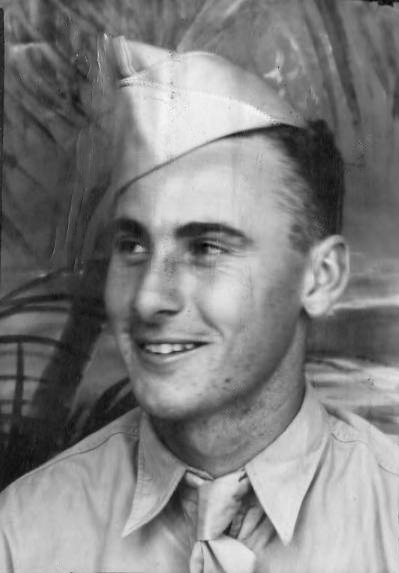
William Crawford Fox was born on September 23, 1923, in the Lebanon area of unincorporated Kent County, Delaware, southeast of the state capital, Dover. He was the son of Timothy Fox, Sr. (c. 1895–1975) and Laura Fox (née Laura Virginia Gibson, c. 1890–1956). He might have gone by his middle name, since he was listed as Crawford Fox on the 1930 and 1940 censuses. Fox’s father had different occupations in various records including farmhand, garage worker, laborer, and finally plumber.
In later records, Fox’s parents and siblings often used the spelling Foxx. All known records pertaining to Fox himself use the shorter spelling, including his mother’s statement for the Public Archives Commission, though some newspaper articles referred to him as Foxx.
Fox had an older sister, two older brothers, three younger sisters, and a younger brother. He was Catholic. He was recorded on the census in April 1930 living with his parents and four siblings in Lebanon. Census records indicate that the Fox family moved to Dover prior to April 1, 1935. By April 1940, they were living at 19 South New Street there.
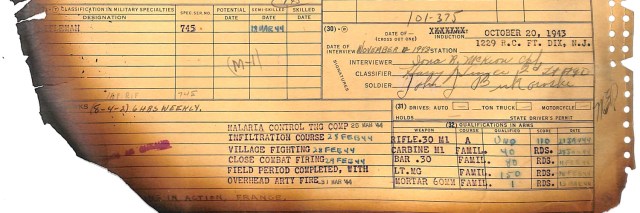
The 1940 census stated that Fox was unemployed and had dropped out of school after completing the 6th grade. Similarly, his enlistment data card stated that he had a grammar school education.
Before entering the service, Fox worked as a clerk for the American Store Company grocery store at Lockerman and New Streets in Dover. When he registered for the draft on June 30, 1942, Fox was still living at 19 South New Street. The registrar described him as standing five feet, seven inches tall and weighing 138 lbs., with brown hair and eyes.
Fox’s older brothers also served during World War II: Timothy Caleb Foxx, Jr. (1917–1987) in the U.S. Army and Calvin Thomas Foxx (1920–1995) in the Army Air Forces.
Military Career
When Fox was 19, about a year after the attack on Pearl Harbor, he decided to volunteer for the U.S. Army. One factor that apparently influenced his decision was legislation that President Roosevelt signed into law on November 13, 1942, lowering the draft age from 21 to 18. Journal-Every Evening later reported: “Foxx [sic] told his mother, Mrs. Timothy Foxx, before he enlisted that he had no fear of death and that he would be proud to make the supreme sacrifice for his country. He had not waited for induction.”
Fox enlisted in Camden, New Jersey, on December 1, 1942. That same day, he went on active duty and was attached unassigned to Company “A,” 1229th Reception Center, Fort Dix, New Jersey. He departed Fort Dix on December 12. On December 18, Private Fox joined Headquarters Company, 3rd Battalion, 69th Armored Regiment, 6th Armored Division. He had his basic training directly with his unit, not an uncommon practice for the Army at the time. The unit was stationed at Rice, California, training in the Mojave Desert, and equipped with the M4 medium tank.
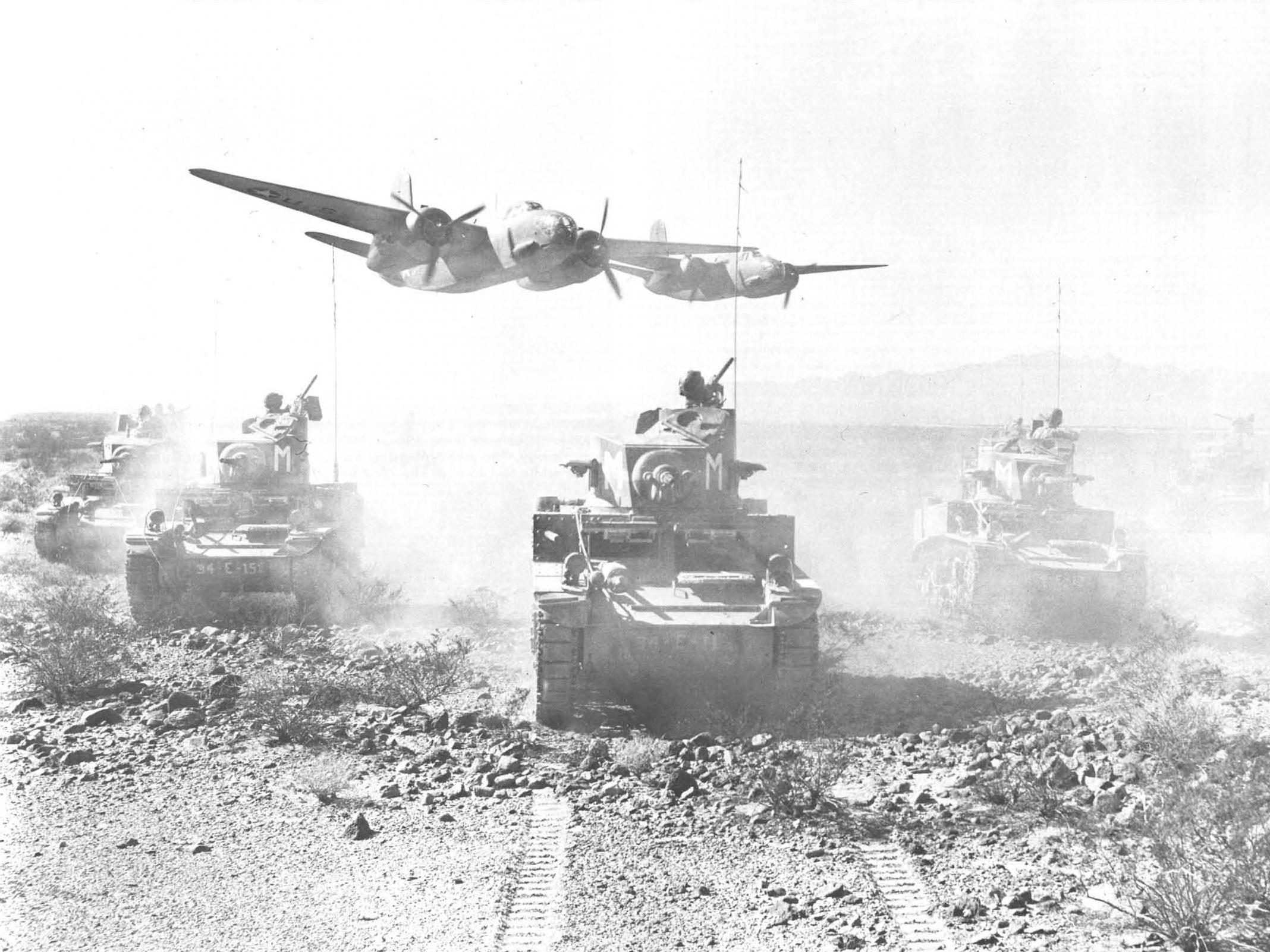
A morning report reported that on January 29, 1943, Private Fox completed his recruit training, though he had not yet qualified in any military occupational specialty (M.O.S.) by that point. That same day, his unit began moving a short distance west to Camp Coxcomb, California, just east of present-day Joshua Tree National Park. They remained there until February 14, when they moved to a bivouac two miles north of Desert Center, California. Fox and his comrades were constantly on the move for the rest of the month, including stops near Camp Coxcomb, Granite Mountain. They finished the month bivouacked midway between Blythe, California, and Desert Center.
Several more moves occurred in early March 1943, with Fox’s unit bivouacking at Cadiz Dry Lake and Danby, California. At 1830 hours on March 14, they departed the desert, arriving at Camp Cooke, California, at 1700 on March 15. Their training continued there.
On April 15, 1943, Private Fox was transferred from Headquarters Company to Headquarters 3rd Battalion, 69th Armored Regiment. A morning report from the same day noted a change in his duty and/or M.O.S. code from 521, basic, to 345, light truck driver. Fox was promoted to private 1st class on June 10, 1943.
Private 1st Class Fox went on furlough on August 2, 1943, returning to duty on August 17. Journal-Every Evening later reported that “he never had a furlough which enabled him to get home.” If correct, Fox chose not to return to Delaware during his furlough. Of course, a pair of cross-country journeys would have been expensive and consumed much of the available time.
Midway through the war, Army planners determined that armored divisions were too large and unbalanced, with too many tanks and not enough armored infantry. Most armored divisions were reorganized and their pair of armored regiments (three armored battalions each) broken up into individual battalions. Even then, under the new table of organization and equipment, the new light armored division only needed three tank battalions, not six. On September 19, 1943, 3rd Battalion, 69th Armored Regiment was inactivated. Effective the following day, its personnel and equipment were transferred to the newly activated 708th Tank Battalion. No longer part of the 6th Armored Division, it was now one of the so-called separate tank battalions, which were typically attached to support infantry divisions, which lacked organic armor units.
On October 16, 1943, leaving its tanks behind, the 708th Tank Battalion moved north to Fort Ord, California, a base on the shores of Monterey Bay. Later that month, on October 27, the unit was redesignated as the 708th Amphibian Tank Battalion and reorganized. Two separate companies, Headquarters Company and Service Company, were merged into a single Headquarters & Service Company, which Private 1st Class Fox was transferred to that same day. If not before, following the implementation of Table of Organization and Equipment No. 17-116 dated January 29, 1944, Headquarters & Service Company consisted of company headquarters and three sections: Administrative, Operations & Intelligence, and Maintenance & Supply.
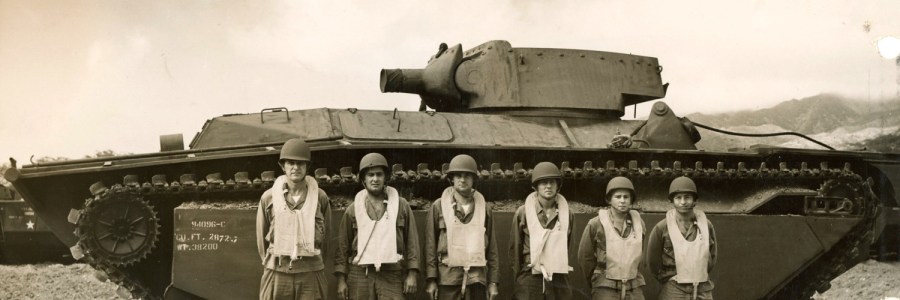
Private 1st Class Fox and his comrades began training for a very different set of combat conditions than desert armored warfare. Instead of medium tanks, they were equipped with the L.V.T. (landing vehicle, tracked), informally known as the amphibious tractor or amtrac. Later, amtanks, modified versions of amtracs equipped with a turret instead of a cargo hold, were added to their arsenal. A wartime battalion history stated:
Immediately after being settled in the assigned area at Ft. Ord, the battalion was issued its new amphibious vehicles. Training began at once. Although the battalion was designated a tank unit, the amphibious vehicles with which it first worked, were amphibious tractor type. Training was carried on [sic] day and night. In addition to the purely amphibious training, all weapons were fired in intensive range work: Village combat, night infiltration, close combat, foxhole courses, grenade practices, swimming instruction, all were undergone by the entire personnel of the unit. Monterey Bay with its fickle aquatic conditions provided the training area for familiarization with the utterly new equipment. And although the bay was characteristically rough, and the surf reached mountainous proportions, no vehicle was lost during this period. As a matter of fact, conditions encountered then were the worst with which the unit has ever been called upon to contend.
On December 9, 1943, the 708th Amphibian Tank Battalion was dispatched by train to Camp Stoneman, California, where it staged for overseas deployment. Journal-Every Evening reported that Fox’s “expected furlough last Christmas was spoiled by a hurry call from the battle area.” Of course, it is unclear whether that furlough was planned or merely rumored. On December 22, after traveling by ferry to Fort Mason (San Francisco Port of Embarkation), the men of the battalion boarded S.S. Robin Wentley. They shipped out for the Pacific Theater on the morning of Christmas Eve 1943. Many men in the battalion were too seasick to enjoy Christmas dinner, though conditions improved on the fourth day of the voyage. They arrived at Pearl Harbor, Oahu, Hawaii, early on December 31. The battalion, less Company “D,” moved to Waianae under the 4th Armored Group. The unit history stated:
The first days of the new year were busily occupied in preparing for an impending operation in the very close future. Water formations preparatory to beach landings were practiced incessantly in addition to combat firing. This was the first contact of the unit with the type of water and beach conditions with which it was to become so familiar in the following months.
The Battle of Kwajalein
During the Battle of Tarawa in November 1943, amtracs had been instrumental in landing Marines ashore when landing craft were unable to pass the coral reef around the atoll. Even so, casualties had been shockingly high. Taking the lessons of Tarawa to heart, planners sought to avoid similar bloodletting during Operation Flintlock, the invasion of Kwajalein Atoll and other islands in the Marshalls just over two months later.
Operation Flintlock was also the first time amtanks would see combat. The 708th Amphibian Tank Battalion, less Company “D,” was attached to the 7th Infantry Division on December 31, 1943, or January 3, 1944. Unit records are contradictory about movements at this point. A unit history states that on January 12, the battalion shipped out for Maui, where they spent a few days of rehearsing for the operation. A Headquarters & Service Company morning report indicates that the company stayed at Waianae until January 14, when it moved to Koko Head, Oahu. Adding to the confusion, a later morning report contradicted that, stating the company was stationed elsewhere on Oahu, at Schofield Barracks, during January 11–20.
At around 1030 hours on January 21, 1944, Private 1st Class Fox and most of Headquarters & Service Company (less a detachment of men who remained behind in Hawaii) boarded the attack transport U.S.S. Harry Lee (APA-10) at Honolulu, along with men from the 7th Infantry Division. They set sail around 1400 hours the following day.
It is unclear if Fox’s duty had remained light truck driver through the various moves and the transition from a medium tank to an amphibious tank battalion. Changes in M.O.S. were not always reliably documented in morning reports. It certainly possible that he remained a truck driver, since under the table of organization, both the Operations & Intelligence and Maintenance & Supply sections each had six light truck drivers, of whom half were supposed to hold the grade of private or private 1st class. Other potential slots that existed at Fox’s grade were bugler, clerk (code, headquarters, or supply), gunner (tank or machine gun), cook’s helper, orderly, and scout.
However, none of the battalion’s wheeled transport was brought along for Operation Flintlock, so if Fox was still a truck driver, it is unclear what he would have been doing during the battle. Journal-Every Evening described him as a “navigator of an amphibious tank.” That statement is difficult to parse since navigator was not a position in an amphibian tank company. The Operations & Intelligence section was supposed to have five scouts, which theoretically could be conflated with navigator in the sense of its reconnaissance and route-finding role. Although amphibian tank crew composition varied based on the type of amtrac or amtank, none had navigators. All vehicles had a commander (a noncommissioned officer), a driver (typically a technician 5th grade), and radio operator. Some vehicles had gunners, assistant gunners, and assistant drivers.
Company “A,” 708th Amphibian Tank Battalion was equipped with 17 LVT(A)-1 amtanks, an amtrac modified with additional armor and a light tank turret armed with a 37 mm gun, instead of a hold for carrying troops or equipment. However, too few amtanks were available to equip the entire battalion in time for the Kwajalein operation. The contemporary history explained: “For this operation the 708th Amphibian Tank Battalion had been temporarily reorganized into the 708th Provisional Amphibian Tractor Battalion. Three (3) anti-tank companies from the 17th Infantry, 32nd Infantry, 184th Infantry, had been converted into LVT groups.” Each of those four groups were equipped with 14 LVT(A)-2 armored amtracs and 20 LVT-2 amtracs, used to land men and equipment from the 7th Infantry Division.
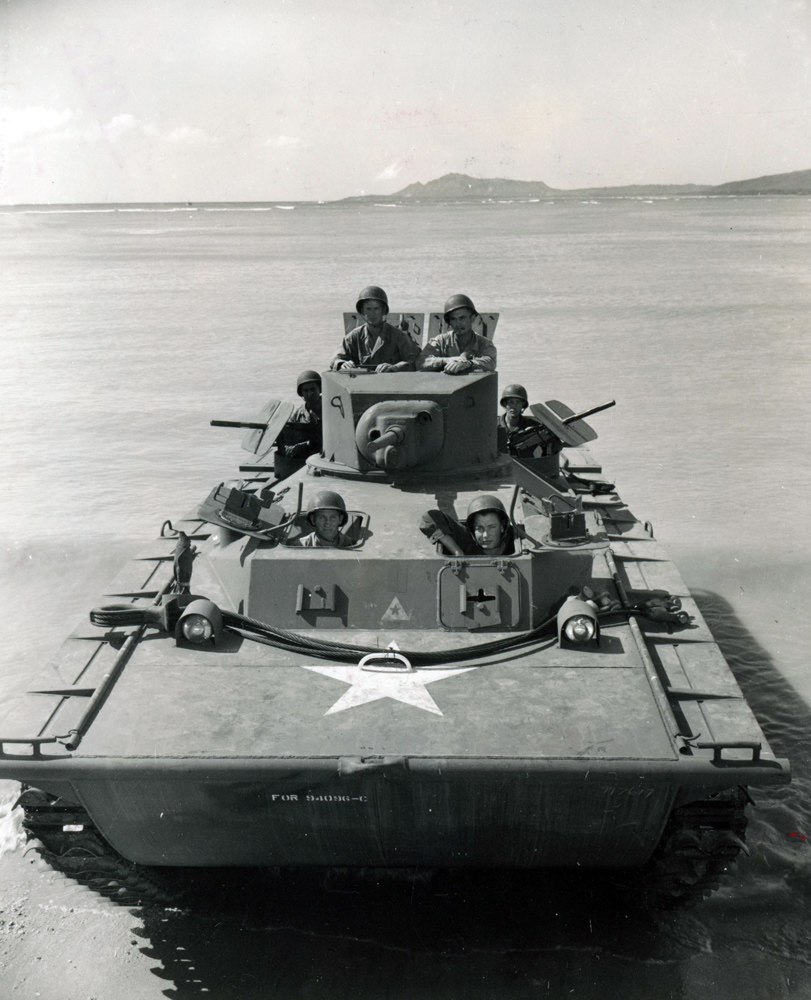
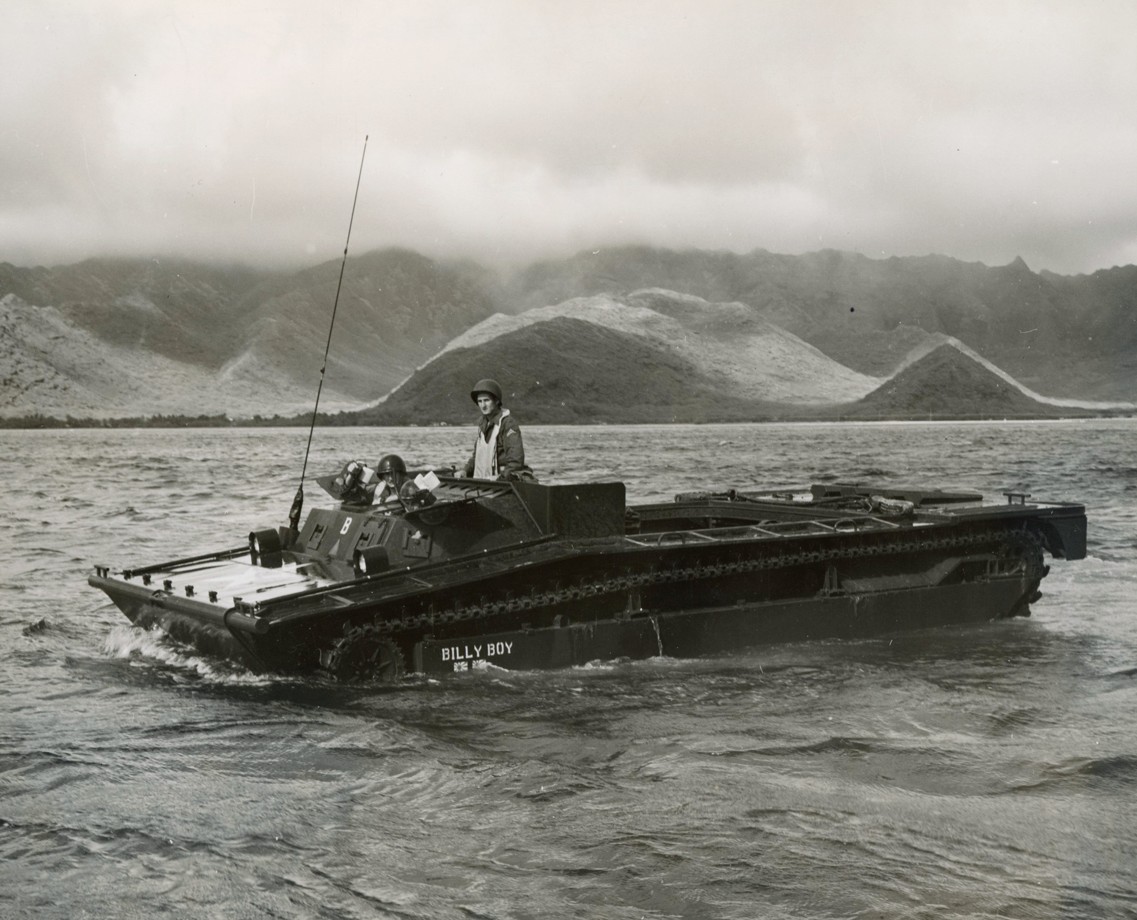
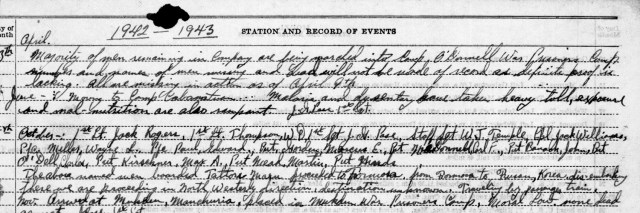
The battalion returned to Oahu on January 16, 1944, shipping out from Pearl Harbor the following day. Their convoy arrived in the Marshall Islands on January 31. Kwajalein Atoll has dozens of islands. On January 31, the 708th landed on two islands. “Rear Detachment, 708th Provisional Amph Tractor Bn., landed on CARLOS ISLAND”— that is, Ennylabegan—“and established a service and supply park in conjunction with the 707th Ordnance” (Light Maintenance) Company. This may have included part of Headquarters & Service Company, but its morning report indicated that it assisted 1st Platoon, Company “A,” with capturing Enubuj, codenamed Carlson Island.
The following day, February 1, 1944, Headquarters & Service Company supported Company “A” as the 708th Provisional Amphibian Tractor Battalion landed troops on the main island of Kwajalein following a powerful aerial and naval bombardment. During subsequent days, American troops landed on other minor islands in the atoll. The 708th finished combat operations on February 6.
On February 14, 1944, Private 1st Class Fox was part of a group of 18 men dispatched back to Koko Head Camp on detached service while the rest of his company participated in the capture of Eniwetok. The entire Headquarters & Service Company, 708th Amphibian Tank Battalion was reunited at Koko Head on March 14.
The operation went smoothly overall and the Americans lost far fewer men in the Marshall Islands than on Tarawa. The 708th Amphibian Tank Battalion lost one man killed in action and 36 wounded.
The Battle of Saipan
Private 1st Class Fox was awarded the Good Conduct Medal per General Orders No. 6, Headquarters 708th Amphibian Tank Battalion, dated April 14, 1944. The following day, he went on detached service for one week at Fort Kamehameha, near Pearl Harbor. That same month, the battalion’s officers began planning for their next operation, the invasion of the Mariana Islands. The 708th Amphibian Tank Battalion would be attached to the 4th Marine Division for the operation, codenamed Forager.
The Marianas had great strategic importance, since capturing them would bring the Japanese Home Islands into range of American B-29 Superfortress bombers. Up to that point, the B-29 had been deployed only to China. All fuel and ordnance had to be transported to India and then flown to China, a time-consuming and inefficient process.
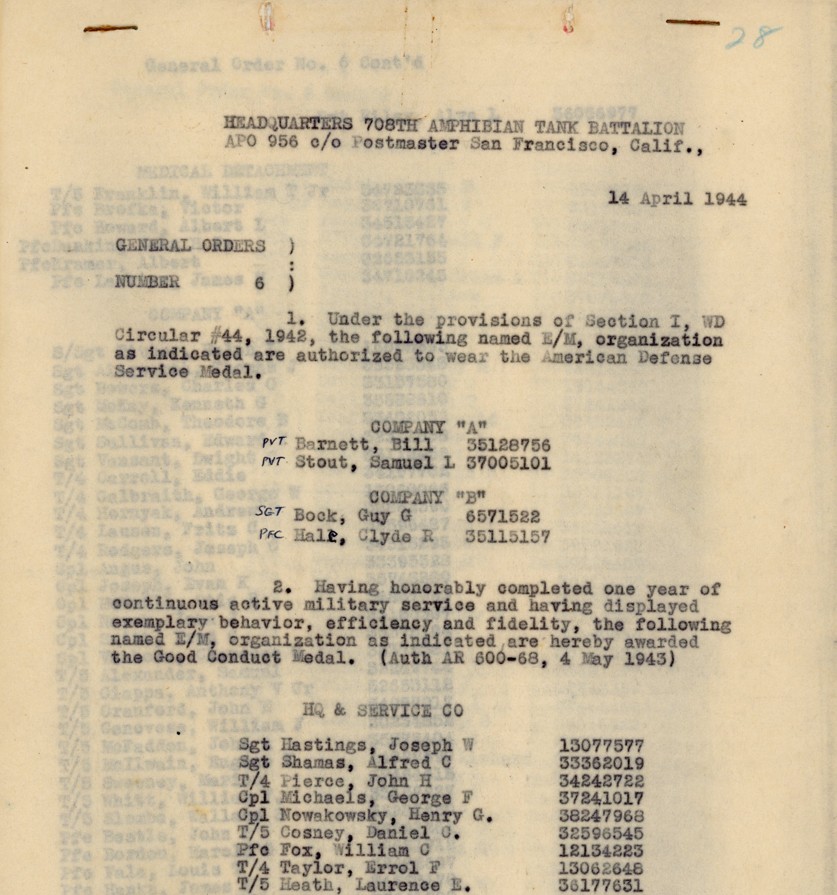
Prior to Operation Forager, enough amtanks had arrived to fully equip the 708th. Preparations were intensive but the men of the battalion were also able to get some rest. The battalion history stated:
During the period [between] 12 March and 11 May 1944, maximum stress was placed upon rehabilitation of personnel and equipment, as well as further training in all phases of amphibious combat. Men of the battalion were given every opportunity to enjoy the varied recreational facilities available not only on Oahu but also on other islands of the Hawaiian group.
On May 9, 1944, Private 1st Class Fox and a group of other enlisted men from Headquarters & Service Company were attached to and placed on special duty with Headquarters 708th Amphibian Tank Battalion, which nominally consisted of the battalion commander and his staff officers but no support personnel. On May 11, his unit sailed for Maui, arriving early the next morning for several days of rehearsals. They sailed from Maui on May 19, arriving at Pearl Harbor the following morning.
On the afternoon of May 21, 1944, during preparations for Operation Forager, U.S.S. LST-353, a vessel loaded with fuel and ammunition, suddenly blew up, setting off explosions on other similarly laden vessels nearby. The 708th Amphibian Tank Battalion’s casualties from what became known as the West Loch Disaster were almost as heavy as the entire Marshall Islands campaign: one killed and 27 wounded. The battalion history noted that “all preloaded equipment of this Bn, personnel equipment, and ‘A’ bags of 165 men, were a complete loss.”
On May 23, 1944, Fox and his unit moved back to Koko Head Camp but returned to Pearl Harbor the following day. According to morning reports, maintenance personnel embarked on U.S.S. LST-223 at 0600 on May 24, while the rest of Headquarters 708th Amphibian Tank Battalion embarked on U.S.S. LST-19 at 0230 the next morning. (Curiously, LST-19’s war diary stated that the only passengers aboard from the 708th Amphibian Tank Battalion were three officers and 46 enlisted men from 3rd Platoon, Company “B.”) Their ships departed Pearl Harbor around noon on May 25. After a stop at Eniwetok Atoll in the Marshall Islands on June 7, the convoy of landing ships resumed their journey to the Marianas on June 9.
During the invasion of Saipan, Company “A” and Company “B” supported the 23rd Marines, while Company “C” and Company “D” supported the 25th Marines. Each company was equipped with four LVT(A)-4s and 13 LVT(A)-1s. The LVT(A)-4 was a new amtank armed with a more powerful 75 mm howitzer. Headquarters 708th Amphibian Tank Battalion was equipped with four amtracs, with a medical and maintenance amtrac assigned to “A” and “B” and another pair assigned to “C” and “D.”
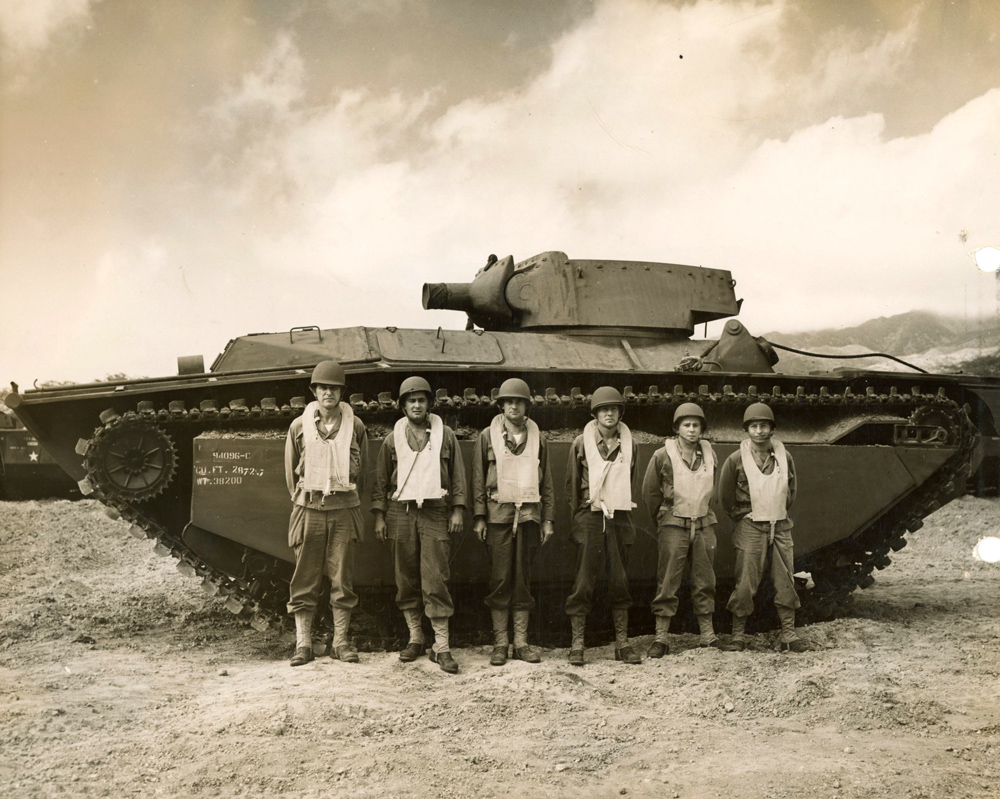
According to a unit after action report plan was for the amtanks to lead amtracs loaded with the Marines to the beach and then “assist in seizing and defending a preselected phase line, termed O-1.” The report added: “For the purposes of control, the following Command & Liaison system was established. Bn Commander & S-3 [operations officer], with enlisted detachment”—likely including Private 1st Class Fox—“were with 4th Mardiv Hq, maintaining contact with all units of Bn by means of SCR 510 radio.” Liaison officers equipped with radios were placed with each Marine regiment.
On the first day of Operation Forager, June 15, 1944, the 708th Amphibian Tank Battalion began launching their amtanks around 0730 hours. H-Hour was initially set for 0830 but was pushed back by 10 minutes. The 708th amtanks began their run to the beach at around 0800.
The battalion after action report stated: “Heavy enemy mortar and artillery fire was encountered on the approach run to the beach, approximately 600 yards offshore.” The amtanks returned fire. Several amtanks were knocked out during the fighting as they pushed inland.
That afternoon, Private 1st Class Fox landed on Saipan. The battalion history stated:
Bn Hq, consisting of Bn Comdr, S-3 and enlisted detachment, landed on BEACH YELLOW 2 at approximately 1400 and established a working CP [command post] with 4th Mardiv Advance Message Center, in area 135 K. Command Post subjected to heavy enemy mortar and artillery fire.
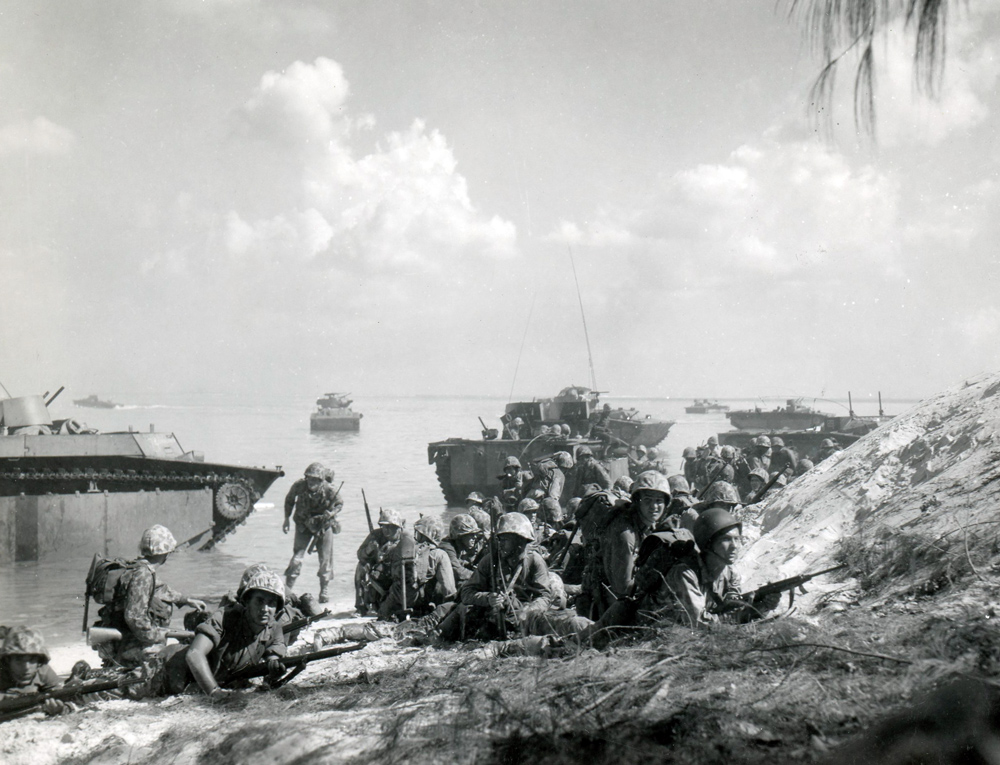
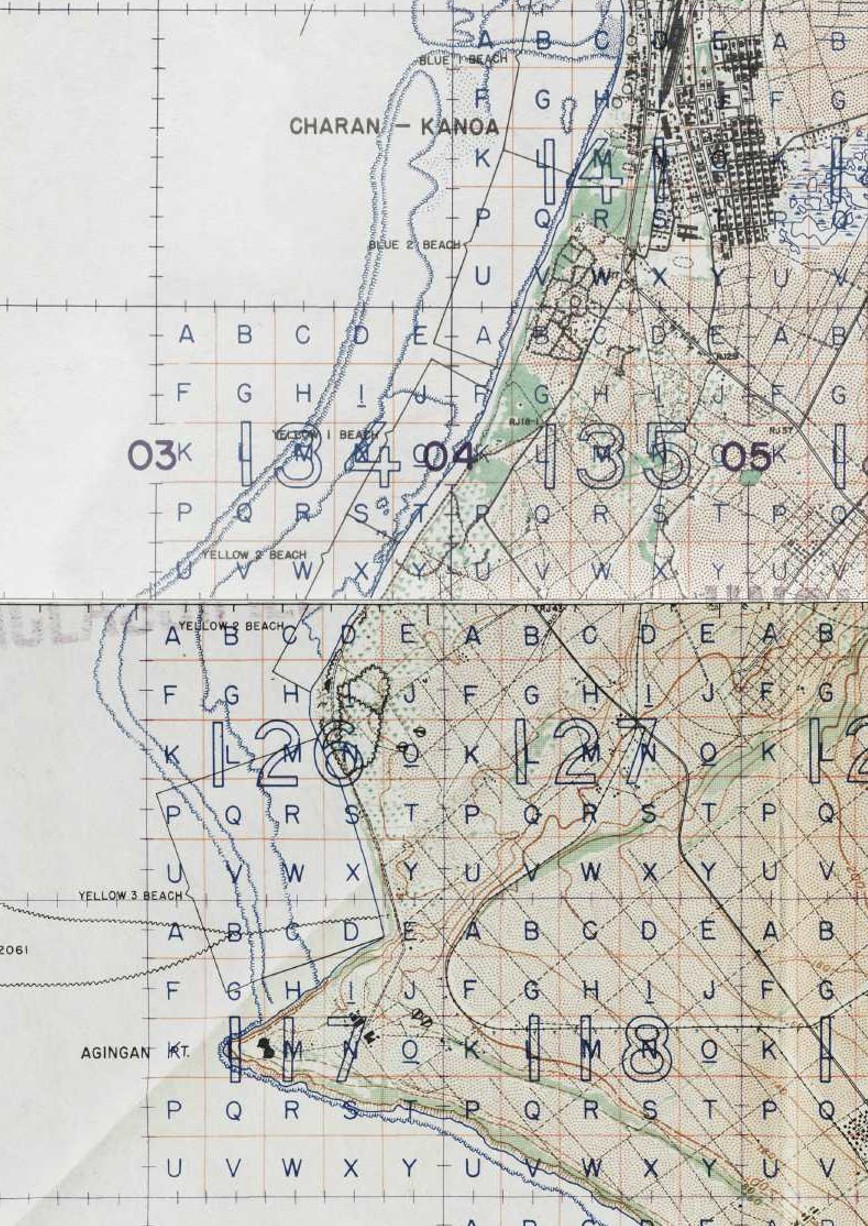
Headquarters 708th Amphibian Tank Battalion took a single casualty that day: Private 1st Class Fox was killed in action. No known documentation describes how he died, though a likely cause is the mortar and artillery fire mentioned in the report. He was initially buried at the 4th Marine Division Cemetery on Saipan.
Journal-Every Evening reported that Private 1st Class Fox’s family was notified of his death on June 30, 1944. The paper added:
His last letter, written to his sister, Doris Mae, and enclosing money with which to buy war stamps for his little brother, Francis Eugene, was dated May 23 and was cheerful and lively in tone. He also had sent pictures taken among palm trees, but did not say where he was stationed.
The 708th Amphibian Tank Battalion’s casualties were far higher during the Battle of Saipan than in its previous operation, with at least 30 men killed in action and about 135 wounded.
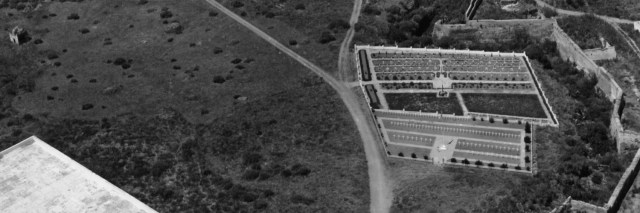
After the war, American authorities began consolidating numerous overseas cemeteries into a handful of permanent ones. All the recovered American fallen from the Pacific Theater were either repatriated to the United States or reburied in a pair of permanent cemeteries, one in the Philippines and the other in Hawaii. In 1948, Fox’s parents requested that his body be interred in a permanent cemetery overseas. In accordance with their wishes, on February 2, 1949, he was reburied at the Honolulu National Cemetery, now known as the National Memorial Cemetery of the Pacific. Curiously, his headstone erroneously lists his date of birth as September 23, 1925. He is also honored on a World War II memorial in Dover and at Veterans Memorial Park in New Castle.
Acknowledgments
Special thanks to Geoffrey Rocker for a map and to the Delaware Public Archives for the use of their photo.
Bibliography
Birth Index Card for William C. Fox. Undated, c. 1923. Delaware Vital Records, 1650-1974. Delaware Public Archives, Dover, Delaware. https://www.familysearch.org/ark:/61903/3:1:33S7-9Y3N-DFV
“Calvin T. Foxx.” June 2, 1995. The News Journal. https://www.newspapers.com/article/192274383/
Census Record for Crawford Fox. April 2, 1930. Fifteenth Census of the United States, 1930. Record Group 29, Records of the Bureau of the Census. National Archives at Washington, D.C. https://www.familysearch.org/ark:/61903/3:1:33SQ-GR4B-Z27
Census Record for Crawford Fox. April 11, 1940. Sixteenth Census of the United States, 1940. Record Group 29, Records of the Bureau of the Census. National Archives at Washington, D.C. https://www.familysearch.org/ark:/61903/3:1:3QSQ-G9MR-MZP
Census Record for Timothy Fox. January 13, 1920. Fourteenth Census of the United States, 1920. Record Group 29, Records of the Bureau of the Census. National Archives at Washington, D.C. https://www.familysearch.org/ark:/61903/3:1:33S7-9R68-X6
Certificate of Birth for Fox. December 2, 1920. Record Group 1500-008-094, Birth Certificates. Delaware Public Archives, Dover, Delaware. https://www.familysearch.org/ark:/61903/3:1:S3HY-696Q-51Y
Certificate of Death for Laura V. Foxx. October 18, 1956. Record Group 1500-008-092, Death Certificates. Delaware Public Archives, Dover, Delaware. https://www.familysearch.org/ark:/61903/3:1:33S7-9YQM-7S83
Certificate of Marriage for Timothy Fox and Laura Virginia Gibson. June 1, 1916. Record Group 1500-008-093, Marriage Certificates. Delaware Public Archives, Dover, Delaware. https://www.familysearch.org/ark:/61903/3:1:3Q9M-CS7K-R1BJ
Draft Registration Card for Timothy Fox. June 5, 1917. World War I Selective Service System Draft Registration Cards, 1917–1918. National Archives at Washington, D.C. https://www.familysearch.org/ark:/61903/3:1:33S7-8B5L-X59
“Dover Soldier Dies in Central Pacific Action.” July 1, 1944. Journal-Every Evening. https://www.newspapers.com/article/192269739/
Draft Registration Card for William Crawford Fox. June 30, 1942. Draft Registration Cards for Delaware, October 16, 1940 – March 31, 1947. Record Group 147, Records of the Selective Service System. National Archives at St. Louis, Missouri. https://www.familysearch.org/ark:/61903/3:1:3Q9M-CSMG-XSZZ
Enlistment Record for Timothy C. Foxx, Jr. November 14, 1941. World War II Army Enlistment Records. Record Group 64, Records of the National Archives and Records Administration. National Archives at College Park, Maryland. https://aad.archives.gov/aad/record-detail.jsp?dt=893&mtch=1&tf=F&q=foxx%23timothy&bc=&rpp=10&pg=1&rid=2831874
Enlistment Record for William C. Fox. December 1, 1942. World War II Army Enlistment Records. Record Group 64, Records of the National Archives and Records Administration. National Archives at College Park, Maryland. https://aad.archives.gov/aad/record-detail.jsp?dt=893&mtch=1&cat=all&tf=F&q=12134223&bc=&rpp=10&pg=1&rid=573456
Foxx, Laura. Individual Military Service Record for William Crawford Fox. Undated, c. 1946. Record Group 1325-003-053, Record of Delawareans Who Died in World War II. Delaware Public Archives, Dover, Delaware. https://cdm16397.contentdm.oclc.org/digital/collection/p15323coll6/id/18735/rec/1
Heath, H. K. “USS LST 19 War Diary.” Undated, c. July 1944. World War II War Diaries, Other Operational Records and Histories, c. January 1, 1942–c. June 1, 1946. Record Group 38, Records of the Office of the Chief of Naval Operations. National Archives at College Park, Maryland. https://catalog.archives.gov/id/78516582
“History of 708th Amphibian Tank Battalion.” Undated c. 1944. World War II Operations Reports, 1940–48. Record Group 407, Records of the Adjutant General’s Office. National Archives at College Park, Maryland.
Individual Deceased Personnel File for William C. Fox. 1944–1953. Army Individual Deceased Personnel Files, 1942–1970. Record Group 92, Records of the Office of the Quartermaster General, 1774–1985. National Archives at St. Louis, Missouri. Courtesy of U.S. Army Human Resources Command.
Linton, P. J. “U.S.S. Harry Lee War Diary.” Undated, c. February 1944. World War II War Diaries, Other Operational Records and Histories, c. January 1, 1942–c. June 1, 1946. Record Group 38, Records of the Office of the Chief of Naval Operations. National Archives at College Park, Maryland. https://catalog.archives.gov/id/78305294
Morning Reports for Company “A,” 1229th Reception Center. December 1942. U.S. Army Morning Reports, c. 1912–1946. Record Group 64, Records of the National Archives and Records Administration. National Archives at St. Louis, Missouri. https://s3.amazonaws.com/NARAprodstorage/lz/partners/st-louis/rg-064/85713825-wwii/85713825_1940-01-thru-1943-07/85713825_1940-01-thru-1943-07_Roll-2835/85713825_1940-01-thru-1943-07_Roll-2835-03.pdf, https://s3.amazonaws.com/NARAprodstorage/lz/partners/st-louis/rg-064/85713825-wwii/85713825_1940-01-thru-1943-07/85713825_1940-01-thru-1943-07_Roll-2835/85713825_1940-01-thru-1943-07_Roll-2835-04.pdf
Morning Reports for Headquarters 3rd Battalion, 69th Armored Regiment. April 1943 – May 1943. U.S. Army Morning Reports, c. 1912–1946. Record Group 64, Records of the National Archives and Records Administration. National Archives at St. Louis, Missouri. https://s3.amazonaws.com/NARAprodstorage/lz/partners/st-louis/rg-064/85713825-wwii/85713825_1940-01-thru-1943-07/85713825_1940-01-thru-1943-07_Roll-0607/85713825_1940-01-thru-1943-07_Roll-0607-11.pdf
Morning Reports for Headquarters 3rd Battalion, 69th Armored Regiment. August 1943. U.S. Army Morning Reports, c. 1912–1946. Record Group 64, Records of the National Archives and Records Administration. National Archives at St. Louis, Missouri. https://s3.amazonaws.com/NARAprodstorage/lz/partners/st-louis/rg-064/85713825-wwii/85713825_1943-08/85713825_1943-08_Roll-0232/85713825_1943-08_Roll-0232-22.pdf
Morning Reports for Headquarters 708th Amphibian Tank Battalion. May 1944 – June 1944. U.S. Army Morning Reports, c. 1912–1946. Record Group 64, Records of the National Archives and Records Administration. National Archives at St. Louis, Missouri. https://s3.amazonaws.com/NARAprodstorage/lz/partners/st-louis/rg-064/85713825-wwii/85713825_1944-05/85713825_1944-05_Roll-0708/85713825_1944-05_Roll-0708-14.pdf, https://s3.amazonaws.com/NARAprodstorage/lz/partners/st-louis/rg-064/85713825-wwii/85713825_1944-05/85713825_1944-05_Roll-0708/85713825_1944-05_Roll-0708-15.pdf, https://s3.amazonaws.com/NARAprodstorage/lz/partners/st-louis/rg-064/85713825-wwii/85713825_1944-06/85713825_1944-06_Roll-0451/85713825_1944-06_Roll-0451-20.pdf
Morning Reports for Headquarters 708th Amphibian Tank Battalion. October 1943. U.S. Army Morning Reports, c. 1912–1946. Record Group 64, Records of the National Archives and Records Administration. National Archives at St. Louis, Missouri. https://s3.amazonaws.com/NARAprodstorage/lz/partners/st-louis/rg-064/85713825-wwii/85713825_1943-10/85713825_1943-10_Roll-0134/85713825_1943-10_Roll-0134-13.pdf
Morning Reports for Headquarters 708th Tank Battalion. September 1943 – October 1943. U.S. Army Morning Reports, c. 1912–1946. Record Group 64, Records of the National Archives and Records Administration. National Archives at St. Louis, Missouri. https://s3.amazonaws.com/NARAprodstorage/lz/partners/st-louis/rg-064/85713825-wwii/85713825_1943-09/85713825_1943-09_Roll-0176/85713825_1943-09_Roll-0176-20.pdf, https://s3.amazonaws.com/NARAprodstorage/lz/partners/st-louis/rg-064/85713825-wwii/85713825_1943-10/85713825_1943-10_Roll-0134/85713825_1943-10_Roll-0134-11.pdf
Morning Reports for Headquarters & Service Company, 708th Amphibian Tank Battalion. October 1943 – June 1944. U.S. Army Morning Reports, c. 1912–1946. Record Group 64, Records of the National Archives and Records Administration. National Archives at St. Louis, Missouri. https://s3.amazonaws.com/NARAprodstorage/lz/partners/st-louis/rg-064/85713825-wwii/85713825_1943-10/85713825_1943-10_Roll-0134/85713825_1943-10_Roll-0134-13.pdf, https://s3.amazonaws.com/NARAprodstorage/lz/partners/st-louis/rg-064/85713825-wwii/85713825_1943-11/85713825_1943-11_Roll-0158/85713825_1943-11_Roll-0158-04.pdf, https://s3.amazonaws.com/NARAprodstorage/lz/partners/st-louis/rg-064/85713825-wwii/85713825_1943-12/85713825_1943-12_Roll-0178/85713825_1943-12_Roll-0178-19.pdf, https://s3.amazonaws.com/NARAprodstorage/lz/partners/st-louis/rg-064/85713825-wwii/85713825_1943-12/85713825_1943-12_Roll-0476/85713825_1943-12_Roll-0476-28.pdf, https://s3.amazonaws.com/NARAprodstorage/lz/partners/st-louis/rg-064/85713825-wwii/85713825_1943-12/85713825_1943-12_Roll-0702/85713825_1943-12_Roll-0702-17.pdf, https://s3.amazonaws.com/NARAprodstorage/lz/partners/st-louis/rg-064/85713825-wwii/85713825_1944-01/85713825_1944-01_Roll-0701/85713825_1944-01_Roll-0701-28.pdf, https://s3.amazonaws.com/NARAprodstorage/lz/partners/st-louis/rg-064/85713825-wwii/85713825_1944-02/85713825_1944-02_Roll-0632/85713825_1944-02_Roll-0632-31.pdf, https://s3.amazonaws.com/NARAprodstorage/lz/partners/st-louis/rg-064/85713825-wwii/85713825_1944-03/85713825_1944-03_Roll-0693/85713825_1944-03_Roll-0693-13.pdf, https://s3.amazonaws.com/NARAprodstorage/lz/partners/st-louis/rg-064/85713825-wwii/85713825_1944-04/85713825_1944-04_Roll-0484/85713825_1944-04_Roll-0484-04.pdf, https://s3.amazonaws.com/NARAprodstorage/lz/partners/st-louis/rg-064/85713825-wwii/85713825_1944-04/85713825_1944-04_Roll-0484/85713825_1944-04_Roll-0484-05.pdf, https://s3.amazonaws.com/NARAprodstorage/lz/partners/st-louis/rg-064/85713825-wwii/85713825_1944-05/85713825_1944-05_Roll-0708/85713825_1944-05_Roll-0708-15.pdf, https://s3.amazonaws.com/NARAprodstorage/lz/partners/st-louis/rg-064/85713825-wwii/85713825_1944-06/85713825_1944-06_Roll-0451/85713825_1944-06_Roll-0451-20.pdf
Morning Reports for Headquarters Company, 3rd Battalion, 69th Armored Regiment. December 1942 – April 1943. U.S. Army Morning Reports, c. 1912–1946. Record Group 64, Records of the National Archives and Records Administration. National Archives at St. Louis, Missouri. https://s3.amazonaws.com/NARAprodstorage/lz/partners/st-louis/rg-064/85713825-wwii/85713825_1940-01-thru-1943-07/85713825_1940-01-thru-1943-07_Roll-0607/85713825_1940-01-thru-1943-07_Roll-0607-12.pdf, https://s3.amazonaws.com/NARAprodstorage/lz/partners/st-louis/rg-064/85713825-wwii/85713825_1940-01-thru-1943-07/85713825_1940-01-thru-1943-07_Roll-0607/85713825_1940-01-thru-1943-07_Roll-0607-13.pdf
“Pay Roll of Headquarters & Headquarters Company 3rd Battalion 69th Armd Regt For month of July, 1943.” July 31, 1943. U.S. Army Muster Rolls and Rosters, November 1, 1912 – December 31, 1943. Record Group 64, Records of the National Archives and Records Administration. National Archives at St. Louis, Missouri. https://s3.amazonaws.com/NARAprodstorage/lz/st-louis/rg-064/85713803_1940-1943/85713803_1940-1943_Roll-0094/85713803_1940-1943_Roll-0094_17.pdf
“Pay Roll of Headquarters Co 3rd Battalion Headquarters 3rd Battalion 69th Armd Regt For month of May, 1943.” May 31, 1943. U.S. Army Muster Rolls and Rosters, November 1, 1912 – December 31, 1943. Record Group 64, Records of the National Archives and Records Administration. National Archives at St. Louis, Missouri. https://s3.amazonaws.com/NARAprodstorage/lz/st-louis/rg-064/85713803_1940-1943/85713803_1940-1943_Roll-0094/85713803_1940-1943_Roll-0094_17.pdf
“Pvt. Foxx Had No Fear Of ‘Glorious Death’.” July 3, 1944. Journal-Every Evening. https://www.newspapers.com/article/192267965/
Rogers, James L. “Outline of Unit History.” May 3, 1944. World War II Operations Reports, 1940–48. Record Group 407, Records of the Adjutant General’s Office. National Archives at College Park, Maryland.
Rogers, James L. “Report of 708th Provisional Amphibian Tractor Bn on Flintlock Operation.” February 14, 1944. World War II Operations Reports, 1940–48. Record Group 407, Records of the Adjutant General’s Office. National Archives at College Park, Maryland.
“Roosevelt Signs Draft Bill; Plans Special Training.” November 14, 1942. Wilmington Morning News. https://www.newspapers.com/article/193293638/
“Special Operational Report, FORAGER operation.” Undated, c. June 1944. World War II Operations Reports, 1940–48. Record Group 407, Records of the Adjutant General’s Office. National Archives at College Park, Maryland.
“Table of Organization and Equipment No. 17-116: Headquarters and Headquarters and Service Company, Amphibian Tank Battalion.” January 29, 1944. War Department Archives. https://www.wdarchives.com/archives/record/8870/
Zaloga, Steven J. Amtracs: US Amphibious Assault Vehicles. 1999. Osprey Publishing.
Last updated on May 12, 2026
More stories of World War II fallen:




To have new profiles of fallen soldiers delivered to your inbox, please subscribe below.

