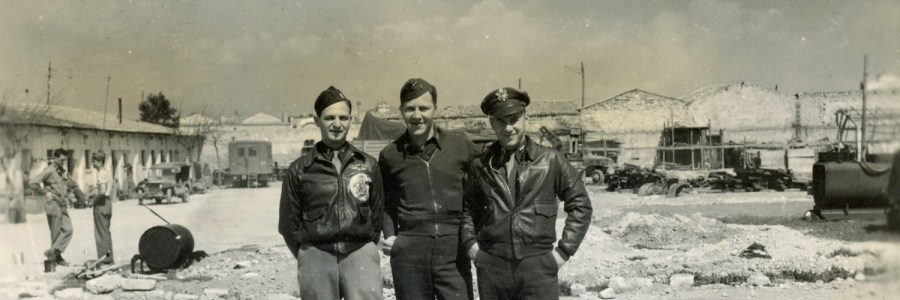
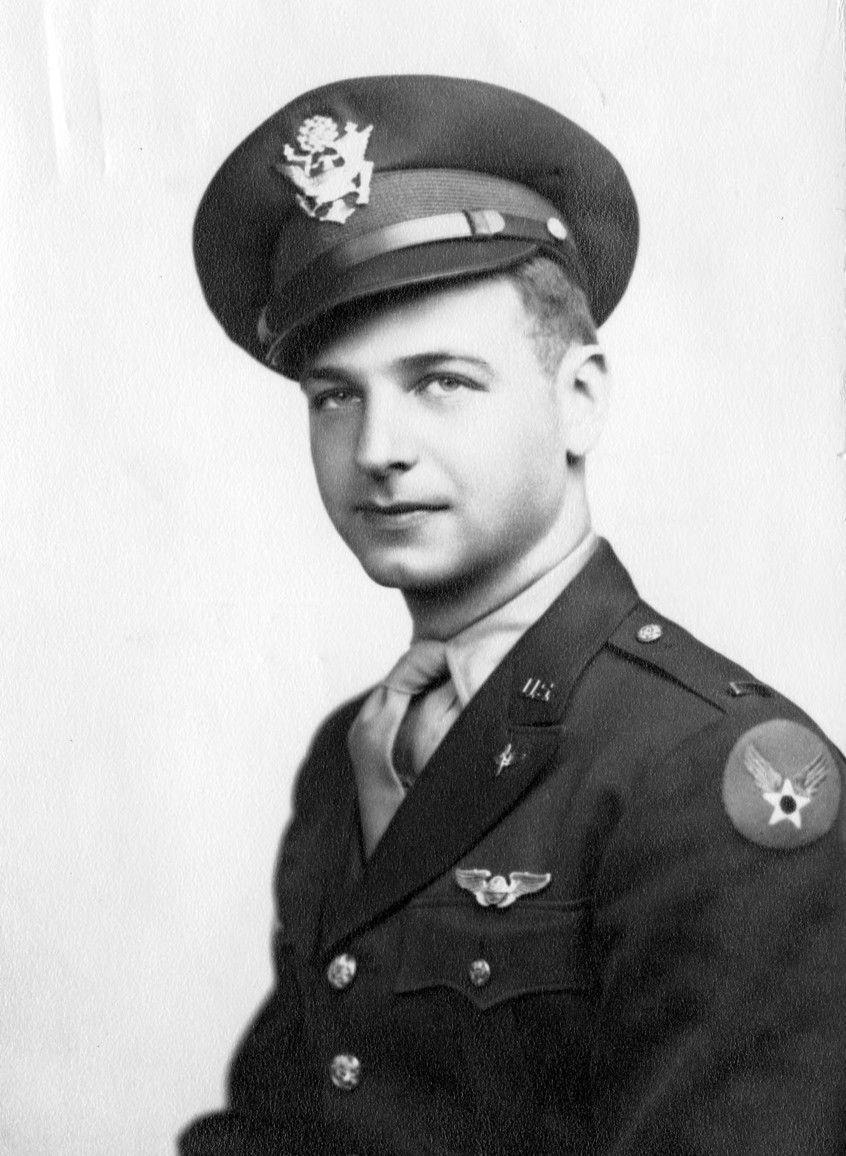
| Branch | Civilian Occupation |
| U.S. Army Air Forces | Budget manager for Kiel Motor Company |
| Theater | Service Number |
| Mediterranean | Enlisted 12054220 / Officer O-691975 |
| Military Occupational Specialty | Unit |
| 1034 (navigator) | 765th Bombardment Squadron (Heavy), 461st Bombardment Group (Heavy) |
| Awards | Campaigns/Battles |
| Air Medal with three oak leaf clusters, Purple Heart | European air campaign |
Early Life & Family
Harry Matthew First was born in Saint Paul, Minnesota, on October 5, 1915. He was the son of Philip First (c. 1877–1948) and Sarah First (c. 1886–1945), Jewish immigrants who had been born in the Russian Empire in what is now Lithuania. He had an older brother, three older sisters, a younger sister, and a younger brother.
A vaccination record for First dated June 18, 1919, indicates that he was living with his family in Bradford, Pennsylvania. His father was a rabbi. From 1919 to 1928, Rabbi First served at Congregation B’Nai Abraham in Meriden, Connecticut, before moving to Wilmington, Delaware, where he led Congregation Chesed Shel Emeth at 227 Shipley Street until he retired in January 1944.
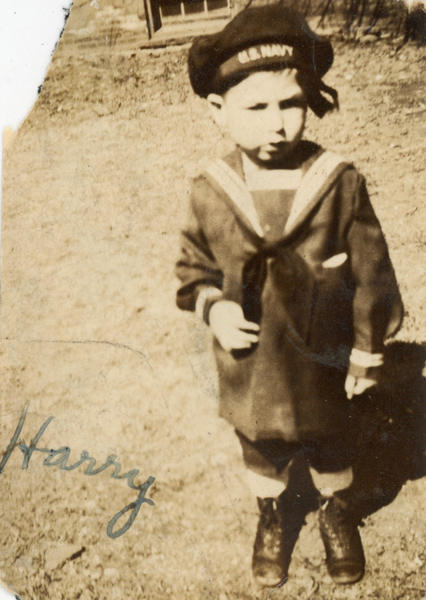
On May 8, 1928, First’s parents purchased a home at 412 North Franklin Street. Available records suggest that First lived there until he entered the service.
After graduating from Wilmington High School on June 22, 1932, First enrolled in the University of Delaware in nearby Newark. During his senior year, First was elected to an honor society, Phi Kappa Phi, which Walter Hullihen (1875–1944), University of Delaware president, described as “the highest academic distinction that is conferred at the University of Delaware” in a congratulatory letter.
First was recorded on the census in April 1940 living with his family and working as a stenographer. Later that year, when he registered for the draft on October 16, 1940, First was working for the Kiel Motor Company at 11th and Tatnall Streets. The registrar described him as standing five feet, seven inches tall and weighing 145 lbs., with brown hair and blue eyes. First was Kiel’s budget manager prior to entering the service.
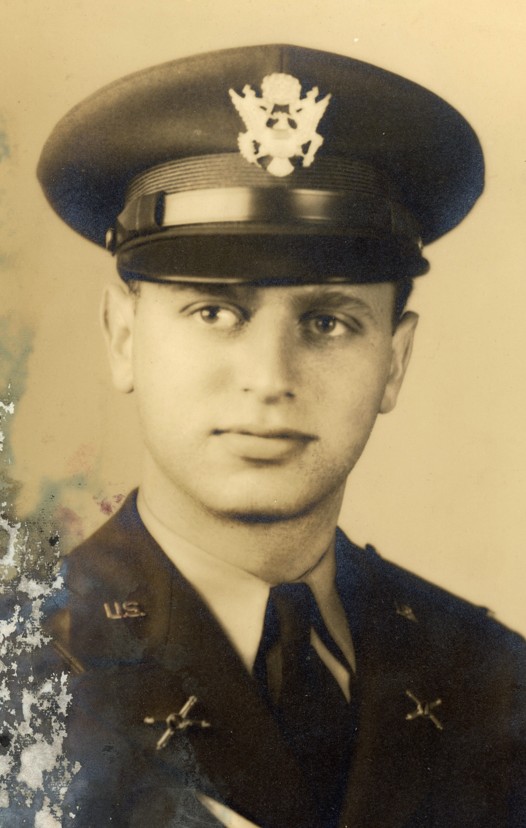
First’s younger brother, Joseph M. First (1920–1969), served as an antiaircraft artillery officer in the U.S. Army in Europe during World War II.
Military Career
While at the University of Delaware, First participated in two years of the Reserve Officers’ Training Corps program.
First volunteered for the Army Air Forces (A.A.F.), enlisting in Trenton, New Jersey, on May 26, 1942. His enlistment data card indicates he was placed in the reserves, and it appears he did not go on active duty until that November. He volunteered for air crew training and was accepted as an aviation cadet.
Beginning on November 15, 1942, Aviation Cadet First was attached to Aviation Cadet Squadron 107 while he was assessed at the A.A.F. Classification Center, San Antonio Aviation Cadet Center, Texas. On November 24 he wrote a letter to Mollye Sklut (1906–2006)—a Wilmington woman who was the nexus of a network of communication between the home front and Delaware’s Jewish servicemen worldwide—stating: “I have just received a bulletin that I have been classified for training as a pilot, and I expect to stay here until there is an opening in a pre-flight school.” He described the center:
This is not a flight school of any kind. It is merely a classification center in which cadets are classified as either pilot, navigator, or [bombardier].
The route here is similar to that of any other Army camp. We have drill, exercises, athletic [pursuits?], and work details just as the other boys in other camps have.
As far as I’m concerned, I find Army life to be a “breeze.” The work isn’t too difficult, the food is excellent, and the athletic exercises are really putting me in great physical shape. It gets very hot here in the afternoons, and I am already sporting a sun-burn that would be the envy of many of our Wilmington glamor girls. Furthermore, I find the fellows in my barracks to be a bunch of “regular guys.”
One of the few familiar faces in Texas was a friend from Wilmington, Lieutenant Seymour Berman (1916–2010), a navigation instructor stationed nearby who would later serve with First in the Fifteenth Air Force. First told Sklut in a letter dated December 2, 1942, that Berman “has been up to see me several times, however, and since I am not allowed off the post, we have spent several enjoyable hours chatting in his car which incidentally is a beautiful 1942 Pontiac.”
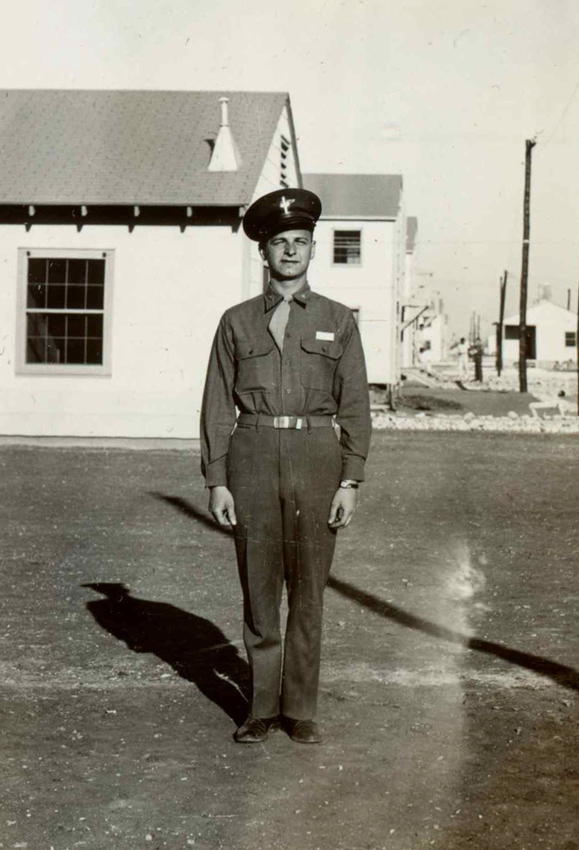
First joined the 883rd Pre-Flight Training Squadron (Pilot) at the Army Air Forces Pre-Flight School, San Antonio Aviation Cadet Center on December 15, 1942. On January 22, 1942, he wrote to Sklut: “This Cadet training certainly keeps me busy. In addition to regular drill, calisthenics, and formal parades, I have quite a bit of classroom work including a course in Morse Code.”
First passed his preflight training. On February 17, 1943, he began his primary pilot training with Class 43-H, attached to the 304th Army Air Forces Flying Training Detachment at Coleman Field, Texas. Pilot training was intensive and attrition was significant. According to his flight records, First accumulated 13 hours and four minutes of flight time in February and March 1943 in PT training aircraft. He continued his training with the 304th until March 23, 1943, when he was transferred back to the San Antonio Aviation Cadet Center, where he was assigned to Squadron 114 for reclassification. Promising aviation cadets who did not pass pilot training often transferred to bombardier or navigators training programs, while others ended up training as gunners.
On March 27, 1943, First wrote to Sklut about a long-distance telephone call he made, a rare luxury at the time:
I guess my folks told you that I called home and talked to Joie. I was so excited that he was home I couldn’t think of a darn thing to say to him except “Hello.” However, it certainly was grand to hear the voices of the folks. […]
You have probably heard by this time that I was eliminated from pilot training. I consider myself quite fortunate in having been sent back here to sad SAACC, as I fully expected to have been made a Private without any chance for further air crew training. However, I appeared before a Faculty Board yesterday at which time I was reclassified for training in Navigation.
On April 14, 1943, Aviation Cadet First was transferred to Squadron “D,” A.A.F. Gulf Coast Training Center Pool, San Antonio Aviation Cadet Center, waiting for a slot to open to begin his navigator training. In an April 25 letter, First wrote: “Seymour and I have gone out several times, and we have left plenty of our dough at the San Antonio night clubs. Other than that, it’s the same old Army life.”
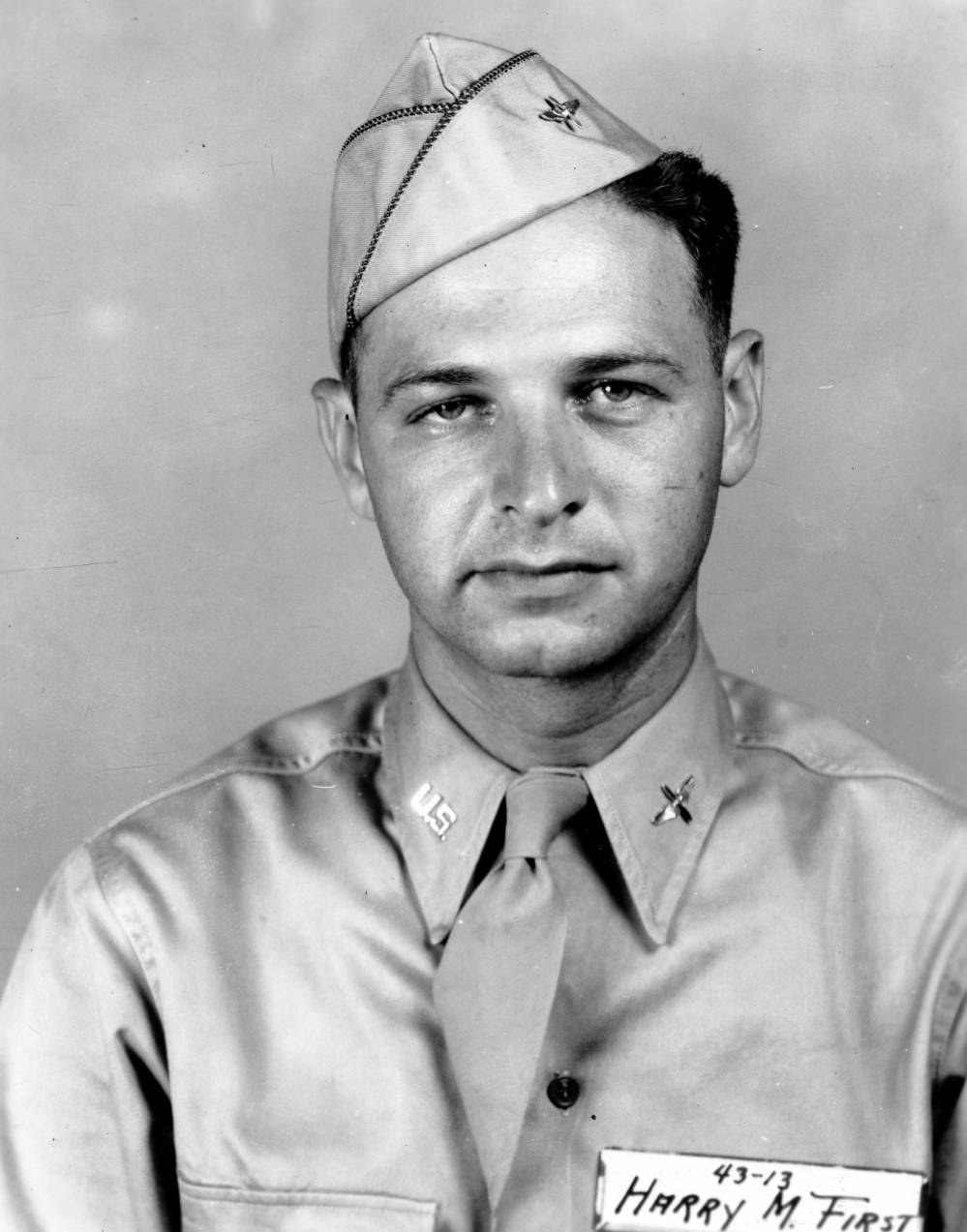
On May 13, 1943, Aviation Cadet First departed San Antonio bound for the A.A.F. Navigation School at Hondo Army Air Field, Texas. Upon reporting there, he was attached unassigned to Headquarters and Headquarters Squadron, 88th Navigation Training Group. On May 23, he wrote to Sklut:
I have just completed my first week here at the Advanced Navigation School, and I find the course far more interesting than that of pilot training. I really enjoy the work very much, and so far, the days just seem to have flown by.
As of July 30, 1943, when he had a medical exam at Hondo, First stood five feet, 6½ inches tall and weighed 144 lbs., with 20/20 vision.
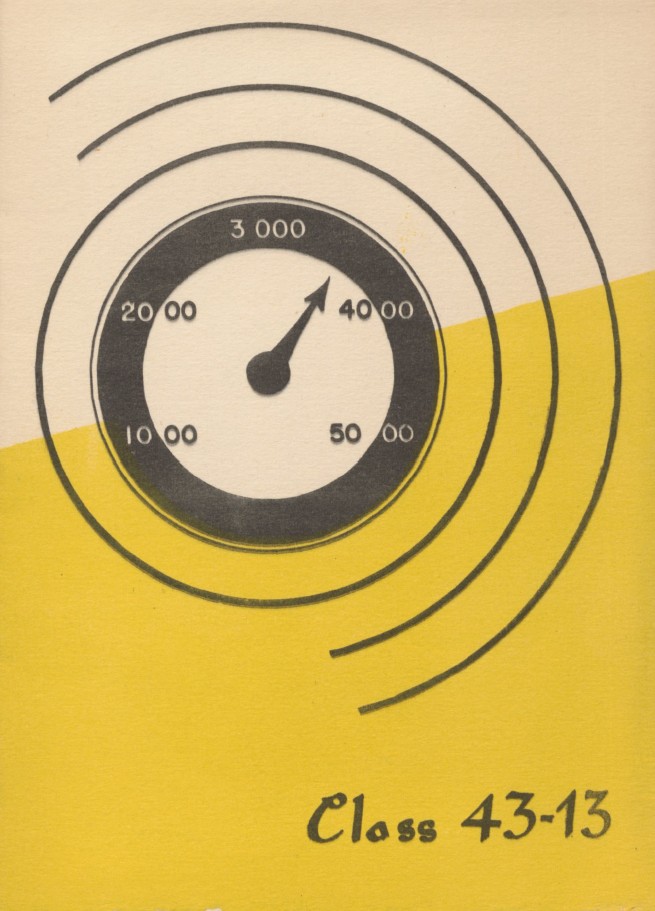
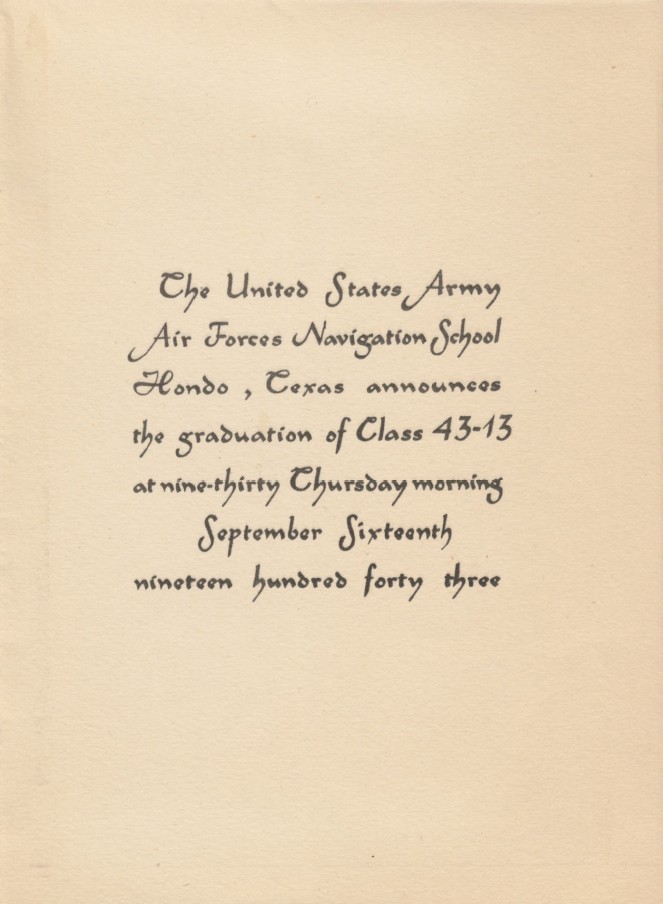
According to his flight records, between May 14 and September 16, 1943, First accumulated 96 hours and 45 minutes of flight time as a student navigator in Beechcraft AT-7 and Lockheed B-34 aircraft, including 28 hours and 20 minutes at night. On September 15, after finishing navigator training, First was honorably discharged as a formality to accept a commission as a 2nd lieutenant effective the following day, when Hondo’s Class 43-13 graduated.
A set of orders came down on September 17, 1943, from Headquarters A.A.F. Navigation School, Hondo Army Air Field, transferring 2nd Lieutenant First to the 470th Bombardment Group (Heavy)—an operational training unit at Mountain Home Army Air Field, Idaho—with a report date no later than September 30. In the meantime, he was able to visit friends and family back in Wilmington.
Though he had not yet arrived, on September 26 First was attached to the group’s 800th Bomb Squadron (Heavy). His unit was equipped with the Consolidated B-24 Liberator four-engine bomber. On October 4, Lieutenant First underwent mask fitting and then passed a test involving 30 minutes in a chamber simulating high altitude. Stateside training was hazardous. On October 23, 15 men from First’s squadron were killed in a midair collision.
By November 13, 1943, 2nd Lieutenant First had joined a crew led by 2nd Lieutenant Richard E. Avery (1918–1981), who had joined the 800th Bomb Squadron on October 19. The crew also included an Italian-born gunner from Wilmington, Sergeant Louis Di Martino (1922–1944). On November 13, the Avery crew was transferred to the 399th Bombardment Group (Heavy) at Wendover Field, Utah, with a report date of on or about November 14. However, on November 25, they were detached from the 399th Bomb Group and dispatched back to the 470th Bomb Group at Mountain Home. On November 27, First’s crew was attached to the group’s 801st Bombardment Squadron (Heavy).
On December 7, 1943, First and his crew were detached from the 801st Bomb Squadron and transferred to the 461st Bombardment Group (Heavy) at Hammer Field, Fresno, California. There, on December 10, they joined the group’s 765th Bombardment Squadron (Heavy) as Crew 25, replacing the previous ill-fated Crew 25 led by Charles W. Turvey (1921–1943), which vanished in the Sierra Nevada Mountains during a training flight on December 5. The wreckage of the plane, which had crashed in a remote part of Kings Canyon National Park, California, was not discovered until 1960. The tragedy could not hold up the unit’s timetable. When First and his crew joined, the 461st Bomb Group was mere weeks from going overseas.
By the end of 1943, Lieutenant First had another 78 hours and 30 minutes of flight time under his belt, for a total of 175 hours and 15 minutes (including his time as a student navigator).
A 461st Bomb Group history noted that the unit went overseas with 70 crews but only 62 aircraft, with priority given to crews that had completed their training first. First’s crew, which had joined the group only that month, were not assigned a plane. The group history stated that the members of the eight crews, except their first pilot, “were assigned to the ground echelon for the overseas movement.”
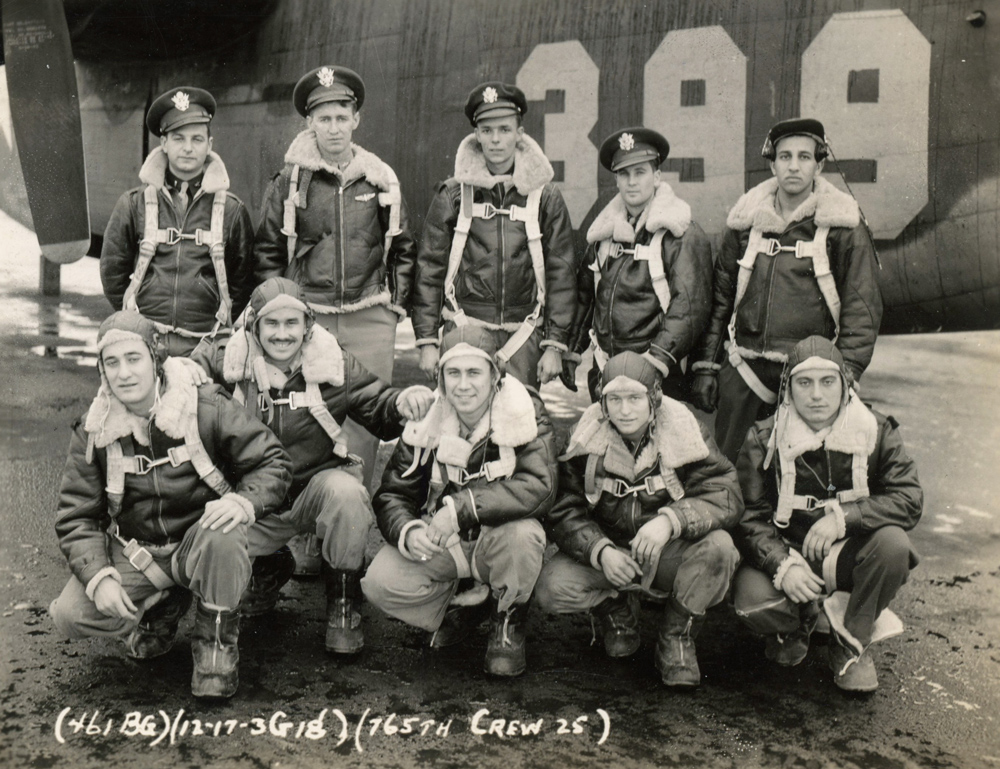
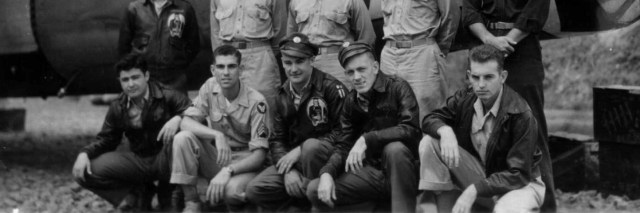
Although Lieutenant Avery appeared in a Crew 25 photo dated December 17, 1943, his name did not appear on a list of the group’s first pilots compiled at the end of the month. Though he remained in the squadron until the following July, this detail suggests that Avery had already been replaced as First’s crew’s pilot, likely by Glenial Fulks (1921–1944). Fulks had been an aviation cadet in Class 43-D at Eagle Pass, Texas, with another future fallen Delawarean, Joseph A. Dugan (1920–1945). Fulks had been commissioned on April 22, 1943, and did transition training to fly B-24 Liberators. He had been a member of the 765th Bomb Squadron’s Crew 31 but flew in combat with Crew 25.
Even though it was about to go overseas, First’s squadron continued its training. He grumbled in a letter:
On Xmas Eve, I was weathered in at a field in the middle of the Mojave desert in California. Boy, was I mad. I had arranged to attend a party that night, but instead I was stuck in the middle of a desert […] on account of the weather in California where it’s supposed to be sunny all the time.
The ground echelon, including Lieutenant First, left Hammer Field by rail on December 31, 1943. First later recalled: “I really did hate to leave Fresno, Cal. It was a paradise there compared to any other post to which I’ve been attached, and I wouldn’t have minded staying there a couple of months longer.” After staging at Camp Patrick Henry, Virginia, the ground echelon of the 765th Bomb Squadron boarded S.S. George Handley at the nearby Hampton Roads Port of Embarkation on January 12, 1944.
First officially entered foreign service on January 13, 1944, when his ship moved a short distance from port. It dropped anchor until Convoy UGS-30 departed on January 14. In a V-mail to Sklut written at sea sometime that month, First wrote:
Everything is being made as pleasant and comfortable as possible for us on this boat. We have books, games, phonograph records, etc. all for free. I understand that all this junk has been contributed by the Red Cross. We staged a boxing exhibition on deck the other day. I happened to be around, so I was chosen as one of the judges. After one of my bum decisions, I thought I would be mobbed and tossed overboard.
First also passed the voyage playing cards, though he seems to have lost money playing. His main opponent, who he had dismissed as looking “like easy pickings,” ended up proving to be a better player than First expected “and financially, the trip resulted in a dismal failure.”
The convoy entered the Mediterranean Sea on January 31, 1944. Various ships in the convoy were routed to different destinations in the Mediterranean. Most of the vessels carrying the ground echelons of the 461st Bomb Group put into port at Tunis, Tunisia, but George Handley ended up at Augusta, Sicily. After a few days, the ship moved to Naples, Italy, where the ground echelon of the 765th finally disembarked on February 15, and went into staging at Bagnoli. There was no alcohol available aboard ship, so First and some comrades were pleased to be able to buy some wine at a shop near the staging area on February 19. “Not being able to converse in Italian,” he wrote the following day, “I find that you can do wonders with the sign language.”
While First and the others were still in transit, the air echelon of the 765th Bomb Squadron crossed the country in late January 1944, then departed Morrison Field, West Palm Beach, Florida. After intermediate stops in the British West Indies, Brazil, French West Africa, Morocco, Algeria, and Tunisia, they arrived at Torretta, Italy, part of the Foggia complex, on February 23.
On February 23, the 765’s ground echelon began a roundabout journey by truck and train, and were finally reunited with the air echelon at Torretta the following day. The 461st Bomb Group was assigned to the 55th Bombardment Wing, Fifteenth Air Force, but moved to the 49th Bombardment Wing on March 14.
Combat Over Europe
When the 461st Bomb Group arrived, Torretta was in poor condition with limited facilities. The contemporary 765th Bomb Squadron history for March 1944 stated: “Everyone worked together in perfect unison to get the planes, equipment, and crew in condition to perform combat missions. Several Squadron and Group practice missions were flown during the month.”
Living conditions were spartan at first, with most of the men living in tents heated with improvised oil stoves. They converted agricultural buildings in the vicinity to quarters and club rooms.
Bomber crews in the Fifteenth Air Force flew longer tours of duty than the better-known United Kingdom-based Eighth Air Force, though they shared many of the same dangers, especially during deep penetration missions into central Europe. From fields in Italy, the Fifteen Air Force could hit targets in the German Reich, occupied countries in southern Europe, and the Axis countries of Hungary and Romania. Although missions varied, the 461st Bomb Group’s most frequent targets involved oil refineries, railroad marshalling yards, and airfields.
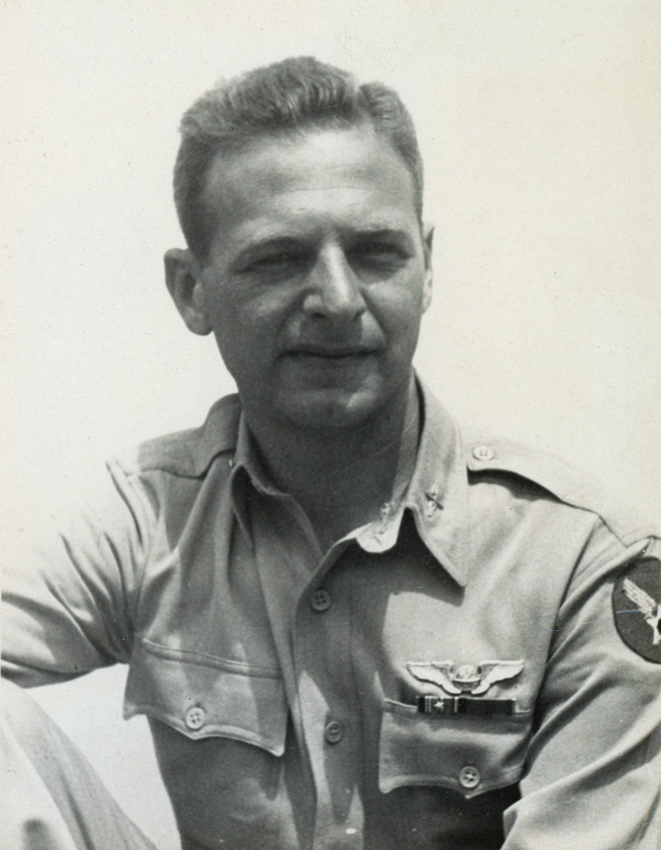
First’s flight records state that he flew five times in March, totaling 19 hours and 50 minutes, but not the type of flight. The 461st Bomb Group’s first combat mission took place on April 2, 1944, against “the Bihac Marshalling Yards in North Western Yugoslavia.” First’s flight record documents that he participated in a five hour, 45 minute flight that day, suggesting that he participated in this “freshman mission.”
During April 1944, First flew 10 times, totaling 48 hours and 20 minutes. Based on squadron records, seven were probably combat missions. Bad weather over targets interfered with bombing several times, but enemy resistance tended to be light. His squadron lost two planes and 14 men that month.
There was an uptick in operational tempo in May 1944 and First’s missions were mostly of longer duration than in April. He participated in 12 flights totaling 85 hours, 50 minutes, all of them probably combat missions. His squadron lost two more crews that month. First’s last mission of the month was a nearly nine-hour mission against the Concordia Vega refinery at Ploești, Romania. The year before, Ploești’s refineries became infamous when they were targeted in a costly low-altitude raid by B-24s known as Operation Tidal Wave. It was not a knockout blow, and subsequent high-altitude raids continued to pound the Ploești refineries.
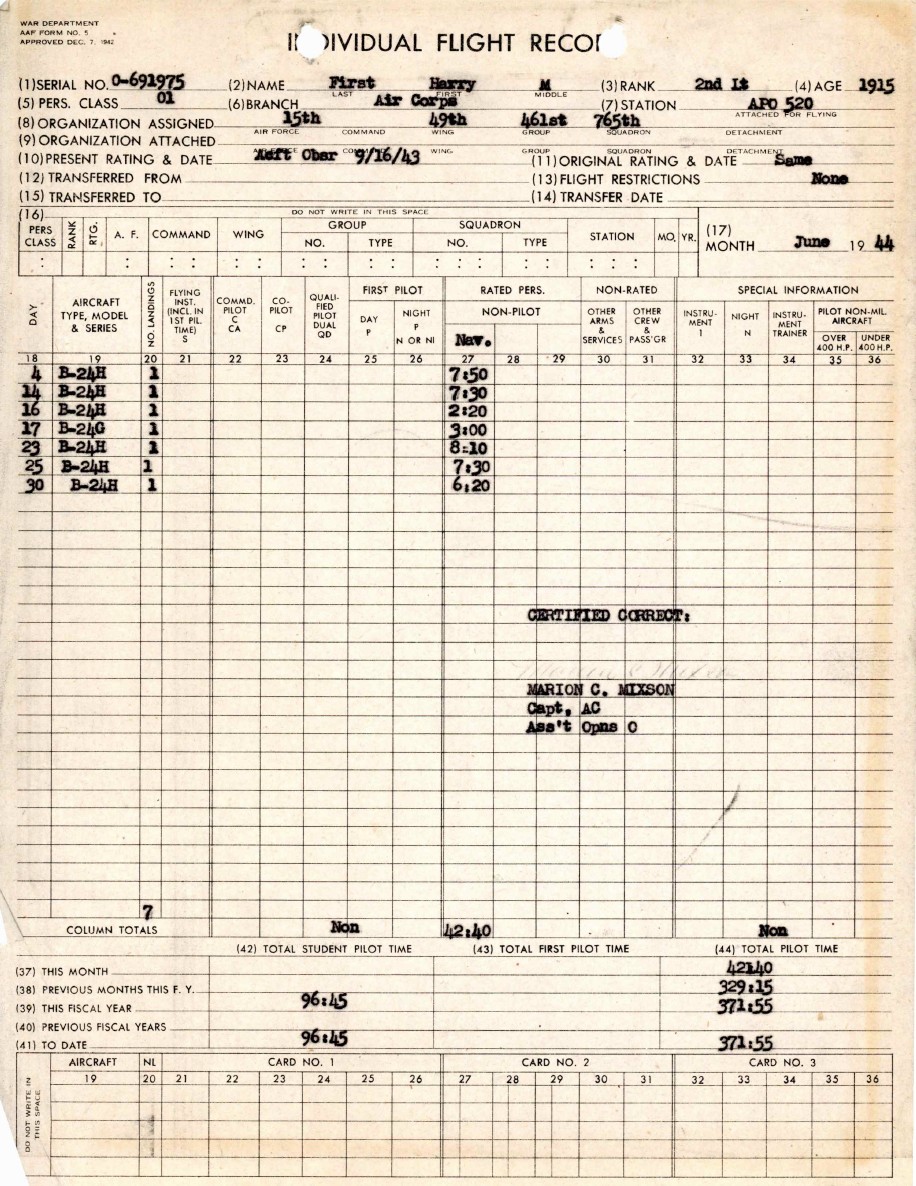
June 1944 was a slower month, partially due to poor weather. After a mission on June 4, the same day that Rome fell, 2nd Lieutenant First got a break. On June 5, 1944, he and his crew went on temporary duty for a week at a rest camp on the island of Capri. They returned to duty on June 13. That month, First logged seven flights, totaling 42 hours, 40 minutes in the air, including five probable combat missions attacking targets in Hungary, Romania, France, and Germany. His squadron participated in 16 combat missions that month with no losses except one man wounded in action.
The following month, July 1944, the 461st Bomb Group flew long missions against targets in Italy, Hungary, France, Romania, Austria, and Germany. First was promoted to 1st lieutenant effective July 16. According to his flight records, Lieutenant First flew 13 times that month, totaling about 86 hours including estimated flight time on his final mission. That gave him about 329 hours and 15 minutes of flight time, not counting the 13 hours logged during his pilot training. 12 of his flights that month were probably combat missions.
July 1944 was a tough month, and not just because of the usual problems caused by weather. Lieutenant First survived two of his unit’s most difficult missions to date. The mission to Nîmes, France, on July 12 was heavily opposed by enemy fighters and the 461st Bomb Group lost four crews, though none of them were from First’s squadron. On July 22, during the attack on the Româno-Americană oil refinery at Ploești, the lead plane for the group was hit by antiaircraft fire and two engines damaged, resulting in the bombardier jettisoning his bombs. Unfortunately, the rest of the group had orders to drop their ordnance on cue from the lead bombardier, resulting in the entire group releasing short of the target. During the mission, the 461st Bomb Group lost one crew over enemy territory. Another crew, from First’s squadron, nursed their stricken B-24 back to friendly territory and bailed out, with officer killed when his parachute did not open in time. Frustrating as these two were, the 461st Bomb Group’s most disastrous mission was still to come.
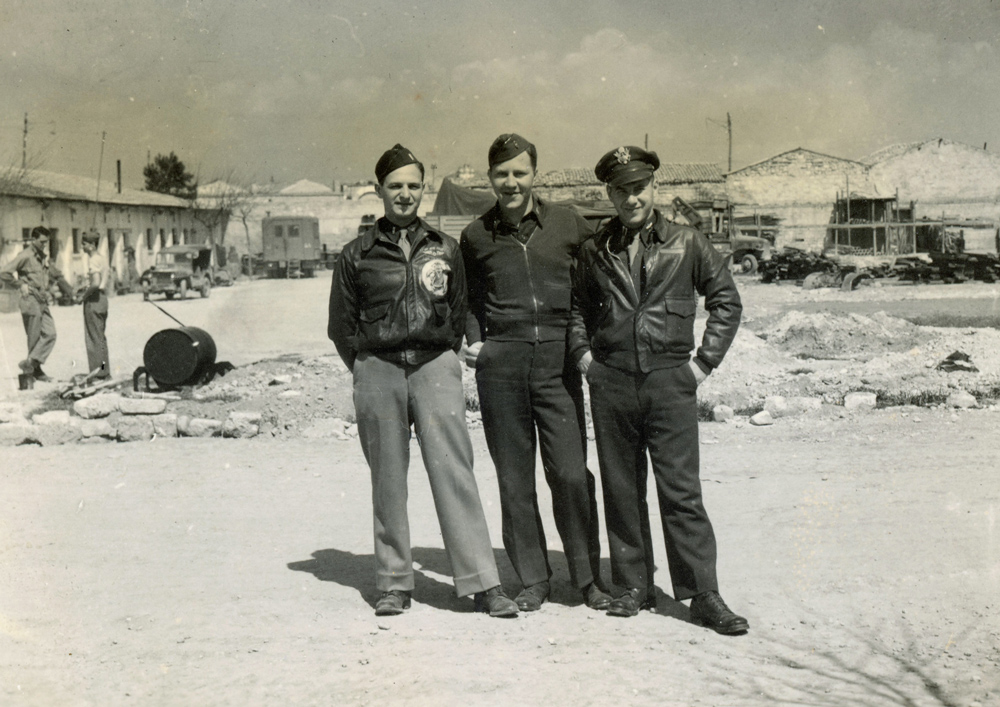
Final Mission
The 765th Bomb Squadron history stated that on July 25, 1944, “The men were briefed to hit the Herman Goering Tank Works at Linz, Austria, and also that this would be a rough mission, with lots of flak and fighters.” Rough undersold just how bad the mission against the Reichswerke Hermann Göring plant would be. That morning, First took off aboard a B-24H piloted by 1st Lieutenant Fulks and 2nd Lieutenant Warren O. Ludlum (1923–2009). The plane, A.A.F. serial number 42-52368, was 461st Bomb Group Ship No. 34, nicknamed Piecemaker.
10-men bomber crews often included men from all over the country, but First’s crew was particularly diverse. They had entered the service from seven states—Pennsylvania, Delaware, Illinois, California, Kentucky, Indiana, and New York—plus the Panama Canal Zone. Two were immigrants: Staff Sergeant Di Martino and Staff Sergeant Morris Krivitsky (1913–1944), a top turret gunner who had immigrated from the Soviet Union and who had already been wounded by flak the month before. Two were Jewish, Lieutenant First and Sergeant Krivitsky.
This fateful day, the weather was far better than during previous missions: ceiling and visibility unlimited. This made it easier for the bombers to find the target but also for the Germans to intercept them.
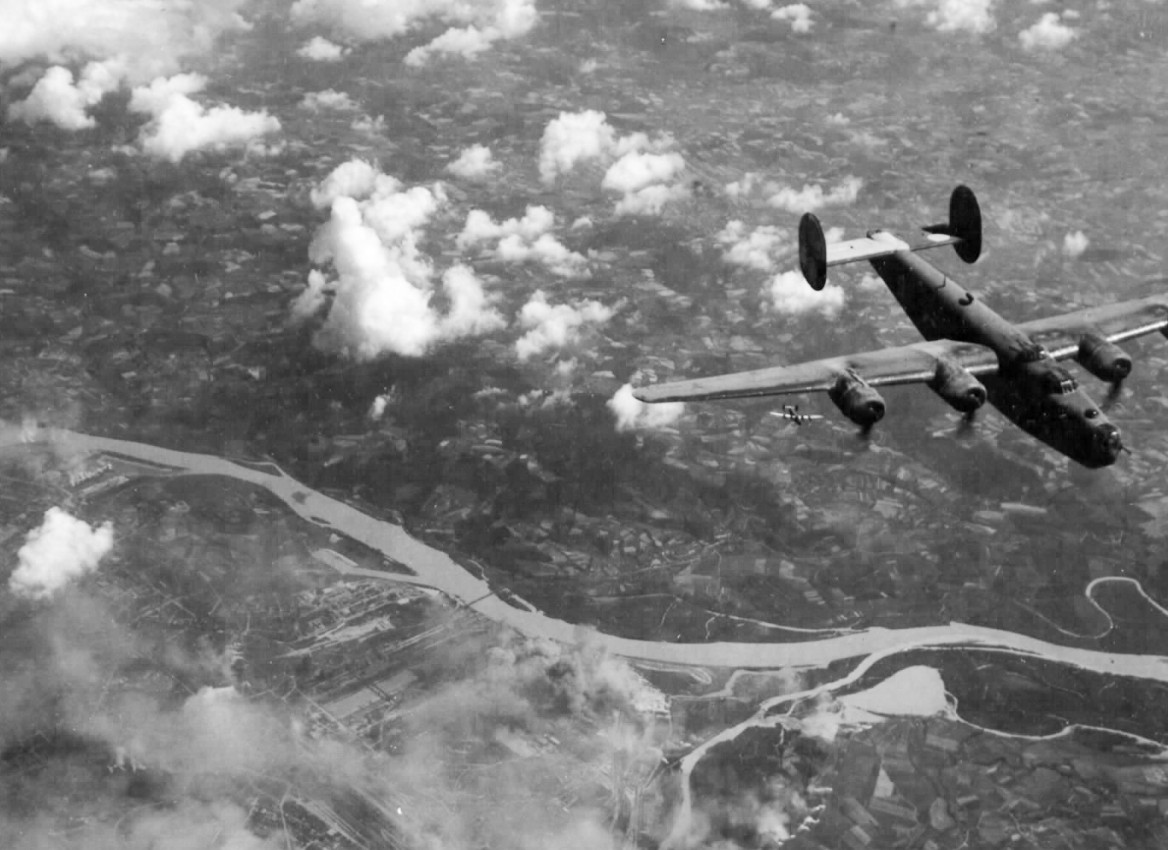
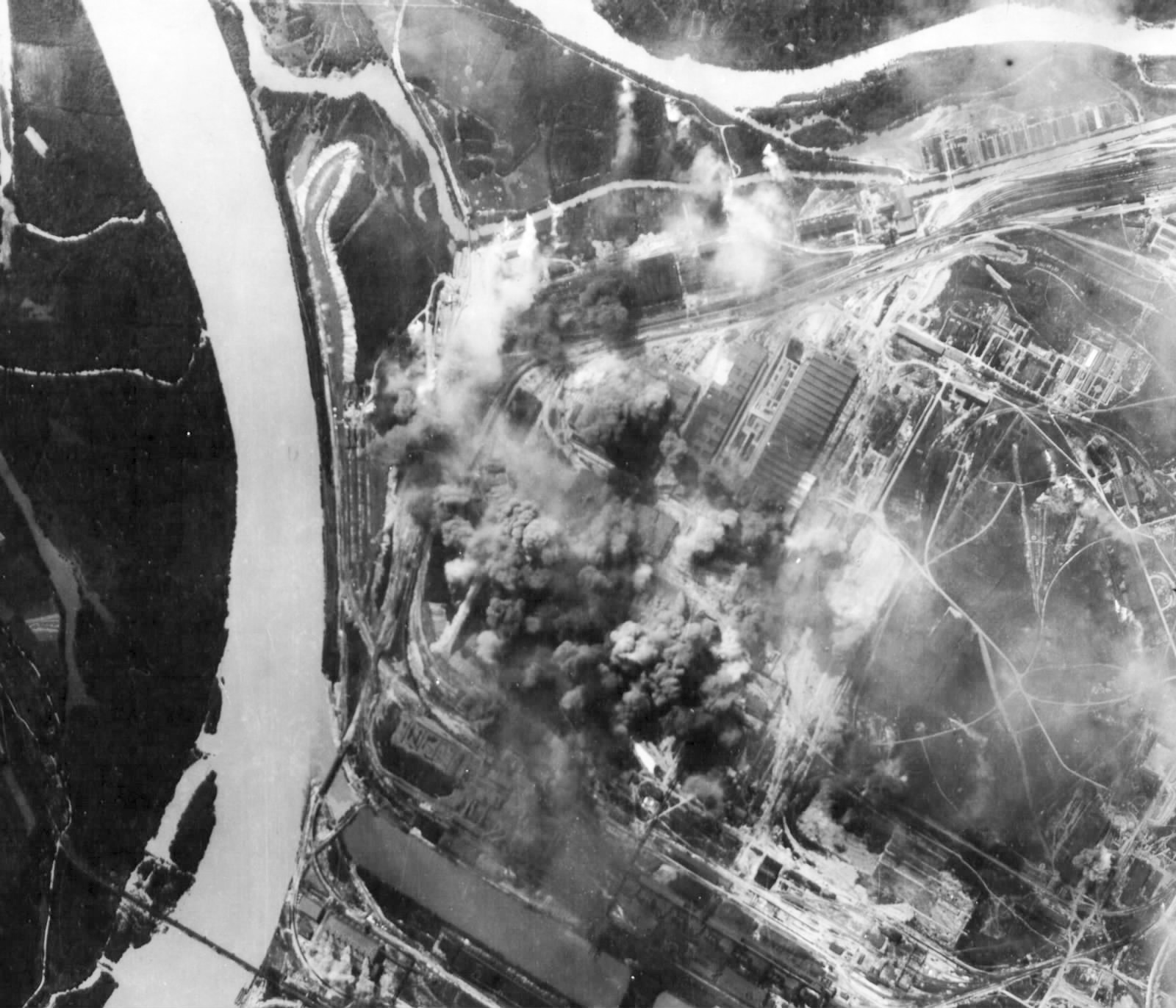
21 B-24s from the 461st Bomb Group had begun their bomb run on Linz when approximately 25 twin-engine and 125 single-engine German fighters pounced. The contemporary 461st Bomb Group history stated:
Taking advantage of the fact that most of the planes flown by new crews did not have their ball turret down on the bomb run, the twin engine planes came up under the lead flight of the formation and began throwing rockets through the open bomb bay doors. The first plane to go down was Major [William] Burke’s lead plane. Instead of packing the formation in close, the inexperienced bomber pilots spread the formation. Captain Franklin, 1st Lt. Henry, Lt. King, Lt. Sullivan, and Lt. Gizelba, flying the deputy lead plane, salvoed [jettisoned] their bombs and attempted to rally the formation. By this time, however, the single engine fighters, still attacking low but now from the rear, picked off planes in the straggling formation. Eleven bombers were knocked down as parachutes, tracers, rockets, enemy fighters, and exploding bombers filled the air with confusion.
The group history was unequivocal in calling the mission the “Linz catastrophe.” 11 B-24s from the 461st Bomb Group were shot down and their crews killed or captured. Another crew managed to bail out from their heavily damaged bomber over friendly territory. Three other B-24s that made it back were so badly damaged that they were written off. The group history stated that among the 113 men lost on the mission, “seven officers and nine enlisted men were flying their fiftieth sortie.” This was particularly unfortunate for them since 50 missions were required to complete a tour of duty and be rotated back to the non-combat duty, mostly in the continental U.S. The report ruefully added: “For the first time in its history, enemy fighters successfully turned back the 461st Group short of its target.” Other groups did successfully attack the plant, however.
Three of the lost crews were from the 765th Bomb Squadron, including First’s. The squadron history stated:
With out a doubt this was the BLACKEST DAY for the Squadron. Of the six ships that made it to the target area, only one was able to make it back to the field, and one was able to land at Foggia. […] The story that the two returning crews told was that approximately 150 to 170 fighters jumped them just before they started over the target. Things happened so fast, and there was [sic] so many ships falling that the men had no time to watch other ships or much of anything else. They were busy shooting at ME’s and FW’s.
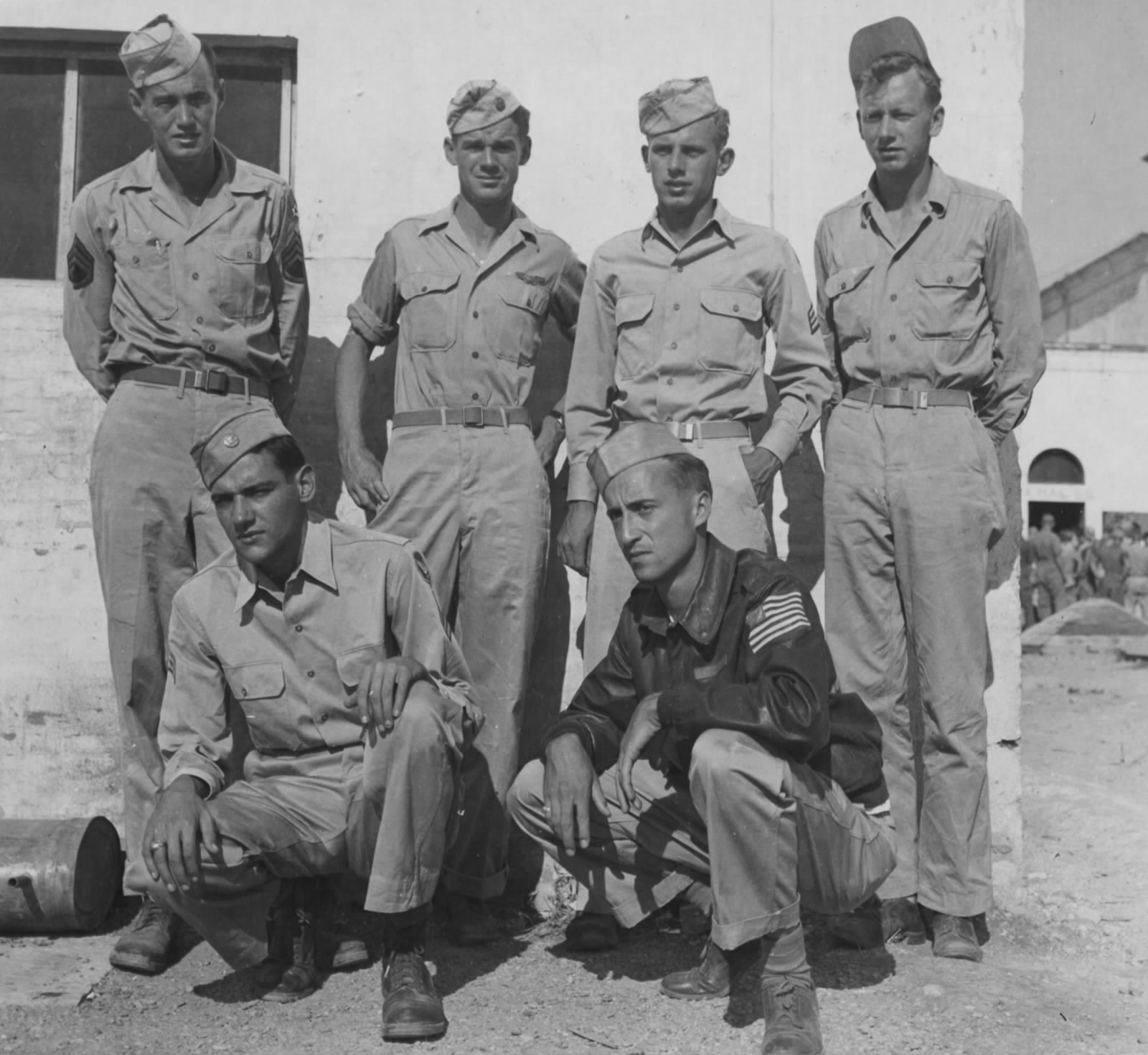
The day after the mission, Technical Sergeant Hugh G. Baker (1923–1989), aboard B-24G 42-78444, nicknamed All American, made the following statement:
On 25 July 1944 I saw ship number 34, type B-24-H go down in flames. The wing seemed to be a solid sheet of fire with the flames streaming back past the tail. It turned over on its back completely out of control. That is all I saw. The time was about 11:20. I saw no one bail out.
Another member of Baker’s crew, Sergeant Warren H. Moss (1921–1983), made a similar statement:
On 25 July 1944 at approximately 11:20 hours I saw ship number 34 type B-24-H go down in flames. The wings were a solid sheet of fire with flames streaming back past the tail. It turned over out of control. I did not see any chutes but it is possible for them to have gotten out later.
According to German records, the B-24 crashed about 14 miles east of Linz at 1107 hours. Remarkably, three members of the crew successfully bailed out and survived as prisoners of war. After the surrender of Nazi Germany, American military authorities distributed questionnaires to survivors of downed aircraft in an attempt to determine the fates of crewmembers still missing. It appears that only the right waist gunner, George Diamond (1923–1991), was interviewed, or at least his responses were the only ones to be attached to Missing Air Crew Report No. 7110.
Technical Sergeant (then Staff Sergeant) Diamond only had firsthand knowledge of the left waist gunner, Staff Sergeant Di Martino, who was “hit very badly while at his guns” and was badly wounded or dead before the plane crashed. Diamond recalled that he jumped or was thrown through a hole in the fuselage made by an explosion.
Diamond also relayed information from 2nd Lieutenant Ludlum. The copilot told Diamond that while leaving the flight deck to bail out, he saw First lying on the floor of the radio compartment, apparently already dead. Ludlum reported that fire from enemy fighters had piercing the front of the B-24 and he even heard shells (or shell fragments) bouncing off the armor behind the pilot seats. He believed that the exploding shells had killed Lieutenant First as well as the top turret gunner, Sergeant Krivitsky. Diamond also reported that ball turret gunner Staff Sergeant Fred C. Duzan, Jr. (1920–1944), no novice gunner, had been trapped in his turret when the plane went down.
Journal-Every Evening reported that Lieutenant First was missing in action on August 11, 1944, and confirmed his death on September 28, the same day that the War Department changed his status to killed in action after German government reported it via the International Red Cross. Captain Joseph First, by then overseas with Headquarters Battery, 549th Antiaircraft Artillery (Automatic Weapons) Battalion, wrote to Mollye Sklut on November 7, 1944: “I just found out yesterday of Harry’s death, and it’s pretty hard to take.” He vowed not to leave Europe until he learned the truth about his brother’s death.
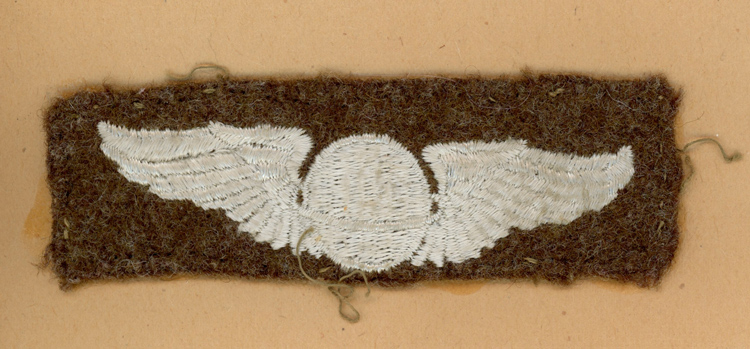
First’s personal effects included a Fifteenth Air Force shoulder patch, a folder with three photographs, a pair of navigator’s wings, a silk scarf, a Ronson lighter, a deck of playing cards, a short snorter, and a novel, The Robe.
During his service, Lieutenant First earned the Air Medal with three oak leaf clusters. He was posthumously awarded the Purple Heart.
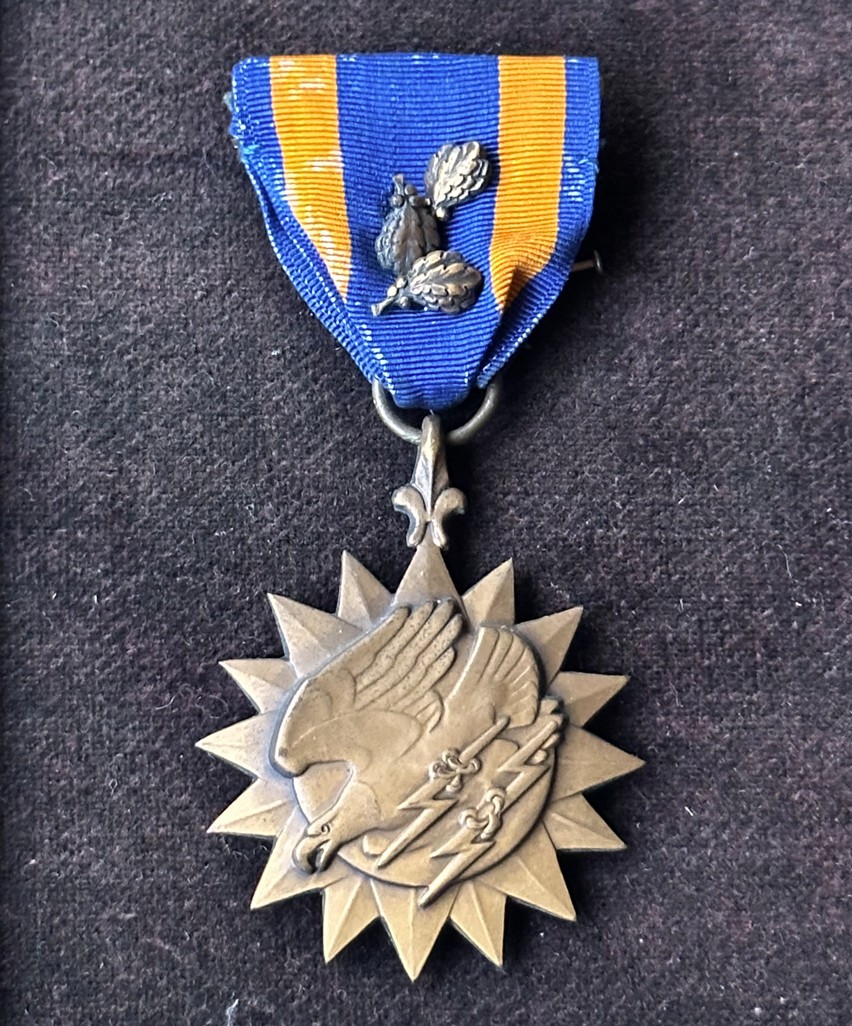
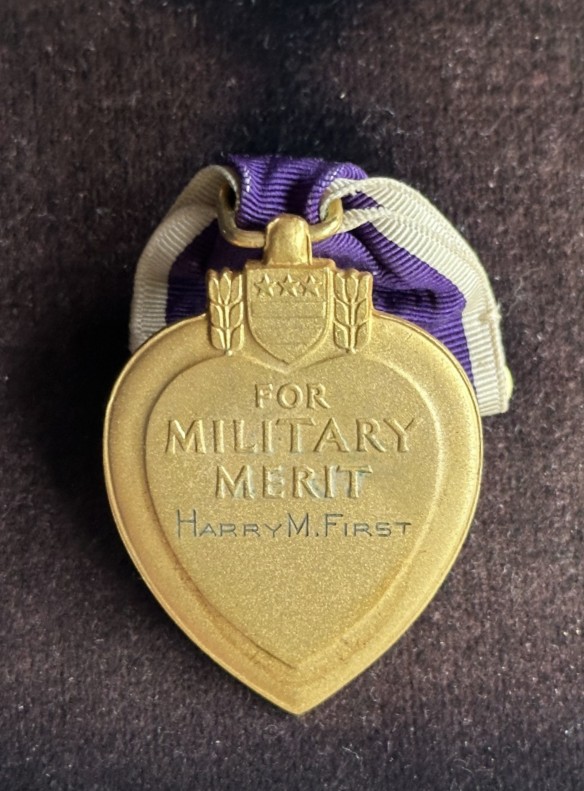
Austrian civilians initially buried Lieutenant First and six other Americans in a cemetery in Tragwein, Austria. Five of the bodies had been located inside the crashed plane and two others nearby. By August 26, 1946, American Graves Registration Command, European Theater Area had obtained information about slain American air crew, suspected to members the Fulks crew, buried at Tragwein. Possibly because it was in the Soviet occupation area, it was only on June 12, 1947, that the bodies were recovered by personnel from the 612th Army Graves Registration Company. They were transferred to a military cemetery at Neuville-en-Condroz, Belgium, where First’s remains were designated Unknown X-6077.
Authorities conducted a forensic examination on August 18, 1947, and reburied the body one week later. It was not until July 1948 that First was officially identified from dental records. Later that year, with Lieutenant First’s parents now deceased, his siblings requested his repatriation to the United States. In the spring of 1949, First’s body returned by sea from Antwerp, Belgium, to the New York Port of Embarkation. On the morning of June 3, U.S. Air Force 1st Lieutenant Raymond B. Kleber (1925–2021) escorted Lieutenant First’s casket by train from Jersey City, New Jersey, to Wilmington.
Following services at the Chandler Funeral Home in Wilmington on June 5, 1949, Lieutenant First was buried in the Jewish section of Lombardy Cemetery, now known as the Jewish Community Cemetery. His name is honored on a memorial there and at Veterans Memorial Park in New Castle.
Crew of B-24H Piecemaker on July 25, 1944
The following list was adopted from Missing Air Crew Report No. 7110 with grade, name, service number, position, and status (killed or captured).
1st Lieutenant Glenial Fulks, O-676774 (pilot) – K.I.A.
2nd Lieutenant Warren O. Ludlum, O-813535 (copilot) – P.O.W.
1st Lieutenant Harry M. First, O-691975 (navigator) – K.I.A.
Flight Officer Robert B. Stewart, T-1573 (bombardier) – K.I.A.
Staff Sergeant Walter R. Jaske, 36740606 (nose turret gunner) – K.I.A.
Staff Sergeant Morris Krivitsky, 33310332 (top turret gunner) – K.I.A.
Staff Sergeant Fred C. Duzan, Jr., 15062921 (ball turret gunner) – K.I.A.
Staff Sergeant George Diamond, 12187570 (right waist gunner) – P.O.W.
Staff Sergeant Louis Di Martino, 13153198 (left waist gunner) – K.I.A.
Staff Sergeant Peter N. Godino, 7021152 (tail gunner) – P.O.W.
Lieutenant First’s Combat Missions
This list of probable combat missions, all in 1944, is based on First’s flight records—which do not distinguish training or administrative flights from operational ones—cross-referenced to missions flown by his unit. Of course, he theoretically could have flown a training or administrative flight on the same day that his group flew a combat mission. This list may contain outdated or erroneous spellings, as contemporary American records often mangled foreign place names.
- April 2: Bihac Marshalling Yards, Yugoslavia
- April 5: Nis Marshalling Yards, Yugoslavia
- April 12: Zagreb Marshalling Yards, Yugoslavia
- April 16: Belgrade Zomun Airdrome, Yugoslavia (alternate after poor weather over Brasov Airdrome, Romania)
- April 17: Belgrade Zomun Airdrome, Yugoslavia
- April 21: Chitila Marshalling Yards, Bucharest, Romania
- April 23: Bad Voslau Airdrome, Austria
- May 2: La Spezia Harbor, Italy
- May 7: Bucharest, Romania
- May 12: Marina di Carrara Marshalling Yards, Italy
- May 14: Padua Marshalling Yards, Italy
- May 18: Belgrade Zomun Airdrome, Yugoslavia
- May 22: Piombino Harbor, Italy
- May 23: Subiaco Road Junction, Italy
- May 25: Carnoules Marshalling Yards, France
- May 26: Lyon-Vaise Marshalling Yards, France
- May 29: Wiener Neustadt Werke 1, Austria
- May 30: Wels Aircraft Factory, Austria
- May 31: Concordia Vega Oil Refinery, Ploești, Romania
- June 2: Szolnok Marshalling Yards, Hungary
- June 14: Szony Oil Storage, Hungary
- June 23: Giurgiu Oil Storage, Romania
- June 25: Avignon East Marshalling Yards, France
- June 30: Blechhammer South Synthetic Oil Plant, Germany
- July 3: Bucharest Mogasaia Oil Storage, Romania
- July 6: Aviano Oil Storage, Italy
- July 8: Korneuburg Oil Refinery, Austria
- July 11: Toulon Harbor, France
- July 12: Nîmes Marshalling Yards, France
- July 15: Creditul Minier Oil Refinery, Ploești, Romania
- July 16: Wiener Neudorf Aircraft Engine Factory, Austria
- July 18: Manzell Dornierwereke Aircraft Components Factory, Friedrichshafen, Germany
- July 21: Brux Synthetic Oil Refinery, Czechoslovakia
- July 22: Româno-Americană Oil Refinery, Ploești, Romania
- July 24: Troop concentrations around Pljevlja, Prejepolje, Sjenica, and Adrijevica, Yugoslavia
- July 25: Herman Goering Tank Works, Linz, Austria
Notes
Number of Missions
First’s sister told the Public Archives Commission that her brother “was on his 50th mission when” he was shot down. This was a potentially heartbreaking detail since bomber crews in his group had to fly a 50-mission tour before being rotated to non-combat duty, usually back in the continental U.S. Journal-Every Evening described First as “A veteran of more than 47 missions[.]” Similarly, another member of his crew, George Diamond, stated that First had flown 49 missions. Lieutenant Ludlow, the crew’s copilot, also was described as having been shot down on his 49th mission in his obituary. Likewise, Staff Sergeant Di Martino’s family also reported that he died during his 49th mission. Di Martino’s qualification card, which survived the 1973 National Personnel Records Center fire, stated: “Had 48 combat missions.”
First’s five flights in March 1944 and on April 1, before the beginning of combat operations, would seem not to have counted as combat missions. Based on flight records, which do not distinguish training or administrative missions from combat or operational ones, he could have flown at most nine combat missions in April, 12 in May, seven in June, and 13 in July, for a total of 41 flights. More likely figures based on comparing squadron records to First’s flight records are seven in April, 12 in May, five in June, and 12 in July, for a total of 36 probable combat missions.
In his postwar questionnaire, George Diamond stated that First and most of the crew had 49 missions. On the sheet for the pilot, he jotted down 35 specific missions including the last, but added “others [sic] missions not included[.]”
One possible explanation for the discrepancy was that some missions earned double credit for being especially hazardous, though there would have to be quite a few of these to resolve the discrepancy.
Ship
Unit records give the name of the vessel aboard which the ground echelon of the 765th Bomb Squadron crossed the Atlantic Ocean as S.S. George S. Hanly, but convoy records show that it was S.S. George Handley.
Sergeants Krivitsky and Jaske
The top turret gunner, Morris Krivitsky, was referred to as a staff sergeant in unit morning reports and the missing air crew report, but as a technical sergeant in Diamond’s statement and on the official casualty list. The nose gunner, Walter R. Jaske, Jr. (1922–1944), was listed as a staff sergeant in contemporary records and on the casualty list, but as a technical sergeant on his headstone.
Acknowledgments
Special thanks to Dan First and the First family as well as to the Jewish Historical Society of Delaware for providing photos and documents, to Matt LeMasters for obtaining flight records, to Charles Randall Morgan and Hughes Glantzberg for unit records, and to the Delaware Public Archives for the use of their photos.
Bibliography
“2LT Charles Willis Turvey.” Find a Grave. https://www.findagrave.com/memorial/49329727/charles-willis-turvey
“358 High School Graduates Presented With Diplomas.” June 23, 1932. Wilmington Morning News. https://www.newspapers.com/article/202093460/
“461st Bomb Gp (H) 49th Bomb Wing 15th Air Force Chapter V Jan. and Feb 1944.” Undated, c. 1944. Reel B0610. Air Force Historical Research Agency, Maxwell Air Force Base, Alabama. Courtesy of Charles Randall Morgan and Hughes Glantzberg.
“461st Bomb Gp (H) 49th Bomb Wing 15th Air Force Chapter VI March 1944.” Undated, c. 1944. Reel B0610. Air Force Historical Research Agency, Maxwell Air Force Base, Alabama. Courtesy of Charles Randall Morgan and Hughes Glantzberg.
“461st Bomb Gp (H) 49th Bomb Wing 15th Air Force Chapter VII April 1944.” Undated, c. 1944. Reel B0610. Air Force Historical Research Agency, Maxwell Air Force Base, Alabama. Courtesy of Charles Randall Morgan and Hughes Glantzberg.
“461st Bomb Gp (H) 49th Bomb Wing 15th Air Force Chapter VIII May 1944.” Undated, c. 1944. Reel B0610. Air Force Historical Research Agency, Maxwell Air Force Base, Alabama. Courtesy of Charles Randall Morgan and Hughes Glantzberg.
“461st Bomb Gp (H) 49th Bomb Wing 15th Air Force Chapter IX June 1944.” Undated, c. 1944. Reel B0610. Air Force Historical Research Agency, Maxwell Air Force Base, Alabama. Courtesy of Charles Randall Morgan and Hughes Glantzberg.
“461st Bomb Gp (H) 49th Bomb Wing 15th Air Force Chapter X July 1944.” Undated, c. 1944. Reel B0610. Air Force Historical Research Agency, Maxwell Air Force Base, Alabama. Courtesy of Charles Randall Morgan and Hughes Glantzberg.
Census Record for Harry First. April 10, 1930. Fifteenth Census of the United States, 1930. Record Group 29, Records of the Bureau of the Census. National Archives at Washington, D.C. https://www.familysearch.org/ark:/61903/3:1:33S7-9RHM-K7K
Census Record for Harry First. April 1940. Sixteenth Census of the United States, 1940. Record Group 29, Records of the Bureau of the Census. National Archives at Washington, D.C. https://www.familysearch.org/ark:/61903/3:1:3QS7-L9MR-9HP
Census Record for Harry First. January 3, 1920. Fourteenth Census of the United States, 1920. Record Group 29, Records of the Bureau of the Census. National Archives at Washington, D.C. https://www.familysearch.org/ark:/61903/3:1:33SQ-GR6Z-ZR7
“COL Raymond Bernard Kleber.” Find a Grave. https://www.findagrave.com/memorial/224633581/raymond-bernard-kleber
“Convoy UGS.30.” Arnold Hague Convoy Database. https://www.convoyweb.org.uk/ugs/index.html?ugs.php?convoy=30!~ugsmain
Deed Between Jeremiah J. Lynch and Katherine C. Lynch, Parties of the First Part, and Philip First and Sarah First, Parties of the Second Part. May 8, 1928. Delaware Land Records, 1677–1947. Record Group 2555-000-011, Recorder of Deeds, New Castle County. Delaware Public Archives, Dover, Delaware. https://www.ancestry.com/imageviewer/collections/61025/images/31303_257024-00315
“Delaware Casualty List of 11 Includes Three Killed in Action.” August 11, 1944. Journal-Every Evening. https://www.newspapers.com/article/136957520/
Draft Registration Card for Harry Matthew First. October 16, 1940. Draft Registration Cards for Delaware, October 16, 1940 – March 31, 1947. Record Group 147, Records of the Selective Service System. National Archives at St. Louis, Missouri. https://www.familysearch.org/ark:/61903/3:1:3Q9M-CSMG-6JR3
Enlistment Record for Harry M. First. May 26, 1942. World War II Army Enlistment Records. Record Group 64, Records of the National Archives and Records Administration. National Archives at College Park, Maryland. https://aad.archives.gov/aad/record-detail.jsp?dt=929&mtch=1&cat=all&tf=F&q=12054220&bc=&rpp=10&pg=1&rid=23005
“Enlisted Record of First Harry M., 12054220, Av/Cadet.” September 16, 1943. Courtesy of Dan First and the First family.
“Extract From the Squadron History for the Month of July.” July 31, 1944. Reel A0659. Air Force Historical Research Agency, Maxwell Air Force Base, Alabama. Courtesy of Charles Randall Morgan and Hughes Glantzberg.
First, Harry M. Letter to Mollye Sklut. April 15, 1944. Dear Mollye Letters. Courtesy of the Jewish Historical Society of Delaware. https://jewishhistorica-my.sharepoint.com/personal/jhsd_jewishhistorica_onmicrosoft_com/_layouts/15/embed.aspx?UniqueId=1744645f-a65c-489b-99bc-8f5399e14d28
First, Harry M. Letter to Mollye Sklut. April 25, 1943. Dear Mollye Letters. Courtesy of the Jewish Historical Society of Delaware. https://jewishhistorica-my.sharepoint.com/personal/jhsd_jewishhistorica_onmicrosoft_com/_layouts/15/embed.aspx?UniqueId=2cc41920-c9df-4cff-8fad-2b9ac3fc098e
First, Harry M. Letter to Mollye Sklut. December 2, 1942. Dear Mollye Letters. Courtesy of the Jewish Historical Society of Delaware. https://jewishhistorica-my.sharepoint.com/personal/jhsd_jewishhistorica_onmicrosoft_com/_layouts/15/embed.aspx?UniqueId=861660e3-9ca6-4a96-a8a0-de6ab5609b76
First, Harry M. Letter to Mollye Sklut. February 20, 1944. Dear Mollye Letters. Courtesy of the Jewish Historical Society of Delaware. https://jewishhistorica-my.sharepoint.com/personal/jhsd_jewishhistorica_onmicrosoft_com/_layouts/15/embed.aspx?UniqueId=1744645f-a65c-489b-99bc-8f5399e14d28
First, Harry M. Letter to Mollye Sklut. January 10, 1944. Dear Mollye Letters. Courtesy of the Jewish Historical Society of Delaware. https://jewishhistorica-my.sharepoint.com/personal/jhsd_jewishhistorica_onmicrosoft_com/_layouts/15/embed.aspx?UniqueId=1744645f-a65c-489b-99bc-8f5399e14d28
First, Harry M. Letter to Mollye Sklut. January 22, 1943. Dear Mollye Letters. Courtesy of the Jewish Historical Society of Delaware. https://jewishhistorica-my.sharepoint.com/personal/jhsd_jewishhistorica_onmicrosoft_com/_layouts/15/embed.aspx?UniqueId=2cc41920-c9df-4cff-8fad-2b9ac3fc098e
First, Harry M. Letter to Mollye Sklut. June 17, 1944. Dear Mollye Letters. Courtesy of the Jewish Historical Society of Delaware. https://jewishhistorica-my.sharepoint.com/personal/jhsd_jewishhistorica_onmicrosoft_com/_layouts/15/embed.aspx?UniqueId=1744645f-a65c-489b-99bc-8f5399e14d28
First, Harry M. Letter to Mollye Sklut. March 27, 1943. Dear Mollye Letters. Courtesy of the Jewish Historical Society of Delaware. https://jewishhistorica-my.sharepoint.com/personal/jhsd_jewishhistorica_onmicrosoft_com/_layouts/15/embed.aspx?UniqueId=2cc41920-c9df-4cff-8fad-2b9ac3fc098e
First, Harry M. Letter to Mollye Sklut. May 12, 1943. Dear Mollye Letters. Courtesy of the Jewish Historical Society of Delaware. https://jewishhistorica-my.sharepoint.com/personal/jhsd_jewishhistorica_onmicrosoft_com/_layouts/15/embed.aspx?UniqueId=2cc41920-c9df-4cff-8fad-2b9ac3fc098e
First, Harry M. Letter to Mollye Sklut. May 13, 1944. Dear Mollye Letters. Courtesy of the Jewish Historical Society of Delaware. https://jewishhistorica-my.sharepoint.com/personal/jhsd_jewishhistorica_onmicrosoft_com/_layouts/15/embed.aspx?UniqueId=1744645f-a65c-489b-99bc-8f5399e14d28
First, Harry M. Letter to Mollye Sklut. May 23, 1943. Dear Mollye Letters. Courtesy of the Jewish Historical Society of Delaware. https://jewishhistorica-my.sharepoint.com/personal/jhsd_jewishhistorica_onmicrosoft_com/_layouts/15/embed.aspx?UniqueId=2cc41920-c9df-4cff-8fad-2b9ac3fc098e
First, Harry M. Letter to Mollye Sklut. May 29, 1944. Dear Mollye Letters. Courtesy of the Jewish Historical Society of Delaware. https://jewishhistorica-my.sharepoint.com/personal/jhsd_jewishhistorica_onmicrosoft_com/_layouts/15/embed.aspx?UniqueId=1744645f-a65c-489b-99bc-8f5399e14d28
First, Harry M. Letter to Mollye Sklut. November 24, 1942. Dear Mollye Letters. Courtesy of the Jewish Historical Society of Delaware. https://jewishhistorica-my.sharepoint.com/personal/jhsd_jewishhistorica_onmicrosoft_com/_layouts/15/embed.aspx?UniqueId=861660e3-9ca6-4a96-a8a0-de6ab5609b76
First, Harry M. V-mail to Mollye Sklut. January 1944. Dear Mollye Letters. Courtesy of the Jewish Historical Society of Delaware. https://jewishhistorica-my.sharepoint.com/personal/jhsd_jewishhistorica_onmicrosoft_com/_layouts/15/embed.aspx?UniqueId=1744645f-a65c-489b-99bc-8f5399e14d28
First, Harry M. V-mail to Mollye Sklut. March 30, 1944. Dear Mollye Letters. Courtesy of the Jewish Historical Society of Delaware. https://jewishhistorica-my.sharepoint.com/personal/jhsd_jewishhistorica_onmicrosoft_com/_layouts/15/embed.aspx?UniqueId=1744645f-a65c-489b-99bc-8f5399e14d28
First, Joseph M. Letter to Mollye Sklut. Undated, c. May 16, 1944. Dear Mollye Letters. Courtesy of the Jewish Historical Society of Delaware. https://jewishhistorica-my.sharepoint.com/personal/jhsd_jewishhistorica_onmicrosoft_com/_layouts/15/embed.aspx?UniqueId=09663d2e-4ec7-4442-883a-2d6c3a655e8a
First, Joseph M. V-mail to Mollye Sklut. November 7, 1944. Dear Mollye Letters. Courtesy of the Jewish Historical Society of Delaware. https://jewishhistorica-my.sharepoint.com/personal/jhsd_jewishhistorica_onmicrosoft_com/_layouts/15/embed.aspx?UniqueId=09663d2e-4ec7-4442-883a-2d6c3a655e8a
“History of the 461st Bombardment Group (H) 1 July 1943 to 30 September 1943.” October 1943. Reel B0609. Air Force Historical Research Agency, Maxwell Air Force Base, Alabama. Courtesy of Charles Randall Morgan and Hughes Glantzberg.
“Hullihen Lauds U. of D. Classes.” June 9, 1936. Wilmington Morning News. https://www.newspapers.com/article/201816079/
Individual Deceased Personnel File for Harry M. First. 1944–1990. Army Individual Deceased Personnel Files, 1942–1970. Record Group 92, Records of the Office of the Quartermaster General, 1774–1985. National Archives at St. Louis, Missouri.
Individual Flight Records for Harry M. First. February 1943 – July 1944. Individual Flight Records, 1911–1958. Record Group 64, Records of the National Archives and Records Administration. National Archives at St. Louis, Missouri. Courtesy of Matt LeMasters.
Individual Flight Records for Harry M. First. May 1943 – June 1944. Courtesy of Dan First and the First family.
“Lieut. Berman Named Kelly Field Instructor.” March 2, 1942. Journal-Every Evening. https://www.newspapers.com/article/204776141/
“Lieut. First Funeral Is Planned for Sunday.” May 31, 1949. Journal-Every Evening. https://www.newspapers.com/article/202172710/
“Medical History of 461st Bombardment Group From 1 January 1944 to June 30 1944.” August 15, 1944. “Extract From the Squadron History for the Month of July.” July 31, 1944. Reel B0610. Air Force Historical Research Agency, Maxwell Air Force Base, Alabama. Courtesy of Charles Randall Morgan and Hughes Glantzberg.
“MSgt Hugh G. Baker.” Find a Grave. https://www.findagrave.com/memorial/151007897/hugh-g.-baker
Morning Reports for 34th Field Hospital. June 1944. U.S. Army Morning Reports, c. 1912–1946. Record Group 64, Records of the National Archives and Records Administration. National Archives at St. Louis, Missouri. https://catalog.archives.gov/medialz/partners/st-louis/rg-064/85713825-wwii/85713825_1944-06/85713825_1944-06_Roll-0491/85713825_1944-06_Roll-0491-17.pdf
Morning Reports for 304th Army Air Forces Flying Training Detachment. February 1943 – March 1943. U.S. Army Morning Reports, c. 1912–1946. Record Group 64, Records of the National Archives and Records Administration. National Archives at St. Louis, Missouri. https://catalog.archives.gov/medialz/partners/st-louis/rg-064/85713825-wwii/85713825_1940-01-thru-1943-07/85713825_1940-01-thru-1943-07_Roll-0422/85713825_1940-01-thru-1943-07_Roll-0422-06.pdf, https://catalog.archives.gov/medialz/partners/st-louis/rg-064/85713825-wwii/85713825_1940-01-thru-1943-07/85713825_1940-01-thru-1943-07_Roll-0422/85713825_1940-01-thru-1943-07_Roll-0422-07.pdf
Morning Reports for 765th Bombardment Squadron (Heavy). December 1943 – July 1944. U.S. Army Morning Reports, c. 1912–1946. Record Group 64, Records of the National Archives and Records Administration. National Archives at St. Louis, Missouri. https://catalog.archives.gov/medialz/partners/st-louis/rg-064/85713825-wwii/85713825_1943-12/85713825_1943-12_Roll-0467/85713825_1943-12_Roll-0467-13.pdf, https://catalog.archives.gov/medialz/partners/st-louis/rg-064/85713825-wwii/85713825_1943-12/85713825_1943-12_Roll-0467/85713825_1943-12_Roll-0467-14.pdf, https://catalog.archives.gov/medialz/partners/st-louis/rg-064/85713825-wwii/85713825_1943-12/85713825_1943-12_Roll-0233/85713825_1943-12_Roll-0233-28.pdf, https://catalog.archives.gov/medialz/partners/st-louis/rg-064/85713825-wwii/85713825_1944-01/85713825_1944-01_Roll-0318/85713825_1944-01_Roll-0318-14.pdf, https://catalog.archives.gov/medialz/partners/st-louis/rg-064/85713825-wwii/85713825_1944-01/85713825_1944-01_Roll-0718/85713825_1944-01_Roll-0718-08.pdf, https://catalog.archives.gov/medialz/partners/st-louis/rg-064/85713825-wwii/85713825_1944-02/85713825_1944-02_Roll-0481/85713825_1944-02_Roll-0481-19.pdf, https://catalog.archives.gov/medialz/partners/st-louis/rg-064/85713825-wwii/85713825_1944-03/85713825_1944-03_Roll-0574/85713825_1944-03_Roll-0574-17.pdf, https://catalog.archives.gov/medialz/partners/st-louis/rg-064/85713825-wwii/85713825_1944-04/85713825_1944-04_Roll-0562/85713825_1944-04_Roll-0562-10.pdf, https://catalog.archives.gov/medialz/partners/st-louis/rg-064/85713825-wwii/85713825_1944-04/85713825_1944-04_Roll-0562/85713825_1944-04_Roll-0562-11.pdf, https://catalog.archives.gov/medialz/partners/st-louis/rg-064/85713825-wwii/85713825_1944-05/85713825_1944-05_Roll-0595/85713825_1944-05_Roll-0595-18.pdf, https://catalog.archives.gov/medialz/partners/st-louis/rg-064/85713825-wwii/85713825_1944-05/85713825_1944-05_Roll-0595/85713825_1944-05_Roll-0595-19.pdf, https://catalog.archives.gov/medialz/partners/st-louis/rg-064/85713825-wwii/85713825_1944-06/85713825_1944-06_Roll-0545/85713825_1944-06_Roll-0545-01.pdf, https://catalog.archives.gov/medialz/partners/st-louis/rg-064/85713825-wwii/85713825_1944-06/85713825_1944-06_Roll-0545/85713825_1944-06_Roll-0545-02.pdf, https://catalog.archives.gov/medialz/partners/st-louis/rg-064/85713825-wwii/85713825_1944-07/85713825_1944-07_Roll-0748/85713825_1944-07_Roll-0748-15.pdf, https://catalog.archives.gov/medialz/partners/st-louis/rg-064/85713825-wwii/85713825_1944-07/85713825_1944-07_Roll-0748/85713825_1944-07_Roll-0748-16.pdf
Morning Reports for 800th Bombardment Squadron (Heavy). September 1943 – November 1943. U.S. Army Morning Reports, c. 1912–1946. Record Group 64, Records of the National Archives and Records Administration. National Archives at St. Louis, Missouri. https://catalog.archives.gov/medialz/partners/st-louis/rg-064/85713825-wwii/85713825_1943-09/85713825_1943-09_Roll-0447/85713825_1943-09_Roll-0447-09.pdf, https://catalog.archives.gov/medialz/partners/st-louis/rg-064/85713825-wwii/85713825_1943-10/85713825_1943-10_Roll-0457/85713825_1943-10_Roll-0457-01.pdf, https://catalog.archives.gov/medialz/partners/st-louis/rg-064/85713825-wwii/85713825_1943-10/85713825_1943-10_Roll-0457/85713825_1943-10_Roll-0457-02.pdf, https://catalog.archives.gov/medialz/partners/st-louis/rg-064/85713825-wwii/85713825_1943-11/85713825_1943-11_Roll-0385/85713825_1943-11_Roll-0385-12.pdf
Morning Reports for 801st Bombardment Squadron (Heavy). November 1943 – December 1943. U.S. Army Morning Reports, c. 1912–1946. Record Group 64, Records of the National Archives and Records Administration. National Archives at St. Louis, Missouri. https://catalog.archives.gov/medialz/partners/st-louis/rg-064/85713825-wwii/85713825_1943-11/85713825_1943-11_Roll-0385/85713825_1943-11_Roll-0385-13.pdf, https://catalog.archives.gov/medialz/partners/st-louis/rg-064/85713825-wwii/85713825_1943-12/85713825_1943-12_Roll-0095/85713825_1943-12_Roll-0095-23.pdf
Morning Reports for Army Air Forces Gulf Coast Training Center Pool. April 1943. U.S. Army Morning Reports, c. 1912–1946. Record Group 64, Records of the National Archives and Records Administration. National Archives at St. Louis, Missouri. https://catalog.archives.gov/medialz/partners/st-louis/rg-064/85713825-wwii/85713825_1940-01-thru-1943-07/85713825_1940-01-thru-1943-07_Roll-0510/85713825_1940-01-thru-1943-07_Roll-0510-05.pdf, https://catalog.archives.gov/medialz/partners/st-louis/rg-064/85713825-wwii/85713825_1940-01-thru-1943-07/85713825_1940-01-thru-1943-07_Roll-0510/85713825_1940-01-thru-1943-07_Roll-0510-06.pdf
Morning Reports for Aviation Cadet Squadron 107. November 1942 – December 1942. U.S. Army Morning Reports, c. 1912–1946. Record Group 64, Records of the National Archives and Records Administration. National Archives at St. Louis, Missouri. https://catalog.archives.gov/medialz/partners/st-louis/rg-064/85713825-wwii/85713825_1940-01-thru-1943-07/85713825_1940-01-thru-1943-07_Roll-0508/85713825_1940-01-thru-1943-07_Roll-0508-13.pdf
Morning Reports for Aviation Cadet Squadron 114. March 1943 – April 1943. U.S. Army Morning Reports, c. 1912–1946. Record Group 64, Records of the National Archives and Records Administration. National Archives at St. Louis, Missouri. https://catalog.archives.gov/medialz/partners/st-louis/rg-064/85713825-wwii/85713825_1940-01-thru-1943-07/85713825_1940-01-thru-1943-07_Roll-0509/85713825_1940-01-thru-1943-07_Roll-0509-16.pdf, https://catalog.archives.gov/medialz/partners/st-louis/rg-064/85713825-wwii/85713825_1940-01-thru-1943-07/85713825_1940-01-thru-1943-07_Roll-0509/85713825_1940-01-thru-1943-07_Roll-0509-17.pdf
Morning Reports for Headquarters and Headquarters Squadron, 88th Navigation Training Group. June 1943. U.S. Army Morning Reports, c. 1912–1946. Record Group 64, Records of the National Archives and Records Administration. National Archives at St. Louis, Missouri. https://catalog.archives.gov/medialz/partners/st-louis/rg-064/85713825-wwii/85713825_1940-01-thru-1943-07/85713825_1940-01-thru-1943-07_Roll-0054/85713825_1940-01-thru-1943-07_Roll-0054-09.pdf
Morning Reports for Headquarters and Headquarters Squadron, 88th Navigation Training Group. June 1943. U.S. Army Morning Reports, c. 1912–1946. Record Group 64, Records of the National Archives and Records Administration. National Archives at St. Louis, Missouri. https://catalog.archives.gov/medialz/partners/st-louis/rg-064/85713825-wwii/85713825_1943-09/85713825_1943-09_Roll-0470/85713825_1943-09_Roll-0470-09.pdf
“Mrs. Sarah First, Wife Of City Rabbi, Dead.” September 25, 1945. Journal-Every Evening. https://www.newspapers.com/article/201816125/
Official Military Personnel File for Louis Di Martino. 1943–1947. Official Military Personnel Files, 1912–1998. Record Group 319, Records of the Army Staff. National Archives at St. Louis, Missouri.
“Rabbi Philip First.” May 12, 1948. Meriden Record. https://www.newspapers.com/article/201820436/
“Richard Eugene Avery.” Find a Grave. https://www.findagrave.com/memorial/157363913/richard-eugene-avery
“Services Today For Rabbi First.” May 12, 1948. Wilmington Morning News. https://www.newspapers.com/article/201820869/
“Seymour Berman.” July 15, 2024. JHSDWiki. Jewish Historical Society of Delaware. https://jhsdelaware.org/wiki/index.php?title=Seymour_Berman
Sinai, Samuel B. “Missing Air Crew Report No. 7110.” 1944 – 1945. Missing Air Crew Reports (MACRs), 1942–1947. Record Group 92, Records of the Office of the Quartermaster General, 1774–1985. The National Archives at College Park, Maryland. https://catalog.archives.gov/id/91025384
Sklut, Edith F. Individual Military Service Record for Harry M. First. November 17, 1944. Record Group 1325-003-053, Record of Delawareans Who Died in World War II. Delaware Public Archives, Dover, Delaware. https://cdm16397.contentdm.oclc.org/digital/collection/p15323coll6/id/18693/rec/2
“Special Order No. 329, Headquarters Army Air Base, Wendover Field, Utah.” November 25, 1943. U.S. Army Morning Reports, c. 1912–1946. Record Group 64, Records of the National Archives and Records Administration. National Archives at St. Louis, Missouri. https://catalog.archives.gov/medialz/partners/st-louis/rg-064/85713825-wwii/85713825_1943-11/85713825_1943-11_Roll-0393/85713825_1943-11_Roll-0393-09.pdf
“Summary of the Squadron History for the Month of December.” December 28, 1943. Reel A0659. Air Force Historical Research Agency, Maxwell Air Force Base, Alabama. Courtesy of Charles Randall Morgan and Hughes Glantzberg.
“Summary of the Squadron History for the Month of July.” July 31, 1944. Reel A0659. Air Force Historical Research Agency, Maxwell Air Force Base, Alabama. Courtesy of Charles Randall Morgan and Hughes Glantzberg.
“Summary of the Squadron History for the Month of June.” June 30, 1944. Reel A0659. Air Force Historical Research Agency, Maxwell Air Force Base, Alabama. Courtesy of Charles Randall Morgan and Hughes Glantzberg.
“Summary of the Squadron History for the Month of March.” March 31, 1944. Reel A0659. Air Force Historical Research Agency, Maxwell Air Force Base, Alabama. Courtesy of Charles Randall Morgan and Hughes Glantzberg.
“Summary of the Squadron History for the Month of May.” May 31, 1944. Reel A0659. Air Force Historical Research Agency, Maxwell Air Force Base, Alabama. Courtesy of Charles Randall Morgan and Hughes Glantzberg.
“Summary of the Squadron History for the Month of September.” September 30, 1944. Reel A0659. Air Force Historical Research Agency, Maxwell Air Force Base, Alabama. Courtesy of Charles Randall Morgan and Hughes Glantzberg.
“Three Missing Delawareans Reported Dead.” September 28, 1944. Journal-Every Evening. https://www.newspapers.com/article/202172880/
“Transfer Memorandum No. 144, Headquarters Army Air Forces Classification Center, San Antonio Aviation Cadet Center, San Antonio, Texas.” December 15, 1942. U.S. Army Morning Reports, c. 1912–1946. Record Group 64, Records of the National Archives and Records Administration. National Archives at St. Louis, Missouri. https://catalog.archives.gov/medialz/partners/st-louis/rg-064/85713825-wwii/85713825_1940-01-thru-1943-07/85713825_1940-01-thru-1943-07_Roll-0355/85713825_1940-01-thru-1943-07_Roll-0355-10.pdf
“Warren Oliver Ludlum.” Find a Grave. https://www.findagrave.com/memorial/49250302/warren-oliver-ludlum
Last updated on October 8, 2026
More stories of World War II fallen:






To have new profiles of fallen soldiers delivered to your inbox, please subscribe below.

