| Hometown | Civilian Occupation |
| Laurel, Delaware | Salesclerk for A&P |
| Branch | Service Number |
| U.S. Army | 12133696 |
| Theater | Unit |
| Mediterranean | Company “B,” 31st Signal Construction Battalion |
Author’s note: This piece incorporates some text from my previous article, Sergeant William A. Rittenhouse (1917–1943), about another member of the same company.
Early Life & Family
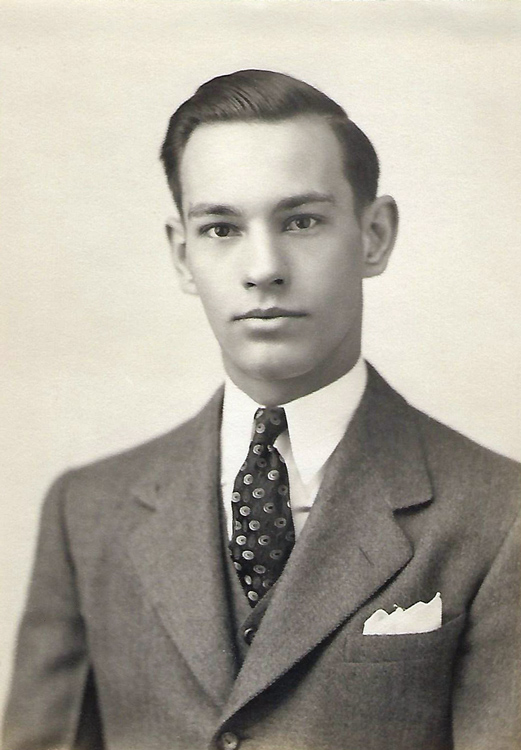
Donald Blair Ellis was born in Laurel, Delaware, on the morning of October 25, 1922. He was the fourth son of Wilbur Pierce Ellis (then a mail clerk, 1893–1954) and Elsie Ellis (née Elsie Collins Hastings, 1897–1953), both natives of Laurel. Ellis, who went by his middle name, had three older brothers: Wilbur Pierce Ellis, Jr. (who also went by his middle name, 1917–2012), Richard Hastings Ellis (1919–1989), and Joseph Charles Ellis (1921–1978).
Ellis was recorded on the census in April 1930 living on Central Avenue in Laurel. His father was described as assistant superintendent at a chain store. Ellis was baptized at the Centenary Methodist Church in Laurel on March 17, 1935. The next census in April 1940 recorded him as Blair Ellis, living at 803 Central Avenue in Laurel. His father’s occupation was listed as chain store supervisor.
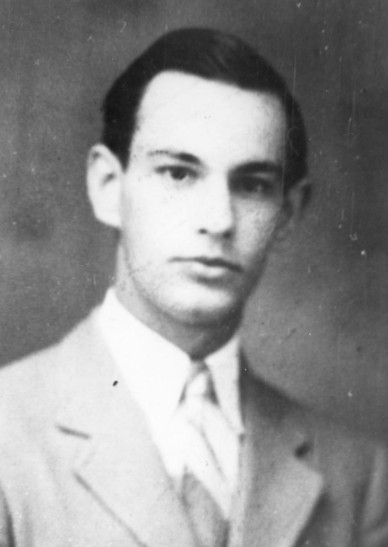
Ellis was a fullback on the Laurel High School varsity football team. A classmate, Jim Allen, recalled in a 2003 article that “if you ask any member of the Laurel class of 1942 who their best friend was in high school you would get the same answer. ‘Jabbo,’ as we called him, was loved by all. He was one ‘heck-of-a-guy.’ ”
When he registered for the draft on June 30, 1942, Ellis was living at 804 Central Avenue, suggesting that either his family had moved across the street or there had been a typo in the 1940 census. (Interestingly, Ellis’s nephew recalls the family home having yet another address: 802 Central Avenue.) The registrar described Ellis as standing six feet, one inch tall and weighing 172 lbs., with black hair and brown eyes. His employer was listed as Howard Windsor at the A&P store in Laurel. Similarly, his enlistment data card listed his occupation as salesclerk.
All three of Ellis’s brothers served in the U.S. Army during World War II. Pierce Ellis was a medical student in the Army Specialized Training Program, Richard Ellis was a decorated Army Air Forces B-24 pilot in the Pacific, and Joseph Ellis in the Chemical Warfare Service with Headquarters Company, First Army in Europe.
Military Training
Ellis volunteered for the U.S. Army, enlisting in Camden, New Jersey, on November 6, 1942. That same day, he was attached unassigned to Company “A,” 1229th Reception Center, Fort Dix, New Jersey. By November 8, 1942, Private Ellis had been classified as a 521, basic, meaning that his civilian work experience was not applicable to any Army specification serial number. A set of orders came down that day dispatching him by rail the following day to join the 31st Signal Construction Battalion at Camp Atterbury, Indiana. In the same group was a fellow Delawarean who had enlisted on the same day, William Alexander Rittenhouse (1917–1943).
Documentation is little unclear, but it appears that Rittenhouse and Ellis were in a group of 198 men from the 1229th Reception Center who joined Company “B,” 31st Signal Construction Battalion, on either November 10 or 12, 1942. The battalion had been activated at Camp Atterbury on August 17, 1942, and fillers were still flowing into the unit. During World War II, it was not uncommon for men to have their basic training directly with their future units under the direction of experienced cadre rather than first attending training at a replacement training center. Some members of the battalion were reservists who as civilians had worked for the Chesapeake & Potomac Telephone Company.
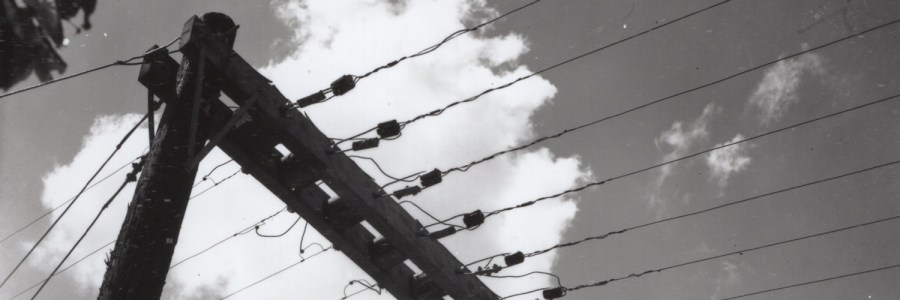
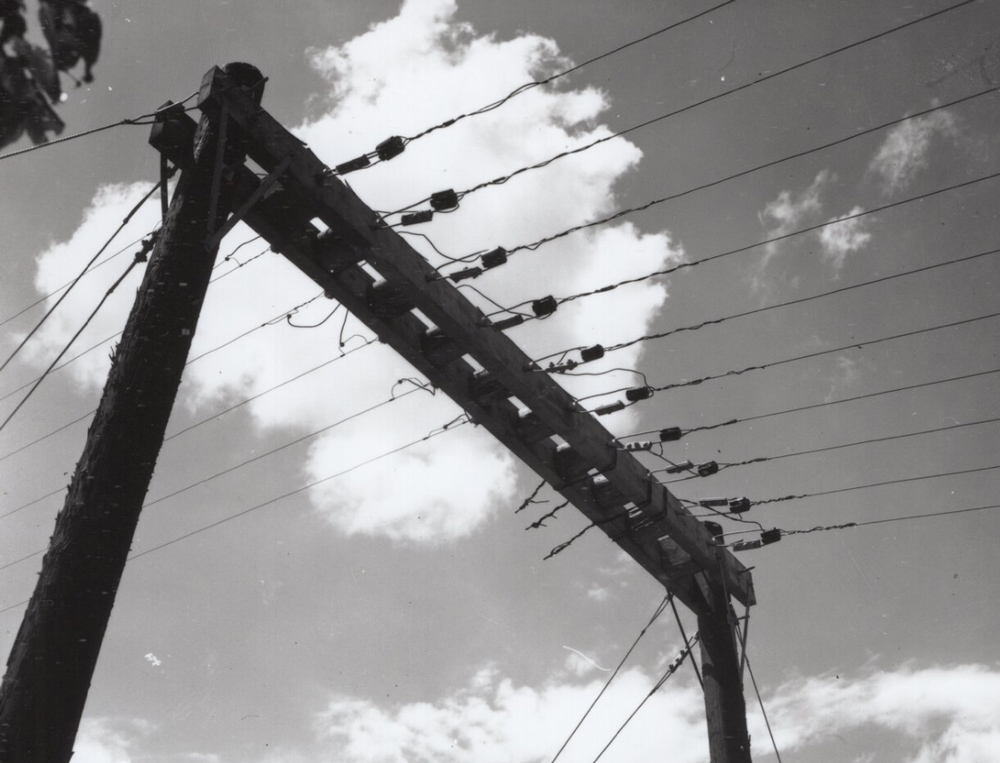
Signal construction battalions placed poles and wires to provide vital communications between command posts and other installations behind the lines. Under the table of organization, a private or private 1st class in such a unit could have been assigned one of several duties: chauffeur, cook’s helper, orderly, or lineman. Lineman—officially “Lineman, pole, telephone and telegraph”—was the most common duty in the company, performed by 140 of the 255 enlisted men, including 80 of the privates.
Private Ellis went on furlough on December 15, 1942, returning to duty on December 20. He was hospitalized on January 6, 1943, but returned to duty one week later. On February 27, 1943, his unit departed Camp Atterbury to participate in Second Army Maneuvers. After an overnight stop at Fort Knox, Kentucky, they arrived in Lebanon, Tennessee, on February 28.
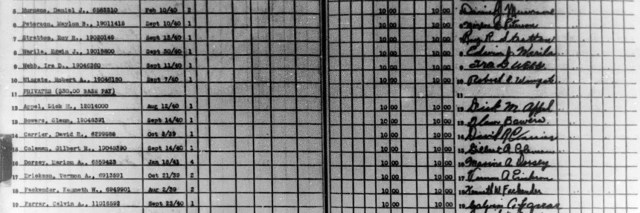
Company “B” morning reports from spring 1943 went missing before they could be microfilmed. With the destruction of Ellis’s personnel file, a microfilmed payroll record may be the only surviving record of Ellis’s promotions. The document is hard to read, but it appears that he was promoted to private 1st class on April 15, 1943, and to technician 5th grade, which was paid the same as a corporal, on May 4. The table of organization suggests that Ellis would have performed one of the following duties after his promotion: automobile mechanic, chauffeur, general clerk, supply clerk, cook, telephone and telegraph draftsman, earth-borer operator, lineman, or utility repairman.
Technician 5th Grade Ellis and the other men in his unit remained in the Tennessee Maneuver Area until June 24, 1943, when they headed back to Camp Atterbury with an overnight stop at Fort Knox.
Ellis was promoted again on or about July 16, 1943, this time to technician 4th grade, equivalent in pay to sergeant. A tech 4 in a construction company was supposed to perform the duty of automobile mechanic, cable splicer, cook, or lineman. As with other grades, lineman was the most common duty for a tech 4, performed by 24 out of 31 men if the company was at full strength. Based on his promotion history, it is likely that Ellis trained as a lineman and advanced rapidly through the ranks with that military occupational specialty, but it is unlikely that there are any surviving documents that would confirm or refute that theory.
On August 28, 1943, the battalion began a 25-mile road march as part of a Second Army physical fitness test. They got an early start at 0400, finishing at noon. On September 22, the battalion departed Camp Atterbury by train, arriving the following day at Camp Patrick Henry, Virginia, to enter staging before going overseas. A morning report recorded that on October 1, Company “B” was “presented with cup for winning bn softball championship[.]”
Overseas Service
The 31st Signal Construction Battalion was split up for shipment overseas. At 1630 hours on October 2, 1943, Company “B” and a detachment of medical personnel entrained at Camp Patrick Henry, arriving at Newport News, Virginia, 45 minutes later. At 1745 hours, they boarded S.S. Andrew Hamilton, which departed the pier at 1930 hours and anchored at Lynnhaven Roads to the east. Their voyage began in earnest at 0700 hours on October 5 when the transport joined a transatlantic convoy, UGS-20. Portions of the convoy were bound for Port Said, Egypt, though some vessels were scheduled to go into intermediate ports (Oran, Algeria, in the case of Andrew Hamilton).
The 31st Signal Construction Battalion was bound for the China Burma India (C.B.I.) Theater. Far from the public eye, at the end of tortuously long supply lines, and with a fraction of the American personnel deployed to Europe, the Mediterranean, or the Pacific, the C.B.I. was nonetheless vital to the war effort. Enormous numbers of Japanese troops were tied down fighting and occupying China. If China collapsed, those troops could be moved to the Pacific, threatening the Allied island-hopping campaign.
After over two weeks at sea, land finally came into view around noon on October 21, 1943. A few hours later, UGS-20 passed through the Strait of Gibraltar into the Mediterranean Sea. Andrew Hamilton docked at Oran at 2000 hours on October 22. Around 0950 hours the following morning, Company “B” disembarked and moved to a nearby bivouac site known as Staging Area No. 2. The main body of the 31st Signal Construction Battalion shipped out October 13 aboard S.S. John Harvey, arriving safely in Algeria on November 2.
It appears that after arriving in North Africa, Ellis was able to dispatch presents home to his family, as Journal-Every Evening reported: “A package of gifts for the family was received shortly before Christmas.” His last letter home was dated November 20, 1943.
Although both parts of the battalion were in the same staging area, they were assigned to different ships to continue their journey to the C.B.I. At noon on November 23, 1943, Ellis and Company “B” departed their staging area by truck, arriving at 1330 hours at Mers-el-Kébir, Algeria, a port near Oran. Around 1530, they boarded the British transport H.M.T. Rohna. That same day, the main body of the 31st Signal Construction Battalion boarded another ship, H.M.T. Rajula, but they would not ship out for another week.

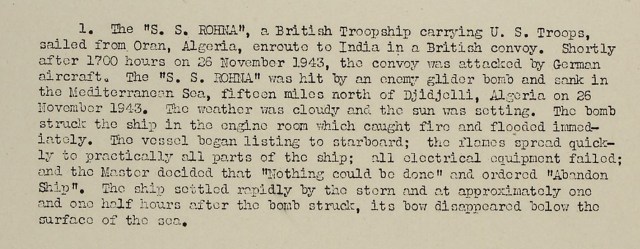
Completed in 1926, the Rohna had been converted from a passenger liner to a troopship in 1940. On the afternoon of Thanksgiving Day, November 25, 1943, Rohna departed Oran with about 2,201 aboard, including about 1,988 American soldiers and Red Cross workers. Rohna joined an eastbound convoy, KMF-26, which was traveling from Scotland to Egypt. The convoy consisted of 17 merchant ships with 10 escorts.
On the morning of November 26, 1943, KMF-26 was discovered by German reconnaissance aircraft flying out southern France. That evening, the convoy was sailing at 12 knots in the Mediterranean Sea north of Djidjelli (Jijel), Algeria, when it came under attack from about 35 German bombers. The attackers came in two waves beginning at 1640 hours. Eight Allied fighters were on patrol in the vicinity of the convoy and Allied controllers scrambled additional aircraft from fields in North Africa, but they were unable to fully blunt the attack.
Among the attacking aircraft were Heinkel He 177s armed with a deadly new weapon, the Henschel Hs 293 guided bomb. The Hs 293 was dropped from the attacking aircraft and briefly engaged a rocket motor. The rocket only had enough fuel for 10 seconds, after which the bomb glided towards the target, controlled by radio from the launching bomber. The weapon was known to the Allies and during the attack, the convoy’s escorts attempted to jam the radio signals guiding the weapons.
In the face of fierce resistance from both Allied aircraft and antiaircraft fire from the convoy—and possibly, the jamming—most of the German ordnance missed. Only one Hs 293 found its mark. This single bomb, however, which exploded in Rohna’s engine room around 1715 hours, during the second wave, was sufficient to cause tremendous loss of life.
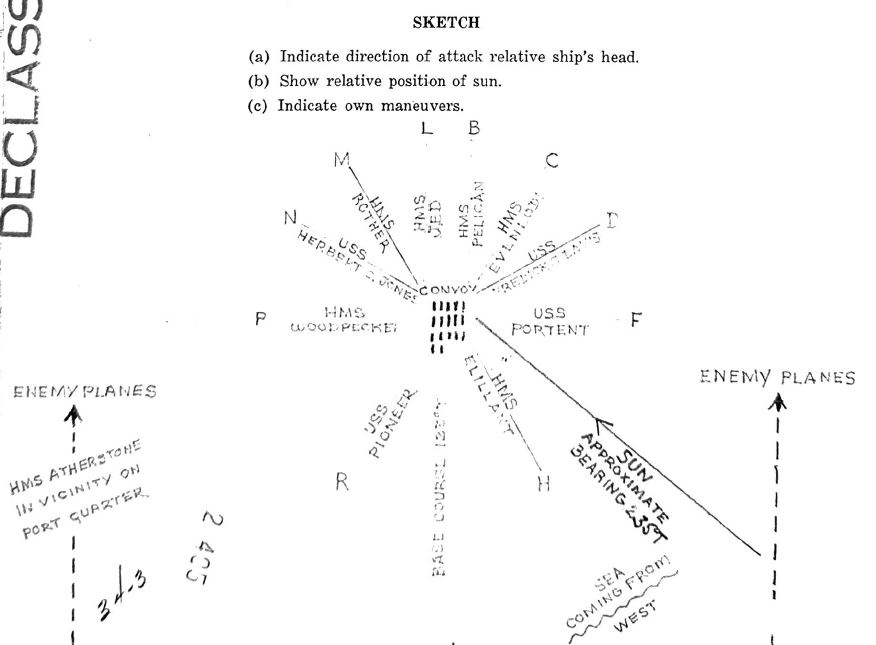
In their book, Soldiers Lost at Sea: A Chronicle of Troopship Disasters, James E. Wise, Jr. and Scott Baron wrote:
As Second Officer Willis recorded in his statement, “The bomb struck the engine room on the port side, just above the waterline. The No. 4 bulkhead collapsed.” The bomb explosion caused extensive damage blowing holes in both sides of the ship so large that one survivor recalled, “you could drive a truck through them.” Fires broke out, and power was lost, resulting in no lights, no communication, and no water pressure. An estimated three hundred men died in the initial explosion. Powerless in the dark, and with no other options, Captain [T. J.] Murphy ordered the ship to be abandoned, though lack of power prevented his order from being broadcast throughout the ship.
Rohna slipped beneath the waves around 1830 hours. Wise and Baron added: “The rescue effort was hampered by failing light, high seas, and the loss of a significant number of lifeboats, both from the initial explosion and subsequent mishandling by troops and crewmen.”
According to a contemporary battalion history, “All personnel from Company B got safely off the ship into the water. Survivors, after being in a rough sea for one-half (½) to eight (8) hours, were picked up by allied rescue ships.”
Most of the details of what Technician 4th Grade Ellis and his comrades experienced after their ship was hit are forever lost to history, although those of Private 1st Class James Willis Pope (1920–1995) give some idea of the chaos. A commendation in General Order No. 3, Headquarters 31st Signal Construction Battalion, stated that he came to the rescue of Technician 4th Grade William H. Wasp (1924–1990), who had lost his lifebelt:
[Wasp] was unable to swim and after calling to those in the water that he could not swim he dropped into the water. Private First Class Pope dove, caught hold of T/4 Wasp, and swam with him to a lifeboat. When the boat became overcrowded and capsized, Private First Class Pope again took T/4 Wasp in tow and swam with him toward the rescue ship **************. After covering part of the distance Pfc Pope found a life preserver which he placed about T/4 Wasp and continued to tow him to the rescue ship which was reached after being in the water about one hour.
Pope was later awarded the Bronze Star Medal. Few other stories pertaining to Rohna had such a happy ending.
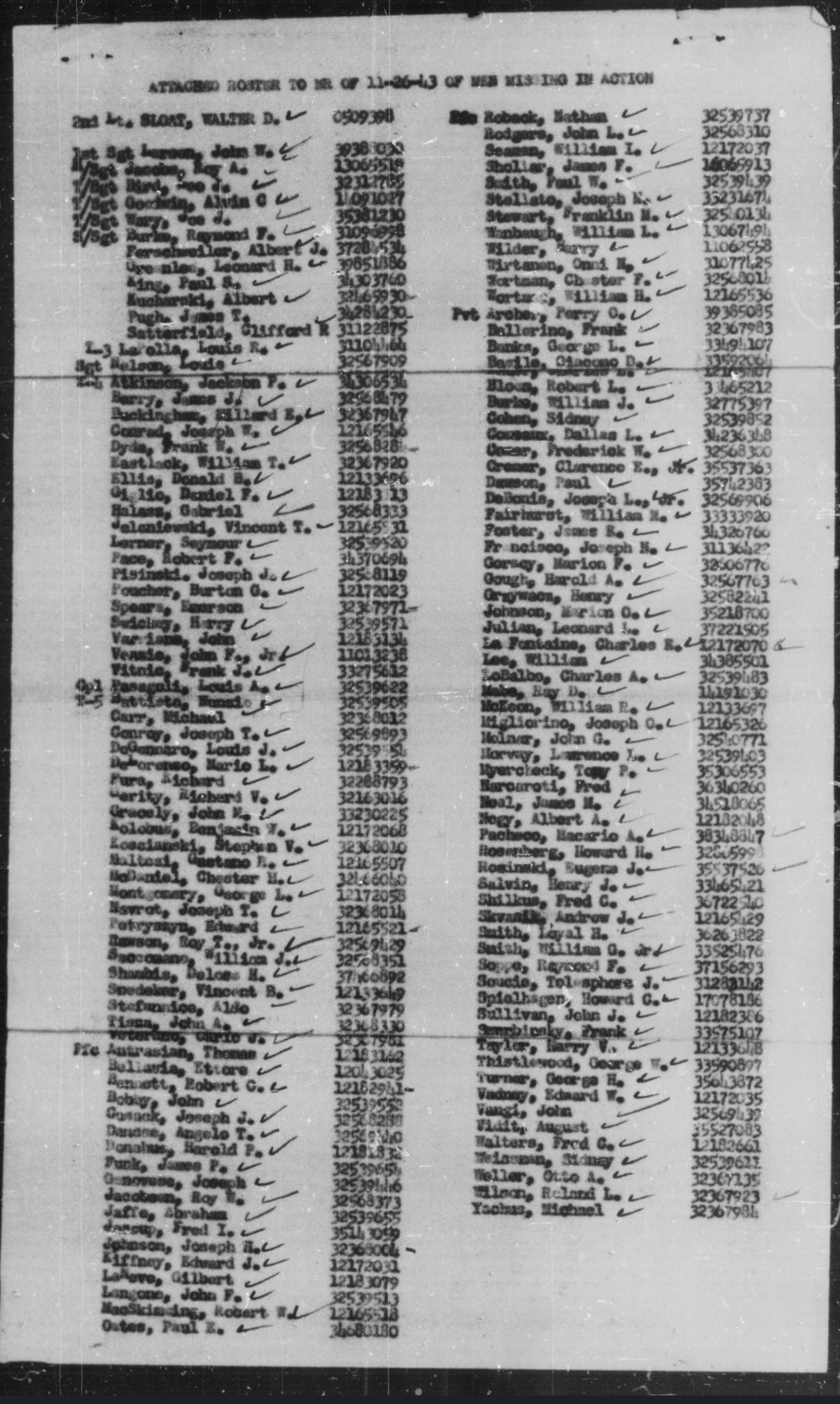
129 men from Company “B” and two men attached from the battalion medical detachment were killed in the sinking, including Technician 4th Grade Ellis and Sergeant Rittenhouse. Another Delawarean was also killed, Sergeant Paul E. Hayden (1911–1943). Approximately 1,149 personnel were lost in the sinking, including about 1,015 American soldiers. (Some sources indicate that 35 Americans died of their wounds after rescue, but it is unclear if those men are included in the figures.)
Other ships from the convoy, most notably the minesweeper U.S.S. Pioneer (AM-105), rescued hundreds of survivors. A preliminary count reported that of the 259 men in Company “B” embarked aboard Rohna, Pioneer had rescued 84 men, the British destroyer H.M.S. Atherstone (L05) rescued 16 men, and S.S. Clan Campbell rescued another 10, a total of 110 survivors. Based on the final company fatality figure, it appears that another 18 men were eventually located alive, some of them wounded.
The Rohna incident represents the greatest loss of American soldiers due to the sinking of any troopship in history. In terms of American losses aboard ships in World War II, Rohna was exceeded only by the loss of the battleship U.S.S. Arizona (BB-39) during the attack on Pearl Harbor and the sinking of the Japanese hellship Arisan Maru.
A summary of an American investigation included in Sergeant Rittenhouse’s I.D.P.F. noted:
An investigation of the circumstances surrounding the sinking of the “S. S. ROHNA” reveal the contributing factors in the extreme loss of life, and the unusual proportion of unrecovered remains, to be:
- The terrific effect of the explosion.
- The poor condition of the ship’s equipment and the conduct of its crew.
- The difficulties encountered in the rescue operations.
The Germans achieved few subsequent successes with their guided antiship ordnance. Historian Steven J. Zaloga has argued this largely due to increasing Allied air superiority, which suppressed German airbases before their bombers could even take off and either shot down or drove off others before they could attack. Allied intelligence coups, such as capturing a pair of Hs 293s, may have also played a role.
Journal-Every Evening reported that Ellis’s parents were notified on December 28, 1943, that their youngest son was missing in action. With no indication that he could have survived or been taken prisoner, the War Department declared him dead the following year. Journal-Every Evening reported his death on June 13, 1944. He was posthumously awarded the Purple Heart.
On May 29, 1946, Journal-Every Evening announced that Ellis’s family had created the Donald Blair Ellis Memorial Prize, “awarded to the football player chosen by the majority vote of the members of the team.” It added: “The qualities of loyalty, courage, sportsmanship, and accomplishment as attributed to Donald Blair Ellis during his life as a student of Laurel High School were the factors considered in the voting.” The prize was awarded through at least 1960.
Ellis’s name is honored on the Tablets of the Missing at the North Africa American Cemetery and Memorial in Tunisia, at Veterans Memorial Park in New Castle, Delaware, and on a cenotaph at Odd Fellows Cemetery in Laurel, where his parents and brothers Pierce and Joseph are buried.
Notes
Brothers
W. Pierce Ellis became a doctor and after leaving the Army practiced medicine in the Laurel area for about 45 years. Richard Ellis briefly practiced law before returning to active duty in the U.S. Air Force in 1950, rising to the grade of general prior to his retirement in 1981. After the war, Joseph Ellis worked for a supermarket and an agricultural equipment company.
Acknowledgments
Special thanks to Matt LeMasters for obtaining payroll records that establish when Ellis was promoted to technician 4th grade, and to the Delaware Public Archives for the use of their photo.
Bibliography
“3 Delaware Soldiers Killed; 2 Are Missing.” June 13, 1944. Journal-Every Evening. https://www.newspapers.com/article/53219996/
Allen, Jim. “Fifty years later, truth of Blair Ellis’ death at sea is known.” May 22–28, 2003. Morning Star.
Baptism Record for Donald Blair Ellis. March 17, 1935. Centenary Methodist Church of Laurel Delaware Being a Copy of All Record Books as to Membership Baptisms Marriages and Etc. Delaware Bureau of Archives and Records Management, Dover, Delaware. https://www.familysearch.org/ark:/61903/3:1:3QS7-89CG-3ZL6
Census Record for Donald B. Ellis. April 14, 1930. Fifteenth Census of the United States, 1930. Record Group 29, Records of the Bureau of the Census. National Archives at Washington, D.C. https://www.familysearch.org/ark:/61903/3:1:33S7-9R4Z-L4J
Census Record for Blair Ellis. April 15, 1940. Sixteenth Census of the United States, 1940. Record Group 29, Records of the Bureau of the Census. National Archives at Washington, D.C. https://www.familysearch.org/ark:/61903/3:1:3QSQ-G9MR-M9HJ
Certificate of Birth for Donald Blair Ellis. October 25, 1922. Record Group 1500-008-094, Birth Certificates. Delaware Public Archives, Dover, Delaware. https://www.familysearch.org/ark:/61903/3:1:S3HT-D4FS-4MX
Draft Registration Card for Donald Blair Ellis. June 30, 1942. Draft Registration Cards for Delaware, October 16, 1940 – March 31, 1947. Record Group 147, Records of the Selective Service System. National Archives at St. Louis, Missouri. https://www.familysearch.org/ark:/61903/3:1:3Q9M-CSMG-X9WV-S
Enlistment Record for Donald B. Ellis. November 6, 1942. World War II Army Enlistment Records. Record Group 64, Records of the National Archives and Records Administration. National Archives at College Park, Maryland. https://aad.archives.gov/aad/record-detail.jsp?dt=893&mtch=1&cat=all&tf=F&q=12133696&bc=&rpp=10&pg=1&rid=573074
Enlistment Record for William A. Rittenhouse. November 6, 1942. World War II Army Enlistment Records. Record Group 64, Records of the National Archives and Records Administration. National Archives at College Park, Maryland. https://aad.archives.gov/aad/record-detail.jsp?dt=893&mtch=1&cat=all&tf=F&q=12133700&bc=&rpp=10&pg=1&rid=573078
Hastings, Elise. Individual Military Service Record for Donald Blair Ellis. November 16, 1944. Record Group 1325-003-053, Record of Delawareans Who Died in World War II. Delaware Public Archives, Dover, Delaware. https://cdm16397.contentdm.oclc.org/digital/collection/p15323coll6/id/18644/rec/1
Individual Deceased Personnel File for William A. Rittenhouse. 1944–1955. Army Individual Deceased Personnel Files, 1942–1970. Record Group 92, Records of the Office of the Quartermaster General, 1774–1985. National Archives at St. Louis, Missouri. Courtesy of U.S. Army Human Resources Command.
“Laurel Flier’s ‘Hedge-Hopping’ in B-24 Outwits 10 Jap Zeros.” July 10, 1944. Journal-Every Evening. https://www.newspapers.com/article/200425376/
“Laurel Seniors Hear Willimas.” June 9, 1960. Wilmington Morning News. https://www.newspapers.com/article/200425683/
“Laurel Soldier Reported Lost.” December 29, 1943. Journal-Every Evening. https://www.newspapers.com/article/200424710/
“Memorial Award Honors Veteran.” May 29, 1946. Journal-Every Evening. https://www.newspapers.com/article/200421368/
Morning Reports for Company “A,” 1229th Reception Center. November 1942. U.S. Army Morning Reports, c. 1912–1946. Record Group 64, Records of the National Archives and Records Administration. National Archives at St. Louis, Missouri. https://catalog.archives.gov/medialz/partners/st-louis/rg-064/85713825-wwii/85713825_1940-01-thru-1943-07/85713825_1940-01-thru-1943-07_Roll-2835/85713825_1940-01-thru-1943-07_Roll-2835-03.pdf
Morning Reports for Company “B,” 31st Signal Construction Battalion. August 1943 – November 1943. U.S. Army Morning Reports, c. 1912–1946. Record Group 64, Records of the National Archives and Records Administration. National Archives at St. Louis, Missouri. https://catalog.archives.gov/medialz/partners/st-louis/rg-064/85713825-wwii/85713825_1943-08/85713825_1943-08_Roll-0170B/85713825_1943-08_Roll-0170B-16.pdf, https://catalog.archives.gov/medialz/partners/st-louis/rg-064/85713825-wwii/85713825_1943-09/85713825_1943-09_Roll-0196/85713825_1943-09_Roll-0196-28.pdf, https://catalog.archives.gov/medialz/partners/st-louis/rg-064/85713825-wwii/85713825_1943-10/85713825_1943-10_Roll-0602/85713825_1943-10_Roll-0602-24.pdf, https://catalog.archives.gov/medialz/partners/st-louis/rg-064/85713825-wwii/85713825_1943-11/85713825_1943-11_Roll-0700/85713825_1943-11_Roll-0700-17.pdf
Morning Reports for Company “B,” 31st Signal Construction Battalion. November 1942 – February 1943. U.S. Army Morning Reports, c. 1912–1946. Record Group 64, Records of the National Archives and Records Administration. National Archives at St. Louis, Missouri. https://catalog.archives.gov/medialz/partners/st-louis/rg-064/85713825-wwii/85713825_1940-01-thru-1943-07/85713825_1940-01-thru-1943-07_Roll-2548/85713825_1940-01-thru-1943-07_Roll-2548-24.pdf
“Ship Sinkings in War Against Germany and Italy Cost 3,604 American Lives.” Undated, released June 13, 1945. Administrative History Collection, Transportation – General. Record Group 498, Records of Headquarters, European Theater of Operations, United States Army (World War II). National Archives at College Park, Maryland. https://www.fold3.com/image/291168451/341b-transportation-general-page-18-us-wwii-european-theater-army-records-1941-1946
Silverman, Lowell. “Sergeant Paul E. Hayden (1911–1943).” May 4, 2024. Updated July 14, 2026. Delaware’s World War II Fallen. https://delawarewwiifallen.com/2024/05/04/sergeant-paul-e-hayden/
Silverman, Lowell. “William A. Rittenhouse (1917–1943).” June 14, 2026. Delaware’s World War II Fallen. https://delawarewwiifallen.com/2026/06/14/sergeant-william-a-rittenhouse/
Sullivan, Arthur J. “Organizational History of 31st Signal Construction Battalion 1 January 1943 to 31 December 1943.” Undated, c. 1944. World War II Operations Reports, 1940–48. Record Group 407, Records of the Adjutant General’s Office. National Archives at College Park, Maryland.
“Table of Organization No. 11-27: Signal Construction Company.” April 1, 1942. War Department Archives. https://www.wdarchives.com/archives/record/8939/
“William H. Wasp: former Yonkers resident.” August 8, 1990. The Herald Statesman. https://www.newspapers.com/article/199566908/
“Wilbur Pierce Ellis Sr.” Find a Grave. https://www.findagrave.com/memorial/130640165/wilbur-pierce-ellis
Last updated on November 26, 2026
More stories of World War II fallen:


To have new profiles of fallen soldiers delivered to your inbox, please subscribe below.

