| Branch | Civilian Occupation |
| U.S. Army | Plumber |
| Theater | Service Number |
| Pacific | 12014073 |
| Campaigns/Battles | Unit |
| Philippines (1941–1942) | Signal Company, Aircraft Warning, Philippine Department |
Author’s note: This article incorporates some text from my previous piece, Private 1st Class John E. Adams, Jr. (1921–1944), about the Philippines campaign.
Early Life & Family
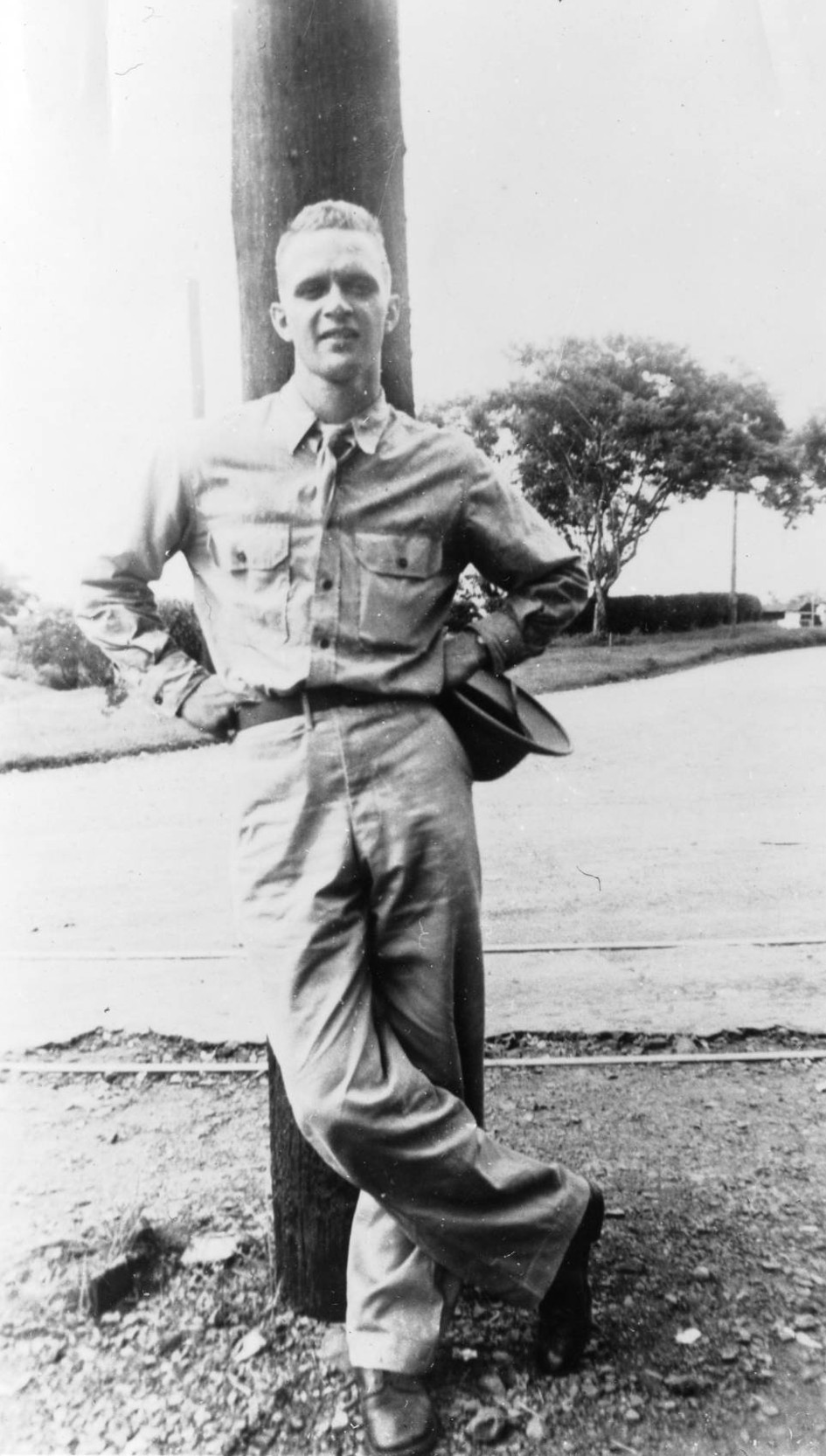
William Kirk Baynard was born at the Delaware Hospital in Wilmington, Delaware, on June 9, 1917. He was the first child of William J. Baynard (c. 1895–1980) and Julia Baynard (née Julia Sarah Kirk, 1894–1997). Baynard was living at 2117 Biddle Street in Wilmington as of July 10, 1919, when his younger brother, Philip Gladwin Baynard (1919–1998), was born.
Baynard’s mother was described as a housewife on her sons’ birth certificates. However, her obituary noted that “She taught at schools in Richardson Park, Arden and Dover and later lived in a house on South State Street in Dover that was built by her great-grandfather, Thomas Stevenson, a cabinetmaker and prominent citizen of Dover.”
Baynard’s father’s occupation was recorded as cigar maker when he married in 1916, brakeman when his first son was born, and riveter when his second son was born. In a 1945 letter to the Army Effects Bureau, Baynard’s mother stated that her son “was deserted by his father at the age of two.” During World War II, the elder Baynard worked at the Pusey and Jones shipyard in Wilmington.
Baynard was recorded on the census in January 1920 living at 420 South State Street in Dover with his mother, brother, and maternal great-aunts, Sarah and Mary Kirk. Baynard’s mother filed for divorce in Kent County, Delaware, obtaining a decree nisi on October 19, 1920.
Baynard’s mother remarried on August 2, 1926, to Alfred Sidney Biggs (1895–1974), with whom she had one additional son, Alfred S. Biggs, Jr. (who went by Jimmy, 1928–1968). The family was recorded on the next census in April 1930 living on Delaware Avenue in Dover.
In a 1948 letter, Baynard’s mother mentioned that “my son is always known as Kirk here in his home town.” Baynard’s enlistment data card stated that he was a plumber with a high school education before entering the service, while his mother described him as a plumbing and heating mechanic. Journal-Every Evening later reported:
When the boy was two years old the family moved to Dover. He went to the Dover schools. After graduating, he went into the plumbing business with his step-father in Dover. Later he came to Wilmington and was employed at the DuPont dye works plant at Deep Water, N. J.
When Baynard registered for the draft on October 16, 1940, he was living at 919 Washington Street in Wilmington and working for the DuPont Company. The registrar described him as standing five feet, 11 inches tall and weighing 155 lbs., with brown hair and blue eyes. On an unknown date, his address was crossed out and his mother’s address substituted, 420 South State Street in Dover.
Baynard’s younger brother, Philip, served in the U.S. Army’s 198th Coast Artillery Regiment, a Delaware National Guard unit federalized in 1940.
Military Training
Baynard volunteered for the U.S. Army, enlisting in Dover, Delaware, on February 24, 1941. As a Regular Army volunteer prior to the U.S. entry into World War II, he had more control over his assignment than the draftees beginning to swell the Army’s ranks at that time. Baynard specifically enlisted for service in the Signal Corps in the Philippine Islands, an American possession promised its independence in 1946. Until then, the U.S. was still responsible for the defense of the archipelago.
A morning report stated that on February 26, 1941, Private Baynard was attached for duty to Company “D,” 2nd Signal Training Battalion, Signal Corps Replacement Training Center, Fort Monmouth, New Jersey. He was attached to Company “A” in the same battalion “for rations and quarters only[.]” He was detached from Company “D” at 1800 hours on March 19, and attached to Company “C,” 3rd Signal Training Battalion for training as a student at the Signal Corps School at Fort Monmouth. Several of the other men in his training units were also earmarked for the Philippine Department. Details of his training are unknown. In addition to his basic training, he may have done some radar-related training, based on his eventual unit.
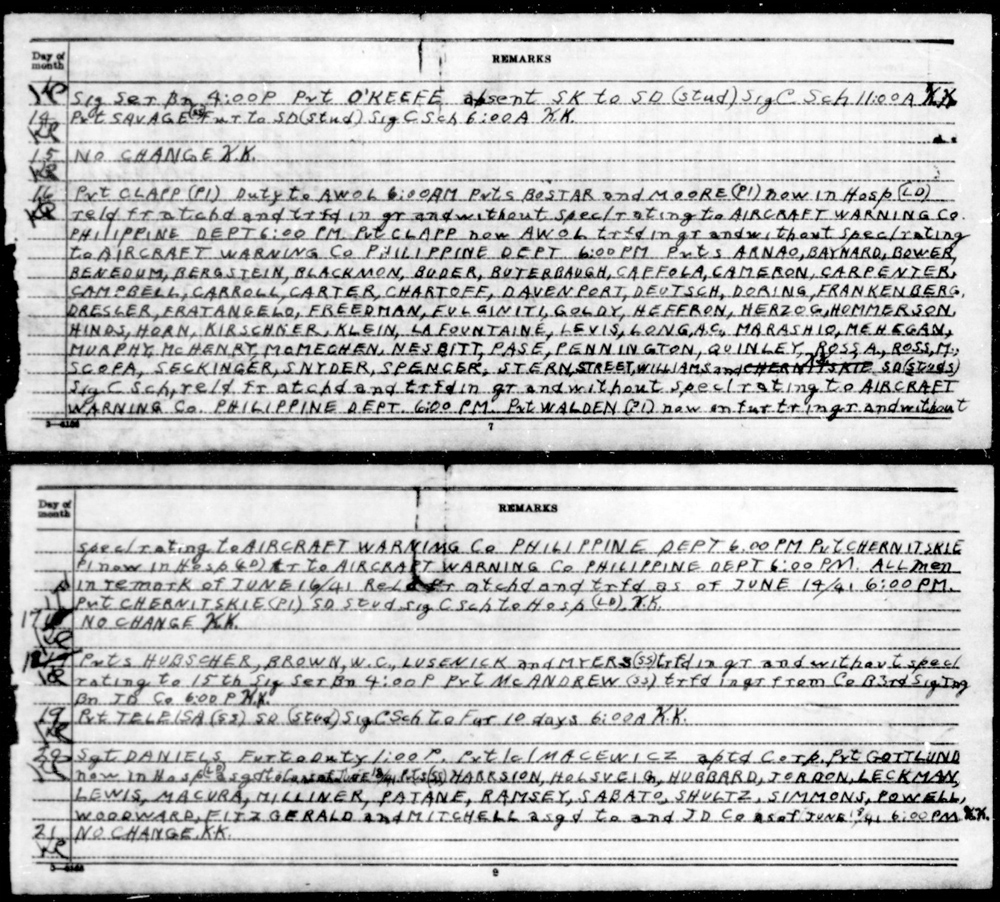
Effective at 1800 hours on June 14, 1941, Private Baynard and a group of several dozen men were detached from Company “C” and transferred to Signal Company, Aircraft Warning, Philippine Department (also known as Aircraft Warning Company, Philippine Department), a radar unit. Many records were lost in the fall of the Philippines. It is unclear where and when the unit was activated and when it went overseas. In her statement for the Public Archives Commission, Baynard’s mother wrote that in July 1941 her son shipped out from San Francisco, California, to Manila aboard S.S. President Coolidge.
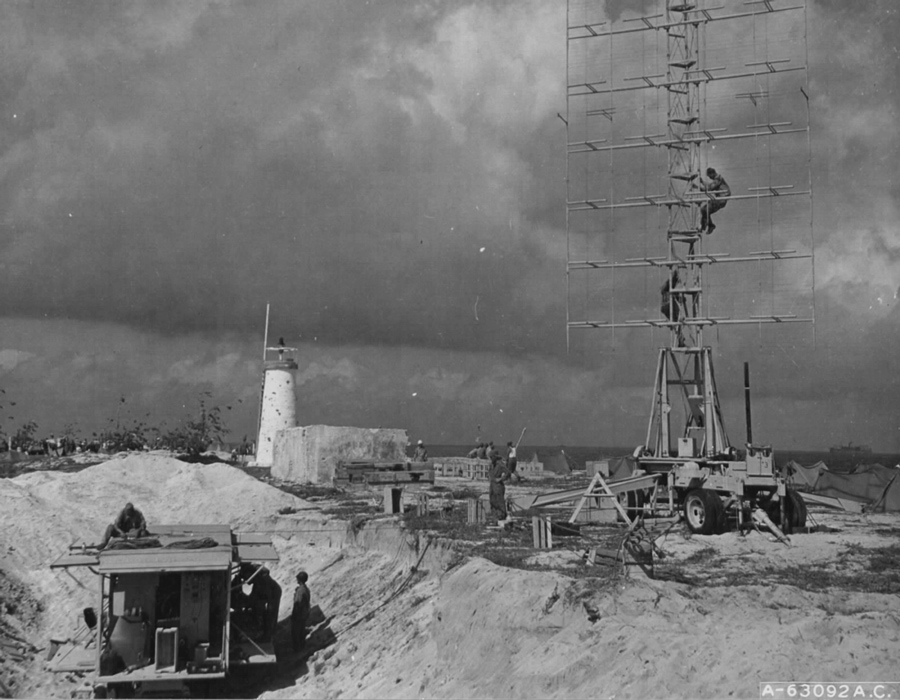
The U.S. Army first began developing air warning systems in the 1930s. The technological challenges were daunting. To have an effective system, enemy aircraft first had to be detected far from their targets. Then, observers had to identify them as hostile. They also had to ascertain their heading and altitude. If they managed to do that accurately, they had to rapidly communicate that information to a center capable of rapidly alerting antiaircraft defenses and scrambling fighters (then known as pursuit aircraft). Of course, dispatching aircraft was not enough. Friendly fighters had to be routed to intercept the enemy aircraft, meaning the enemy aircraft would have to continuously be tracked and that information relayed to the fighters by radio.
During initial testing, the early warning network was reliant on ground observers. Of course, the disadvantage was that no matter how comprehensive the network and no matter how vigilant the observers, they could not detect the enemy until attackers were practically on top of them. In the 1930s, the U.S. Naval Research Laboratory and Signal Corps Laboratory conducted some experiments in detecting aircraft using radio waves, culminating in the development of the Army’s SCR-268 and SCR-270 radar sets. Similar efforts were underway in the United Kingdom, culminating in the Chain Home network. The system proved instrumental in ensuring their victory during the Battle of Britain in 1940. The Royal Air Force also developed an effective system to plot the locations of enemy aircraft and direct fighters to intercept them.
Of course, radar detection was only one link in the chain of a successful system. In his book, “Radar Contact!”: The Beginnings of Army Air Forces Radar and Fighter Control, Randall DeGering noted that the British pioneered ground-controlled interception (G.C.I.), in which a controller could view a radar display and direct pilots by radio. The British also developed the first identification-friend-or-foe system, making it easier to distinguish which aircraft on their screens were hostile. Although the United States and the United Kingdom were on friendly terms even before the American entry into World War II, and the British shared information on their technological advances with American observers, it would take time for them to them to catch up.
Defense of the Philippines
By August 31, 1941, the date of the earliest surviving company roster, Signal Company, Aircraft Warning, Philippine Department was headquartered at Fort William McKinley, near Manila.
The earliest table of organization pertaining to radar units, Table of Organization No. 11-400: Signal Organization, Aircraft Warning, Special Type, was flexible and could cover units as small as companies or as large as regiments. Whether large or small, it was to have a reporting unit operating the radars, a plotting unit to interpret the data, and a communications unit to link the two. Although the War Department anticipated that as many as 2,052 men would be necessary for a radar unit covering the Hawaiian Islands, the Signal Company, Aircraft Warning, Philippine Department, would have cover a larger archipelago with a fraction of the resources.
None of the surviving company rosters reveal Private 1st Class Baynard’s duty. Under the table of organization, the most common duty for a private or a private 1st class in a Signal Corps radar unit was aircraft warning operator. However, he could also have been a chauffeur, automobile mechanic, cook or cook’s helper, filterer, messenger, plotter, power plant and rectifier attendant, telephone powerman, radio electrician, radio operator, historical recorder, telegraph repeaterman, or several telephone and telegraph duties: frameman, insideman, installer-repairman, and lineman.
Most records such as morning reports pertaining to American units in the Philippines at the start of the war were lost or destroyed. Incredibly, another Delawarean in Private Baynard’s unit, 1st Sergeant Joseph Giles Pase (1912–1955), managed to safeguard a portion of the company’s morning reports covering the period from February 1942 until after the fall of Bataan. He kept the records throughout his captivity and turned them over to American authorities after his liberation in 1945. An officer in the unit, 1st Lieutenant William D. Thompson (1913–1948), recorded additional details in a secret notebook during his captivity.
Members of Baynard’s company served at several locations in the Philippines. DeGering wrote in his book:
The Signal Company, Aircraft Warning, Philippines Department, arrived in August of 1941 to Fort William McKinley, in Manila, but without any AW equipment. However, by October, a single SCR-270 radar had been established at Iba Field, 75 miles northwest of Manila. Although seven radar sets had reached the Philippines by December 1941, only two—one at Iba and another one outside Manila—were operational.
A wartime history of the 24th Pursuit Group indicates that the American aircraft warning network in the Philippines was not nearly advanced as the British G.C.I. system:
Communications for aircraft warning: Telephone and air [Filipino] watches, one Radar set installed at Iba, one Radar set in process of installation 60 miles west of Aparri and one set enroute to Legaspi for installation. All reports were sent in to 5th Interceptor headquarters at Manila and relayed via teletype to the plotting board at Clark Field. Delay in time for the relaying of messages due to telephone communications was from 5 to25 [sic] minutes.
The Japanese wasted no time in attacking the Philippines on December 8, 1941, just hours after the attack on Pearl Harbor (the Philippines being on the other side of the International Date Line from Hawaii). At around 0400 hours, Iba radar station detected unidentified aircraft approaching but American fighters were unable to locate them in the early morning darkness.
Radar detected several formations of Japanese aircraft that day, but none resulted in successful interceptions. The main American air base at Clark Field was devastated in a Japanese raid. Later that day, the Japanese caught P-40s of the 3rd Pursuit Squadron returning to Iba after failing to intercept Japanese aircraft over the South China Sea. Unfortunately, “due to a breakdown in communications” the radar data was not relayed to the pilots. Some American fighters were shot down or forced to crash land. The ground facilities at Iba were hit hard and the radar station was demolished. Lieutenant Thompson’s notes and company morning reports indicate that during the attack on Iba, five men from the Signal Company, Aircraft Warning were killed and five others wounded. In less than a day of fighting the Japanese had established air superiority over the Philippines and air supremacy soon afterward. They began landing in the Philippines on December 10, 1941.
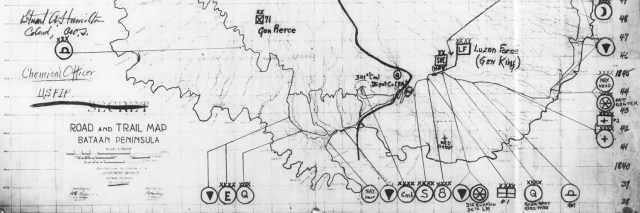
Although the prewar War Plan Orange-3 called for a withdrawal to Bataan if the Japanese invaded the Philippines, few supplies had been stockpiled there. General Douglas MacArthur (1880–1964) had also delayed executing the plan until two weeks after the Japanese invaded the Philippines in the vain hope that American and Filipino forces could halt the Japanese without ceding most of the archipelago. The delay meant that forces evacuating to Bataan had no choice but to abandon food and equipment that would be desperately needed in the months ahead—indeed, during the first week in January 1942, the defenders’ rations were drastically reduced to conserve what food remained. Still, with Bataan and the island fortresses in Manila Bay in American-Filipino hands, the Japanese were denied use of the vital port.
Morning reports and Lieutenant Thompson’s notes offer glimpses of activities performed by some members of Baynard’s unit during the campaign but not a comprehensive history. They show that a portion of Baynard’s company evacuated to the Bataan Peninsula, including Baynard. Morning reports also indicate that the company was split into at least four separate detachments by February 1942. 3rd Detachment was on Bataan as of April 1, 1942. A detachment under Lieutenant Arnold was based in Bagabag, Luzon, though extant morning reports do not disclose the detachment number or names of its members.
Thompson’s notes indicate that Private Baynard’s commanding officer during the Philippines campaign was 1st Lieutenant Jack Rogers (1910–2003). Morning reports state that Rogers assumed command of 4th Detachment on January 26, 1942, and that 4th Detachment was stationed on Bataan as of February 25.
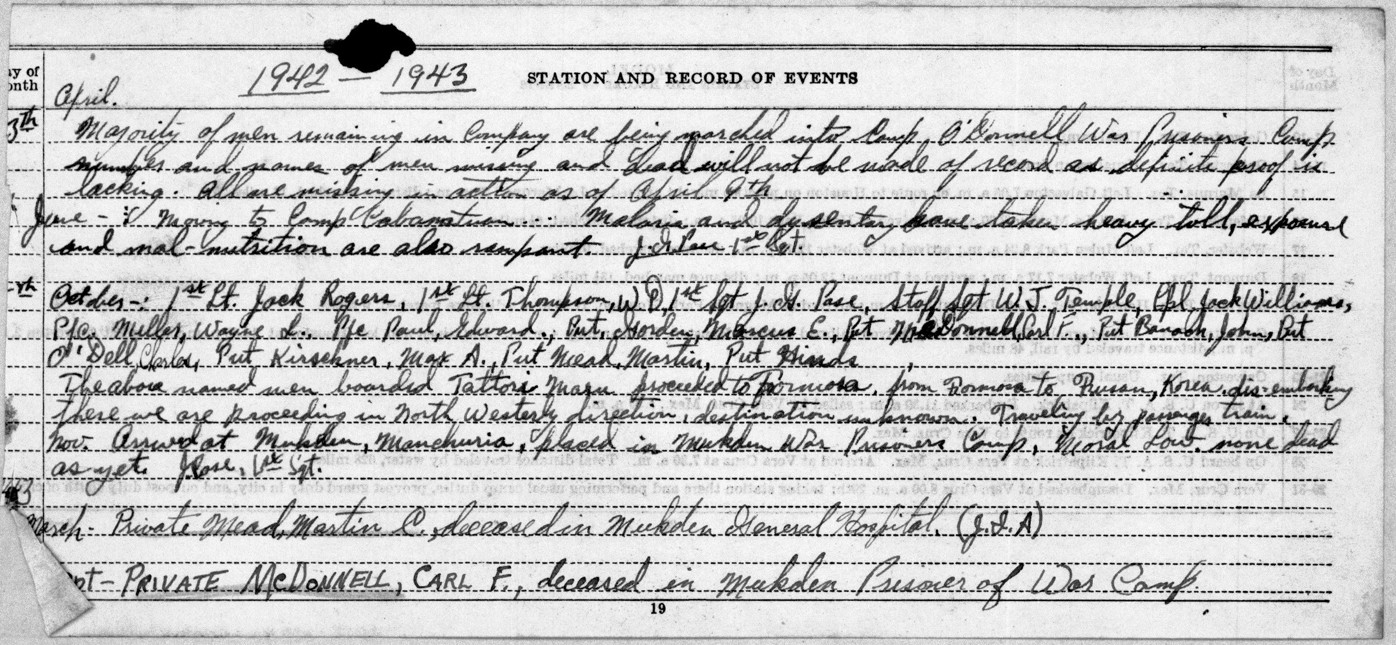
Company records indicate that a detachment of 29 men served in combat at Agloloma Point during the Battle of the Points on Bataan, which began January 22, 1942. A rare Allied victory during the campaign, it involved largely rear echelon personnel containing a Japanese amphibious operation until the arrival of American and Filipino reinforcements. Morning reports did not disclose the identities of most of the men in the detachment, so it is unknown if Baynard was among them. The only two identified members were the two who became casualties: Private Carl F. McDonnell (1922–1943) was wounded by a grenade on February 3, 1942, while Private Delbert R. Fear (1921–1942) was also wounded by enemy rifle fire during the battle. They both died in captivity after the fall of the Philippines. A company morning report noted that on February 6, 1942, the other 27 men returned to duty.
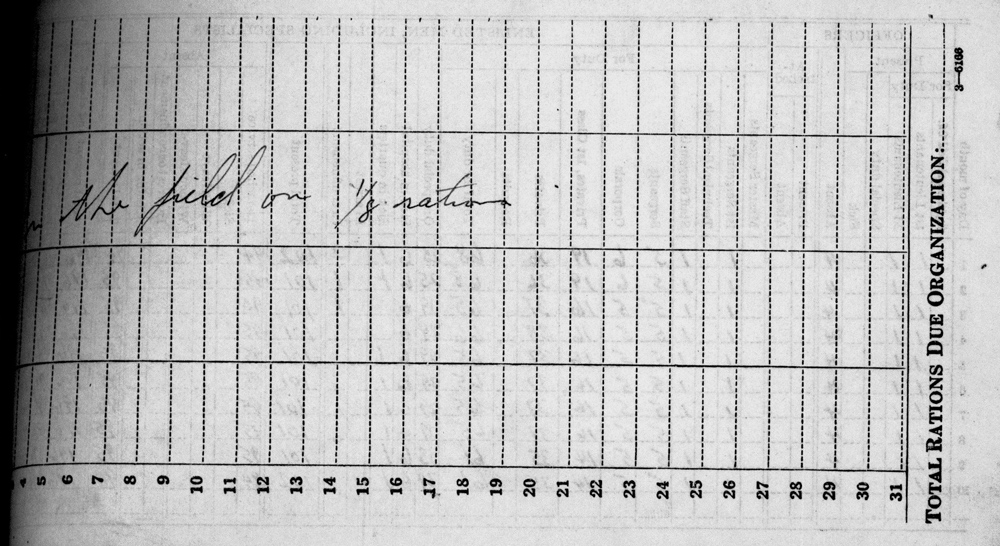
Conditions on Bataan were dire by early 1942. A note on the Signal Company, Aircraft Warning rations slip included with the March 1942 morning reports stated the company was “In the field on 1/8 rations.”
The last morning report to mention Private Baynard was dated April 1, 1942. It stated that he and three other men were “attached to Signal Base Camp for rations, quarters, and duty.” Presumably this refers to the Signal Corps base camp on Bataan nicknamed Camp Mudhole.
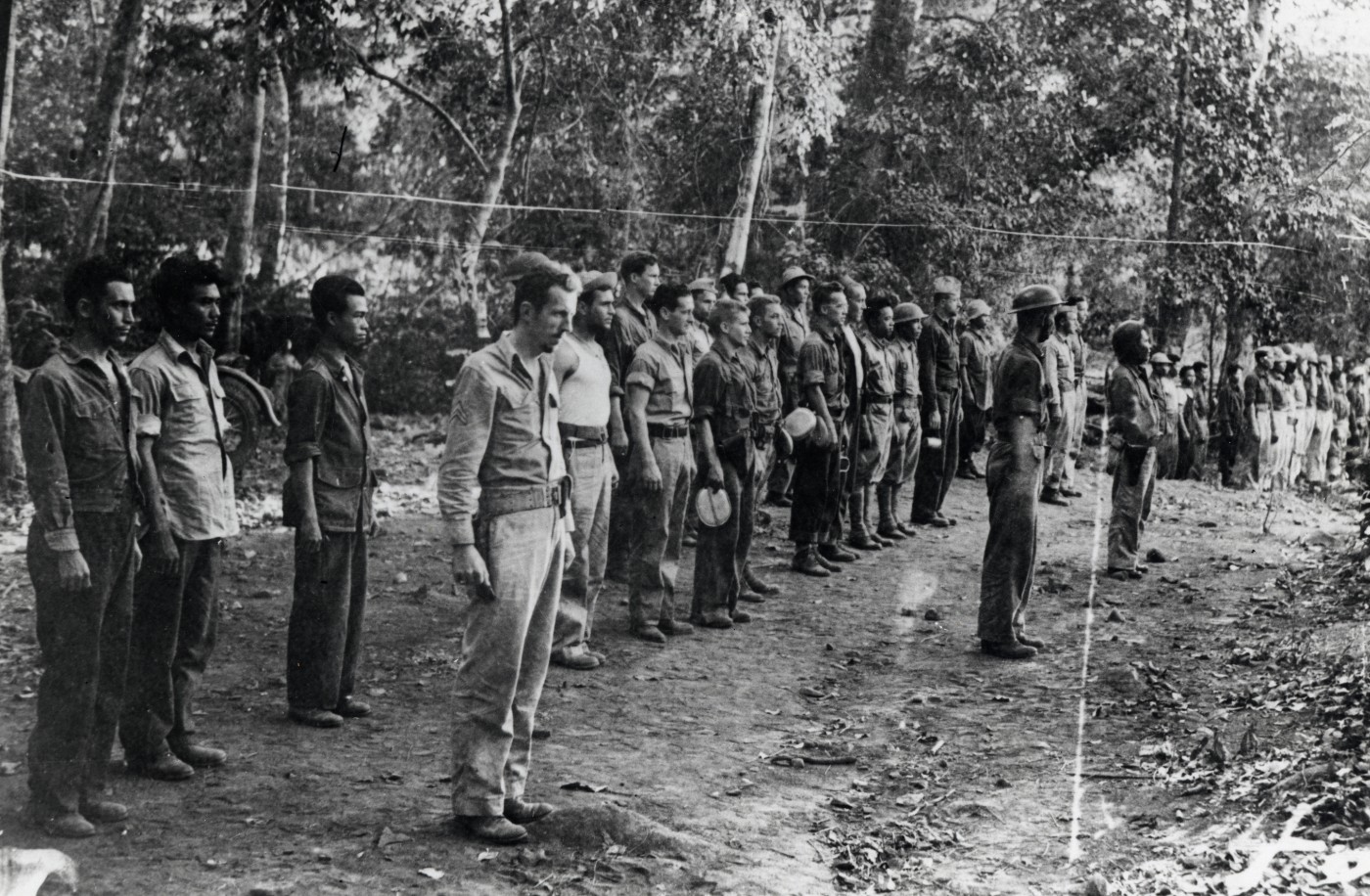
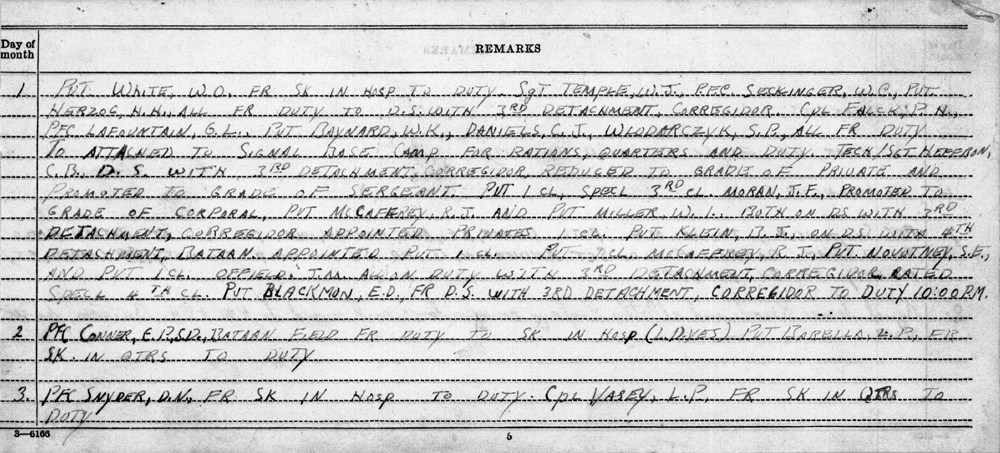
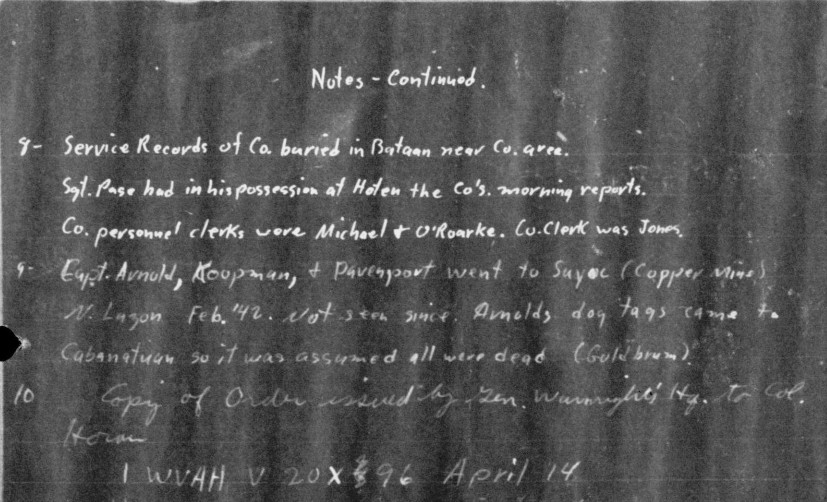
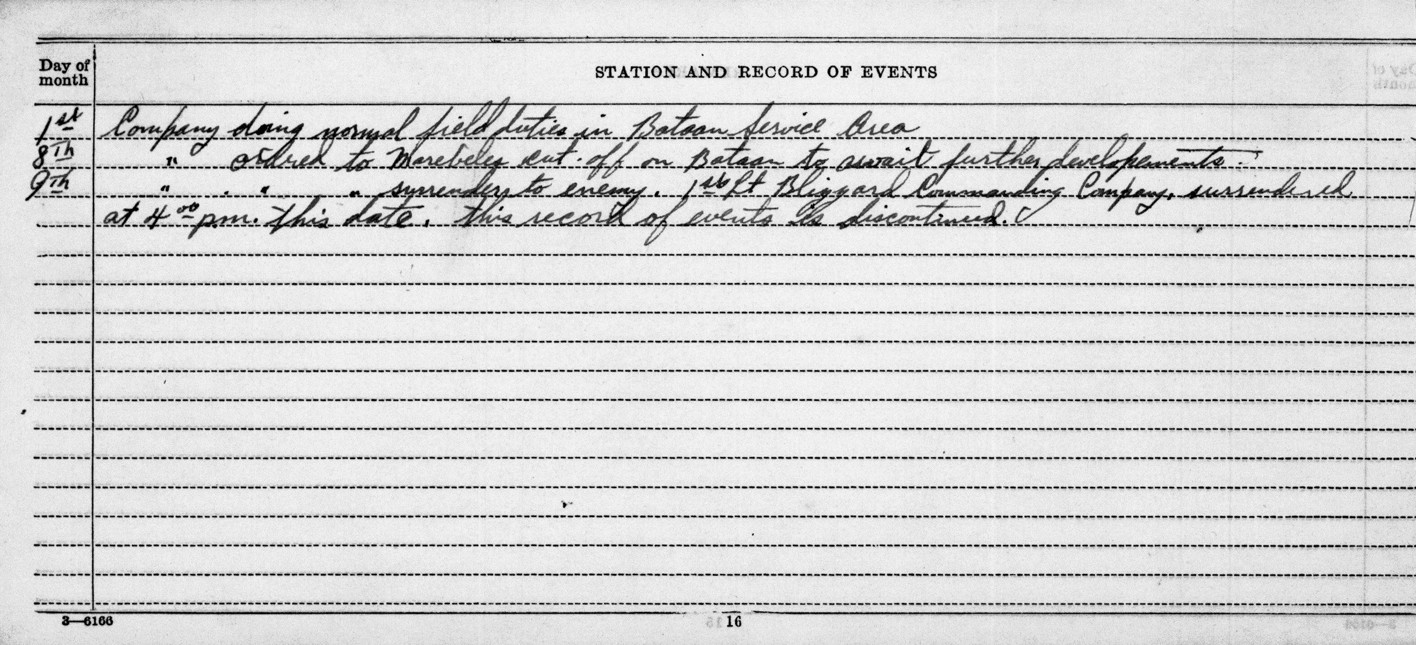
According to morning report entries, on April 8, 1942, during the final Japanese offensive on Bataan, Signal Company, Aircraft Warning, Philippine Department was “ordered to Mariveles Cut-off [Road] on Bataan to await further developments.” With the end near, personnel “Buried Service Records and all other Company correspondence and moved to K.M. #184, Bataan Service Area[.]” It is unknown if any of these documents were ever recovered. Whatever was left of Baynard’s personnel file was destroyed in the 1973 National Personnel Records Center fire.
Curiously, while neither rosters nor morning reports mention Baynard being promoted to private 1st class prior to the surrender, War Department records do show his grade at time of death as private 1st class. That raises the possibility that he was promoted after capture or posthumously.
Prisoner of the Japanese
At 1600 hours on April 9, 1942, the main body of Signal Company, Aircraft Warning, Philippine Department, surrendered to Japanese forces. Private Baynard was most likely captured that same day at the Signal Corps base camp. He survived the infamous Bataan Death March and arrived at Camp O’Donnell, where most surviving members of his company were briefly imprisoned. A handful of men from the unit were on detached service with at Corregidor when Bataan fell. They later destroyed equipment to prevent it falling into Japanese hands on the night of May 5, 1942, hours before the island surrendered.
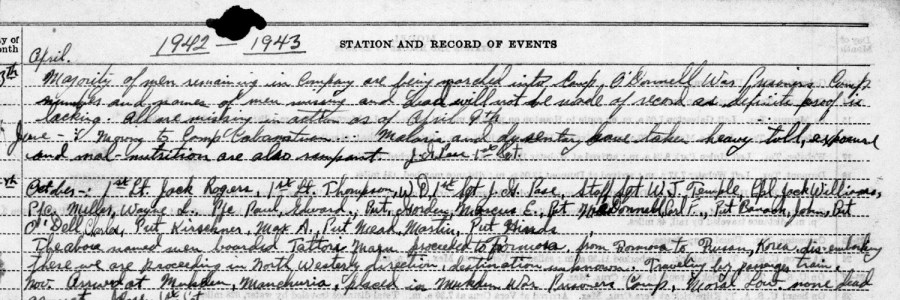
1st Sergeant Pase had one blank page in the set of company morning reports he had hidden from the Japanese. Although officially the record of events had been discontinued when unit surrendered, Pase decided to use the last page to record some details of the men’s captivity. In June 1942, he added a brief note: “Moving to Camp Cabanatuan… Malaria and dysentery have taken heavy toll, exposure and mal-nutrition are also rampant.”
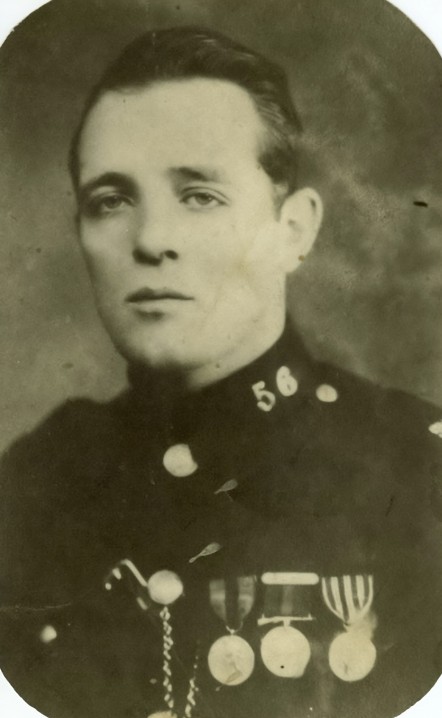
Many members of the company ended up transferred to different camps scattered across Asia. Baynard’s name appears in a list of men in a notebook belonging to Captain Walter J. Hewitt (1915–1993) of the 12th Signal Company (Philippine Scouts). The list was described as “Pertaining to 200 man labor detail taken from Cabanatuan, Phil, Islands to Japan[.]” He wrote that the detail went to Bilibid Prison in Manila on October 28, 1942. Several pages of names were crossed out, including Baynard’s. It is unclear what that alteration means, but Baynard was clearly in Japan by the end of the year.
Hewitt wrote that the group departed Bilibid Prison on November 5, sailed from the Philippines on November 6, and arrived at Moji on November 24. That is consistent with documentation about the first inmates at Baynard’s future prison camp, Yodogawa. They traveled to Moji aboard the hell ship Nagato Maru, arriving on November 24. Switching to a train, they arrived on or about November 26, 1942, at the Yodogawa Branch Camp (later known as Yodogawa 3-B and eventually Yodogawa 3-D), which as the name implies was located on the Yodo River north of Osaka.
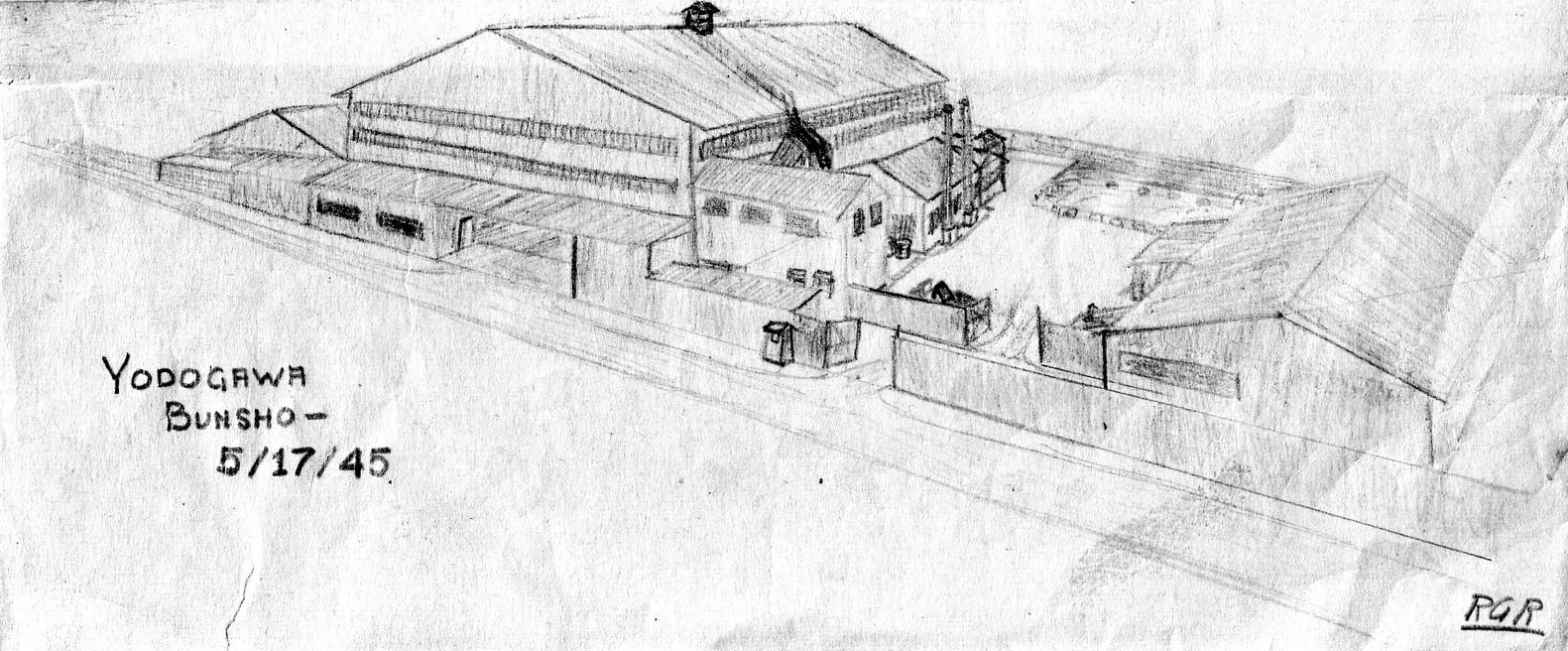
Prisoners at Yodogawa had to work in various local industries including blast furnaces, machine shops, and on the docks. Meals at the camp were typically watery vegetable soup and rice. Protein was rare. There were few opportunities to bathe. It was not until December 27, 1942, that the prisoners were first issued Red Cross packages, which had potentially lifesaving food and other amenities, and even then, three men had to share each package. There was inadequate heating in quarters for the men. Still wearing the warm weather clothing they had been captured in, they suffered immensely from the cold. Guards inflicted beatings for trivial offenses. Men died regularly from disease.
The Empire of Japan did not report its prisoners of war in timely fashion. A document in Baynard’s individual deceased personnel file (I.D.P.F.) stated that the War Department only learned of his capture via the International Red Cross on January 18, 1943, over nine months after his surrender. Baynard’s mother was informed that he was a prisoner of war only on January 20.
Baynard’s decline is better documented than most other prisoners of the Japanese thanks to records kept by Captain Frank Lloyd Richardson (1905–1955), a doctor originally with the 3rd Pursuit Squadron, 24th Pursuit Group, who arrived at the camp on December 7, 1942. His notes indicate that Baynard’s health had deteriorated by the end of 1942, which he diagnosed as beriberi due to malnutrition. White rice, a dietary staple for Baynard both before and after capture, is poor in thiamine, and many of the prisoners suffered from beriberi even before arriving at the camp.
Richardson wrote that Baynard received an injection of “VB”—vitamin B1, thiamine—on December 30, 1942. Baynard was hospitalized in the camp sick bay on January 1, 1943, apparently due to eye issues. He returned to light duty on January 2, and full duty on January 6. However, he returned to light duty on January 8 due to his eyes, and to sick bay on January 10. Being able to work could mean the difference between life and death in the camps. The guards cut rations for men who could not work, making it even more difficult to recover. When the Japanese distributed overcoats on January 1, 1943, only men who were in work details received them.
Dr. Richardson documented further vitamin B injections during January 25–31, 1943, and February 1–9, 1943. He also received cod liver oil January 14–17. It is when Baynard returned to duty, but he was hospitalized again at Yodogawa on March 7, 1943. As of March 12, 1943, he was being treated at a ward run by Storekeeper 2nd Class William Floyd Jeffries (1919–2005), who despite his rating served as a hospital corpsman under Captain Richardson. Baynard’s beriberi had led to heart failure. Richardson wrote that Baynard “Ate a bowl of rice 15 min before he died” on March 12, 1943.
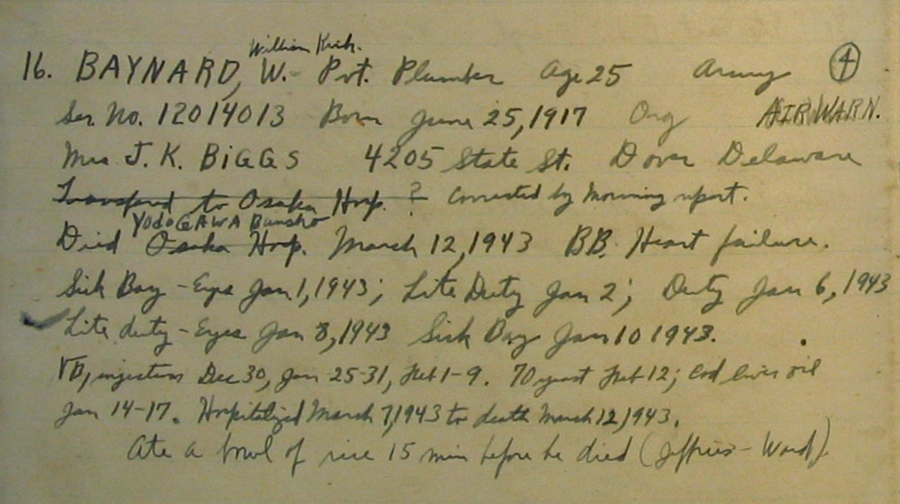
The Japanese government belatedly reported Baynard’s death via the International Red Cross, which forwarded the notice to the United States on July 20, 1943, that Baynard had died of cardiac beriberi at Osaka Prison Camp. The War Department received that notice on July 25, Of course, he had been dead for over four months by that point, a fact that subsequently came to light. Initially, since the Japanese did not report a date of death, the War Department made his official date of death July 20, 1943.
Journal-Every Evening reported Baynard’s death on August 7, 1943, recording his mother’s reaction at length:
“When we complain of the lack of our accustomed comforts, we might realize that many of our soldiers who lived to be captured by the Japanese, face a slow death, caused by improper food.
“These are the same boys who persisted in the face of hopeless odds, who waited in vain for re-enforcements and supplies.
“At a time when our attention is focused on our increasing victories both in the Mediterranean and in the Pacific, it might be well for us to have another thought for the remnants of our forces from Bataan,” Mrs. Biggs said.
“Those boys who are in Japanese prisons do not all receive the help needed by them offered by the Red Cross because—as I understand it—of the lack of cooperation of the Japanese Government,” Mrs. Biggs spoke not in a spirit of resentfulness but in the hope of aiding other prisoners of war, and to prevent them, if possible, from meeting the same fate as her own son.
The Japanese cremated Baynard’s body. At the end of the war, a box of ashes labeled with his name was recovered along with those of other prisoners of war at Juganji, a Buddhist temple in Osaka. They were initially transported to the crypt at an American military cemetery in Manila.
In 1947, Baynard’s mother requested that her son’s ashes be repatriated to the United States. The following year, they crossed the Pacific Ocean aboard U.S.A.T. Sgt. Morris E. Crain, arriving at the San Francisco Port of Embarkation. They traveled across the country to Philadelphia, Pennsylvania, and from there to Dover by train on October 15, 1948.
On October 16, 1948, following a funeral with military honors from the American Legion, the ashes identified as belonging to Private 1st Class Baynard’s were buried at Christ Churchyard (Christ Episcopal Church Cemetery) in Dover. His name is honored on a memorial in Dover and on the Wall of Remembrance at Veterans Memorial Park in New Castle, Delaware.
Julia Sarah Kirk Barnard Biggs outlived two of her three children prior to her death in 1997, aged 102. She and her other two sons were buried next to Private 1st Class Baynard after their deaths.
Notes
Grade
The earliest known document to describe Baynard as a private 1st class was a corrected Adjutant General’s Office report of death dated November 16, 1945. All known wartime documents describe him as a private including company rosters through March 1942, a War Department letter about his capture dated January 27, 1943, Captain Hewitt’s notebook, Captain Richardson’s list, and Baynard’s initial death report dated August 2, 1943. Discrepancies of this sort are remarkably common with regard to prisoners of war held by the Japanese, many of whom seem to have advanced in rank during captivity.
Juganji
Allied servicemembers who died as Japanese prisoners are still honored at Juganji, though the temple was relocated in 1962 from Osaka to Higashiosaka (East Osaka City).
Acknowledgments
Special thanks to Matt LeMasters for obtaining Signal Company, Aircraft Warning, Philippine Department rosters, to Steve Schwarze for its morning reports, to Wes Injerd for Richardson’s death list, to Sasamoto Taeko for information, and to Josephine Pase Day and the Delaware Public Archives for the use of their photos.
Bibliography
“3 Get Divorce in Kent County.” October 19, 1920. The Evening Journal. https://www.newspapers.com/article/192596260/
“24th Pursuit Group: History, 1940 – 1 May 1942.” Undated, c. 1942. Reel A7501. Courtesy of the Air Force Historical Research Agency.
Biggs, Julia K. Individual Military Service Record for William Kirk Baynard. November 21, 1944. Record Group 1325-003-053, Record of Delawareans Who Died in World War II. Delaware Public Archives, Dover, Delaware. https://cdm16397.contentdm.oclc.org/digital/collection/p15323coll6/id/17615/rec/1
“Carl F McDonnell.” Find a Grave. https://www.findagrave.com/memorial/2521471/carl-f-mcdonnell
Census Record for Kirk Baynard. April 4, 1930. Fifteenth Census of the United States, 1930. Record Group 29, Records of the Bureau of the Census. National Archives at Washington, D.C. https://www.familysearch.org/ark:/61903/3:1:33SQ-GR4B-DBY
Census Record for Kirk W. Baynard. January 5, 1920. Fourteenth Census of the United States, 1920. Record Group 29, Records of the Bureau of the Census. National Archives at Washington, D.C. https://www.familysearch.org/ark:/61903/3:1:33S7-9R6Z-2J2
Certificate of Birth for Philip Gladwin Baynard. July 1919. Record Group 1500-008-094, Birth Certificates. Delaware Public Archives, Dover, Delaware. https://www.familysearch.org/ark:/61903/3:1:S3HT-D4X3-2L1
Certificate of Birth for William Kirk Baynard. 1917. Record Group 1500-008-094, Birth Certificates. Delaware Public Archives, Dover, Delaware. https://www.familysearch.org/ark:/61903/3:1:S3HY-DR29-H4L
Certificate of Death for Alfred S. Biggs, Jr. July 9, 1968. Record Group 1500-008-092, Death Certificates. Delaware Public Archives, Dover, Delaware. https://www.familysearch.org/ark:/61903/3:1:3Q9M-CS3G-KQ8G-J
Certificate of Marriage for Alfred S. Biggs and Julia K. Baynard. August 2, 1926. Record Group 1500-008-093, Marriage Certificates. Delaware Public Archives, Dover, Delaware. https://www.familysearch.org/ark:/61903/3:1:3Q9M-CSWM-TGV8
Certificate of Marriage for William J. Baynard and Julia S. Kirk. August 20, 1916. Record Group 1500-008-093, Marriage Certificates. Delaware Public Archives, Dover, Delaware. https://www.familysearch.org/ark:/61903/3:1:S3HY-611S-261
“Col Walter John Hewitt.” Find a Grave. https://www.findagrave.com/memorial/117575431/walter_john-hewitt
Craven, Wesley Frank, ed. Cate, James Lea, ed. The Army Air Forces In World War II: Plans and Early Operations January 1939 to August 1942. Originally published in 1948, republished 1983 by the Office of Air Force History. https://dn790002.ca.archive.org/0/items/Vol1PlansAndEarlyOperations/Vol1PlansAndEarlyOperations.pdf
DeGering, Randall. “Radar Contact!”: The Beginnings of Army Air Forces Radar and Fighter Control. 2018. Air University Press. https://www.airuniversity.af.edu/Portals/10/AUPress/Books/B_0152_Degering_Radar_Contact.pdf
“Delaware Soldier Dies in Jap Prison Camp; Sailor Missing.” August 7, 1943. Journal-Every Evening. https://www.newspapers.com/article/192605595/
Draft Registration Card for William Kirk Baynard. October 16, 1940. Draft Registration Cards for Delaware, October 16, 1940 – March 31, 1947. Record Group 147, Records of the Selective Service System. National Archives at St. Louis, Missouri. https://www.familysearch.org/ark:/61903/3:1:3Q9M-CSMG-XSVS-9
Enlistment Record for William K. Baynard. February 24, 1941. World War II Army Enlistment Records. Record Group 64, Records of the National Archives and Records Administration. National Archives at College Park, Maryland. https://aad.archives.gov/aad/record-detail.jsp?dt=893&mtch=1&cat=all&tf=F&q=12014073&bc=&rpp=10&pg=1&rid=484684
Hewitt, Walter J. “American Personnel.” Undated, c. 1944. Diaries and Historical Narratives, 1940–1945. Record Group 407, Records of the Adjutant General’s Office, 1905–1981. National Archives at College Park, Maryland. https://s3.amazonaws.com/NARAprodstorage/opastorage/live/4/4433/12443304/content/arcmedia/dc-metro/rg-407/Entry-1067/Box_132/Folder5/1255524_Box132_Folder5.pdf
Individual Deceased Personnel File for William K. Baynard. 1943–1949. Army Individual Deceased Personnel Files, 1942–1970. Record Group 92, Records of the Office of the Quartermaster General, 1774–1985. National Archives at St. Louis, Missouri.
“Jack Rogers.” Find a Grave. https://www.findagrave.com/memorial/226441159/jack-rogers
“Jap Prison Camp Victim To Be Buried at Dover.” October 15, 1948. Journal-Every Evening. https://www.newspapers.com/article/192636363/
“Julia Biggs, 102, longtime teacher.” March 27, 1997. The News Journal. https://www.newspapers.com/article/192594958/
“Julia Sarah Kirk Baynard Biggs.” Find a Grave. https://www.findagrave.com/memorial/132775375/julia_sarah-baynard_biggs
“Juganji Temple.” 2023. Translation of entry in Encyclopedia of POW Camps and Civilian Internment Camps. Courtesy of Sasamoto Taeko.
Morning Reports for Company “C,” 3rd Signal Training Battalion. March 1941 – June 1941. U.S. Army Morning Reports, c. 1912–1946. Record Group 64, Records of the National Archives and Records Administration. National Archives at St. Louis, Missouri. https://s3.amazonaws.com/NARAprodstorage/lz/partners/st-louis/rg-064/85713825-wwii/85713825_1940-01-thru-1943-07/85713825_1940-01-thru-1943-07_Roll-2578/85713825_1940-01-thru-1943-07_Roll-2578-33.pdf, https://s3.amazonaws.com/NARAprodstorage/lz/partners/st-louis/rg-064/85713825-wwii/85713825_1940-01-thru-1943-07/85713825_1940-01-thru-1943-07_Roll-2578/85713825_1940-01-thru-1943-07_Roll-2578-34.pdf
Morning Reports for Company “D,” 2nd Signal Training Battalion. February 1941 – March 1941. U.S. Army Morning Reports, c. 1912–1946. Record Group 64, Records of the National Archives and Records Administration. National Archives at St. Louis, Missouri. https://s3.amazonaws.com/NARAprodstorage/lz/partners/st-louis/rg-064/85713825-wwii/85713825_1940-01-thru-1943-07/85713825_1940-01-thru-1943-07_Roll-2578/85713825_1940-01-thru-1943-07_Roll-2578-15.pdf
Morning Reports for Signal Company, Aircraft Warning, Philippine Department. February 1942 – October 1942. Diaries and Historical Narratives, 1940–1945. Record Group 407, Records of the Adjutant General’s Office, 1905–1981. National Archives at College Park, Maryland. Courtesy of Steve Schwarze.
“Osaka POW Camp #3-D.” Allied POWS Under the Japanese website. https://www.mansell.com/pow_resources/camplists/osaka/Yodogawa/yodogawa.html
“Physician Passes.” January 22, 1955. The Daily Chronicle. https://www.newspapers.com/article/198030989/
“PVT Delbert Ray Fear.” Find a Grave. https://www.findagrave.com/memorial/56760211/delbert-ray-fear
Richardson, Frank L. “Death List.” 1943–1945. Diaries and Historical Narratives, 1940–1945. Record Group 407, Records of the Adjutant General’s Office, 1905–1981. National Archives at College Park, Maryland. Allied POWS Under the Japanese website. https://mansell.com/pow_resources/camplists/osaka/Yodogawa/OSA-3D_Richardson_Diary_a.pdf
Sontag, Louis and Reardon, William B. “Yodogawa Diary.” 1942–1943. Allied POWS Under the Japanese website. https://www.mansell.com/pow_resources/camplists/osaka/Yodogawa/readon_yodogawa_diary.html
“Table of Organization No. 11-400: Signal Organization, Aircraft Warning, Special Type.” September 4, 1941. War Department Archives. https://www.wdarchives.com/archives/record/8943/
Thompson, William D. “Aircraft Warning Company—Philippine Dep’t.” Undated, c. 1945. Diaries and Historical Narratives, 1940–1945. Record Group 407, Records of the Adjutant General’s Office, 1905–1981. National Archives at College Park, Maryland. https://s3.amazonaws.com/NARAprodstorage/opastorage/live/65/4491/12449165/content/arcmedia/dc-metro/rg-407/Entry-1067/Box_143A/Folder6/1255524_Box143A_Folder6.pdf
“William F. Jeffries.” Find a Grave. https://www.findagrave.com/memorial/11898167/william-f.-jeffries
Last updated on May 23, 2026
More stories of World War II fallen:






To have new profiles of fallen soldiers delivered to your inbox, please subscribe below.

