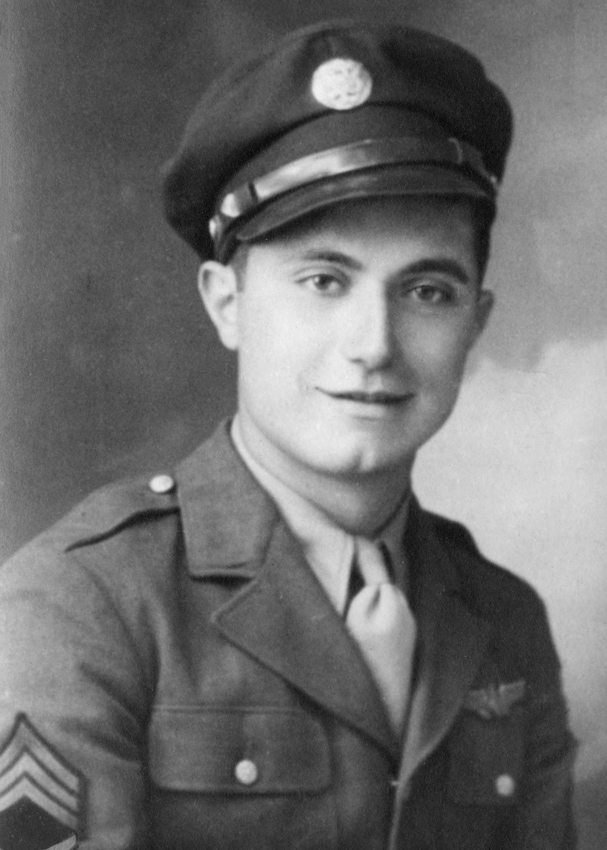
| Branch | Civilian Occupation |
| U.S. Army Air Forces | Acetylene burner for Bethlehem Steel Company |
| Theater | Service Number |
| Mediterranean | 13153198 |
| Military Occupational Specialty | Unit |
| 612 (airplane armorer-gunner) | 765th Bombardment Squadron (Heavy), 461st Bombardment Group (Heavy) |
| Awards | Campaigns/Battles |
| Air Medal with two oak leaf clusters, Purple Heart | European air campaign |
Author’s note: This piece incorporates some text from my previous article about another member of his crew, 1st Lieutenant Harry M. First (1915–1944).
Early Life & Family
Louis Di Martino was born Luigi Di Martino in Lama dei Peligni, Chieti, Italy, on April 11, 1922. It appears that he was the first child of Filippo Di Martino (1897–1988) and Giovannina or Giovanna Di Martino (née Laudadio, 1898–1936).
Soon after Di Martino was born, his father, a World War I veteran later known as Philip DiMartino, emigrated to United States. He sailed from Naples, Italy, arrived in New York City on November 1, 1922, and joined family already living in Providence, Rhode Island. By December 15, 1927, when the elder Di Martino petitioned for naturalization, he had settled at 15 Windmill Street in Providence and was working as a laborer. He was living at the same address when wife and son joined him the following summer.
On July 17, 1928, Di Martino and his mother obtained visas at Naples to immigrate to the United States. The following day, they left Naples aboard S.S. Conte Grande. They arrived in New York City on July 27. It appears that his mother adopted the name Jennie after immigrating.
Di Martino became a U.S. citizen. It is unclear when he moved to Delaware, though it must have been prior to February 8, 1936, when Journal-Every Evening reported that his mother, “Mrs. Giovanna DiMartino, 37, wife of Philip DiMartino, of 2317 West Second street, died yesterday in St. Francis’ Hospital of complications following the birth of a child Tuesday. The baby died at birth.”
Journal-Every Evening reported that a Louis Di Martino been awarded a certificate after completing a first aid class from the American Red Cross at Baynard Junior High School in Wilmington on January 23, 1937, suggesting that he had Americanized his name by that point. He graduated from Bayard on June 14, 1938.
Di Martino was likely living at 1915 West 8th Street in Wilmington as of January 2, 1938. That was the address listed when Philip Di Martino remarried to Norina Dal Gesso (née Angelini, 1911–1972), herself a widow with two sons. Her name was listed as Rena in Di Martino’s military paperwork, which inaccurately described her as his mother instead of as his stepmother.
Di Martino was recorded in the census in April 1940 living at 722 Douglass Street in Wilmington with his stepmother and two stepbrothers. His father was working as a laborer at a mill.
Journal-Every Evening reported that Di Martino “was a graduate of Brown Vocational High School and worked as a welder at the Harlan Plant of the Bethlehem Steel Company” prior to entering the military.
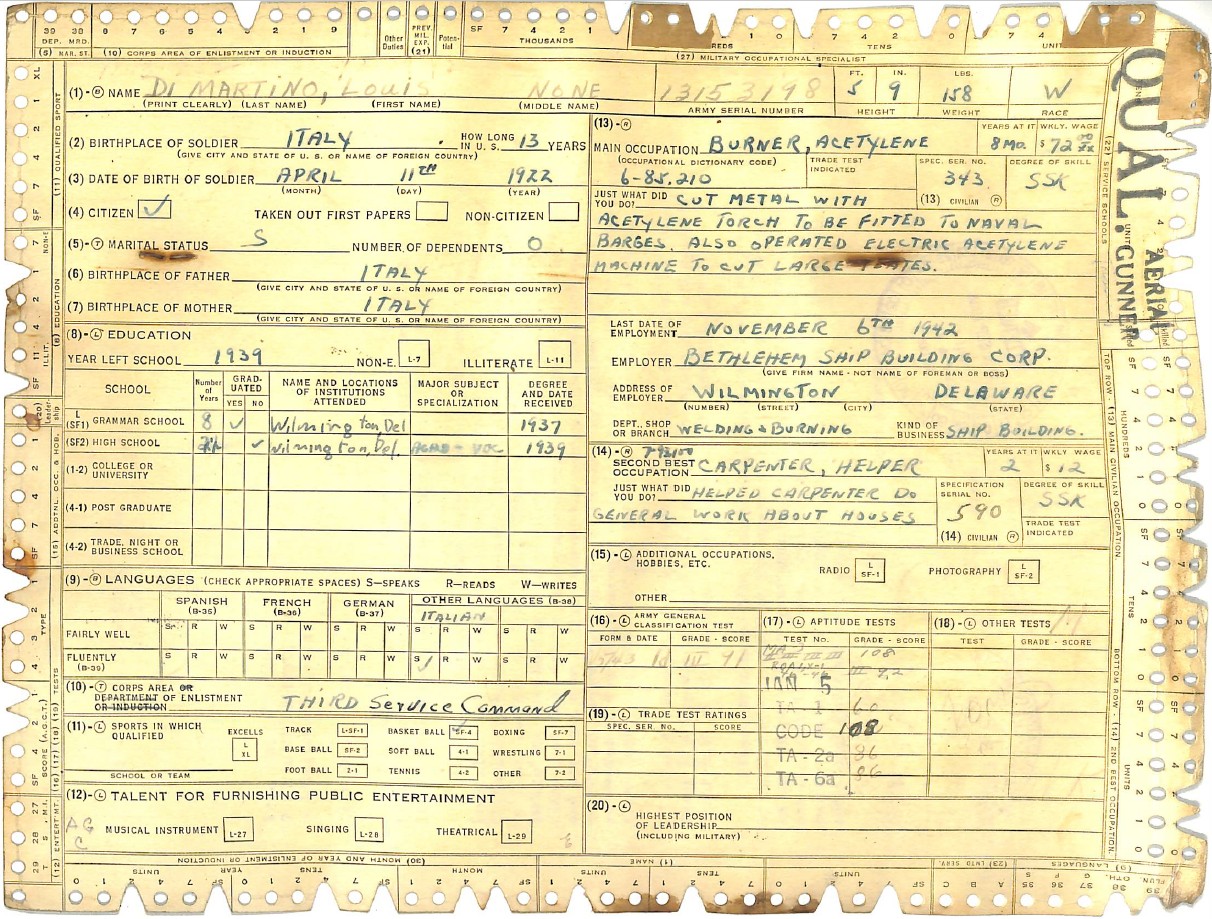
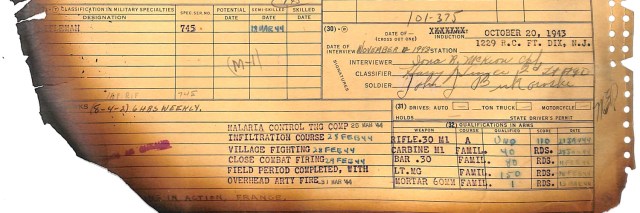
However, Di Martino’s qualification card, which miraculously survived the 1973 National Personnel Records Center fire, stated that he completed two and a half years of high school before leaving school in 1939 without graduating. The card stated that he had worked for two years as a carpenter helper, earning $12 per week (about $285 in 2026 dollars) assisting the “carpenter do general work about houses[.]” Di Martino also reported working for eight months as an acetylene burner at the Bethlehem Steel shipyard, earning $72 per week (about $1,430 in 2026 dollars). The qualification card described his work: “Cut metal with acetylene torch to be fitted to naval barges. Also operated electric acetylene machine to cut large plates.”
When Di Martino registered for the draft on June 30, 1942, he was still living at 722 Douglass Street and working at the Bethlehem Steel Company’s Harlan Plant. The registrar described him as standing about five feet, nine inches tall and weighing 155 lbs., with brown hair and eyes.
Di Martino’s enlistment data card stated he was a U.S. citizen prior to entering the military. He reported to the Army that he spoke Italian fluently and played no sports except for basketball. Di Martino was Catholic.
Military Career
Di Martino volunteered for the Army Air Forces (A.A.F.), enlisting as a private in Philadelphia, Pennsylvania, on November 7, 1942. He went on active duty the same day, reporting to the reception center at New Cumberland, Pennsylvania.
Joining the military entailed a significant pay cut, since Di Martino made more in a week working in the shipyard than a U.S. Army private made in a month. Bethlehem even paid him more than he would be making later as a sergeant, even taking flight pay and overseas service pay into account.
Di Martino was soon dispatched to Stockton, California. However, he was there only briefly before moving to Tanforan, California, on November 15. The following month, he crossed the country again and on December 27, 1942, he was attached to the 1143rd Technical School Squadron at Miami Beach, Florida. The reason for all these moves is unclear, since neither Stockton nor Tanforan appear to have been training centers and most members of the A.A.F. who entered the service from Delaware during the time were immediately dispatched to Miami Beach for their basic training.
It was only on January 5, 1943, that Private Di Martino took the Army General Classification Test. His score of 91 placed him in Grade III, average. That same day, he also took a battery of aptitude tests, scoring average in mechanical aptitude. He sat for a classification interview the following day.
On April 3, 1943, Private Di Martino was attached to the 765th Technical School Squadron at Buckley Field, Colorado, as a student armorer. On May 10, 1943, after completing that course, he was attached to the 37th Technical School Group at Lowry Field, Denver, Colorado, to continue his training as an armorer. His qualification card indicates that he was promoted to private 1st class around this time.
On June 29, 1943, after completing another aircraft armament course, Di Martino was reclassified with military occupational specialty (M.O.S.) code 911, airplane armorer. If he had not already done so, at this point he volunteered for air crew training.
On July 5, 1943, Private Di Martino was attached to Headquarters and Headquarters Squadron, 326th Flexible Gunnery Training Group to attend the A.A.F. Flexible Gunnery School, Las Vegas Army Air Field, Nevada. Upon graduation on August 21, he was promoted to sergeant and reclassified with the military occupational specialty (M.O.S.) of 612, airplane armorer-gunner. The same orders transferred him to the 18th Replacement Wing at the Army Air Base, Salt Lake City, Utah, though they were not effective immediately.
Private DiMartino was detached from the 326th Flexible Gunnery Training Group at 1800 hours on August 24, 1943. At 1130 hours the following day, he reported as a casual at the Crew Routing Pool, Salt Lake City along with a group of 271 enlisted men from Las Vegas. A note in his qualification card dated August 25 indicated he had qualified as an armorer-gunner on both the Boeing B-17 Flying Fortress and Consolidated B-24 Liberator heavy bombers, though he ended up crewing the latter.
A set of orders from Headquarters 18th Replacement Wing dated September 1, 1943, dispatched Di Martino to the 29th Bombardment Group (Heavy) at Gowen Field, Boise, Idaho. On September 3, he was attached to Headquarters Detachment, 29th Bomb Group (Heavy). He was detached on September 13 and transferred with a group of enlisted men to the 470th Bomb Group (Heavy) at the Army Air Base, Mountain Home, Idaho. The following day, he was officially attached to the group’s 800th Bomb Squadron (Heavy). At the end of the month, 2nd Lieutenant Harry M. First (1915–1944), another man from Wilmington, was also attached to the squadron. Eventually, they would be assigned to the same crew.
By October 21, 1943, Sergeant Di Martino had been assigned to a crew, but it was not yet filled out, lacking at least a lead pilot. On that date, Di Martino was dispatched by train to the Army Air Base, Wendover Field, Utah, for the “purpose of attending approx. thirty (30) day Gunnery Course[.]”
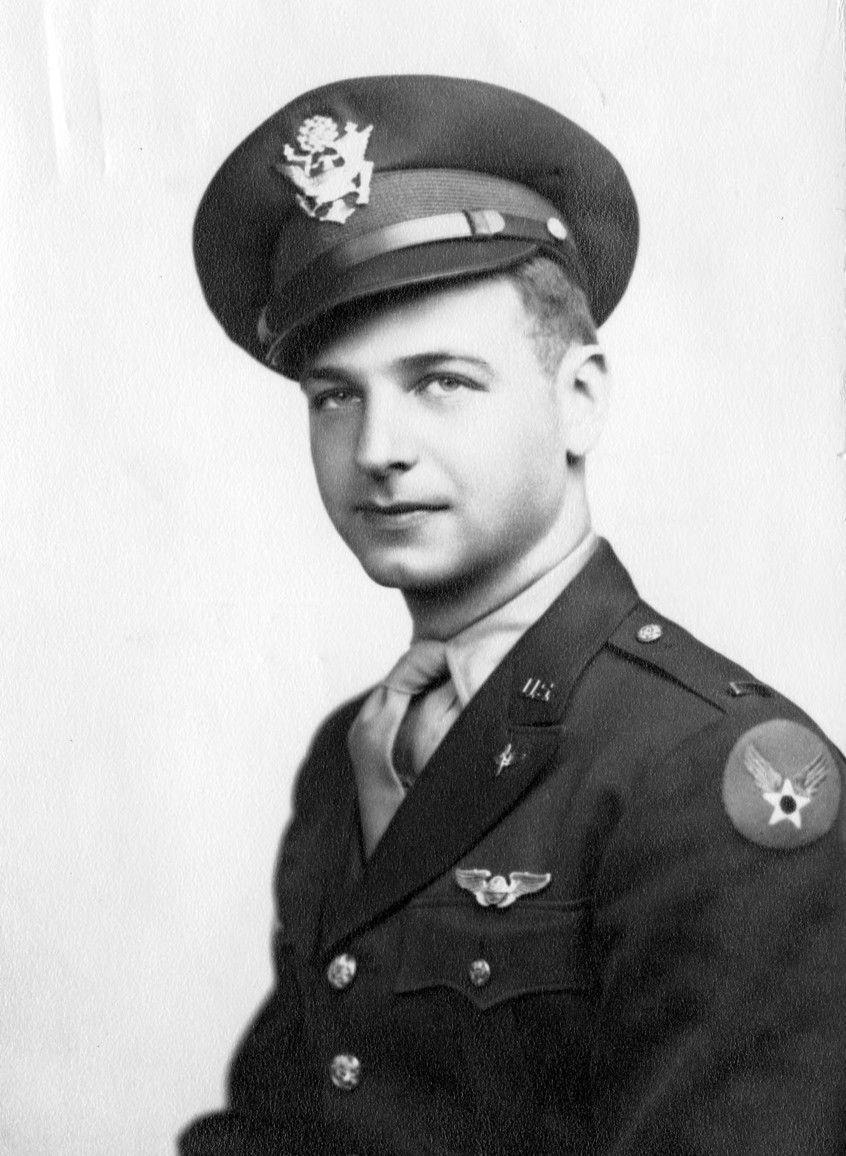
By November 13, 1943, when Di Martino finished the course, both 2nd Lieutenant First and a lead pilot, 2nd Lieutenant Richard E. Avery (1918–1981), had been assigned to his crew. On that date, his crew was attached to the 399th Bombardment Group (Heavy) at Wendover Field, with a report date of on or about November 14. It appears that Di Martino and the other gunners waited at Wendover for the rest of their crew rather than first returning to Mountain Home. Regardless, they were at Wendover only a short time longer. On November 25, the crew was detached from the 399th Bomb Group and dispatched back to the 470th Bomb Group at Mountain Home. On November 27, the Avery crew was attached to the group’s 801st Bombardment Squadron (Heavy).
On December 7, 1943, Di Martino and his crew were detached from the 801st Bomb Squadron and transferred to the 461st Bombardment Group (Heavy) at Hammer Field, Fresno, California. There, on December 10, they joined the group’s 765th Bombardment Squadron (Heavy) as Crew 25, replacing the previous ill-fated Crew 25 led by Charles W. Turvey (1921–1943), which vanished in the Sierra Nevada Mountains during a training flight on December 5. The wreckage of their B-24, which had crashed in a remote part of Kings Canyon National Park, California, was not discovered until 1960. The tragedy could not hold up the unit’s timetable and the 461st Bomb Group was mere weeks from going overseas.
A 461st Bomb Group history noted that the unit went overseas with 70 crews but only 62 aircraft, with priority for air transport given to crews that had completed their training first. Crew 25, which had joined the group only that month, were not assigned a plane. The group history stated that the members of the eight crews, except their first pilot, “were assigned to the ground echelon for the overseas movement.”
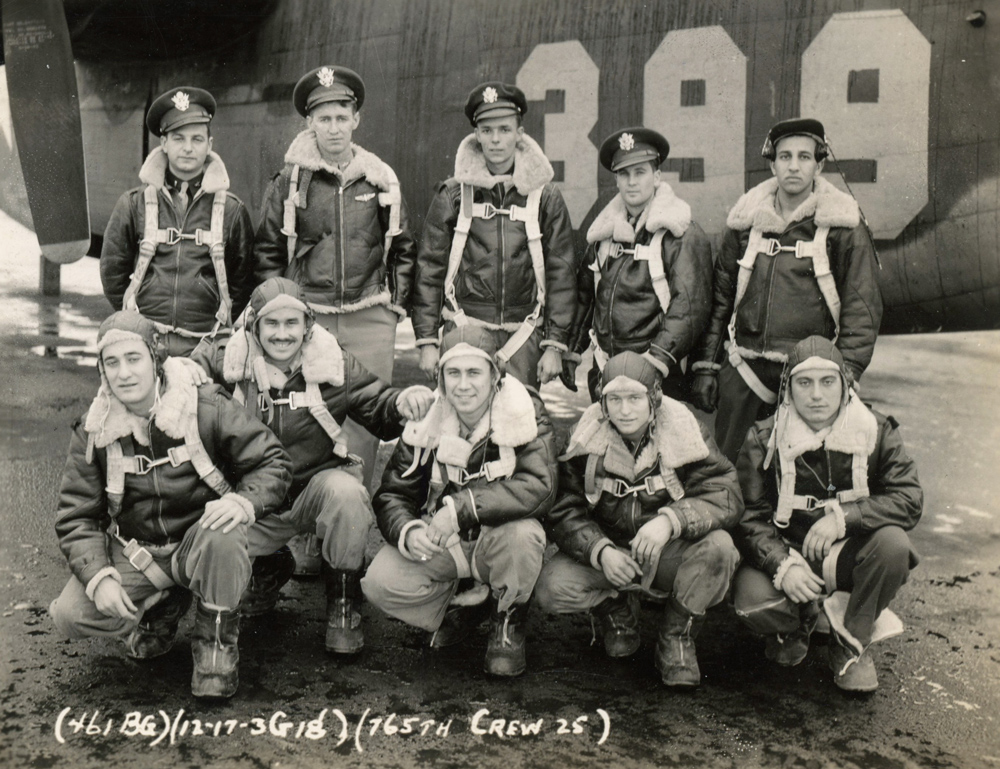
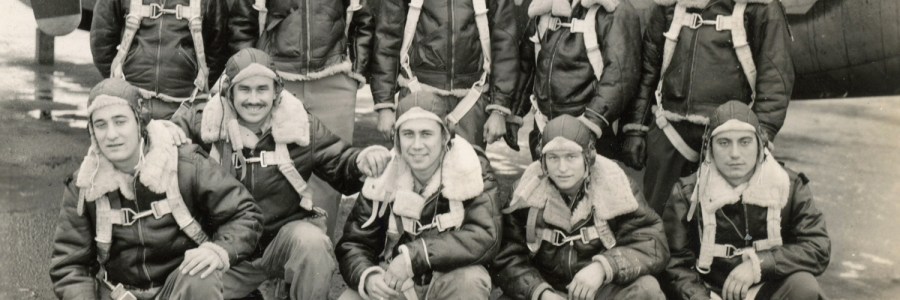
Although Lieutenant Avery appeared in a Crew 25 photo dated December 17, 1943, his name did not appear on a list of the group’s first pilots compiled at the end of the month. Though he remained in the squadron until the following July, this detail suggests that Avery had already been replaced as Di Martino’s crew’s pilot, likely by Glenial Fulks (1921–1944). Fulks had been an aviation cadet in Class 43-D at Eagle Pass, Texas, with another future fallen Delawarean, Joseph A. Dugan (1920–1945). Fulks had been commissioned on April 22, 1943, and did transition training to fly B-24 Liberators. He had been a member of the 765th Bomb Squadron’s Crew 31 but flew in combat with Crew 25.
The ground echelon, including Sergeant Di Martino, left Hammer Field by rail on December 31, 1943. After staging at Camp Patrick Henry, Virginia, the ground echelon of the 765th Bomb Squadron boarded S.S. George Handley at the nearby Hampton Roads Port of Embarkation on January 12, 1944. Di Martino officially entered foreign service on January 13, 1944, when his ship moved a short distance from port. It dropped anchor until Convoy UGS-30 departed on January 14.
The convoy entered the Mediterranean Sea on January 31, 1944. Various ships in the convoy were routed to different destinations in the Mediterranean. Most of the vessels carrying the ground echelons of the 461st Bomb Group put into port at Tunis, Tunisia, but George Handley ended up at Augusta, Sicily. After a few days, the ship moved to Naples, Italy, where the ground echelon of the 765th finally disembarked on February 15, and went into staging at Bagnoli. Sergeant Di Martino found himself back in his homeland, though as an American soldier.
While Di Martino and the others were still in transit, the air echelon of the 765th Bomb Squadron crossed the country in late January 1944, then departed Morrison Field, West Palm Beach, Florida. After intermediate stops in the British West Indies, Brazil, French West Africa, Morocco, Algeria, and Tunisia, they arrived at Torretta, Italy, part of the Foggia complex, on February 23.
On February 23, the 765’s ground echelon began a roundabout journey by truck and train, and were finally reunited with the air echelon at Torretta the following day. The 461st Bomb Group was assigned to the 55th Bombardment Wing, Fifteenth Air Force, but moved to the 49th Bombardment Wing on March 14.
Combat Over Europe
When the 461st Bomb Group arrived, Torretta was in poor condition with limited facilities. The contemporary 765th Bomb Squadron history for March 1944 stated: “Everyone worked together in perfect unison to get the planes, equipment, and crew in condition to perform combat missions. Several Squadron and Group practice missions were flown during the month.”
Living conditions were spartan at first, with most of the men living in tents heated with improvised oil stoves. They converted agricultural buildings in the vicinity to quarters and club rooms.
Bomber crews in the Fifteenth Air Force flew longer tours of duty than the better-known United Kingdom-based Eighth Air Force. Despite that, they shared many of the same dangers, especially during deep penetration missions into central Europe. From fields in Italy, the Fifteen Air Force could hit targets in the German Reich, occupied countries in southern Europe, and the Axis countries of Hungary and Romania. Although missions varied, the 461st Bomb Group’s most frequent targets involved oil refineries, railroad marshalling yards, and airfields.
Sergeant Di Martino’s flight records were not preserved in his personnel file or did not survive the 1973 fire. Lieutenant First’s records may offer insight into Di Martino’s experiences. First participated in the 461st Bomb Group’s first combat mission on April 2, 1944. First likely flew seven missions in April, 12 in May, five in June, and 12 in July, for a total of 36 probable combat missions. Di Martino certainly flew many and possibly all the missions that First did.
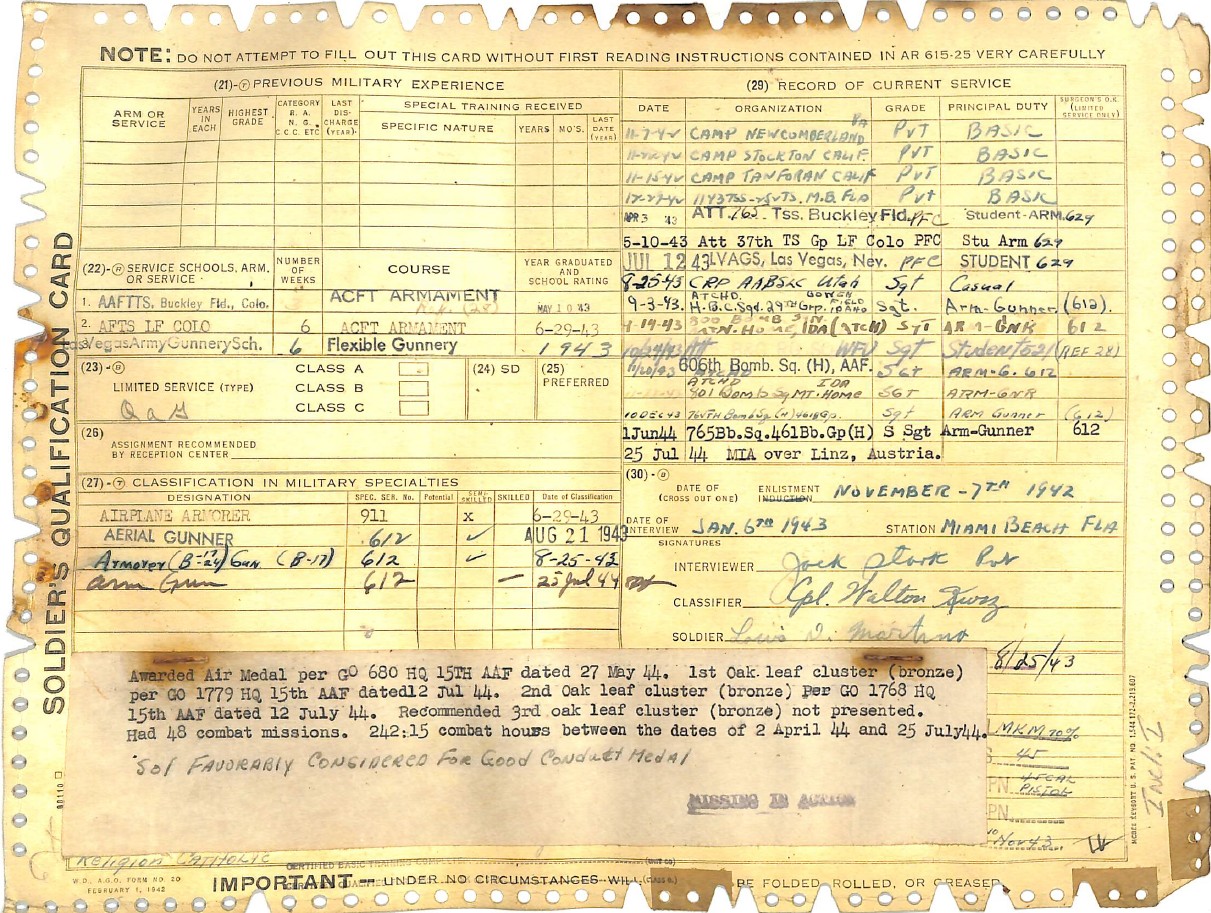
Di Martino was awarded the Air Medal on May 27, 1944. He was later awarded at least two oak leaf clusters in lieu of additional Air Medals and was promoted to staff sergeant on June 1, 1944. That month had a slower operation tempo, in part due to poor weather. On June 5, 1944, Di Martino and his crew went on temporary duty for a week at a rest camp on the island of Capri. They returned to duty on June 13.
The following month, July 1944, the 461st Bomb Group flew long missions against targets in Italy, Hungary, France, Romania, Austria, and Germany. It was a tough month, and not just because of the usual problems caused by weather. First, who was promoted to 1st lieutenant on July 16, and likely Sergeant Di Martino, survived two of their unit’s most difficult missions to date.
The mission to Nîmes, France, on July 12, 1944, was heavily opposed by enemy fighters and the 461st Bomb Group lost four crews, though none of them were from Di Martino’s squadron. On July 22, during the attack on the Româno-Americană oil refinery at Ploești, the lead plane for the group was hit by antiaircraft fire and two engines damaged, resulting in the bombardier jettisoning his bombs. Unfortunately, the rest of the group had orders to drop their ordnance on cue from the lead bombardier, resulting in the entire group releasing short of the target. During the mission, the 461st Bomb Group lost one crew over enemy territory. Another crew, from First’s squadron, nursed their stricken B-24 back to friendly territory and bailed out, with officer killed when his parachute did not open in time. Frustrating as these two were, the 461st Bomb Group’s most disastrous mission was still to come.
Final Mission
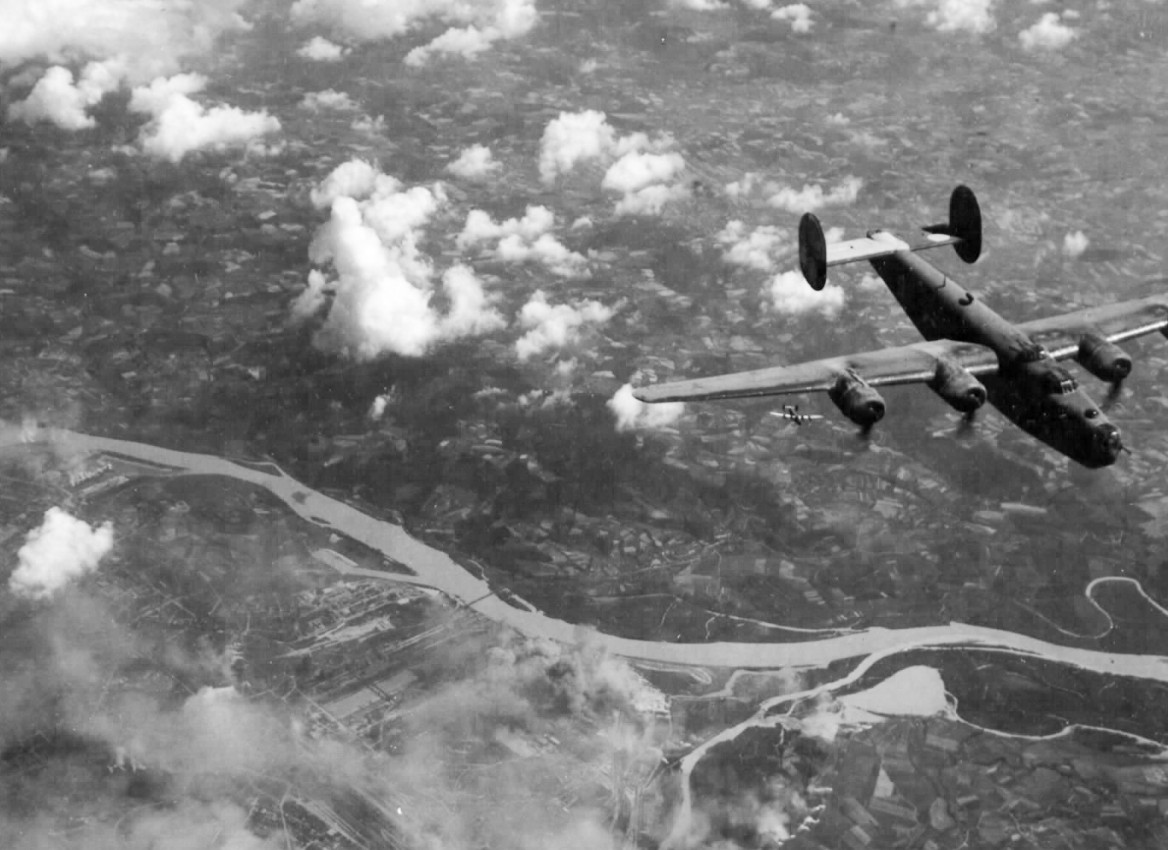
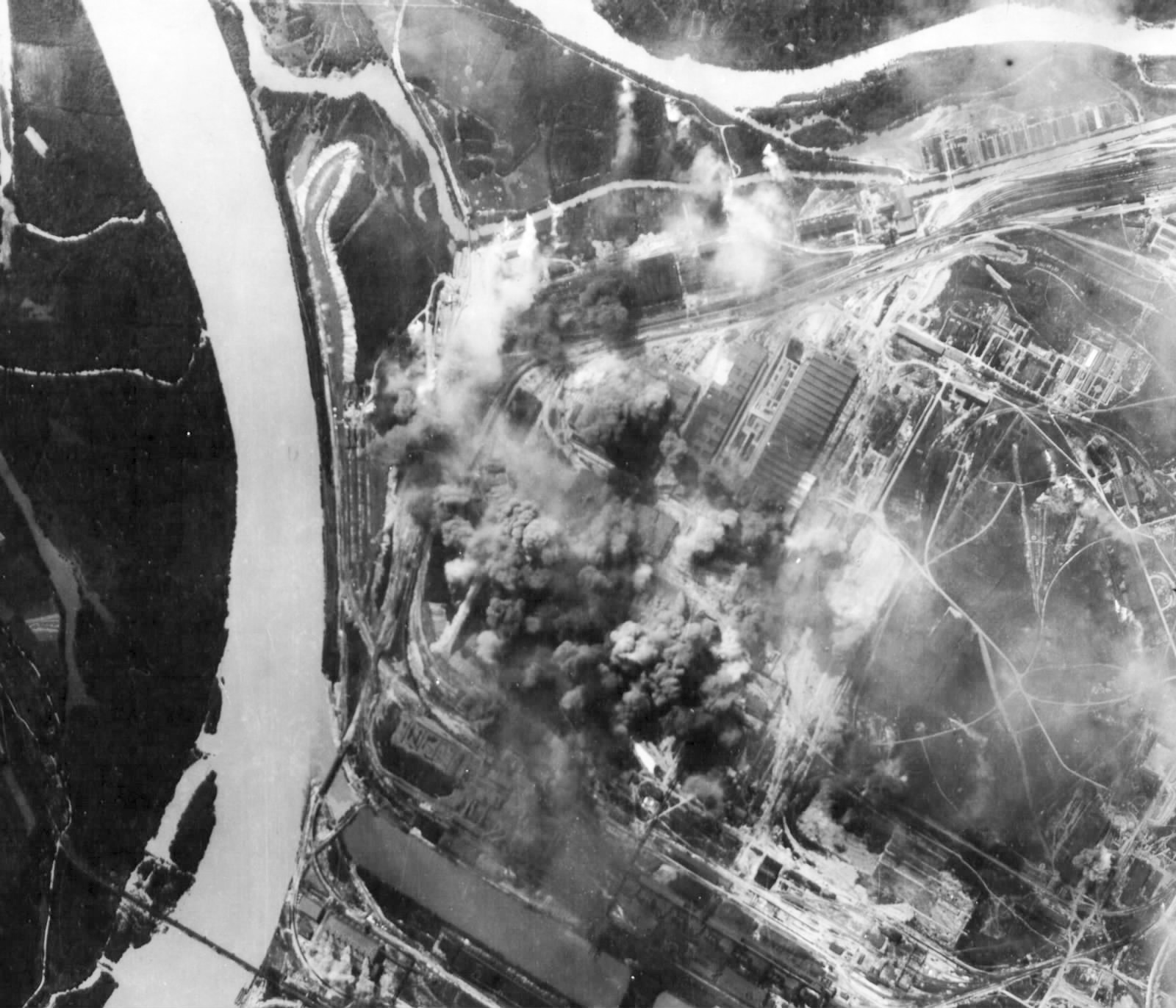
The 765th Bomb Squadron history stated that on July 25, 1944, “The men were briefed to hit the Herman Goering Tank Works at Linz, Austria, and also that this would be a rough mission, with lots of flak and fighters.” Rough undersold just how bad the mission against the Reichswerke Hermann Göring plant would be. That morning, Staff Sergeant Di Martino manned the left waist gun aboard a B-24H piloted by 1st Lieutenant Fulks and 2nd Lieutenant Warren O. Ludlum (1923–2009). The plane, A.A.F. serial number 42-52368, was 461st Bomb Group Ship No. 34, nicknamed Piecemaker.
10-men bomber crews often included men from all over the country, but Di Martino’s final crew was particularly diverse. They had entered the service from seven states—Pennsylvania, Delaware, Illinois, California, Kentucky, Indiana, and New York—plus the Panama Canal Zone. Two were immigrants: Staff Sergeant Di Martino and Staff Sergeant Morris Krivitsky (1913–1944), a top turret gunner who had immigrated from the Soviet Union and who had already been wounded by flak the month before. Two were Jewish, Lieutenant First and Sergeant Krivitsky. At least six of the men were volunteers and at least two had been drafted.

This fateful day, the weather was far better than during previous missions: ceiling and visibility unlimited. This made it easier for the bombers to find the target but also for the Germans to intercept them.
21 B-24s from the 461st Bomb Group had begun their bomb run on Linz when approximately 25 twin-engine and 125 single-engine German fighters pounced. The contemporary 461st Bomb Group history stated:
Taking advantage of the fact that most of the planes flown by new crews did not have their ball turret down on the bomb run, the twin engine planes came up under the lead flight of the formation and began throwing rockets through the open bomb bay doors. The first plane to go down was Major [William] Burke’s lead plane. Instead of packing the formation in close, the inexperienced bomber pilots spread the formation. Captain Franklin, 1st Lt. Henry, Lt. King, Lt. Sullivan, and Lt. Gizelba, flying the deputy lead plane, salvoed [jettisoned] their bombs and attempted to rally the formation. By this time, however, the single engine fighters, still attacking low but now from the rear, picked off planes in the straggling formation. Eleven bombers were knocked down as parachutes, tracers, rockets, enemy fighters, and exploding bombers filled the air with confusion.
The group history was unequivocal in calling the mission the “Linz catastrophe.” 11 B-24s from the 461st Bomb Group were shot down and their crews killed or captured. Another crew managed to bail out from their heavily damaged bomber over friendly territory. Three other B-24s that made it back were so badly damaged that they were written off. The group history stated that among the 113 men lost on the mission, “seven officers and nine enlisted men were flying their fiftieth sortie.” This was particularly unfortunate for them since 50 missions were required to complete a tour of duty and be rotated back to the non-combat duty, mostly in the continental U.S. The report ruefully added: “For the first time in its history, enemy fighters successfully turned back the 461st Group short of its target.” Other groups did successfully attack the plant, however.
Three of the lost crews were from the 765th Bomb Squadron, including Di Martino’s. The squadron history stated:
With out a doubt this was the BLACKEST DAY for the Squadron. Of the six ships that made it to the target area, only one was able to make it back to the field, and one was able to land at Foggia. […] The story that the two returning crews told was that approximately 150 to 170 fighters jumped them just before they started over the target. Things happened so fast, and there was [sic] so many ships falling that the men had no time to watch other ships or much of anything else. They were busy shooting at ME’s and FW’s.
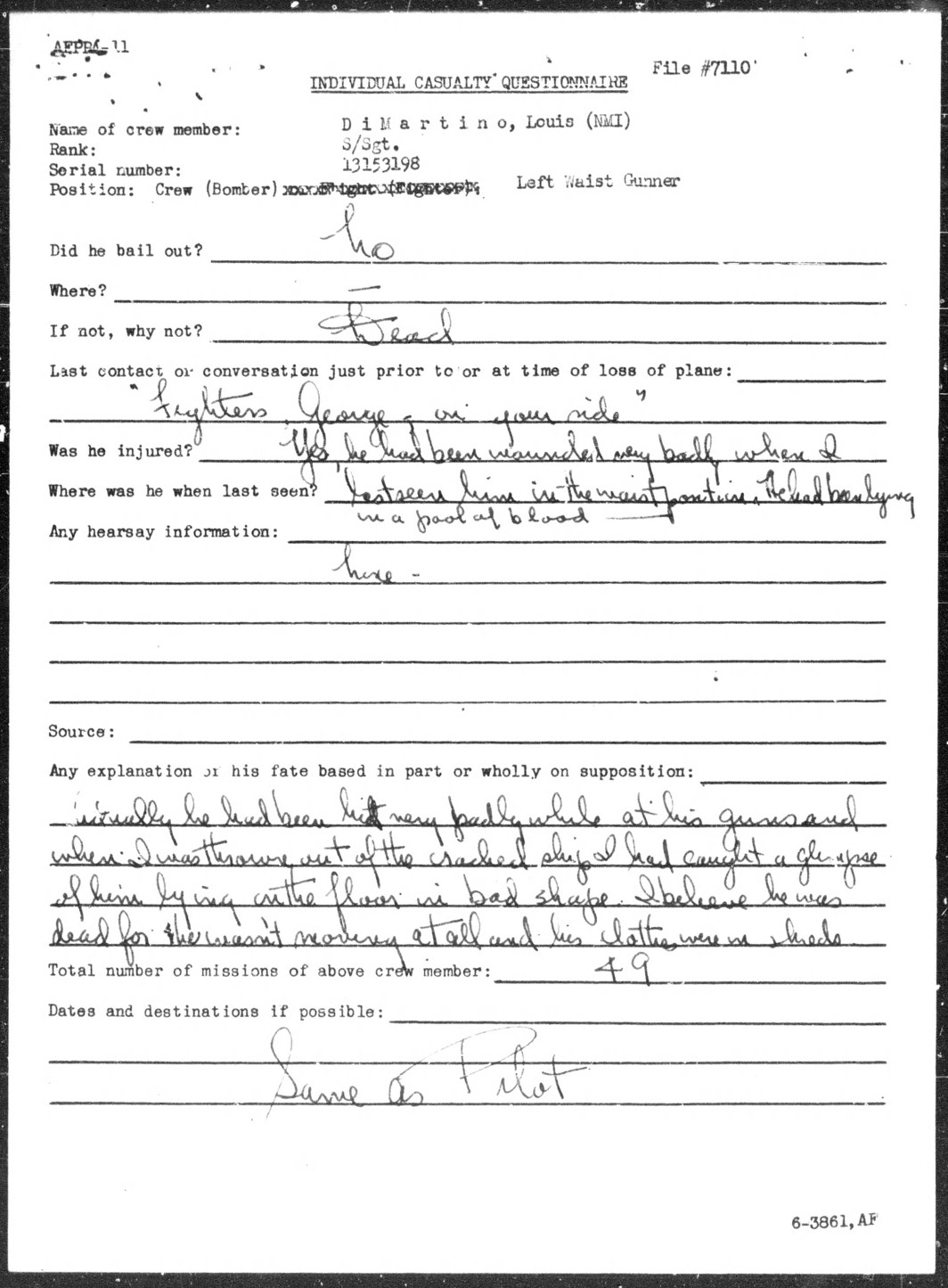
Piecemaker’s right waist gunner, George Diamond (1923–1991), later recalled that the last words he heard Di Martino say were, “Fighters, George, on your side.” Soon after, he discovered that Di Martino “had been hit very badly while at his guns” and was “lying in a pool of blood[.]” Diamond added: “I believe he was dead for he wasn’t moving at all and his clothes were in shreds.”
The day after the mission, Technical Sergeant Hugh G. Baker (1923–1989), aboard B-24G 42-78444, nicknamed All American, made the following statement:
On 25 July 1944 I saw ship number 34, type B-24-H go down in flames. The wing seemed to be a solid sheet of fire with the flames streaming back past the tail. It turned over on its back completely out of control. That is all I saw. The time was about 11:20. I saw no one bail out.
Diamond jumped or was thrown through a hole in the fuselage made by an explosion. Whether Di Martino was already dead by that point or just severely wounded, he did not survive the crash.
According to German records, the B-24 crashed at Mistlberg, Austria, about 14½ miles northeast of Linz, at 1107 hours. Just three members of the crew survived as prisoners of war.
On August 11, 1944, Journal-Every Evening reported that Staff Sergeant Di Martino and Lieutenant First were missing in action when their B-24 went down over Austria. Although First’s death was confirmed the following month, it was not until more than a year after their deaths, on August 4, 1945, that the paper reported that Di Martino had also been killed.
Although Staff Sergeant Di Martino’s flight records were not preserved in his personnel file, a slip of paper attached to his qualification card stated: “Had 48 combat missions. 242:15 combat hours between the dates of 2 April 44 and 25 July44 [sic].” The slip stated that Di Martino had been recommended for a third oak leaf cluster to his Air Medal. However, the Air Medal decoration card for him on file in the National Archives documents only two oak leaf clusters, suggesting that the third was never awarded. His soldier’s qualification card stated that he was “Favorably Considered For Good Conduct Medal” but likewise, there is no indication it was ever awarded. Di Martino’s only confirmed posthumous award was the Purple Heart.
Journal-Every Evening reported on September 14, 1945: “A high requiem mass will be said for Staff Sergt. Louis DiMartino Sunday morning [September 16,] at 9 o’clock in St. Anthony’s Church.” Later that month, on September 29, 1945, the paper reported: “A memorial mass for Staff Sergt. Louis di Martino will be said at 9 o’clock tomorrow morning at St. Anthony’s R. C. Church at the request of cousins and uncles living in Providence, R. I.”
Di Martino’s personnel effects included a knife, his Air Medal, a leather wallet, a religious book, two souvenir books about Pompeii, a souvenir scarf and straw hat, his swim trunks, and six photographs.
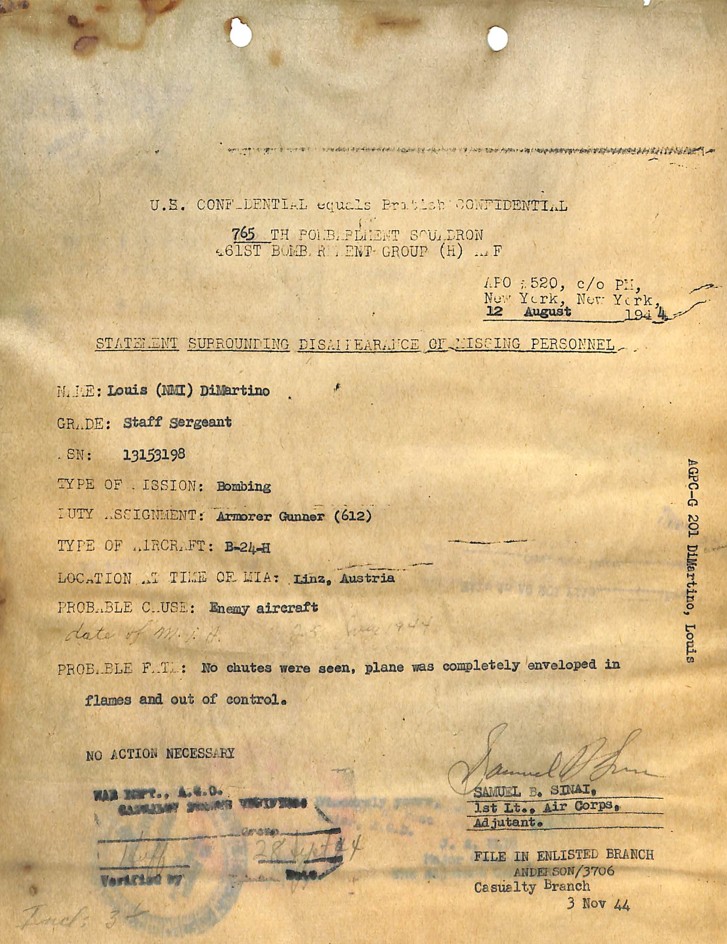
Austrian civilians initially buried Staff Sergeant Di Martino and six other Americans in a cemetery in Tragwein, Austria. At the end of the war, the Allies captured German documents listing Di Martino as dead, though for unknown reasons that information was not relayed to the United States via the International Red Cross. With no indication that Di Martino could have survived, the War Department issued a finding of death, making his presumed date of death July 26, 1945, a year and a day after his disappearance. By August 26, 1946, American Graves Registration Command, European Theater Area had obtained information about slain American air crew, suspected to members the Fulks crew, buried at Tragwein.
Possibly because Tragwein was in the Soviet occupation area, it was only on June 12, 1947, that the bodies were recovered by personnel from the 612th Army Graves Registration Company. The bodies were transferred to a military cemetery at Neuville-en-Condroz, Belgium, where Di Martino’s remains were designated Unknown X-6075.
On August 18, 1947, the remains were subjected to a forensic examination. One of Di Martino’s dog tags was “found in pocket of electrically heated trousers by processors.” X-6075’s tooth chart was also consistent with Di Martino’s dental records and dissimilar to any other member of the crew. The body was buried at Neuville-en-Condroz on August 22. Curiously, it took nearly a year before X-6075 was positively identified as being Di Martino, with a board of review approving the identification on July 12, 1948.
In 1949, Di Marinto’s father requested that his son’s body remain buried overseas. In the years after the end of the war, American military cemeteries abroad were consolidated into a handful of permanent cemeteries, and bodies from those permanent cemeteries repatriated. As a result, Sergeant Di Martino’s casket was disinterred again. He was reburied for the final time on July 16, 1949, at Neuville-en-Condroz, now known as the Ardennes American Cemetery. His name is honored at Veterans Memorial Park in New Castle, Delaware.
Crew of B-24H Piecemaker on July 25, 1944
The following list was adopted from Missing Air Crew Report No. 7110 with grade, name, service number, position, and status (killed or captured).
1st Lieutenant Glenial Fulks, O-676774 (pilot) – K.I.A.
2nd Lieutenant Warren O. Ludlum, O-813535 (copilot) – P.O.W.
1st Lieutenant Harry M. First, O-691975 (navigator) – K.I.A.
Flight Officer Robert B. Stewart, T-1573 (bombardier) – K.I.A.
Staff Sergeant Walter R. Jaske, 36740606 (nose turret gunner) – K.I.A.
Staff Sergeant Morris Krivitsky, 33310332 (top turret gunner) – K.I.A.
Staff Sergeant Fred C. Duzan, Jr., 15062921 (ball turret gunner) – K.I.A.
Staff Sergeant George Diamond, 12187570 (right waist gunner) – P.O.W.
Staff Sergeant Louis Di Martino, 13153198 (left waist gunner) – K.I.A.
Staff Sergeant Peter N. Godino, 7021152 (tail gunner) – P.O.W.
Notes
Grade
A set of orders dated August 21, 1943, at the end of his flexible gunnery training, promoted Di Martino to sergeant. Curiously, another set of orders issued on August 23 revoked the promotion for Di Martino and five other men, while leaving the transfer and change of M.O.S. intact. However, Di Martino had already left that duty station and all known documents after that date, as well as his qualification card, referred to him as a sergeant with no reduction to private.
It is unclear if the revocation was itself rescinded, whether new orders promoted him back to sergeant, or whether word of the demotion simply never caught up to him, making it effectively meaningless. Of course, absent serious misconduct on their part, aircrew of the era typically entered combat as noncommissioned officers, so even if reduced back to private, he surely would have been promoted to sergeant soon afterward anyway.
Number of Missions
Various sources describe Sergeant Di Martinoand Lieutenant First as having flown 48 or 49 missions at the time of their deaths. Di Martino’s family told the Public Archives Commission that he died on his 49th mission, and his qualification card stated: “Had 48 combat missions.” Diamond also stated that Fulks, First, and Di Martino had flown 49 missions. He jotted down the date and targets of 35 specific missions for Lieutenant Fulks, including Linz, but added “others [sic] missions not included[.]”
The count is similarly confusing in the case of Lieutenant First. His flight records record only 41 flights after going overseas, of which 36 were probable combat missions.
One possible explanation for the discrepancy was that some missions earned double credit for being especially hazardous, though there would have to be quite a few of these to resolve the discrepancy.
Ship
Unit records give the name of the vessel aboard which the ground echelon of the 765th Bomb Squadron crossed the Atlantic Ocean as S.S. George S. Hanly, but convoy records show that it was S.S. George Handley.
Sergeants Krivitsky and Jaske
The top turret gunner, Morris Krivitsky, was referred to as a staff sergeant in unit morning reports and the missing air crew report, but as a technical sergeant in Diamond’s statement and on the official casualty list. The nose gunner, Walter R. Jaske, Jr. (1922–1944), was listed as a staff sergeant in contemporary records and on the casualty list, but as a technical sergeant on his headstone.
Acknowledgments
Special thanks to Charles Randall Morgan and Hughes Glantzberg for unit records, and to the Delaware Public Archives and to Dan First for the use of their photos.
Bibliography
“612 Pupils Are Promoted At 2 Junior High Schools.” June 15, 1938. Journal-Every Evening. https://www.newspapers.com/article/202448635/
Air Medal Decoration for Louis DeMartino [sic]. Award Cards, 1942–1963. Record Group 64, Records of the National Archives and Records Administration. National Archives at St. Louis, Missouri. https://catalog.archives.gov/medialz/st-louis/rg-064/4530002/09/4530002_074/4530002_074_0964.jpg
“Baynard School News.” January 23, 1937. Journal-Every Evening. https://www.newspapers.com/article/202449067/
Census Record for Louis DiMartino. April 19, 1940. Sixteenth Census of the United States, 1940. Record Group 29, Records of the Bureau of the Census. National Archives at Washington, D.C. https://www.familysearch.org/ark:/61903/3:1:3QS7-89MR-M9YF
Certificate of Death for Norina Di Martino. December 26, 1972. Record Group 1500-008-092, Death Certificates. Delaware Public Archives, Dover, Delaware. https://www.familysearch.org/ark:/61903/3:1:3Q9M-CS3B-WSJB-K
Certificate of Marriage for Philip Di Martino and Norina Del Gusso [sic]. January 2, 1938. Record Group 1500-008-093, Marriage Certificates. Delaware Public Archives, Dover, Delaware. https://www.familysearch.org/ark:/61903/3:1:S3HT-61G9-ZBL
“Delaware Casualty List of 11 Includes Three Killed in Action.” August 11, 1944. Journal-Every Evening. https://www.newspapers.com/article/136957520/
Draft Registration Card for Louis Di Martino. June 30, 1942. Draft Registration Cards for Delaware, October 16, 1940 – March 31, 1947. Record Group 147, Records of the Selective Service System. National Archives at St. Louis, Missouri. https://www.familysearch.org/ark:/61903/3:1:3Q9M-CSMG-X9F6-S
Enlistment Record for Louis DiMartino. November 7, 1942. World War II Army Enlistment Records. Record Group 64, Records of the National Archives and Records Administration. National Archives at College Park, Maryland. https://aad.archives.gov/aad/record-detail.jsp?dt=893&mtch=1&cat=all&tf=F&q=13153198&bc=&rpp=10&pg=1&rid=780029
Individual Deceased Personnel File for Louis Dimartino. 1944–1949. Army Individual Deceased Personnel Files, 1942–1970. Record Group 92, Records of the Office of the Quartermaster General, 1774–1985. National Archives at St. Louis, Missouri.
Individual Military Service Record for Louis Di Martino. Undated, c. 1946. Record Group 1325-003-053, Record of Delawareans Who Died in World War II. Delaware Public Archives, Dover, Delaware. https://cdm16397.contentdm.oclc.org/digital/collection/p15323coll6/id/18443/rec/1
“Jennie DiMartino.” Find a Grave. https://www.findagrave.com/memorial/109836638/jennie-dimartino
“List or Manifest of Alien Passengers for the United States Immigration Officer at Port of Arrival, S. S. ‘Conte Grande’, Passengers sailing from Naples, July 18th, 1928 Arriving at Port of New York, Jul 27 1928.” July 27, 1928. Passenger Lists of Vessels Arriving at New York, New York, 1897–1957. Record Group 36, Records of the U.S. Customs Service, Record Group 36. National Archives at Washington, D.C. https://www.ancestry.com/imageviewer/collections/7488/images/NYT715_4308-0524
“List or Manifest of Alien Passengers for the United States Immigration Officer at Port of Arrival, S. S. Patria, Passengers sailing from Naples, September 30th, 1922 Arriving at Port of New York November, the 1st, 1922.” November 1, 1922. Passenger Lists of Vessels Arriving at New York, New York, 1897–1957. Record Group 36, Records of the U.S. Customs Service, Record Group 36. National Archives at Washington, D.C. https://www.ancestry.com/imageviewer/collections/7488/images/NYT715_3209-0587
“Memorial Mass.” September 29, 1945. Journal-Every Evening. https://www.newspapers.com/article/202448513/
Morning Reports for 765th Bombardment Squadron (Heavy). December 1943 – July 1944. U.S. Army Morning Reports, c. 1912–1946. Record Group 64, Records of the National Archives and Records Administration. National Archives at St. Louis, Missouri. https://catalog.archives.gov/medialz/partners/st-louis/rg-064/85713825-wwii/85713825_1943-12/85713825_1943-12_Roll-0467/85713825_1943-12_Roll-0467-13.pdf, https://catalog.archives.gov/medialz/partners/st-louis/rg-064/85713825-wwii/85713825_1943-12/85713825_1943-12_Roll-0467/85713825_1943-12_Roll-0467-14.pdf, https://catalog.archives.gov/medialz/partners/st-louis/rg-064/85713825-wwii/85713825_1943-12/85713825_1943-12_Roll-0233/85713825_1943-12_Roll-0233-28.pdf, https://catalog.archives.gov/medialz/partners/st-louis/rg-064/85713825-wwii/85713825_1944-01/85713825_1944-01_Roll-0318/85713825_1944-01_Roll-0318-14.pdf, https://catalog.archives.gov/medialz/partners/st-louis/rg-064/85713825-wwii/85713825_1944-01/85713825_1944-01_Roll-0718/85713825_1944-01_Roll-0718-08.pdf, https://catalog.archives.gov/medialz/partners/st-louis/rg-064/85713825-wwii/85713825_1944-02/85713825_1944-02_Roll-0481/85713825_1944-02_Roll-0481-19.pdf, https://catalog.archives.gov/medialz/partners/st-louis/rg-064/85713825-wwii/85713825_1944-03/85713825_1944-03_Roll-0574/85713825_1944-03_Roll-0574-17.pdf, https://catalog.archives.gov/medialz/partners/st-louis/rg-064/85713825-wwii/85713825_1944-04/85713825_1944-04_Roll-0562/85713825_1944-04_Roll-0562-10.pdf, https://catalog.archives.gov/medialz/partners/st-louis/rg-064/85713825-wwii/85713825_1944-04/85713825_1944-04_Roll-0562/85713825_1944-04_Roll-0562-11.pdf, https://catalog.archives.gov/medialz/partners/st-louis/rg-064/85713825-wwii/85713825_1944-05/85713825_1944-05_Roll-0595/85713825_1944-05_Roll-0595-18.pdf, https://catalog.archives.gov/medialz/partners/st-louis/rg-064/85713825-wwii/85713825_1944-05/85713825_1944-05_Roll-0595/85713825_1944-05_Roll-0595-19.pdf, https://catalog.archives.gov/medialz/partners/st-louis/rg-064/85713825-wwii/85713825_1944-06/85713825_1944-06_Roll-0545/85713825_1944-06_Roll-0545-01.pdf, https://catalog.archives.gov/medialz/partners/st-louis/rg-064/85713825-wwii/85713825_1944-06/85713825_1944-06_Roll-0545/85713825_1944-06_Roll-0545-02.pdf, https://catalog.archives.gov/medialz/partners/st-louis/rg-064/85713825-wwii/85713825_1944-07/85713825_1944-07_Roll-0748/85713825_1944-07_Roll-0748-15.pdf, https://catalog.archives.gov/medialz/partners/st-louis/rg-064/85713825-wwii/85713825_1944-07/85713825_1944-07_Roll-0748/85713825_1944-07_Roll-0748-16.pdf
Morning Reports for 800th Bombardment Squadron (Heavy). September 1943 – November 1943. U.S. Army Morning Reports, c. 1912–1946. Record Group 64, Records of the National Archives and Records Administration. National Archives at St. Louis, Missouri. https://catalog.archives.gov/medialz/partners/st-louis/rg-064/85713825-wwii/85713825_1943-09/85713825_1943-09_Roll-0447/85713825_1943-09_Roll-0447-09.pdf, https://catalog.archives.gov/medialz/partners/st-louis/rg-064/85713825-wwii/85713825_1943-10/85713825_1943-10_Roll-0457/85713825_1943-10_Roll-0457-01.pdf, https://catalog.archives.gov/medialz/partners/st-louis/rg-064/85713825-wwii/85713825_1943-10/85713825_1943-10_Roll-0457/85713825_1943-10_Roll-0457-02.pdf, https://catalog.archives.gov/medialz/partners/st-louis/rg-064/85713825-wwii/85713825_1943-11/85713825_1943-11_Roll-0385/85713825_1943-11_Roll-0385-12.pdf
Morning Reports for 801st Bombardment Squadron (Heavy). November 1943 – December 1943. U.S. Army Morning Reports, c. 1912–1946. Record Group 64, Records of the National Archives and Records Administration. National Archives at St. Louis, Missouri. https://catalog.archives.gov/medialz/partners/st-louis/rg-064/85713825-wwii/85713825_1943-11/85713825_1943-11_Roll-0385/85713825_1943-11_Roll-0385-13.pdf, https://catalog.archives.gov/medialz/partners/st-louis/rg-064/85713825-wwii/85713825_1943-12/85713825_1943-12_Roll-0095/85713825_1943-12_Roll-0095-23.pdf
Morning Reports for Classification Routing Pool, Army Air Base, Salt Lake City, Utah. August 1943. U.S. Army Morning Reports, c. 1912–1946. Record Group 64, Records of the National Archives and Records Administration. National Archives at St. Louis, Missouri. https://catalog.archives.gov/medialz/partners/st-louis/rg-064/85713825-wwii/85713825_1943-08/85713825_1943-08_Roll-0419/85713825_1943-08_Roll-0419-06.pdf
Morning Reports for Headquarters and Headquarters Squadron, 326th Flexible Gunnery Training Group. July 1943 – August 1943. U.S. Army Morning Reports, c. 1912–1946. Record Group 64, Records of the National Archives and Records Administration. National Archives at St. Louis, Missouri. https://catalog.archives.gov/medialz/partners/st-louis/rg-064/85713825-wwii/85713825_1940-01-thru-1943-07/85713825_1940-01-thru-1943-07_Roll-0060/85713825_1940-01-thru-1943-07_Roll-0060-21.pdf, https://catalog.archives.gov/medialz/partners/st-louis/rg-064/85713825-wwii/85713825_1940-01-thru-1943-07/85713825_1940-01-thru-1943-07_Roll-0060/85713825_1940-01-thru-1943-07_Roll-0060-22.pdf, https://catalog.archives.gov/medialz/partners/st-louis/rg-064/85713825-wwii/85713825_1943-08/85713825_1943-08_Roll-0448/85713825_1943-08_Roll-0448-18.pdf, https://catalog.archives.gov/medialz/partners/st-louis/rg-064/85713825-wwii/85713825_1943-08/85713825_1943-08_Roll-0448/85713825_1943-08_Roll-0448-19.pdf
Morning Reports for Headquarters Detachment, 29th Bomb Group (Heavy). September 1943. U.S. Army Morning Reports, c. 1912–1946. Record Group 64, Records of the National Archives and Records Administration. National Archives at St. Louis, Missouri. https://catalog.archives.gov/medialz/partners/st-louis/rg-064/85713825-wwii/85713825_1943-09/85713825_1943-09_Roll-0443/85713825_1943-09_Roll-0443-16.pdf, https://catalog.archives.gov/medialz/partners/st-louis/rg-064/85713825-wwii/85713825_1943-09/85713825_1943-09_Roll-0443/85713825_1943-09_Roll-0443-17.pdf
“Mother and Baby Die.” February 8, 1936. Journal-Every Evening. https://www.newspapers.com/article/202449273/
Official Military Personnel File for Louis Di Martino. 1943–1947. Official Military Personnel Files, 1912–1998. Record Group 319, Records of the Army Staff. National Archives at St. Louis, Missouri.
“Petition for Naturalization for Philip Di Martino.” December 15, 1927. Petitions and Records of Naturalization, February 1942 – c. 1991. Record Group 21, Records of District Courts of the United States. National Archives at Boston, Massachusetts. https://www.ancestry.com/imageviewer/collections/61208/images/007766398_00047
“Philip DiMartino.” April 4, 1988. Evening Journal. https://www.newspapers.com/article/202450209/
“Sergt. Louis DiMartino.” September 14, 1945. Journal-Every Evening. https://www.newspapers.com/article/202448056/
“Sergt. Louis DiMartino Lost On Mission Against Reich.” August 4, 1945. Journal-Every Evening. https://www.newspapers.com/article/202447668/
Silverman, Lowell. “1st Lieutenant Harry M. First (1915–1944).” October 8, 2026. Delaware’s World War II Fallen website. https://delawarewwiifallen.com/2026/10/08/1st-lieutenant-harry-m-first/
Last updated on October 12, 2026
More stories of World War II fallen:





To have new profiles of fallen soldiers delivered to your inbox, please subscribe below.


