
| Residences | Civilian Occupation |
| Italy, Delaware, Massachusetts | District supervisor for Public Shoe Service of Chicago |
| Branch | Service Number |
| U.S. Army | 31427391 |
| Theater | Unit |
| European | Company “A,” 7th Infantry Regiment, 3rd Infantry Division |
| Military Occupational Specialty | Campaigns/Battles |
| 610 (antitank crewman) | Rhineland campaign |
Early Life & Family
Samuel Judge was born Salvatore Lo Giudice on May 14, 1911, in Mongiuffi Melia, Sicily, Italy. He was the first child of Antonio Lo Giudice (c. 1879 –1918) and Carmela or Carmella Lo Giudice (c. 1891–1970). His father emigrated to the United States and settled on South Van Buren Street in Wilmington, Delaware, where he worked as a laborer. On December 12, 1913, he and his mother sailed from Palermo, Sicily, aboard S.S. Calabria, arriving in New York City on December 27. He had three younger sisters born in the United States: Maria Congetta Lo Giudice (also known as Mary Louise Judge, later Volzone, and eventually Capano, 1914–1995), Vittoria Talia Lo Giudice (Victoria Rose Judge, later Constantino, 1917–1988), and Antonina Lo Giudice (Anna Helen Judge, later Cheseroni, 1919–2002). He was Catholic.
The Lo Giudices were living at 208 Cedar Street in Wilmington as of September 26, 1914, when the family’s eldest girl was born, and at the same address as of May 23, 1917, when the family welcomed another daughter.
Judge’s father was employed with the Delaware Paper Mill Company prior to his death at the Wilmington Country Club Emergency Hospital on October 12, 1918. That was one of several temporary hospitals set up when the local healthcare system was overwhelmed by the Great Influenza Pandemic. The cause of death was listed as pneumonia, a common complication of the flu. Judge’s mother was pregnant with the couple’s fourth child, another girl, whom she gave birth to on March 17, 1919. The address on her birth certificate was 209 Cedar Street. If not a typo, that suggests the family had moved across the street from their prior address. By 1920, Judge’s mother had remarried, to Luigi (Louis) Triano (c. 1887–1952), with whom she raised three additional children. Judge’s half-brother, Louis Triano, Jr. (1925–1970), served in the U.S. Navy during World War II and the Korean War.
Judge was recorded on the census in April 1930 as Samuel Judico, living with his mother, stepfather, three sisters, three half-siblings, and a border on Mount Cuba Road in unincorporated New Castle County, Delaware. He and his stepfather were described as gardeners on a private estate. Their residence was in the rolling hills of northern Delaware, an area dotted with sprawling mansions and farms belonging to Delaware’s elite with names like Granogue and Winterthur. At some point, he and his sisters Anglicized their names, adopting a literal translation: Judge. Journal-Every Evening reported that Judge had “been employed in the shoe repair department of the Wilmington Dry Goods store.”
The 1940 census stated that Judge dropped out of school after completing the 8th grade. Similarly, his enlistment data card described his education level as grammar school. He was described as an alien on the 1930 census but a U.S. citizen by the time he entered the military.
According to census records, Judge was living in Wilmington as of April 1, 1935, but subsequently moved to Brockton, Massachusetts. He married Clara Ann Stanco (1912–2005), a Massachusetts native, on an unknown date prior to April 1, 1940.
Judge and his wife were recorded on the census in April 1940 living at 37 Ellsworth Street in Brockton. Judge was described as a district manager for a shoe repair shop. The census stated that his income in 1939 was $2,000 (about $47,875 in 2026 dollars). When he registered for the draft later that year on October 16, 1940, Judge was living at the same address. The registrar described him as standing about five feet, seven inches tall and weighing 165 lbs., with brown hair and blue eyes. His employer was listed as the Public Shoe Corporation of Chicago, Illinois, but his place of work as Edgar’s Department Store on Main Street in Brockton. Journal-Every Evening stated that Judge “was employed as district supervisor for the Public Shoe Service of Chicago, with headquarters in Brockton[.]”
In the spring of 1943, a few months before he was drafted, Judge and his wife welcomed their only child, a son.
Military Career
After he was drafted, Judge was inducted into the U.S. Army in Boston, Massachusetts, on December 6, 1943. A set of orders issued that day transferred Judge and 15 other men to the Enlisted Reserve Corps on inactive duty, further adding:
Effective 28 December 1943, each of the above named men of the Enlisted Reserve Corps is called to Active Duty and will assemble at the Brockton City Hall, Brockton, Mass., at 6:30 A.M., and will proceed from the City Hall to the Reception Center at Fort Devens, Mass., reporting to the Commanding Officer thereat for duty.
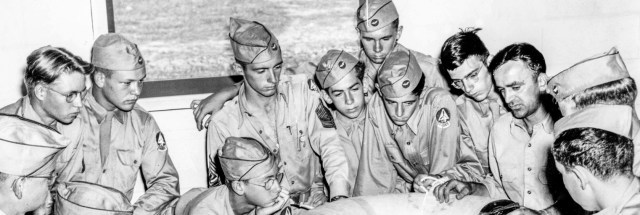
After going on active duty, Private Judge was issued uniforms, educated on military law, vaccinated, tested, and classified. The specification serial number that most closely matched his civilian work experience was 204, shoe repairman. However, by then, the Army needed infantrymen, not shoe repairmen. On January 25, 1944, he was ordered to proceed by rail to the Infantry Replacement Training Center, Camp Blanding, Florida. Effective January 27, he was attached unassigned to Company “D,” 223rd Infantry Training Battalion. He trained with infantry weapons and had specialized training to crew towed antitank guns.
After completing his basic training, Judge was rated with the military occupational specialty (M.O.S.) code 610, antitank gun crewman. Per Special Orders No. 125, Headquarters Infantry Replacement Training Center, Camp Blanding, Florida, dated May 25, 1944, and effective May 31, Private Judge was transferred to Army Ground Forces Depot No. 1, Fort George G. Meade, Maryland. He was authorized 13 days’ delay, reporting no later than noon on June 14. That day, he was attached to Company “D,” 3rd Replacement Battalion, 1st Replacement Regiment.
On June 24, 1944, as set of orders came down effective the following day, attaching Judge a shipment of replacements, GP-040(a)-A. On June 25, he boarded a troop train bound for a port of embarkation. He went overseas soon after. Upon arriving in Italy, he reported for duty at the 2nd Replacement Depot.
On July 21, 1944, he was attached unassigned to the 394th Replacement Company, 9th Replacement Battalion, at La Fagianeria, possibly near Caserta, Italy. A set of orders issued July 28 and effective the following day transferred Judge to the 439th Replacement Company located at a dairy farm in La Fagianeria. Yet another set of transfer orders dated July 31 transferred him to the 2645th Replacement Company at the same location, though morning reports indicate that transfer did not occur until August 3. That morning, the 2645th Replacement Company moved 30 miles to the ironically named Blizzard Staging Area, possibly located at Pozzuoli. The company was attached to the U.S. Seventh Army for the upcoming Operation Dragoon, the invasion of southern France. This operation, together with the breakout from Normandy, made it impossible for the Germans to hold France.
At midnight on the night of August 9–10, 1944, the 2645th Replacement Company was disbanded and its personnel transferred to a new unit activated at 0001, the 535th Replacement Company. On or about August 19, 1944, shortly after the beginning of the southern France campaign, the 535th Replacement Company boarded a group of four landing craft infantry, LCI-669, LCI-670, LCI-672, and LCI-673, for the voyage from Italy to France. They disembarked at Saint-Tropez, France, on August 22 and remained in a nearby bivouac area until September 6, when they boarded trucks. They departed at 1230 hours for the 250-mile overnight journey to Polygone, France, arriving at 1000 hours the following morning.
On September 24, 1944, Judge was attached unassigned to the to the 399th Replacement Company, also located at Polygone.
Combat in the European Theater
A set of orders came down from Headquarters 2nd Replacement Depot on September 30, 1944, but not immediately effective, transferring Private Judge and a group of other men to the 7th Infantry Regiment, 3rd Infantry Division. They departed the 399th Replacement Company the following morning.
The rapid pursuit of the Germans across France had slowed as summer faded. Allied supply lines lengthened while German supply lines grew shorter. At the time Private Judge was dispatched to join it, the 3rd Infantry Division was fighting in the Vosges.
On October 3, 1944, Private Judge was in a group of 44 enlisted replacements who joined Company “A,” part of 1st Battalion, 7th Infantry Regiment. A morning report stated that the company was in defensive positions 2½ miles northeast of Rupt-sur-Moselle, France. The Army had trained Judge to fire an antitank gun but then assigned him to a rifle company that lacked antitank guns. Although the 7th Infantry had an antitank company, in combat its nine rifle companies suffered the highest casualty rates.
Private Judge had been bouncing around replacement units for over three months, but he would have only two days to adjust to his new unit before going into battle for the first time. On October 4, 1944, Company “A” moved to Saint-Amé, France, by road, joining the rest of 1st Battalion, 7th Infantry, in preparation for a new offensive through La Moselotte Valley, which ran east to Crémanvillers and then south to the main objective, Vagney. A contemporary operations report stated:
The 2nd Bn (Reinf[orced]) opened the attack in the late afternoon of 4 October from the NORTHWEST and seized its first objective, Hill 828, against strong resistance. Enemy counterattacks were repulsed and in the afternoon of 5 October the 1st Bn (Reinf) joined battle, also from the NORTHWEST, and met small enemy resistance.
Judge’s Company “A” was on the 1st Battalion right, Company “B” on the left, and Company “C” following Company “B.”
The operations report stated: “Enemy attempts at infiltration were defeated and during the night of 5–6 October the 2nd Bn left its positions on Hill 828 and followed the 1st Bn advance.”
Coordinates in an entry in the regimental journal indicate that Company “A” gained about 1,100 yards by 1940 hours. They would not have long to rest: “1st Bn ordered to move from 500 to 1000 yards tonight[.]”
1st Battalion resumed its advance around 0130 hours on October 6, 1944. The regimental action report continued:
Mid morning of October 6th 2nd Bn moved to the Right flank of 1st Bn and together the Bns launched an attack that captured [Crémanvillers], Hill 822 and sped toward the SAPOIS–VAGNEY road until slowed by heavy enemy mortar, artillery, MG [machine gun] and small arms fire.
The regimental journal stated that at 1910 hours, 1st Battalion reported that Company “A” had almost reached Fontaine, over halfway between Crémanvillers and Vagney. That evening, they took up positions in Fontaine and set up a roadblock.
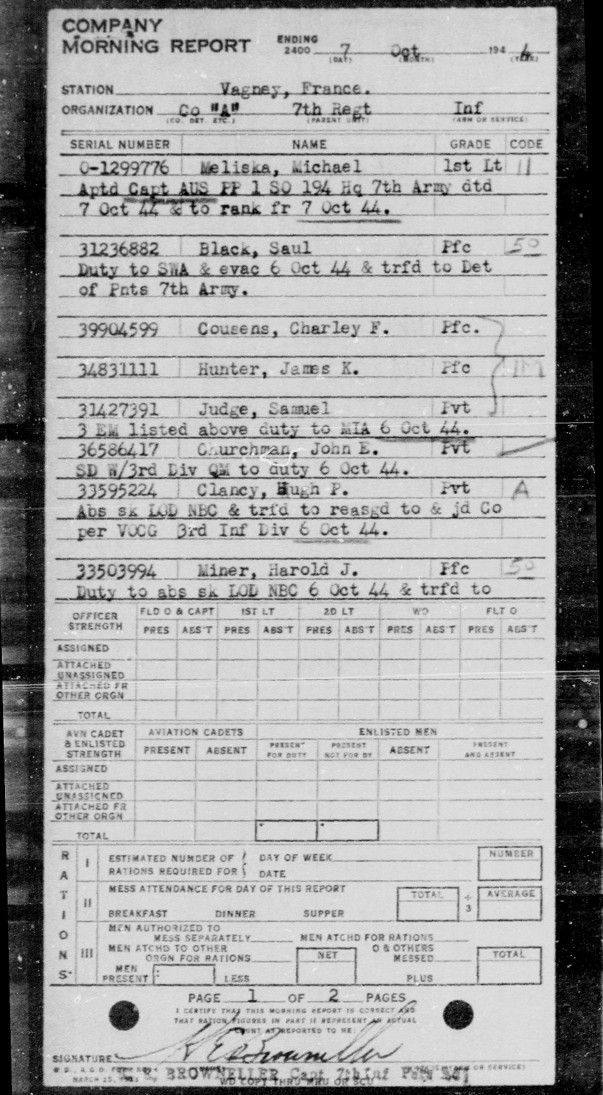
According to Company “A” morning reports, Private Judge was reported missing in action (M.I.A.) on his second day in combat, October 6, 1944. Men were declared M.I.A. if their unit could not account for them during battle. In various cases they were later determined to have been killed, wounded, captured, or temporarily separated from their unit by the chaos inherent in combat. It is unclear if Judge was trapped behind enemy lines during the period he was unaccounted for or whether he was separated from his unit and temporarily ended up with another. A subsequent morning report reported him as returning to duty on October 10. By then, 1st Battalion had been pulled out of the line. On October 12, most of 1st Battalion (except one company) “commenced a 5 day training period in the vicinity of St. AME.”
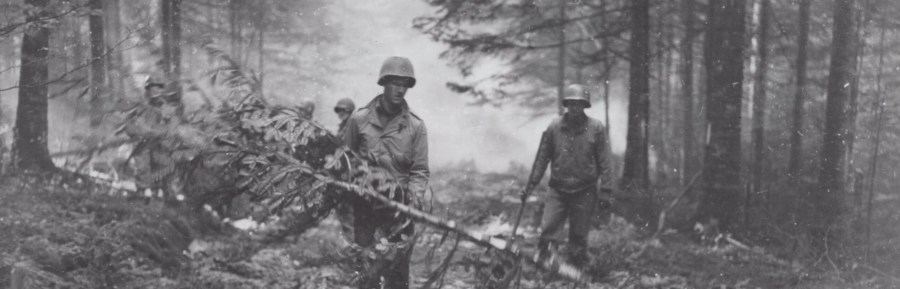
Following the training, the 7th Infantry returned to combat. Once again, Private Judge’s Company “A” was on the 1st Battalion right, Company “B” on the left, and Company “C” in reserve, with orders to cross the line of departure at noon. 1st Battalion’s attack was launched in cooperation with the legendary 442nd Regimental Combat Team, whose soldiers were of Japanese descent. The regimental report stated:
The 7th Inf (Reinf) moved tactically without incident to vicinity of V234593 [48° 13’ 45” North, 6° 42’ 20” East] during the night and morning of 19–20 October; immediately made reconnaissance and formulated plans for combat operations to the EAST. At 1200A [1200 hours Able, the local time zone], 20 October 1944 7th Inf (Reinf) attacked to the EAST against strong enemy resistance, consisting of MG and small arms fire from bunker positions. Enemy opposition became more determined but was defeated.
The regimental journal indicates that Company “A” had a frustrating afternoon, spending hours “pinned down by MG and mortar fire.” They continued to push overnight, but at 0255 hours on October 21, 1944, 1st Battalion reported that “Co A is making very little progress due to darkness – have them move out at first light.”
The regimental operations report stated: “VERVEZELLE and DOMFAING were freed on 21 October and the attack pushed to the NORTHEAST in the direction of St. DIE [Saint-Dié-des-Vosges].” During the next eight days, the 7th Infantry Regiment moved up a narrow river valley surrounded by heavily wooded hills. The operations report stated:
During the period 22–29 October the 7th Inf (Reinf) fought against heavy resistance, succeeded in pock[et]ing an enemy force, captured 730 prisoners, seized the villages of MAILLENFAING [Maillefaing], HALLEY [Hallé], Les ROGUES EAUX [Les Rouges-Eaux], TEMPOIX [Tempois on some maps] and BLAUCHEFONTAIN [Blanche Fontaine].
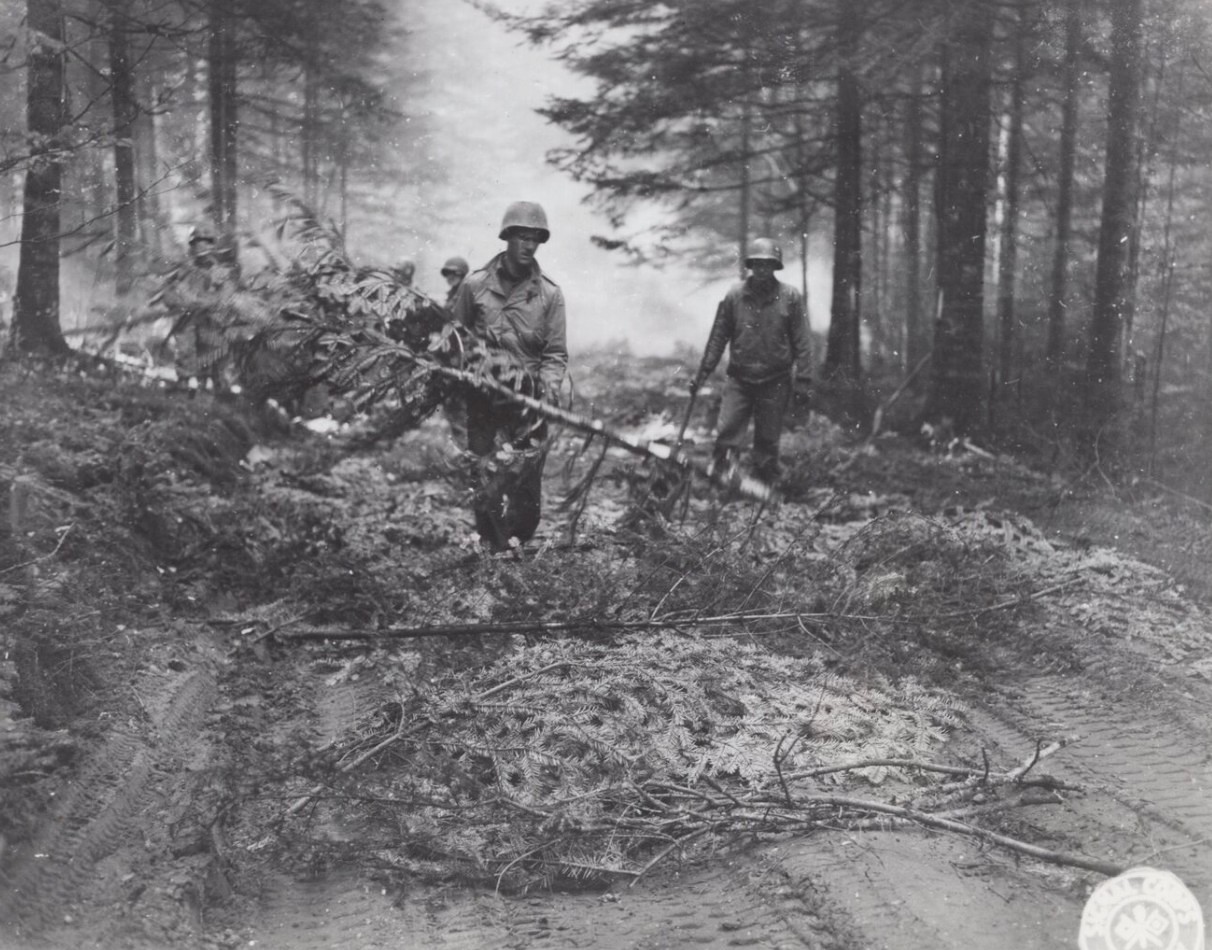
By October 27, 1944, Company “A” had reached the area of a pair of hamlets, Tempoix and Blanche Fontaine. 1st Battalion continued its attack the following day. According to the regimental journal, 1st Battalion reported at 0615 hours on October 28 that Company “A” had begun its attack. Another report at 1030 stated that “Co A has captured 27 EM [enlisted men] and 2 officers – they now occupy a part of the town”—apparently referring to Blanche Fontaine. In another journal entry at 1325 hours, 1st Battalion reported: “Co A has occupied several houses in vicinity 332643 [48° 16’ 31” North 6° 50’ 12” East] – Company B is trying to cut road – […] Co C is to hold high ground[.]”
At 1710 hours, 1st Battalion reported: “Co A still fighting for the buildings to be used as the next Regimental CP [command post] – Co B is still trying to cut the road – Co C is still on the high ground.” Then at 1745:
Co B is at 324639 – one unit is close to the road and can fire on the road and across the valley on the other road – 1 enemy tank is at the nose of the hill – Co A has all the houses at 3364 – snipers are firing into the houses – Co A has a road block to try to cut off the tank[.]
1st Battalion reported their sector quiet as of 2215 hours, and that 24 prisoners, most of them wounded, were on their way to the rear.
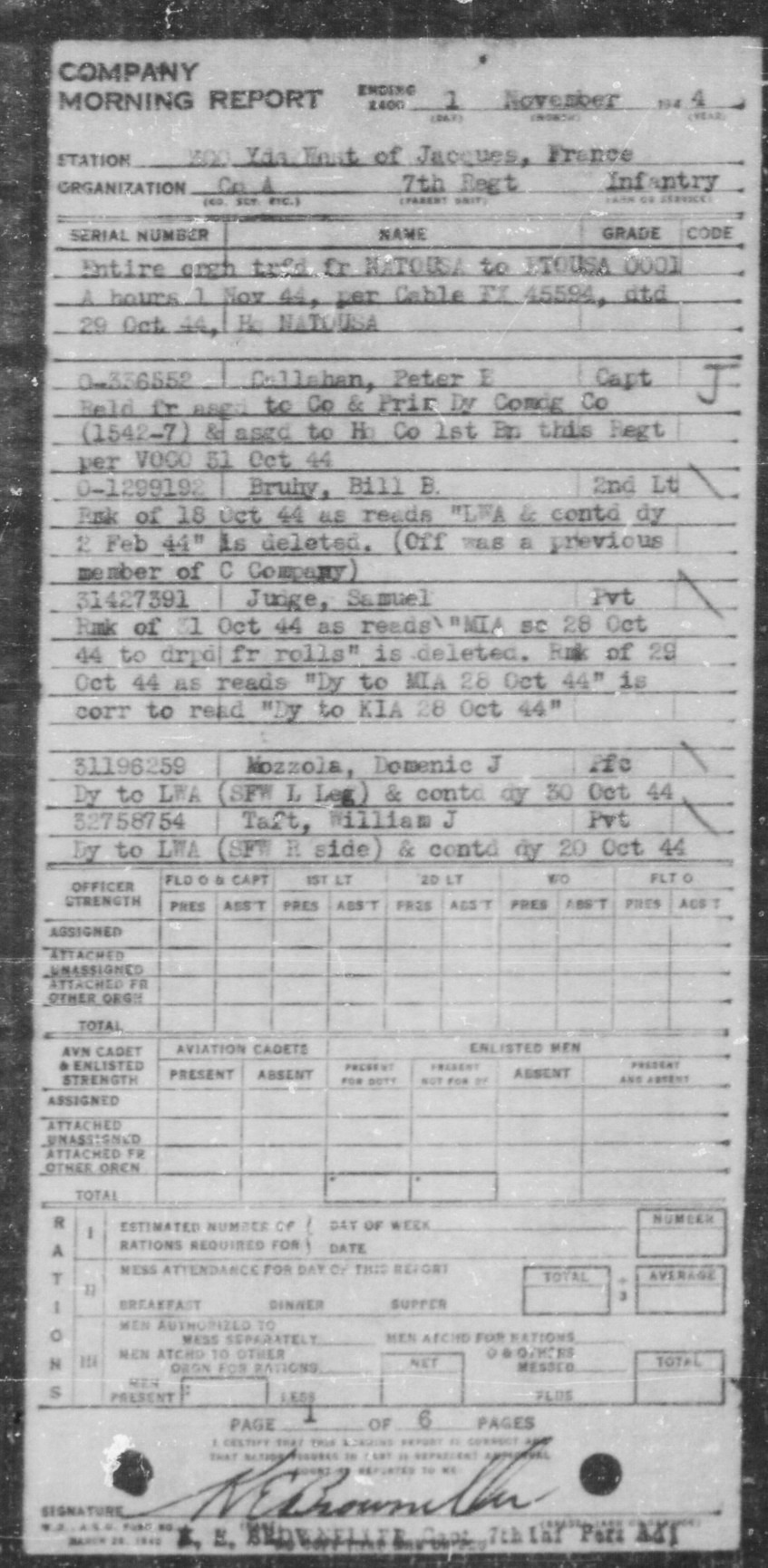
Private Judge was reported missing in action that day, October 28, 1944. It was subsequently determined that he had been killed in action on the date that he went missing.
According to his burial report, Private Judge suffered a fatal gunshot wound to the right side of his chest. He was buried at a U.S. military cemetery at Epinal, France, on November 1, 1944.
After the war, Clara Judge requested that her husband’s body be repatriated to the United States. In accordance with her wishes his casket returned from Antwerp, Belgium, to the New York Port of Embarkation aboard Lawrence Victory. On July 28, 1948, a military escort accompanied the body by train from New York to Brockton. Following his funeral the following day, Private Judge was buried at Melrose Cemetery. His widow did not remarry.
Judge’s name is honored at Veterans Memorial Park in New Castle, Delaware.
Notes
Name
Judge served in the U.S. Army under the name Samuel Judge with no middle initial. The individual military service record submitted to the Public Archives Commission by an unknown individual listed his full name as Samuel George Judge.
Military Occupational Specialty (M.O.S.)
The morning report dated October 5, 1944, listed Private Judge’s M.O.S. as 531, cannoneer. Technically, the U.S. Army considered code 531 obsolete by late 1944. Within antitank units, all 531s were reclassified as 610s, antitank gun crewman, the M.O.S. that Judge held as of January 1944 and which appeared in other documents, including the orders from Headquarters 2nd Replacement Depot dated September 30, 1944, transferring him to the 7th Infantry Regiment. It seems likely then Judge’s M.O.S. did not change during that brief interval, but that his unit in the field had not yet implemented the most up-to-date changes implanted by the War Department.
Acknowledgments
Special thanks to the Delaware Public Archives for the use of their photo.
Bibliography
“Carmella Silicato Triano.” Find a Grave. https://www.findagrave.com/memorial/112132349/carmella-triano
Census Record for Samuel Judge. April 3–10, 1940. Sixteenth Census of the United States, 1940. Record Group 29, Records of the Bureau of the Census. National Archives at Washington, D.C. https://www.familysearch.org/ark:/61903/3:1:3QSQ-G9M1-7755
Census Record for Samuel Judico. April 21, 1930. Fifteenth Census of the United States, 1930. Record Group 29, Records of the Bureau of the Census. National Archives at Washington, D.C. https://www.familysearch.org/ark:/61903/3:1:33SQ-GRHM-74F
Certificate of Birth for Antonina Lo Giudice. March 29, 1919. Record Group 1500-008-094, Birth Certificates. Delaware Public Archives, Dover, Delaware. https://www.familysearch.org/ark:/61903/3:1:S3HT-DWL9-H6T
Certificate of Birth for Maria Congetta Delgindice. Undated, c. September 26, 1914. Record Group 1500-008-094, Birth Certificates. Delaware Public Archives, Dover, Delaware. https://www.familysearch.org/ark:/61903/3:1:S3HT-69CS-7JL
Certificate of Birth for Vittoria Talia Lo Giudice. June 1, 1917. Record Group 1500-008-094, Birth Certificates. Delaware Public Archives, Dover, Delaware. https://www.familysearch.org/ark:/61903/3:1:S3HT-DTMW-W98
Certificate of Death for Anthony Logodice. October 12, 1918. Record Group 1500-008-092, Death Certificates. Delaware Public Archives, Dover, Delaware. https://www.familysearch.org/ark:/61903/3:1:S3HT-D51Q-B4V
Draft Registration Card for Samuel Judge. October 16, 1940. Draft Registration Cards for Massachusetts, October 16, 1940 – March 31, 1947. Record Group 147, Records of the Selective Service System. National Archives at St. Louis, Missouri. https://www.ancestry.com/imageviewer/collections/2238/images/44016_10_00051-00197
Enlistment Record for Samuel Judge. December 6, 1943. World War II Army Enlistment Records. Record Group 64, Records of the National Archives and Records Administration. National Archives at College Park, Maryland. https://aad.archives.gov/aad/record-detail.jsp?dt=893&mtch=1&cat=all&tf=F&q=31427391&bc=&rpp=10&pg=1&rid=2596286
Harrell, Ben. “Report of Operations For Period 1–31 October 1944 (Inclusive).” November 4, 1944. World War II Operations Reports, 1940–48. Record Group 407, Records of the Adjutant General’s Office. National Archives at College Park, Maryland. War Department Archives. https://www.wdarchives.com/archives/record/8370/
Individual Deceased Personnel File for Samuel Judge. 1944–1948. Army Individual Deceased Personnel Files, 1942–1970. Record Group 92, Records of the Office of the Quartermaster General, 1774–1985. National Archives at St. Louis, Missouri.
Individual Military Service Record for Samuel George Judge. Undated, c. 1946. Record Group 1325-003-053, Record of Delawareans Who Died in World War II. Delaware Public Archives, Dover, Delaware. https://cdm16397.contentdm.oclc.org/digital/collection/p15323coll6/id/19475/rec/2
“List or Manifest of Alien Passengers for the United States Immigration Officer at Port of Arrival. S. S. Calabria sailing form Palermo, 12th December, 1913 Arriving at Port of New York Dec 27 1913.” December 27, 1913. Passenger and Crew Lists of Vessels Arriving at New York, New York, June 16, 1897–July 3, 1957. Record Group 85, Records of the Immigration and Naturalization Service. National Archives at Washington, D.C. https://www.ancestry.com/imageviewer/collections/7488/images/NYT715_2245-1002
“Louis Triano Jr.” Find a Grave. https://www.findagrave.com/memorial/135189801/louis-triano
“May Close All Public Places to Check ‘Flu’.” October 1, 1918. The Evening Journal. https://www.newspapers.com/article/200213822/
“Military Funeral Held For Pvt. Samuel Judge.” August 28, 1948. Journal-Every Evening. https://www.newspapers.com/article/samuel-judge-funeral/123696102/
Morning Reports for 394th Replacement Company, 9th Replacement Battalion. July 1944. U.S. Army Morning Reports, c. 1912–1946. Record Group 64, Records of the National Archives and Records Administration. National Archives at St. Louis, Missouri. https://catalog.archives.gov/medialz/partners/st-louis/rg-064/85713825-wwii/85713825_1944-07/85713825_1944-07_Roll-0733/85713825_1944-07_Roll-0733-03.pdf
Morning Reports for 399th Replacement Company. September 1944 – October 1944. U.S. Army Morning Reports, c. 1912–1946. Record Group 64, Records of the National Archives and Records Administration. National Archives at St. Louis, Missouri. https://catalog.archives.gov/medialz/partners/st-louis/rg-064/85713825-wwii/85713825_1944-09/85713825_1944-09_Roll-0676/85713825_1944-09_Roll-0676-07.pdf, https://catalog.archives.gov/medialz/partners/st-louis/rg-064/85713825-wwii/85713825_1944-09/85713825_1944-09_Roll-0676/85713825_1944-09_Roll-0676-08.pdf, https://catalog.archives.gov/medialz/partners/st-louis/rg-064/85713825-wwii/85713825_1944-10/85713825_1944-10_Roll-0440/85713825_1944-10_Roll-0440-06.pdf
Morning Reports for 439th Replacement Company. August 1944. U.S. Army Morning Reports, c. 1912–1946. Record Group 64, Records of the National Archives and Records Administration. National Archives at St. Louis, Missouri. https://catalog.archives.gov/medialz/partners/st-louis/rg-064/85713825-wwii/85713825_1944-08/85713825_1944-08_Roll-0482/85713825_1944-08_Roll-0482-22.pdf
Morning Reports for 535th Replacement Company. August 1944 – September 1944. U.S. Army Morning Reports, c. 1912–1946. Record Group 64, Records of the National Archives and Records Administration. National Archives at St. Louis, Missouri. https://catalog.archives.gov/medialz/partners/st-louis/rg-064/85713825-wwii/85713825_1944-08/85713825_1944-08_Roll-0486/85713825_1944-08_Roll-0486-01.pdf, https://catalog.archives.gov/medialz/partners/st-louis/rg-064/85713825-wwii/85713825_1944-09/85713825_1944-09_Roll-0663/85713825_1944-09_Roll-0663-03.pdf, https://catalog.archives.gov/medialz/partners/st-louis/rg-064/85713825-wwii/85713825_1944-09/85713825_1944-09_Roll-0663/85713825_1944-09_Roll-0663-04.pdf, https://catalog.archives.gov/medialz/partners/st-louis/rg-064/85713825-wwii/85713825_1944-09/85713825_1944-09_Roll-0663/85713825_1944-09_Roll-0663-05.pdf, https://catalog.archives.gov/medialz/partners/st-louis/rg-064/85713825-wwii/85713825_1944-09/85713825_1944-09_Roll-0663/85713825_1944-09_Roll-0663-06.pdf, https://catalog.archives.gov/medialz/partners/st-louis/rg-064/85713825-wwii/85713825_1944-09/85713825_1944-09_Roll-0663/85713825_1944-09_Roll-0663-07.pdf
Morning Reports for 2645th Replacement Company. August 1944. U.S. Army Morning Reports, c. 1912–1946. Record Group 64, Records of the National Archives and Records Administration. National Archives at St. Louis, Missouri. https://catalog.archives.gov/medialz/partners/st-louis/rg-064/85713825-wwii/85713825_1944-08/85713825_1944-08_Roll-0486/85713825_1944-08_Roll-0486-01.pdf
Morning Reports for Company “A,” 7th Infantry Regiment. October 1944 – November 1944. U.S. Army Morning Reports, c. 1912–1946. Record Group 64, Records of the National Archives and Records Administration. National Archives at St. Louis, Missouri. https://catalog.archives.gov/medialz/partners/st-louis/rg-064/85713825-wwii/85713825_1944-10/85713825_1944-10_Roll-0390/85713825_1944-10_Roll-0390-14.pdf, https://catalog.archives.gov/medialz/partners/st-louis/rg-064/85713825-wwii/85713825_1944-10/85713825_1944-10_Roll-0390/85713825_1944-10_Roll-0390-15.pdf, https://catalog.archives.gov/medialz/partners/st-louis/rg-064/85713825-wwii/85713825_1944-11/85713825_1944-11_Roll-0655/85713825_1944-11_Roll-0655-22.pdf
Morning Reports for Company “A,” Service Command Unit No. 1112. December 1943 – January 1944. U.S. Army Morning Reports, c. 1912–1946. Record Group 64, Records of the National Archives and Records Administration. National Archives at St. Louis, Missouri. https://catalog.archives.gov/medialz/partners/st-louis/rg-064/85713825-wwii/85713825_1943-12/85713825_1943-12_Roll-0314/85713825_1943-12_Roll-0314-05.pdf, https://catalog.archives.gov/medialz/partners/st-louis/rg-064/85713825-wwii/85713825_1944-01/85713825_1944-01_Roll-0139/85713825_1944-01_Roll-0139-21.pdf
Morning Reports for Company “D,” 3rd Replacement Battalion, 1st Replacement Regiment. June 1944. U.S. Army Morning Reports, c. 1912–1946. Record Group 64, Records of the National Archives and Records Administration. National Archives at St. Louis, Missouri. https://catalog.archives.gov/medialz/partners/st-louis/rg-064/85713825-wwii/85713825_1944-06/85713825_1944-06_Roll-0205/85713825_1944-06_Roll-0205-12.pdf
Morning Reports for Company “D,” 223rd Infantry Training Battalion. January 1944. U.S. Army Morning Reports, c. 1912–1946. Record Group 64, Records of the National Archives and Records Administration. National Archives at St. Louis, Missouri. https://catalog.archives.gov/medialz/partners/st-louis/rg-064/85713825-wwii/85713825_1944-01/85713825_1944-01_Roll-0372/85713825_1944-01_Roll-0372-19.pdf
“Seventh Infantry Unit Journal For Period 1–31 October 1944.” October 1944. World War II Operations Reports, 1940–48. Record Group 407, Records of the Adjutant General’s Office. National Archives at College Park, Maryland. War Department Archives. https://www.wdarchives.com/archives/record/8353/
“Soldier Gives Life Overseas; Sailor Missing.” November 17, 1944. Journal-Every Evening. https://www.newspapers.com/article/samuel-judge-kia/123698667/
“Table of Organization and Equipment No. 7-16: Headquarters and Headquarters Company, Infantry Battalion.” War Department, February 26, 1944. Military Research Service website. http://www.militaryresearch.org/7-16%2026Feb44.pdf
“Table of Organization and Equipment No. 7-17: Infantry Rifle Company.” War Department, February 26, 1944. Military Research Service website. http://www.militaryresearch.org/7-17%2026Feb44.pdf
Last updated on September 5, 2026
More stories of World War II fallen:






To have new profiles of fallen soldiers delivered to your inbox, please subscribe below.

