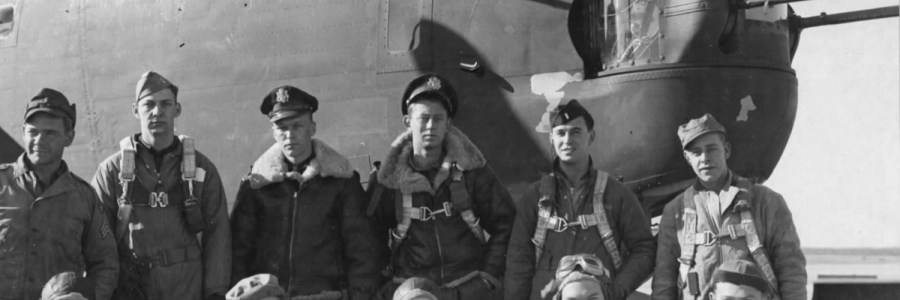
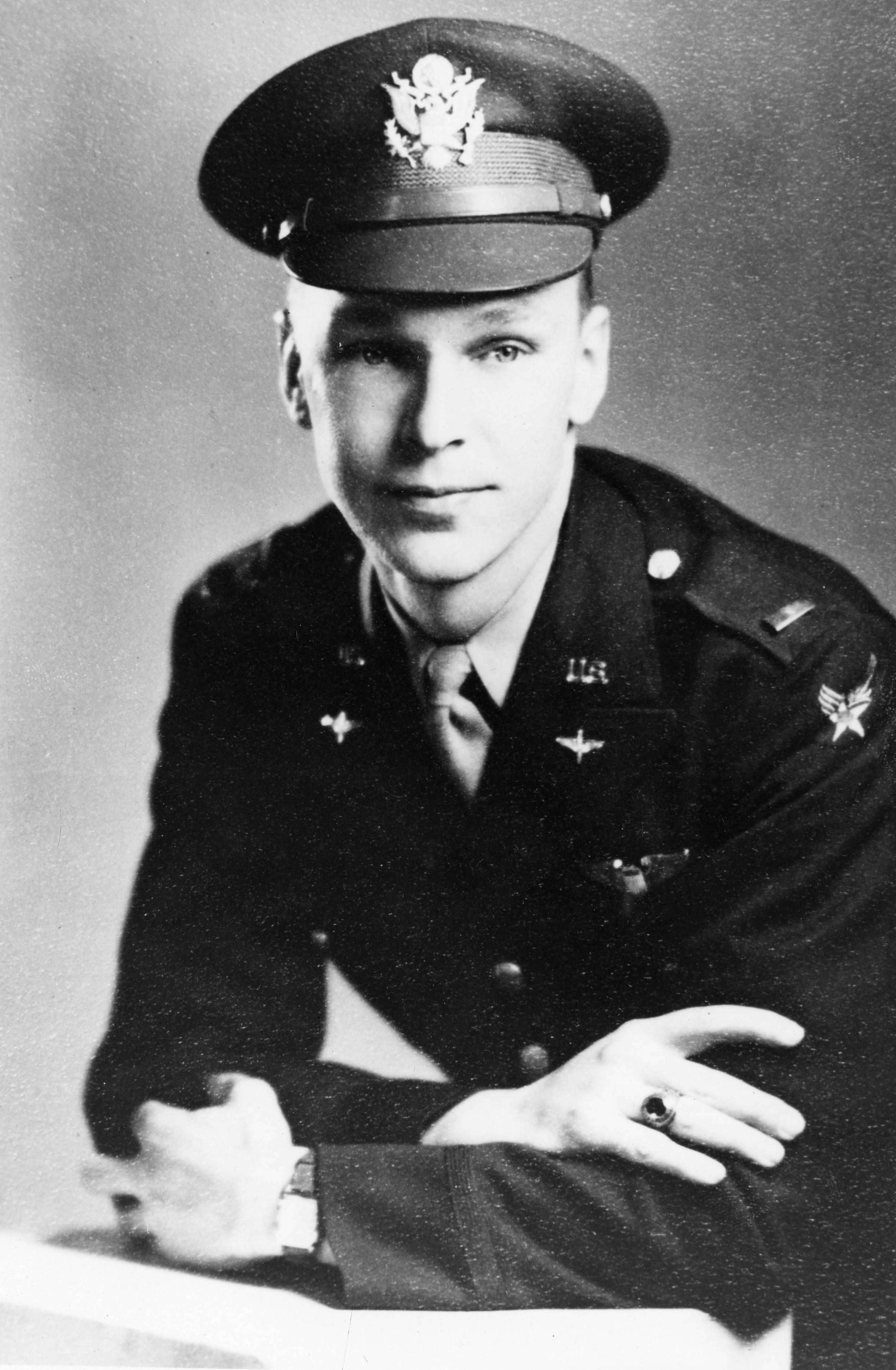
| Hometown | Civilian Occupation |
| Laurel, Delaware | Special inspector for DuPont Company |
| Branch | Service Number |
| U.S. Army Air Forces | Enlisted 13106613 / Officer O-818123 |
| Theater | Unit |
| European | 849th Bombardment Squadron (Heavy), 490th Bombardment Group (Heavy) |
| Military Occupational Specialty | Campaigns/Battles |
| 1091 (pilot, B-17) | European air campaign |
| Awards | Entered the Service From |
| Air Medal with three oak leaf clusters | Laurel, Delaware |
Early Life & Family
Louis James Deputy was born on January 4, 1918, in Laurel, Delaware. He was the third child of Willard Francis Deputy (1877–1938) and Pearl Esther Lowe Deputy (1882–1958). His father was a lumber dealer. He had two older sisters, Helen Kirk Deputy (later Ellis, 1906–1993) and Mary Ellen Deputy (later Fowler, 1912–2000). Deputy’s name appears in a record of baptisms by the Centenary Methodist Church in Laurel, though probably by 1931 and definitely by World War II, the Deputy family was Episcopalian and members of St. Philip’s Episcopal Church, also in Laurel. His mother told the War Department that “my son was a member of the vestry and active in his Church.”
The Deputy family was recorded in censuses taken in January 1920 and April 1930 living on 8th Street in Laurel. This was likely 216 West 8th Street, which was Deputy’s address at the time of the next census in April 1940 as well as his address of record when he entered the military.
Journal-Every Evening stated that Deputy’s father “was elected state senator in 1926 and served to 1930” and after retiring from the lumber business and was appointed collector of Internal Revenue for the District of Delaware by President Franklin Roosevelt. After years of declining health, the elder Deputy retired on June 30, 1938, dying soon after on August 9.
Deputy’s personnel file not only survived the 1973 National Personnel Records Center fire largely intact, but its contents are unusually thorough for the era, providing both prewar biographical information and extensive details about his training.
Deputy told the Army that he was president of his high school class. He wrote that he “Raised and trained bird dogs” as a hobby, and that he played basketball and football, swam, and boxed.
After graduating from Laurel High School in 1935, Deputy studied history and government at the University of Virginia. He completed three and a half years of college before dropping out in 1940. He was a member of the Phi Delta Theta fraternity. He also studied the Spanish language, rating his abilities as fair.
Perhaps wisely, in his application for aviation cadet training, Deputy did not mention that in early 1936 he had become president of the University of Virginia’s chapter of a satirical organization known as the Profiteers of Future Wars, which facetiously advocated for increased weapons production while supposedly arranging to provide its members with “free medical exams to prove they have flat feet, astigmatism, partial deafness or other disability exempting them from military service.” Ironically, Deputy did in fact have a mild case of pes planus, though it did not prevent him from entering the military when he later chose to do so.
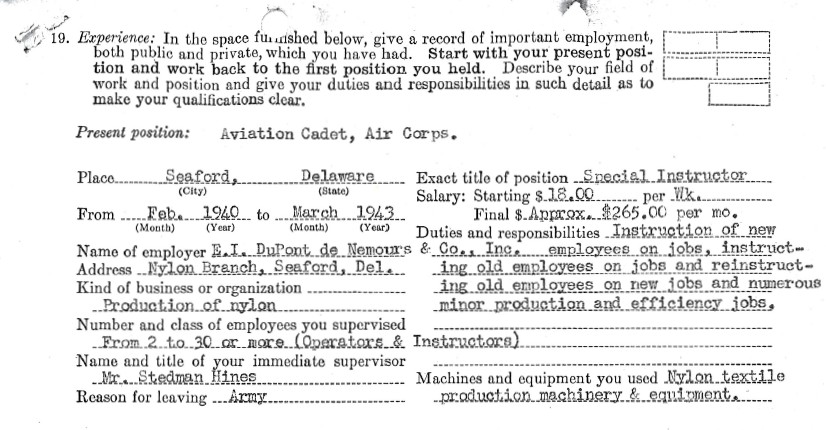
Deputy was hired by the DuPont Company on February 2, 1940, working at the company’s very first nylon factory, which had opened just a few months earlier in Seaford. His starting pay was $18 per week (about $430 in 2026 dollars), but within three years his salary had more than tripled. As of March 1943, he was making about $265 per month (about $5,250). As a special instructor, he taught new employees at the factory and retrained existing employees.
When Deputy registered for the draft on October 16, 1940, the registrar described him as standing about five feet, 10½ inches tall and weighing 147 lbs., with blond hair and blue eyes.
Military Training
Deputy’s first attempt to become a military pilot was unsuccessful. On May 12, 1941, after working a night shift, he drove four hours to Camden, New Jersey, where the Flying Cadet Examining Board (Traveling) was screening prospective candidates for the Air Corps. Bleary-eyed, he failed the vision portion of a physical exam because the examiner assessed him as having accommodative insufficiency and convergence insufficiency. The physician recommended against Deputy being reexamined. The former chapter president of Profiteers of Future Wars must have appreciated the irony. However, he later got another chance after the American entry into World War II.
Deputy had an appendectomy on April 13, 1942, but made a full recovery. Later that same year, on September 4, he applied to become an aviation cadet in the Army Air Forces (A.A.F.). This time he passed the physical including the vision exam. That afternoon, he appeared before the Aviation Cadet Examining Board, Baltimore, Maryland, which found that he was “qualified mentally, morally and physically for Aviation Cadet Training.”
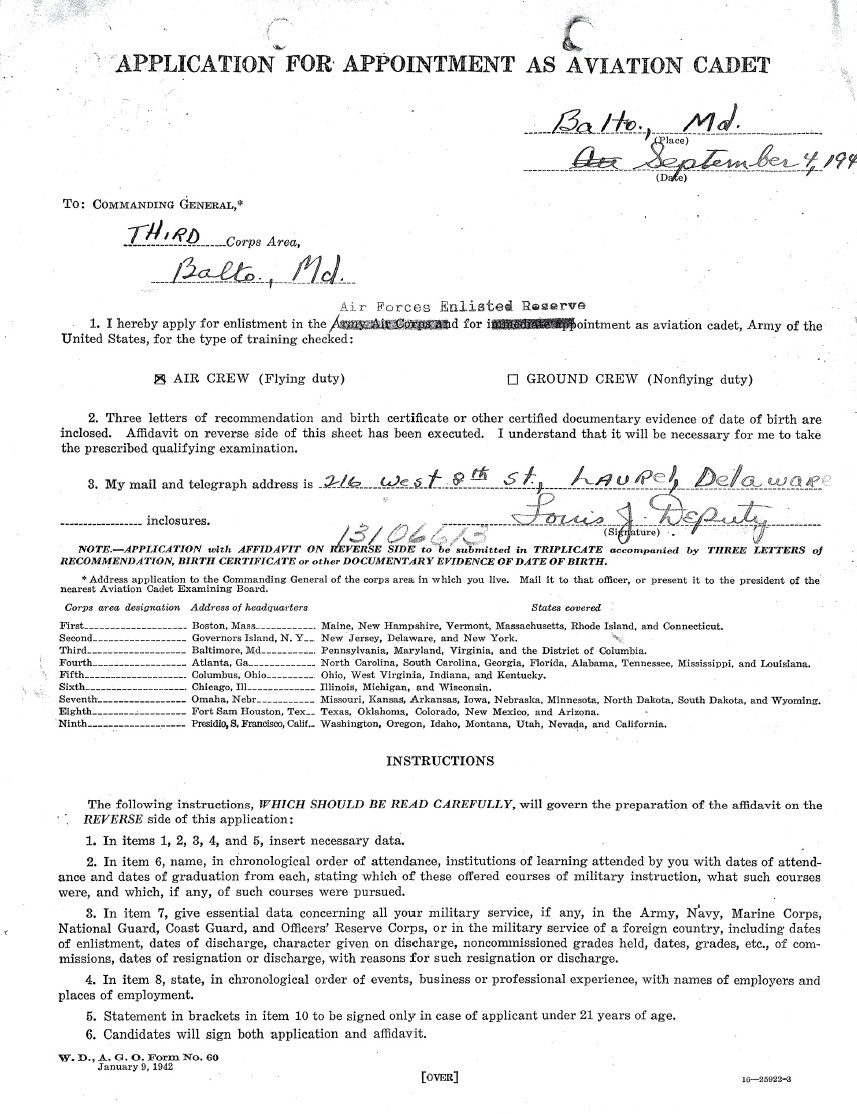
On September 8, 1942, Deputy enlisted as a private in the A.A.F. in Baltimore. He was placed in the Air Forces Enlisted Reserve on inactive duty for a few months before going on active duty as an aviation cadet on March 2, 1943, in Baltimore. That same day, he departed Baltimore by train en route to the A.A.F. Classification Center, Nashville, Tennessee.
On March 6, 1943, Deputy submitted his preference list for training. Most of all, he wanted to become a pilot, with navigator and bombardier training as his second and third choices respectively. At the time of a medical exam on March 15, he stood five feet, 9¾ inches tall and weighed 143 lbs. A set of orders dated March 31 assigned Deputy to pilot training at Maxwell Field, Alabama.
Deputy had to complete four phases to earn his wings and a commission: preflight, primary, basic, and advanced. On or about April 3, 1943, Deputy began his preflight training with Class 43-K at Maxwell Field. Unlike the three other phases, this was entirely ground school. Topics included aircraft recognition, mathematics, physics, maps, War Department publications, code, customs and courtesies, and discussion of ground, air, and naval forces. Deputy performed well, compiling a general average of 90.2%.
On May 26, 1943, Aviation Cadet Deputy was attached unassigned to the 57th A.A.F. Flying Training Detachment, A.A.F. Contract Flying School, Greenville Aviation School, Ocala, Florida. He arrived there and began primary flight training on June 1. Ground school topics included aircraft engines, navigation, meteorology, aircraft identification, chemical warfare, military courtesy, and infantry drill. Cadets had to achieve a minimum score of 70% in each subject, or a grade of satisfactory for pass/fail topics, in order to advance. Deputy performed well, scoring a general average of 89%. He logged 66 hours of flight time in a PT-17 trainer, of which 39 hours and seven minutes were solo.
Per Special Orders No. 140, Headquarters 57th Flying Training Detachment, dated July 24, 1943, Deputy and his class were detached from that unit and attached to the A.A.F. Basic Flying School, Cochran Field, Macon, Georgia. He departed Ocala by train late on July 28. Deputy began the basic flight training phase at Cochran Field around July 30. Ground school topics included aircraft recognition, radio code and communications, meteorology, and infantry drill, with Deputy scoring an 87%. During his basic phase, he flew another 71 hours and 20 minutes, including 40 hours and five minutes solo in BT aircraft.
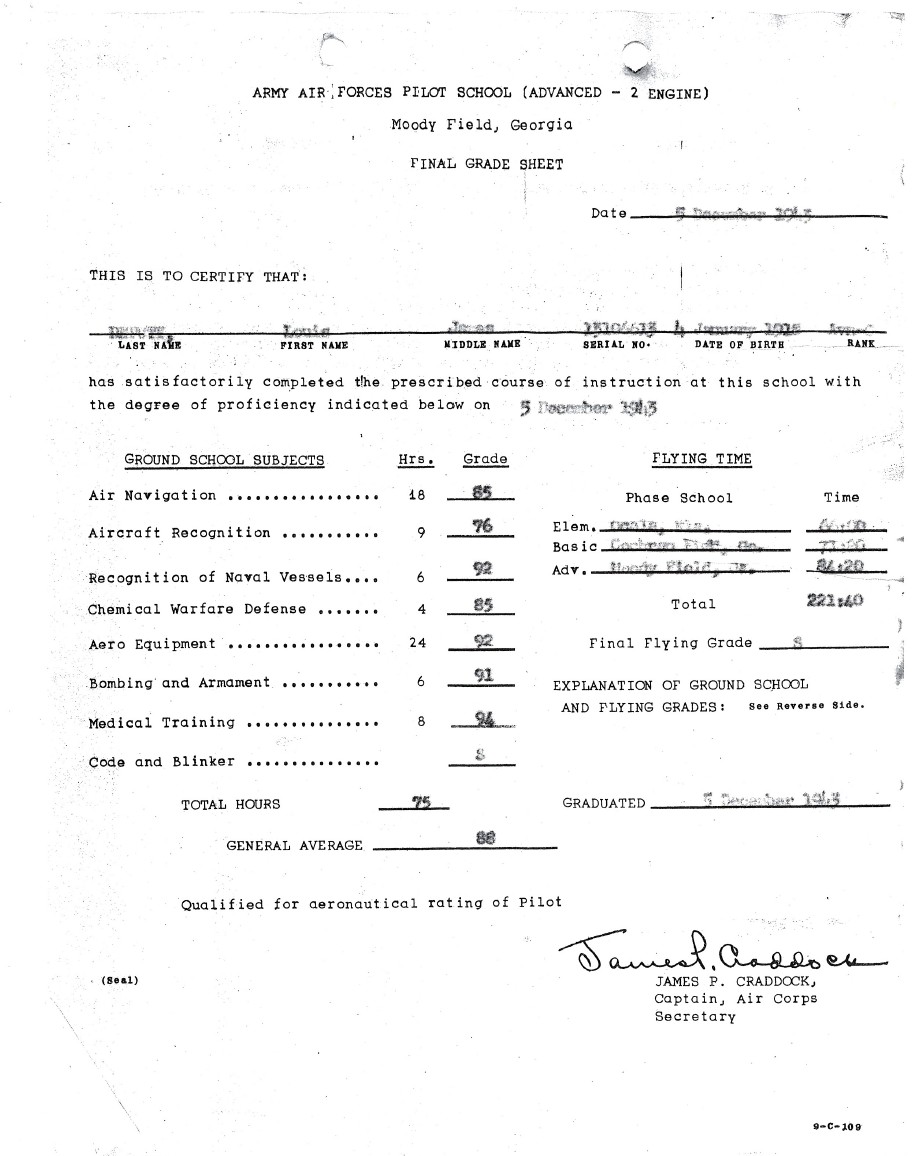
Special Orders No. 258, Headquarters Cochran Field, dated September 28, 1943, dispatched Aviation Cadet Deputy to Moody Field, Valdosta, Georgia, for advanced twin-engine flight training, with a report date on or about October 1. He resumed his training there on October 3. During the advanced phase, Deputy accumulated another 84 hours and 20 minutes of flight time, for a total of 221 hours (or 221 hours and 40 minutes according to another document) of flight time. He also completed 75 hours of ground school, with subjects including navigation, aircraft and naval vessel identification, aeronautical equipment, medical training, with an overall score of 88%. He received his instrument rating on November 19, 1943.
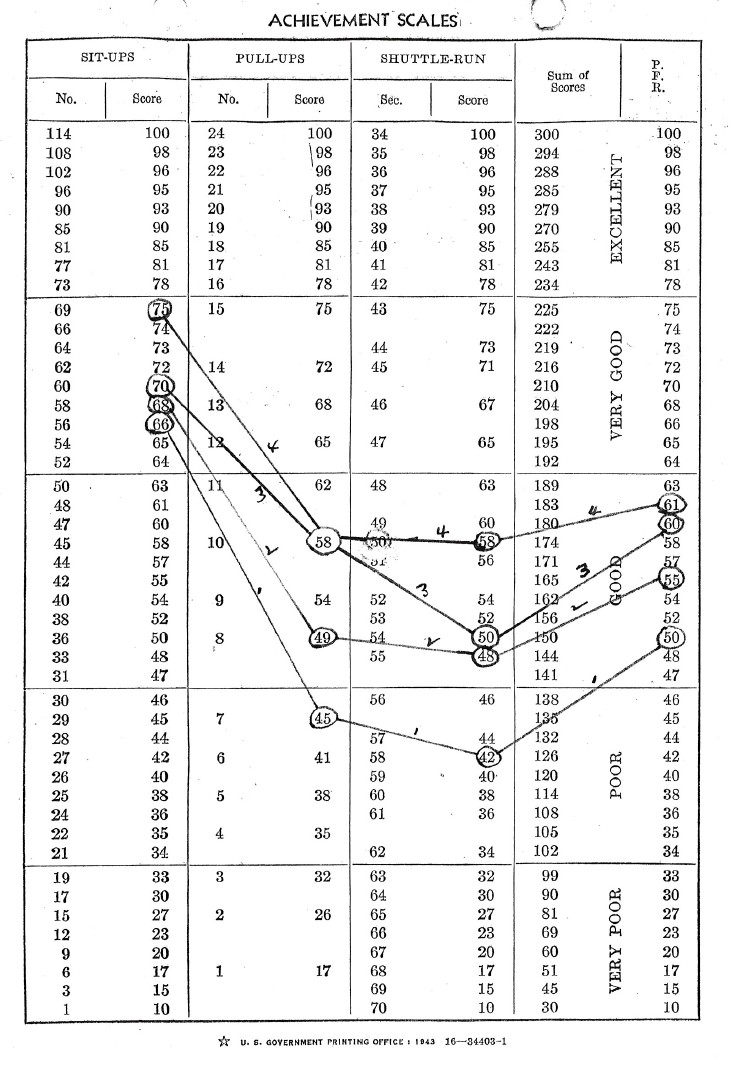
During his training, Deputy put on six pounds and continually improved his physical fitness scores during each phase. At that time the achievement scale was based on sit-ups, pull-ups, and the shuttle run. His overall physical fitness scores were rated as good—the middle category of five—during each phase, with sit-ups being his strongest event.
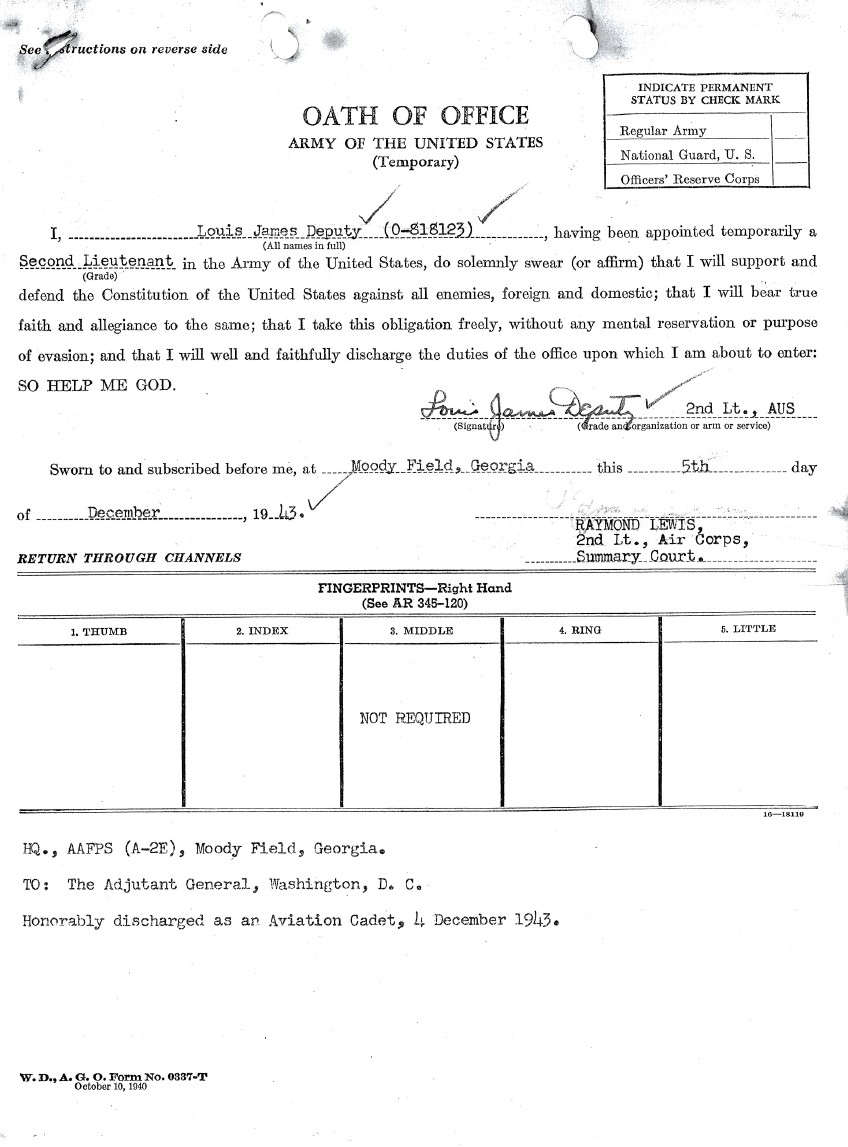
Aviation Cadet Deputy, along with those members of Class 43-K who had successfully completed their pilot training, were honorably discharged on December 4, 1943, as a formality to accept their commissions.
Deputy was commissioned as a 2nd lieutenant on December 5, 1943. That same day, he was rated with military occupational specialty (M.O.S.) code 1022, bomber pilot, two engine. He was ordered to report to the 18th Replacement Wing, Army Air Base, Salt Lake City, Utah, by December 18.
By December 29, 1943, 2nd Lieutenant Deputy had been assigned as copilot in Crew No. 1879 led by 2nd Lieutenant Vincent R. Bullard (1921–1982). On that date, they were among heavy bomber crews dispatched to Davis–Monthan Field, Tucson, Arizona, where they were attached to the 32nd Base Headquarters and Air Base Squadron. The crew was not complete, lacking a navigator and two gunners.
On January 5, 1944, Deputy flew aboard a Consolidated B-24 Liberator for the first time, apparently as a passenger. The next day, he took the controls himself. He accumulated 42 hours of flight time as copilot that month over the course of 17 flights, mostly flying in old B-24Ds. On January 24, he passed a test in a low-pressure chamber simulating a high-altitude flight.
On February 1, 1944, 2nd Lieutenant Deputy and his crew were transferred to the 490th Bombardment Group (Heavy), U.S. Second Air Force, at the Army Air Base, Mountain Home, Idaho, a unit equipped with the Consolidated B-24 Liberator heavy bomber. They departed Tucson by train the following day. On February 5, his crew was further assigned to the group’s 849th Bombardment Squadron (Heavy). His crew was now nine men strong but still lacked a navigator. The group continued intensive training, both in ground school and when the bitter winter weather was suitable to permit flying. Deputy logged only 25 hours, 20 minutes of flight time that month. The group’s weekly training bulletins emphasized the importance of practicing the high-altitude flying that they would soon be performing in combat.
March 1944 was a busy month, the 490th Bomb Group both continuing its training and beginning preparations to go overseas. The 849th Bomb Squadron report for the month noted that “One thousand mile navigation missions, and celestial navigation missions were performed by all crews.” Lieutenant Deputy logged 70 hours, 20 minutes of flight time. 20 of those flights were in B-24s, with another 13 in the Cessna UC-78 Bobcat. He also spent five hours in a Link trainer for instrument practice. On March 20, Deputy’s M.O.S. code changed to 1024, pilot, four engine. On March 25, he fired 40 rounds with the Colt M1911 .45 pistol for familiarization.
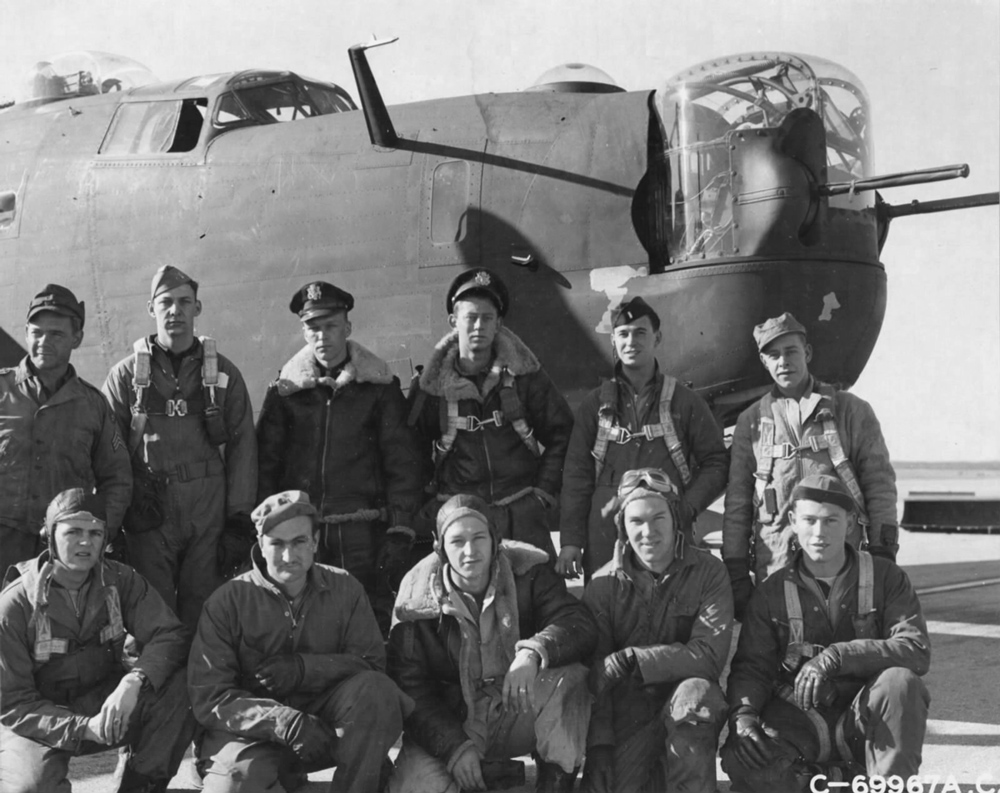
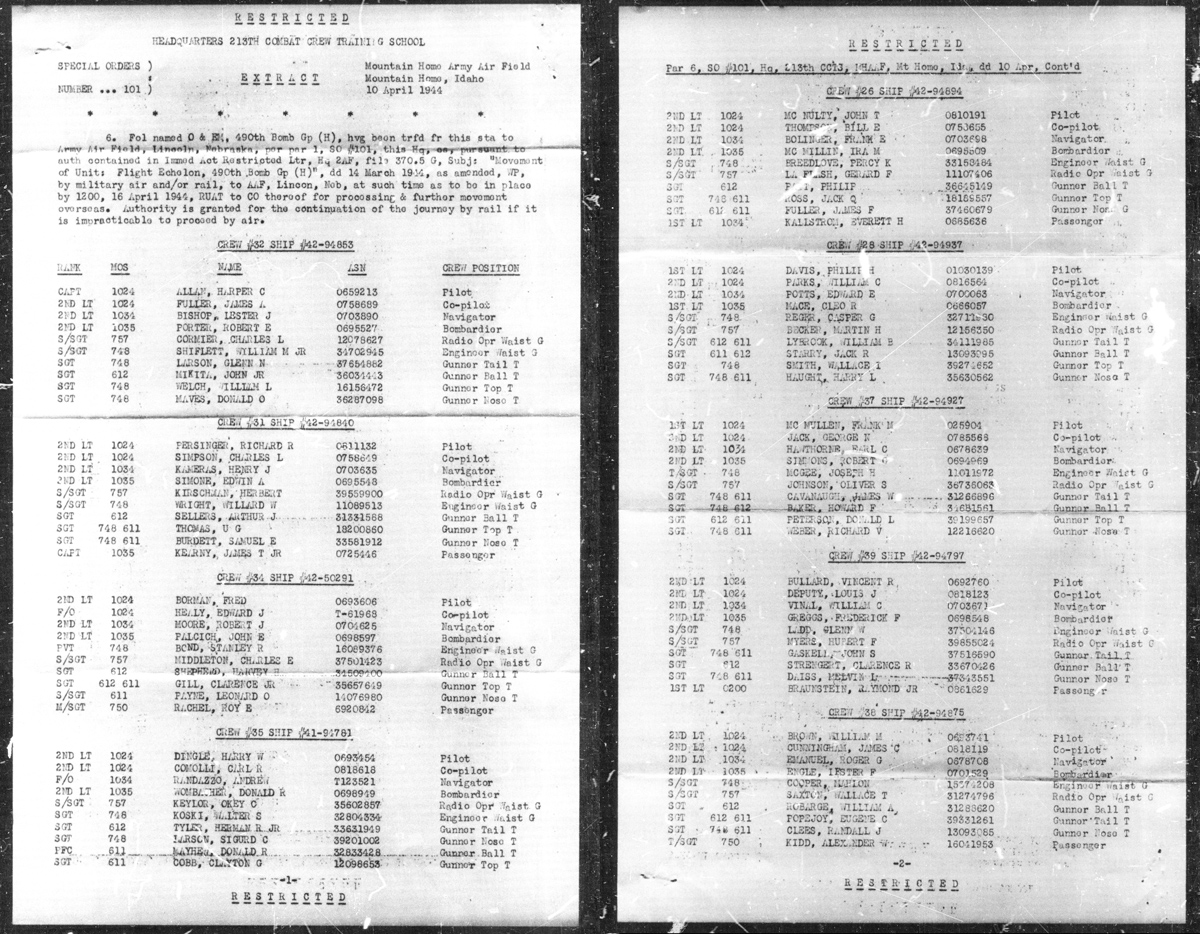
A set of orders dated April 10, 1944, dispatched 490th Bomb Group crews including Deputy’s—now fully staffed and designated Crew No. 39—to the Army Air Base, Lincoln, Nebraska. The orders specified movement by air or rail so that they would arrive by noon on April 16, though squadron morning reports indicate that Deputy and the others did not depart Mountain Home until April 18. At Lincoln, movement orders were issued on April 22. Bullard and Deputy would pick up a B-24H, serial number 42-94797, and with the rest of their crew plus one passenger, proceed to Morrison Field, West Palm Beach, Florida, to go overseas.
Deputy’s mother’s statement for the Public Archives Commission provided a detailed description of his overseas journey, which was made “with the assistance of his Navigator,” 2nd Lieutenant William C. Vinal (1920–2000?). Her statement is largely consistent with Deputy’s flight records, which provides the date and flying times but not origin or destination.
Deputy’s mother wrote that on April 30, 1944, her son’s crew took off from Morrison Field aboard their B-24, nicknamed Yankee Maid, landing at Borinquen Field, Puerto Rico. The following day, they flew to Trinidad. On May 2, they flew to Belém, Brazil, and then the following day to Fortaleza, Brazil. On May 4, Deputy and his crew flew 11 hours and 45 minutes across the Atlantic Ocean to Dakar, Senegal. They continued their journey north to Marrakesh, Morocco, on May 7.
On May 8, 1944—it was probably evening—Deputy and his crew took off for the United Kingdon. Their flight, which presumably avoided both neutral Spain and occupied France, took 11 hours and 50 minutes, of which eight hours, 30 minutes was at night. The entire seven-flight journey from Florida involved 53 hours, 15 minutes in the air and covered over 8,000 miles.
On May 9, 1944, Deputy and his crew arrived at the 490th Bomb Group’s new home, U.S.A.A.F. Station 134 at Royal Air Force Eye in Suffolk, England. The group was assigned to the 93rd Combat Bombardment Wing, 3rd Bombardment Division, U.S. Eighth Air Force. That same day, Deputy’s M.O.S. code changed to 1092, B-24 pilot. One week later, on May 16, orders came down from Headquarters U.S.A.A.F. Station 134, likely related to the upcoming invasion of Normandy, canceling all leaves and passes for recreational purposes, and with limited duty-related exceptions, restricting all personnel to the post.
Combat Over Europe
On May 31, 1944, 2nd Lieutenant Deputy participated in his squadron’s first combat mission, a raid on Jemelle, Belgium. Most of the 490th Bomb Group’s missions during the following month were tactical raids on targets in occupied France, in support of the invasion of Normandy. Deputy’s second mission, on June 6, D-Day in Normandy, was supposed to be against Caen, France, but was recalled in the air.
Deputy flew eight or nine combat missions in June 1944, including two in a single day, June 20. The first was the 490th Bomb Groups’ only strategic mission of the month, against an oil refinery at Misburg, Germany, while the second was a “Noball” raid on a V-1 flying bomb launch site in France. Group casualties in June were light, with one plane and crew lost during a mission and another that crash landed in England due to damage from enemy antiaircraft fire and fighters. Including non-combat missions, Deputy logged 15 flights totaling 66 hours during the month.
2nd Lieutenant Deputy was awarded the Air Medal per General Orders No. 3, Headquarters 3rd Bomb Division (Heavy), dated June 21, 1944. He was later awarded oak leaf clusters to his Air Medal in lieu of additional awards on July 20, July 30, and September 12, 1944.
2nd Lieutenant Deputy flew 10 or 11 combat missions during the month of July 1944. 490th Bomb Group casualties were again light, with one crew interned after landing in neutral Switzerland. There were also a total of four fatalities resulting from a pair of crashes at the field.
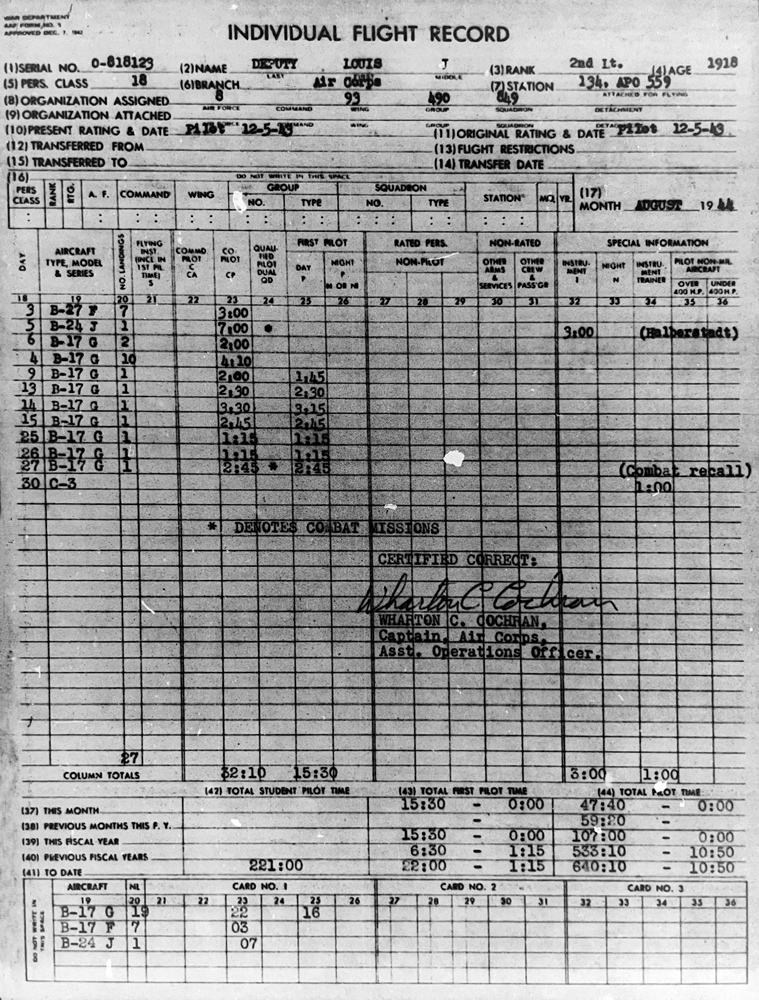
Deputy’s last mission flying in the B-24 Liberator was his 20th, against Halberstadt, Germany, on August 5, 1944. That month, the 490th Bomb Group converted from the B-24 Liberator to the Boeing B-17 Flying Fortress, the Eighth Air Force’s other mainstay four-engine bomber. Deputy made his first seven flights in a B-17 on August 3, shortly before his last B-24 mission. Transition training both on the ground and in the air was intense and marred by a midair collision on August 13 which cost 10 men from the 848th Bomb Squadron their lives.
During the transition period, he was also given increased responsibility. Beginning on August 9, 1944, he began logging flight hours as first pilot as well as copilot, with flight time roughly divided in half between the two. This suggests he was a candidate to become a first pilot himself if the opportunity presented itself due to illness or casualty, or in the event of a second tour of duty in combat. That month he logged 47 hours, 40 minutes of flight time including 15 hours, 30 minutes as first pilot.
By August 15, 1944, when he went on leave, Deputy’s M.O.S. code had changed to 1091, B-17 pilot. He returned to duty on August 23. Deputy flew in the 490th Bomb Group’s first combat mission in the B-17 during an August 27 raid on Genshagen, Germany, though it was recalled.
September 1944 was a frustrating month. Deputy’s next mission, on September 1, was also recalled, but two planes and crews from his squadron were lost in a midair collision. The 490th Bomb Group also lost a crew during a September 9 mission to Monheim, Germany, and the following day’s mission failed after the premature release of ordnance by the lead plane due to an equipment malfunction caused the rest of the bombers to also release. The group also lost two more crews during a September 13 mission to Ludwigschafen, Germany. Then, another pair of the group’s planes collided in midair on September 25, though unlike the previously two accidents they managed to land safely. It is unclear if the transition from the familiar B-24 to the B-17 played any role in this remarkable string of incidents.
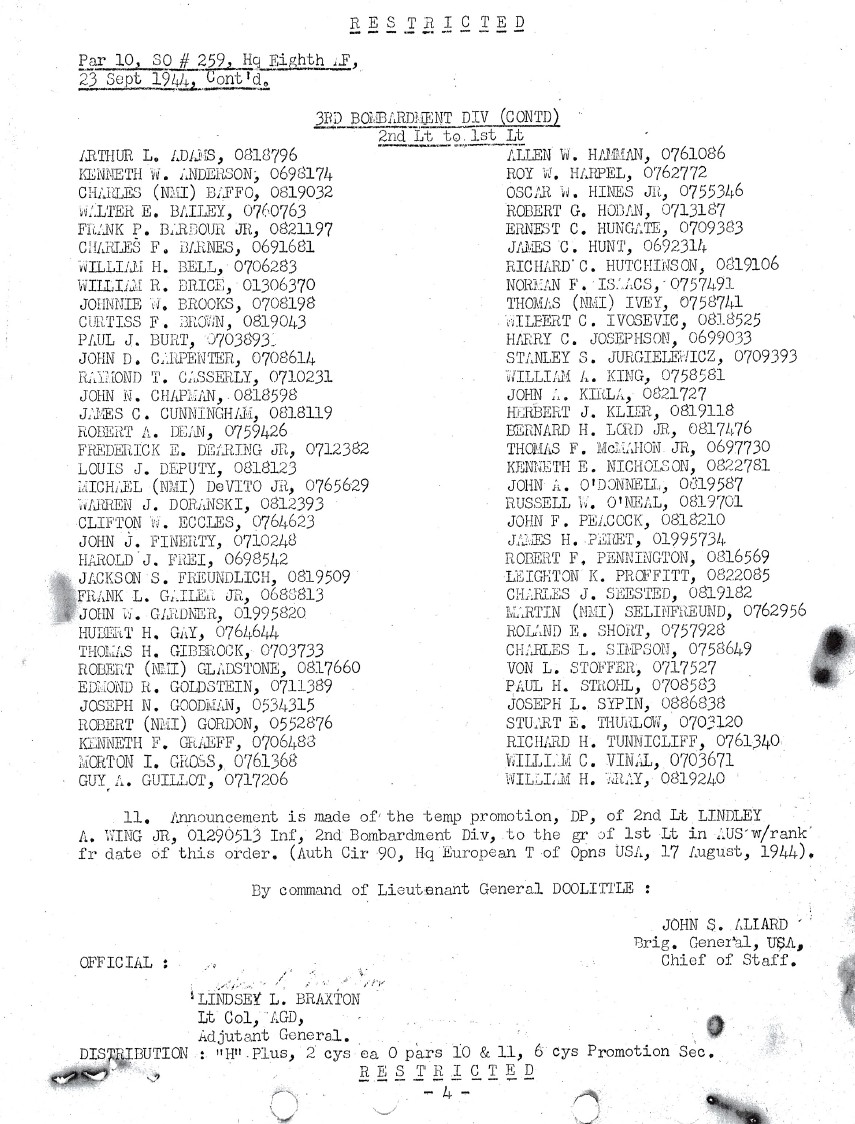
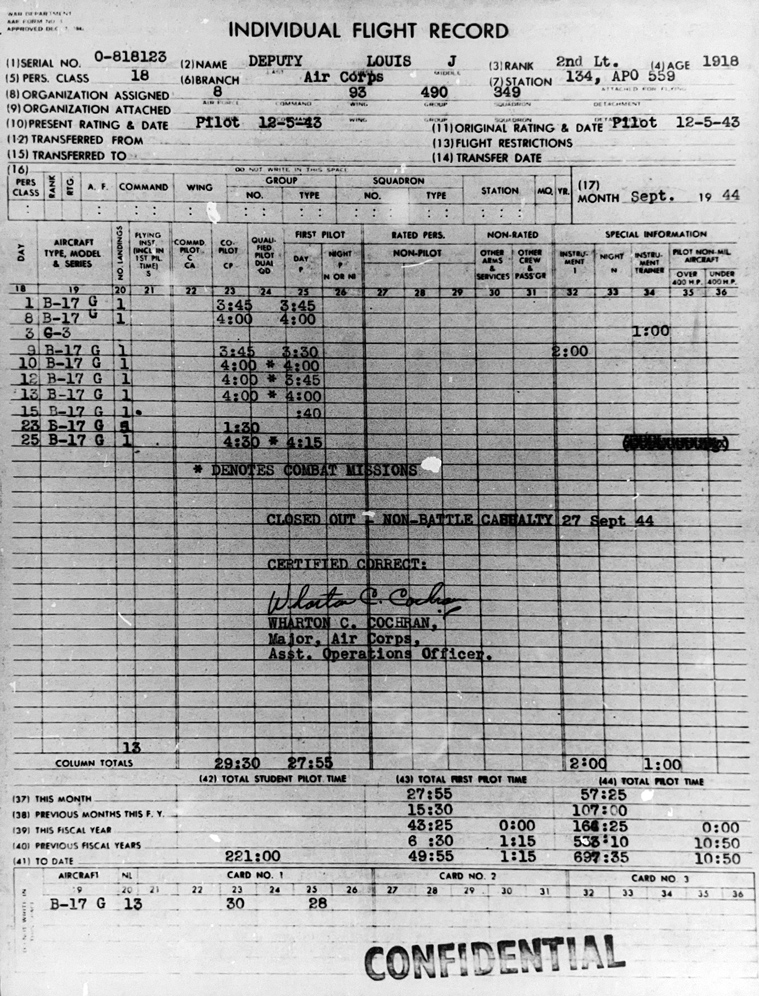
Deputy was promoted to 1st lieutenant per Special Orders No. 259, Headquarters Eighth Air Force, dated September 23, 1944, though it appears that word did not reach his unit for four more days. He flew his last combat mission against Ludwigschafen on September 25. By the end of that mission, he had been credited with 57 hours and 25 minutes of flight time that month, including 27 hours and 55 minutes as first pilot. Including his time as a student, he had a total of 697 hours and 35 minutes as a pilot under his belt.
Though three missions recalled in the air did not count, leaving him with credit for 25 missions, he was most of the way through the 35 combat missions necessary to complete his tour of duty.
Final Flight
On September 27, 1944, 1st Lieutenant Deputy joined a crew led by 1st Lieutenant Michael H. Primus (1918–1944) for a night training flight aboard a B-17G, serial number 43-37776, nicknamed Heavenly Body. Primus had gotten his wings on August 30, 1943. His crew was assigned to the 849th Bomb Squadron on December 31, 1943, about a month before Deputy. It was both Deputy and Primus’s first time flying the B-17 at night. Each had logged 22 hours and 10 minutes of night flight time in the prior six months, though none in the prior month.
In addition to Primus’s crew, there were three men from the 1st Mobile Training Unit (B-17), who according to the crash investigators were “instructors getting in their flying time.”
Deputy’s mother wrote that Deputy was substituting for Primus’s copilot, who was sick that night. Unit records indicate that Primus’s copilot was 1st Lieutenant William A. King (1916–1997) at the time the squadron went overseas, though morning reports do not list him as sick at the time of the crash.
Investigators wrote: “The pilot and crew were briefed for a night practice flight including three (3) landings at the home base and three (3) hours of night navigation.” The moon was a waxing gibbous, almost three-quarters illuminated.
A local miner, Albert Squires, later recalled that around 2040 hours,
I was cycling from Nailstone Wood, Colliery, along Grange Road, Nailstone in company with Ernest Widdowson and Albert Price. I saw an aeroplane with lights on coming along from a Northerly direction. It was gradually gliding down as though about to land. The engines of the aircraft were running and did not sound to be in trouble. I said to them he’s dropping and we turned in that direction. About 3 minutes later there were two red flashes as though he had thrown flares out. Shortly afterwards there was a terrific explosion. We jumped off our cycles and raced across the field to where the aircraft had crashed. It had no doubt crashed into some trees and the trees and the aircraft were all in flames. Ammunition was exploding and bullets were flying straight through the trees. I crawled up to within about 8 yards of the plane. I could not get any closer because of the heat. We were the first to get to it but we were unable to do anything for the crew. We were there at the crash within about 7 minutes of the explosion and if it had not been for the trees the aircraft would have landed in the field quite all right.
Widdowson’s account was similar to Squires’s with one key difference:
I saw an aircraft coming in from a North Easterly direction, it had lights on and the engines were running and the machine did not appear to be in difficulties at all. The aircraft then swerved round to the left and appeared to nose dive. […] When the aircraft started to nose dive the engines started to race and it was then travelling too fast to make a proper landing.
All 12 men aboard, including Lieutenant Deputy, were killed in the crash. While Squires’s account suggests the B-17 crashed because it clipped the trees on approach to the airfield, Widdowson’s account suggests it may have struck the trees after stalling at low altitude.
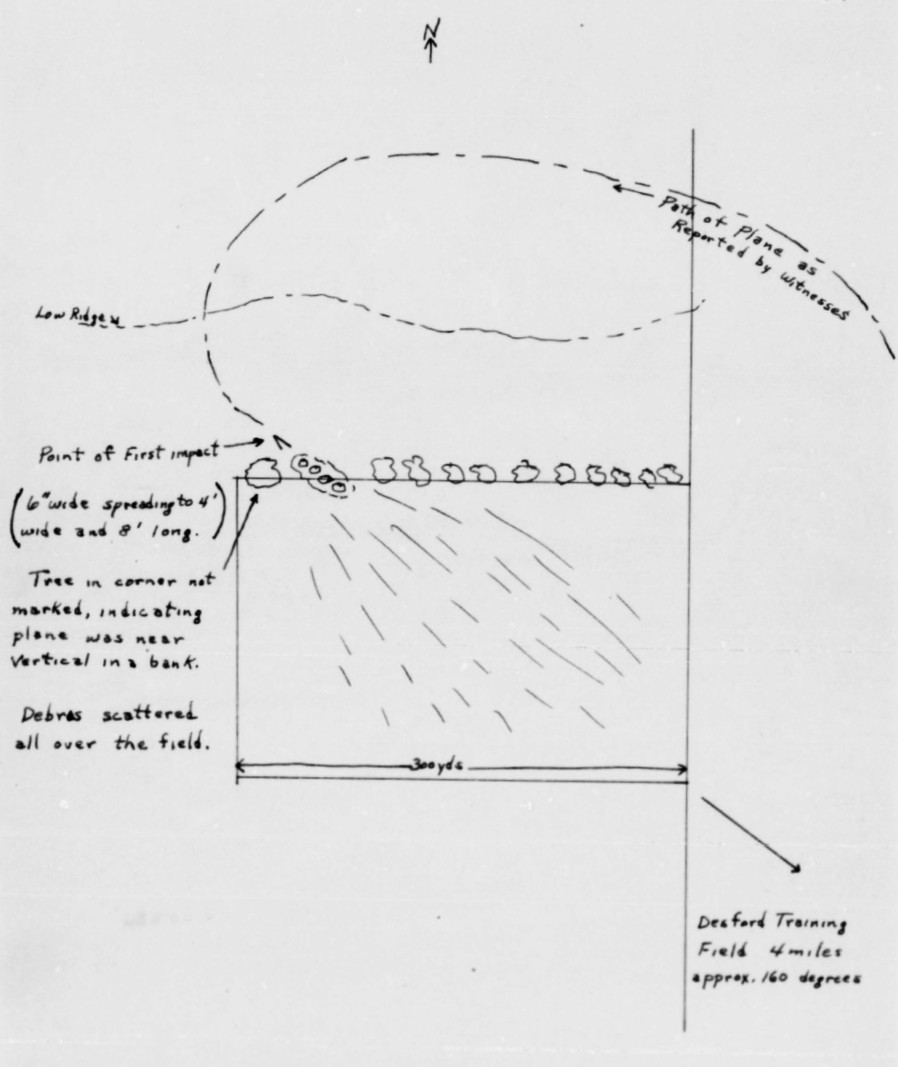
The B-17 appears to have been lined up with a practice field at Royal Air Force Desford, Leicester, about four miles distant from the crash site. The A.A.F. accident investigation, cursory at best, noted that based on witness accounts, “it appears that the plane was trying to land.” Curiously, the report gave no indication that the B-17 was supposed to land at Desford during the flight, which was supposed to end about 100 miles to the southeast back at Eye. The investigation indicated that the Primus and Deputy had completed the three landings at Eye and “were on the navigation flight when the crash occurred.”
Investigators did not provide any explanation about why the plane would have attempted to land at Desford, since there was no sign of mechanical failure. The report did not raise the possibility of navigational or pilot error, classifying the cause of the crash as “undetermined.”
Sergeant Leonard G. Rose of the Leicestershire Constabulary reported that at around 2045 hours, he heard an explosion and saw a fire. Rushing to the scene, “in a field owned by William Lewis, Farmer, Elmside Farm, Nailstone, I saw an aeroplane burning furiously and practically the whole of the field burning as well, no doubt from the petrol from the plane.” Ambulances, fire engines, and the Home Guard soon arrived at the scene. Rose and other responders began the grisly work of recovering the bodies.
Deputy’s personal effects included a Bible, a prayer book, a knife and sheath, two leather billfolds, a leather notebook, two pairs of pajamas, two swimsuits, a gym suit, a fountain pen, an automatic pencil, and four pipes.
During his career, Deputy earned the Air Medal with three oak leaf clusters, the American Campaign Medal, and European–African–Middle Eastern Campaign Medal with four service stars.
On October 11, 1944, the War Department dispatched a casualty telegram to Deputy’s mother.
In a letter dated June 2, 1947, Deputy’s mother wrote that “I am heart-broken over the tragic death of my only son, and there is not any one to take his place. He had a diary and I would like to have it.” She noted that his regular crew had completed their tour of duty and returned safely, lamenting that “if he had not helped another crew in their routine flight would have returned with them.” She also inquired about whether he would be awarded the Purple Heart, and the status of a money order that was supposed to have been sent to her following the sale of his bicycle. Unfortunately, there was no diary listed among his personal effects and since his death occurred on a training mission, he was not eligible for the Purple Heart. There is no indication in extant documentation that the missing money order ever turned up.
Individual identification proved impossible for Deputy, Primus, and the flight engineer, Roy E. Griswould (1924–1944). They were initially buried in Cambridge, England.
After the war, the military offered the next of kin of servicemembers buried overseas the option of repatriation for reburial in either a private or national cemetery, or burial in a permanent overseas cemetery. However, there were fewer options in the case of group burials, for which the standard policy a national cemetery midway between the families of the different individuals involved. Of course, this frequently resulted in the burial site being hundreds of miles from the place any of the servicemembers called home.
Griswold’s family was from Colorado and Primus’s was from Minnesota, so the Army’s proposed burial site was Fort Leavenworth National Cemetery, Kansas. To Pearl Deputy, this decision was ludicrous. She wrote that it would make more sense to have them remain at Cambridge than move them to Leavenworth. In the spring of 1948, Deputy’s mother convinced the other families to agree to change the cemetery to Arlington National Cemetery, Virginia. However, she was unaware of the fact that travel to the funeral would not be reimbursed. After she found out of the financial hardship she had inadvertently imposed on the other two families, Deputy’s mother angrily wrote to President Truman on December 6, 1948:
I do not believe you or anyone would think of making parents pay their expenses to and from their homes to a burial of a group. I have been a widow for ten years and have lost my only son in this horrible war, 1. Lt. Louis James Deputy who was killed in a B-17 plane crash, September 27, 1944. He and two others were buried together, which was necessary on account of identification. One parent Mrs. Harry Griswould lives in Arlington, Colorado, and the other parents lives in St. Cloud, Minnesota, Mrs. Josephine Primus. I am not asking for my expenses, but I feel very sorry for Mrs. Griswould as she has written she cannot afford to pay for the transportation […] and the group burial is a necessity which parents cannot help. These parents have already sacrificed so much.
At Lieutenant Primus’s mother’s request, the funeral was delayed until she had enough money to travel. The three men’s remains were buried at Arlington on October 10, 1949.
1st Lieutenant Deputy’s name is honored on memorials at Nailstone, the University of Virginia, Veterans Memorial Park in New Castle, Delaware, and on cenotaph in Odd Fellows Cemetery in Milford, Delaware, where his parents are buried. His name is also listed on a plaque of DuPont employees who died during World War II originally displayed at the nylon factory and now preserved at the Seaford Museum.
Crew of B-17G Heavenly Body on September 27, 1944
The following list was adopted from Report of Aircraft Accident 45-9-27-515 with grade, name, service, number, and position.
1st Lieutenant Michael H. Primus, O-810215 (pilot)
1st Lieutenant Louis J. Deputy, O-818123 (copilot)
2nd Lieutenant Richard J. Hermann, O-703253 (navigator)
2nd Lieutenant Richard C. Simmons, O-694969 (bombardier)
Technical Sergeant Roy E. Griswould, 17092155 (flight engineer)
Technical Sergeant Claude E. Keele, 37416085 (radio operator)
Staff Sergeant Harry Stoever, 33504840 (gunner)
Staff Sergeant Lawrence I. Richter, 19200834 (gunner)
Staff Sergeant Americo Virgili, 16117605 (gunner)
Staff Sergeant Ralph W. Franke, 33362517 (passenger)
Staff Sergeant John C. Barry, 11031790 (passenger)
Staff Sergeant Edward Shively, Jr., 13011085 (passenger)
Lieutenant Deputy’s Combat Missions
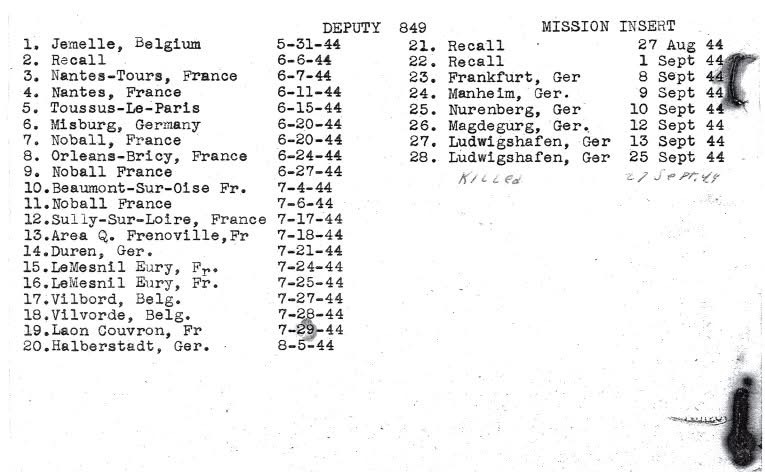
This list of missions, all from 1944, was compiled from Deputy’s personnel file. This list may contain outdated or erroneous spellings, as American records often mangled foreign place names. The Noball missions refer to missions against V-1 flying bomb sites in France rather than a particular city named Noball. The recalled or aborted missions did not count toward the completion of his tour of duty.
- May 31: Jemelle, Belgium
- June 6: Caen, France (recall)
- June 7: Nantes/Tours, France
- June 11: Nantes, France
- June 15: Toussus-le-Noble
- June 20: Misburg, Germany (oil refinery)
- June 20: Noball
- June 24: Orléans–Bricy, France (airfield)
- June 27: Noball
- July 4: Beaumont-Sur-Oise, France
- July 6: Noball
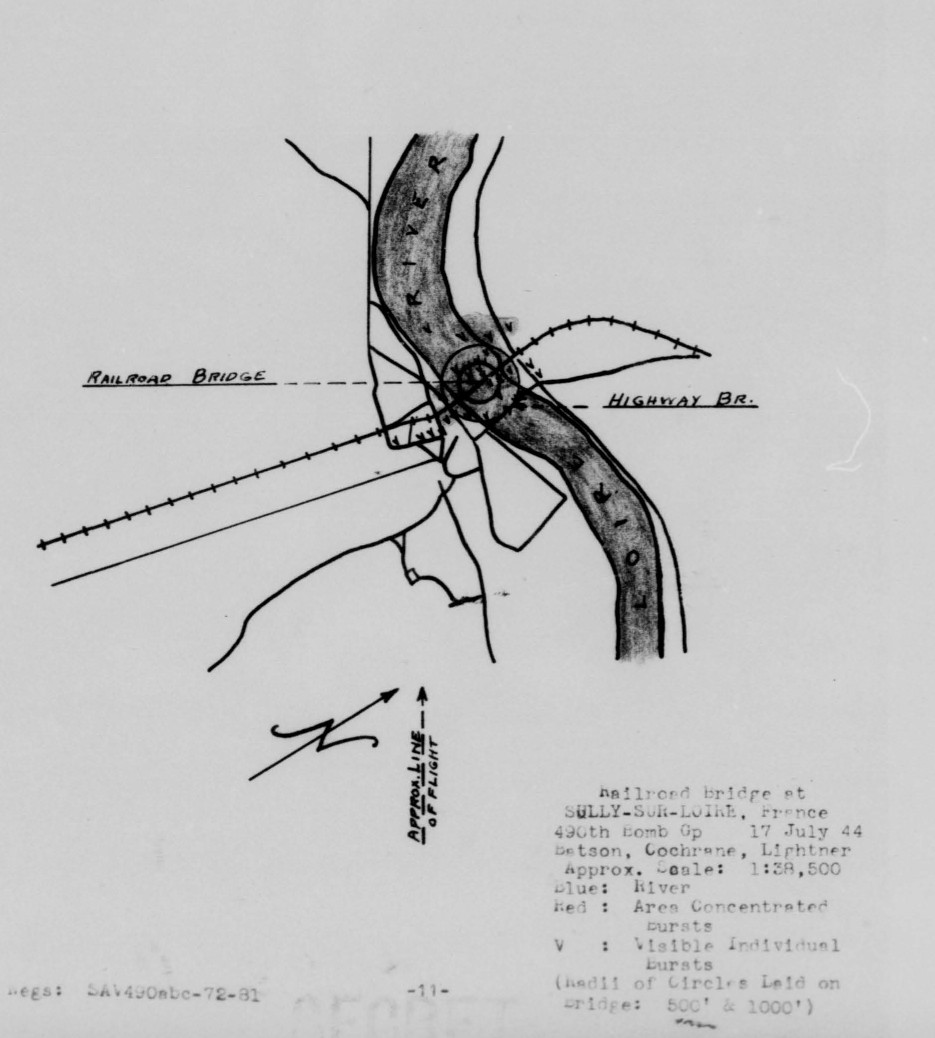
- July 17: Sully-sur-Loire, France (railroad bridge)
- July 18: Area Q, Frénouville, France (gun emplacements)
- July 21: Duren, Germany
- July 24: LeMesnil Eury, France
- July 25: LeMesnil Eury, France
- July 27: Vilbord, Belgium
- July 28: Volvorde, Belgium
- July 29: Laon Couvron, France
- August 5: Halberstadt, Germany (airfield)
- August 27: Genshagen, Germany (recall)
- September 1: Gustavsburg, Germany (recall)
- September 8: Frankfurt, Germany (group records list target as ordnance depot, Mainz, Germany)
- September 9: Monheim, Germany
- September 10: Fürth, Germany
- September 12: Magdeburg, Germany pg. 966
- September 13: Ludwigshafen, Germany
- September 25: Ludwigshafen, Germany
Notes
Name
Some websites refer to Deputy as having a second middle name, making his full name Louis James Stanton Deputy. It is unclear what the origin of this is, since Stanton does not appear on his birth certificate, his baptism record, census records, any known newspaper articles, his college yearbook, his signature, morning reports, his headstone, his personnel file, his individual deceased personnel file, or in his mother’s statement for the Public Archives Commission.
Church
That the Deputy family were members of St. Philip’s Episcopal Church by 1931 is based on a recommendation letter by Reverand R. Y. Barber (1878–1948) dated September 3, 1942, stating: “I have known Louis J. Deputy for eleven years and as his rector I have a varied contact with him with and thru the many activities of parish life.” Newspaper articles stated that Barber became rector on September 1, 1931, and had not previously lived in Delaware.
Overseas Journey
Deputy’s mother’s summary of his overseas journey is largely consistent with his flight records, with one exception. She stated that he flew from Fortaleza to Dakar on May 6. Deputy’s flight records show no flight that day, but a long flight on May 4.
The May 8 flight to the United Kingdom would appear to have been an overnight flight that arrived May 9, since it was described as involving eight hours and 30 minutes at night. Had it departed just after midnight on May 8 and arrived the same day, the night flying time should have been shorter. It is unclear if Deputy’s crew flew directly to R.A.F. Eye or to some other airfield.
Combat Missions
Deputy’s personnel file has an page listing 28 combat missions, of which three were recalls. This is largely consistent with his individual flight records. However, his flight records list combat missions on June 14 and July 12 that do not appear on his personnel file.
It is possible that those two missions were training flights erroneously logged as combat missions. Deputy’s June 14 flight was listed as three hours, 30 minutes. The 461st Bomb Group’s target that day was Orléans–Bricy. In theory, that flying time may have been sufficient for a B-24 based in England to get there and back, but probably only if it flew directly there and back without forming up as part of a group. Indeed, Deputy’s June 24 mission to the same target took six hours, 15 minutes. The July 12 flight was only one hour and 15 minutes, surely not enough time for a B-24 based in England to attack a target on the continent and return. Group records show that there was a mission on July 12 involving only 13 aircraft, which failed to bomb due to mechanical problems and weather.
Deputy’s September flight records are also curious. His September 1 and 9 missions are not labeled combat missions, and the September 8 mission recorded on the insert is not listed in his flight records at all.
Acknowledgments
Special thanks to Matt LeMasters for Deputy’s individual flight records, to Robert Coalter for unit records, and to the Delaware Public Archives for the use of their photo.
Bibliography
“1Lt. Louis James Deputy.” Find a Grave. https://www.findagrave.com/memorial/13077652/louis-james-deputy
“B-17 ‘Heavenly Body’ (43-37776) Memorial.” American War Memorials Overseas, Inc. https://www.uswarmemorials.org/html/monument_details.php?SiteID=2135&MemID=2801
Baptism Record for Louis Jas Deputy. 1918. Centenary Methodist Church of Laurel Delaware Being a Copy of All Record Books as to Membership Baptisms Marriages and Etc. Undated, c. 1944. https://www.familysearch.org/ark:/61903/3:1:3QSQ-G9CG-38Q9
Census Record for Lewis [sic] Deputy. April 24, 1940. Sixteenth Census of the United States, 1940. Record Group 29, Records of the Bureau of the Census. National Archives at Washington, D.C. https://www.familysearch.org/ark:/61903/3:1:3QSQ-G9MR-M9CS
Census Record for Louis Deputy. April 22, 1930. Fifteenth Census of the United States, 1930. Record Group 29, Records of the Bureau of the Census. National Archives at Washington, D.C. https://www.familysearch.org/ark:/61903/3:1:33SQ-GR4Z-2LL
Census Record for Louis J. Deputy. January 9, 1920. Fourteenth Census of the United States, 1920. Record Group 29, Records of the Bureau of the Census. National Archives at Washington, D.C. https://www.familysearch.org/ark:/61903/3:1:33SQ-GR6C-6V4
Deputy, Pearl Esther Lowe. Individual Military Service Record for Louis James Deputy. Undated, c. 1946. Record Group 1325-003-053, Record of Delawareans Who Died in World War II. Delaware Public Archives, Dover, Delaware. https://cdm16397.contentdm.oclc.org/digital/collection/p15323coll6/id/18400/rec/5
Draft Registration Card for Louis James Deputy. October 16, 1940. Draft Registration Cards for Delaware, October 16, 1940 – March 31, 1947. Record Group 147, Records of the Selective Service System. National Archives at St. Louis, Missouri. https://www.familysearch.org/ark:/61903/3:1:3Q9M-CSMG-D9R6-B
Enlistment Record for Louis J. Deputy. September 8, 1942. World War II Army Enlistment Records. Record Group 64, Records of the National Archives and Records Administration. National Archives at College Park, Maryland. https://aad.archives.gov/aad/record-detail.jsp?dt=929&mtch=1&cat=all&tf=F&q=13106613&bc=&rpp=10&pg=1&rid=87228
“Every Profiteer of Future Wars Is To Be Made Executive.” March 31, 1936. The Roanoke Times. https://www.newspapers.com/article/207912887/
“Give Concert at Laurel Next Week.” September 10, 1931. Every Evening. https://www.newspapers.com/article/208519837/
“History of the 490th Bombardment Group (H) April – May 1944.” Undated, c. June 1944. Reel B0650. Air Force Historical Research Agency. Courtesy of Robert Coalter.
“History of the 490th Bombardment Group (H) February 1944.” Undated, c. March 1944. Reel B0650. Air Force Historical Research Agency. Courtesy of Robert Coalter.
“History of the 490th Bombardment Group (H) March 1944.” Undated, c. April 1944. Reel B0650. Air Force Historical Research Agency. Courtesy of Robert Coalter.
“History of the 490th Bombardment Group (H), Station 134 APO 559 For the Month of August, 1944.” September 18, 1944. Reel B0650. Air Force Historical Research Agency. Courtesy of Robert Coalter.
“History of the 490th Bombardment Group (H) Station 134 A P O 559 For the Month of July, 1944.” August 14, 1944. Reel B0650. Air Force Historical Research Agency. Courtesy of Robert Coalter.
“History of the 490th Bombardment Group (H) Station 134 A P O 559 For the Month of June, 1944.” July 14, 1944. Reel B0650. Air Force Historical Research Agency. Courtesy of Robert Coalter.
“History of the 490th Bombardment Group (H), Station 134 APO 559 For the Month of September, 1944.” October 18, 1944. Reel B0650. Air Force Historical Research Agency. Courtesy of Robert Coalter.
“History of the 849th Squadron of the 490th Bombardment Group (H) From 1 February 1944 to 29 February 1944.” Undated, c. March 1944. Reel B0650. Air Force Historical Research Agency. Courtesy of Robert Coalter.
“History of the 849th Squadron of the 490th Bombardment Group (H) From 1 March 1944 to 31 March 1944.” Undated, c. April 1944. Reel B0650. Air Force Historical Research Agency. Courtesy of Robert Coalter.
Individual Deceased Personnel File for Louis J. Deputy. 1944–1998. Army Individual Deceased Personnel Files, 1942–1970. Record Group 92, Records of the Office of the Quartermaster General, 1774–1985. National Archives at St. Louis, Missouri.
Individual Flight Records for Louis J. Deputy. January 1944 – September 1944. Individual Flight Records, 1911–1958. Record Group 64, Records of the National Archives and Records Administration. National Archives at St. Louis, Missouri. Courtesy of Matt LeMasters.
Interment Control Form for Louis J. Deputy. November 4, 1949. Interment Control Forms, 1928–1962. Record Group 92, Records of the Office of the Quartermaster General, 1774–1985. National Archives at College Park, Maryland. https://www.ancestry.com/imageviewer/collections/2590/images/40479_2421402106_0460-01334
Morning Reports for 849th Bombardment Squadron (Heavy). December 1943. U.S. Army Morning Reports, c. 1912–1946. Record Group 64, Records of the National Archives and Records Administration. National Archives at St. Louis, Missouri. https://catalog.archives.gov/medialz/partners/st-louis/rg-064/85713825-wwii/85713825_1943-12/85713825_1943-12_Roll-0096/85713825_1943-12_Roll-0096-02.pdf
Morning Reports for 849th Bombardment Squadron (Heavy). February 1944 – September 1944. U.S. Army Morning Reports, c. 1912–1946. Record Group 64, Records of the National Archives and Records Administration. National Archives at St. Louis, Missouri. https://catalog.archives.gov/medialz/partners/st-louis/rg-064/85713825-wwii/85713825_1944-02/85713825_1944-02_Roll-0400/85713825_1944-02_Roll-0400-07.pdf, https://catalog.archives.gov/medialz/partners/st-louis/rg-064/85713825-wwii/85713825_1944-03/85713825_1944-03_Roll-0279/85713825_1944-03_Roll-0279-14.pdf, https://catalog.archives.gov/medialz/partners/st-louis/rg-064/85713825-wwii/85713825_1944-04/85713825_1944-04_Roll-0379/85713825_1944-04_Roll-0379-19.pdf, https://catalog.archives.gov/medialz/partners/st-louis/rg-064/85713825-wwii/85713825_1944-05/85713825_1944-05_Roll-0281/85713825_1944-05_Roll-0281-09.pdf, https://catalog.archives.gov/medialz/partners/st-louis/rg-064/85713825-wwii/85713825_1944-05/85713825_1944-05_Roll-0620/85713825_1944-05_Roll-0620-31.pdf, https://catalog.archives.gov/medialz/partners/st-louis/rg-064/85713825-wwii/85713825_1944-06/85713825_1944-06_Roll-0615/85713825_1944-06_Roll-0615-02.pdf, https://catalog.archives.gov/medialz/partners/st-louis/rg-064/85713825-wwii/85713825_1944-07/85713825_1944-07_Roll-0641/85713825_1944-07_Roll-0641-17.pdf, https://catalog.archives.gov/medialz/partners/st-louis/rg-064/85713825-wwii/85713825_1944-07/85713825_1944-07_Roll-0641/85713825_1944-07_Roll-0641-18.pdf, https://catalog.archives.gov/medialz/partners/st-louis/rg-064/85713825-wwii/85713825_1944-08/85713825_1944-08_Roll-0660/85713825_1944-08_Roll-0660-07.pdf, https://catalog.archives.gov/medialz/partners/st-louis/rg-064/85713825-wwii/85713825_1944-09/85713825_1944-09_Roll-0612/85713825_1944-09_Roll-0612-15.pdf
Morning Reports for Headquarters 93rd Combat Bombardment Wing (Heavy). September 1944. U.S. Army Morning Reports, c. 1912–1946. Record Group 64, Records of the National Archives and Records Administration. National Archives at St. Louis, Missouri. https://catalog.archives.gov/medialz/partners/st-louis/rg-064/85713825-wwii/85713825_1944-09/85713825_1944-09_Roll-0607/85713825_1944-09_Roll-0607-26.pdf
Official Military Personnel File for Louis J. Deputy. 1942–1945. Official Military Personnel Files, 1912–1998. Record Group 319, Records of the Army Staff. National Archives at St. Louis, Missouri.
“Roy Ernest Griswould.” Find a Grave. https://www.findagrave.com/memorial/79246663/roy-ernest-griswould
“Special Orders Number 101, Headquarters 213th Combat Crew Training School.” April 10, 1944. U.S. Army Morning Reports, c. 1912–1946. Record Group 64, Records of the National Archives and Records Administration. National Archives at St. Louis, Missouri. https://catalog.archives.gov/medialz/partners/st-louis/rg-064/85713825-wwii/85713825_1944-04/85713825_1944-04_Roll-0375/85713825_1944-04_Roll-0375-09.pdf
“Special Orders Number 363, Headquarters 18th Replacement Wing.” December 29, 1943. U.S. Army Morning Reports, c. 1912–1946. Record Group 64, Records of the National Archives and Records Administration. National Archives at St. Louis, Missouri. https://catalog.archives.gov/medialz/partners/st-louis/rg-064/85713825-wwii/85713825_1943-12/85713825_1943-12_Roll-0103/85713825_1943-12_Roll-0103-04.pdf
“U. Va. Profiteers OF Future Wars Chapter Grows.” March 30, 1936. The Richmond News Leader. https://www.newspapers.com/article/207912931/
“Willard Deputy Ex – Revenue Collector, Dies” August 10, 1938. Journal-Every Evening. https://www.newspapers.com/article/206337842/
Last updated on October 18, 2026
More stories of World War II fallen:





To have new profiles of fallen soldiers delivered to your inbox, please subscribe below.

