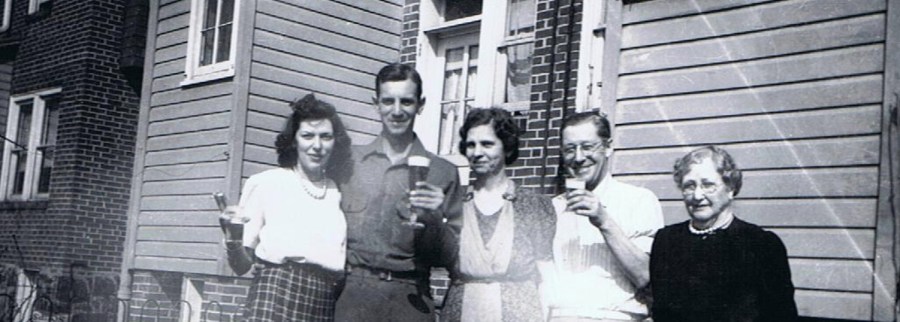
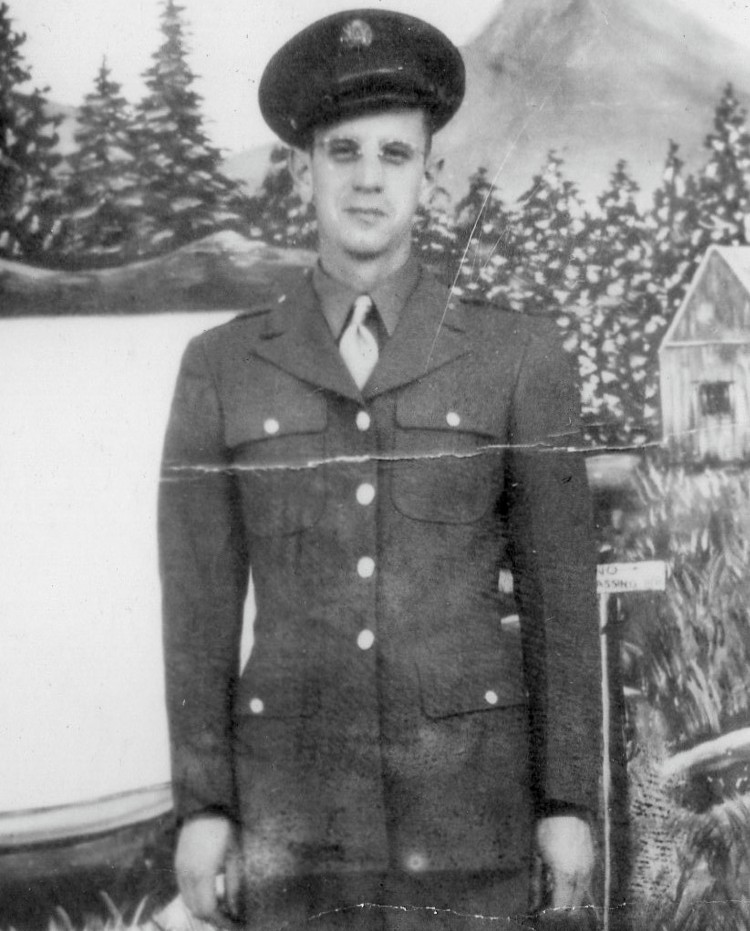
| Home State | Civilian Occupation |
| Delaware | Electrician’s helper for the Sun Shipbuilding and Dry Dock Company |
| Branch | Service Number |
| U.S. Army | 32367646 |
| Theater | Unit |
| Mediterranean | Company “A,” 16th Infantry Regiment, 1st Infantry Division |
| Military Occupational Specialty | Campaigns/Battles |
| 745 (rifleman) | Sicily |
Early Life & Family
Paul Otto Miller was born at 615 Concord Avenue in Wilmington, Delaware, on June 26, 1916. He was the eldest child of Paul Miller (né Peter Paul Müller, 1889–1979) and Rebecca M. Miller (née Rebecca Morgan Mammele, 1898–1959). His father was a German immigrant whose occupation was recorded on different records through the years as clerk, salesman, hotel manager, machinist, mechanic, electrical engineer, and merchant. Miller had four younger sisters and two younger brothers, one of whom died very young. He was Catholic.
When Miller’s father registered for the draft on June 5, 1917, he gave his address as the southeast corner of 22nd Street and Lamotte Street in Wilmington, apparently the hotel he was managing. The family had moved to Marshallton, west of Wilmington, by February 20, 1919, when Miller’s younger sister, Betsy Ann Miller (later Deverell, 1919–2013), was born.
Later that year, on April 28, 1919, Miller’s father purchased a home in the Brack Ex area west of Elsmere, Delaware. The family was recorded on census in January 1920, living on Lincoln Highway in Representative District 7. At that time, Lincoln Highway was apparently contiguous with Capitol Trail, now Old Capitol Trail and Kirkwood Highway depending on the portion of the route. The elder Paul Miller was described as a merchant. Miller’s parents sold the property on July 6, 1920.
Miller’s family was living in Centerville, Delaware, by the time his next sibling, DeWitt William Miller (1925–1994), was born on March 24, 1925. Documents stated they were living in Hockessin when another son, Frederick Mammele Miller, was born on October 19, 1927, but in nearby Centerville when the infant died of hydrocephalus on November 21, 1927. The Millers were living at 200 West 26th Street in Wilmington by August 11, 1929, when Miller’s sister, Alma Marie Miller (1929–1994), was born. They were at the same address when the next census was taken in April 1930. At that time, the elder Paul Miller was described as a radio store proprietor.
Miller was recorded on the next census in April 1940 living with his family at 608 West 30th Street in Wilmington. Miller was working as a railroad laborer, while his father was described as a maintenance superintendent.
When miller registered for the draft on October 16, 1940, he was still living at 608 West 30th Street and working for the Pennsylvania Railroad. The registrar described him as standing six feet tall and weighing 155 lbs., with brown hair and gray eyes, and a scar on his lower right lip.
Census records state that Miller dropped out of high school after completing two years. On the other hand, his enlistment data card stated that he completed three years of high school and described his occupation as “semiskilled mechanics and repairmen, railroad and carshop.” It appears that these data cards used the occupation supplied on an affidavit that men submitted shortly after registering for the draft, even if they changed occupations prior to being drafted. Indeed, DeWitt Miller—himself a U.S. Army veteran of World War II—told the Public Archives Commission that his brother’s occupation was electrician. Similarly, Journal-Every Evening later reported that Miller “worked as an electrician’s helper at the Sun Shipbuilding and Dry Dock Co.” in Chester, Pennsylvania.
Miller married Elizabeth “Betty” Scott Smith (1917–1981) in Elsmere on May 2, 1942.
Military Training
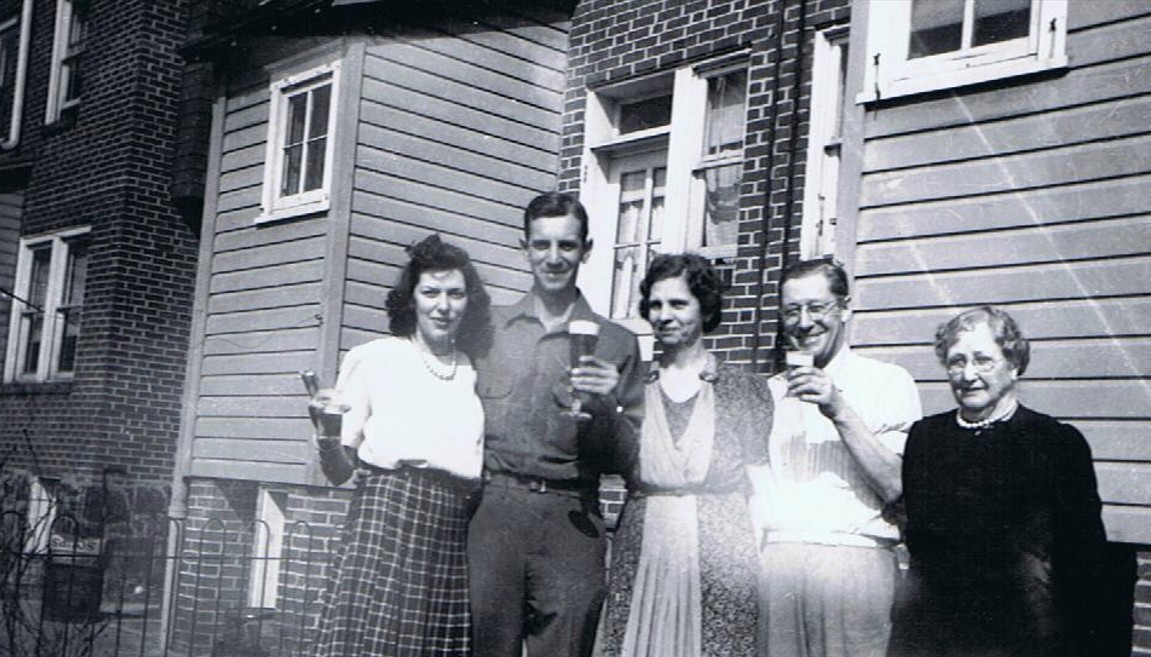
After he was drafted, Miller was inducted into the U.S. Army at Camden, New Jersey, on October 22, 1942. According to his brother’s statement, Private Miller went on active duty at Fort Dix, New Jersey, on November 5, 1942, and began basic training at Camp Wheeler, Georgia, on November 11, 1942. A set of orders dated February 14, 1943, confirms that Private Miller attended basic training attached unassigned to Company “D,” 14th Infantry Training Battalion, Infantry Replacement Training Center, Camp Wheeler, Georgia. The same document listed Miller’s military occupational specialty (M.O.S.) code as 745, rifleman, and stated that he was being transferred around February 17, 1943.
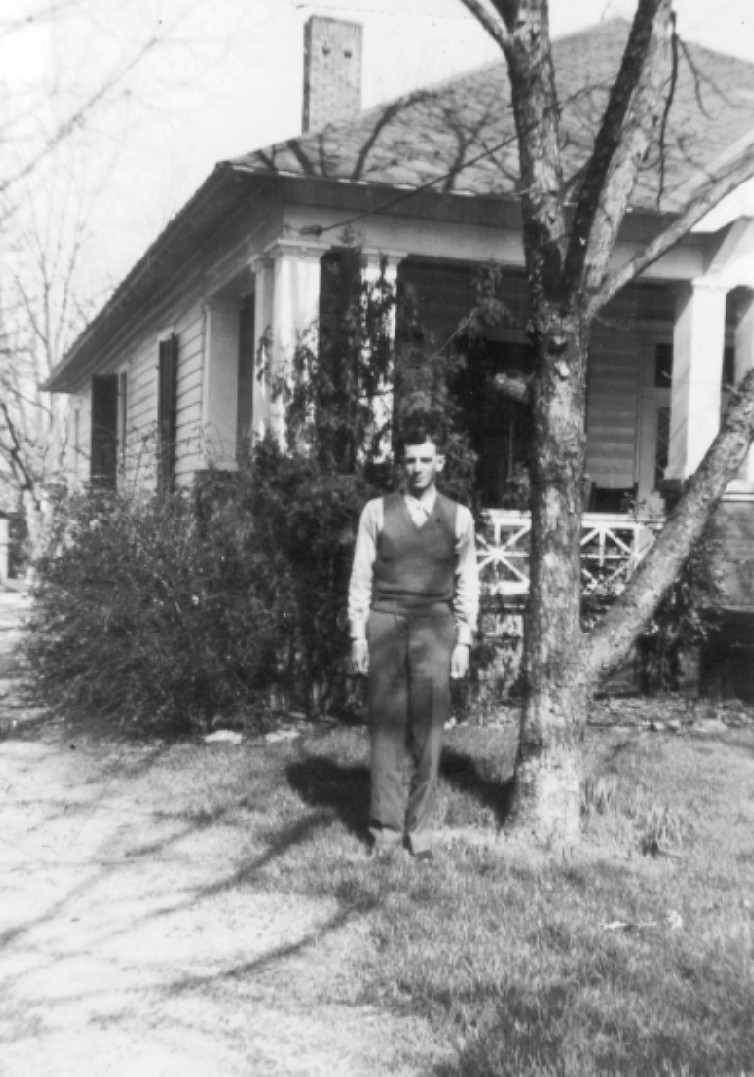
DeWitt Miller added that Private Miller left Camp Wheeler on February 23, 1943, and was briefly at Camp Kilmer, New Jersey, during February 25–28, 1943. Journal-Every Evening reported that Miller visited Wilmington on a 12-hour pass on February 21, 1943. Either the newspaper or Miller’s brother must have been slightly off about the dates that month, since Private Miller could not have gone from Georgia to Delaware on such a brief pass. Presumably, his visit was either in transit from Georgia to New Jersey, or while he was stationed at Camp Kilmer.
Miller’s last pay voucher states that he “entered upon Foreign Service March 5/43.” Miller’s brother gave a slightly different account to the Public Archives Commission, stating that Private Miller shipped out from the New York Port of Embarkation on February 28, 1943, arriving in Casablanca, Morocco, on March 14, 1943. He noted that his brother subsequently moved to Oran, Algeria, but was unaware of his subsequent movements.
After arriving in North Africa, Private Miller was assigned to the 1st Infantry Division. Before World War II the division had been composed of men from the Regular Army. After two campaigns, however, transfers and casualties meant that a significant portion of the unit was made up of men who had volunteered or been drafted in the preceding three years, like Private Miller. As of October 31, 1942, just prior to entering combat, about 64% of Company “A” enlisted men were Regular Army. By the end of May 1943, only about 45% of Company “A” enlisted men were holdovers from the prewar Regular Army.
Miller was initially assigned to the 1st Infantry Division Training Battalion. A G-1 report explained:
From January 15th to April 12th, 1943, the 1st Infantry Division received 1902 replacements in addition to the casuals. The majority of replacements had had little training and it was found necessary to establish a training battalion within the Division, where further instruction was given before assigning the men to various units. Due to the almost continuous operation of the Division replacements were assigned, and joined their units, during brief rest periods between March 1st to 9th, 1943, and from April 8th to 14th, 1943.
On May 7, 1943, Miller was transferred to and joined Company “A,” 16th Infantry Regiment, 1st Infantry Division. That same day, Allied forces captured the major ports of Tunis and Bizerte, cutting off over 200,000 Axis troops in North Africa from resupply and forcing their surrender, bringing the Tunisian campaign to a close. Those ports also proved to be a critical jumping off point to continue the Allied offensive in the Mediterranean by invading Sicily.
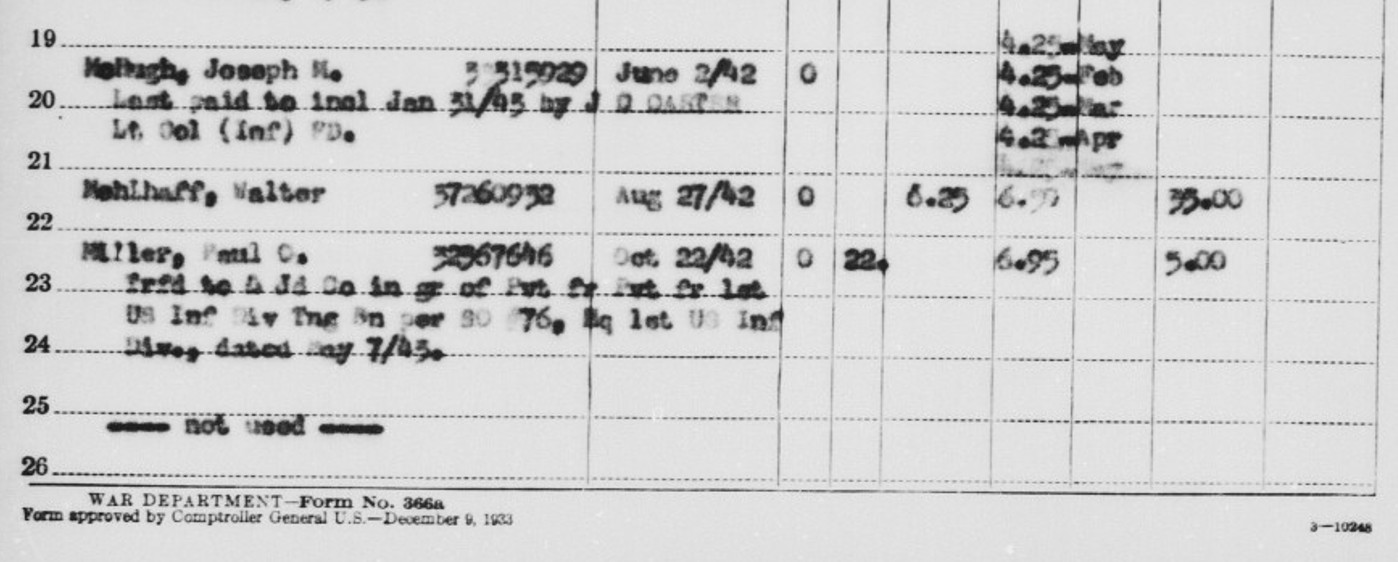
On June 22, 1943, the Wilmington Morning News reported Private Miller’s thoughts about a recent miners’ strike, a sentiment widely shared by servicemen overseas and those back in the states:
Private Paul O. Miller, 27, of 608 West Thirtieth Street, would gladly change his place in the North African battle zone with the striking coal miners.
In a letter received yesterday by his father, Private Miller criticized the miners and added “I don’t know what is the matter with the miners to call a strike during these times.”
As that letter crossed the ocean, Private Miller was training before entering combat for the first time. According to an after action report, the 16th Infantry and attachments “carried on an extremely intensive training program under the supervision of the Invasion Training Center, operated by 5th Army” on the coast “between Arzew and Mostaganem. Various courses were set up, including rifle and mortar ranges, street fighting, methods of reducing pill-boxes, amphibious operations in their various stages, combat exercises, and night problems.” Replacements like Miller also attended “a short course of special training.” Recreational opportunities included swimming, “athletics, movies and stage shows[.]”
The main body of the 16th Infantry sailed from Arzew, Algeria, on June 11, 1943, arriving two days later at Algiers. They then moved by truck to their new camp at Staoueli, Algeria.
Company “A” went to the firing range on June 15 and 18, 1943. At 1900 hours on June 21, Private Miller and his company headed back to Algiers. At 2030, they boarded the transport U.S.S. Elizabeth C. Stanton (AP-69). Early on the morning of June 24, 1943, they disembarked into landing craft for a nighttime amphibious drill. That afternoon, they returned to their previous camp at Staoueli. Journal-Every Evening reported that Miller’s “last letters, written on his birthday, June 26, reported he was spending ‘a very quiet birthday.’”
At 0500 hours on July 5, 1943, Company “A” boarded their trucks and reboarded U.S.S. Elizabeth C. Stanton at Algiers. When they shipped out at 1000 hours on July 6, 1943, it was not for more training exercises. Operational security was tight and while rumors surely abounded about their destination, it was only while in transit on July 8 that Miller and his comrades were told that they were heading to Sicily.
Combat on Sicily
The invasion of Sicily, Operation Husky, was the largest amphibious operation yet attempted during the war, with the Allies landing two armies, the British Eighth and U.S. Seventh. The Americans would land three divisions on the southern coast of the island, with the 1st Infantry Division in the center landing near Gela. The 1st Infantry Division’s plan was to land the 16th Regimental Combat Team (Private Miller’s 16th Infantry Regiment and attachments, also known as Combat Team 16) on the division right at beaches codenamed Red and Green, while Combat Team 26 on the left landed at Yellow and Blue. The attached Ranger Force would also capture shore batteries and Gela itself. After landing, the division was to push inland and capture the Ponte Olivo airfield. The division’s 18th Infantry Regiment was held as a floating reserve. To compensate for that temporary reduction in strength, the plan was that paratroopers from the 505th Parachute Infantry Regiment of the 82nd Airborne Division dropped inland would, once contacted, be attached to the division. In the event, the paratroopers were scattered across the countryside and the 18th Infantry was ordered ashore on the first day, though they did not enter combat until D+1.
Two companies from 1st Battalion, 16th Infantry were scheduled to land at Beach Green-2 at H-Hour, with the rest of the 1st Battalion Landing Team arriving in subsequent waves 30 minutes and one hour into the invasion. The 16th Infantry began landing on Sicily around 0245 hours on July 10, 1943. According to a morning report, Miller’s Company “A” departed their transport at 0220 and landed at 0315.
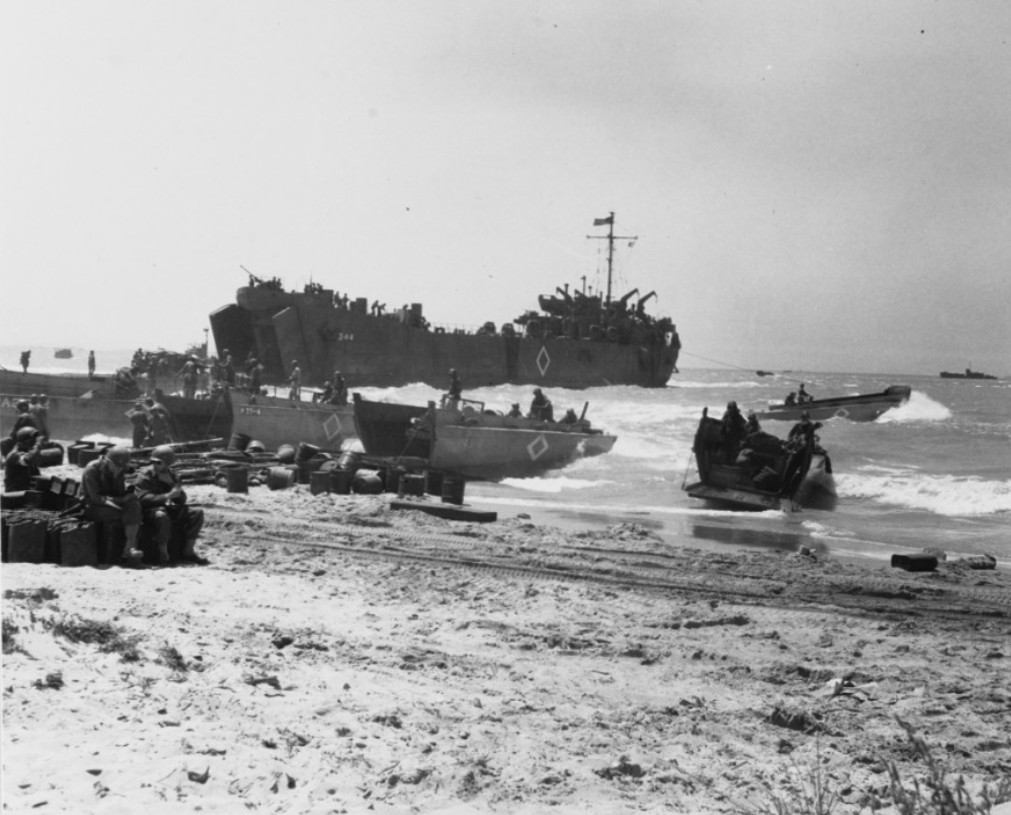
Axis forces were caught by surprise and the Americans overcame Italian coastal defenses near Gela with little difficulty. A 16th Infantry after action report stated:
Few casualties occur on the beach. During mid-morning tanks were observed moving into the area in vicinity of the road junction of N[i]scemi road with Gela–Vittoria road. By noon 20–30 11 ton Renault tanks were active at the road junction, and they constantly harassed our forward companies.
The report stated that the 16th Infantry had held enemy armor “at bay with bazookas, mortars, and artillery.” Such measures were necessary in large part because the Americans had difficulty landing their own tanks and getting them off the beach. That obsolete R35 light tanks were giving Miller’s unit such difficulty presaged trouble for the following day.
A Company “A” morning report recorded that on July 11, 1943, “Company Attacked North West toward Niscemi 0500 Hours from 4 Miles North West of Gela. Advanced 2 Miles. Encountered Stiff Enemy Resistance and Went into Defensive Position.”
Rather than advancing, the men of the 1st Infantry Division were soon fighting for their lives. The 16th Infantry was in the path of a counterattack by the Hermann Göring Division. The regimental after action report stated:
Attempts to move forward on the morning of the second day were stopped by heavy fire from enemy tanks. It became apparent by noon that the 11 ton Renault tanks had been replaced by German Mk III and Mk IV Special tanks. Shortly after noon the tanks advanced on forward units overrunning their position in places. At the same time other German tanks broke through the 26th Infantry, and drove almost to the beach.
Despite the sangfroid description of events in the report, the July 11 counterattack was the most serious threat to the beachhead during the entire campaign and portrayed very differently in the 1st Infantry Division’s 1947 history, Danger Forward:
In the 16th Infantry zone, fighting was just as heavy. […] Under heavy attack, the Regimental Commander [Colonel George A. Taylor] had ordered:
“Everybody stays put just where he is!…Under no circumstances will anyone be pulled back. Take cover from tanks!…Don’t let anything else get through. The Cannon Company is on the way…Everyone to hold present positions.”
Lt. Col Hugh Matthews, Regimental Executive Officer, observed thirty enemy tanks just off the road, about 1,200 yards northeast of the intersection of the Gela-Niscemi road. By 11:00 A.M., Lt. Col. Charles Denholm, commanding the 1st Battalion, 16th Infantry, was wounded seriously while personally manning an anti-tank gun, and was evacuated despite protest. […] The Regiment had only 3 anti-tank guns left out of 9 […] Colonel Taylor reported the situation as critical:
“We are being overrun by tanks. In Crawford’s area (2nd Battalion) the enemy has 10 tanks in front of the Battalion, and ringed them with an additional thirty. We have no idea what is going on to the east of us at the moment. The 3rd Battalion is covering the main road.”
The situation was serious enough that antiaircraft troops and engineers were pressed into battle as infantry. A handful of American tanks made it off the beach and into action. Finally, the enemy counterattack withered under an avalanche of shells from American artillery and naval gunfire.
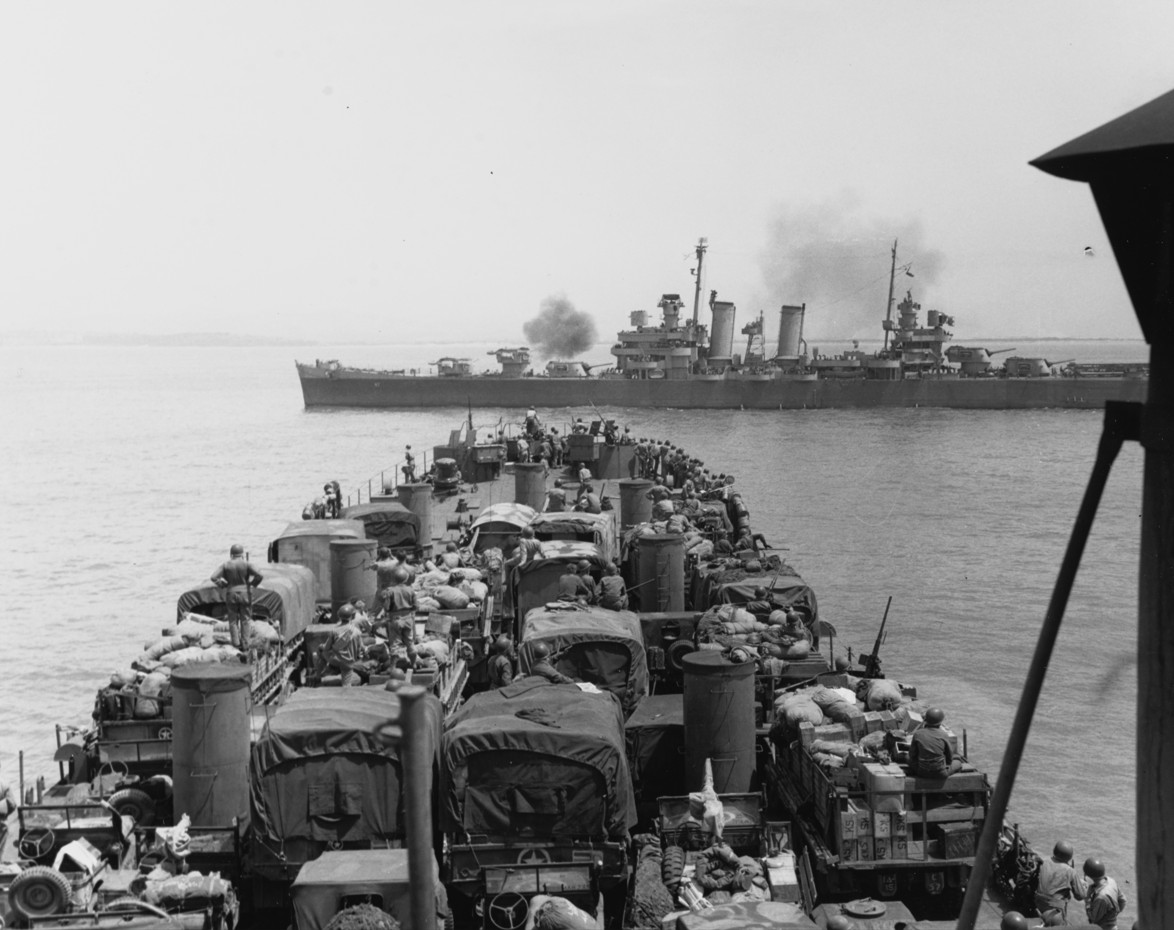
That evening, the Germans began massing in front of the 16th Infantry, apparently in preparation for another counterattack the following day. The 1st Infantry Division commander, Major General Allen Terry de la Mesa Allen (1888–1969), decided to beat them to the punch by launching a spoiling attack that night.
The Company “A” morning report for July 12, 1943, stated:
Company Attacked North West toward Niscemi, Sicily at 0200 Hours. Encountered Stiff Enemy Resistance and suffered some casualties. Then withdrew to original defensive position 5 miles North West of Gela. Company attacked again at 1900 Hours. No resistance and advanced 2 miles.
The 16th Infantry’s after action report stated of the morning’s attack: “At daylight tanks were observed moving south on the Niscemi road, and the two forward battalions were taken under mortar and small arms fire. Enemy tanks followed by infantry caused a slight withdrawal of the 1st Battalion.”
Overall, the day was a successful one for the 1st Infantry Division and they reached a key objective, the Ponte Olivo Airfield. It was not without cost, however.
A company morning report dated July 12, 1943, stated that Miller was one of five men killed “during Assault near Gela Sicily. Multiple Shrapnel Wounds.” According to his burial report, Private Miller was struck in the neck by shell fragments and killed.
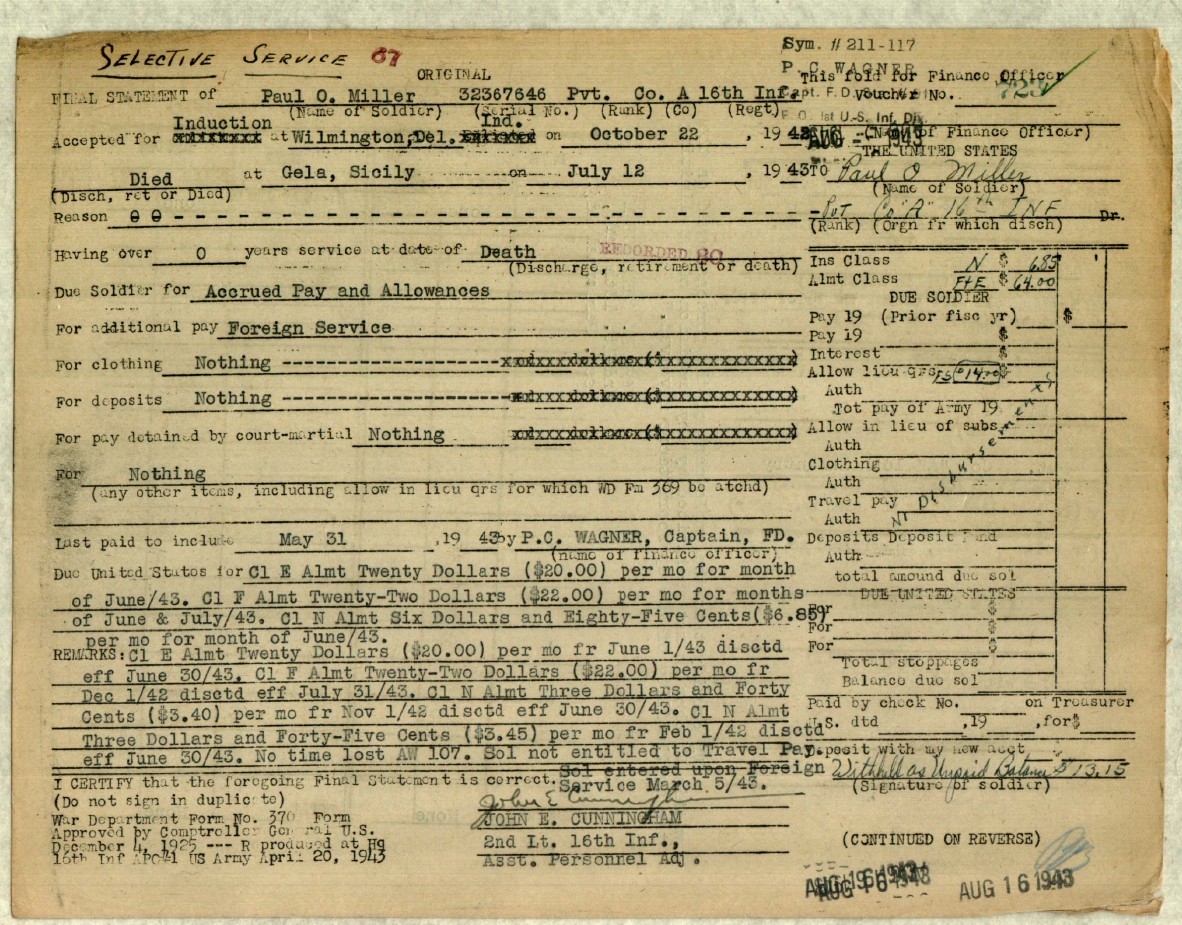
Private Miller’s wife was notified of his death on August 14, 1943. When the sad news arrived, Miller’s brother, Private DeWitt Miller, who had been drafted about three weeks before Miller was killed, was attending basic training attached to Company “B,” 35th Medical Training Battalion, 8th Medical Training Regiment at Camp Grant, Illinois. Another trainee in the same company was Lynn E. Ritter, Jr. (1924–1944), destined to lose his life in Italy. DeWitt Miller was able to take a five-day furlough to be with his family. He later served as a litter bearer in Italy with Company “C,” 310th Medical Battalion and Medical Detachment, 337th Infantry Regiment, both part of the 85th Infantry Division.
Miller’s mother-in-law wrote to the Adjutant General’s Office on October 9, 1943, that her daughter still held out hope because none of his personnel belongings or dog tags had arrived, explaining: “My daughter, by not receiving these things, is under the impression he is still alive, wounded, or a prisoner. The suspense of all this uncertainty is making her a nervous wreck and is impairing her health.” In fact, dog tags were used to mark the body and grave and not returned to the family, and during the war the return of belongings from overseas was often a drawn out process.
Private Miller was initially buried at a temporary cemetery along the road to Niscemi on July 13, 1943. His personal effects included a rosary, a religious medal, a cigarette case, and his Social Security card. On July 26, 1943, he was reburied at another temporary cemetery, U.S. Military Cemetery 2-S in Gela. On April 10, 1947, he was reburied for a third time at Monte Soprano, Italy. In 1948, Miller’s widow requested that his body be buried in a permanent cemetery overseas. Postwar, the American military cemeteries in Italy were consolidated into two permanent cemeteries, near Florence and Rome. Miller’s body was disinterred and reburied at Nettuno, now known as the Sicily-Rome American Cemetery.
Notes
Father
Miller’s father was referred to as Paul Peter Miller in some records. Later he went by Paul William Miller some records. Although he was born in Germany, later records claim he was born in Illinois. Although some census records refer to the younger Paul Miller as Paul Miller, Jr., no records indicate that they shared a middle name.
Hospitalization?
DeWitt Miller told the Public Archives Commission: “We have had letters and telephone calls from boys who were with him, stating, they were in hospitals with him.” He added that Miller had been under medical care at the 21st General Hospital, though he did not specify when. The 21st General Hospital was based at Sidi Bou Hanifia, Algeria, not far from Oran, making it plausible that Miller could have been hospitalized there after arriving in North Africa. There are no hospital admission cards under his service number, but that does not prove he was never treated by one. Unfortunately, with the loss of records in the 1973 National Personnel Records Center fire combined with morning reports that went missing before they could be microfilmed, the details of this incident may remain unknown.
Date of Death
Recordkeeping under combat conditions was fraught with difficulty and incorrect dates of death were often recorded in military records. Although there is no specific evidence that Private Miller’s date of death is inaccurate, it is notable that Company “A” morning reports recorded casualties of just seven men wounded or sick and one missing on July 10, followed by one killed, three missing, and seven wounded or sick on July 11, when the regiment was hit by a German counterattack. July 12, however, saw much heavier reported casualties: five dead, five missing, and 12 wounded or sick.
Widow
Miller’s widow remarried to William Edward Fawcett, Sr. (1918–1996), himself a U.S. Army veteran of World War II, in Newport, Delaware, on January 29, 1949. After divorcing, she later married a third time to Robert Charles Ogden (1909–1972).
Acknowledgments
Special thanks to Private Miller’s niece, Diane Deverell Rafferty, for contributing photos and information.
Bibliography
“Betsy A Miller Deverell.” Find a Grave. https://www.findagrave.com/memorial/103442895/betsy-a-deverell
Census Record for Paul Miller. April 10, 1940. Sixteenth Census of the United States, 1940. Record Group 29, Records of the Bureau of the Census. National Archives at Washington, D.C. https://www.familysearch.org/ark:/61903/3:1:3QS7-L9MR-M3QV
Census Record for Paul Miller, Jr. January 17, 1920. Fourteenth Census of the United States, 1920. Record Group 29, Records of the Bureau of the Census. National Archives at Washington, D.C. https://www.familysearch.org/ark:/61903/3:1:33SQ-GR6S-PC
Census Record for Paul W. Miller, Jr. April 17, 1930. Fifteenth Census of the United States, 1930. Record Group 29, Records of the Bureau of the Census. National Archives at Washington, D.C. https://www.familysearch.org/ark:/61903/3:1:33SQ-GRHM-FWX
Certificate of Birth for Alma Marie Miller. Undated, c. 1937. Record Group 1500-008-094, Birth Certificates. Delaware Public Archives, Dover, Delaware. https://www.familysearch.org/ark:/61903/3:1:33S7-9YQM-QTN4
Certificate of Birth for Elizabeth Anna Miller. February 1919. Record Group 1500-008-094, Birth Certificates. Delaware Public Archives, Dover, Delaware. https://www.familysearch.org/ark:/61903/3:1:S3HT-D4X3-VVN
Certificate of Birth for Elizabeth Scott Smith. October 1917. Record Group 1500-008-094, Birth Certificates. Delaware Public Archives, Dover, Delaware. https://www.familysearch.org/ark:/61903/3:1:S3HT-DTMW-FWD
Certificate of Birth for Frederick Mammele Miller. Undated, c. October 1927. Record Group 1500-008-094, Birth Certificates. Delaware Public Archives, Dover, Delaware. https://www.familysearch.org/ark:/61903/3:1:33SQ-GYQM-QCQ9
Certificate of Birth for William Dewitt Miller. Undated, c. March 1925. Record Group 1500-008-094, Birth Certificates. Delaware Public Archives, Dover, Delaware. https://www.familysearch.org/ark:/61903/3:1:33S7-9YQM-Q4NC
Certificate of Delayed Birth Registration for Paul Otto Miller. December 5, 1942. Record Group 1500-008-094, Birth Certificates. Delaware Public Archives, Dover, Delaware. https://www.familysearch.org/ark:/61903/3:1:S3HY-DR29-QMH
Certificate of Marriage for Paul O. Miller and Elizabeth S. Smith. May 2, 1942. Record Group 1500-008-093, Marriage Certificates. Delaware Public Archives, Dover, Delaware. https://www.familysearch.org/ark:/61903/3:1:S3HY-X3W5-1R
Certificate of Marriage for William Edward Fawcett and Elizabeth Scott Miller. January 29, 1949. Record Group 1500-008-093, Marriage Certificates. Delaware Public Archives, Dover, Delaware. https://www.familysearch.org/ark:/61903/3:1:S3HY-6RS6-MQ
Draft Registration Card for Paul Otto Miller. October 16, 1940. Draft Registration Cards for Delaware, October 16, 1940 – March 31, 1947. Record Group 147, Records of the Selective Service System. National Archives at St. Louis, Missouri. https://www.familysearch.org/ark:/61903/3:1:3Q9M-CSMG-D9W3-H
“Elizabeth S. Ogden.” October 27, 1981. The Morning News. https://www.newspapers.com/article/190770690/
Enlistment Record for DeWitt Miller. June 21, 1943. World War II Army Enlistment Records. Record Group 64, Records of the National Archives and Records Administration. National Archives at College Park, Maryland. https://aad.archives.gov/aad/record-detail.jsp?dt=893&mtch=1&cat=all&tf=F&q=32952367&bc=&rpp=10&pg=1&rid=3448611
Enlistment Record for Paul O. Miller. October 22, 1942. World War II Army Enlistment Records. Record Group 64, Records of the National Archives and Records Administration. National Archives at College Park, Maryland. https://aad.archives.gov/aad/record-detail.jsp?dt=893&mtch=1&cat=all&tf=F&q=32367646&bc=&rpp=10&pg=1&rid=2990280
“Final Statement of Paul O. Miller 32367646 Pvt. Co. A 16th Inf.” 1943. Individual Pay Vouchers, c. 1926–1963. Record Group 64, Records of the National Archives and Records Administration. National Archives at St. Louis, Missouri.
Indenture Between Elizabeth Magnell and Andrew M. Magnell, Parties of the First Part, and Paul Miller, Party of the Second Part. April 28, 1919. Delaware Land Records, 1677–1947. Record Group 2555-000-011, Recorder of Deeds, New Castle County. Delaware Public Archives, Dover, Delaware. https://www.ancestry.com/imageviewer/collections/61025/images/31303_256936-00225
Indenture Between Paul Miller and Rebecca Miller, Parties of the First Part, and William Gilbert, Party of the Second Part. July 6, 1920. Delaware Land Records, 1677–1947. Record Group 2555-000-011, Recorder of Deeds, New Castle County. Delaware Public Archives, Dover, Delaware. https://www.ancestry.com/imageviewer/collections/61025/images/31303_256957-00308
Individual Deceased Personnel File for Paul O. Miller. Army Individual Deceased Personnel Files, 1942–1970. Record Group 92, Records of the Office of the Quartermaster General, 1774–1985. National Archives at St. Louis, Missouri. Courtesy of U.S. Army Human Resources Command.
“The Invasion of Sicily.” Undated, c. 1944. First Division Museum website. https://firstdivisionmuseum.nmtvault.com/jsp/PsImageViewer.jsp?doc_id=5d51b39f-52d3-4177-b65e-30b812011812%2Fiwfd0000%2F20141124%2F00000375
Knickerbocker, H. R., Thompson, Jack, Belden, Jack, Whitehead, Don, Liebling, A. J., Watson, Mark, Peterman, Cy, Carpenter, Iris, Dupuy, R. E., and Middleton, Drew. Danger Forward: The Story of the First Division In World War II. Albert Love Enterprises, 1947. First Division Museum website. https://firstdivisionmuseum.nmtvault.com/jsp/PsImageViewer.jsp?doc_id=5d51b39f-52d3-4177-b65e-30b812011812%2Fiwfd0000%2F20150521%2F00000001
Kratz, Jessie. “You Can’t Dig Coal With Bayonets.” July 11, 2018. Pieces of History. https://prologue.blogs.archives.gov/2018/07/11/you-cant-dig-coal-with-bayonets/
“Landing Table.” June 27, 1943. First Division Museum website. https://firstdivisionmuseum.nmtvault.com/jsp/PsImageViewer.jsp?doc_id=5d51b39f-52d3-4177-b65e-30b812011812%2Fiwfd0000%2F20141124%2F00000364
Miller, DeWitt W. Individual Military Service Record for Paul Otto Miller. July 24, 1947. Record Group 1325-003-053, Record of Delawareans Who Died in World War II. Delaware Public Archives, Dover, Delaware. https://cdm16397.contentdm.oclc.org/digital/collection/p15323coll6/id/20006/rec/4
Morning Reports for Company “A,” 16th Infantry Regiment. June 1943 – July 1943. U.S. Army Morning Reports, c. 1912–1946. Record Group 64, Records of the National Archives and Records Administration. National Archives at St. Louis, Missouri. https://s3.amazonaws.com/NARAprodstorage/lz/partners/st-louis/rg-064/85713825-wwii/85713825_1940-01-thru-1943-07/85713825_1940-01-thru-1943-07_Roll-1566_Dup/85713825_1940-01-thru-1943-07_Roll-1566_Dup-21.pdf, https://s3.amazonaws.com/NARAprodstorage/lz/partners/st-louis/rg-064/85713825-wwii/85713825_1940-01-thru-1943-07/85713825_1940-01-thru-1943-07_Roll-1566_Dup/85713825_1940-01-thru-1943-07_Roll-1566_Dup-22.pdf
Morning Reports for Company “B,” 35th Medical Training Battalion. August 1943. U.S. Army Morning Reports, c. 1912–1946. Record Group 64, Records of the National Archives and Records Administration. National Archives at St. Louis, Missouri. https://s3.amazonaws.com/NARAprodstorage/lz/partners/st-louis/rg-064/85713825-wwii/85713825_1943-08/85713825_1943-08_Roll-0089/85713825_1943-08_Roll-0089-27.pdf, https://s3.amazonaws.com/NARAprodstorage/lz/partners/st-louis/rg-064/85713825-wwii/85713825_1943-08/85713825_1943-08_Roll-0089/85713825_1943-08_Roll-0089-28.pdf
Morning Reports for Company “C,” 310th Medical Battalion. October 1944. U.S. Army Morning Reports, c. 1912–1946. Record Group 64, Records of the National Archives and Records Administration. National Archives at St. Louis, Missouri. https://s3.amazonaws.com/NARAprodstorage/lz/partners/st-louis/rg-064/85713825-wwii/85713825_1944-10/85713825_1944-10_Roll-0428/85713825_1944-10_Roll-0428-18.pdf
Morning Reports for Headquarters Company, 3rd Battalion, 337th Infantry Regiment. October 1944. U.S. Army Morning Reports, c. 1912–1946. Record Group 64, Records of the National Archives and Records Administration. National Archives at St. Louis, Missouri. https://s3.amazonaws.com/NARAprodstorage/lz/partners/st-louis/rg-064/85713825-wwii/85713825_1944-10/85713825_1944-10_Roll-0430/85713825_1944-10_Roll-0430-18.pdf
“Paul William Miller.” Find a Grave. https://www.findagrave.com/memorial/131640757/paul_william-miller
“Pay Roll of Company ‘A’ Sixteenth Infantry For month of May, 1943.” May 31, 1943. U.S. Army Muster Rolls and Rosters, November 1, 1912 – December 31, 1943. Record Group 64, Records of the National Archives and Records Administration. National Archives at St. Louis, Missouri. https://s3.amazonaws.com/NARAprodstorage/lz/st-louis/rg-064/85713803_1940-1943/85713803_1940-1943_Roll-1501/85713803_1940-1943_Roll-1501_12.pdf, https://s3.amazonaws.com/NARAprodstorage/lz/st-louis/rg-064/85713803_1940-1943/85713803_1940-1943_Roll-1501/85713803_1940-1943_Roll-1501_13.pdf
“Private Paul O. Miller Awarded Purple Heart.” September 11, 1943. Wilmington Morning News. https://www.newspapers.com/article/190764673/
“Roster.” October 31, 1942. U.S. Army Muster Rolls and Rosters, November 1, 1912 – December 31, 1943. Record Group 64, Records of the National Archives and Records Administration. National Archives at St. Louis, Missouri. https://s3.amazonaws.com/NARAprodstorage/lz/st-louis/rg-064/85713803_1940-1943/85713803_1940-1943_Roll-1501/85713803_1940-1943_Roll-1501_13.pdf
“Special Orders No. 40, HQ Infantry Replacement Training Center, Office of the Commanding General, Camp Wheeler, Georgia.” February 14, 1943. U.S. Army Morning Reports, c. 1912–1946. Record Group 64, Records of the National Archives and Records Administration. National Archives at St. Louis, Missouri. https://s3.amazonaws.com/NARAprodstorage/lz/partners/st-louis/rg-064/85713825-wwii/85713825_1940-01-thru-1943-07/85713825_1940-01-thru-1943-07_Roll-1996/85713825_1940-01-thru-1943-07_Roll-1996-29.pdf
Taylor, George A. “Reports After Action Against The Enemy.” August 18, 1943. First Division Museum website. https://firstdivisionmuseum.nmtvault.com/jsp/PsImageViewer.jsp?doc_id=5d51b39f-52d3-4177-b65e-30b812011812%2Fiwfd0000%2F20141124%2F00000364
“Two Soldiers From City Die.” August 16, 1943. Journal-Every Evening. https://www.newspapers.com/article/190764752/
Ware, Charles. “Report After Action G-1 First Infantry Division November 15th, to April 14th, 1943.” First Division Museum website. https://firstdivisionmuseum.nmtvault.com/jsp/PsImageViewer.jsp?doc_id=5d51b39f-52d3-4177-b65e-30b812011812%2Fiwfd0000%2F20141124%2F00000158
“William Edward Fawcett Sr.” Find a Grave. https://www.findagrave.com/memorial/43014480/william-edward-fawcett
“Willing to Trade Jobs With Miners.” June 22, 1943. Wilmington Morning News. https://www.newspapers.com/article/190768687/
Woislaw, Jonathan A. “The 1st Infantry Division in Sicily: A Case Study in Tactical Intelligence.” 2021. U.S. Army Command and General Staff College, Master’s Thesis. https://apps.dtic.mil/sti/trecms/pdf/AD1157541.pdf
“World War II Story of Company C 16th Infantry 1 August 1942 15 June 1945.” First Division Museum website. https://firstdivisionmuseum.nmtvault.com/jsp/PsImageViewer.jsp?doc_id=5d51b39f-52d3-4177-b65e-30b812011812%2Fiwfd0000%2F20141124%2F00000019
Last updated on April 19, 2026
More stories of World War II fallen:




To have new profiles of fallen soldiers delivered to your inbox, please subscribe below.

