

| Residences | Civilian Occupation |
| Maryland, Delaware | Automobile body repairman |
| Branch | Service Number |
| U.S. Army | 33903343 |
| Theater | Unit |
| European | Company “F,” 112th Infantry Regiment, 28th Infantry Division |
| Military Occupational Specialty | Campaigns/Battles |
| 745 (rifleman) | Battle of Normandy |
Early Life & Family
Walter Short Turner was born on August 20, 1916, in Federalsburg, Caroline County, on Maryland’s Eastern Shore. He was the son of Clarence Homer Turner (a masonry contractor, 1874 or 1875–1958) and Sallie M. Turner (née Short, 1885–1981). He was nicknamed “Shorty.” He had an older sister, two older brothers, and a younger brother, Joseph Frank Turner (1920–1992), who also served in the U.S. Army during World War II.
The Turner family was recorded on the 1920 census living in unincorporated Caroline County. The family was recorded in the next census in April 1930, living on Federalsburg–Hurlock State Road. Census records state that Turner was living in Federalsburg as of April 1, 1935. His was Methodist.
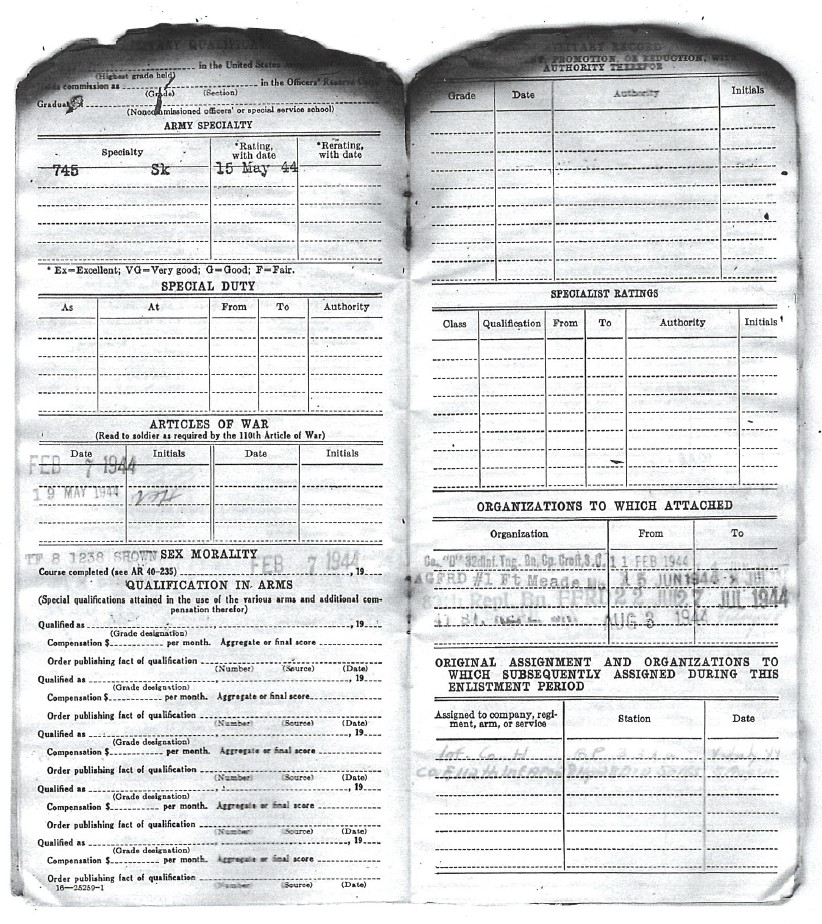
Census records indicate that Turner dropped out of school after completing 7th grade, but his enlistment data card described him as a high school graduate. According to documents from his personnel file, which survived the 1973 National Personnel Records Center fire, Turner completed seven years of grammar school and four years of high school.
Turner married Arintha Willey (1919–2010) in early October 1938 in Elkton, Maryland. A newspaper article stated that the couple planned to make their home in Easton. The couple had one son. Turner and his wife (though curiously, not their son) were recorded on the census in April 1940 living at 210 South Washington Street in Easton, Maryland. His occupation was listed as automobile painter.
When he registered for the draft on October 16, 1940, Turner was working for J. W. Hallowell in Easton. The registrar described him as standing about six feet, three inches tall and weighing 165 lbs., with brown hair and blue eyes. An article in the Denton Journal reported that Turner moved to his wife’s hometown of Seaford, Delaware, around 1940, suggesting that Turner relocated to Delaware soon after registering. He also joined the Seaford Volunteer Fire Department on December 9, 1942.
Journal-Every Evening reported that Turner operated a body shop in Seaford before he was drafted. According to the occupational qualifications section of his service record booklet, Turner worked six years as an automobile body repairman, earning $60 per week (about $1,155 in 2026 dollars). He also reported working for five years as a truck driver, earning $30 per week.
According to a statement by his wife to the State of Delaware Public Archives Commission, Turner was living at 403 Market Street in Seaford when he entered the service. Curiously, his service record listed his home of record as King Street in Wilmington, Delaware.
Military Career
Turner was 27 when he was inducted into the U.S. Army in Baltimore, Maryland, on January 14, 1944. His service record stated that he stood six feet, two inches tall and weighed 153 lbs. at induction. Turner was briefly transferred to the Enlisted Reserve Corps on inactive duty. He went on active duty at the Reception Center, Fort George G. Meade, Maryland, on February 4. Despite his work history, what the Army needed most by 1944 was infantrymen.
A set of orders dated February 9, 1944, effective the following day, dispatched Private Turner and hundreds of other men by train to the Infantry Replacement Training Center, Camp Croft, South Carolina. Upon arrival on February 11, he was attached unassigned to Company “D,” 32nd Infantry Training Battalion.
During his training, Turner qualified at the Sharpshooter level with the M1 Garand rifle, his score of 179 being only one point shy the Expert level. He also passed the battery of tests required to earn the Expert Infantryman Badge (E.I.B.), which included qualifying with his individual weapon, passing the grenade course and a physical fitness test, completing nine-mile and 25-mile marches, and completing infiltration, close quarters, and urban combat courses. However, his personnel file does not confirm that he was in fact awarded the E.I.B. On May 15, 1944, Turner was rated with the military occupational specialty of 745, rifleman.
A set of orders dated June 8, 1944, and effective June 14, detached Private Turner from 32nd Infantry Training Battalion and transferred him to the Army Ground Forces Replacement Depot No. 1 at Fort George G. Meade. He was provided with train transportation as far as Washington, D.C., authorized a 13-day furlough plus one travel day, and ordered to report by noon on June 28. After visiting his family, he reported as ordered and was attached to Company “B,” 12th Replacement Battalion, 3rd Replacement Regiment.
A set of orders dated July 1, 1944, and effective two days later, transferred Private Turner to a group of replacements, Shipment No. GP-333(a)-A. He went overseas that same month. Upon arriving in Europe, he entered the arcane Ground Force Replacement System. On July 23, he was attached to Detachment 89, Ground Force Replacement System, in Yeovil, Somerset, England. This was one of many replacement units under the control of the 12th Replacement Depot.
In the grueling combat of the European Theater, riflemen were in high demand. In his book, Beyond the Beachhead, Joseph Balkoski wrote:
Replacements were the army’s homeless. After a hasty separation from the units with which they had trained or fought, the lonely replacements found themselves in an unfamiliar repple depple [replacement depot], where they lost all sense of belonging to a cohesive military unit. Even new friendships made within the replacement depots were generally fleeting since it was unlikely that two buddies would be assigned to the same squad, or even the same platoon. Many replacements thought of themselves as nameless pieces of army equipment, like crates of ammunition, sent to the front and promptly consumed. […] “Being a replacement is just like being an orphan,” a rifleman recalled.
On July 27, 1944, Private Turner was attached to Replacement Detachment X-62-E and dispatched to the continent. At 2000 hours on July 29, 1944, he and the other men in the detachment were attached unassigned to Replacement Detachment 87 (87th Replacement Battalion) near Trévières, Normandy. On August 3, he was detached from that unit and attached to Replacement Detachment 41 (41st Replacement Battalion) at Bérigny, Normandy.

On August 4, 1944, Private Turner and seven other enlisted men joined Company “F,” 112th Infantry Regiment, 28th Infantry Division. Seven of the eight were riflemen. There was little time for him to get acclimated to his new unit. The 2nd Battalion report for the month stated that “On the morning of 4 August the Bn, as Regimental reserve, following the 1st Bn, moved to Le Mesnil[-]Caussois. Here enemy artillery fell on us and mine fields were encountered.”
Turner’s company’s morning report recorded on August 5, 1944: “MADE STEADY ADVANCE – ALL PERSONNEL HOLDING UP GOOD[.]” The company history for the month stated that day, “We followed 2nd Armored [Division] advancing through [Saint-Manvieu-Bocage] and dug in on a very high hill.”
The following day, August 6, 1944, 2nd Battalion continued its advance to the southeast. The Company “F” history stated:
“F” Company on right of”G” [sic] Company on left of “E” Company in reserve,we moved out to attack Hill 193. Two(2) prisoners captured informed us that there was enemy gun position about 1,000 yards forward of our initial objective. In our attempt to destroy these guns which was successful[, w]e had heavy casaulties [sic] and we were cut off and had to moved [sic] our way back to our lines while under heavy fire.
The 2nd Battalion report for the month added:
On 6 August the Bn attacked with G Company on the left, F Company on the right and E Company in reserve with La Julli[è]re as the objective. G Company, meeting heavy resistance, was held up on Hill 193. F Company lost contact with the Bn, being cut off by enemy infiltration, and did not rejoin the Bn until that night. E Company meanwhile built up on a line with G Company.
Private Turner was reported missing in action on August 6, 1944. In fact, he was one of at least five men from his company killed in action that day. According to the report of burial, Turner suffered fatal wounds to his thoracic cavity. Similarly, the hospital admission card filled out under his service number stated he was killed by injuries to his thorax due to an artillery shell explosion. (These cards were filled out even when a soldier died prior to reaching medical care, like Turner.)


Private Turner was initially buried at the military cemetery at Le Chêne Guérin on August 12, 1944. Despite that, it was only on September 6 that the War Department changed his status to killed in action. Turner was posthumously awarded the Purple Heart.
On October 7, 1944, Arintha wrote a letter to the War Department.
I have waited a month now since I received your last letter concerning the death of my husband. I have tried to have patience and wait to hear more details but I have just got to know something or go insane:
Where it happened?
Was his body found?
If so, where his body was put to rest?
Since I have heard nothing from you I have begun to hope that maybe he is alive somewhere. Oh God, I pray that he may be.
I have a little boy aged five and he ask[s] so many questions that if I knew anything positive perhaps I could answer his questions better.
I try not to be bitter by I can’t help it. My husband was only in the Army six months and two days when this tragedy happened. I guess I am only one person in a million with the feeling that if he had had more training perhaps this wouldn’t have happened. I know there is plenty of men over her [sic] with three years training. May God forgive me for having these thoughts but I feel better getting it off my chest.
Please try to find out something for me. Maybe a few details will help.
Do you think I can hope that he is safe some where?
Sincerely,
Mrs. Walter S. Turner
There is no indication in Turner’s personnel file nor in his individual deceased personnel file (I.D.P.F.) that his widow was provided with any of the answers she sought beyond the location of the temporary cemetery he was buried at and a brief explanation about Army training.
After the war, Turner’s family requested that his body be repatriated to the United States. In 1949, his casket returned to the United States aboard the Liberty ship Barney Kirschbaum.
A military escort, Corporal Robert A. Arscott, accompanied the body from the New York Port of Embarkation on the overnight train journey to Federalsburg. Corporal Arscott met Turner’s father on April 6, 1949, and was invited to stay for the funeral at the Frampton Funeral Home there. After services on April 9, 1949, Private Turner was buried in Odd Fellows Cemetery in Seaford.
Arintha Turner remarried on March 7, 1947, to Charles E. Morris. She was destined to be widowed three times.
Private Turner is honored on the Seaford Veterans Memorial and at Veterans Memorial Park in New Castle, Delaware.
Notes
Marriage Date
Journal-Every Evening stated that Turner and his wife married on October 7, 1938, while his wife’s statement gave the date as October 4, 1938.
La Jullière
La Jullière appears on some maps as La Jeulière.
Photo Enhancement
The photo at the top of the page was digitally enhanced using tools on the genealogy website MyHeritage. This software is useful in instances where the only known photograph is of limited resolution (in this case, because the family was able to locate only a cell phone picture of the print and not the original photo). I believe this to be an accurate reconstruction, but the software could potentially introduce errors by misinterpreting fuzzy details in the original photograph. A comparison of the original and enhanced versions of the photo can be viewed below.

Acknowledgments
Special thanks to the Turner family for the use of their photo and to Chief John Wilson of the Seaford Volunteer Fire Department for providing the date that Turner joined the S.V.F.D.
Bibliography
“Arintha Willey Heller.” Find a Grave. https://www.findagrave.com/memorial/60946945/arintha-heller
Balkoski, Joseph. Beyond the Beachhead: The 29th Infantry Division in Normandy. Revised ed. 2005. Stackpole Books.
Barwick, Clarence J. “Company History for August 1944.” September 17, 1944. World War II Operations Reports, 1940–1948. Record Group 407, Records of the Adjutant General’s Office, 1905–1981. National Archives at College Park, Maryland.
“C. H. Turner.” September 15, 1958. The Salisbury Times. https://www.newspapers.com/article/109287879/
Census Record for Walter S. Turner. April 17, 1930. Fifteenth Census of the United States, 1930. Record Group 29, Records of the Bureau of the Census. National Archives at Washington, D.C. https://www.familysearch.org/ark:/61903/3:1:33SQ-GR41-C66
Census Record for Walter S. Turner. April 1940. Sixteenth Census of the United States, 1940. Record Group 29, Records of the Bureau of the Census. National Archives at Washington, D.C. https://www.familysearch.org/ark:/61903/3:1:3QS7-89M1-ZZC6
Census Record for Walter S. Turner. January 3, 1920. Fourteenth Census of the United States, 1920. Record Group 29, Records of the Bureau of the Census. National Archives at Washington, D.C. https://www.familysearch.org/ark:/61903/3:1:33S7-9R6K-N7W
Draft Registration Card for Clarence Homer Turner. September 12, 1918. World War I Selective Service System Draft Registration Cards, 1917–1918. National Archives at Washington, D.C. https://www.familysearch.org/ark:/61903/3:1:33S7-9YT6-XL6?cc=1968530
Draft Registration Card for Walter Short Turner. October 16, 1940. Draft Registration Cards for Maryland, October 16, 1940 – March 31, 1947. Record Group 147, Records of the Selective Service System. National Archives at St. Louis, Missouri. https://www.familysearch.org/ark:/61903/3:1:3Q9M-CS7H-7S6B-N
Enlistment Record for Walter S. Turner. January 14, 1944. World War II Army Enlistment Records. Record Group 64, Records of the National Archives and Records Administration. National Archives at College Park, Maryland. https://aad.archives.gov/aad/record-detail.jsp?dt=893&mtch=1&cat=all&tf=F&q=33903343&bc=&rpp=10&pg=1&rid=4352727
Hospital Admission Card for 33903343. August 1944. U.S. WWII Hospital Admission Card Files, 1942–1954. Record Group 112, Records of the Office of the Surgeon General (Army), 1775–1994. National Archives at College Park, Maryland. https://www.fold3.com/record/705237053/turner-walter-s-us-wwii-hospital-admission-card-files-1942-1954
Individual Deceased Personnel File for Walter S. Turner. 1944–1949. Army Individual Deceased Personnel Files, 1942–1970. Record Group 92, Records of the Office of the Quartermaster General, 1774–1985. National Archives at St. Louis, Missouri. Courtesy of U.S. Army Human Resources Command.
Morning Reports for Company “B,” 12th Replacement Battalion, 3rd Replacement Regiment. June 1944 – July 1944. U.S. Army Morning Reports, c. 1912–1946. Record Group 64, Records of the National Archives and Records Administration. National Archives at St. Louis, Missouri. https://catalog.archives.gov/medialz/partners/st-louis/rg-064/85713825-wwii/85713825_1944-06/85713825_1944-06_Roll-0209/85713825_1944-06_Roll-0209-02.pdf, https://catalog.archives.gov/medialz/partners/st-louis/rg-064/85713825-wwii/85713825_1944-07/85713825_1944-07_Roll-0289/85713825_1944-07_Roll-0289-16.pdf
Morning Reports for Company “D,” 32nd Infantry Training Battalion. June 1944. U.S. Army Morning Reports, c. 1912–1946. Record Group 64, Records of the National Archives and Records Administration. National Archives at St. Louis, Missouri. https://catalog.archives.gov/medialz/partners/st-louis/rg-064/85713825-wwii/85713825_1944-06/85713825_1944-06_Roll-0306/85713825_1944-06_Roll-0306-20.pdf
Morning Reports for Company “F,” 112th Infantry Regiment. August 1944. U.S. Army Morning Reports, c. 1912–1946. Record Group 64, Records of the National Archives and Records Administration. National Archives at St. Louis, Missouri. https://catalog.archives.gov/id/567385773?objectPage=2924, https://catalog.archives.gov/id/567385773?objectPage=2966
Morning Reports for Replacement Detachment 41, Ground Force Replacement System. August 1944. U.S. Army Morning Reports, c. 1912–1946. Record Group 64, Records of the National Archives and Records Administration. National Archives at St. Louis, Missouri. https://catalog.archives.gov/medialz/partners/st-louis/rg-064/85713825-wwii/85713825_1944-08/85713825_1944-08_Roll-0704/85713825_1944-08_Roll-0704-12.pdf, https://catalog.archives.gov/medialz/partners/st-louis/rg-064/85713825-wwii/85713825_1944-08/85713825_1944-08_Roll-0704/85713825_1944-08_Roll-0704-13.pdf
Morning Reports for Replacement Detachment 87, Ground Force Replacement System. July 1944. U.S. Army Morning Reports, c. 1912–1946. Record Group 64, Records of the National Archives and Records Administration. National Archives at St. Louis, Missouri. https://catalog.archives.gov/medialz/partners/st-louis/rg-064/85713825-wwii/85713825_1944-07/85713825_1944-07_Roll-0663/85713825_1944-07_Roll-0663-10.pdf
Morning Reports for Replacement Detachment 89, Ground Force Replacement System. July 1944. U.S. Army Morning Reports, c. 1912–1946. Record Group 64, Records of the National Archives and Records Administration. National Archives at St. Louis, Missouri. https://catalog.archives.gov/medialz/partners/st-louis/rg-064/85713825-wwii/85713825_1944-07/85713825_1944-07_Roll-0664/85713825_1944-07_Roll-0664-03.pdf, https://catalog.archives.gov/medialz/partners/st-louis/rg-064/85713825-wwii/85713825_1944-07/85713825_1944-07_Roll-0664/85713825_1944-07_Roll-0664-04.pdf
Nesbitt, James T. “Unit History for August 1944.” May 15, 1945. World War II Operations Reports, 1940–1948. Record Group 407, Records of the Adjutant General’s Office, 1905–1981. National Archives at College Park, Maryland.
Official Military Personnel File for Walter S. Turner. 1944. Official Military Personnel Files, 1912–1998. Record Group 319, Records of the Army Staff. National Archives at St. Louis, Missouri.
“Pvt. Turner Killed In Action In France.” September 22, 1944. Denton Journal. https://www.newspapers.com/article/109064803/
“Pvt. Walter S. Turner Military Rites Saturday.” April 8, 1949. Journal-Every Evening. https://www.newspapers.com/article/109073085/
“Pvt Walter Short Turner.” Find a Grave. https://www.findagrave.com/memorial/54166338/walter-short-turner
Turner, Arintha W. Individual Military Service Record for Walter Short Turner. Undated, c. 1946. Record Group 1325-003-053, Record of Delawareans Who Died in World War II. Delaware Public Archives, Dover, Delaware. https://cdm16397.contentdm.oclc.org/digital/collection/p15323coll6/id/21189/rec/1
“Special Orders No 34, (Reception Center) Fort George G. Meade, Maryland.” February 9, 1944. U.S. Army Morning Reports, c. 1912–1946. Record Group 64, Records of the National Archives and Records Administration. National Archives at St. Louis, Missouri. https://catalog.archives.gov/medialz/partners/st-louis/rg-064/85713825-wwii/85713825_1944-02/85713825_1944-02_Roll-0100/85713825_1944-02_Roll-0100-08.pdf
“Willey-Turner.” October 14, 1938. Journal-Every Evening. https://www.newspapers.com/article/109077797/
Wilson, John. Email correspondence. November 9, 2022.
Young American Patriots: The Youth of Maryland and Delaware in World War II. National Publishers, Inc., 1950. https://www.ancestry.com/imageviewer/collections/8941/images/md_de1-0337
Last updated on October 14, 2026
More stories of World War II fallen:























To have new profiles of fallen soldiers delivered to your inbox, please subscribe below.

