
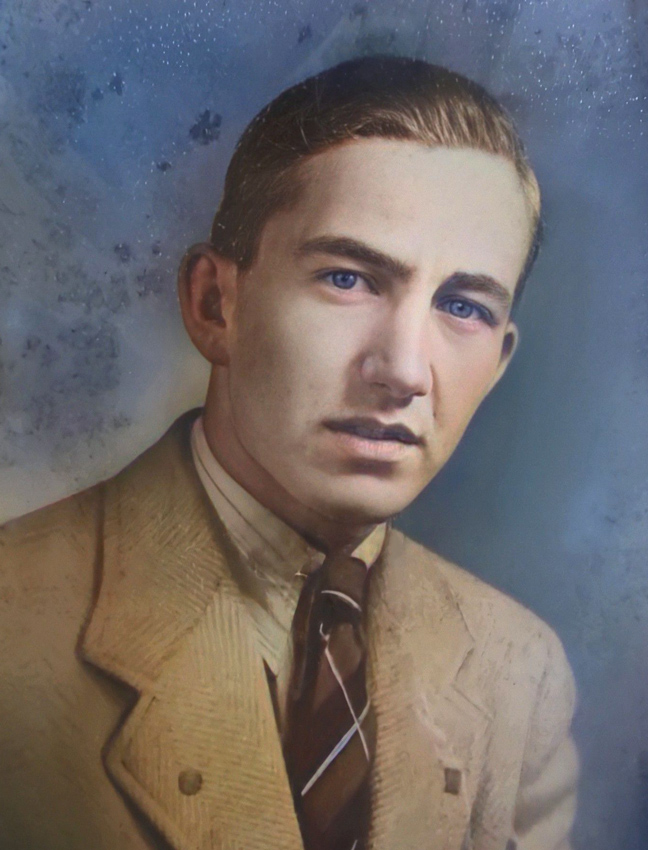
| Hometown | Civilian Occupation |
| Lewes, Delaware | Recent graduate |
| Branch | Service Number |
| U.S. Army | 32952507 |
| Theater | Unit |
| Mediterranean | Company “A,” 310th Medical Battalion, 85th Infantry Division |
| Military Occupational Specialty (Presumed) | Campaigns/Battles |
| 657 (medical aidman/litter bearer) | Rome-Arno and North Apennines campaigns |
Early Life & Family
Lynn E. Ritter, Jr. was born in Georgetown, Delaware, on the morning of October 27, 1924. He was the first child of Lynn E. Ritter (1896–1981) and Amelia Elizabeth Ritter (née Rogers, 1904–1982). Ritter’s father had served in the U.S. Marine Corps stateside during World War I. At the time of his son’s birth, he was working as an engineer in a factory, but he was appointed as a constable in 1939 and later became chief of the Lewes Police Department. Ritter had two younger sisters: Hazel E. Ritter (1930–1937) and Grace Ritter (later Grace Ritter Lafferty, 1933–2007).
On December 14, 1929, Ritter’s father purchased two tracts totaling 258¾ acres of farmland in Lewes & Rehoboth Hundred, located southwest of downtown Lewes near Black Oak Stream (also known as Black Oak Gut or Black Hog Gut). Tragedy struck the family on February 10, 1937, when Ritter’s younger sister, Hazel, became sick. She died four days later from meningitis, aged six.
The Ritter family was recorded on the 1940 census living on Road 267 near Lewes, Delaware. (Road 267 is still extant as a crescent-shaped route from Lewes to U.S. Route 9, but the 1940 census enumeration map indicates that back then, Road 267 also included what is now known as Clay Road.)
Ritter was a member of Future Farmers of America while attending Lewes High School. When he registered for the draft on December 23, 1942, Ritter was living in Lewes. The registrar described him as standing five feet, 10½ inches tall and weighing 150 lbs., with blond hair and blue eyes. Ritter was Protestant according to his military paperwork.
Military Training
Shortly after graduating from Lewes High School, Ritter was drafted. He was inducted into the U.S. Army in Camden, New Jersey, on June 22, 1943. He went on active duty on or about July 6, 1943, when he was attached to Company “B,” 1229th Reception Center, Fort Dix, New Jersey. Assigned to the Medical Department, Ritter trained with two other Delawareans who had been inducted on the same day: William G. Walls (1924–1982) had been born and raised in Georgetown, while Preston L. Dyer (1924–2018) hailed from Milford. All three men departed Fort Dix on July 13, 1943, and attended basic training at the Medical Replacement Training Center at Camp Grant, Illinois. The following day, Ritter and Walls were attached unassigned to Company “B,” 35th Medical Training Battalion, 8th Medical Training Regiment at Camp Grant, while Dyer trained with Company “A.”
After completing their basic training, Private Ritter and his classmates had the opportunity to go on furlough before transferring to their future units. Ritter and Walls were among a group of 60 men whose eight-day furlough began on October 9, 1943. They were due back at midnight on the night of October 16–17, 1943. Ritter and 10 other men failed to report back on time and were declared absent without leave (A.W.O.L.) effective 0001 hours on October 17, 1943. Most likely, if they visited home, their return journeys were delayed and they either were unable to get in contact with their commanding officer to obtain an extension or their request for one was denied. Ritter returned to duty the following day. Ritter’s commanding officer evidently went easy on him, since the infraction did not prevent him from receiving the Good Conduct Medal after one year of service on active duty.
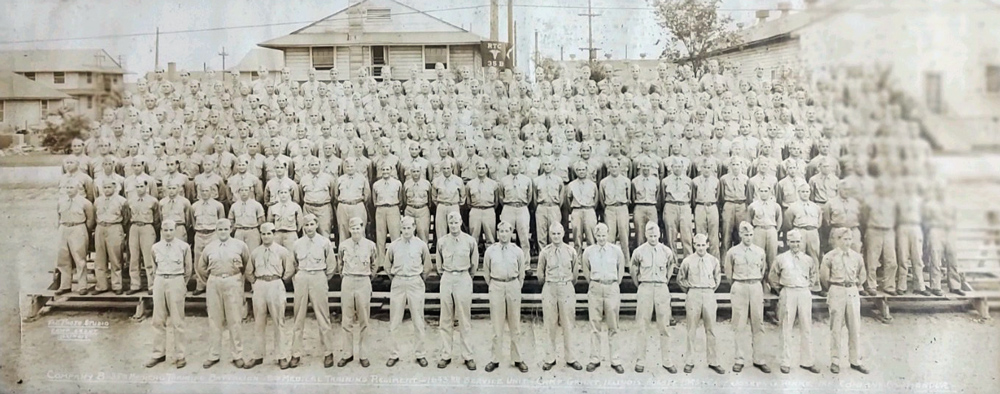
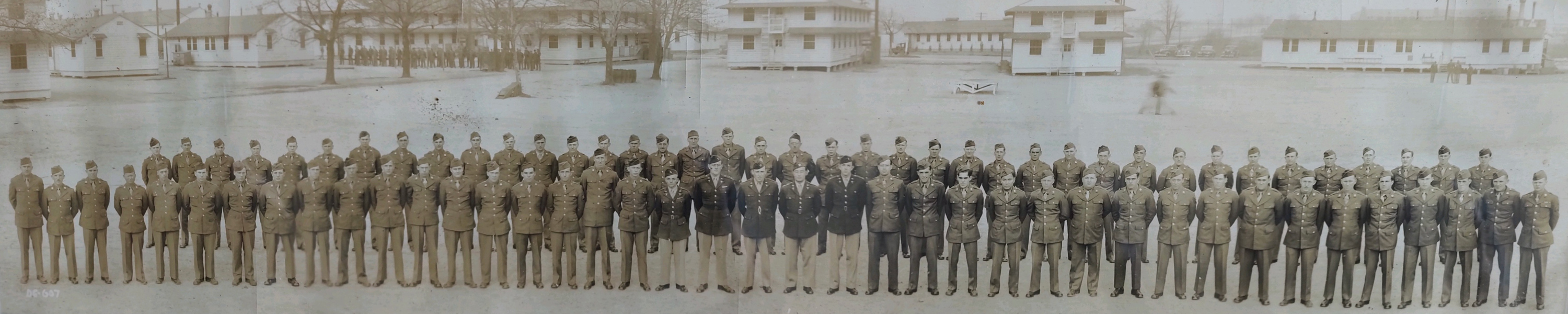
No sooner had Ritter returned to Illinois than he found himself ordered back to the East Coast. Ritter, Dyer, and Walls were transferred to the 85th Infantry Division at Fort Dix effective October 23, 1943, per Special Orders No. 185, Headquarters 1613th Service Unit, Camp Grant, Illinois, dated October 20, 1943.
After arriving at Fort Dix, the trio joined the 310th Medical Battalion, 85th Infantry Division. The battalion had been activated on May 15, 1942, after its predecessor, the 310th Medical Regiment, was deactivated when the 85th Infantry Division transformed from a “square” division with four infantry regiments to a leaner three-regiment “triangular” division.
On October 24, 1943, Privates Ritter and Walls joined the 310th’s Company “A,” while Private Dyer joined Company “B.” Despite having completed basic training, none of the men had qualified in a military occupational specialty (M.O.S.), so their M.O.S. codes were listed as 521, basic.
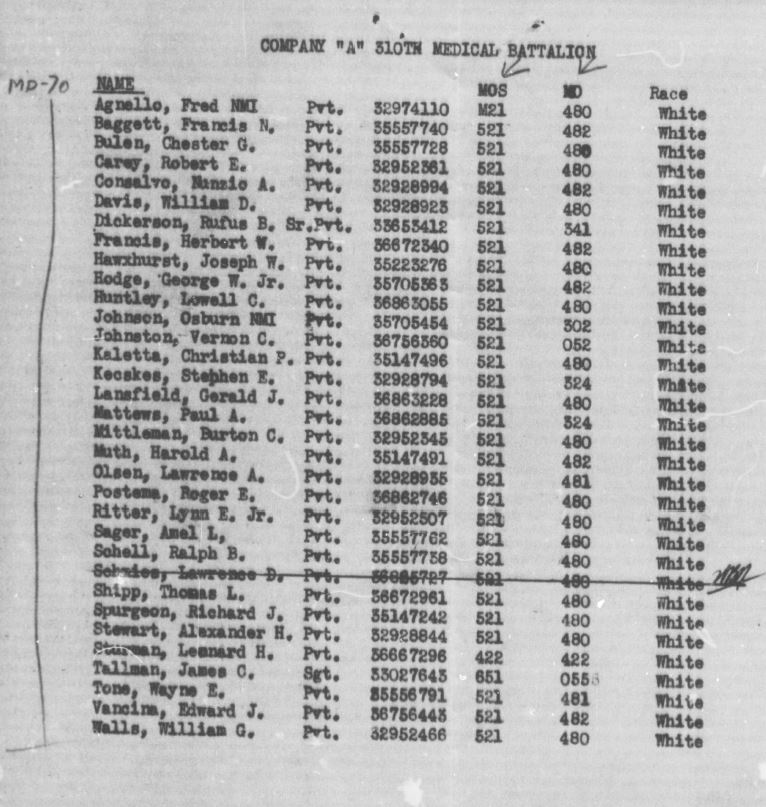
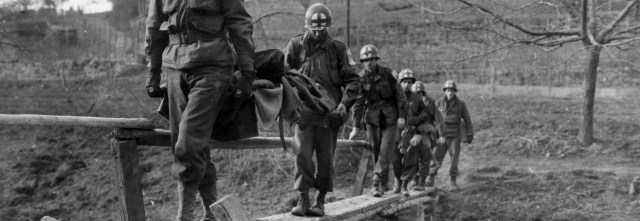
Usually, initial care for wounded soldiers from infantry divisions was provided by members of the regimental medical detachments. These detachments supplied medics to frontline units and operated aid stations. Medical battalions like Ritter’s represented an intermediate (division-level) link in the chain of survival. Each medical battalion had three collecting companies (“A,” “B,” and “C”). Generally, litter bearers moved the wounded soldiers from the aid station to their company’s collecting station.
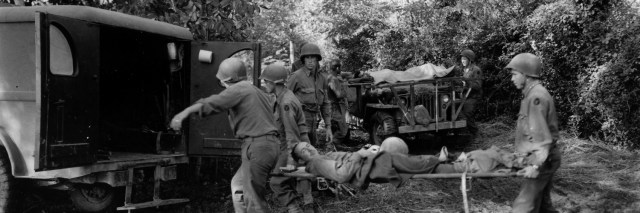
Dyer and Walls were litter bearers during their service overseas. It is likely that Ritter was one too. Even with four men to a litter, carrying a casualty over rough terrain was backbreaking work. When possible, patients were transferred to a wheeled litter at a litter relay post for movement the rest of the way to the collecting station.

At the collecting station, medical personnel cared for patients until they could be moved to the medical battalion’s clearing station (operated by the clearing company, “D”). There, patients were triaged, received further treatment, and if necessary, were evacuated by ambulance to a hospital.
The 85th Infantry Division arrived at Camp Patrick Henry, Virginia, in mid-December 1943 prior to shipping out from the Hampton Roads Port of Embarkation on Christmas Eve. The division arrived in Casablanca, Morocco, in early January 1944 and trained in Algeria during the winter before arriving at Naples, Italy, in late March 1944.
Service in Italy
Italy had originally been part of the Axis powers but capitulated shortly after Allied forces began invading the Italian mainland on September 3, 1943. German forces quickly occupied much of their former ally’s homeland. Geography benefitted these German defenders, who fortified the narrow peninsula with defensive line after defensive line. As Allied forces broke through each line, the Germans retreated in good order to their next line. Despite Allied naval superiority, they made only one attempt to bypass defensive lines with an amphibious assault, at Anzio in January 1944. That beachhead was quickly bottled up by the Germans for months. Future operations in Normandy, the South of France, and the Pacific ruled out any further amphibious operations in Italy, and the diversion of resources to those areas sapped the U.S. Fifth and British Eighth Armies’ offensive strength. Nonetheless, Allied pressure forced the Germans to commit divisions that could otherwise have been moved to northwest or eastern Europe. For that reason, costly combat continued in Italy until mere days before the final surrender of the Nazi regime in May 1945.
April 1, 1944, found Company “A” of the 310th Medical Battalion bivouacked in the vicinity of Bagnoli, near Naples, but the unit moved to Mondragone on April 3. The company went into service in a combat area for the first time on April 24, relieving Company “C” along the Gustav Line near Minturno. The unit evacuated 85th Infantry Division casualties until relieved by Company “B” on May 2, 1944. Ritter and his comrades went back into action on the night of May 11, 1944, when the 85th Infantry Division launched another attack on the Gustav Line. The 310th Medical Battalion evacuated 544 men on May 12 alone. Company “A” suffered its first fatality that day when an ambulance orderly, Private 1st Class Belvin A. Allison (1922–1944), was killed by an artillery shell.
The May 1944 operations report stated:
Due to the large number of casualties and to the type of terrain, which was very mountainous, the number of litter bearers provided for the Division were far from adequate. All litter bearers of Company “A” were sent to help out and in addition the Division provided men from the 85th Quartermaster Company, the Division Band and the defense platoon of Headquarters Company of the Division. Also two companies for a total of about 240 of the 67th Infantry Regiment, an Italian unit, were used to assist in litter bearing. All of these additional litter bearers were forwarded as needed to Companies “B” and “C” who in turn were called on for assistance by the battalion aid stations.
In addition to needing additional litter bearers the number of ambulances in the Battalion were insufficient to keep the evacuation process open. All ambulances of Company “A” were put into use, six ambulances were drawn from Corps and with this increase it was still necessary to evacuate many truck loads of walking wounded by whatever vehicle was available.
Ritter’s buddy, Private William G. Walls, was among the wounded that month.
The 85th Infantry Division came out of the line on May 27, 1944, but Ritter and his comrades went back into combat near Cori three days later. With the Gustav Line finally broken and Allied forces streaming out of the long-static Anzio beachhead, Rome fell, an achievement soon overshadowed by the Normandy landings. June 1944 also saw the wounding of Private Preston L. Dyer, leaving Ritter as the last unwounded member of the Delaware trio that had been inducted and trained together.

The 310th Medical Battalion got a break from combat beginning on June 10, 1944. Some men were able to travel to Rome on pass. By July 7, 1944, when he was awarded the Good Conduct Medal, Ritter had been promoted to private 1st class. Company “A” returned to the line near Roccastrada on July 13, 1944. However, activity was generally light during the rest of July and August. The 310th Medical Battalion spent much of the summer training.
In mid-September 1944, the Allies began a new offensive against the Gothic Line north of Florence. Company “A” was supporting the 337th Infantry Regiment, which was initially in reserve. The 310th Medical Battalion commanding officer, Lieutenant Colonel Robert P. Campbell, wrote in his September 1944 report:
A fairly rapid advance across difficult terrain began after the 17th. Evacuation of casualties was smooth and continuous despite terrain difficulties. All three collecting companies were now operating with an advanced section giving close support, and the remainder of the company staying behind. This noticeably increased the flexibility of the company. Litter bearers were with [infantry] Battalion aid Stations, ambulances with the forward station and the remainder of the company in the rear. A small reserve of litter bearers was kept in the rear to relieve exhausted men with the Battalion aid Stations. Hot meals were brought up to the forward stations daily. At the first opportunity the remainder of the company would join the advanced station. In this manner even in its most rapid advances the infantry would receive close support.
The weather turned miserable in late September, though combat continued in heavy rain. On September 29, 1944, four Company “A” ambulances were washed away in a flash flood. Despite the weather and terrain, the 310th Medical Battalion successfully evacuated 1,375 American, 47 German, and 21 Italian civilian casualties between September 13–30, losing one man killed and 10 wounded in the process.
The offensive continued the following month, though conditions were little better, as Lieutenant Colonel Campbell wrote in his report covering operations during October 1–10, 1944:
The Collecting Companies, in support of their respective combat teams, were experiencing much difficulty at this time in the evacuation of casualties because of the almost continuous rains, rendering the few roads nearly impassable; and the mountainous terrain, necessitating long and arduous litter hauls. In spite of all difficulties evacuation was smooth and continuous.
As of October 1, 1944, the main body of Company “A” was based in San Pellegrino. Unit records indicate that at 1100 hours an advance party opened a collecting station in the hilly country near the hamlet of Roco (also known as Roco Di Sotto), just north of Castelvecchio, Tuscany. That same day, Ritter’s buddy, Private William G. Walls, rejoined the company after recovering from his wounds.
The following day, October 2, was rainy again. As the 85th Infantry Division captured Hills 719 and 751, the main body of Company “A” left San Pellegrino at 0930 hours for the 23-mile drive to Roco, arriving at 1330.
Around 1400 hours on October 3, 1944, Private 1st Class Ritter was killed when the jeep he was riding in detonated a land mine. According to his burial report, Ritter died near Piancaldoli, about a mile up the road from Roco. Private Walls, wounded in the left eye by the same explosion that killed Ritter, was treated at the 56th Evacuation Hospital.

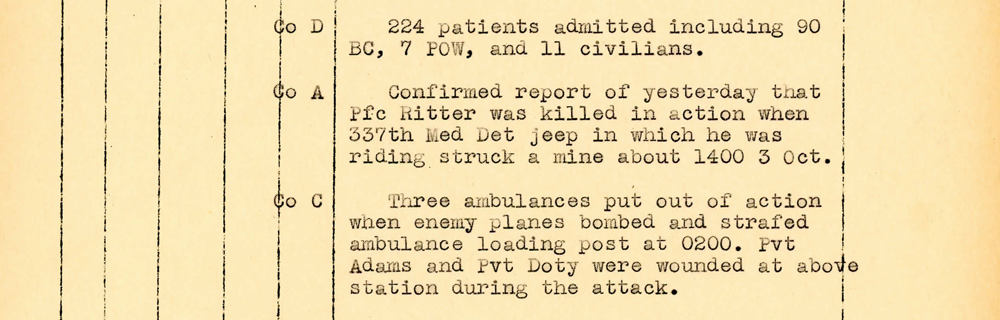
Journal-Every Evening reported on October 27, 1944: “A letter from their son, telling them not to worry, was received by Mr [sic] and Mrs. Ritter just four days before the War Department telegram announcing his death arrived.”
Private 1st Class Ritter was initially buried on October 8, 1944, in a temporary U.S. military cemetery at Castelfiorentino, Italy. After the war, in December 1947, his parents requested that their son’s body be repatriated to the United States. The following fall, Ritter and other fallen servicemen returned to the United States from Livorno, Italy, aboard the Lawrence Victory. A military escort accompanied his body to Georgetown by train.
After services at Atkins Funeral Home in Lewes on December 9, 1948, Private 1st Class Ritter was buried next to his late sister, Hazel, at nearby Bethel Methodist Cemetery. His parents and as well as his sister, Grace, were also buried there after their deaths.
Notes
Middle Name
Ritter’s birth certificate listed his middle name as Earnest, while the index card in the Delaware Vital Records collection spelled it Ernest.
Photo Enhancement
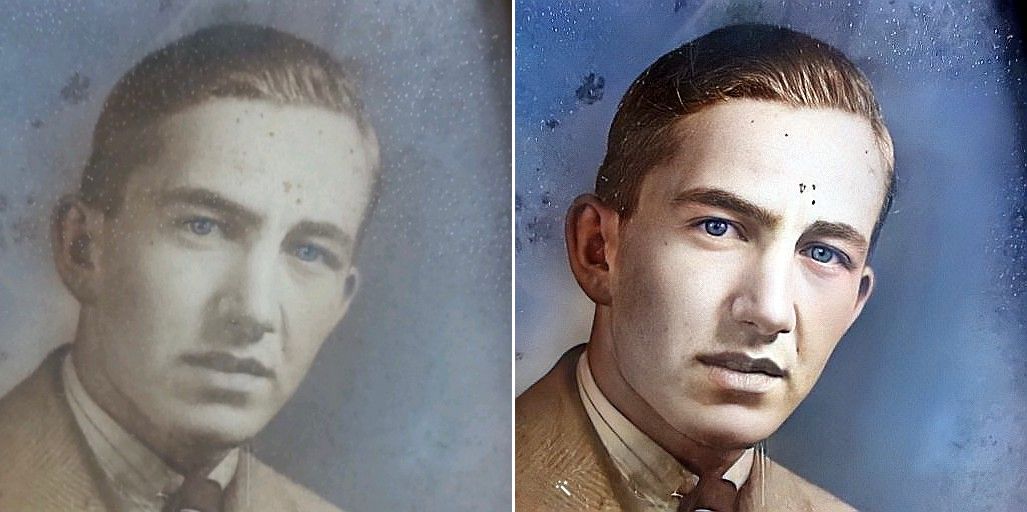
The photo at the top of the page was digitally enhanced using tools on the genealogy website MyHeritage. This software is useful in instances where the only known photograph is of limited resolution (in this case, because the picture was behind glass and had damage due to its age). I believe this to be an accurate reconstruction, but the software could potentially introduce errors by misinterpreting fuzzy details in the original photograph. A comparison of the original and enhanced versions of the photo can be viewed below.
Acknowledgments
Special thanks to Private 1st Class Ritter’s niece, Lacey Lafferty, for the use of her pictures.
Bibliography
Batens, Alain S. and Major, Ben. “The WW2 Medical Battalion, Infantry Division.” WW2 US Medical Research Centre website. https://www.med-dept.com/articles/the-ww2-medical-battalion-infantry-division/
Batens, Alain S. and Major, Ben. “The WW2 Medical Detachment Infantry Regiment.” WW2 US Medical Research Centre website. https://www.med-dept.com/articles/the-ww2-medical-detachment-infantry-regiment/
Campbell, Robert P. “310th Medical Battalion Report of Operations July – August 1944.” Headquarters 310th Medical Battalion, September 14, 1944. World War II Operations Reports, 1940–1948. Record Group 407, Records of the Adjutant General’s Office, 1905–1981. National Archives at College Park, Maryland.
Campbell, Robert P. “310th Medical Battalion Report of Operations October 1944.” November 24, 1944. World War II Operations Reports, 1940–1948. Record Group 407, Records of the Adjutant General’s Office, 1905–1981. National Archives at College Park, Maryland.
Campbell, Robert P. “310th Medical Battalion Report of Operations September 1944.” October 18, 1944. World War II Operations Reports, 1940–1948. Record Group 407, Records of the Adjutant General’s Office, 1905–1981. National Archives at College Park, Maryland.
Census Record for Leu Ritter, Jr. June 19, 1940. Sixteenth Census of the United States, 1940. Record Group 29, Records of the Bureau of the Census. National Archives at Washington, D.C. https://www.ancestry.com/imageviewer/collections/2442/images/m-t0627-00548-00708
Certificate of Birth for Lynn Earnest Ritter, Jr. 1924. Record Group 1500-008-094, Birth certificates. Delaware Public Archives, Dover, Delaware. https://www.familysearch.org/ark:/61903/3:1:33S7-9YQM-QWVK
Certificate of Death for Hazel E. Ritter. 1937. Delaware Death Records. Delaware Public Archives, Dover, Delaware. https://www.familysearch.org/ark:/61903/3:1:3Q9M-CSMJ-Y7PG-F
“Club Entertains Lewes Graduates.” Wilmington Morning News, May 18, 1943. https://www.newspapers.com/clip/119809625/ritter-graduate-lewes-hs/
“Deed: Dr. John S. Pretyman, Jr. [illegible] To Lynn E. Ritter.” December 14, 1929. Delaware Land Records, 1677–1947. Record Group 4555-000-030, Recorder of Deeds, Sussex County. Delaware Public Archives, Dover, Delaware. https://www.ancestry.com/imageviewer/collections/61025/images/31303_236527-00553
Draft Registration Card for Lynn Ernest Ritter, Jr. December 23, 1942. Draft Registration Cards for Delaware, October 16, 1940 – March 31, 1947. Record Group 147, Records of the Selective Service System. National Archives at St. Louis, Missouri. https://www.ancestry.com/imageviewer/collections/2238/images/44003_05_00008-01074
Enlistment Record for Lynn E. Ritter, Jr. June 22, 1943. World War II Army Enlistment Records. Record Group 64, Records of the National Archives and Records Administration. National Archives at College Park, Maryland. https://aad.archives.gov/aad/record-detail.jsp?dt=893&mtch=1&cat=all&tf=F&q=32952507&bc=&rpp=10&pg=1&rid=3448746
Morning Reports for Company “A,” 310th Medical Battalion. October 1944. U.S. Army Morning Reports, c. 1912–1946. Record Group 64, Records of the National Archives and Records Administration. National Archives at St. Louis, Missouri. https://s3.amazonaws.com/NARAprodstorage/lz/partners/st-louis/rg-064/85713825-wwii/85713825_1943-10/85713825_1943-10_Roll-0129/85713825_1943-10_Roll-0129-16.pdf
Morning Reports for Company “B,” 35th Medical Training Battalion. October 1943. U.S. Army Morning Reports, c. 1912–1946. Record Group 64, Records of the National Archives and Records Administration. National Archives at St. Louis, Missouri. https://s3.amazonaws.com/NARAprodstorage/lz/partners/st-louis/rg-064/85713825-wwii/85713825_1943-10/85713825_1943-10_Roll-0081/85713825_1943-10_Roll-0081-22.pdf
Morning Reports for Trainees, Company “B,” 35th Medical Training Battalion. July 1943. U.S. Army Morning Reports, c. 1912–1946. Record Group 64, Records of the National Archives and Records Administration. National Archives at St. Louis, Missouri. https://s3.amazonaws.com/NARAprodstorage/lz/partners/st-louis/rg-064/85713825-wwii/85713825_1940-01-thru-1943-07/85713825_1940-01-thru-1943-07_Roll-2096/85713825_1940-01-thru-1943-07_Roll-2096-31.pdf
Morning Reports for Company “B,” 310th Medical Battalion. October 1943. U.S. Army Morning Reports, c. 1912–1946. Record Group 64, Records of the National Archives and Records Administration. National Archives at St. Louis, Missouri. https://s3.amazonaws.com/NARAprodstorage/lz/partners/st-louis/rg-064/85713825-wwii/85713825_1943-10/85713825_1943-10_Roll-0129/85713825_1943-10_Roll-0129-16.pdf
Morning Reports for Company “B,” 1229th Reception Center. July 1943. U.S. Army Morning Reports, c. 1912–1946. Record Group 64, Records of the National Archives and Records Administration. National Archives at St. Louis, Missouri. https://s3.amazonaws.com/NARAprodstorage/lz/partners/st-louis/rg-064/85713825-wwii/85713825_1940-01-thru-1943-07/85713825_1940-01-thru-1943-07_Roll-2839/85713825_1940-01-thru-1943-07_Roll-2839-13.pdf
Patterson, Ralph M. “310th Medical Battalion Report of Operations June 1944.” July 9, 1944. World War II Operations Reports, 1940–1948. Record Group 407, Records of the Adjutant General’s Office, 1905–1981. National Archives at College Park, Maryland.
“Pfc. L. E. Ritter, Jr.” The Salisbury Times, December 8, 1948. https://www.newspapers.com/clip/113319702/pfc-ritter-funeral/
“Pfc. Lynn Ernest Ritter Jr.” Find a Grave. https://www.findagrave.com/memorial/95385228/lynn-ernest-ritter
“Report of Operations for April 1944.” Undated, c. May 1944.. World War II Operations Reports, 1940–1948. Record Group 407, Records of the Adjutant General’s Office, 1905–1981. National Archives at College Park, Maryland.
“Report of Operations for May 1944.” Undated, c. June 1944. World War II Operations Reports, 1940–1948. Record Group 407, Records of the Adjutant General’s Office, 1905–1981. National Archives at College Park, Maryland.
Stanton, Shelby L. World War II Order of Battle: An Encyclopedic Reference to U.S. Army Ground Forces from Battalion through Division 1939–1946. Revised ed. Stackpole Books, 2006.
Last updated on October 24, 2024
More stories of World War II fallen:
























To have new profiles of fallen soldiers delivered to your inbox, please subscribe below.
 Delaware's World War II Fallen
Mr. L. Silverman,
A simple thank you falls short of the gratitude that I feel for your efforts in researching and publishing this biography of my late uncle, Lynn E. Ritter, Jr.. My family has always been extremely proud of my Uncle Lynn’s service and sacrifice. Like so many, he answered the call and never returned home. Even though I never got the opportunity to meet him, your article helps bring his memory to life. For that, I am extremely grateful.
Lest We Forget!
John M. Lafferty
U.S. Navy (Retired)
LikeLiked by 1 person
I’m glad you enjoyed the article. The support of families like yours is really what keeps this project moving forward. Today, I am featuring PFC Ritter’s story on the Facebook companion site: https://www.facebook.com/DelawareWWIIFallen
LikeLike