| Home State | Civilian Occupation |
| Delaware | Apprentice machinist for Bellanca Aircraft Corporation |
| Branch | Service Numbers |
| U.S. Marine Corps Reserve | U.S.N.R. 2440427 / U.S.M.C.R. 030576 |
| Theater | Unit |
| Zone of Interior (American) | Marine Scout Bombing Squadron 464 (VMSB-464), Marine Air Group 41 (MAG-41) |
| Military Occupational Specialty | Campaigns/Battles |
| 1021 (scout bomber pilot, single-engine) | None |
Early Life & Family
Belford Sidney Dunn was born at 515 North Rodney Street in Wilmington, Delaware, on March 8, 1923. He was the son of James Nellis Dunn (1898–1984) and Minnie Dunn (née Wood, 1901–1969). His mother was British. Dunn’s father worked for the Pennsylvania Railroad at the Wilmington Shops, finishing his four-decade career in 1965 as a car inspector.
Dunn had an older sister, Audrey Jane Dunn (later Moore, 1921–2017), and a younger sister, Gloria Myrna Dunn (later Tielleman, 1933–2005). The Dunn family was recorded on the census in April 1930 living at 1404 West 6th Street in Wilmington. Dunn and his older sister attended the Alfred I. duPont School in the 1930s. The Dunns had moved to a home in unincorporated New Castle County on Shipley Road near Talleyville by April 1, 1940.
Dunn told the Marine Corps that beginning in March 1938 he worked as a florist for Charles Simon, Jr., & Sons, earning $100 per month. One of his hobbies was training dogs. He played baseball, football, and basketball in high school. Dunn graduated from Pierre S. duPont High School on June 10, 1941. That same month, he left his job as a florist and was hired as an apprentice machinist by the Bellanca Aircraft Corporation, earning $150 per month. Dunn was Methodist.
Navy Service
Dunn volunteered for a six-year term in the U.S. Navy soon after the attack on Pearl Harbor. Since the age of majority at the time was 21, Dunn’s father consented to his son’s enlistment on December 26, 1941. Dunn was accepted for enlistment in Wilmington, Delaware. Shortly thereafter, he enlisted at the Navy Recruiting Station, Philadelphia, Pennsylvania, on January 16, 1942. At enlistment, his personnel file described Dunn as standing five feet, 11 inches tall and weighing 180 lbs., with auburn hair and blue eyes.
On January 18, 1942, Apprentice Seaman Dunn reported for boot camp at the U.S. Naval Training Station, Newport, Rhode Island. On February 11, 1942, he was dispatched to the U.S. Naval Air Station, Naval Operating Base, Norfolk, Virginia. He reported for duty there three days later.
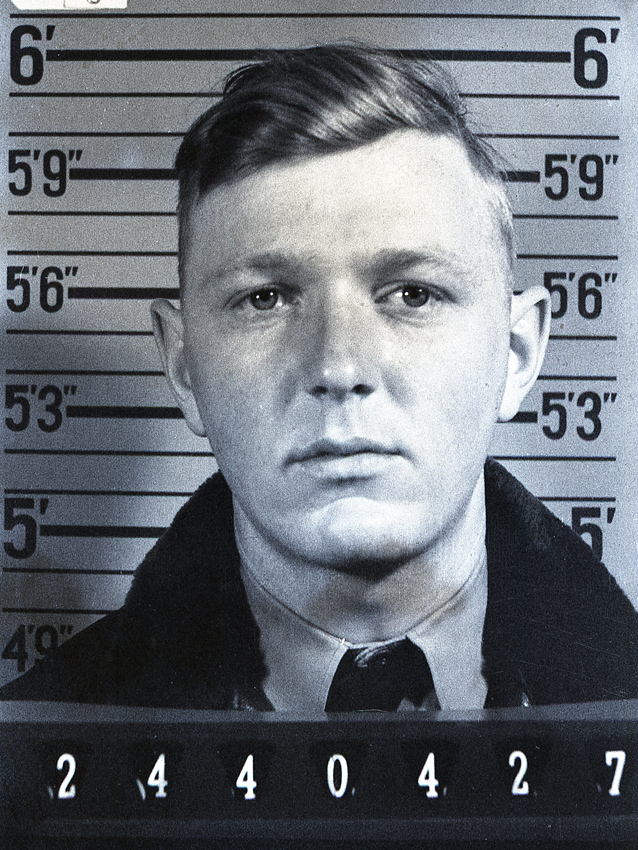
Dunn was promoted to seaman 2nd class on May 16, 1942. He went on leave from May 30, 1942, until June 6, 1942. He took emergency leave on June 11–16, 1942. On August 20, 1942, he completed aviation ordnanceman training.
Dunn volunteered for the V-5 (Naval Aviation Cadet) program. On October 20, 1942, he passed a physical exam qualifying him for flight duty. He went on leave again December 5–11, 1942. On December 16, 1942, he was transferred to the U.S. Navy Pre-Flight School, Chapel Hill, North Carolina. It appears he was authorized a delay in reporting, since he did not arrive at Chapel Hill until December 22, 1942. He was honorably discharged from the U.S. Navy as a formality that same day. The following day, December 23, 1942, he reenlisted as an aviation cadet in the U.S. Naval Reserve, beginning his training at the same location. At this time, his personnel file described Dunn slightly differently from earlier that year: six feet tall and 190 lbs. He participated in boxing and football while at Chapel Hill.
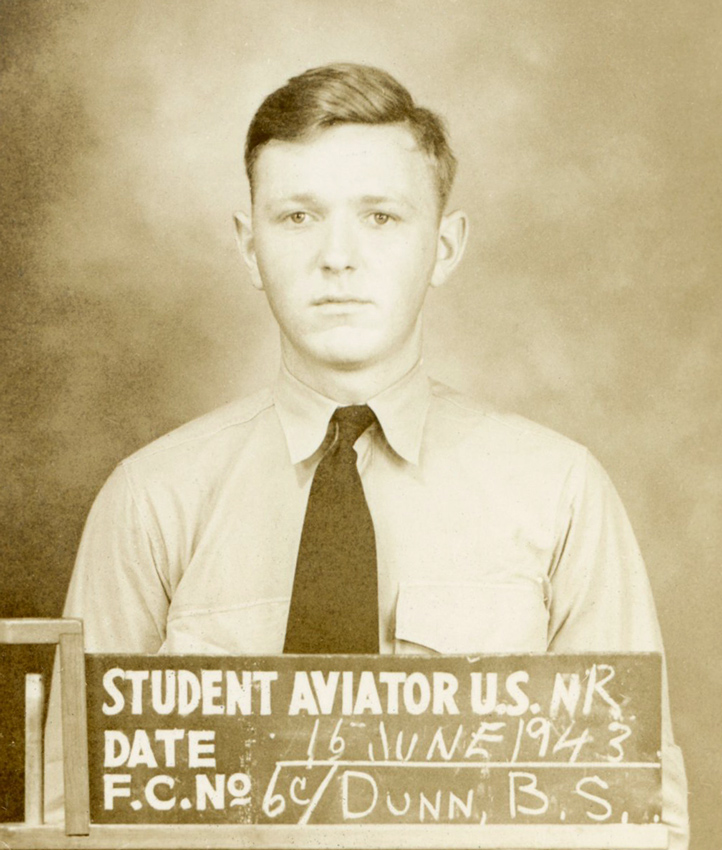
On March 24, 1943, Aviation Cadet Dunn was transferred to the U.S. Naval Air Station, Glenview, Illinois, for primary flight training. The training included aerology, navigation, communication, and recognition. He accumulated 47.5 hours of flight time with an instructor and 60.5 hours of solo flight time. At Glenview, Dunn flew the Naval Aircraft Factory N3N biplane trainer, including training in handling stalls, normal spins, and inverted spins.
On June 2, 1943, Dunn submitted his preferences for future assignment. His first choice was to serve as a fighter pilot in the Pacific, explaining that “I would rather rely on myself for combat rather than have the crew of a larger ship on my hands.” His flight instructor, Ensign G. Reynolds, concurred, writing: “I believe this cadet will make a good fighter pilot as he is aggressive.” Dunn selected, and his instructor concurred, with piloting a scout bomber as his second choice.
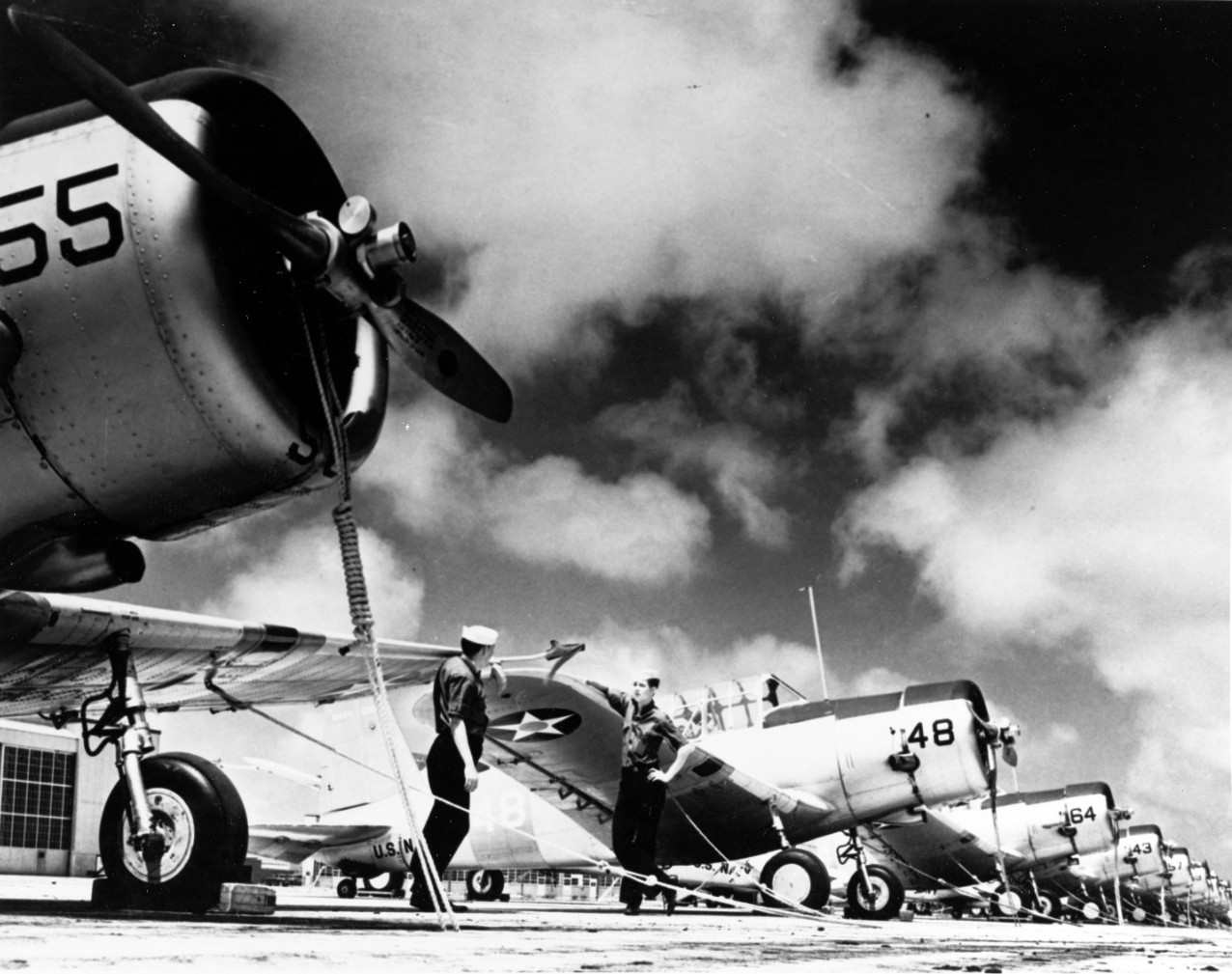
Dunn successfully completed primary on June 4, 1943. One week later, on June 13, 1943, he was dispatched to the U.S. Naval Air Station, Corpus Christi, Texas, for intermediate flight training. On June 21, 1943, he began seven weeks of ground school there. He also flew Vultee SNV and North American SNJ monoplane trainers.
In his final fitness report as an aviation cadet, his instructor, Ensign T. W. Sullivan, rated him as 3.3 out of 4, writing: “Cdt. Dunn is quick to learn his duties and carries them out very well. He is an average student with a good disposition and character.”
Marine Corps Service
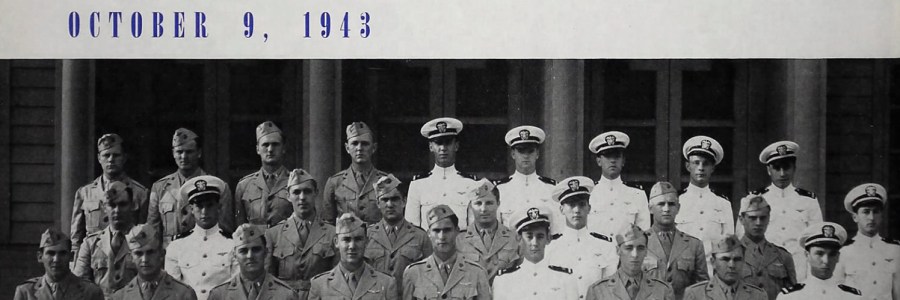
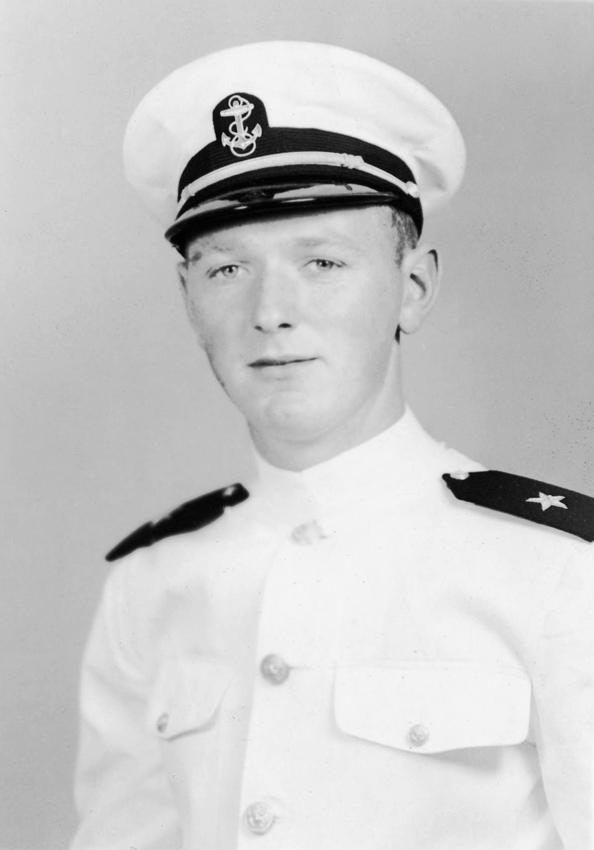
Aviation Cadet Dunn was honorably discharged from the U.S. Naval Reserve on October 8, 1943, again as a formality. The following day, October 9, 1943, Dunn was commissioned as a 2nd lieutenant in the U.S. Marine Corps Reserve, designated a naval aviator, and ordered to the U.S. Naval Air Station, Miami, Florida, for temporary duty beginning the following day. It appears he was authorized a delay in reporting, since another document states that he arrived at Miami on October 16, 1943. On October 22, 1943, a set of orders came down dispatching 2nd Lieutenant Dunn to Jacksonville, Florida, for training as a scout bomber pilot. Dunn arrived there the following day.


2nd Lieutenant Dunn then began his operational training at the U.S. Naval Auxiliary Air Station, Cecil Field, Florida. There, he accumulated 107.1 hours of flight time in the Douglas SBD Dauntless, a scout and dive bomber, including 10.5 hours at night. At the time, guided munitions were still in their infancy. With special training and aircraft, dive bombing—performing a steep dive at the target prior to releasing ordnance—potentially offered greater precision than level bombing.
Dunn ranked in the top third of his operational training class with a grade of 3.6 out of 4. His training records state that Dunn was rated good or excellent in all evaluation areas, particularly excelling in dive bombing and fixed gunnery. Evaluators noted that his navigation skills showed great improvement during this phase of training. His file stated he was “VF Designated – VSB Trained” which suggests a switch to fighters was still possible if the opportunity presented itself.
A set of orders in his personnel file stated that Lieutenant Dunn was dispatched to San Diego, California, with orders to report to the commanding officer at Marine Fleet Air West, Marine Corps Air Depot, Miramar. The orders authorized a 15-day delay in reporting. Dunn left Cecil Field on December 24, 1943. Other records state that he took leave during January 3–15, 1944.
On January 15, 1944, Dunn joined Air Regulating Squadron 3 (ARS-3), Personnel Group, Marine Fleet Air, West Coast, Marine Corps Air Deport, Miramar, San Diego, California. On January 21, 1944, he was transferred to Headquarters Squadron 41, Marine Base Defense Aircraft Group 41 (MBDAG-41), Marine Fleet Air, West Coast, Marine Corps Air Station, El Toro, Santa Ana, California. Although those two units were not particularly distant, Headquarters Squadron muster rolls and Dunn’s personnel file indicate that he joined it two days later, on January 23.
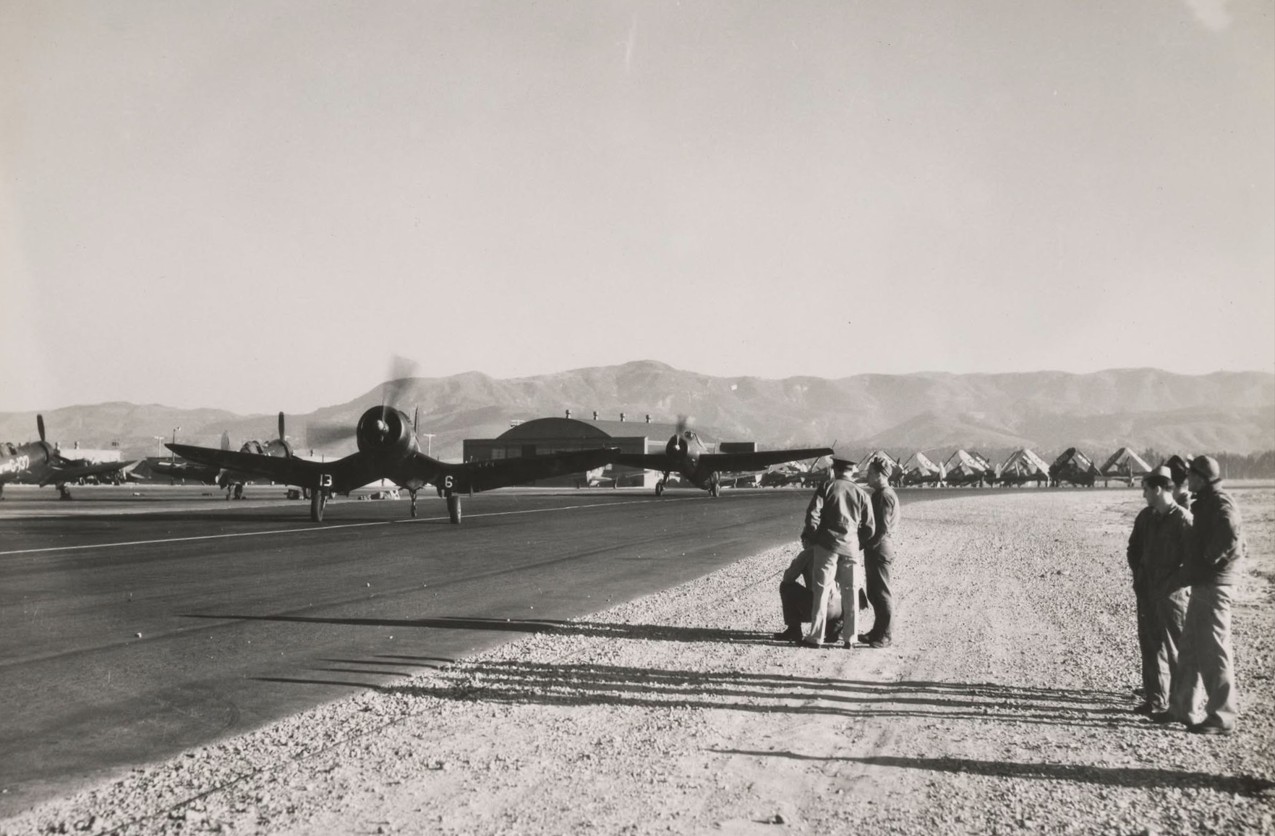
Although MBDAG-41’s designation suggested a defensive mission, by that point in the war the Axis threat to the continental United States was virtually nonexistent. Indeed, a May 1944 MBDAG-41 war diary entry stated that
the primary mission of this group is to administer and supervise the training and activities of attached squadrons for combat duty in the Pacific. Except in emergency situations squadrons attached to this group will not be utilized as a part of the local defense forces.
Lieutenant Dunn was hospitalized at the U.S. Naval Hospital, Corona, California, during March 10–24, 1944. On March 31, 1944, he transferred to Marine Scout Bombing Squadron 234 (VMSB-234), also part of MBDAG-41 at El Toro. When Dunn joined, his squadron was equipped with the familiar SBD Dauntless. Around July 1, 1944, it reequipped with the Curtiss SB2C-1A Helldiver, another dive bomber.
Most SB2Cs were built for the U.S. Navy but the Army Air Forces (A.A.F.) also ordered a modified version designated the A-25A Shrike. By the time the A-25A entered production, the A.A.F. had decided that fighter-bombers and light bombers were better suited for its strike missions. 410 A-25As went to the Marine Corps instead under the designation SB2C-1A.

On April 10, 1944, the Wilmington Morning News announced 2nd Lieutenant Dunn’s engagement to Beverly Bernice Coffey (later Simmons, 1922–2001). Since she was from Chicago, Illinois, the couple presumably met while he was stationed at Glenview. The article mentioned that the couple had recently visited Dunn’s parents in Delaware, presumably during his leave in January.
VMSB-234’s September 1944 war diary described typical training:
Average time for flight crews for the month of September: (a) Familiarization, 1 hour, (b) Formation, 1 hour, (c) Dive Bombing, 16 hours, (d) Instruments, 3 hours, (e) Gunnery, 6 hours, (f) Night Flying, 4 hours, (g) Inter-type Tactics, 3 hours, (h) Ground School: A total of forty-two hours were spent in lectures and technical movies, (i) 783 flights for the month for a total of 1389.2 hours.
On October 14, 1944, 2nd Lieutenant Dunn’s squadron was redesignated as Marine Torpedo Bombing Squadron 234 (VMTB-234). With the change from a dive bombing unit to a torpedo bombing unit, it would soon begin reequipping with the Grumman TBF Avenger. Dunn went on leave on October 16, 1944. On October 27, 1944, while still on leave, he was transferred to Marine Scout Bombing Squadron 464 (VMSB-464), which was equipped with the same SB2C-1A Helldiver that he had been flying. He joined his new unit on October 31, 1944. Like his last unit, VMSB-464 was part of Marine Base Defense Aircraft Group 41 (which was redesignated as Marine Air Group 41 on November 10, 1944).
During November 7–17, 1944, 2nd Lieutenant Dunn went on temporary duty with Air Ferry Squadron 2 (AirFeron 2 or VRF-2), a U.S. Navy squadron based in Columbus, Ohio. This squadron relocated aircraft to various stateside installations, primarily flying newly manufactured aircraft from factories to their future units. He returned to El Toro at the end of the assignment.
As of November 24, 1944, 2nd Lieutenant Dunn had 660 hours of flight time under his belt, including 151.8 flying the SB2C-1A. At 0845 hours that morning, 2nd Lieutenant Dunn departed El Toro, piloting SB2C-1A Bureau No. 75525, along with six other Helldivers from his squadron. Their assignment was to make a practice glide bombing run on Trabuco Target “Z” nine miles away. Glide bombing was similar to dive bombing, but was done at a shallower angle, making it easier to perform but also less accurate. At least in training, glide bombing was potentially safer since it put less strain on the airframe and pilot.
It was a beautiful morning in southern California, with scattered clouds and a gentle breeze. Dunn and the others completed one dive on the target and then rendezvoused for another run. At around 0930 hours, they began their dives from an altitude of 6,000 feet. The first four pilots completed their runs without incident. The pilot behind Dunn, 2nd Lieutenant Frank L. Schaffhausen (1922–2000), saw something come off Dunn’s plane. The Helldiver then crashed into a hillside beyond the target and exploded, killing him instantly.
Investigators stated in a report:
Examination of the wreckage disclosed that the empennage of the plane airplane failed in flight prior to the time the airplane crashed. Portions of the tail assembly were strung from the target to the point of impact six (6) hundred yards away. The vertical stabilizer was lying alongside the target, the horizontal stabilizer about one hundred (100) yards short of the point of impact, while portions of the rudder and elevators were scattered from the target to the point of impact.
When the tail of his Helldiver disintegrated, Dunn’s altitude was too low for him to bail out. The plane had recently been serviced and a pilot who flew it the day before denied experiencing any problems.
Alarmed by the accident, Colonel Lawson H. M. Sanderson (1895–1973), commander of Marine Fleet Air, West Coast, took immediate action. VMSB-464’s war diary noted that the day after the crash, “Dispatch 251841 from COMARFAIRWEST restricts all SB2C-1A aircraft of this command to normal flight and 215 knots indicated air speed, pending investigation of the crash of 24 November.”
The investigation did not determine the cause of Dunn’s plane’s structural failure. As a dive bomber, the SB2C-1A should have been able to handle far more intense aerodynamic forces than the estimated 210 knots in a 25° glide that Dunn and the other pilots were performing. Investigators found no evidence of either maintenance problems or pilot error.
VMSB-464’s war diary entry for November 29, 1944, stated: “There were no planes in commission and no flights. Dispatch 282353 from COMARFAIRWEST grounds all SB2C-1A aircraft of this command pending further inspection of inner structure of stabilizer.” An entry from the following month, on December 20, 1944, noted: “Dispatch (122230), from the Bureau of Aeronautics grounds all model SB2C-1A aircraft until inspection and possible repair or replacement of the horizontal stabilizer can be made.” VMSB-464’s Helldivers were transferred to Service Squadron 41, evidently for this purpose.
2nd Lieutenant James O’Dell accompanied Dunn’s casket from Los Angeles, California, to Wilmington by train. Following services at the William E. Haines Funeral Home in Wilmington on December 1, 1944, Dunn was buried at Gracelawn Memorial Park in New Castle, Delaware. His parents were buried next to him after their deaths. Dunn’s name is honored at Veterans Memorial Park nearby.
Acknowledgments
Special thanks to Geoff Roecker and the Delaware Public Archives for the use of their photos.
Bibliography
“2Lt. Belford Sidney Dunn.” Find a Grave. https://www.findagrave.com/memorial/135605214/belford-sidney-dunn
“A. I. DuPont P.-T. Body to Entertain.” Evening Journal-Every Evening, March 20, 1934. https://www.newspapers.com/article/183249040/
“Beverly Coffey Simmons.” Find a Grave. https://www.findagrave.com/memorial/117704767/beverly-simmons
Census Record for Belford Dunn. April 2, 1940. Sixteenth Census of the United States, 1940. Record Group 29, Records of the Bureau of the Census. National Archives at Washington, D.C. https://www.familysearch.org/ark:/61903/3:1:3QSQ-G9MR-MK7
Census Record for Belford Dunn. April 3, 1930. Fifteenth Census of the United States, 1930. Record Group 29, Records of the Bureau of the Census. National Archives at Washington, D.C. https://www.familysearch.org/ark:/61903/3:1:33SQ-GRH9-SYN
Doyle, David. SB2C Helldiver: Curtiss’s Carrier-Based Dive Bomber in World War II. Schiffer Military, 2020.
Dunn, James N. and Dunn, Minnie. Individual Military Service Record for Belford Sidney Dunn. May 28, 1947. Record Group 1325-003-053, Record of Delawareans Who Died in World War II. Delaware Public Archives, Dover, Delaware. https://cdm16397.contentdm.oclc.org/digital/collection/p15323coll6/id/18573/rec/1
“Engagements.” Wilmington Morning News, April 10, 1944. https://www.newspapers.com/article/183247316/
“James Nellis Dunn.” Evening Journal, November 13, 1984. https://www.newspapers.com/article/183248832/
“Lieut. Belford Dunn.” Wilmington Morning News, November 29, 1944. https://www.newspapers.com/article/183297409/
The Mark III Slipstream. U.S. Naval Air Training Center Corpus Christi, Texas, 1943. https://www.fold3.com/image/303184631/1943-page-598-us-navy-cruise-books-1918-2009
“Muster Roll of Officers and Enlisted Men of the U. S. Marine Corps Air Regulating Squadron Three, Personnel Group, Marine Fleet Air, West Coast, Marine Corps Air Depot, Miramar, San Diego 45, California. From 1 January to 31 January, 1944, inclusive.” January 31, 1944. Muster Rolls and Personnel Diaries, January 1941–December 1980. Record Group 127, Records of the U.S. Marine Corps. National Archives at College Park, Maryland. https://catalog.archives.gov/id/194709425?objectPage=514
“Muster Roll of Officers and Enlisted Men of the U. S. Marine Corps Headquarters Squadron-41, Marine Base Defense Aircraft Group-41 Marine Fleet Air, West Coast, Marine Corps Air Station El Toro, Santa Ana, California. From 1 January to 31 January, 1944, inclusive.” January 31, 1944. Muster Rolls and Personnel Diaries, January 1941–December 1980. Record Group 127, Records of the U.S. Marine Corps. National Archives at College Park, Maryland. https://catalog.archives.gov/id/194709425?objectPage=243
“Muster Roll of Officers and Enlisted Men of the U. S. Marine Corps Headquarters Squadron-41, Marine Base Defense Aircraft Group-41 Marine Fleet Air, West Coast, Marine Corps Air Station El Toro, Santa Ana, California. From 1 March to 31 March, 1944, inclusive.” March 31, 1944. Muster Rolls and Personnel Diaries, January 1941–December 1980. Record Group 127, Records of the U.S. Marine Corps. National Archives at College Park, Maryland. https://catalog.archives.gov/id/194906795?objectPage=263
“Muster Roll of Officers and Enlisted Men of the U. S. Marine Corps Marine Scout Bombing Squadron, Two Thirty Four, Marine Base Defense Aircraft Group-41, Marine Fleet Air, West Coast, U.S. Marine Corps Air Station, El Toro, Santa Ana, California. From 1 November to 30 November, 1944, inclusive.” November 30, 1944. Muster Rolls and Personnel Diaries, January 1941–December 1980. Record Group 127, Records of the U.S. Marine Corps. National Archives at College Park, Maryland. https://catalog.archives.gov/id/194907512?objectPage=298
“Muster Roll of Officers and Enlisted Men of the U. S. Marine Corps United States Marine Corps, Marine Scout Bombing Squadron-464, Marine Aircraft Group-41, Marine Fleet Air, West Coast, U. S. Marine Corps Air Station, El Toro, Santa Ana, California. Marine Scout Bombing Squadron, Two Thirty Four, Marine Base Defense Aircraft Group-41, Marine Fleet Air, West Coast, U.S. Marine Corps Air Station, El Toro, Santa Ana, California. From 1 March to 31 March, 1944, inclusive.” March 31, 1944. Muster Rolls and Personnel Diaries, January 1941–December 1980. Record Group 127, Records of the U.S. Marine Corps. National Archives at College Park, Maryland. https://catalog.archives.gov/id/194913355?objectPage=252
Official Military Personnel File for Belford S. Dunn. Official Military Personnel Files, 1885–1998. Record Group 24, Records of the Bureau of Naval Personnel. National Archives at St. Louis, Missouri.
Official Military Personnel File for Belford S. Dunn. Official Military Personnel Files, 1905–1998. Record Group 127, Records of the U.S. Marine Corps. National Archives at St. Louis, Missouri.
“War Diary of Air Ferry Squadron Two, 1 December 1943 to 31 December 1943.” January 7, 1944. World War II War Diaries, Other Operational Records and Histories, c. January 1, 1942–c. June 1, 1946. Record Group 38, Records of the Office of the Chief of Naval Operations. National Archives at College Park, Maryland. https://catalog.archives.gov/id/78277201
“War Diary of Air Ferry Squadron Two, 1 November to 30 November 1944.” December 5, 1944. World War II War Diaries, Other Operational Records and Histories, c. January 1, 1942–c. June 1, 1946. Record Group 38, Records of the Office of the Chief of Naval Operations. National Archives at College Park, Maryland. https://catalog.archives.gov/id/78691998
“War Diary United States Marine Corps Headquarters, Marine Base Defense Aircraft Group-41 Marine Fleet Air, West Coast, U.S. Marine Corps Air Station El Toro, Santa Ana, California Period Covered May 1, 1944 – May 31, 1944.” June 1944. World War II War Diaries, Other Operational Records and Histories, c. January 1, 1942–c. June 1, 1946. Record Group 38, Records of the Office of the Chief of Naval Operations. National Archives at College Park, Maryland. https://catalog.archives.gov/id/78457396
“War Diary United States Marine Corps Marine Scout Bombing Squadron-464, Marine Aircraft Group-41, Marine Fleet Air, West Coast, Marine Corps Air Station, El Toro, Santa Ana, California Period Covered 1 December, 1944 – 31 December, 1944.” Undated, c. January 1945. World War II War Diaries, Other Operational Records and Histories, c. January 1, 1942–c. June 1, 1946. Record Group 38, Records of the Office of the Chief of Naval Operations. National Archives at College Park, Maryland. https://catalog.archives.gov/id/139787029
“War Diary United States Marine Corps Marine Scout Bombing Squadron-464, Marine Aircraft Group-41, Marine Fleet Air, West Coast, Marine Corps Air Station, El Toro, Santa Ana, California. Period Covered 1 November 1944 – 30 November 1944.” Undated, c. December 1944. World War II War Diaries, Other Operational Records and Histories, c. January 1, 1942–c. June 1, 1946. Record Group 38, Records of the Office of the Chief of Naval Operations. National Archives at College Park, Maryland. https://catalog.archives.gov/id/78701975
“War Diary United States Marine Corps Marine Scout Bombing Squadron, Two Thirty Four, Marine Base Defense Aircraft Group-41, MFAir, West, MCAS, El Toro, Santa Ana, California. Period Covered 1 June, 1944 – 30 June, 1944.” Undated, c. July 1944. World War II War Diaries, Other Operational Records and Histories, c. January 1, 1942–c. June 1, 1946. Record Group 38, Records of the Office of the Chief of Naval Operations. National Archives at College Park, Maryland. https://catalog.archives.gov/id/78503999?objectPage=32
“War Diary United States Marine Corps Marine Scout Bombing Squadron, Two Thirty Four, Marine Base Defense Aircraft Group-41, MFAir West, MCAS, El Toro, Santa Ana, California. Period Covered 1 September 1944 – 30 September 1944.” Undated, c. October 1944. World War II War Diaries, Other Operational Records and Histories, c. January 1, 1942–c. June 1, 1946. Record Group 38, Records of the Office of the Chief of Naval Operations. National Archives at College Park, Maryland. https://catalog.archives.gov/id/134364182
“War Diary United States Marine Corps Marine Torpedo Bombing Squadron (CVS) Two Thirty Four Marine Air Support Group, Forty Eight Marine Corps Air Station, Santa Barbara, (Goleta), California Period Covered 1 November 1944 – 30 November 1944.” Undated, c. December 1944. World War II War Diaries, Other Operational Records and Histories, c. January 1, 1942–c. June 1, 1946. Record Group 38, Records of the Office of the Chief of Naval Operations. National Archives at College Park, Maryland. https://catalog.archives.gov/id/139765038
Last updated on November 2, 2025
More stories of World War II fallen:









To have new profiles of fallen soldiers delivered to your inbox, please subscribe below.
 Delaware's World War II Fallen