| Home State | Civilian Occupation |
| Delaware | Pennsylvania Railroad brakeman |
| Branch | Service Number |
| U.S. Army | 32367640 |
| Theater | Unit |
| European | Company “E,” 5th Ranger Infantry Battalion |
| Awards | Campaigns/Battles |
| Purple Heart | Normandy |
Early Life & Family
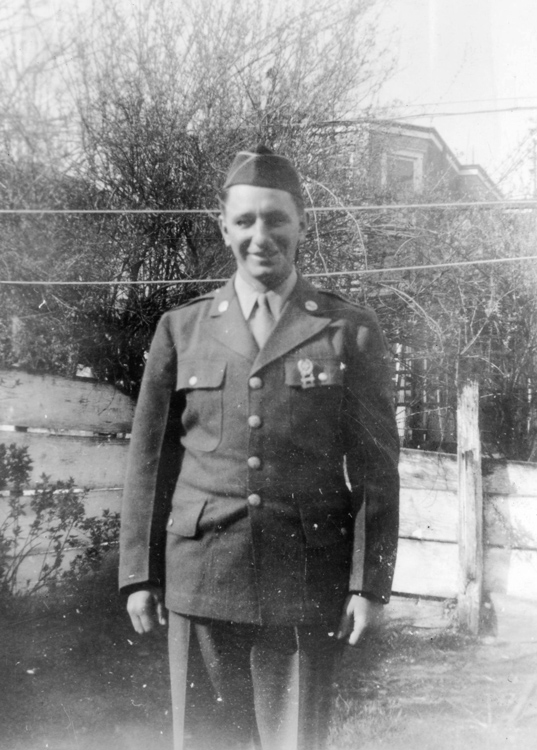
Steven Oboryshko was born in Wilmington, Delaware, likely on September 22, 1920. He was the son of John Oboryshko (Jan Oboriszko in some records, 1893–1971) and Anna Oboryshko (née Muciak, Maciak, or Mocak, 1898–1947). His parents, ethnic Ukrainians, had been born in what was then known as Galicia, Austria-Hungary. According to John Oboryshko’s naturalization paperwork, he was born in Lacko (today Łącko, Poland) and his wife in Dobromil (now Dobrómyl’, Ukraine). Both immigrated to the United States shortly before World War I and married in Wilmington on June 10, 1916. Various records recorded John Oboryshko working as a laborer, then as a helper in a machine shop, and finally as a machinist for the Pennsylvania Railroad.
Steven Oboryshko had two older brothers, two younger brothers, and five younger sisters. The Oboryshko family was recorded on the census in April 1930, living at 1025 Church Street in Wilmington. Oboryshko was recorded again on the census in April 1940 living with his family at 515 East 8th Street in Wilmington. It appears he was unemployed at the time, with his last job being as a laborer in soil conservation for the Civilian Conservation Corps (C.C.C.).
When Oboryshko registered for the draft on February 16, 1942, he was still living at 515 East 8th Street but was now working as a freight brakeman for the Pennsylvania Railroad. The registrar described him as standing about five feet, 8½ inches tall and weighing 173 lbs., with brown hair and eyes. An alteration to the draft card indicated that he moved to 501 West 4th Street in Wilmington prior to entering the service.
By the time of the 1940 census, he had completed one year of high school. The Wilmington Morning News reported that Oboryshko “was graduated from the Bancroft School and Brown Vocational High School.” His enlistment data card stated he completed one year of college. He was Catholic according to his military paperwork. Two of his brothers served in the U.S. Army and one in the U.S. Navy during World War II.
Military Training
After he was drafted, Oboryshko was inducted into the U.S. Army at Camden, New Jersey, on October 22, 1942. Like many selectees, he was briefly placed on inactive duty. He went on active duty on or about November 5, 1942, when he was attached to Company “M,” 1229th Reception Center, Fort Dix, New Jersey. He was there only briefly before departing for basic training at 1830 hours on November 8, 1942.
Private Oboryshko’s basic training was directly with a unit rather than at a training center. On November 10, 1942, he joined Company “K,” 389th Infantry Regiment, 98th Infantry Division at Camp Breckenridge, Kentucky. He was on furlough April 9–17, 1943. On September 5, 1943, Private Oboryshko and his unit departed Kentucky for the Tennessee Maneuver Area.
Private Oboryshko was transferred to the 5th Ranger Infantry Battalion per Special Orders No. 214, Headquarters 98th Infantry Division, dated September 8, 1943. The unit had just been activated on September 1, 1943. Oboryshko joined the battalion at Camp Forrest, Tennessee, the following day. On September 14, 1943, he was assigned to and joined Company “E,” 5th Ranger Infantry Battalion.
On November 3, 1943, Oboryshko and his unit began moving to Fort Pierce, Florida, by train, arriving two days later after intermediate stops in Chattanooga, Tennessee, and Jacksonville, Florida. After amphibious training there, the Rangers entrained again on November 19, 1943, arriving the following day at Fort Dix, New Jersey. Oboryshko was promoted to private 1st class on November 22, 1943.
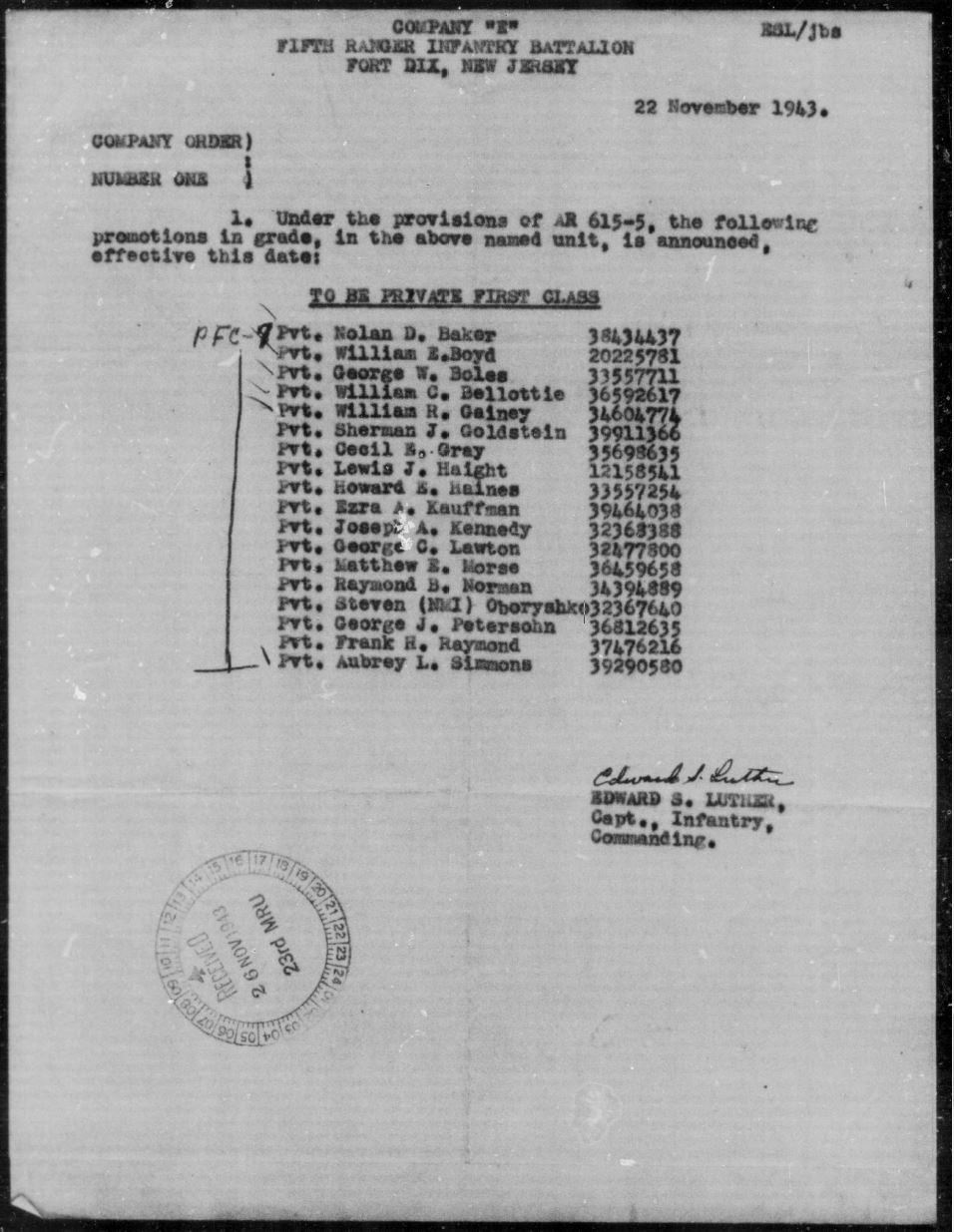
Private 1st Class Oboryshko began a furlough on December 8, 1943, returning to duty five days later. On December 20, 1943, Oboryshko and his unit moved to Camp Kilmer, New Jersey, a staging area for the New York Port of Embarkation (N.Y.P.O.E.). While at Camp Kilmer, Oboryshko was marked absent without leave (A.W.O.L.) at 0600 hours on Christmas Day 1943. He returned to duty the following day at 1100 hours. Another soldier, Technician 5th Grade Joseph J. Markowitz (1921–2010), was marked A.W.O.L. and back to duty at the same times, but it is unclear if the men were traveling together.
Going A.W.O.L. for any length of time could have serious consequences for a soldier’s career. Demotion to private and fines were common punishments. It appears both men were demoted to private, though curiously enough that event was not recorded in the unit’s morning reports.
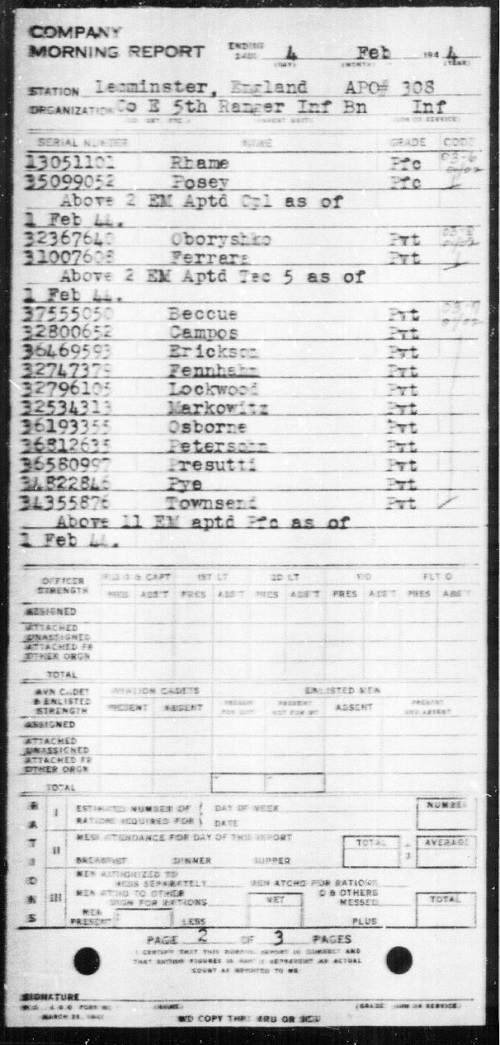
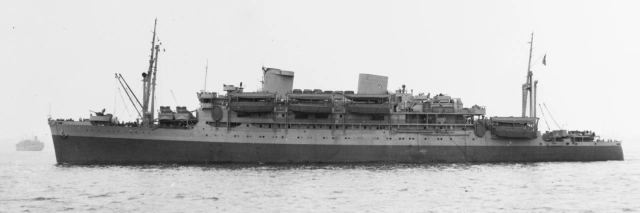
On December 20, 1943, the unit transferred to Camp Kilmer, New Jersey, a staging area for the New York Port of Embarkation. On January 7, 1944, Oboryshko and his comrades moved to the New York Port of Embarkation and boarded the ocean-liner turned troop transport R.M.S. Mauretania. Their transatlantic voyage was supposed to begin the following day, but was delayed when their ship collided with another in the harbor. Damage was not severe and they set sail again on the evening of January 9, 1944, arriving in Liverpool, England, on the morning of January 18. Early the following morning, Oboryshko and the other Rangers went ashore. The unit resumed its training at Leominster, England, for the upcoming Normandy invasion (Operation Overlord). Although it had only been about five weeks since their Christmas escapade, Oboryshko was promoted to technician 5th grade and Markowitz to private 1st class on February 1, 1944.
The Rangers trained in Scotland during May 1944 and then moved to the Assault Training Center in Braunton, England, in early April. After participating in the Fabius exercises during late April and early May 1944, the Rangers spent several weeks training to climb cliffs.
Combat in Normandy
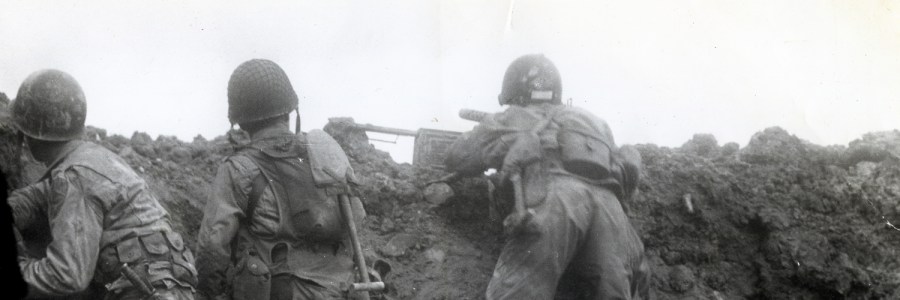
On June 1, 1944, the 5th Ranger Battalion embarked at Weymouth aboard two British ships, H.M.S. Prince Leopold and H.M.S. Prince Baudouin. Before dawn on June 6, 1944, Technician 5th Grade Oboryshko and his comrades from Company “E” boarded L.C.A.s (Landing Craft, Assault). The 5th Rangers would perform one of two missions on D-Day. They would reinforce the landings at the cliffs of Pointe du Hoc (the famous assault by Companies “D,” “E,” and “F” of the 2nd Ranger Infantry Battalion) if signaled to do so by radio or flare no later than 0700 hours. In the event, the Rangers at Pointe du Hoc were fighting for their lives and unable to get any signal out.
The contingency plan was for half of the Headquarters 5th Rangers along with Companies “A,” “B,” and “E” to land at sector Dog Green at Omaha Beach, though they ended up landing at Dog White instead (around 0745 to 0750 hours depending on the source). In the battalion after action report, Captain Hugo W. Heffelfinger explained:
The L. C. A. ‘s slowly threaded their way through gaps in the lines of obstacles and at H+75, 0745, the first wave consisting of one half Battalion Headquarters, Companies A, B, and E, landed on Omaha Dog White Beach at a point approximately 800 yards East of Exit D-1 [Vierville draw]. The Battalion Commander, Lieutenant Colonel Max F. Schneider, had ordered the flotilla commander to touch down his craft east of the intended landing point, Dog Green, because the tremendous volume of fire which covered that portion of the beach was inflicting a large number of casualties on the preceeding [sic] wave.
The first wave [of Rangers] crossed the beach in good order with few casualties, halted temporarily in reach of the sea wall, and immediately reorganized.
Lieutenant Colonel Schneider’s astute assessment of the battlefield saved many lives. In his book, Sand & Steel: The D-Day Invasions and the Liberation of France, Peter Caddick-Adams wrote about the 5th Rangers’ landing point:
This was opposite the demolished villas at Le Hamel-au-Prêtre, and between two strongpoints, WN70 and WN68, something of a blind spot in the defenses and less well defended. Consequently both Company ‘C’ [of the 116th Infantry Regiment] and the Rangers reached the sea wall with far fewer casualties, the defenders’ attention being focused on the draws.
Shortly afterward, a famous exchange took place on the beach between Lieutenant Colonel Schneider and Brigadier General Norman Cota, assistant division commander of the 29th Infantry Division, which concluded with Cota’s order: “Rangers, lead the way!”

The next wave brought in the rest of Headquarters 5th Rangers, Companies “C” and “D,” and one platoon from Company “F.” The Rangers and 1st Battalion of the 116th Infantry Regiment went over the seawall, penetrated enemy barbed wire, passed through a minefield, and advanced up the hill, neutralizing German positions along the way.
Captain Heffelfinger continued:
Company B advanced toward Vierville-sur-Mer receiving heavy sniper and machine gun fire. Several direct hits from enemy artillery on the rear of the battalion column caused numerous casualties. Company E attempted a penetration to the South but was halted by intense machine gun fire. An 81 mm mortar concentration fired by Company C knocked out several of these positions but they were rapidly replaced and the advance remained halted.
The weight of the attack was shifted toward Vierville-sur-Mer and, after overcoming considerable sniper resistance, the battalion advanced through the village to its western outskirts where it was again held up by a large volume of concerted machine gun and sniper fire. […] Dusk was falling and the battalion was ordered to dig-in a perimeter defense for the night. […] The results for the first day were about 100 prisoners taken, 150 enemy dead, and approximately 60 Rangers killed and wounded.
Units inside the perimeter consisted of the 5th Ranger Infantry Battalion, elements of 1st Battalion of the 116th Infantry Regiment, three companies from the 2nd Ranger Infantry Battalion, and some tanks from the 743rd Tank Battalion.
The 5th Ranger Infantry Battalion journal reported that on D+1, June 7, 1944, Companies “B,” “E,” along with elements of Companies “A” and “F” and supported by four tanks “left to clear Vierville and area south” while the rest of the 5th Rangers moved to assist the 2nd Rangers at Pointe du Hoc. Curiously, the account of the day’s events in the battalion after action report does not mention Company “E” for most of the day:
Company B resumed the attack to the southwest from the western edge of Vierville-sur-Mer at 0630. This unit was not able to advance far but did knock out several machine gun nests and numerous snipers.
The remaining platoon of Company A and the remaining platoon of Company F supported by four tanks of the 743rd Tank Battalion attacked South from the town wiping out snipers, machine gun nests, and several enemy combat patrols. Approximately 25 of the enemy were killed and 85 were captured.
During the night snipers had infiltrated back into the town so Company E cleaned out the town again.
There are no known specifics about how Technician 5th Grade Oboryshko met his death, beyond that he was killed in action. No cause of death was listed in either his hospital admission card (which were filled out for all casualties, not just those who survived to reach medical care) nor in the burial report.
Curiously, records are inconsistent about Oboryshko’s date of death. The burial report (filled out on June 17, 1944) gave his date of death as June 6, 1944. It is unclear if the officer filling that report out had any specific information establishing that or simply assumed that the death occurred on the bloody first day of the invasion. On the other hand, the Adjutant General’s Office death report gave his date of death as June 7, 1944, the day he was reported missing in action. The battalion journal listed known casualties as of midnight on D-Day and D+1, but Oboryshko was not mentioned. It is unclear if June 7, 1944, was the day he was killed or whether that was just the day that recordkeeping caught up in the chaotic aftermath of the invasion. However, it appears clear that he was killed in the vicinity of Vierville-sur-Mer.
Technician 5th Grade Oboryshko was initially buried on June 13, 1944, at the U.S. Military Cemetery St. Laurent, France. Journal-Every Evening reported that the War Department informed Technician 5th Grade Oboryshko’s parents that their son was missing in action by telegram on June 25, 1944. The following day, a letter arrived “dated May 25, and postmarked somewhere in England. In the letter he asked his family not to worry about him and also requested some candy to be sent to him.” The paper confirmed Oboryshko’s death on August 1, 1944. He was posthumously awarded the Purple Heart.
After the war, on June 13, 1947, Anna Oboryshko requested that her son’s body be repatriated to the United States. Unfortunately, she died two months later on August 17, 1947, before her wishes were carried out. Technician 5th Grade Oboryshko’s body was disinterred on October 6, 1947, and returned to the New York Port of Embarkation aboard the U.S.A.T. Robert F. Burns.
The Wilmington Morning News reported that on December 14, 1947, “Services were held in the McCrery Funeral Home and in St. Peter and Paul Ukrainian Church with members of the American Legion serving as the guard of honor.” Oboryshko was buried at Gracelawn Memorial Park in New Castle, where his mother had been buried several months earlier. He is also honored at Veterans Memorial Park in New Castle and on the Pennsylvania Railroad World War II Memorial at 30th Street Station in Philadelphia.
Notes
Date of Birth
Oboryshko’s draft card and various military records listed his date of birth as September 22, 1920. Curiously, a pair of headstone application forms filled out by his father listed September 21, 1921, and September 21, 1922. It has been common during my research to find discrepancies in various documents about a soldier’s year of birth (even in documents submitted by a soldier’s parents!), although discrepancies in the actual birthdate are rare. Unfortunately, I was unable to locate a copy of his birth certificate or a Wilmington birth register entry for him which may have settled the matter.
Names
There are numerous variations in the family name in various records: Oboresko, Oboriszko, Obrisky, Eborishko, and Oborishko. Oboryshko’s mother’s maiden name was variously recorded as Muciak, Maciak, or Mocak.
Religion
Oboryshko’s parents were apparently Eastern Orthodox, given that they had his memorial service at Saints Peter & Paul Ukrainian Orthodox Church. Oboryshko listed Catholic as his religious preference. However, at the time, soldiers were limited to four preferences: Catholic, Protestant, Hebrew, or no preference. It is unclear if Oboryshko considered himself Catholic or simply selected it as the closest choice. His nephew, however, noted that several of Oboryshko’s siblings were Catholic, so he may indeed have been as well.
Hospital Admission Card
Curiously, there is a hospital admission card under Oboryshko’s service number for a 25-year-old infantryman wounded on Sicily in July 1943 by a bullet wound to the neck. Based on newspaper articles and his father’s statement, this could not be Oboryshko, who was not overseas yet. It is possible that the wrong service number was entered when the card was originally made, or an error introduced when the card was digitized decades later. Duplicate service numbers are not unheard of, although if there was another man issued the same number, his enlistment data card was lost or could not be digitized.
Acknowledgments
Special thanks to the Delaware Public Archives for the use of their photo.
Bibliography
“5 Delawareans Injured, Four Are Missing.” Journal-Every Evening, June 28, 1944. https://www.newspapers.com/clip/101005489/oboryshko-mia/
Application for Headstone or Marker for Steven Oboryshko. April 17, 1950. Applications for Headstones, January 1, 1925 – June 30, 1970. Record Group 92, Records of the Office of the Quartermaster General, 1774–1985. National Archives at St. Louis, Missouri. https://www.ancestry.com/imageviewer/collections/2375/images/40050_2421402106_0406-01299
Caddick-Adams, Peter. Sand & Steel: The D-Day Invasions and the Liberation of France. Oxford University Press, 2019.
Census Record for John Obrisky. January 16, 1920. Fourteenth Census of the United States, 1920. Record Group 29, Records of the Bureau of the Census. National Archives at Washington, D.C. https://www.ancestry.com/imageviewer/collections/6061/images/4295770-00795
Census Record for Stephen Oborishko. April 24, 1940. Sixteenth Census of the United States, 1940. Record Group 29, Records of the Bureau of the Census. National Archives at Washington, D.C. https://www.ancestry.com/imageviewer/collections/2442/images/m-t0627-00550-00867
Census Record for Steven Oborishko. April 3, 1930. Fifteenth Census of the United States, 1930. Record Group 29, Records of the Bureau of the Census. National Archives at Washington, D.C. https://www.ancestry.com/imageviewer/collections/6224/images/4531894_00765
Certificate of Marriage for John Oborishko and Annie Mocak. June 10, 1916. Delaware Marriages. Bureau of Vital Statistics, Hall of Records, Dover, Delaware. https://www.ancestry.com/imageviewer/collections/61368/images/TH-267-12654-59679-88
“Corp. Steven Oboryshko.” Wilmington Morning News, December 15, 1947. https://www.newspapers.com/clip/100966649/steven-oboryshko-funeral/
Declaration of Intention for Jan Oboriszko. June 25, 1940. Naturalization Petitions of the U.S. District and Circuit Courts For the District of Delaware, 1795-1930. Record Group 21, Records of District Courts of the United States. National Archives at Washington, D.C. https://www.ancestry.com/imageviewer/collections/61336/images/47292_302022005448_2036-00142
Draft Registration Card for John Oborychko. June 5, 1917. World War I Selective Service System Draft Registration Cards, 1917–1918. National Archives at Washington, D.C. https://www.ancestry.com/imageviewer/collections/6482/images/005207039_02926
Draft Registration Card for Steven Oboryshko. February 16, 1942. Draft Registration Cards for Delaware, October 16, 1940 – March 31, 1947. Record Group 147, Records of the Selective Service System. National Archives at St. Louis, Missouri. https://www.familysearch.org/ark:/61903/3:1:3Q9M-CSMG-X99D-H
Enlistment Record for Steven Oboryshko. October 22, 1942. World War II Army Enlistment Records. Record Group 64, Records of the National Archives and Records Administration. National Archives at College Park, Maryland. https://aad.archives.gov/aad/record-detail.jsp?dt=893&mtch=1&cat=all&tf=F&q=steven+oboryshko&bc=&rpp=10&pg=1&rid=2990274
“John Oboryshko.” Find a Grave. https://www.findagrave.com/memorial/126254837/john-oboryshko
Glassman, Henry S. “Lead The Way, Rangers”: A History Of The Fifth Ranger Battalion. World War II Operations Reports, 1940–48. Record Group 407, Records of the Adjutant General’s Office. National Archives at College Park, Maryland.
Heffelfinger, Hugo W. “After Action Against Enemy, Reports After/After Action Reports.” July 22, 1944. World War II Operations Reports, 1940–48. Record Group 407, Records of the Adjutant General’s Office. National Archives at College Park, Maryland.
Hospital Admission Card for 32367640. July 1943. U.S. WWII Hospital Admission Card Files, 1942–1954. Record Group 112, Records of the Office of the Surgeon General (Army), 1775–1994. National Archives at College Park, Maryland. https://www.fold3.com/record/700370539/oboryshko-steven-us-wwii-hospital-admission-card-files-1942-1954
Hospital Admission Card for 32367640. June 1944. U.S. WWII Hospital Admission Card Files, 1942–1954. Record Group 112, Records of the Office of the Surgeon General (Army), 1775–1994. National Archives at College Park, Maryland. https://www.fold3.com/record/704773018/oboryshko-steven-us-wwii-hospital-admission-card-files-1942-1954
Individual Deceased Personnel File for Steven Oboryshko. Individual Deceased Personnel Files, 1939–1953. Record Group 92, Records of the Office of the Quartermaster General, 1774–1985. National Archives at St. Louis, Missouri. Courtesy of U.S. Army Human Resources Command.
“Journal 5th Ranger Inf Bn. From 0001 1 June 1944 To 2400 30 June 1944.” World War II Operations Reports, 1940–48. Record Group 407, Records of the Adjutant General’s Office. National Archives at College Park, Maryland.
Morning Reports for Company “E,” 5th Ranger Infantry Battalion. September 1943 – February 1944. U.S. Army Morning Reports, c. 1912–1946. Record Group 64, Records of the National Archives and Records Administration. National Archives at St. Louis, Missouri. https://s3.amazonaws.com/NARAprodstorage/lz/partners/st-louis/rg-064/85713825-wwii/85713825_1943-09/85713825_1943-09_Roll-0196/85713825_1943-09_Roll-0196-05.pdf, https://s3.amazonaws.com/NARAprodstorage/lz/partners/st-louis/rg-064/85713825-wwii/85713825_1943-09/85713825_1943-09_Roll-0196/85713825_1943-09_Roll-0196-06.pdf, https://s3.amazonaws.com/NARAprodstorage/lz/partners/st-louis/rg-064/85713825-wwii/85713825_1943-10/85713825_1943-10_Roll-0109/85713825_1943-10_Roll-0109-06.pdf, https://s3.amazonaws.com/NARAprodstorage/lz/partners/st-louis/rg-064/85713825-wwii/85713825_1943-10/85713825_1943-10_Roll-0109/85713825_1943-10_Roll-0109-07.pdf, https://s3.amazonaws.com/NARAprodstorage/lz/partners/st-louis/rg-064/85713825-wwii/85713825_1943-11/85713825_1943-11_Roll-0124/85713825_1943-11_Roll-0124-05.pdf, https://s3.amazonaws.com/NARAprodstorage/lz/partners/st-louis/rg-064/85713825-wwii/85713825_1943-12/85713825_1943-12_Roll-0367/85713825_1943-12_Roll-0367-11.pdf, https://s3.amazonaws.com/NARAprodstorage/lz/partners/st-louis/rg-064/85713825-wwii/85713825_1943-12/85713825_1943-12_Roll-0151/85713825_1943-12_Roll-0151-04.pdf, https://s3.amazonaws.com/NARAprodstorage/lz/partners/st-louis/rg-064/85713825-wwii/85713825_1944-01/85713825_1944-01_Roll-0291/85713825_1944-01_Roll-0291-03.pdf, https://s3.amazonaws.com/NARAprodstorage/lz/partners/st-louis/rg-064/85713825-wwii/85713825_1944-01/85713825_1944-01_Roll-0720/85713825_1944-01_Roll-0720-06.pdf, https://s3.amazonaws.com/NARAprodstorage/lz/partners/st-louis/rg-064/85713825-wwii/85713825_1944-02/85713825_1944-02_Roll-0585/85713825_1944-02_Roll-0585-28.pdf
Morning Reports for Company “K,” 389th Infantry Regiment. November 1942 – September 1943. U.S. Army Morning Reports, c. 1912–1946. Record Group 64, Records of the National Archives and Records Administration. National Archives at St. Louis, Missouri. https://s3.amazonaws.com/NARAprodstorage/lz/partners/st-louis/rg-064/85713825-wwii/85713825_1940-01-thru-1943-07/85713825_1940-01-thru-1943-07_Roll-1934/85713825_1940-01-thru-1943-07_Roll-1934-13.pdf, https://s3.amazonaws.com/NARAprodstorage/lz/partners/st-louis/rg-064/85713825-wwii/85713825_1940-01-thru-1943-07/85713825_1940-01-thru-1943-07_Roll-1934/85713825_1940-01-thru-1943-07_Roll-1934-14.pdf, https://s3.amazonaws.com/NARAprodstorage/lz/partners/st-louis/rg-064/85713825-wwii/85713825_1943-08/85713825_1943-08_Roll-0172/85713825_1943-08_Roll-0172-14.pdf, https://s3.amazonaws.com/NARAprodstorage/lz/partners/st-louis/rg-064/85713825-wwii/85713825_1943-08/85713825_1943-08_Roll-0172/85713825_1943-08_Roll-0172-15.pdf, https://s3.amazonaws.com/NARAprodstorage/lz/partners/st-louis/rg-064/85713825-wwii/85713825_1943-09/85713825_1943-09_Roll-0202/85713825_1943-09_Roll-0202-19.pdf
Morning Reports for Company “M,” 1229th Reception Center. November 1942. U.S. Army Morning Reports, c. 1912–1946. Record Group 64, Records of the National Archives and Records Administration. National Archives at St. Louis, Missouri. https://s3.amazonaws.com/NARAprodstorage/lz/partners/st-louis/rg-064/85713825-wwii/85713825_1940-01-thru-1943-07/85713825_1940-01-thru-1943-07_Roll-2857/85713825_1940-01-thru-1943-07_Roll-2857-09.pdf, https://s3.amazonaws.com/NARAprodstorage/lz/partners/st-louis/rg-064/85713825-wwii/85713825_1940-01-thru-1943-07/85713825_1940-01-thru-1943-07_Roll-2857/85713825_1940-01-thru-1943-07_Roll-2857-10.pdf
Morning Reports for Headquarters 5th Ranger Infantry Battalion. September 1943. U.S. Army Morning Reports, c. 1912–1946. Record Group 64, Records of the National Archives and Records Administration. National Archives at St. Louis, Missouri. https://s3.amazonaws.com/NARAprodstorage/lz/partners/st-louis/rg-064/85713825-wwii/85713825_1943-09/85713825_1943-09_Roll-0196/85713825_1943-09_Roll-0196-04.pdf
Oboryshko, John. Individual Military Service Record for Steven Oboryshko. June 29, 1945. Record Group 1325-003-053, Record of Delawareans Who Died in World War II. Delaware Public Archives, Dover, Delaware. https://cdm16397.contentdm.oclc.org/digital/collection/p15323coll6/id/20161/rec/1
“Purple Heart Awarded Man Killed in France.” Wilmington Morning News, October 4, 1944. https://www.newspapers.com/clip/101006355/oboryshko-purple-heart/
Robertson, John. “Joseph John Markowitz.” November 19, 2007. Special Forces Roll of Honour website. https://www.specialforcesroh.com/index.php?media/joseph-john-markowitz.6050/
Stanton, Shelby L. World War II Order of Battle: An Encyclopedic Reference to U.S. Army Ground Forces from Battalion through Division 1939–1946. Revised ed. Stackpole Books, 2006.
Silverman, Lowell. “Private 1st Class Walter S. Brinton (1917–1944).” Delaware’s World War II Fallen website, May 17, 2021. Updated May 18, 2021. https://delawarewwiifallen.com/2021/05/17/private-1st-class-walter-s-brinton/
“Two Delaware Infantrymen, Flier Are Killed.” Journal-Every Evening, August 1, 1944. https://www.newspapers.com/clip/101006259/oboryshko-kia/
Last updated on October 25, 2024
More stories of World War II fallen:
























To have new profiles of fallen soldiers delivered to your inbox, please subscribe below.
 Delaware's World War II Fallen
He was from Lacko, Dobromyl NOT Łącko, Poland. The name changed after WW2 and the village is now called Solyanuvatka, Ukraine.
LikeLike