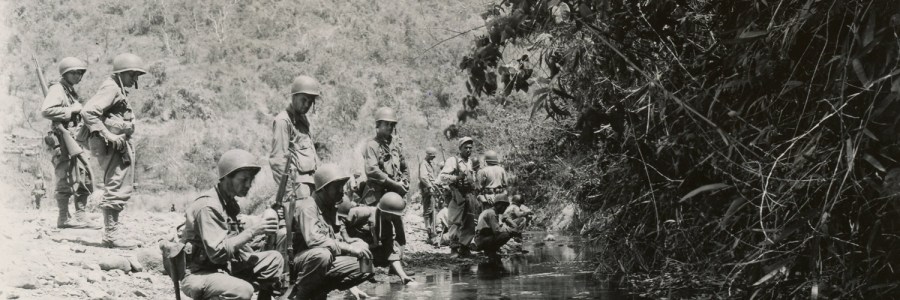

| Home State | Civilian Occupation |
| Delaware | Chauffeur |
| Branch | Service Number |
| U.S. Army | 32242886 |
| Theater | Unit |
| Pacific | Company “B,” 130th Infantry Regiment, 33rd Infantry Division |
| Military Occupational Specialty | Campaigns/Battles |
| 653 (squad leader) | Luzon |
Author’s note: This article includes adopts some narrative previously used in my article on Sergeant Philip A. Beaman, who entered the U.S. Army at the same date and location and who was assigned to the same regiment (albeit a different company).
Early Life & Family
Charles William Greer, Jr. was born in Newark, Delaware, on June 12, 1920. He was the fourth child of Charles William Greer, Sr. (described as a contractor or carpenter in various records, 1891–1947) and Carrie Henrietta Greer (née Keeley, 1891–1963). He was recorded on the census in April 1930 as living in Mill Creek Hundred with his parents, three older sisters, two younger brothers, and paternal grandfather. (Hundreds are an old-fashioned geographic division carried over from England, which lingered in Delaware longer than other states. Mill Creek Hundred’s boundaries roughly include the area north of White Clay Creek and west of Red Clay Creek, including northern Newark, Hockessin, Milltown, and Marshallton.) Greer attended Newark High School, but his enlistment record indicates he dropped out after completing three years.
When he registered for the draft on July 1, 1941, Greer was living in Milford Crossroads in Newark. Milford Crossroads, which is part of Mill Creek Hundred, refers to the area around the intersections of Paper Mill Road, Possum Park Road, and Thompson Station Road north of downtown Newark. Greer was working for Eugene du Pont as a carpenter helper. At the time, he was described as standing five feet, 11 inches tall and weighing 145 lbs., with brown hair and gray eyes.
Greer married Mildred Alberta Takach (1922–2008) on November 15, 1941, in Elkton, Maryland. On the application for their marriage license, Greer’s occupation was listed as caretaker and his bride’s as office clerk. The State of Delaware individual military service record form filled out by his wife stated that Greer was living in Christiana and working as a chauffeur before joining the military.
Early Military Career
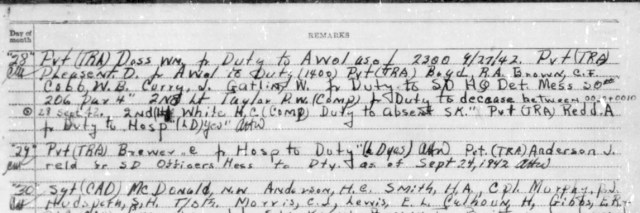
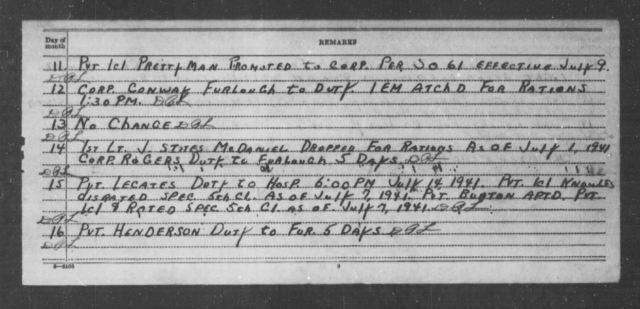
Greer was drafted shortly after the U.S. entered World War II. He went on active duty at Fort Dix, New Jersey, on February 26, 1942. On March 1, 1942, at Camp Forrest, Tennessee, Private Greer was one of 118 replacements attached to Company “B,” 130th Infantry Regiment, 33rd Infantry Division for rations and quarters. He was among the men officially assigned to Company “B” for training effective March 3, 1942. The company roster that month listed Private Greer’s military occupational specialty (M.O.S.) as 521, basic. The April 1942 roster listed his M.O.S. as 745, rifleman.

A July 12, 1945, Journal-Every Evening article stated that three of his siblings also served in the military during the war: Esther Buck (Women’s Army Corps), Grayson Greer (U.S. Army), and James Greer (U.S. Army Air Forces).
The 33rd Infantry Division moved to Fort Lewis, Washington in September 1942. Greer was promoted to private 1st class effective December 17, 1942. On March 1, 1943, Greer was promoted to corporal. Later that month, his division was transferred to Camp Clipper at the Desert Training Center near Needles, California—a move completed in April. Greer was reduced to the grade of private on May 6, 1943. It may have been an administrative change rather than a disciplinary one, since he was promoted back to private 1st class on June 1, 1943.
After further training, the division moved to Camp Stoneman, California, in June 1943 and then San Francisco that same month. According to the division history, The Golden Cross: A History of The 33d Infantry Division In World War II, Greer’s regiment shipped out for Hawaii on June 22, 1943. The regiment was initially stationed in Hilo but moved to Kauai in December for jungle and amphibious warfare training.
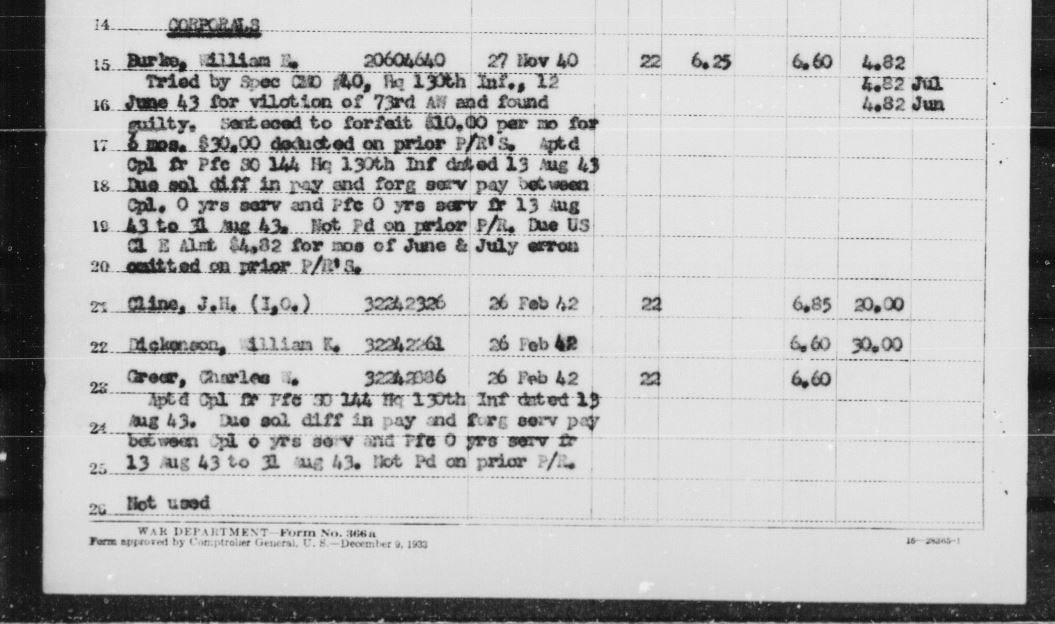
Greer was promoted back to corporal effective August 13, 1943. The Company “B” December 1943 payroll noted that Greer was on detached service attending Ranger & Combat Training School at Schofield Barracks, Oahu.
On April 21, 1944, the men of the 130th Infantry Regiment sailed to Honolulu to ship out for the Southwest Pacific. After two weeks at sea, their ship arrived in Finschhafen, in eastern New Guinea. Only a small portion of the division saw combat in New Guinea. Morale suffered as the division’s infantrymen found themselves consigned to months predominantly tasked with manual labor.
In December 1944, the 130th Infantry Regiment—along with most of the 33rd Infantry Division—shipped out to the Gila Peninsula on Morotai in the Maluku Islands (part of present-day Indonesia). American forces had seized the three months earlier and built an air base to support the recapture of the Philippines.
The Japanese launched multiple air raids and managed to land a regiment on the island. The Japanese force was small and lacked heavy weapons, but still managed to fortify the thick jungle of the area referred to as Hill 40.
Greer first saw combat on Morotai. Although the assault on Hill 40 in early January 1945 was primarily carried out by the 136th Infantry Regiment, 1st Battalion of the 130th Infantry (which included Greer’s company) supported the assault. According to Mildred Greer’s statement, Greer “Saw some action on New Guinea & Dutch E. Indies but main action started around Philippines Feb. 8, [sic] 1945[.]” Greer was awarded the Combat Infantryman Badge per General Orders No. 6, Headquarters 130th Infantry Regiment, effective January 6, 1945.
Combat in the Philippines
With Morotai secured, the 33rd Infantry Division shipped out to the Philippines on January 26, 1945. It began landing in Lingayen Gulf on February 10, 1945, about one month after the first American troops landed on Luzon. By that time, Greer had been promoted to staff sergeant and was serving as a squad leader.
According to The Golden Cross:
Before any major effort could be exerted along [the] forbidding Kennon Road it first became imperative to drive the [Japanese] from their positions on the Division’s right flank and rear. These Japanese, holed up on commanding ground, were capable of impeding supply and communication functions carried on from Division bases at Sison. With the Golden Cross gathering momentum for its northward push, it was vital that rear echelon bases be kept free from Japanese interference.
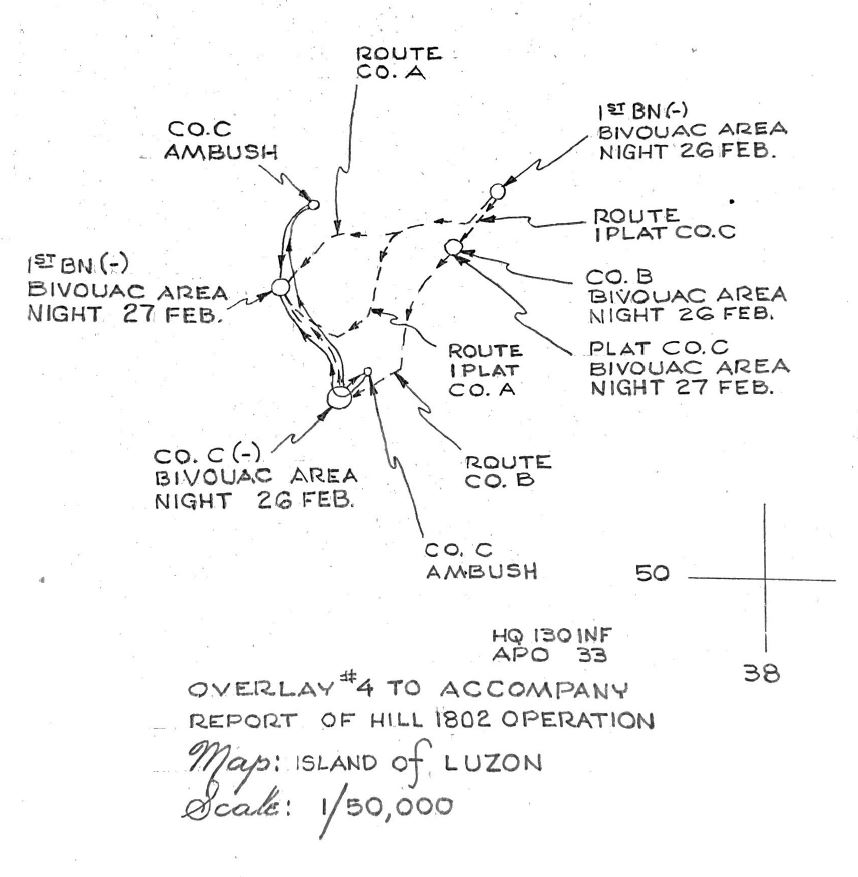
Numerous reconnaissance patrols, dispatched on Division order and manned by personnel of the 1st Battalion of the 130th Infantry, 2d Battalion of the 136th Infantry, and the 33d Cavalry Reconnaissance Troop, were pushed through the Labayug-Alibeng area with the mission of pinpointing each enemy pocket. Reports coming back to G-3 [operations staff] carried the desired information. The largest concentration of enemy troops occupied the crest of Hill 1802. The enemy garrison on 1802—a huge tree-covered mountain midway between Labayug and Alibeng—was estimated at a lone enemy rifle company reinforced by several light machine guns and mortars. Lesser Jap[anese] groups were reported on a chain of smaller hills leading into 1802.

From February 23–25, 1945, American infantry gradually eliminated Japanese positions around Hill 1802. On February 26, Staff Sergeant Greer’s battalion took up positions “several hundred yards below the crest” of the hill.
The Company “B” morning report dated February 27, 1945, described the events of the previous two days:
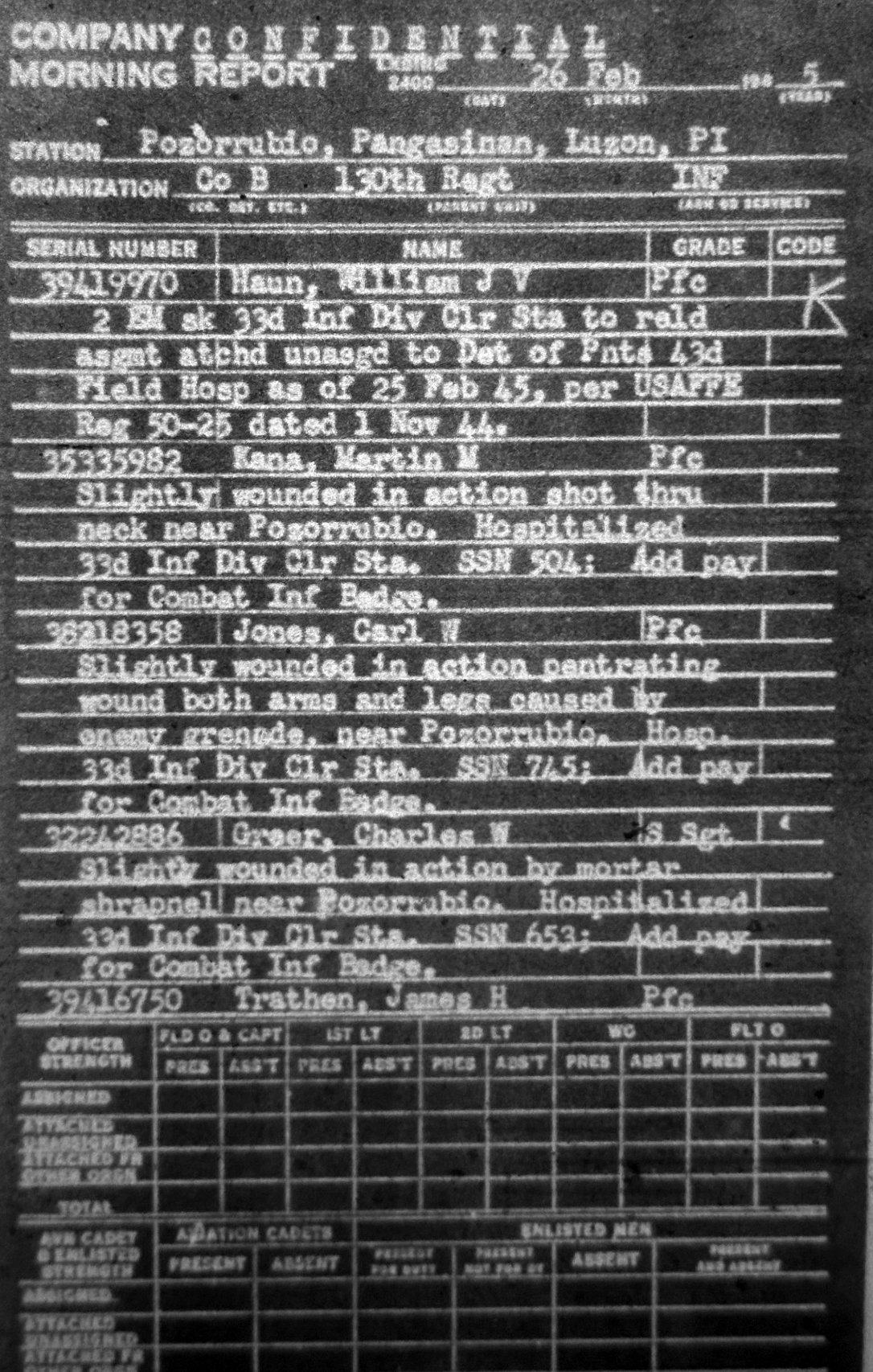
25 Feb 45: Co lost 15 men due to heat exhaustion. The climb was hard on all troops. Dug in for night and during night received Jap[anese] mortar fire. Approx 1200 [sic] perimeter received Jap[anese] mortar fire. Sniper fire and machine gun fire. Field artillery helped to stop the fire [which] lasted about 1 hour and half.
26 Feb 45: Co moved out 0800 toward hill 1802. Traveled 2000 yds to reach objective[.] Reached objective at 1400 and dug in for night 1700. Received [Japanese] mortar at 2000 which lasted most of the night, also 3 Jap[anese] machine guns fired on perimeter during night.
Staff Sergeant Greer was wounded during the fighting near Hill 1802 on February 26, 1945, the day before the hill fell. That day’s morning report stated that Staff Sergeant Greer was “Slightly wounded in action by mortar shrapnel near Pozorrubio.” He was initially treated at his division’s clearing station before he was transferred to the Detachment of Patients, 43rd Field Hospital. According to Mildred Greer’s statement, Staff Sergeant Greer was wounded in his leg by shrapnel on February 26, 1945 (the day before the final assault, though The Golden Cross suggested little fighting occurred that day). Staff Sergeant Greer’s hospital admission card documented penetrating trauma to his ear and thigh caused by fragments from a hand grenade.
Greer’s wife wrote that her husband “Died of complications resulting from wound and battle fatigue and Hepatitis” at the 43rd Field Hospital on April 12, 1945. The burial report in his individual deceased personnel file (I.D.P.F.) listed his caused of death as acute severe hepatitis. It is unclear if his wounds led to the infection, weakened him when he was already ill due to liver disease, or whether the wounds were totally unrelated to his death.
Staff Sergeant Greer’s personal effects included 83 photographs, 16 letters, a leather cigarette case, a watch, a fountain pen, a Ranger School card, and a King Neptune card from a ceremony when he crossed the equator.
A July 12, 1945, article in Journal-Every Evening stated that
Sergeant Greer, wounded exactly three years after his induction, was believed to have recovered but had not returned to duty when complications causing his death set in, according to word received by his wife. The dead soldier’s Purple Heart is being sent to Mrs. Greer, who at present is living with her mother, Mrs. Elizabeth Takach in Christiana.
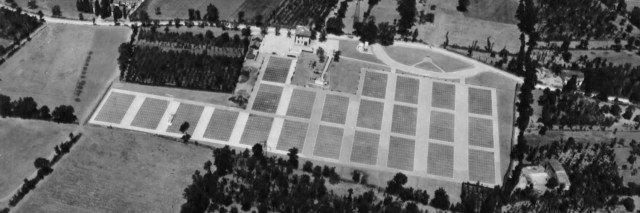
Staff Sergeant Greer’s body was initially buried at a temporary military cemetery at Santa Barbara, Luzon, on April 13, 1945. In late 1947, his body was temporarily moved to the U.S. Army Graces Registration Service Mausoleum, Manila, Philippine Islands. The following year, his mother requested that her son’s body be interred at a permanent military cemetery overseas. He was buried for the final time at Fort William McKinley, now known as the Manila American Cemetery.
Mildred Greer remarried in Wilmington, Delaware on November 16, 1946, to Sergeant Greer’s brother, Grayson Greer (1922–2008). The couple raised three sons.
During his career, Staff Sergeant Greer earned the Purple Heart and the Combat Infantryman Badge. He is honored on Newark’s World War II memorial at Veterans Memorial Park in New Castle, Delaware.
Acknowledgments
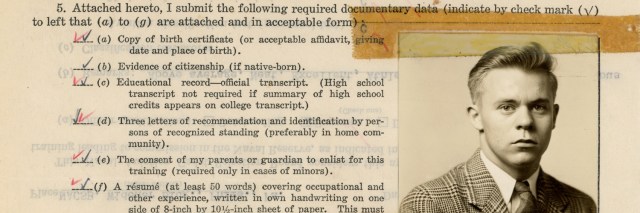
Special thanks to the Delaware Public Archives for the use of their photo of Staff Sergeant Greer.
Bibliography
The 33d Infantry Division Historical Committee. The Golden Cross: A History of The 33d Infantry Division In World War II. Infantry Journal Press, 1948. https://archive.org/details/TheGoldenCross
Census Entry for Charles E. Greer. April 27, 1930. Fifteenth Census of the United States, 1930. Record Group 29, Records of the Bureau of the Census. National Archives at Washington, D.C. https://www.ancestry.com/imageviewer/collections/6224/images/4531890_00702
Certificate of Birth for Charles William Greer, Jr. June 18, 1920. Record Group 1500-008-094, Birth Certificates. Delaware Public Archives, Dover, Delaware. https://www.familysearch.org/ark:/61903/3:1:S3HY-6GVS-GYN
Certificate of Marriage for Grayson Greer and Mildred A. Greer. November 16, 1946. Delaware Marriages. Bureau of Vital Statistics, Hall of Records, Dover, Delaware. https://www.ancestry.com/imageviewer/collections/61368/images/TH-267-13198-30543-92
Draft Registration Card for Charles William Greer, Jr. July 1, 1941. Draft Registration Cards for Delaware, October 16, 1940 – March 31, 1947. Record Group 147, Records of the Selective Service System. National Archives at St. Louis, Missouri. https://www.ancestry.com/imageviewer/collections/2238/images/44003_04_00004-00297
Enlistment Record for Charles W. Greer. February 26, 1942. World War II Army Enlistment Records. Record Group 64, Records of the National Archives and Records Administration. National Archives at College Park, Maryland. https://aad.archives.gov/aad/record-detail.jsp?dt=893&mtch=1&cat=all&tf=F&q=32242886&bc=&rpp=10&pg=1&rid=2884306
Greer, Mildred A. Individual Military Service Record for Charles William Greer. Undated, c. 1946. Record Group 1325-003-053, Record of Delawareans Who Died in World War II. Delaware Public Archives, Dover, Delaware. https://cdm16397.contentdm.oclc.org/digital/collection/p15323coll6/id/18917/rec/2
Hospital Admission Card for Charles W. Greer. February 1945. U.S. WWII Hospital Admission Card Files, 1942–1954. Record Group 112, Records of the Office of the Surgeon General (Army), 1775–1994. National Archives at College Park, Maryland. https://www.fold3.com/record/702038192-greer-charles-w
Individual Deceased Personnel File for Charles W. Greer. Individual Deceased Personnel Files, 1939–1953. Record Group 92, Records of the Office of the Quartermaster General, 1774–1985. National Archives at St. Louis, Missouri.
“Mildred Alberta Takach Greer.” Find a Grave. https://www.findagrave.com/memorial/143658031/mildred-alberta-greer
“Monthly Personnel Roster Apr 30 1942 Company B 130th Infantry.” April 30, 1942. U.S. Army Muster Rolls and Rosters, November 1, 1912 – December 31, 1943. Record Group 64, Records of the National Archives and Records Administration. National Archives at St. Louis, Missouri. https://s3.amazonaws.com/NARAprodstorage/lz/st-louis/rg-064/85713803_1940-1943/85713803_1940-1943_Roll-1709/85713803_1940-1943_Roll-1709_09.pdf
“Monthly Personnel Roster Mar 31 1942 Company B 130th Infantry.” March 31, 1942. U.S. Army Muster Rolls and Rosters, November 1, 1912 – December 31, 1943. Record Group 64, Records of the National Archives and Records Administration. National Archives at St. Louis, Missouri. https://s3.amazonaws.com/NARAprodstorage/lz/st-louis/rg-064/85713803_1940-1943/85713803_1940-1943_Roll-1709/85713803_1940-1943_Roll-1709_09.pdf
Morning reports for Company “B,” 130th Infantry Regiment. February 1945. U.S. Army Morning Reports, c. 1912–1946. Record Group 64, Records of the National Archives and Records Administration. National Archives at St. Louis, Missouri.
“Mr Grayson Arthur Greer, 86.” Northern Virginia Daily, June 25, 2008. https://www.genealogybank.com/doc/obituaries/obit/121884B66DB03290-121884B66DB03290
“Pay Roll of Company B 130th Infantry For month of December, 1943.” December 31, 1943. U.S. Army Muster Rolls and Rosters, November 1, 1912 – December 31, 1943. Record Group 64, Records of the National Archives and Records Administration. National Archives at St. Louis, Missouri. https://s3.amazonaws.com/NARAprodstorage/lz/st-louis/rg-064/85713803_1940-1943/85713803_1940-1943_Roll-1709/85713803_1940-1943_Roll-1709_06.pdf
“Pay Roll of Company B 130th Infantry For month of March, 1943.” March 31, 1943. U.S. Army Muster Rolls and Rosters, November 1, 1912 – December 31, 1943. Record Group 64, Records of the National Archives and Records Administration. National Archives at St. Louis, Missouri. https://s3.amazonaws.com/NARAprodstorage/lz/st-louis/rg-064/85713803_1940-1943/85713803_1940-1943_Roll-1709/85713803_1940-1943_Roll-1709_07.pdf
“Pay Roll of Company B 130th Infantry For month of January, 1943.” January 31, 1943. U.S. Army Muster Rolls and Rosters, November 1, 1912 – December 31, 1943. Record Group 64, Records of the National Archives and Records Administration. National Archives at St. Louis, Missouri. https://s3.amazonaws.com/NARAprodstorage/lz/st-louis/rg-064/85713803_1940-1943/85713803_1940-1943_Roll-1709/85713803_1940-1943_Roll-1709_08.pdf
“Pay Roll of Company B 130th Infantry For month of June & July, 1943.” July 31, 1943. U.S. Army Muster Rolls and Rosters, November 1, 1912 – December 31, 1943. Record Group 64, Records of the National Archives and Records Administration. National Archives at St. Louis, Missouri. https://s3.amazonaws.com/NARAprodstorage/lz/st-louis/rg-064/85713803_1940-1943/85713803_1940-1943_Roll-1709/85713803_1940-1943_Roll-1709_07.pdf
“Pay Roll of Company B 130th Infantry For month of May, 1943.” May 31, 1943. U.S. Army Muster Rolls and Rosters, November 1, 1912 – December 31, 1943. Record Group 64, Records of the National Archives and Records Administration. National Archives at St. Louis, Missouri. https://s3.amazonaws.com/NARAprodstorage/lz/st-louis/rg-064/85713803_1940-1943/85713803_1940-1943_Roll-1709/85713803_1940-1943_Roll-1709_07.pdf
“Pay Roll of Company B 130th Infantry For month of September, 1943.” September 30, 1943. U.S. Army Muster Rolls and Rosters, November 1, 1912 – December 31, 1943. Record Group 64, Records of the National Archives and Records Administration. National Archives at St. Louis, Missouri. https://s3.amazonaws.com/NARAprodstorage/lz/st-louis/rg-064/85713803_1940-1943/85713803_1940-1943_Roll-1709/85713803_1940-1943_Roll-1709_07.pdf
“Record of Events – Co. B – 1st Bn – 130th Infantry Regiment – 33rd Infantry Division 5 Mar 41–20 Sep 1942.” World War II Operations Reports, 1940–48. Record Group 407, Records of the Adjutant General’s Office. National Archives at College Park, Maryland. https://catalog.archives.gov/id/404214375?objectPage=154, https://catalog.archives.gov/id/404214375?objectPage=177
Silverman, Lowell. “Sergeant Philip A. Beaman (1920–1945).” Delaware’s World War II Fallen website. June 13, 2021. https://delawarewwiifallen.com/2021/06/13/sergeant-philip-a-beaman/
“SSgt Charles William Greer Jr.” Find a Grave. https://www.findagrave.com/memorial/56775810/charles-william-greer
“State Soldier Dies on Luzon.” Journal-Every Evening, July 12, 1945. https://www.newspapers.com/clip/61799414/charles-w-greer-jr/
Last updated on August 29, 2024
More stories of World War II fallen:
























To have new profiles of fallen soldiers delivered to your inbox, please subscribe below.
 Delaware's World War II Fallen