I spend many hours researching each profile prior to publication. Some have a development period of just a few days, while others have sat in various stages of completion for more than a year. I often work on a piece until I hit a wall, and then shift gears while I wait for a solution. As this project approached the five-year mark, I decided to present some work in its incomplete, unpolished state. As an article is finished, I will publish a full-length article and remove it from this page.
The reasons each story is on hold varies. In many cases, I am waiting for my next visit to the National Archives in College Park, Maryland, to obtain unit records which contextualize the servicemember’s experiences, or photos to better illustrate the piece. In other cases, I am waiting to obtain morning reports or personnel files that may shed light on a servicemember’s career. In a few cases, I’m stumped by a mystery and fear publishing inaccurate information.
One of the motivations in presenting these briefs is the hopes that family members of the fallen—or somebody with information about the man or his unit—may stumble across them and provide assistance in getting them across the finish line. Bibliographies and acknowledgments have been omitted until final publication. Completed articles are removed from this page.
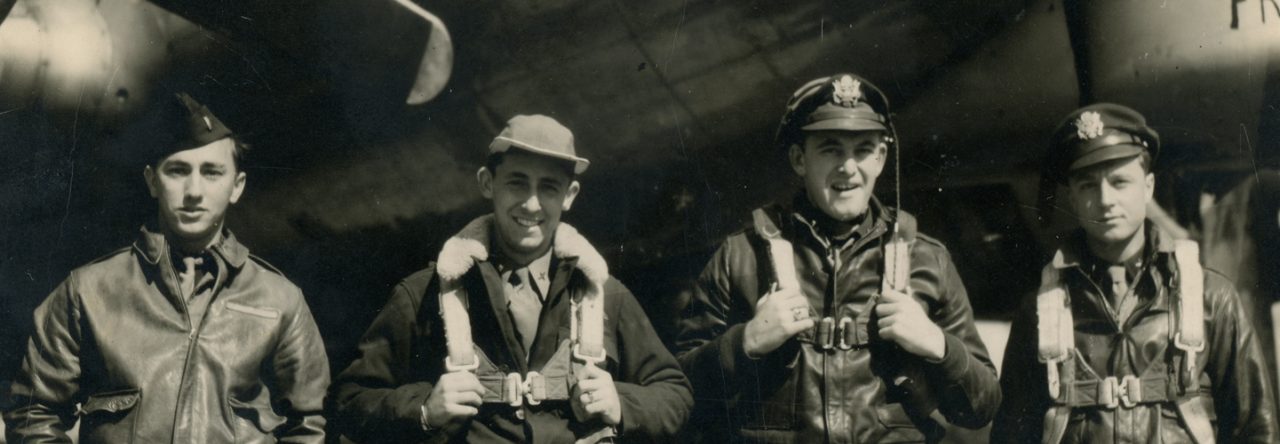
2nd Lieutenant Holstein Harvey, III (1918–1944)
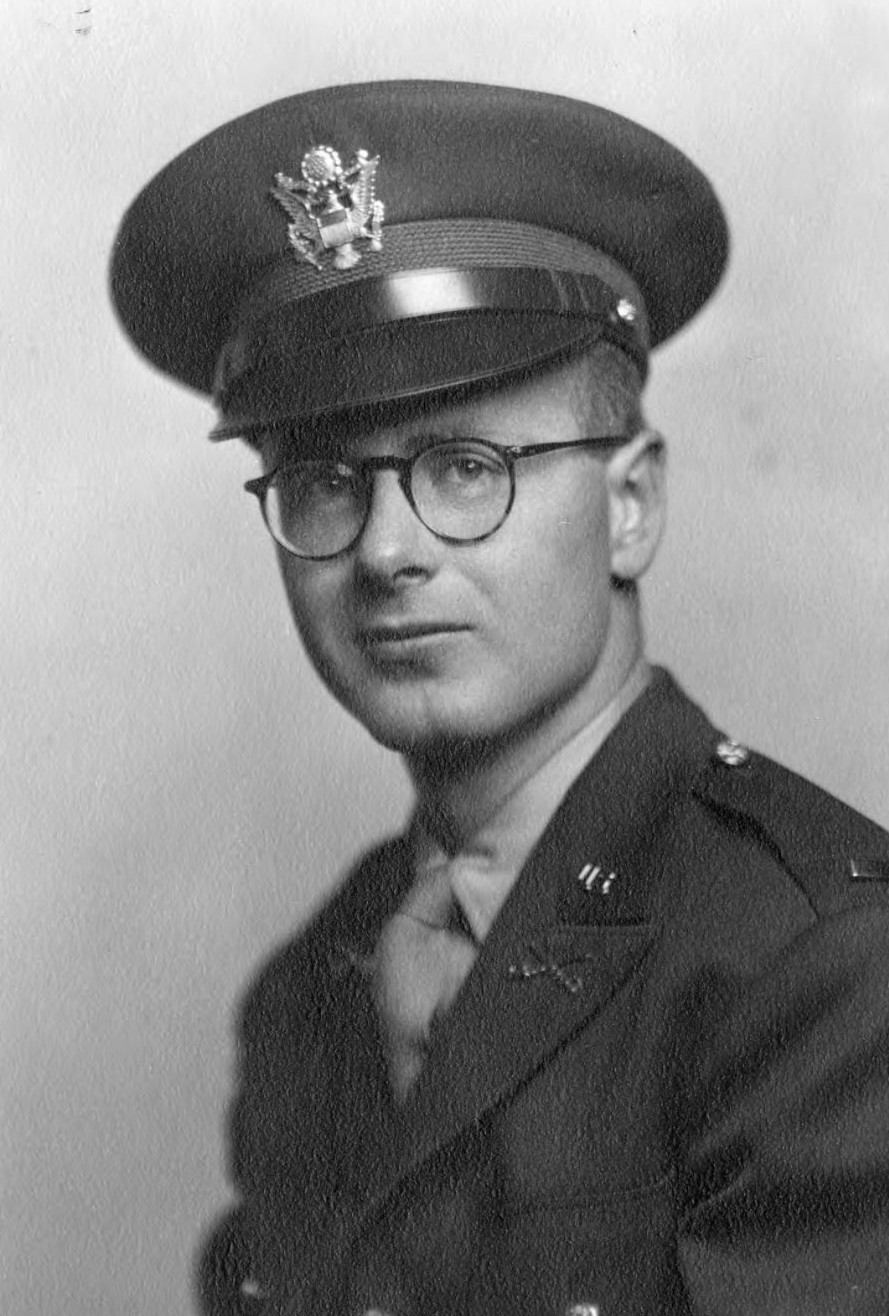
Early Life & Family
Holstein Harvey, III was born on November 6, 1918, at the Delaware Hospital in Wilmington, Delaware. He was the only child of Holstein Harvey, Jr. (1890–1968) and Florence Harvey (née Florence Mae Hurlow, c. 1900–1971), residents of 1303 Delaware Avenue in Wilmington, a home owned by Harvey’s paternal grandparents. His father, a wholesale grocer, was from Delaware, while his mother was born in Virginia. Harvey’s grandfather and namesake, Holstein Harvey (1847–1920), founded the family’s wholesale grocery business. Harvey’s paternal grandmother, Eliza Harvey (née Elliott, 1853–1922), traced her lineage to Private Benjamin Elliott (1745–1815), who fought in the Revolutionary War.
Harvey was recorded on the census in January 1920 living at 1303 Delaware Avenue living with his parents and paternal grandparents. His grandfather died the following month, on February 21, 1920. The family business passed to Harvey’s father and uncle, Morton Harvey (1892–1972). Evidently, they struggled to continue the business’s prior success, and Holstein Harvey, Inc. filed for bankruptcy in 1928.
The next census in April 1930 found Harvey still living at 1303 Delaware Avenue, now owned by his uncle and aunt, George S. Capelle, Jr. (1877–1939) and Josephine Harvey Capelle (1878–1965), along with his mother and another uncle, Ellwood Harvey (1880–1962). Conspicuously absent in the census record was Harvey’s father, suggesting his parents were separated by that point. At the end of 1931, Florence Harvey filed for divorce on grounds of desertion, and obtained a degree nisi on January 4, 1932. She remarried, to William V. R. Coats (1896–1984), in Wilmington on October 19, 1934, with whom she had one daughter, Elizabeth Hurlow Coats (later Autman and eventually Cox, 1936–2014).
According Journal-Every Evening, Harvey “attended Tower Hill School and Harvard University. Later he transferred to the University of North Carolina. He left there in his senior year to join the Army.”
Although he was presumably away at college, Harvey was recorded twice on the next census in April 1940, making it unclear what his permanent residence was. One entry had him living with his now-widowed aunt at 1303 Delaware Avenue, and the other with his mother, stepfather, and half-sister in Bellevue, northeast of Wilmington.
When Harvey registered for the draft on October 16, 1940, in Chapel Hill, North Carolina, he was a senior at the University of North Carolina. The registrar described him as standing about five feet, 11 inches tall and weighing 180 lbs., with blond hair and blue eyes. His permanent address was listed as his mother’s residence in Bellevue, Delaware, outside Wilmington.
Military Career
On January 27, 1941, Harvey enlisted in the Pennsylvania National Guard, joining the First Troop Philadelphia City Cavalry. A small and in many ways a unique unit which selected its own members, it been founded in 1774 and fought in virtually every American conflict since the Revolutionary War. From September 1940 onward, it was formally Troop “A,” 104th Cavalry Regiment.
In 1940, with World War II underway, the still neutral United States implemented a program to expand its armed forces, in part by calling National Guard units to active duty and beginning the first peacetime conscription in the history of the country. Troop “A” including Private Harvey was federalized on the morning of February 17, 1941, going on duty at the First Troop armory in Philadelphia. Many of the men were residents of Philadelphia or the Philadelphia suburbs, though a few had homes of record much further away: New York, Virginia, Connecticut, even Palm Beach, Florida, and Phoenix, Arizona!
During their first 11 days of active duty, morning reports stated the cavalrymen performed the “usual mobilization and basic training duties.” The armory lacked the facilities of a military base was not really suited for an extended deployment. Men who were sick were sent to their homes to convalesce. A February 28 morning report stated that the troop began “[p]acking and preparation for departure to Indiantown Gap Military Reservation[.]” Records from early 1941 give the regimental designation as 104th Cavalry (Horse-Mechanized), meaning they relied on a combination of horses and motor vehicles for transport.
The August 1941 roster, the earliest to include duty codes, listed Private Harvey’s as 603, gunner. The November 1941 roster, the first to list both duty and military occupational specialty (M.O.S.) codes listed Private Harvey as a 603 for both. The February 1942 roster had handwritten alterations, including all 603s changing to the similar 604, light machine gunner. Assistant gunners had the same code.
By the beginning of World War II, it was clear that the horse cavalry was obsolete. During the Battle of Bataan in the Philippines in 1942, a troop of cavalrymen made the last charge by horse cavalry in American history. Soon, however, with American and Filipino soldiers on starvation rations, the cavalry in the Philippines were forced to slaughter their mounts.
The U.S. Army Cavalry would have to adapt to the new order. The 1st Cavalry Division was transformed into an infantry division. Mechanized cavalry reconnaissance squadrons were organized, and infantry divisions were also provided a single reconnaissance troop. These units were intended to fulfil traditional cavalry roles like reconnaissance and screening larger formations, but with jeeps, halftracks, armored cars, and light tanks rather than horses. A modern unit history of First Troop noted: “The Troop sadly said good-bye to its mounts during a heavy rain on April 2, 1942.”
After his promotion to corporal around July 1942, Harvey became a squad leader.
On or about September 4, 1942, Harvey was transferred to the Cavalry Officer Candidate School, Fort Riley, Kansas. He was commissioned as a 2nd lieutenant in December 1942.
On April 16, 1943, 2nd Lieutenant Harvey joined a group of casual officers in a replacement battalion in Hawaii awaiting assignment in what was known as Tent City.
On April 29, 1943, Lieutenant Harvey joined the 27th Cavalry Reconnaissance Troop (Mechanized), 27th Infantry Division on Oahu. At the time, the troop was in the field for exercises. The morning report is hard to read but might indicate they were near Makapuʻu Head. The maneuvers concluded on May 2. It is unclear if it was his initial assignment but Lieutenant Harvey was commanding 3rd Platoon by the time the troop entered combat. Each platoon had one section of armored cars and another of scouts equipped with jeeps.
The 27th Cavalry Reconnaissance Troop spent much of the next year training, with topics including mapping, small arms, and swimming. A handful of men from the troop, though not Harvey, were also able to attend the Ranger & Combat Training School. This was one of a handful of schools intended to hone individual combat skills. It did not confer a Ranger tab like Ranger School in later years, nor was it a prerequisite to join a Ranger battalion.
On July 4, 1943, Lieutenant Harvey and a group of men from the troop went on detached service for amphibious training. They rejoined the troop on July 17.
On September 1, 1943, Lieutenant Harvey and a group of men from his troop fired for qualification with the M1903 Springfield bolt action rifle. He qualified at the Marksman level with a score of 159 on Course “C.” This was a little curious since under the latest table of organization and equipment, reconnaissance troops were supposed to be equipped with M1 Garand semiautomatic rifle, the M1 carbine, and the M3 submachine gun, not the older Springfield.
A morning report dated March 29, 1944, stated that from 0800 to 1600 hours that day, 2nd Lieutenant Harvey went on temporary duty, flying to Kauai and back “in connection with mil[itary] activities per classified AG [Adjutant General] ltr Hq USAF CPA dated 28 Mar 44[.]”
The Battle of Saipan
For unknown reasons, the 27th Cavalry Reconnaissance Troop shipped out for Saipan without their M8 armored cars, relying entirely on halftracks and jeeps for motor transportation and mechanized reconnaissance.
In his after action report, Captain H. Shaw Carter (1912–1965) wrote:
On 17 June 1944 at 0830 I received orders to disembark the Reconnaissance Troop from the troop transport USS J Franklin Bell. Four (4)LCVPs [sic] were made available to me. We were loaded and started ashore at 0900. After riding around about two hours in a Transport area, the troop was transferred to amphibious tractors in order to effect a landing on Blue Beach Two. The landing was completed at approximately 1200 at which time orders were received to assemble the Troop in the vicinity of the 27th Infantry Division CP on Yellow Beach Three.
Carter wrote that at 1630 hours on June 19, 1944, “the 3rd Platoon under 2nd Lt Holstein Harvey III went to White Beach One for all night observation of the Bay area,” relieving 3rd Squad, 1st Platoon. He continued: “At 0730 of [sic] 21 June 1944 the 3rd Platoon under LT Harvey relieved our three OPs [observation posts] at Target Area 117-L; Target Area 110-F; and Target Area 111-W for observation through the day and night.” They were relieved at 0700 the following day.
Typical missions for the 27th Cavalry Reconnaissance Troop during the battle included manning observation posts, collecting intelligence, performing nighttime reconnaissance patrols, and hunting snipers. While other Americans on Saipan, especially Marines, had a reputation for taking few prisoners, the cavalrymen made a concerted effort to take Japanese soldiers alive for intelligence purpose. The enemy too lived up to their reputation for fanaticism and usually refused to surrender.
On June 26, 1944, “3rd Platoon under Lt Harvey joined the 1st Battalion 165th Infantry Regiment and performed night reconnaissance into enemy territory to the north and west of the 1st Battalion 165th Infantry Regiment and the 1st Battalion 105th Infantry Regiment.” After returning at 0730 hours the following morning, “Lt Harvey went to the 27th Infantry Division CP [command post] and submitted his report to the commanding General.”
Beginning the afternoon of June 28, 1944, the troop’s halftracks “worked with the 106th Infantry Regiment evacuating wounded from the front lines back to aid stations, and on the return trips taking rations, water, and ammunition up to the front. During these trips our vehicles were constantly under sniper fire.”
The report continued that on June 30, 1944:
The 3rd Platoon under Lt Harvey joined the 1st Battalion 106th Infantry Regiment at 0600 for the purpose of maintaining physical contact on the 27th Infantry Division’s left flank with the 2nd [M]arine Division. One half of the Platoon remained with C Company of the 106th Infantry Regiment under Lt Havey, and the other half under S/Sgt Victor L[?] Dowling at different times were with F and G companies of the 2nd Marine Division.
On the right flank of the 27th Infantry Division, 2nd Platoon handled the boundary between the 105th Infantry Regiment and the 4th Marine Division. Enemy snipers continued to plague the cavalrymen. Captain Carter continued in his report: “The 2nd and 3rd Platoons reported periodically throughout the day that they were successfully accomplishing their missions. At 1650 Lt Harvey reported that T/5 Arthur R. Zumstein was killed instantly by sniper fire.”
The two platoons continued the same mission the following day, July 1, 1944, which also saw the delivery of the first mail from home since the beginning of the campaign. On July 2, Captain Carter “requested permission to relieve the 2nd and 3rd Platoons from their respective missions.” That permission arrived a few hours too late. Carter continued:
At 1440 Cpl William R Ashford reported that Lt Harvey and Pvt Wanda F Johnson had been killed, and that T/5 John W Smallock was seriously wounded by sniper fire. Lt Harvey was killed instantly by an enemy sniper while attempting to remove T/5 Smallock from the enemy’s field of fire. Both Platoons were relieved of their missions and returned to the Troop at dusk.
On July 27, 1944, 2nd Lieutenant Harvey was posthumously awarded the Silver Star per General Orders No. 47, Headquarters 27th Infantry Division. The citation stated:
While in action against enemy snipers and while directing his patrol, acting as physical contact between infantry and marine divisions, Lieutenant HARVEY disregarding his own safety exposed himself to sniper fire when one of his own men was seriously wounded. From a covered position he moved out to see the wounded man, at the same time directing that automatic rifle fire be concentrated in the direction of sniper positions. As a result of Lieutenant HARVEY’s complete concern for the wounded man he was killed.
Sadly, Lieutenant Harvey’s sacrifice was in vain. Technician 5th Grade John Walter Smallock had suffered a gunshot wound to the thigh and rectum and despite a blood transfusion, he died of his wounds that same day.
A few days after Lieutenant Harvey’s death, what remained of the Japanese garrison on Saipan launched a desperate banzai attack, the largest of the Pacific War. 1st and 2nd Battalions, 105th Infantry were overrun, with some of the survivors making a stand in a pocket with their backs to the sea. That afternoon, 37 men from the 27th Cavalry Reconnaissance Troop, including 24 men from 3rd Platoon, boarded amphibious tractors and rushed up the coast to the pocket. They then helped hold the perimeter while the amtracs evacuated the beleaguered infantrymen were evacuated.
His name is honored on a cenotaph at the Wilmington & Brandywine Cemetery, where many other members of the Harvey family are buried, and on the Wall of Remembrance at Veterans Memorial Park in New Castle, Delaware.
Pharmacist’s Mate 3rd Class Benjamin S. Steelman (1925–1944)
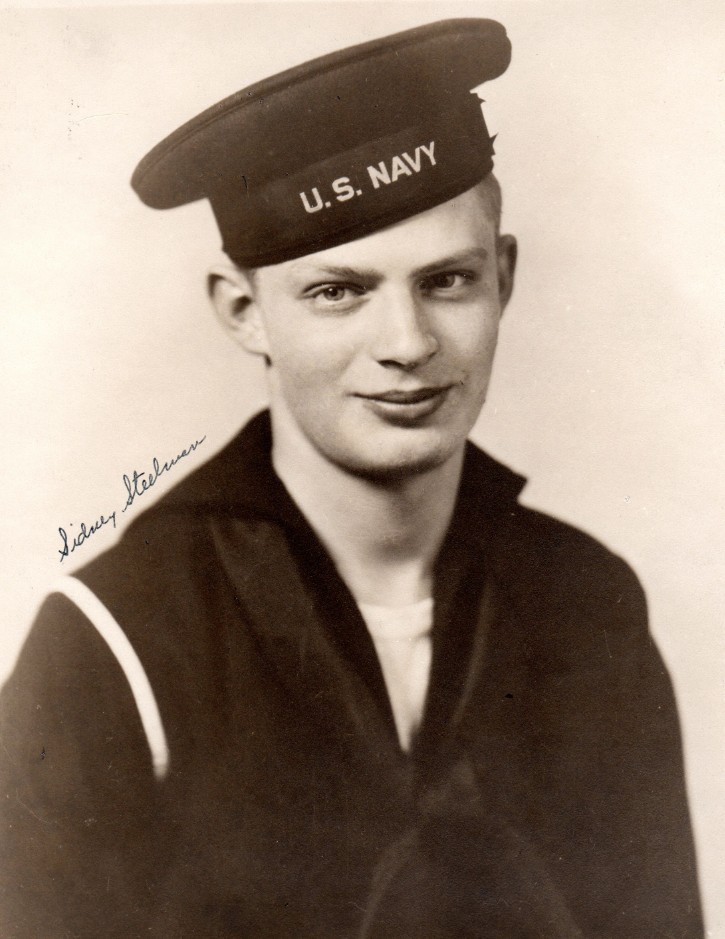
Early Life & Family
Benjamin Sidney Steelman was born in Philadelphia, Pennsylvania, on April 28, 1925. He was the first child of Abraham Steelman (a grocer, c. 1902–1953) and Esther Molly Steelman (née Ester Koller, c. 1903–1979), Jewish immigrants from the Russian Empire. He went by Sidney, or Sid for short. Steelman had a younger sister, Shirley Rosalie Steelman (later Gold, 1932–1976).
The Steelman family had moved to Wilmington, Delaware, April 1930, when they were recorded on the census. His father was a grocery store owner at the time. On January 11, 1932, some of the six-year-old’s alleged antics at a movie theater ended with his mother being arrested on the charge of disturbing the peace. Every Evening reported the following day:
According to Mrs. Anna Fowler, 224 Jefferson St., she and her little daughter were entering the movie when Sidney Steelman, 6, accompanied by his mother, Esther Steelman, 414 West Third St., grabbed the little girl’s hand and “made a face at her.”
The two mothers ended up in an argument after Fowler demanded that Steelman’s mother punish him, ending with each alleging the other woman had spit in her face. The paper reported that “Judge Lynn told Mrs. Fowler that her recourse was to bring the Steelman child into juvenile court and to avoid argument with Mrs. Steelman in the future.” He sentenced Steelman’s mother to six months of probation.
Steelman was a member of the Boys’ Club at the corner of Elm and Jackson Streets and attended their summer camps.
After graduating from Willard Hall Junior High School in 1939, Steelman began attending Wilmington High School. He also attended Adas Kodesch Hebrew School. The Wilmington Morning News reported that Steelman “was a graduate of Wilmington High School and had studied at the Chamberlain School of Aeronautics in Philadelphia.”
Steelman worked for the Pennsylvania Railroad, apparently at the Wilmington shops. He told the Navy his civilian occupation was electrician.
Military Career
On December 8, 1941, the day after the attack on Pearl Harbor, Steelman attempted to join the U.S. Navy. Journal-Every Evening reported:
Benjamin Steelman, of 911 East Twenty-Sixth Street, will not be 17 until April, but he came to the Navy Office this morning to find out if they would make an exception in his case. At present he is a pupil at Wilmington High School. He was told to get his parents’ consent and come back—but warned that 17 is the minimum age for navy enlistments. “Gosh, I don’t want to wait that long,” he said.
Steelman did not immediately enlist upon turning 17, perhaps because he decided to finish high school or because his parents refused to give their permission. One event that might have affected their decisions was that on November 13, 1942, President Roosevelt signed into law a bill that lowered the minimum draft age from 21 to 18. That meant Steelman would have been liable for induction as soon as the following April. By enlisting, he would at least have his choice of branch. On December 10, 1942, Steelman’s father consented to his son’s enlistment.
Steelman enlisted in the U.S. Naval Reserve at the U.S. Navy Recruiting Station, Wilmington, Delaware, on January 9, 1943. At the time, Steelman was described as standing five feet, 8½ inches tall and weighing 128 lbs., with brown hair and blue eyes. He was initially placed on inactive duty.
Apprentice Seaman Steelman went on active duty on February 24, 1943, at the U.S. Navy Recruiting Station, New York, New York. After passing testing there, he reported for boot camp the following day at the U.S. Naval Training Station, Great Lakes, Illinois.
As of April 7, 1943, when Steelman sat down to write a letter to Mollye Sklut (1906–2006), he was with Company 265, Battalion 10 at Great Lakes. Sklut was a Wilmington woman who worked at the Young Men’s Hebrew Association and corresponded with hundreds of Delaware’s Jewish servicemen worldwide. Portions of their letters to her were printed in a newsletter, the Y Recorder. Steelman wrote in part:
Navy life is just like anything else[,] there is nothing you can’t get used to. I had 2 haircuts already and 6 shots. Although it is April it is still march month for us, they really drill us up here. […] We don’t have much time to ourselves, as we are kept on the run most of the time, but occasionally we do get a breathing spell, hence my letter to you.
In another letter, dated April 21, 1943, Steelman wrote:
Monday night we had a Passover service here at the station for the Jewish boys and it was really very nice. We had matzoh, wine and chicken, just like the sed[e]rs we had home. We also had some kafeelta [gefilte] fish. Jewish women from nearby Waukegan and Chicago served as hostesses. […]
My boat training is coming along just fine and I feel like an old salt by now, after all I am every bit of a two month veteran. Tomorrow we have a regimental boat race and between you and me our company is a cinch to take it.
On May 5, 1943, upon completing recruit training, Steelman was promoted to seaman 2nd class. On May 22, Steelman began a six-week course at the Hospital Corps School, U.S. Naval Hospital, Great Lakes, Illinois. Topics included anatomy and physiology, first aid and bandaging, hygiene and sanitation, and nursing. He graduated on July 2, 1943. His final score was 87 out of 100, ranking 241st in his class of 492 men.
That same day, he was promoted to hospital apprentice, 2nd class, and dispatched to the U.S. Naval Hospital, Corona, California. He reported for duty there on July 5. In a letter postmarked July 12, 1943, he wrote to Sklut:
The place where I am stationed is perched up in the mts. and was formerly the Norconian Club where movie stars came to vacation. It is only about 60 miles from Hollywood and about 140 from the Mexican border. At the ft. of the mts. there is a beautiful lake full of row boats and fish, and I take advantage of it every chance I get, you know a sailor always goes row-boating on his day off.
Coincidentally, his uncle, Hyman Steelman (c. 1893–1977), who worked in the poultry business, lived in Pomona nearby, giving him a chance to visit family during his time off. Steelman’s 1st cousin and Hyman’s son, Irving Steelman (1923–1997), was also a sailor, assigned to the battleship U.S.S. New Mexico (BB-40). Corona had been a resort before the war. In a letter postmarked August 16, 1943, Steelman wrote another letter to Sklut, stating in part:
Last week-end I went to Hollywood, that was on a Saturday night and I went to the Hollywood Canteen and saw Hedy La Marr [sic], Joan Leslie, Hed[d]a Hopper, Phil Regan and my cowboy idol Roy Rogers (Yipee!). Sunday morning I went to the Santa Monica Beach with my relatives bathing. Gee Mollye, they really treat me swell. Well you can imagine my surprise while eating a hot-dog (my mouth was all stuffed) lo and behold I see a fellow who used to work with me at the P.R.R. who is in the army and stationed out here. We were talking our old times, how we use[d] to loaf aways hrs. together at the Pennsy. It was really nice to see somebody from Wilmington. […]
You know something Mollye I believe I am becoming a better chicken farmer than sailor. When I first came out California, to tell the truth, I used to be afraid of chickens, but now I help my uncle with a lot of his work.
In addition to serving in naval hospitals and sick bays aboard ships, U.S. Navy corpsmen also served as medics in Marine Corps units, where they were universally known as “doc.” On September 28, 1943, Steelman was transferred to Camp Elliott, San Diego. The following day, he reported for duty at the Medical Field Service School, Camp Elliott, California, where he was assigned to Class 13.
On November 13, 1943, Steelman was hospitalized at the U.S. Naval Hospital, San Diego, California. His personnel file is unclear about his activities in December 1943. One document stated that he was discharged from the hospital on December 16, 1943. Another stated that on December 12, 1943, he reported to the 36th Replacement Battalion, Transient Center, Camp Elliott, San Diego, California. It is possible that he was transferred while still in the hospital and a later document gave that transfer date as report date, but the document is still puzzling because it claims he was transferred from Camp Pendleton, not the hospital nor Camp Elliott.
Steelman was promoted to hospital apprentice 1st class on January 1, 1944. In a letter postmarked January 7, 1944, he told Sklut that he had arrived in Hawaii but omitted certain details that would have been obliterated by the censor:
On my first liberty I went into Hon[o]lulu and went bathing at Waikiki Beach. It is a nice place, but I believe I would trade it for Prices Run anyday. I happened to get in a conversation with a sailor and he told me something which really took me by surprise, that being my cousin’s ship was in —— which is only about 1 mile from my camp. Anyhow I went over there and went aboard the ——, which is the ship my cousin has been on for the last year and half. Well I don’t have to tell you how surprised my cousin was to see me. I was really nice seeing him too.
Later that month, on January 12, he was transferred to the Replacement Battalion, Transient Center, V Amphibious Corps. He was promoted to pharmacist’s mate 3rd class on February 1. Shortly thereafter, in a letter postmarked February 9, 1944, he wrote to Sklut:
Well today was pay day and everybody is sitting around the tent smoking cigars and listening to Bob Hope. They call our tent the camp U.S.O. because everybody assembles here at night and shoot the breeze. What characters we have in our outfit, you don’t have much time to get homesick. We have fellows who would make Abbott & Costello look like a pair of amateurs. […]
Yesterday I went to a show in the camp and they had a community sing for a short and they had parts for the boys & girls to sing, so the boys had to sing the girls part and we really went to town with high pitched voices, it was really comical.
On March 8, Pharmacist’s Mate 3rd Class Steelman was transferred to 2nd Battalion, 23rd Marines, 4th Marine Division.
On April 14, he was in a group of men who moved from Marine Camp Maui to board the attack transport U.S.S. Sheridan (APA-51). They spend several days doing maneuvers at Wailea Beach, Maui, before returning to Marine Camp Maui on April 18.
Steelman was reported absent without leave at 1330 hours on April 23, 1944. He returned to duty at 1630 the following day. Beginning on April 25, he was confined in the brig. On April 28, his 19th birthday, he was convicted at a court-martial and sentenced “To reduction to the next inferior rating.” He spent the rest of the month in the brig. Early the following month, however, he got a belated birthday present: On May 2, the proceedings, conviction, and sentence were quashed by higher authority and Steelman was not demoted.
On March 8, 1944, Pharmacist’s Mate 3rd Class Steelman joined Headquarters Company, 2nd Battalion, 23rd Marines, 4th Marine Division. Technically all the battalion’s corpsmen were members of Headquarters Company, though they were assigned to various companies and platoons throughout the battalion.
The Battle of Saipan
On May 7, 1944, Steelman and his unit boarded the attack transport U.S.S. Leon (APA-48), shipping out the following day for Pearl Harbor. They left Pearl Harbor on May 14 and spent May 15–18 doing landing exercises, again in the area of Wailea Beach. The ship returned to Pearl Harbor on May 19. Due to operational security, only a few officers in the 23rd Marines were privy to the name of the island they were training to take, though that did not stop rumors from swirling freely.
Steelman could not have known it at the time—though he might have suspected it, depending on the quality of the scuttlebutt—the 4th Marine Division was going to take part in Operation Forager, the invasions of Saipan, Tinian, and Guam in the Mariana Islands. The Marianas represented one of the most critical strategic objectives of the entire Pacific War. In addition to providing a jumping off point for further advances in the Pacific, seizing the islands would bring the Japanese home islands into range of Army Air Forces Boeing B-29 Superfortresses. Bases in the Marianas vastly reduced the logistical difficulties of operating the new bombers in China, their only previous combat deployment. It would take time to develop the tactics for the B-29s to become effective weapons, such as devastating firebombing raids of Japanese cities and laying naval mines from the air to strangle Japanese shipping. Once that happened, however, holding the Marianas meant that even in the absence of further advances, it was checkmate for the Japanese war machine.
Saipan, the first target of the campaign, was both the largest island in the northern Marianas and also the most heavily defended. In accordance with American doctrine, “two up, one back” was employed at multiple levels. The plan was to land the 2nd and 4th Marine Divisions on the southwest coast of the island, with the U.S. Army’s 27th Infantry Division serving as a floating reserve. Within the 4th Marine Division, the 23rd and 25th Marines would lead the assault, with the 24th Marines initially remaining in reserve. Together with attached support units, these were known as Regimental Combat Teams 23, 24, 25. In the 23rd Marines area, 3rd Battalion (Battalion Landing Team 3) would land on the left, Steelman’s 2nd Battalion (Battalion Landing Team 2) on the right, with 1st Battalion in reserve, though they landed later on the first day. The first day’s objective was known as the O-1 Line. The Japanese did not know exactly where the Americans planned to land, but there were relatively few good beaches given that three-quarters of the island’s coast was dominated by cliffs.
A setback occurred prior to departure when on May 21, 1944, a landing ship exploded at Pearl Harbor, spreading to other nearby ships in what became known as the West Loch Disaster. The 23rd Marines suffered numerous casualties in the incident, though relatively few fatalities.
On May 29, 1944, with B.L.T. 2 aboard, U.S.S. Leon departed Pearl Harbor for the Marshall Islands. After spending June 9–10 there, she sailed again on June 11, arriving four days later at Saipan, Mariana Islands.
H-Hour on the first day of the invasion, June 15, 1944, was initially scheduled for 0830 hours before being pushed back 10 minutes. That morning, Steelman and his comrades boarded their amphibian tractors (or if he was in a later wave, he boarded a landing craft before transferring to an amtrac at the reef). The amtracs had only light armor and a few machine guns but were prized for their ability to climb over coral reefs and other obstacles that would be impassible to any other vehicle. The first wave began their run to the beach around 0811 or 0812. Leading 2nd Battalion’s amtracs to Blue Beach 2, south of Afetna Point, were 17 amtanks from the U.S. Army’s Company “A,” 708th Amphibian Tank Battalion. Amtanks were modified amphibian tractors with a turret replacing the hold, so they could not carry troops or equipment. Although more lightly armored and armed than the M4A2 medium tanks, until those could be landed, the amtanks would the Marines’ only armored support. The first wave reached the beach on schedule around 0840 under mortar, artillery, and small arms fire.
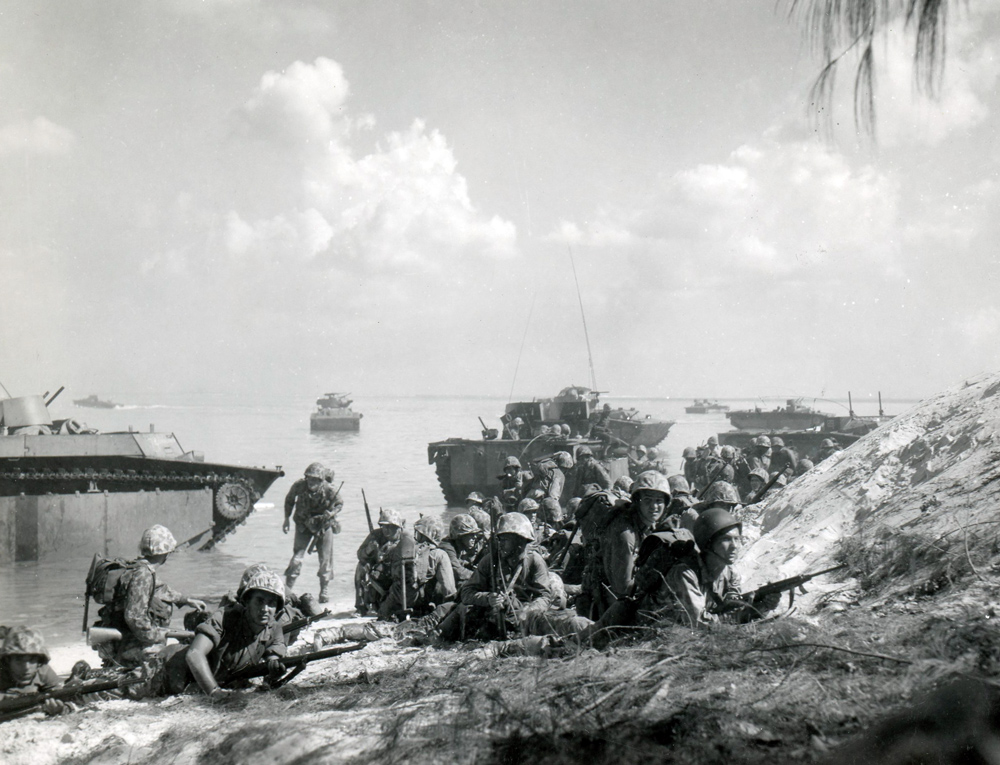
Despite days of bombardment by naval gunfire and aircraft, many of the Japanese defenders were unhurt and unleashed a fusillade at the approaching Americans. According to the R.C.T. 23 action report, Blue Beach 1 and 2 defenses “consisted of a few pillboxes, extensive trenches and many personnel and weapons foxholes and emplacements.”
Additional waves soon landed but the intensity of the fire made it difficult for the 23rd Marines to get organized and make a coordinated push inland. The R.C.T. 23 action report alleged that the 708th Amphibian Tank Battalion amtanks were slow to lead the Marines to the O-1 Line and did so only after being prodded, while the 708th’s report claimed that their amtanks pushed to the O-1 line without support from the Marines and had to wait for hours for them to arrive. Whatever the truth of those events, it is clear that there was poor coordination between the Marine infantry and the Army amtanks on the first day of the battle. Marine medium tanks began landing at Blue Beach 2 shortly before noon, but 2nd Battalion struggled to make headway. The 23rd Marines report stated that by 1630 hours, the “O-1 line on the left was held lightly by elements of BLT 3” but that on the right, Steelman’s “BLT 2 units were 600 yards inland pinned down by heavy MG [machine gun] and mortar fire. No contact had been established between the two BLTs.”
Americans fighting in Europe found that the Germans generally adhered to the Geneva Convention’s prohibition against intentionally harming medical personnel. For that reason, American medics in Europe were typically unarmed and well-marked with red crosses to mark them as noncombatants. In the Pacific, Japanese soldiers not only ignored these rules, but intentionally targeted medics and corpsmen. The logic was coldblooded: kill medical personnel and fewer American combatants would survive their wounds to fight again. For that reason, corpsmen avoided wearing red cross markings and often carried pistols or carbines for self-defense.
If he was attached to a frontline platoon, Steelman would have rushed to calls for help. Quickly exposing and assessing his patient’s wounds, he would have sprinkled sulfa powder on them and done his best to stop the bleeding. Marine litter bearers would evacuate the casualty to an aid station, where other corpsmen and doctors provided further treatment. Saipan was inhabited by significant numbers of civilians, both Chamorro and Japanese. Japanese soldiers sometimes used these civilians as human shields during attacks but even when they did not, many were still caught in the crossfire. Corpsmen provided aid to these unfortunate victims when possible.
That evening, both battalion landing teams withdrew slightly to more defensible positions. Overnight, mortar and artillery fire repeatedly hit the American positions. In some areas small groups Japanese infiltrators attempted to penetrate the Marine lines, followed by an early morning counterattack on D+1 that was defeated in the 3rd Battalion area.
On the second day of the battle, June 16, 1944, orders came down to prepare for another advance to O-1 line, though it was not executed for several hours. The 23rd Marines report stated:
The attack jumped off at 1245 with BLT 2 on the right, BLT 1 on the left, BLT 3 in reserve. The attack was in coordination with 1-24 [1st Battalion, 24th Marines] on our right. Progress of the attack was slow but deliberate, only moderate resistance was encountered consisting mostly of sniper and MG fire. At 1405, O-1 was seized.
On the third morning of the battle, June 17, 1944, the 23rd Marines began another advance:
The attack from O-1 continued at 0730, BLT 2 on the right, BLT 1 on the left, BLT 3 in reserve. The attack progressed slowly against increasing resistance from the front of BLT 2 and from the exposed left flank of BLT 1.
1st Battalion was badly mauled, while “the advance of BLT 2 continued against slight opposition and a gain of about 300 yards was made on the right.” The attack resumed that afternoon. 1st Battalion was again hit hard, advancing only 200 yards, while “BLT2 made gains of another 200 yards and contact between the two battalions was broken. This caused a gap of 400 yards between the two battalions.”
Loath to surrender 2nd Battalion’s gains, reserves from 3rd Battalion and later 3rd Battalion, 24th Marines were committed “to tie in and defend the gap between the two battalions for the night.”
There are contradictory reports of Pharmacist’s Mate 3rd Class Steelman’s date of death. The 2nd Battalion muster roll stated that he was killed in action on June 17, 1944, the third day of the battle, though it noted “exact time and details of death unknown[.]” Other documents in Steelman’s personnel file, including his Navy service record booklet, state he was killed in action on June 17, making this his most likely date of death.
However, months after the battle, a casualty report dispatched from 2nd Battalion to the Secretary of the Navy stated that Steelman was killed in action on June 15, 1944, the first day of the Battle of Saipan. This date of death appears on his headstone.
Adding to the confusion, a separate U.S. Navy muster roll for corpsmen assigned to 2nd Battalion, 23rd Marines stated that Steelman was killed on June 18. Finally, his death certificate gave his date of death as June 19, 1944, likely because that was the date his body was recovered and he was buried. According to his death certificate, Steelman was struck in the abdomen by a shell fragment and killed. He was initially buried in the 4th Marine Division Cemetery on Saipan on June 19, 1944.
His personal effects included his wallet, his social security card, a letter, a ring, five photographs, a news clipping, and $6.35 in cash.
Steelman was posthumously awarded the Purple Heart. For the collective actions of its members, the 4th Marine Division (Reinforced) was awarded the Presidential Unit Citation.
It appears that the Pennsylvania Railroad was never informed of Steelman’s death. Remarkably, it was only in 1958 that the superintendent of the Wilmington shops wrote the Bureau of Naval Personnel to ask about his status. As a result, he was omitted from the Pennsylvania Railroad World War II Memorial at 30th Street Station in Philadelphia, Pennsylvania, which had already been completed. However, his name is honored on a World War II memorial at the Jewish Community Cemetery near Wilmington and on the Wall of Remembrance at Veterans Memorial Park in New Castle, Delaware.
Private 1st Class Harry S. Bowman (1922–1944)
Early Life & Family
Harry Sharp Bowman was born in Minquadale, Delaware, on February 15, 1922. He was the fifth child of Elwood W. Bowman (an electrician, 1888–1964) and Bertha Cecilia Bowman (née Martin, 1891–1969). He had three older sisters, and older brother, two younger sisters, and a younger brother. Bowman was Protestant.
The Bowman family was recorded on the census in April 1930 living on State Road in Representative District 10 in unincorporated New Castle County, Delaware. Census records also state that if not before, they were living in Minquadale by April 1, 1935. After completing the 8th grade at the Minquadale School in 1938, Bowman dropped out of school. At the time of the next census in April 1940, Bowman was unemployed and living with his family in Minquadale.
Bowman was living on Tyrone Avenue in Minquadale when he entered the service. Based on his father’s death certificate, this was 18 Tyrone Avenue.
Bowman’s Marine Corps service record booklet described his civilian work history as machinist’s helper at a hosiery mill for two years, earning $20 per week (about $415 in 2026 dollars). His qualification card stated that he worked as a shop maintenance mechanic at Wilmington Hosiery Mill at Front and Orange Streets. The card stated he had worked for the company for 16 months, earning $22 per week (about $455 in 2026 dollars).
Bowman told the Marine Corps that while still in school, he played baseball and football and participated in school plays. His hobbies included rifle shooting and woodworking.
Military Career
Shortly before he turned 20, Bowman volunteered for the Marine Corps. Since he was under 21 years old, the age of majority at the time, his parents consented to his enlistment on January 30, 1942. Bowman enlisted in Philadelphia, Pennsylvania, on February 3, 1942. An exam described hm as standing five feet, six inches tall and weighing 124 lbs., with brown hair and eyes.
On February 4, 1942, he joined the 8th Recruit Battalion, Recruit Depot, Parris Island, South Carolina. He transferred to the 3rd Recruit Battalion on February 7 and to the 4th Recruit Battalion on February 20.
During World War II, Marines often had only one opportunity to qualify on various weapons during boot camp and it was not required to become a rifleman. Private Bowman attempted to qualify with the M1903 Springfield rifle on March 24, 1942, but his score of 187 of 250 was just under the minimum score of 196 to qualify. On April 11, 1942, he also failed to qualify with the bayonet.
On April 14, 1942, Bowman transferred to and joined the Barracks Detachment, Marine Barracks, Naval Operating Base, Norfolk, Virginia. On May 7, around 1400 hours, he boarded U.S.S. Joseph T. Dickman at Norfolk, sailing at 1300 on May 9. At 1500 on May 14, 1942, his ship arrived at the Naval Operating Base, Guantanamo Bay, Cuba. At 0830 the following morning, May 15, he disembarked and joined the Guard Company, Marine Corps Barracks, Naval Operating Base, Guantanamo Bay, Cuba. Also or later known as 1st Guard Company?
Bowman’s first M.O.S. was 522, guard-patrolman. He was promoted to private 1st class on July 1, 1942.
On October 1, 1942, he transferred to the 155 mm 3” Artillery Group, which was or later became part of the 13th Defense Battalion, at Guantanamo Bay. On November 3, 1942, he shot for qualification with the new M1 Garand rifle, but his service record book does not reveal whether or not he qualified.
On March 1, 1943, he transferred back to the 1st Guard Company, 13th Defense Battalion, Fleet Marine Force, Guantanamo Bay, Cuba. On June 29, 1943, he qualified with the Reising submachine gun, one of the more distinctive Marine weapons. Due to its poor reliability in the rain and mud of Pacific battlefields, it was relegated to guard and shipboard use. Curiously, although Bowman would later earn high honors in combat with the Browning Automatic Rifle, there is no record of him ever attempting to qualify with it.
Bowman’s records indicate that by the summer of 1943 he had gained one inch of height and 21 lbs. of weight. He now stood five feet, seven inches tall and weighed 145 lbs.
On August 13, 1943, Bowman took the Army General Classification Test. His score of 65 placed him in Class IV, below average on the five-class scale. He also scored a 96 a mechanical aptitude test, placing him in Class III. At his classification interview, also on August 13, Bowman stated that his preferred duty would be aviation mechanic.
On August 20, 1943, Private 1st Class Bowman transferred to the Casual Detachment, 25th Marines, Marine Corps Barracks, Naval Operating Base, Guantanamo Bay, Cuba. He was at sea from August 28, 1943, until September 8, 1943. He was able to take a lengthy furlough from September 17, 1943, until October 16, 1943. On October 20, 1943, probably at Camp Elliott, California, he transferred to and joined Company “A,” 1st Battalion, 25th Marines, 4th Marine Division. Shortly thereafter, on October 29, 1943, his M.O.S. was reclassified to 745, rifleman. However, according to his qualification card, his principal duty was 746, automatic rifleman.
In early 1944, the Marine Corps implemented a 13-man rifle squad composed of a squad leader and three four-man fire teams. Each fire team consisted of a team leader, an automatic rifleman, an assistant automatic rifleman, and a rifleman. The automatic rifleman was armed with the Browing Automatic Rifle (B.A.R.). It was a popular weapon, though heavy. Its 20 round magazine and high rate of fire gave it more firepower than the 8-round M1 Garand semiautomatic rifles carried by the other three members of the fire team.
Combat in the Pacific Theater
Company “A” (Reinforced) boarded U.S.S. LST-267 on Maui on the morning of May 12, 1944. The following day, they began five days of rehearsals for their next operation in the Mariana Islands. They set sail on May 19, arriving the following day at Pearl Harbor. On May 21, 1944, a landing ship laden with fuel and ordnance exploded. The conflagration spread to other vessels in what became known as the West Loch Disaster. 1st Battalion, 25th Marines lost one man killed and 11 injured, all from Company “B.” Despite the setback, Landing Team 1 sailed for the Marshall Islands on May 25, 1944, arriving on June 9 at Eniwetok Atoll. The following day, they sailed west again, arriving in the Mariana Islands on June 15.
Amphibious tanks from Company “C,” 708th Amphibian Tank Battalion—a U.S. Army unit—led 1st Battalion, 25th Marines to Beach Yellow 2.
According to the sample citation included with his commander’s recommendation for the Navy Cross submitted after the battle:
(b) During the early hours of morning on D plus one day, heavy enemy artillery and mortar fire was delivered on positions occupied by Private First Class BOWMAN’s platoon. After the fire had ceased, the enemy under cover of the darkness of early morning, launched a severe close in counter-attack employing light machine guns, knee mortars, and rifle fire as well as throwing of many hand grenades. His platoon leader ordered a withdrawal to a more covered position which was begun immediately.
(c) Private First Class BOWMAN without being ordered to do so, elected to remain in his fox-hole to cover the withdrawal. So effectively did he fire his automatic rifle that the withdrawal with carried out without any further casualties. When later the positions were reoccupied by his platoon, he was found dead in his fox-hole, killed by enemy hand grenades. Beside his body were found twenty four empty magazines and all his hand grenades thrown.
If accurate, the detail about 24 empty magazines indicates that Bowman had fired as many as 480 rounds from his B.A.R. at the Japanese attackers before he was overwhelmed. The B.A.R. magazine belt held 12 magazines, suggesting either that Bowman had been carrying extra ammunition, that Bowman’s assistant had left magazines before withdrawing, or both.
Although the citation stated that Bowman was killed by enemy grenades, his death certificate stated that he suffered a fatal gunshot wound to the head.
Around August 23, 1944, Bowman’s company commander, Captain John R. Schumerth (1917–2008), recommended that Bowman be awarded the Navy Cross, noting: “It is doubtful whether such a withdrawal could have taken place had it not been for Private First Class BOWMAN’s action.”
Bowman’s personal effects included a watch, a wallet, two driver’s licenses, a vehicle registration and bill of sale, his Social Security card, a calendar, a civilian identification card, and 76 cents.
On August 15, 1944, Journal-Every Evening reported that “Memorial services for Pfc. Harry S. Bowman, U. S. Marine Corps, killed on June 16 on Saipan, will be held at 8 o’clock next Sunday evening [August 20] at the Peoples Baptist Church in Hamilton Park.”
Bowman was posthumously awarded the Navy Cross, second only to the Medal of Honor. It was presented to his mother on September 28, 1945, at the Marine Barracks, Navy Yard, Philadelphia. He was also awarded the Purple Heart. For the collective actions of its members, the 4th Marine Division was awarded the Presidential Unit Citation.
Bowman was initially buried at the 4th Marine Division Cemetery on Saipan on June 19, 1944. After the war, Bowman’s mother requested that his body be repatriated to the United States. In 1948, his body returned aboard Albert M. Boe. On June 13, 1948, following his funeral at the Mealey Funeral Home in Wilmington, Bowman was buried at Gracelawn Memorial Park near New Castle, Delaware. His name is honored nearby on the Wall of Remembrance at Veterans Memorial Park.
Private 1st Class William K. Baynard (1917–1943)
Early Life & Family
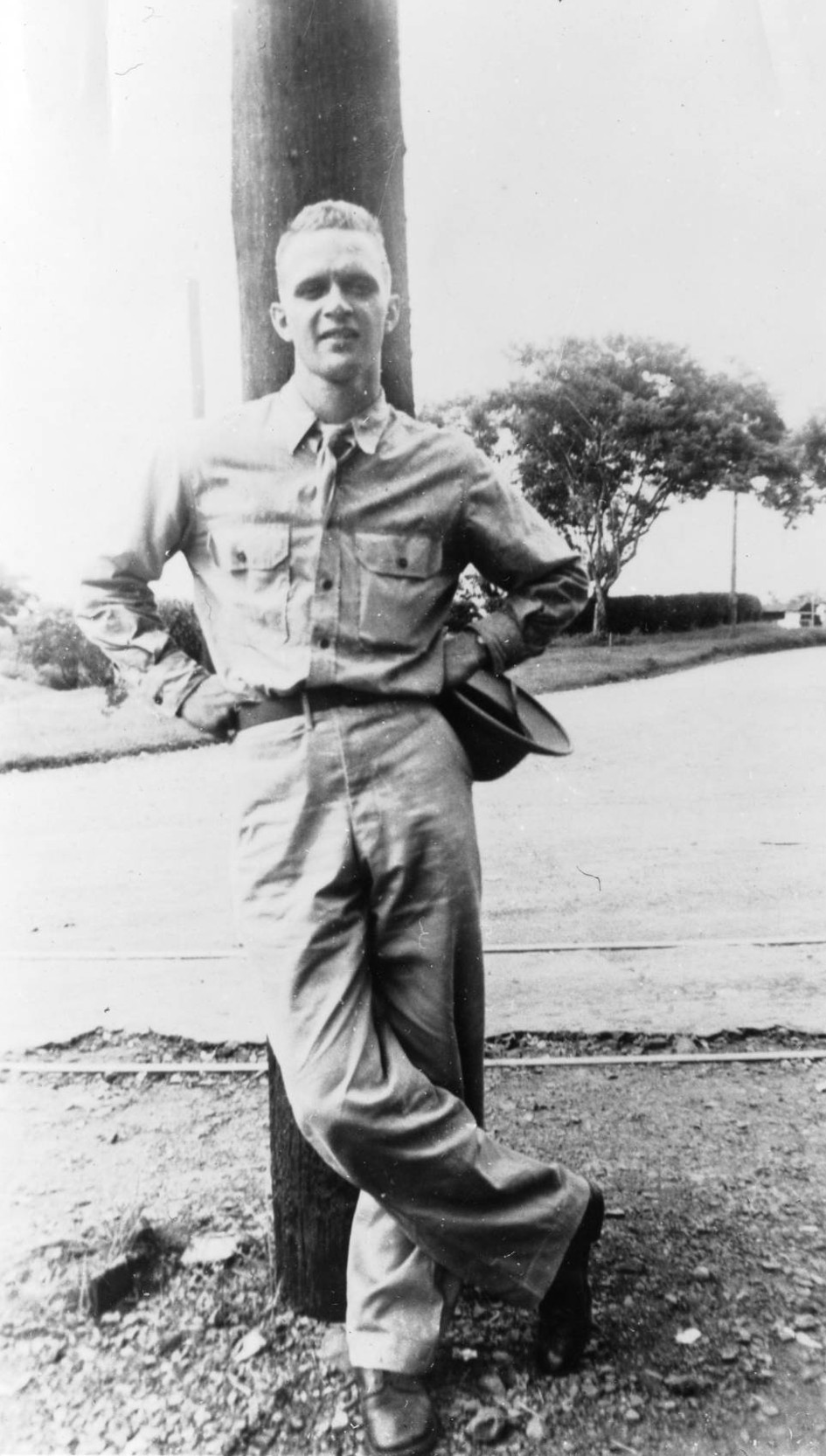
William Kirk Baynard was born at the Delaware Hospital in Wilmington, Delaware, on June 9, 1917. He was the first child of William J. Baynard (c. 1895–1980) and Julia Baynard (née Julia Sarah Kirk, 1894–1997). His parents were residents of Wilmington at the time, but their address was not recorded. The family was living at 2117 Biddle Street in Wilmington as of July 10, 1919, when his younger brother, Philip Gladwin Baynard (1919–1998), was born.
Baynard’s mother was described as a housewife on her sons’ birth certificates. However, her obituary stated: “She taught at schools in Richardson Park, Arden and Dover and later lived in a house on South State Street in Dover that was built by her great-grandfather, Thomas Stevenson, a cabinetmaker and prominent citizen of Dover.”
Baynard’s father’s occupation was recorded as cigar maker when he married in 1916, brakeman when his first son was born, and riveter when his second son was born. In a 1945 letter to the Army Effects Bureau, Baynard’s mother stated: “He was deserted by his father at the age of two.” During World War II, he worked at the Pusey and Jones shipyard in Wilmington.
Baynard was recorded on the census in January 1920 living at 420 South State Street in Dover with his mother, brother, and maternal great-aunts, Sarah and Mary Kirk. Baynard’s mother filed for divorce in Kent County, Delaware, obtaining a decree nisi on October 19, 1920.
Baynard’s mother remarried on August 2, 1926, to Alfred S. Biggs (d. 1974), with whom she had one additional son, Jimmy Biggs (1928–1968).
In a 1948 letter, Baynard’s mother mentioned that “my son is always known as Kirk here in his home town.” Baynard’s enlistment data card stated that he was a plumber with a high school education before entering the service, while his mother described him as a plumbing and heating mechanic. Journal-Every Evening later reported:
When the boy was two years old the family moved to Dover. He went to the Dover schools. After graduating, he went into the plumbing business with his step-father in Dover. Later he came to Wilmington and was employed at the DuPont dye works plant at Deep Water, N. J.
Baynard’s younger brother, Philip, served in the 198th Coast Artillery, which was federalized in 1940.
Military Career
Baynard volunteered for the U.S. Army, enlisting in Dover, Delaware, on February 24, 1941. As a Regular Army volunteer prior to the U.S. entry into World War II, he had more control over his assignment than the draftees swelling the Army’s ranks. Baynard was specifically enlisted for service in the Signal Corps in the Philippine Islands. The Philippines were an American possession but had been promised independence in 1946. Until then, the U.S. was still responsible for the defense of the archipelago.
A morning report stated that on February 26, 1941, Private Baynard was attached for duty to Company “D,” 2nd Signal Training Battalion, Signal Corps Replacement Training Center, Fort Monmouth, New Jersey. He was attached to Company “A” in the same battalion “for rations and quarters only[.]” He was detached from Company “D” at 1800 hours on March 19, 1941, and attached to Company “C,” 3rd Signal Training Battalion for training as a student at the Signal Corps School at Fort Monmouth. Several of the other men in his training units were also earmarked for the Philippine Department.
Effective June 14, 1941, at 1800 hours, Private Baynard and a group of several dozen men were detached from Company “C” and transferred to Signal Company, Aircraft Warning, Philippine Department (also known as Aircraft Warning Company, Philippine Department).
In her statement for the Public Archives Commission, Baynard’s mother wrote that in July 1941 her son went overseas from San Francisco, California, to Manila aboard S.S. President Coolidge.
Beginning in August 1941, Signal Company, Aircraft Warning, Philippine Department, was based at Fort William McKinley, near Manila. Many records were lost in the fall of the Philippines. According to notes made in a prison camp by 1st Lieutenant William D. Thompson (1913–1948), “Service Records of Co. buried in Bataan near Co. area.” However, there is no indication that these were ever recovered. Thompson’s notes indicate that Baynard’s commanding officer, presumably his platoon commander, was 1st Lieutenant Jack Rogers. Thompson also wrote that 1st Sergeant Joseph Giles Pase (1912–1955), a Delawarean like Baynard, “had in his possession at Hoten [Camp, a prison camp in Manchuria] the Co’s. morning reports.”
The U.S. Army first began developing air warning systems in the 1930s. The technological challenges were daunting. To have an effective system, enemy aircraft first had to be detected far from their targets. Observers had to identify them as hostile, ascertain their route and altitude. If they managed to do that accurately, they had to rapidly communicate that information to a center capable of rapidly alerting antiaircraft defenses and scrambling fighters (then known as pursuit aircraft). Of course, dispatching aircraft was not enough. They had to be routed to intercept the enemy aircraft, meaning the enemy aircraft would have to continuously be tracked and that information relayed to the fighters.
During initial testing, the early warning network was reliant on ground observers. Of course, the disadvantage was that no matter how comprehensive the network, no matter how vigilant the observers, they could not detect the enemy until attackers were practically on top of them. In the 1930s, the U.S. Naval Research Laboratory and Signal Corps Laboratory conducted some experiments in detecting aircraft using radio waves, culminating in the development of the Army’s SCR-268 and SCR-270 radar sets. Similar efforts were underway in the United Kingdom, culminating in the Chain Home network. The system proved instrumental in ensuring their victory during the Battle of Britain in 1940. The Royal Air Force also developed an effective system to plot the locations of enemy aircraft and direct fighters to intercept them.
Of course, radar detection was only one link in the chain of a successful system. In his book, “Radar Contact!”: The Beginnings of Army Air Forces Radar and Fighter Control, Randall DeGering noted that the British pioneered ground-controlled interception, in which a controller could view a radar display and direct pilots by radio. The British also developed the first identification-friend-or-foe system, making it easier to distinguish which aircraft on their screens were hostile. Although the American were on friendly terms with the British even before the U.S. entry into World War II, and had officers permitted to observe British advances, it would take time for the Americans to catch up.
Extant rosters give the Signal Company, Aircraft Warning duty station as Fort William McKinley even after that base was evacuated at the end of 1941. However, other documentation shows that its men served at several locations in the Philippines. Randall DeGering wrote:
The Signal Company, Aircraft Warning, Philippines Department, arrived in August of 1941 to Fort William McKinley, in Manila, but without any AW equipment. However, by October, a single SCR-270 radar had been established at Iba Field, 75 miles northwest of Manila. Although seven radar sets had reached the Philippines by December 1941, only two—one at Iba and another one outside Manila—were operational.
The Japanese wasted no time in attacking the Philippines on December 8, 1941, just hours after the attack on Pearl Harbor (the Philippines being on the other side of the International Date Line from Hawaii). The Iba radar station detected suspected Japanese aircraft but American fighters were unable to locate them in the early morning darkness. Later that day, the Japanese caught the 3rd Pursuit Squadron returning to Iba from an unsuccessful patrol. Virtually all of them were shot down or forced to crash land, and the radar station was demolished. Lieutenant Thompson’s notes indicate that during the attack on Iba, five men from the Signal Company, Aircraft Warning were killed and five others wounded. Clark Field was also devastated. In less than a day the Japanese had established air superiority over the Philippines and air supremacy soon afterward.
Journal-Every Evening reported that coincidentally, Baynard’s last letter to make it home was delivered that same day, December 8, 1941.
Thompson’s notes indicate that some of the unit evacuated to the Bataan Peninsula, since one man was wounded by a grenade during the Battle of the Points. Other members of the unit were on Corregidor and destroyed equipment to prevent it falling into Japanese hands on the night of May 5, 1942, hours before the island surrendered. Baynard’s movements and actions during the campaign are unknown. If he was captured on Bataan on April 9, 1942, he survived the Bataan Death March. If not, he would have been captured when Corregidor surrendered on May 6, 1942.
Baynard was promoted to private 1st class on an unknown date.
Prisoner of the Japanese
Baynard’s name appears in a list of men in a notebook belonging to Captain Walter J. Hewitt of the 12th Signal Company (Philippine Scouts). The list was described as “Pertaining to 200 man labor detail taken from Cabanatuan, Phil, Islands to Japan[.]” He wrote that the detail went to Bilibid Prison in Manila on October 28, 1942. Several pages of names were crossed out, including Baynard’s. It is unclear what that alteration means, but he was clearly in Japan by the end of the year.
Most likely, Baynard traveled to Japan aboard the hell ship Nagato Maru to Moji, Japan, and then by train, arriving on or about November 26, 1942, at the Yodogawa Branch Camp (later known as Yodogawa 3-B and eventually Yodogawa 3-D). The camp was located on the Yodo River north of Osaka. Prisoners had to work in various local industries such as blast furnaces, machine shops, and on the docks. Meals at the camp were typically watery vegetable soup and rice. Protein was rare. There were few opportunities to bathe. It was not until December 27, 1942, that the prisoners were first issued Red Cross packages, which had potentially lifesaving food and other amenities, and even then, three men had to share each package. There was inadequate heating in quarters for the men, still wearing the clothing they had been captured in, suffered immensely from the cold. Beatings were common for the most trivial offenses.
The Empire of Japan did not report its prisoners of war in timely fashion. A document in Baynard’s individual deceased personnel file (I.D.P.F.) stated that the War Department only learned of his capture via the International Red Cross on January 18, 1943, and that Baynard’s mother was informed that he was a prisoner of war only on January 20.
Baynard’s decline is better documented than most other prisoners of the Japanese thanks to records kept by Captain Frank L. Richardson, a doctor originally with the 3rd Pursuit Squadron, 24th Pursuit Group, who arrived at the camp on December 7, 1942. His notes indicate that Baynard’s health had deteriorated by the end of 1942, diagnosed as beriberi due to malnutrition. White rice, a dietary staple for Baynard both before and after capture, is poor in thiamine, and many of the prisoners were already suffering from beriberi by the time they arrived at the camp. Men died regularly from disease.
Richardson wrote that Baynard received an injection of “VB”—vitamin B1, thiamine—on December 30, 1942. Baynard was hospitalized in the camp sick bay on January 1, 1943, apparently due to eye issues. He returned to light duty on January 2, and full duty on January 6. However, he returned to light duty on January 8 due to his eyes, and to sick bay on January 10. Being able to work could mean the difference between life and death in the camps. The Japanese cut rations for men who could not work, making it even more difficult to recover and when the Japanese distributed overcoats on January 1, 1943, only men who were in work details received them.
It is unclear when Baynard returned to duty. Dr. Richardson documented further vitamin B injections during January 25–31, and February 1–9, 1943. He also received cod liver oil January 14–17.
Baynard was hospitalized again at Yodogawa on March 7, 1943. As of March 12, 1943, he was being treated at a ward run by Storekeeper 2nd Class William Floyd Jeffries (1919–2005), who despite his rating served as a hospital corpsman under Captain Richardson. Baynard’s beriberi had led to heart failure. Richardson wrote that Baynard “Ate a bowl of rice 15 min before he died” on March 12, 1943.
The Japanese government belatedly reported his death via the International Red Cross, which forwarded the notice to the United States on July 20, 1943, that Baynard had died of cardiac beriberi at Osaka Prison Camp. The War Department received that notice on July 25, Of course, he had been dead for over four months by that point, a fact that subsequently came to light. Initially, since the Japanese did not report a date of death, the War Department made his official date of death July 20, 1943.
Journal-Every Evening reported Baynard’s death on August 7, 1943, recording his mother’s reaction at length:
“When we complain of the lack of our accustomed comforts, we might realize that many of our soldiers who lived to be captured by the Japanese, face a slow death, caused by improper food.
“These are the same boys who persisted in the face of hopeless odds, who waited in vain for re-enforcements and supplies.
“At a time when our attention is focused on our increasing victories both in the Mediterranean and in the Pacific, it might be well for us to have another thought for the remnants of our forces from Bataan,” Mrs. Biggs said.
“Those boys who are in Japanese prisons do not all receive the help needed by them offered by the Red Cross because—as I understand it—of the lack of cooperation of the Japanese Government,” Mrs. Biggs spoke not in a spirit of resentfulness but in the hope of aiding other prisoners of war, and to prevent them, if possible, from meeting the same fate as her own son.
The Japanese cremated Baynard’s body. At the end of the war, a box of his ashes was recovered along with those of other prisoners of war at Juganji, a temple in Osaka. They were initially transported to the crypt at an American military cemetery in Manila. In 1947, Baynard’s mother requested that her son’s ashes be repatriated to the United States. The following year, his remains crossed the Pacific Ocean aboard U.S.A.T. Sgt. Morris E. Crain, arriving at the San Francisco Port of Embarkation. They traveled across the country to Philadelphia, Pennsylvania, and from there to Dover by train on October 15, 1948.
On October 16, 1948, following a funeral with military honors from the American Legion, Private 1st Class Baynard’s ashes were buried at Christ Churchyard (Christ Episcopal Church Cemetery) in Dover. His name is honored on a memorial in Dover and on the Wall of Remembrance at Veterans Memorial Park in New Castle, Delaware.
Julia Sarah Kirk Barnard Biggs outlived two of her three children prior to her death in 1997, aged 102. She and her other two sons were buried next to Private 1st Class Baynard after their deaths.
Notes
Grade
The earliest known document to describe Baynard as a private 1st class was a corrected Adjutant General’s Office report of death dated November 16, 1945. All known wartime documents describe him as a private including company rosters through March 1942, a War Department letter about his capture dated January 27, 1943, Captain Hewitt’s notebook, Captain Richardson’s list, and Baynard’s initial death report dated August 2, 1943. Discrepancies of this sort are remarkably common with regard to prisoners of war held by the Japanese.
Private 1st Class William C. Fox (1923–1944)
Early Life & Family
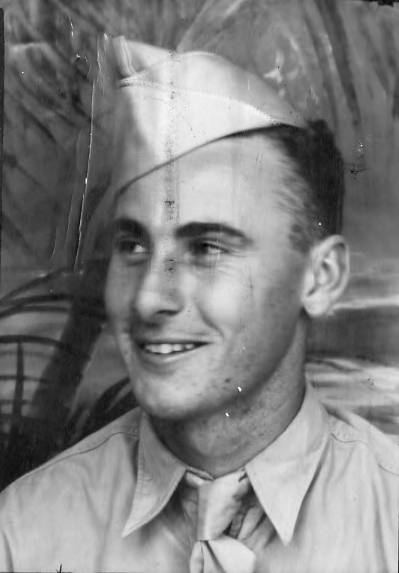
William Crawford Fox was born in Kent County, Delaware, on September 23, 1923. His draft card listed his place of birth as Lebanon, Delaware, while his Delaware birth index card stated he was born near Dover. He was the son of Timothy Fox, Sr. (c. 1895–1975) and Laura Fox (née Laura Virginia Gibson, c. 1890–1956). He might have gone by his middle name, since he was listed as Crawford Fox on the 1930 and 1940 censuses. Fox’s father had different occupations in various records including farmhand, garage worker, laborer, and finally plumber.
In later records, Fox’s parents and siblings often used the spelling Foxx. All known records pertaining to Fox himself use the shorter spelling, including his mother’s statement for the Public Archives Commission, though some newspaper articles referred to him as Foxx.
Fox had an older sister, two older brothers, three younger sisters, and a younger brother. He was Catholic. He was recorded on the census in April 1930 living with his parents and four siblings in Lebanon. Census records indicate that the Fox family moved to Dover, Delaware, prior to April 1, 1935. By April 1940, they were living at 19 South New Street in Dover.
The 1940 census stated that Fox was unemployed and had dropped out of school after completing the 6th grade. Similarly, his enlistment data card stated that he had a grammar school education.
Before entering the service, Fox worked as a clerk for the American Store Company grocery store at Lockerman and New Streets in Dover. When he registered for the draft on June 30, 1942, Fox was still living at 19 South New Street in Dover. The registrar described him as standing five feet, seven inches tall and weighing 138 lbs., with brown hair and eyes.
Fox’s older brothers also served during World War II: Timothy Caleb Foxx, Jr. (1917–1987) in the U.S. Army and Calvin Thomas Foxx (1920–1995) in the Army Air Forces.
Military Career
Fox volunteered for the U.S. Army, enlisting in Camden, New Jersey, on December 1, 1942. He went on active duty that same day and was attached unassigned to Company “A,” 1229th Reception Center, Fort Dix, New Jersey.
Journal-Every Evening later reported: “Foxx [sic] told his mother, Mrs. Timothy Foxx, before he enlisted that he had no fear of death and that he would be proud to make the supreme sacrifice for his country. He had not waited for induction.”
Fox departed Fort Dix on December 12. On December 18, he joined Headquarters Company, 3rd Battalion, 69th Armored Regiment, 6th Armored Division. Since he would be having his basic training directly with the unit and had not qualified in a military occupational specialty (M.O.S.), the morning report noted that he was a 521, basic. At the time, his new unit was stationed at Rice, California, training in the Mojave Desert, and equipped with the M4 medium tank.
A morning report reported that on January 29, 1943, Private Fox completed his recruit training, though he had not yet qualified in any M.O.S. by that point. That same day, his unit began moving a short distance west to Camp Coxcomb, just east of present-day Joshua Tree National Park. They remained there until February 14, when they moved to a bivouac two miles north of Desert Center, California. Fox and his comrades were constantly on the move for the rest of the month, including stops near Camp Coxcomb, Granite Mountain. They finished the month bivouacked midway between Blythe, California, and Desert Center. Several more moves occurred in early March 1943, with bivouacs at Cadiz Dry Lake and Danby, California. At 1830 hours on March 14, they departed the desert, arriving at Camp Cooke, California, at 1700 on March 15. Training continued there.
On April 15, 1943, Private Fox was transferred from Headquarters Company to Headquarters 3rd Battalion, 69th Armored Regiment. A morning report from the same day noted a change in duty and/or M.O.S. code from 521, basic, to 345, light truck driver. Fox was promoted to private 1st class on June 10, 1943.
Private 1st Class Fox went on furlough on August 2, 1943. He returned to duty on August 17. Curiously, Journal-Every Evening later reported that he had never gone on furlough. That suggests that he did not return to Delaware during the furlough. Of course, a pair or cross-country journeys would have been expensive and consumed much of his furlough time.
Midway through the war, Army planners determined that armored divisions were too large and unbalanced, with too many tanks and not enough armored infantry. Most armored divisions were reorganized and their pair of armored regiments (three armored battalions each) broken up into individual battalions. Even then, under the new tables of organization and equipment, the new light armored division only needed three tank battalions, not six. On September 19, 1943, 3rd Battalion, 69th Armored Regiment was inactivated. Effective the following day, its personnel and equipment were transferred to the newly activated 708th Tank Battalion. No longer part of the 6th Armored Division, it was now one of the so-called separate tank battalions, which were typically attached to support infantry divisions, which lacked organic armor units.
On October 16, 1943, leaving its tanks behind, the 708th Tank Battalion moved north to Fort Ord, California, a base on the shores of Monterey Bay. Later that month, on October 27, the battalion was redesignated as the 708th Amphibian Tank Battalion and reorganized. Two separate companies, Headquarters Company and Service Company, were merged into a single Headquarters & Service Company, which Private 1st Class Fox was transferred to that same day.
Private 1st Class Fox and his comrades began training for a very different set of combat conditions than desert armored warfare. Instead of medium tanks, they were equipped with the L.V.T. (landing vehicle, tracked), informally known as the amtrac. A wartime battalion history stated:
Immediately after being settled in the assigned area at Ft. Ord, the battalion was issued its new amphibious vehicles. Training began at once. Although the battalion was designated a tank unit, the amphibious vehicles with which it first worked, were amphibious tractor type. Training was carried on [sic] day and night. In addition to the purely amphibious training, all weapons were fired in intensive range work: Village combat, night infiltration, close combat, foxhole courses, grenade practices, swimming instruction, all were undergone by the entire personnel of the unit. Monterey Bay with its fickle aquatic conditions provided the training area for familiarization with the utterly new equipment. And although the bay was characteristically rough, and the surf reached mountainous proportions, no vehicle was lost during this period. As a matter of fact, conditions encountered then were the worst with which the unit has ever been called upon to contend.
On December 9, 1943, the 708th Amphibian Tank Battalion was dispatched to Camp Stoneman, staging for overseas deployment. Journal-Every Evening reported that Fox’s “expected furlough last Christmas was spoiled by a hurry call from the battle area.” Of course, it is unclear whether that furlough was planned or merely rumored. They boarded a transport on December 22, shipping out on Christmas Eve. Many men in the battalion were too seasick to enjoy Christmas dinner, though conditions improved on the fourth day of the voyage. They arrived at Pearl Harbor, Oahu, Hawaii, early on December 31. The battalion, less Company “D,” moved to Waianae [?] under the 4th Armored Group. The unit history stated:
The first days of the new year were busily occupied in preparing for an impending operation in the very close future. Water formations preparatory to beach landings were practiced incessantly in addition to combat firing. This was the first contact of the unit with the type of water and beach conditions with which it was to become so familiar in the following months.
The Battle of Kwajalein
During the Battle of Tarawa in November 1943, amtracs had been instrumental in getting Marines ashore when landing craft were unable to get past the coral reef around the atoll. Even so, casualties had been shockingly high. Taking the lessons of Tarawa to heart, planners sought to avoid similar bloodletting during Operation Flintlock, the invasion of Kwajalein Atoll. Taking place a little over two months after Tarawa, it was the first time amtanks would enter combat.
The 708th Amphibian Tank Battalion, less Company “D,” was attached to the 7th Infantry Division on December 31, 1943, or January 3, 1944. Unit records are contradictory about movements at this point. A unit history states that on January 12, the battalion shipped out for Maui, where they spent a few days of rehearsing for the operation. A Headquarters & Service Company morning reports indicate that the company stayed at Waianae until January 14, when it moved to Koko Head, Oahu. Then, a later morning report stated the company was stationed elsewhere on Oahu at Schofield Barracks during January 11–20!
At around 1030 hours on January 21, 1944, Private 1st Class Fox and most of Headquarters & Service Company (less a detachment who remained behind in Hawaii) boarded the attack transport U.S.S. Harry Lee (APA-10) at Honolulu. They set sail around 1430 hours the following day.
It is unclear if Fox’s duty remained light truck driver through the various transfers and transitions from a medium tank to an amphibious tank battalion. None of the battalion’s wheeled transport was brought along for Operation Flintlock. Journal-Every Evening described him as a “navigator of an amphibious tank.” That statement is difficult to parse since navigator was not a position in the 708th. Crew composition varied based on the type of amtrac or amtank, but all vehicles had a commander (a noncommissioned officer), a driver (typically a technician 5th grade), and radio operator. Some vehicles had gunners, assistant gunners, and assistant drivers.
Company “A,” 708th Amphibian Tank Battalion was equipped with 17 LVT(A)-1 amtanks, an amtrac modified with additional armor and a light tank turret armed with a 37 mm gun, instead of a hold for carrying troops or equipment.
Too few amtanks were available to equip the entire battalion in time for the operation. As a result, the contemporary history stated: “For this operation the 708th Amphibian Tank Battalion had been temporarily reorganized into the 708th Provisional Amphibian Tractor Battalion. Three (3) anti-tank companies from the 17th Infantry, 32nd Infantry, 184th Infantry, had been converted into LVT groups.” Each of those four groups were equipped with 14 LVT(A)-2 armored amtracs and 20 LVT-2 amtracs, used to land men and equipment from the 7th Infantry Division.
The battalion returned to Oahu on January 16, shipping out from Pearl Harbor the following day. Their convoy arrived in the Marshall Islands on January 31, 1944. Kwajalein Atoll has dozens of islands. On January 31, the 708th landed on two islands. “Rear Detachment, 708th Provisional Amph Tractor Bn., landed on CARLOS ISLAND”— that is, Ennylabegan—“and established a service and supply park in conjunction with the 707th Ordnance” (Light Maintenance) Company. This may have included part of Headquarters & Service Company, but its morning report indicated that it assisted 1st Platoon, Company “A,” with capturing Enubuj, codenamed Carlson Island.
The following day, February 1, 1944, Headquarters & Service Company supported Company “A” as the 708th Provisional Amphibian Tractor Battalion landed troops on the main island of Kwajalein following a powerful aerial and naval bombardment. During subsequent days, American troops landed on other minor islands in the atoll. The 708th finished combat operations in the atoll on February 6.
On February 14, 1944, Private 1st Class Fox was part of a group of 18 men dispatched back to Koko Head Camp on detached service while the rest of his company participated in the capture of Eniwetok. The entire Headquarters & Service Company was reunited at Koko Head on March 14.
The operation went smoothly overall and the Americans lost far fewer men in the Marshalls than on Tarawa. The 708th Amphibian Tank Battalion lost one man killed in action and 36 wounded.
The Battle of Saipan
Private 1st Class Fox was awarded the Good Conduct Medal per General Orders No. 6, Headquarters 708th Amphibian Tank Battalion, dated April 14, 1944. The following day, he went on detached service for one week at Fort Kamehameha, near Pearl Harbor. That same month, the battalion’s officers began planning for their next operation, the invasion of the Mariana Islands. The 708th Amphibian Tank Battalion would be attached to the 4th Marine Division for the operation, codenamed Forager.
The Marianas had great strategic importance, since capturing them would bring the Japanese Home Islands into range of American B-29 Superfortress bombers. Up to that point, the B-29 had been deployed only to China. All fuel and ordnance had to be transported to India and then flown to China, a time-consuming and inefficient process.
Between Flintlock and Forager, enough amtanks had arrived to fully equip the battalion. Preparations were intensive but the men of the 708th were also able to get some rest. The battalion history stated:
During the period [between] 12 March and 11 May 1944, maximum stress was placed upon rehabilitation of personnel and equipment, as well as further training in all phases of amphibious combat. Men of the battalion were given every opportunity to enjoy the varied recreational facilities available not only on Oahu but also on other islands of the Hawaiian group.
On May 9, 1944, Private 1st Class Fox and a group of other enlisted men from Headquarters & Service Company were attached to and placed on special duty with Headquarters 708th Amphibian Tank Battalion. On May 11, his unit sailed for Maui, arriving early the next morning for several days of rehearsals. They sailed from Maui on May 19, arriving at Pearl Harbor the following morning.
During preparations for Operation Forager, on the afternoon of May 21, 1944, U.S.S. LST-353, a vessel loaded with fuel and ammunition, suddenly exploded, setting off explosions on other similarly laden vessels nearby. The 708th Amphibian Tank Battalion’s casualties from what became known as the West Loch Disaster were almost as heavy as the entire Marshall Islands campaign: one killed and 27 wounded. The battalion history noted that “all preloaded equipment of this Bn, personnel equipment, and ‘A’ bags of 165 men, were a complete loss.”
On May 23, 1944, Fox and his unit moved back to Koko Head Camp but returned to Pearl Harbor the following day. Maintenance personnel embarked on U.S.S. LST-223, while the rest of Headquarters 708th Amphibian Tank Battalion embarked on U.S.S. LST-19 early the next morning. Their ships departed Pearl Harbor around noon on May 25. After a stop at Eniwetok Atoll in the Marshall Islands on June 7, the convoy of landing ships resumed their journey to the Marianas on June 9.
During the invasion of Saipan, Company “A” and Company “B” supported the 23rd Marines, while Company “C” and Company “D” supported the 25th Marines. Each company was equipped with four LVT(A)-4s and 13 LVT(A)-1s. The LVT(A)-4 was a new amtank armed with a more powerful 75 mm howitzer. Headquarters 708th Amphibian Tank Battalion was equipped with four amtracs, with a medical and maintenance amtrac assigned to “A” and “B” and another pair assigned to “C” and “D.”
According to a unit after action report plan was for the amtanks to lead amtracs loaded with the Marines to the beach and then “assist in seizing and defending a preselected phase line, termed O-1.” The report added: “For the purposes of control, the following Command & Liaison system was established. Bn Commander & S-3 [operations officer], with enlisted detachment”—likely including Private 1st Class Fox—“were with 4th Mardiv Hq, maintaining contact with all units of Bn by means of SCR 510 radio.” Liaison officers equipped with radios were placed with each Marine regiment.
On the first day of Operation Forager, June 15, 1944, the 708th Amphibian Tank Battalion began launching their amtanks around 0730 hours. H-Hour was initially set for 0830 but was pushed back by 10 minutes. The 708th amtanks began their run to the beach at around 0800.
The battalion after action report stated: “Heavy enemy mortar and artillery fire was encountered on the approach run to the beach, approximately 600 yards offshore.” The amtanks returned fire. Several amtanks were knocked out during the fighting as they pushed inland.
That afternoon, Private 1st Class Fox landed on Saipan. The battalion history stated:
Bn Hq, consisting of Bn Comdr, S-3 and enlisted detachment, landed on BEACH YELLOW 2 at approximately 1400 and established a working CP [command post] with 4th Mardiv Advance Message Center, in area 135 K. Command Post subjected to heavy enemy mortar and artillery fire.
Headquarters 708th Amphibian Tank Battalion took a single casualty that day: Private 1st Class Fox was killed in action. No known documentation describes how he died, though a likely cause is the mortar and artillery fire mentioned in the report. He was initially buried at the 4th Marine Division Cemetery on Saipan.
Journal-Every Evening reported that Private 1st Class Fox’s family was notified of his death on June 30, 1944. The paper added:
His last letter, written to his sister, Doris Mae, and enclosing money with which to buy war stamps for his little brother, Francis Eugene, was dated May 23 and was cheerful and lively in tone. He also had sent pictures taken among palm trees, but did not say where he was stationed.
The 708th Amphibian Tank Battalion’s casualties were far higher during the Battle of Saipan, with at least 30 men killed in action and about 135 wounded.
After the war, American authorities began consolidating numerous overseas cemeteries into a handful of permanent ones. All the recovered American fallen from the Pacific Theater were either repatriated to the United States or reburied in a pair of permanent cemeteries, one in the Philippines and the other in Hawaii. In 1948, Fox’s parents requested that his body be interred in a permanent cemetery overseas. In accordance with their wishes, on February 2, 1949, he was reburied at the Honolulu National Cemetery, now known as the National Memorial Cemetery of the Pacific. He is honored on a World War II memorial in Dover and at Veterans Memorial Park in New Castle.
Curiously, his headstone erroneously lists his date of birth as September 23, 1925.
Private Paul A. August (1917–1944)
Early Life & Family
Paul Aloysius August was born in Wilmington, Delaware, on January 25, 1917. He was the third child of Joseph Bernard August (1882 or 1883–1937) and Bertha Ellen August (née Davis, 1887–1966). He had two older brothers, James Edward August (1910–1926) and Francis August (1913–1942), a younger brother, Joseph Fred August (1919–1989), and a younger sister, Margorie or Majorie Ann August (1920–1920).
Available records suggested that August lived in Wilmington until he entered the service. The August family was recorded on the census in January 1920 living at 338 South Claymont Street. August’s father was working as a cooper. The family was living at the same address when his younger sister was born on August 3, 1920. Tragically, she died two months later, on October 15, 1920.
The August family had moved to 320 South Claymont Street by November 10, 1926, when another tragedy struck the family. August’s 15-year-old brother, James, died of tetanus at the Physicians and Surgeons Hospital in Wilmington a few days after accidentally shooting himself in the hand with a pistol. August was recorded on the census in April 1930 at the same address. His father was unemployed and his mother was working for a meatpacker, while his older brother, Francis, was working as a laborer. August’s father died of heart disease at the Delaware Hospital in Wilmington on October 22, 1937.
August was recorded on the next census in April 1940 still living at 320 South Claymont Street and working as a molder for an iron company. His mother was working for a wholesale meatpacker, his brother, Francis, as a truck driver for a beer company, and his other brother, Fred, as a welder at a shipyard.
When he registered for the draft on October 16, 1940, August was living at the same address and working for W. E. Williams at 821 Orange Street. The registrar described him as standing five feet, 11 inches tall and weighing 186 lbs., with brown hair and blue eyes and a scar on his right knee.
According to his personnel file, which survived the 1973 National Personnel Records Center fire largely intact, August was a laborer at a foundry who had completed one year of high school. He told the Army that he “molded metal parts by machine” and earned a weekly wage of $25 (about $568 in 2026 dollars). His mother told the Public Archives Commission that her son worked at the malleable iron works.
Military Career & Marriage
After he was drafted, August was ordered to report at the State Armory in Wilmington at 0730 hours on April 29, 1941. Later that day, he was inducted into the U.S. Army in Trenton, New Jersey. He immediately went on active duty and was attached unassigned to Company “I,” 1229th Reception Center, Fort Dix, New Jersey. By May 5, 1941, he had been assessed and classified. At the time, his specification serial number was recorded as 521, basic, indicating that he did not have civilian skills applicable to a specific military job.
During World War II, some soldiers had basic training while attached unassigned to training units, while others were assigned directly to units, where they were trained by more experienced men. On May 8, 1941, August was one of seven men from his reception company dispatched to the Field Artillery Replacement Center, Fort Bragg, North Carolina. However, once there, he was assigned not to a Field Artillery unit but a Coast Artillery Corps unit. On May 9, 1941, August joined Company “A,” 67th Coast Artillery Regiment (Antiaircraft). At the time, antiaircraft artillery was not a separate branch but under the Coast Artillery Corps.
On May 13, 1941, August’s unit moved to Windy Hill, South Carolina. They returned to Fort Bragg on June 4. A roster dated July 31, 1941, the earliest to list Private August’s duty, recorded his code as 704, field telephone operator. Effect August 2, 1941, his basic training was complete and he ceased to be a mere “recruit” in the eyes of his regiment.
On August 27, 1941, Private August and his unit moved by road to Quewhiffle, North Carolina. The following day, they moved to Lakeview, North Carolina, before returning to Fort Bragg on August 29.
Private August went on furlough on August 30, 1941, returning to duty on September 6. Later that month, his battery had target practice. On October 8, 1941, August’s battery spent the day “on Motor Convoy practice” driving to Myrtle Beach, South Carolina. The next day, they drove back. Then on October 11, they moved again to Wilmington, North Carolina, where they installed communications equipment. A morning report noted that during October 20–25, they “Participated in Interceptor exercises[.]” They returned to Fort Bragg on October 26. On November 6, August’s unit departed Fort Bragg again, heading to South Carolina. They spent most of the month participating in the Carolina Maneuvers with IV Corps before arriving back at Fort Bragg late on November 30.
The November 1941 roster, the earliest to list both duty and military occupational specialty (M.O.S.) codes, listed August as a field telephone operator for both.
In the aftermath of the attack on Pearl Harbor and the German declaration of war on the United States, antiaircraft units were rushed to defend vital factories and military installations along the East Coast. This was either due to paranoia or to provide public reassurance. Germany and Italy did not have any operational aircraft carriers nor did they possess land-based aircraft with the range to threaten the continental United States from their bases in Europe and Africa. In theory, the Germans could have developed a submarine capable of launching a plane, a capability that the Japanese demonstrated, but in the event no such U-boats were deployed. The Japanese did not have the necessary logistical capabilities to attack the West Coast with their aircraft carriers, much less the East Coast.
Private August and Battery “A” departed Fort Bragg on December 9, 1941, and headed north. On December 12, the battery arrived at Mitchel Field, New York. 1st Platoon was dispatched to Paterson, New Jersey, home of the Curtiss-Wright aircraft engine factory, that same night. The following day, the rest of the unit headed to Camp Upton, New York. 2nd Platoon also headed to Paterson that night. The entire battery was reunited at Paterson on December 14. It operated as a searchlight battery there.
On January 28, 1942, the Wilmington Morning News reported that Private August “has recovered from an illness in which he received treatment at the Governor’s Island Hospital, and is with his company at Pearl River, N. Y.” That location is a little northeast of Paterson.
The February 1942 roster listed August’s duty as field telephone operator but his M.O.S. code changed was 691. It is unclear what 691 was at the time, though later it was flexible gunnery trainer operator mechanic. There were no further changes until the May 1942 roster, when both were crossed out and 544, control station operator, written in for both. That duty involved controlling an antiaircraft searchlight control station, and according to AR 615-26, to qualify in that M.O.S., a soldier needed “at least 2 months’ training and experience in control station operating.”
On June 15, 1942, Battery “A” was disbanded and its personnel transferred to other three other batteries in the newly activated 3rd Battalion, 67th Coast Artillery. Private August was one of 162 men transferred to Battery “I,” which was activated as the 3rd Battalion searchlight battery at Paterson the same day.
Another shuffle occurred the same month. Effective June 1, 1942, technician grades were introduced in the U.S. Army, involving a pay bump (and at the time, noncommissioned officer status) to men with special skills. The Battery “I” morning report dated June 22, 1942, stated that August was promoted to technician 5th grade effective June 1. On the other hand, his personnel file gave the effective date as June 15. Battery “I” finally departed Paterson on October 31, 1942, moving a short distance to Teaneck, New Jersey. From this point, 3rd Battalion operated separately from the rest of the regiment.
On November 11, 1942, Technician 5th Grade August lost another brother when Francis August died of testicular cancer in the Memorial Hospital in Wilmington. The funeral was scheduled for the morning of November 16, 1942. August was reported absent without leave (A.W.O.L.) at 2300 hours that night. It is unclear if he overstayed a pass as a result of the death or whether he slipped off base to attend the funeral after failing to obtain a furlough. He returned to duty at 1400 hours on November 18. Going A.W.O.L. for any length of time for any reason could have serious repercussions for a soldier’s career.
On November 19, 1942, August and his unit headed south by road, staying overnight at Havre de Grace, Maryland, before continuing on to the A.P. Hill Military Reservation, Virginia, on November 20. Likely as a result of going A.W.O.L., August was reduced back to private on December 14, 1942.
At 0700 hours on New Year’s Day 1943, Private August and his battery moved to Portsmouth, Virginia, arriving at 1545 that afternoon. The Norfolk Naval Shipyard was a vital military facility in the area, though as before there was no threat from Axis aircraft. On the morning of January 3, 1943, August went on a special duty assignment with Battery “I,” 502nd Coast Artillery Regiment (Antiaircraft). He returned to his regular unit at 1600 hours on January 5. On the morning of March 15, 1943, he went on detached service at Camp Myles Standish, Massachusetts. He returned to Battery “I” at 1800 hours on March 21.
The 67th Coast Artillery Regiment, less August’s 3rd Battalion, had gone overseas to the Mediterranean Theater in January 1943. The orphaned 3rd Battalion was inactivated on May 24, 1943, and reorganized into the 371st Antiaircraft Searchlight Battalion. Battery “I,” 67th Coast Artillery became Battery “A,” 371st Antiaircraft Searchlight Battalion. They remained at Portsmouth. On the initial roster, dated May 24, 1943, Private August’s duty and military occupational specialty codes were listed as 763, searchlight crewman. He went on furlough on June 20, 1943, returning to duty on June 27.
August married Eula Gertrude Jarrett (née Charlton, 1900–1989) in New Haven, Connecticut, on December 24, 1943. His bride, a resident of Norfolk, Virginia, across the river from where August had been stationed in Portsmouth, had lost her first husband to tuberculosis. August became a stepfather, though his stepdaughter, Edna Banasiak (later Weller, 1918–2004), was just a little younger than him. His stepson, Charles Holland Jarrett (1921–2014), was an aviation cadet under instruction with the 999th Technical School Squadron at Yale University, which presumably is why the wedding happened in Connecticut rather than in Virginia or Delaware. Neither morning reports nor August’s personnel file mentioned a furlough, suggesting he had a pass for Christmas.
On December 27, 1943, Battery “A” moved by road to Camp Pendleton, in Virginia Beach, Virginia. Two days later, they moved a short distance south to Pungo, Virginia, before returning to Camp Pendleton on December 30. On January 7, 1944, they moved west by road to Franklin, Virginia, but returned to Camp Pendleton during the night of January 10–11. On January 19 they moved to Oceana, near Virginia Beach, returning to Camp Pendleton on January 27.
August went on furlough on February 1, 1944, returning to duty on February 7. This may have been as close as he got to a honeymoon, since it was the first furlough he had after his wedding. On March 1, 1944, his battalion began moving south to Camp Davis, North Carolina. 91 men from Battery “A” moved by road that day, while the 131 others followed the next evening by train. The unit was reunited at Camp Davis at 0945 hours on March 3.
On April 7, 1944, Private August was in a group of men from his battalion who went on temporary duty at the Ordnance Shop, Camp Butner, North Carolina. He returned to Battery “A” the following day.
By this point, of course, the aerial threat to the American homeland had failed to materialize. Allied advances pushed the Axis back further and further while increasingly degrading enemy air forces. At the same time, combat losses made it clear that when a new front opened in 1944 in northwest Europe, the U.S. Army faced a shortage of replacement infantry. Recognizing that it had more antiaircraft personnel than it needed, the Army began combing through units looking for soldiers to retrain as infantrymen.
A set of orders from Headquarters Antiaicraft Artillery Training Center dated May 9, 1944, transferred Private August and a large number of men from his battalion to the 300th Infantry Regiment, with a report date no later than May 15. His M.O.S. at that time was still searchlight crewman.
On May 13, 1944, Private August was one of 104 men from Battery “A” who left Camp Davis to join the 300th Infantry at Camp McCain, Mississippi. The following day, he and 138 other former members of the 371st joined Company “H,” 300th Infantry.
Private August went on furlough again on July 3, 1944. Journal-Every Evening mentioned that August and his wife visited August’s mother during this furlough. It is possible that he did not disclose his marriage to his family until then, since Norfolk papers announced the marriage in January but the Wilmington papers did not until the end of July. August was late returning from furlough and was reported A.W.O.L. at 0600 hours on July 17, 1944. He returned to duty at 2300 hours on July 20.
Effective July 17, 1944, August’s M.O.S. changed to 745, rifleman. With the completion of his retraining, a set of orders came down on July 29, 1944, transferring Private August to Army Ground Forces Replacement Depot No. 1, Fort George G. Meade, Maryland. He and 72 other men from Company “H” departed the 300th Infantry on August 3. On August 17, he was transferred to a replacements shipment, GC-900(a)-A.
Combat in the European Theater
Private August shipped out from the New York Port of Embarkation on August 24, 1944. He arrived in the United Kingdom on August 31 and entered the replacement system for the European Theater of Operations. He shipped out again for France on September 17, 1944, arriving the following day. On September 26, 1944, Private August was transferred from the Detachment 71, Ground Forces Replacement System (71st Replacement Battalion), to the 79th Infantry Division. That same day, he joined that division’s Company “L,” 314th Infantry Regiment.
August was awarded the Combat Infantryman Badge effective November 1, 1944.
Private August was reported killed in action on December 2, 1944, near Niederschaeffolsheim, France. According to his burial report, he suffered fatal shell fragment wounds to his head, left side of his torso, and left leg. A morning report stated that his battalion was in defensive positions and that Private August was the only casualty his company suffered that day. He was initially buried on December 12, 1944, at a military cemetery in Epinal, France.
August’s personal effects included his wedding ring, an identification bracelet, a Bible, a prayer book, a crucifix, a Ronson cigarette lighter, a pocket knife, two religious medals, an Eversharp fountain pen and pencil kit, an address book, and 10 photographs.
In a letter dated June 22, 1945, an officer from the Quartermaster Corps wrote to August’s widow:
I regret to advise that included among your husband’s effects are books which are damaged, apparently by bloodstain and water. Please say whether you want these items sent with the remainder of the property. It is our desire to refrain from sending any article which would be distressing; at the same time, we do no feel justified in removing the items without your consent.
Eula August responded:
Thanks for your consideration, but wish to have all of my husbands [sic] effects, regardless of condition, if my husband had to fight and give his life in a Hell, I think I can stand to know a little about the circumstances. Even tho the Army seems to think we should be deceived about so many things concerning our loved one’s [sic] and what they had to suffer[.]
In 1947, Private August’s widow requested that his body be repatriated to the United States for burial at Arlington National Cemetery, Virginia. His casket returned to the United States from Antwerp, Belgium, aboard Lawrence Victory, and then went from the New York Port of Embarkation to Washington, D.C., by train. He was buried at Arlington National Cemetery on May 19, 1948. His name is honored on the Wall of Remembrance at Veterans Memorial Park in New Castle.
Why on hold: Unit records and trying to get a photo
Private 1st Class Joseph M. Le Van (1919–1944)
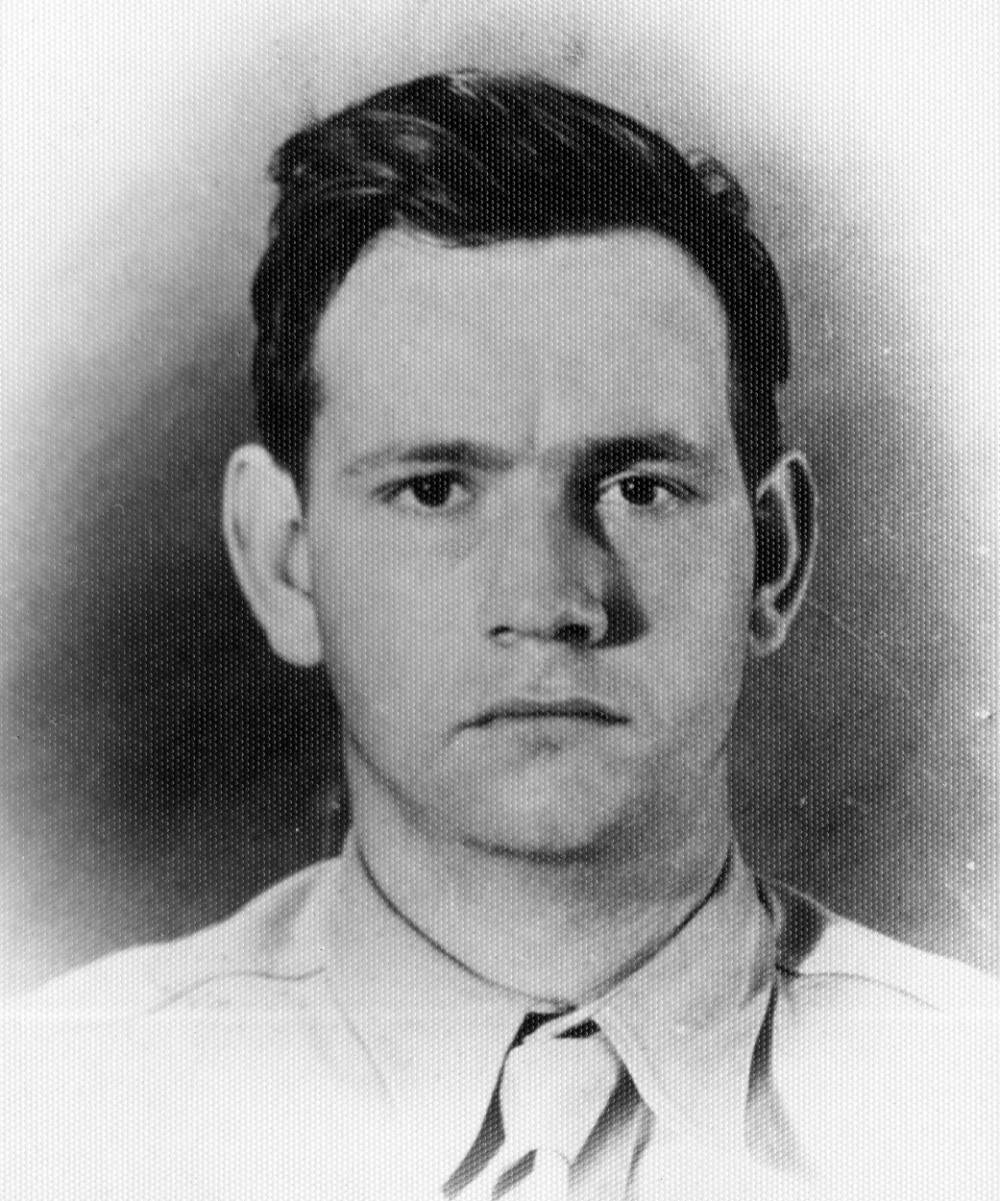
Early Life & Family
Joseph Michael Le Van was born on the morning of March 22, 1919, at the Homeopathic Hospital, 1501 North Van Buren Street in Wilmington, Delaware. He was the second son of John Paul Le Van (also known as Paul John LeVan, 1893–1977) and Sophia Levan (née Gallagher, c. 1890–1955). At the time he was born, his parents were living at 415 Lombard Street in Wilmington.
Le Van’s father was a house painter whose first wife, Sophia’s sister, Bridget (1891–1914), had died from tuberculosis complicated by childbirth. The couple’s two children also died very young. In addition to those two half-siblings, Le Van had an older brother, Paul Le Van (1916–1989), and a younger sister, Marie Le Van (1921–1973). Le Van was Catholic.
Available records indicate that Le Van moved several times during his childhood but remained in Wilmington. The Le Van family was recorded on the census in January 1920 living at 1 South Lincoln Street in Wilmington. When his sister, Marie, was born on September 25, 1921, the Le Vans’ address was listed as 701 Bennett Street.
Le Van attended various parochial schools in Wilmington: St. Mary’s, St. Paul’s, and St. Patrick’s. His hobbies included movies, reading, and swimming. As of the spring of 1936, Le Van was living at 204 West 7th Street.
On May 8, 1936, Le Van applied for the Civilian Conservation Corps (C.C.C.) in Wilmington. During the 1930s, the C.C.C. provided opportunities for unemployed young men to earn money for their families while completing various public works projects as part of President Roosevelt’s New Deal. Although not a military organization, the C.C.C. was administered by military officers in paramilitary fashion. Le Van told the C.C.C. that he dropped out of school in February 1936 after completing the 6th grade.
Le Van enrolled in the C.C.C. on May 14, 1936. His term of enrollment was variable at the discretion of the government, with discharge possible as soon as September 30, 1937, or as late as October 15, 1938. He was examined at Fort DuPont, Delaware, where a physician noted that he stood five feet, 6¼ inches tall and weighed 139 lbs. Le Van began doing mosquito control work while assigned to the 1295th Company at Camp MC-54, Magnolia, Delaware. He was honorably discharged on September 30, 1937.
Le Van applied to reenroll in the C.C.C. in Wilmington on May 21, 1938. He wrote that he wanted to find work as a painter after completing his C.C.C. service.
At the time of his second enrollment in Wilmington on July 7, 1938, he was still living at 204 West 7th Street. He stood five feet, eight inches tall and weighed 165 lbs., with brown hair and eyes and a scar on his left hand. He committed to serve with the 1295th Company at Magnolia again until December 31, 1938. He compiled a satisfactory record doing mosquito control work there through November 8, 1938. The following day, a detachment from his company was dispatched to Redding, California, presumably by train. On November 14, 1938, Le Van began doing forest reclamation work at Camp Baird No. 2. He performed satisfactorily there and agreed to an extension of his enrollment. On September 17, 1939, after declining to reenroll, Le Van departed the 1295th Company. He returned to the East Coast and was honorably discharged from the C.C.C. at Fort Dix, New Jersey, on September 25, 1939.
Le Van’s older brother was in the Delaware National Guard and federalized on September 16, 1940.
Military Career
Le Van enlisted in the U.S. Army in Wilmington on September 4, 1940. As a volunteer prior to the American entry into World War II, he was able to choose his branch and duty station: Infantry, Panama Canal Department. He was briefly stationed at Fort Slocum, near New York City. On October 1, 1940, he joined Company “B,” 33rd Infantry Regiment at Fort Clayton, Canal Zone. A roster dated August 31, 1941, the first to include duty codes, listed Le Van’s as 745, rifleman. Later rosters also listed his military occupational specialty (M.O.S.) code as 745. The attack on Pearl Harbor saw his unit with Force “A” in Dutch Guinea (Surinam). His parent organization was later redesignated U.S. Army Forces in Surinam.
On July 20, 1942, the Wilmington Morning News reported about Le Van’s activities in surprising detail considering wartime censorship pertaining to overseas military activities, stating that he
is among the U. S. soldiers in the vicinity of Paramaribo, Dutch Guinea, South America, who are keeping close watch against sabotage on the bauxite ships. He and his companions have been making round tripos on the Surinam River from the capital city of Paramaribo to a point 104 miles up stream to the bauxite village of Moengo.
Military necessity sometimes resulted in ironic assignments. Regulars like Private Le Van who had volunteered to become infantrymen sometimes ended up in backwater assignments far from combat zones, even as draftees with less time in service began entering combat.
Le Van was promoted to private 1st class on April 12, 1943. It appears that around June 1, 1943, his company was redesignated or inactivated and a new Company “B,” 33rd Infantry reconstituted from Company “B,” 166th Infantry Regiment.
July 1943 found Private 1st Class Le Van a member of Company 18, 2nd Provisional Battalion at Jackson Barracks, New Orleans Port of Embarkation. At 1800 hours on August 1, 1943, Le Van and a group of men departed Jackson Barracks, en route to the 69th Replacement Battalion, Infantry Replacement Training Center, Fort McClellan, Alabama. There , he was attached to Company “C,” 69th Replacement Battalion. On August 7, 1943, he was placed on special duty “at S.P.A. Fort McClellan[.]”
On September 17, 1943, Private 1st Class Le Van joined Company “C,” 64th Armored Infantry Battalion at Camp Chaffee, Arkansas. On October 25, 1943, he went on a special duty assignment at the officers’ mess. He returned to regular duty with Company “C” on November 22, 1943. He was hospitalized at the Station Hospital, Camp Chaffee, during February 3–11, 1944. Le Van went on furlough on March 23, 1944, returning to duty on April 4.
On April 15, 1944, Le Van and three other men from his company were transferred to the 7th Armored Division. Two days later, Le Van joined Company “B,” 48th Armored Infantry Battalion, 7th Armored Division at Fort Benning, Georgia.
Private 1st Class Le Van served as a rifleman in his new unit.
Private 1st Class Le Van was one of 35 men from his company declared missing in action as of October 29, 1944.
Private Lawrence P. Traynor, Jr. (1921–1945)
Early Life & Family
Lawrence P. Traynor, Jr. was born on June 15, 1921, at the Physicians and Surgeons Hospital on Adams Street in Wilmington, Delaware. He was the only child of Lawrence P. Traynor (1897–1950) and Leona E. Traynor (née Wiedeman, 1902–1933). His father, a salesman, was a World War I veteran, while his mother was an inspector for a bolthing [?] company. When Traynor was born, his parents were living at 411 North Van Buren Street. He had an older half brother, Francis Daniels (1919–?), whose father, John A. Daniels (1892–1918), was a victim of the Great Influenza pandemic.
Traynor was recorded on the census in April 1930 living at 1200 Elm Street with his paternal grandparents, parents, and half-brother. They were still living there as of early 1933.
When Traynor was 11, on March 1, 1933, his mother died in the Homeopathic Hospital in Wilmington from what her death certificate stated was “Degeneration of Brain Tissue[.]”
Traynor attended Wilmington High School.
Military Career
Most of the records pertaining to Traynor’s military career were destroyed during the fall of the Philippines and in the 1973 National Personnel Records Center fire.
Traynor volunteered for the U.S. Army in Wilmington on August 14, 1939. Before the U.S. entry into World War II, volunteers often had their choice of unit or at least branch. His enlistment data card reported that he was enlisted for the Philippine Department. The following day, the Wilmington Morning News reported:
Family tradition of following the profession of arms was maintained yesterday by Lawrence P. Traynor, Jr., 18, of 1028 McDowell Street, who enlisted at the district recruiting office of the U. S. Army, postoffice building, for service with the Coast Artillery Corps in Hawaii.
His father, Lawrence P. Traynor, served in the Searchlight Division during the World War. His uncle, Andrew P. Traynor, was in the Second Tank Corps during the way.
His first cousin, Andrew F. Traynor, Jr., is now a sergeant with the Twelfth Infantry at Fort Howard, Md.
On October 27, 1939, Private Traynor joined Battery “A,” 59th Coast Artillery Regiment (Harbor Defense) on Fort Mills on Corregidor. Early the following year, on January 17, 1940, he transferred to Headquarters Battery, 59th Coast Artillery. He was promoted to private 1st class on July 26, 1940. A roster noted that on December 24, 1940, Private 1st Class Traynor went on detached service “for purpose of visiting points of military interest in” the Philippine Islands. He returned to duty on January 2, 1941. He was reduced back to the grade of private effective February 1, 1941. On June 1, 1941, he was transferred to Headquarters & Headquarters Battery, Harbor Defenses of Manila & Subic Bays, also located at Fort Mills. On November 5, 1941, Private Traynor was hospitalized at Sternberg General Hospital in Manila.
Wilmington newspapers reported that Traynor was still in the hospital when the Pacific War began. For the Philippines, on the other side of the International Date Line from Hawaii, it was December 8, 1941.
Many records were lost in the fall of the Philippines, including the morning reports for Harbor Defenses of Manila & Subic Bays. However, Traynor must have returned to duty by February 1942 since he signed that month’s payroll. He was also in the March 1942 payroll, the last to make it out of the Philippines before the surrender.
The Empire of Japan was slow to report the names of its prisoners of war. It was only on February 24, 1943, over a year after his capture, that the War Department was notified of his capture via the International Red Cross. The Wilmington Morning News reported on April 3, 1943, that his family had only been informed three weeks earlier that Traynor was a prisoner of war.
Private 1st Class Alfred A. Rosendale (1916–1943)
Early Life & Family
Alfred Rosendale was born in the Delaware Hospital in Wilmington on March 20, 1916. He was the child of Arthur Penn Rosendale (c. 1878–1951), a farmer, and Eva Rosendale (née Eva May Mahan, 1895–1972).
He had an older half-sister, Elizabeth May Mahan (later Smith and eventually Elizabeth Smith Maio, 1914–1996). Census and Social Security records suggest that she was raised by her maternal grandparents, Howard W. Mahan (1867–1941) and Emma Sheppard Mahan (1877–1947). Rosendale would later list his half-sister and grandmother as his beneficiaries when he entered the service.
When he was born, Rosendale’s parents were living on Christiana Road. By September 12, 1918, when Rosendale’s father registered for the draft, his father had moved to 302 Jefferson Street in Wilmington, where Rosendale’s father was working as a dairy operator for the Cloverdale Dairy at 12th and Orange Streets. Curiously, Eva Rosendale was described as a resident of Marshallton west of the city. However, the entire family was recorded on the next census in January 1920 living at 302 Jefferson Street. The elder Rosendale was described as a milkman.
The Rosendale family likely moved to the Delaware City area by the fall of 1925, when an Alfred Rosendale was noted as being a third grader there. The next census in April 1930 recorded Rosendale and his father living on River Road in unincorporated New Castle County, Delaware, with his father again farming. Curiously, Eva Rosendale was not recorded in that census, though it appears her parents, daughter, and some of her siblings were living next door to her husband and son. The Wilmington Morning News later described the Mahans as living at the “Hill Top Farm, near Delaware City,” formerly the H. M. Pierce farm. Documents in Rosendale’s individual deceased personnel file (I.D.P.F.) also establish that his parents were living at the Hill Top Farm during the war.
A 1940 Wilmington directory listed Rosendale as a mechanic working for the Porter Motor Company and living on State Road. A U.S. Army data card described him as having completed two years of high school.
Military Career & Marriage
Prior to World War II, Rosendale joined the Delaware National Guard. Journal-Every Evening stated that he joined the National Guard in 1940. It was likely later that year, since his name was not mentioned in a Delaware National Guard book published around June 1. Private Rosendale went on active duty on September 16, 1940, the same day the 198th was federalized. The following day, he joined Battery “B,” 198th Coast Artillery.
A roster dated July 31, 1941, the earliest to list duty codes, listed Private 1st Class Rosendale’s as 014, automotive mechanic.
Private Rosendale was transferred to the Enlisted Reserve Corps (E.R.C.) on inactive duty just prior to September 25, 1941. The exact reason for that change is unclear, but he may have requested it due to his age based on a policy announced on August 19, 1941. In his book, The Rise of the G.I. Army, 1940–1941, Paul Dickson wrote that
the Associated Press in a totally unexpected story revealed that despite the provisions of the draft extension bill, the Army was planning to release a selected 200,000 draftees, Guardsmen, and Reservists before Christmas, meaning that these men would have served, on average, less than 18 months rather than the 30 months just authorized by Congress. […] These early releases were not automatic; men had to request them. Those with a proven hardship would be released first, followed by married men and those who would be 28 years of age or older by July 1, 1942.
When he registered for the draft on September 25, 1941, Rosendale was living on Rural Free Delivery No. 2, River Road near Red Lion Creek, between New Castle and Delaware City. He may have been residing with his recently widowed maternal grandmother, Emma Mahan, who was listed as his emergency contact. Rosendale was working for the Diamond Ice & Coal Company in Wilmington. The registrar described him as standing five feet, 10 inches tall and weighing 192 lbs., with brown hair and blue eyes.
After Pearl Harbor, Private 1st Class Rosendale was recalled to active duty effective January 17, 1942. That day, he was attached unassigned to Company “A,” 1229th Reception Center, Fort Dix, New Jersey, along with other E.R.C. personnel. He did not rejoin his old unit, which was about to ship out for the Pacific.
Rosendale was hospitalized from January 29, 1942, to February 8, 1942. Later that month, on February 26, 1942, he was transferred to the 717th Military Police Battalion at Fort Ontario, New York. The base was located where the Oswego River flows into Lake Ontario.
Rosendale married Marjorie C. Hague () in McDaniel Heights, Delaware, on the evening of February 21, 1942. Journal-Every Evening reported: “The wedding took place at the parsonage of Mt. Lebanon Methodist Church, Rockland, with the Rev. W. E. Fosnocht officiating. Mr. Rosendale is in the military police at Ontario, N. Y.”
On the morning of May 26, 1942, Rosendale went on detached service with Company “C,” 717th Military Police Battalion, the same day it moved to Burlington Armory, New Jersey. He was hospitalized at Fort Dix, New Jersey, during June 23, 1942. While still hospitalized, on July 1, 1942, he was officially transferred from Headquarters Company to Company “C.” He returned to duty with Company “C” at Burlington at 1100 hours on July 18. However, at 0900 hours on July 20, he was transferred to Headquarters Engineer Amphibian Command at Camp Edwards, Massachusetts.
On July 31, 1942, at 1000 hours, Rosendale joined Company “G,” 3rd Battalion, 531st Engineer Shore Regiment at Camp Edwards. His company (regiment?) had been activated on June 15, 1942.
On the evening of August 4, 1942, Rosendale and his new comrades boarded a train for the New York Port of Embarkation. At 0630 hours the following morning, they boarded the ocean liner turned transport U.S.A.T. Thomas H. Barry. Their ship got underway at 0530 hours on the morning of August 6, 1942. They pulled into Halifax, Nova Scotia, on the morning of August 8, sailing for Europe one day later. While still at sea, Rosendale was promoted to sergeant on August 14, 1942.
After crossing the Atlantic Ocean safely, Thomas H. Barry arrived in Belfast, Northern Ireland, on August 17, 1942. Company “G” disembarked around 1600 hours and moved by train to Red Hall Camp outside the city. Later that month and into early September, they trained with the M1 Garand rifle. The 531st Engineers had presumably been equipped with the older M1903 Springfield bolt action rifle.
On September 4, 1942, Sergeant Rosendale and his company moved again by train to Eglinton Camp, Northern Ireland. Later that month, at 1300 hours on September 22, they departed Eglinton by train, arriving at 1700 at Larne, Northern Ireland, where they boarded the British ferry turned transport Princess Maud at 1815. That night, they crossed the North Channel, disembarking at Rothesay, Scotland. They transferred to a landing craft for a quick jaunt to Camp Toward, Scotland.
At 1400 hours on January 31, 1943, Sergeant Rosendale was hospitalized at the 180th Station Hospital for an unspecified illness not in the line of duty. He returned to duty at 1300 hours on February 11. He was reduced to the grade of private on February 27.
Most passenger manifests associated with the U.S. Army’s massive overseas buildup were disposed of after the war. However, manifests from the period in which the 531st Engineers were staging at Camp Edwards ended up preserved in a collection of general correspondence at the National Archives. It lists Private Rosendale as a member of 1st Platoon, Company “G.”
He returned to duty from detached service at 1800 hours on June 13, 1943.
Combat on Sicily
The plan for Operation Husky, the invasion of Sicily, called for the 531st Engineer Shore Regiment to support the 1st Infantry Division. The 531st’s shore party, including the engineers, signal personnel, and a U.S. Navy beach battalion, were collectively known as the Dime Force. Per Field Order No. 6, 3rd Battalion “assists the landing of CT [Combat Team] 16 (reinf) D-day y organizing and operating all shore installations on Beaches RED 2 and GREEN 2, necessary for debarkation, supply, evacuation, and local security.”
D-Day on Sicily was July 10, 1943.
531st Engineer Shore Regiment records are incomplete, with after action reports preserved for 2nd Battalion but not 3rd Battalion. The Allies’ amphibious doctrine was still being honed in mid-1943 and not everything went smoothly on Sicily. A Western Naval Task Force report noted:
Dumps did not appear to be organized according to a predetermined plan. On some beaches there was a critical shortage of transportation, in spite of the thousands of vehicles being landed. […]
Supplies were piled high on the beaches without any effort to accomplish segregation. Gasoline, ammunition, water, food, and assorted equipment were strewn about in a hopeless mass.
The report stated specifically of Dime Force:
In the DIME area the chaotic condition on D day was terminated on D plus one by the evacuation of those beaches due to the advance of the German tanks. Enemy shelling of these beaches resulted in the Engineer Regiment being called inland as support troops and the withdrawal seaward by boats of other beach personnel. The DIME beaches were at a standstill on D plus one, though some ships diverted boats to the beaches near the Acate River in order to continue unloading. As the enemy threat was overcome, the DIME situation gradually cleared up as naval working parties took over unloading of boats and craft.
Private 1st Class Rosendale was killed in action on the afternoon of July 11, 1943, when he was struck in the thorax by artillery shell fragments, likely during the German counterattack. Private 1st Class Stanley E. Bohac (1912–1943) was killed in the same incident or around the same time.
Journal-Every Evening reported Rosendale’s death on September 2, 1943, noting:
Mrs. Rosendale said today that last word she had received from her husband was a letter dated June 30 and received July 10, the day before he was killed.
She said that, not having heard from him for some time prior to receiving the telegram from the War Department, she had worried “for fear something had happened.”
Rosendale was initially buried at a temporary military cemetery near Gela. On July 25, 1943, he was reburied at another cemetery nearby, 2-S Gela. After the war, American authorities began consolidating the temporary cemeteries scattered across Europe. As a result, Rosendale was reburied on April 10, 1947, at Monte Soprano, Italy. The following month, Marjorie Rosendale requested that her husband remain overseas in a permanent military cemetery. In 1948, he was reburied for the final time at the Sicily–Rome American Cemetery in Nettuno, Italy. His name is honored at Veterans Memorial Park in New Castle, Delaware.
Why on hold: Unit movements and records
1st Lieutenant Edward V. Atwell, Jr. (1920–1944)
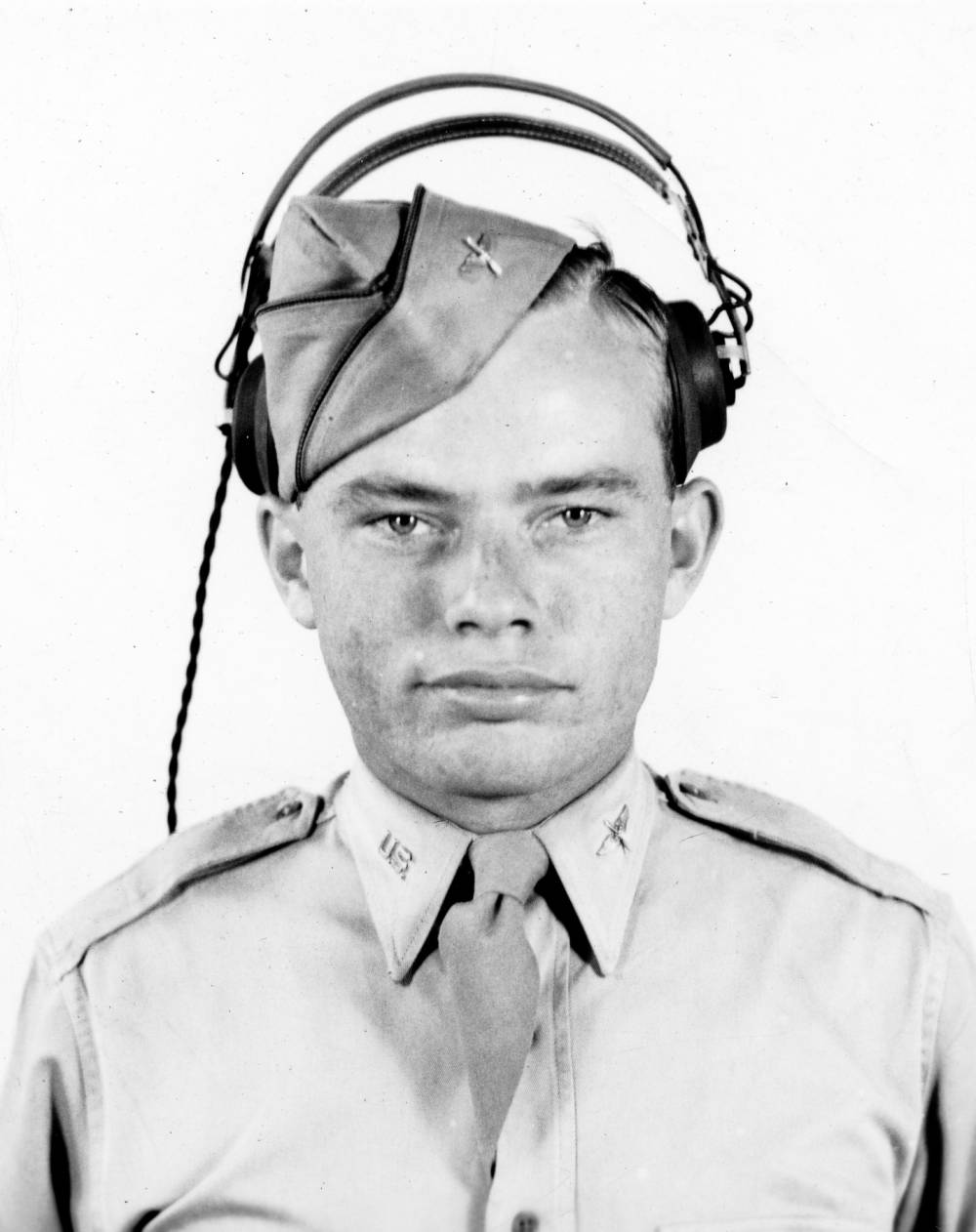
Early Life & Family
Edward Victor Atwell, Jr. was born at St. Paul’s Sanitarium in Dallas, Texas, on January 19, 1920. He was the only child of Edward Victor Atwell, Sr. (a real estate broker 1883–1969) and Ida Bakey Atwell (née Ida Mary Bakey, 1883–1933). His birth certificate noted that his parents were residents of Wilmington, Delaware, at the time. On September 30, 1921, Every Evening, a Wilmington newspaper, described Atwell’s father: “During the World War he left Wilmington to enter the military service, and after the declaration of the armistice he went to Texas. Since his return from the South he has resided in Delaware City.” On the other hand, in 1969, the Evening Journal reported that the elder Atwell “was formerly a real estate researcher for the Du Pont Co. Later, he went into the real estate business for himself, occupying an office at 10th and Market Sts.” The paper described him as a resident of Wilmington since 1901, though it appears that the Atwells divided their time between residences in Wilmington and a farm they owned in Cecil County, Maryland.
The Atwells were recorded on the census in April 1930 living at the Du Pont Building on West 10th Street in Wilmington.
Atwell was 13 when his mother died of a cerebral hemorrhage on May 23, 1933. Her obituary gave her residence as Barksdale, Maryland, in unincorporated Cecil County off Barksdale Road, north of Elkton, Mayland, while her death certificate described her as a resident of Elkton itself. Atwell graduated from Wilmington High School in June 1939. Later that year, on October 28, 1939, his father remarried in Wilmington to Emma Whiteman Snyder (née Emma Whiteman Richards, 1886–1973), herself a widow. The 1940 census recorded the Atwells as living in the Fair Hill area north of Elkton, Maryland.
When he registered for the draft on July 1, 1941, Atwell was living with his father on Rural Free Delivery No. 3 in Elkton, Maryland. His occupation was listed as “Farming & Automobile Mechanic” and his employer as Mackenzie & Strickland Automobile Agency in nearby Newark, Delaware. Similarly, his enlistment data card later that year described him as a semiskilled motor vehicle mechanic. The registrar described him as standing about five feet, eight inches tall and weighing 150 lbs., with blond hair and blue eyes and scars on his right elbow. His military paperwork described him similarly, albeit with brown hair.
Upon enlistment, Atwell described his work history as three years of “General Mechanic Work” earning $25 per week (about $525 in 2025 dollars). On the other hand, the Wilmington Morning News reported that “Atwell was an auditor with the Coca-Cola Company here before entering the service.”
Military Career
A portion of Atwell’s personnel file, mostly pertaining to his time as an enlisted man, survived the 1973 National Personnel Records Center fire, meaning some more details about his career are available than many other soldiers. Microfilmed copies of his flight records and morning reports also survived.
Atwell was drafted before the U.S. entered World War II. The Wilmington Morning News reported that on November 17, 1941, Atwell and 14 other men selected by the Local Board, Cecil County, were notified to report for induction into the U.S. Army on November 24, 1941. On November 25, 1941, he went on active duty and was attached unassigned to Company “B,” 1303rd Service Unit, Camp Lee, Virginia. Evidently Atwell expressed interest in the Army Air Forces or was recruited based on his background as a mechanic, but there was a catch: Atwell had to commit to a three-year stint in the Regular Army. As a formality, he was honorably discharged from the U.S. Army on November 26, 1941, and reenlisted the following day. On December 6, 1941, he was transferred to Jefferson Barracks, Missouri, though he did not leave Camp Lee until December 11, shortly after the attack on Pearl Harbor.
Upon reporting at Jefferson Barracks on December 12, 1941, Private Atwell was attached unassigned to the 357th School Squadron.
In 1942, Atwell volunteered to become an aviation cadet. On September 7, 1942, he passed a flight physical at the Army Air Forces Classification Center, Nashville, Tennessee.
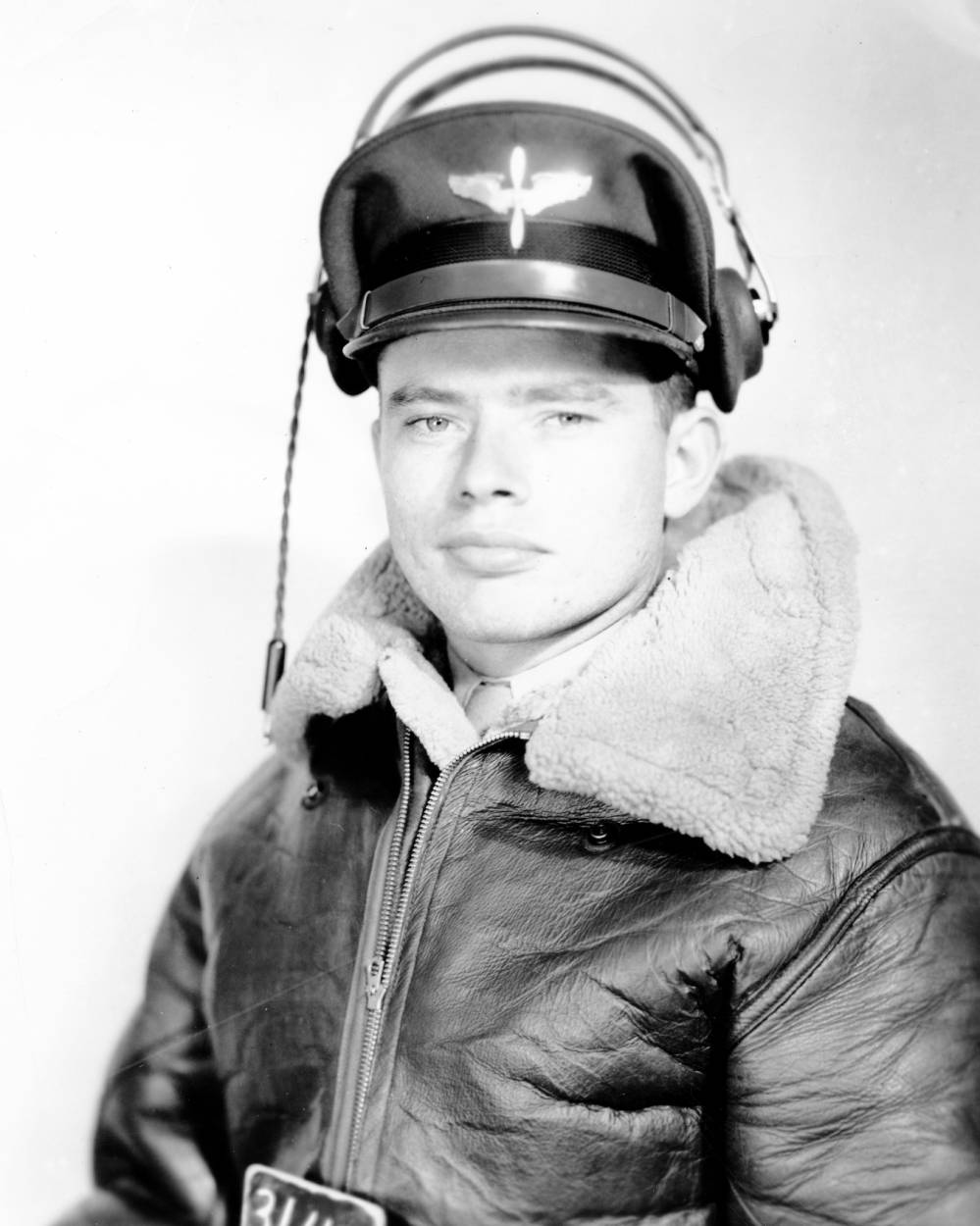
By May 25, 1943, Atwell had 231.4 hours under his belt as a student pilot, including 171.8 hours as first pilot. In April and May 1943 he was flying the AT-6 and AT-10.
Aviation Cadet Atwell was honorably discharged from the U.S. Army on May 27, 1943, at Blytheville Army Air Field, again as a formality. On May 28, 1943, Atwell was commissioned as a 2nd lieutenant.
On May 29, 1943, a set of orders came down transferring 2nd Lieutenant Atwell to the 46th Bombardment Group at Will Rogers Field, Oklahoma. He was authorized to take 10 days of leave prior to reporting by June 10, 1943. He joined the 51st Bombardment Squadron (Light), 46th Bombardment Group (Light). On June 19, 1943, he was transferred to the 673rd Bombardment Squadron (Light), 417th Bombardment Group (Light). He accumulated more hours, mostly flying the A-20 and B-25.
On the morning of October 19, 1943, Lieutenant Atwell was cleaning a pistol but failed to verify that the weapon was unloaded. When he pulled the trigger, it discharged, fracturing the terminal phalanx (bone at the tip) of his left hand. He was treated at the Station Hospital, DeRidder Army Air Base, where physicians debrided the wound and applied a Banjo traction splint. He returned to duty on November 7, 1943.
The Pacific Theater
By May 22, 1944, 1st Lieutenant Atwell had 643 hours, 25 minutes of flight time under his belt, including 365 hours, 55 minutes as first pilot since getting his wings. May 1944 was a particularly busy month. During the first three weeks of the month, Atwell logged 20 flights in A-20s and B-25s, totaling 45 hours.
On May 22, 1944, 1st Lieutenant Atwell and his copilot, 2nd Lieutenant Chester N. Burns (1919–1944), took off from Nagzab, New Guinea, in B-25 serial number 41-29692. In addition to the three crew members, there were seven passengers aboard. Their route would take them over the dense mountains of eastern New Guinea to Saidor, on the northern coast. The bomber was not heard from again. Searches of the rugged terrain along their route turned up nothing.
In a March 11, 1947, letter to State Archivist Leon deValinger, Jr. (1905–2000), the elder Atwell glumly noted: “No further word have [sic] ever been received of my Son, or any of the 10 [sic] others in the Plane with him […] no one seems to know what happened and I doubt now if we ever will.” In 1950, a board of officers declared that Lieutenant Atwell and the others aboard the plane were non-recoverable. However, that was not the end of the story.
According to a summary by the Quartermaster Corps Memorial Division, in May 1959, a Lutheran missionary notified the U.S. consulate in Sydney, Australia, that
certain United States Army publications had been recovered from the wreckage of a plane found by natives at the headwaters of the Sorop and Erap rivers in New Guina. Human remains were reported to be present at the wreckage site.
A U.S. Army search and recovery team based in Hawaii arrived in New Guinea on June 23, 1959. The crash site was deep in the mountainous interior of the island. The town of Naramonke was the closest the team could approach by road. With an Australian guide and locals hired as carriers, the team hiked from village to village along mountain trails. “On 1 July, the Search Party finally reached the site of the wreckage, situated below the tree line at an elevation of 9,500 feet.”
The team was able to recover human remains from at least seven men and some personal effects, including identification tags for Captain Randall M. Dorton, Jr. (1920–1944) and a plate from a flight jacket belonging to 1st Lieutenant Robert J. Arndt (1921–1944). Individual identification proved impossible and in 1960 the remains, which the Army declared were from all 10 men, were given a group burial at Jefferson Barracks National Cemetery, Missouri.
1st Lieutenant Atwell’s name is honored at the Manila American Cemetery and Veterans Memorial Park in New Castle, Delaware.
Why on hold: Gathering unit records
Sergeant John J. Paisley (1920–1944)
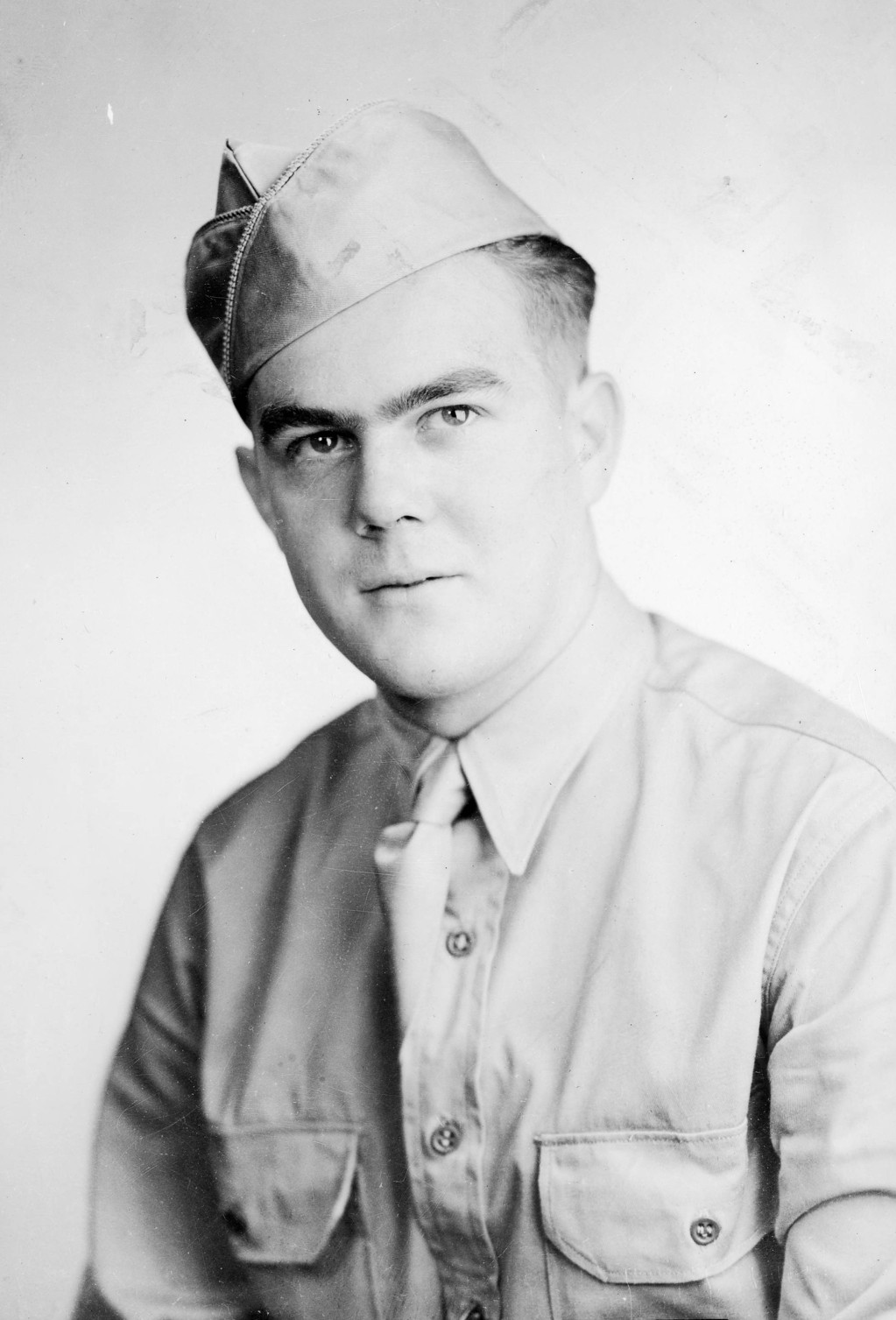
Early Life & Family
John Joseph Paisley was born at 1340 Claymont Street in Wilmington, Delaware, on February 25, 1920. He was the son of Elizabeth May Paisley (also known as Elizabeth Needham, later Denn, and eventually Murphy, 1905–1987). His mother, only 14 at the time, was the victim of rape. She declined to name the father when she applied for a birth certificate for him in 1939. Paisley may have been raised to believe that his mother was his sister, since he described her that way when he registered for the draft.
Paisley was recorded on the census in April 1940 living at 929 East 17th Street with his mother and stepfather, John Murphy. He was described as a truck driver working on a C.C.C. drainage project. Journal-Every Evening reported that Paisley “attended the George Gray School and St. Patrick’s Parochial School.”
Paisley’s enlistment data card described him as a carpenter with a grammar school education.
When Paisley registered for the draft on July 1, 1941, he was still living at 929 East 17th Street with his mother and stepfather, but was now working as a joiner for the Pullman Company in Wilmington. Journal-Every Evening stated that Paisley worked for the company for over a year prior to entering the military. The registrar described him as standing five feet, 10 inches tall and weighing 153 lbs., with brown hair and hazel eyes.
Military Career
After he was drafted, Paisley joined the U.S. Army at Fort Dix, New Jersey, on January 28, 1942. Another Delawarean, Harold T. Hitchens (1915–1944), was drafted in the same cohort as Private Paisley. On April 9, 1942, both men joined Company “B,” 104th Infantry Regiment, 26th Infantry Division, at Camp Edwards, Massachusetts, transferring from the Branch Immaterial Replacement Center, Fort McClellan, Alabama.
The 104th Infantry was originally part of the Massachusetts National Guard. Company “B” had been federalized in Springfield, Massachusetts, on January 16, 1941. The company was understrength at the time, with only 48 enlisted men on the rolls. Draftees flowed into the unit beginning with local conscripts and then, after the attack on Pearl Harbor, those from further afield like Hitchens and Paisley.
During the spring of 1942, the 104th Infantry was scattered across the southeastern United States, patrolling the coastline from Florida to North Carolina. Despite the paranoia that followed the attack on Pearl Harbor, the Germans lacked the amphibious capacity to successfully cross the English Channel, much less the Atlantic Ocean. At most, German submarines could land spies or saboteurs, which happened only a handful of times.
As of May 31, 1942, Private Paisley’s duty and military occupational specialty (M.O.S.) codes were both listed as 521, basic. That indicated he was still in training or not yet qualified for an M.O.S. The last known Company “B” roster to list duty and M.O.S. codes was September 1942. Private Paisley was still listed as a 521.
A 104th Infantry history book published at the end of the war, History of a Combat Regiment 1639–1945, “In January, 1943, the regiment was withdrawn from patrol duty and reassembled on the 27th of the month at Camp Blanding, Florida, for conditioning and amphibious training.” Similarly, Company “B” morning reports state that on January 24, 1943, Paisley and his comrades moved to Wilmington, North Carolina, where they boarded a train, arriving at Camp Blanding early the following morning.
Paisley was promoted to private 1st class on April 1, 1943. On the night of April 17–18, 1943, Company “B” boarded a train and headed back north around midnight. Following a brief stop in Macon, Georgia, Paisley and the others arrived at Camp Gordon, Georgia, that afternoon. At Camp Gordon, the 26th Infantry Division was finally reassembled and continued its training.
Paisley and Hitchens were among a group of enlisted men who went on furlough on June 21, 1943. After returning to Delaware, on the afternoon of June 27, 1943, Paisley married Mary Christine Lentelle (1924–1974) in Wilmington. Paisley was due back by at Camp Gordon by midnight on the night of July 1–2, 1943. Four men including Paisley and Hitchens did not make it back in time and were declared absent without leave (A.W.O.L.). Presumably, their return journey took longer than anticipated and they did not attempt to contact their commanding officer to request an extension, could not get through, or their requests were denied. It may also have complicated matters that on July 2, Company “B” moved a short distance to a bivouac area outside Camp Gordon. There is no indication that the two Delawareans were traveling together since Private 1st Class Paisley returned to duty at 1000 hours on July 3, while Hitchens returned the following day at 1500 hours.
Going A.W.O.L. for any length of time could be extremely damaging to a soldier’s career, with demotions to private and fines common. In Paisley’s case, neither occurred—perhaps his company commander took pity on his newly married soldier—though perhaps not coincidentally, he was selected for a special duty assignment pulling guard duty at the post stockade later that month.
On September 2, 1943, Company “B” departed Camp Gordon by road. After stopovers in Fairmount, Georgia, and Fayetteville, Tennessee, the unit arrived at Camp Campbell, Kentucky, on September 10.
Paisley went on furlough on November 17, 1943. He was promoted to corporal effective November 19, 1943, and returned to duty on November 27. He presumably became an assistant squad leader at that point.
Paisley was promoted to sergeant on January 1, 1944, apparently in anticipation changes to the rifle company table of organization that was officially released the following month, with rifle squad leaders becoming staff sergeants rather than sergeants and assistant squad leaders becoming sergeants rather than corporals. Later that month, on January 22, 1944, the 104th Infantry departed Camp Campbell for the Tennessee Maneuver area near Lebanon.
For the next two months, the 104th Infantry was in the field. Sergeant Paisley and the men of Company “B” were constantly on the move by truck or on foot, participating in various exercises and bivouacking while waiting for the next. History of a Combat Regiment 1639–1945, stated:
Tennessee Maneuvers were “rough.” The problems, with the accompanying rain, snow, and mud, were executed so realistically that men of the 104th later agreed that the only difference between maneuvers and combat was that there was no “hot lead” flying around. The combat battalions marched through a blacked-out countryside, forded small streams, ate K-rations, and slept in the mud. Always it seemed to rain. Support and supply units followed up and performed their duties much the same as in combat. Armies were designated by red or blue helmet and arm bands. Each week a different type of tactical problem of from three to five days was “fought,” with umpires armed with special signal flags and score sheets ruling on the success or failure of local actions and ultimately determining the “victors” in each week’s campaign.
On week-ends, a limited number of men when into troop-crowded Lebanon, Nashville or surrounding towns for showers and a good meal.
Company “B” crossed the Cumberland River during at least two exercises, including one on March 16, 1944. Viewed from above, the meanders of the river north of Lebanon resemble a series of horseshoes lined up from west to east. The land on the interiors of the horseshoes, surrounded by the river on three sides, are known as bends: Cairo Bend, Belotes Bend, Hunters Point Bend, etc.
On the night of March 22–23, 1944, the 104th Infantry Regiment began its last exercise of the Tennessee Maneuvers at Averitts Ferry on the east side of Beasleys Bend. The mission to cross over the river to Puryears Bend must have seemed simple enough. In that area, the Cumberland River is about 400 to 500 feet wide. What they saw that night, however, must have given them pause: swollen by days of rain, the river was a raging torrent.
That night, 23 men, all but one of them from the 104th Infantry, clambered into an assault boat. 17 of the men were from Company “B.” Aside from Sergeant Paisley, the occupants included 1st Lieutenant John N. Dunski (1918 – 1944), the regimental S-1 (personnel officer); 1st Lieutenant Walford T. Nilsson (1915–1985), the Company “B” executive officer; 2nd Lieutenant Richard P. Grosvenor (1919–1944), who had been attached to Company “B” from the 76th Infantry Division on February 11; 1st Sergeant Bernard J. Jackimczyk (1915–1944); and Private Leroy C. Strand (1921–1944), a combat veteran who was wounded during the Battle of Attu in the Aleutians.
Out in the Cumberland River, the boat overturned, throwing the soldiers into the swift-flowing water. Sergeant Paisley and 20 other men drowned. There were only two survivors: 1st Lieutenant Nilsson and Private 1st Class Simon Neurick (1912–2004) from Medical Detachment, 104th Infantry. The Nashville Tennessean reported on March 25, 1944, that the two men were “rescued by another boat after they had struggled to the point of exhaustion in the heavy waters[.]” The article added that “Private Neurick reported that he touched shore on at least three occasions, but could find no foothold that would enable him to crawl ashore.”
Accounts are contradictory about whether the tragedy occurred before or after midnight on March 23, 1944, though officially the men went missing on the 22nd. Recovery efforts continued for weeks afterward. Sergeant Paisley’s wife was notified on March 25, 1944, that her husband was missing. Paisley’s body was recovered on April 5, 1944.
After funeral services at his mother’s home on April 11, 1944, and requiem mass at St. Patrick’s Roman Catholic Church, Paisley was buried at Cathedral Cemetery.
Paisley’s widow remarried on June 10, 1946, to James Robert North (1926–1995), with whom she raised two daughters.
Paisley’s name is honored at Veterans Memorial Park in New Castle, Delaware, and on a plaque at Cumberland University in Lebanon, Tennessee, commemorating the accident.
Staff Sergeant Charles E. Banning (1921–1944)
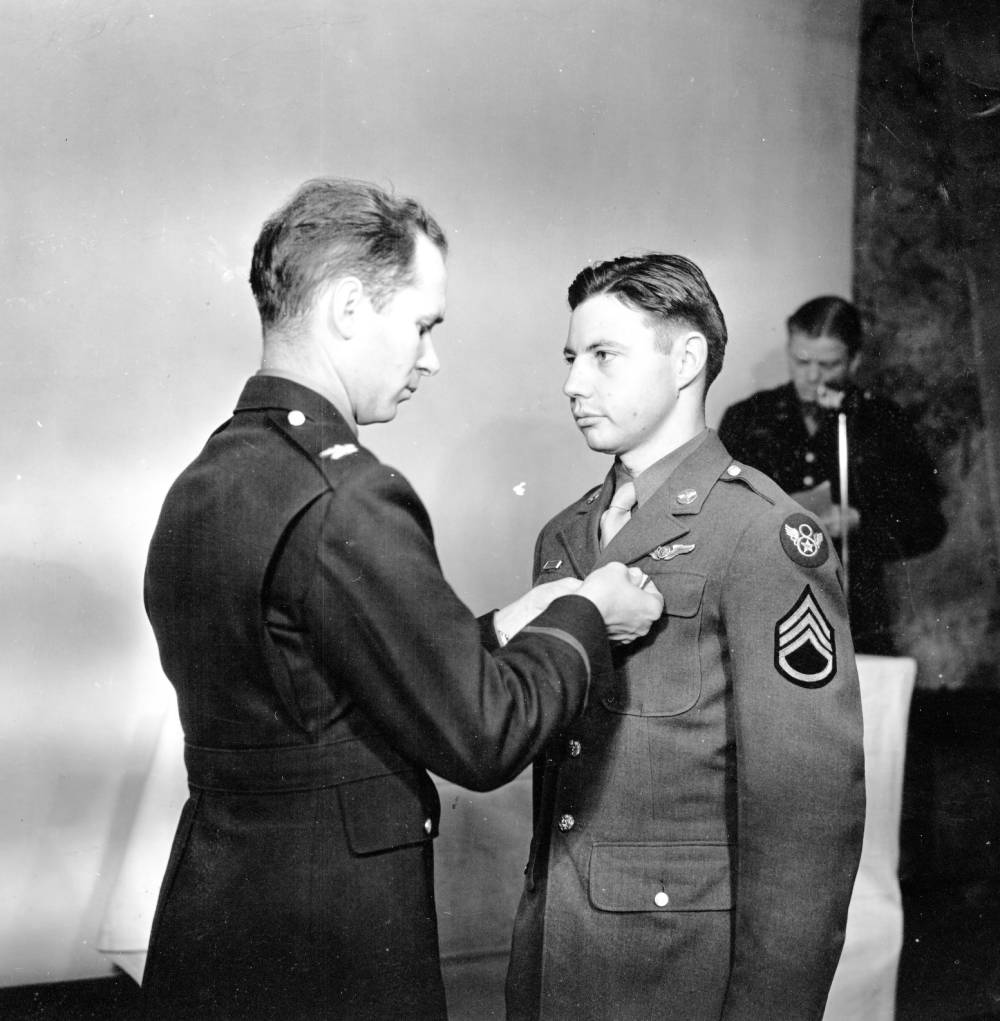
Early Life & Family
Charles Edward Banning was born in the Bronx, New York, on October 21, 1921. He was the son of Charles Edward Banning (1892–1950?) and Anna Sabina Banning (née Mark, c. 1891–1951). His father was born in England, immigrated to the United States, became a naturalized citizen, and worked as a bricklayer. He had an older sister, Muriel Barbara Banning (later Fennimore, c. 1917–1997?)
Banning graduated from Pierre S. duPont High School in 1939. He told the Army that the only sport he participated in was boxing.
Little is clear about Banning’s early life. He was not recorded on any known census records from 1930, though it appears that his parents were separated or divorced by then. Banning’s mother was described as a widow on the 1940 census—though this was a common deception at the time due to the shame of divorce—and when consenting to her son’s enlistment later that year, she told the U.S. Army that her husband was deceased.
According to his enlistment paperwork, Banning had worked as a truck driver for five months prior to entering the military, earning $18 per week. On his qualification card, he also stated he had worked for one year of experience as a carpenter apprentice for the Boyce Construction Company in Wilmington, earning $15 per week until he left that job on September 1, 1940. The job included setting floor joists, laying hardwood floors, and installing window sashes.
As of November 5, 1940, when he was examined in Wilmington prior to enlistment, Banning was described as standing five feet, 7½ inches tall and weighing 139 lbs., with brown hair and eyes.
Military Career
Soon after he turned 19, Banning volunteered for the Regular Army in Wilmington, Delaware, on or about November 4, 1940. Since the age of majority at the time was 21, his mother consented to his enlistment. By volunteering, he was able to pick his branch and duty station, something that would be inconceivable soon after when draftees swelled the ranks of the Army. On November 9, 1940, Private Banning enlisted in Wilmington for a three-year term in the Hawaiian Department in the Medical Department.
According to his personnel file, Banning was attached to 3rd Recruit Company from November 12, 1940, until January 4, 1941. After basic training, Private Banning shipped out from Fort McDowell, California, on January 24, 1941, arriving in Honolulu, Hawaii, six days later.
On January 30, 1941, Private Banning was attached to the Division Medical Detachment, Schofield Barracks, Hawaii. For unknown reasons—possibly because he was still training—he did not become an assigned member of that unit until February 20, 1941. On March 14, 1941, Banning transferred to the (4th?) Service Company, 11th Medical Regiment, also stationed at Schofield Barracks. On an unknown date, he was transferred to the 44the Pursuit Squadron at Wheeler Field. He was attached to that unit around September 8, 1942, until October 17, 1942, possibly before a transfer. He joined the 333rd Fighter Squadron at Wheeler Field on August 23, 1942. He was attached to Headquarters and Headquarters Squadron, 18th Fighter Group, from October 17, 1942, through January 21, 1943.
On May 1, 1941, Private Banning was rated as a specialist 6th class. At the time, specialist ratings indicated that a private or private 1st class possessed a special skill. His personnel file gave the reason for the rating as Banning being qualified as a clerk. However, he was derated on July 1, 1941.
Banning was promoted to private 1st class on October 2, 1941, and to corporal on an unknown date. The first military occupational specialty (M.O.S.) listed in Banning’s personnel file was 055, general clerk, as of December 1941.
On or about March 10, 1942, Corporal Banning was accused of being drunk and disorderly in Honolulu. He was placed under arrest in his quarters at Wheeler Field, demoted to private, and referred for trial by summary court-martial. On March 23, Banning pled guilty. He was restricted to the base for one month and forfeited $20 in pay. However, he was promoted back to corporal on May 1, 1942. He was promoted to sergeant on July 21, 1942.
He was attached to the 73rd Fighter Squadron from February 18, 1943, through April 15, 1943.
On April 18, 1943, Banning departed Honolulu by sea, arriving at San Francisco, California, on April 27. Around April 28 he joined the 4th Air Force Replacement Depot, Hammer Field, California. On May 23, 1943, he joined the 337th Fighter Squadron at Glendale, California. On May 25, 1943, his M.O.S. was reclassified as 747, airplane and engine mechanic. On July 5, 1943, Sergeant Banning was examined at Sawtelle, California, to determine if he was physically qualified to attend aerial gunnery training. Physicians determined that he did meet the qualifications. Sergeant Banning graduated from Aerial Gunnery and Fire Control School at Wendover Field, Utah, on an unknown date. On September 18, 1943, Sergeant Banning was rated as 748, airplane mechanic-gunner. On December 24, 1943, Sergeant Banning qualified at the expert level with the .45 pistol.
Although he had previously passed on purchasing National Service Life Insurance, on January 6, 1944, Sergeant Banning applied for a $10,000 policy effective February 1, with his mother as beneficiary.
In February 1944, Sergeant Banning went overseas via the southern route. Flying to Europe via the Caribbean Sea, South America, and Africa took significantly longer time than flying over the North Atlantic Ocean, but had generally less hazardous weather and shorter overwater segments.
Banning’s crew departed from West Palm Beach, Florida, on February 1, 1944, arriving at Borinquin, Puerto Rico. They flew to Atkinson Field, British Guiana, on February 2; to Belém, Brazil, on February 6; to Natal, Brazil, on February 7; across the Atlantic to Dakar, Senegal on February 11; and to Marrakesh, Morocco, on February 12. The final segment on February 17, 1944, was the longest, an 11-hour flight to Prestwick, Scotland, bypassing neutral Portugal, Spain, and Ireland, as well as German-occupied France.
Banning was with Squadron “A,” 14th Replacement Control Depot until he was transferred to the 44th Bombardment Group (Heavy) on February 28, 1944. The same day, his crew was assigned to the 68th Bombardment Squadron (Heavy) per Special Orders No. 59, Headquarters 44th Bombardment Group (Heavy), and joined the squadron the following day.
Why on hold: He has the largest and most comprehensive B-file that I have ever seen. This a good thing, but it also means a lot of material to go through and incorporate.
2nd Lieutenant Charles D. Campbell (1911–1944)
Early Life & Family
Charles Denard Campbell was born in Selbyville, Delaware, on September 13, 1911. He was the second child of George Campbell (a sawyer in a sawmill) and Elizabeth Hubbard Campbell.
Military Career
Campbell was drafted a few months after the attack on Pearl Harbor. His enlistment data card described him as a manufacturing foreman with one year of college. He was inducted back into the U.S. Army on March 21, 1942, at Fort Dix, New Jersey. That same day, he was attached to Company “G,” 1229th Reception Center at Fort Dix. He left Fort Dix by train for an unknown destination on March 25, 1942. According to his mother’s statement, Campbell was quickly promoted back to sergeant and stationed at Camp Jackson, South Carolina. She added that he moved to Fort Benning, Georgia—probably for Officer Candidate School—and was subsequently stationed at Camp Joseph T. Robinson, Arkansas, and Fort George G. Meade, Maryland.
It appears 2nd Lieutenant Campbell was on detached service at the B.F. Goodrich Army Training School, Akron, Ohio, when the 533rd Armored Infantry Battalion was disbanded on August 31, 1943. He was attached unassigned to Headquarters 534th Armored Infantry Battalion, joining that unit on September 13, 1943, at Camp Chaffee after completing his assignment in Akron. He was transferred from the 12th Tank Group to go overseas as a replacement officer. On October 3, 1943, he was detached from the 534th Armored Infantry Battalion and dispatched to Army Ground Forces Replacement Depot No. 1, Fort George G. Meade, Maryland. On October 5, 1943, he was attached unassigned and joined Headquarters Detachment, 4th Replacement Regiment there. He was assigned the duty of pool officer.
On November 13, 1943, Campbell was transferred to a replacement shipment, GI-633-A., which also included Private Ralph G. Henretty (1925–1944), a fellow Delawarean also destined to lose his life in the Mediterranean Theater. Campbell most likely shipped out from the Hampton Roads Port of Embarkation and arrived in Casablanca, Morocco. On December 4, 1943, he was attached unassigned to Company “B,” 32nd Replacement Battalion (Separate), at Camp Don B. Passage, near Casablanca, Morocco.
Campbell’s movements for the next few months are unclear, but he was with the 2nd Replacement Depot by the summer of 1944. He was attached unassigned to the 405th Replacement Company, 18th Replacement Battalion, 8th Replacement Depot effective July 23, 1944.
Why on hold: Awaiting release of 1945 morning reports and still hoping to get photo from family.
Private Paul O. Miller (1916–1943)

Early Life & Family
Paul Otto Miller was born at 615 Concord Avenue in Wilmington, Delaware, on June 26, 1916. He was the eldest child of Paul William Miller (né Müller, 1889–1979) and Rebecca M. Miller (née Rebecca Morgan Mammele, 1898–1959). His father, who various records recorded as a clerk, salesman, machinist, mechanic, and merchant, was born in Germany but he had immigrated to the United States as a young child and grown up in Wilmington. Miller had four younger sisters and two younger brothers, one of whom died very young.
The Miller family was living in Marshallton, west of Wilmington, on February 20, 1919, when Miller’s younger sister, Elizabeth, was born. The Miller family was recorded on the census on January 17, 1920, living on Lincoln Highway in Representative District 7. At that time, Lincoln Highway was apparently contiguous with Capitol Trail, now Old Capitol Trail, suggesting that the family lived north of Newport, such as the Cranston Heights area, a little to the east of Marshallton.
The family was living in Centerville, Delaware, by the time Miller’s next sibling, William, was born on March 24, 1925. The family was listed as living in Hockessin when Miller’s next sibling, Frederick Mammele Miller, was born on October 19, 1927, but in Centerville when the infant died of hydrocephalus on November 21, 1927. The Millers were living at 200 West 26th Street in Wilmington by August 11, 1929, when Miller’s sister Alma was born. They were recorded there on the next census on April 17, 1930. The elder Paul Miller was recorded as a radio store proprietor.
Miller married Elizabeth Smith in Wilmington, Delaware, on May 2, 1941.
Military Career
After he was drafted, Miller was inducted into the U.S. Army at Camden, New Jersey, on October 22, 1942. According to a statement by his brother, De Witt Miller, Private Miller went on active duty at Fort Dix, New Jersey, on November 5, 1942, and began basic training at Camp Wheeler, Georgia, on November 11, 1942. He added that Private Miller left Camp Wheeler on February 23, 1943, and was briefly at Camp Kilmer, New Jersey, during February 25–28, 1943. Miller’s brother stated that Private Miller shipped out from the New York Port of Embarkation on February 28, 1943, arriving in Casablanca, Morocco, on March 14, 1943. Beyond the fact that his brother had moved to Oran, Algeria, he was unaware of any subsequent movements
After arriving in North Africa, Private Miller was assigned to the 1st Infantry Division Training Battalion. On May 7, 1943, he was transferred to and joined Company “A,” 16th Infantry Regiment, 1st Infantry Division. At the time, the Tunisian campaign was winding down. That same day, Allied forces captured the major ports of Tunis and Bizerte, cutting off over 200,000 Axis troops in North Africa from resupply and forcing their surrender. Those ports also proved to be a critical jumping off point to continue the Allied offensive in the Mediterranean by invading Sicily.
Before World War II the 1st Infantry Division had been composed of men from the Regular Army. After two campaigns, however, transfers and casualties meant that a significant portion of the unit was made up of men who had volunteered or been drafted in the preceding three years, like Private Miller. As of October 31, 1942, just prior to entering combat, about 64% of Company “A” enlisted men were Regular Army. By the end of May 1943, only about 45% of Company “A” enlisted men were holdovers from the prewar Regular Army.
During the Sicilian campaign, Private Miller was struck in the neck by shell fragments and killed. Private Miller’s wife was notified of his death on August 14, 1943. Even so, as Miller’s mother-in-law wrote to the Adjutant General’s Office on October 9, 1943, that her daughter still held out hope because none of his personnel belongings or dog tags had arrived, explaining: “My daughter, by not receiving these things, is under the impression he is still alive, wounded, or a prisoner. The suspense of all this uncertainty is making her a nervous wreck and is impairing her health.” In fact, dog tags were used to mark the body and grave and not returned to the family, and return of belongings from overseas was often a drawn out process.
Private Miller was initially buried in Gela, Sicily, and later moved to Monte Soprano, Italy. In 1948, Miller’s widow requested that his body be buried in a permanent cemetery overseas. Postwar, the American military cemeteries in Italy were consolidated into two permanent cemeteries, near Florence and Rome. Miller’s body was disinterred and reburied at Nettuno, now known as the Sicily-Rome American Cemetery.
Miller’s widow remarried on January 29, 1949.
Why on hold: Need to gather unit records
Private James J. Giletti (1906–1945)
Early Life & Family
James Joseph Giletti was born Vincenzo Giletti in Wilmington, Delaware, on December 18, 1906. He was the son of John Giletti (c. 1871–1949) and Sabina Giletti (née Colalillo or similar, 1881–1920), Italian immigrants. His father was a stonemason. He had at least five sisters.
A document listing “Infant Baptisms at Italian Mission,” West Presbyterian Church in Wilmington, listed Giletti and one of his younger sisters being baptized on July 16, 1909.
In April 1910, the family was recorded living at 1814 West 7th Street.
The family was at 1916 West 8th Street in January 1920 when recorded on the census. Giletti was recorded as Vicent. It appears that his mother died of complications from childbirth that same year.
In April 1940, Giletti was recorded as Vincent Giletti living with his father and older sister at 406 North Union Street.
When Giletti registered for the draft on October 16, 1940, he was unemployed and living with his father at 406 North Union Street. The registrar described him as standing five feet, 5½ inches tall and weighing 145 lbs., with black hair and brown eyes and a mole on his left cheek. He worked as a roofer before entering the service.
Although he was already 35 years old, Giletti was examined at the direction of Local Board No. 3, Wilmington, and found to be suitable for military service.
Though he served under the name James Joseph Giletti, and it is the most common spelling in other records, his headstone gives his name as James Joseph Gilletti. However, his mother’s headstone uses the spelling Giletti. Another variant seen in some directories is James J. Gillette.
Military Career
After he was drafted, Giletti was inducted into the U.S. Army at Fort Dix, New Jersey, on May 12, 1942. That same day, he went on active duty and was attached unassigned to Company “D,” 1229th Reception Center there. On or about May 16, 1942, Private Giletti left Fort Dix to begin his training. On May 26, 1942, Giletti was assigned to Company “C,” 142nd Infantry Regiment, 36th Infantry Division, at Camp Blanding, Florida. He was placed on special duty with the 36th Division Reception Center, presumably for basic training. On July 8, 1942, he went on detached service with the 36th Division Rear Detachment, Camp Blanding, Florida.
On August 22, 1942, he transferred to Medical Detachment, 142nd Infantry.
The Wilmington Morning News reported on November 21, 1942: “Announcement has been made by Mr. Frank Colonna of the engagement of his daughter, Miss Frances Clonna, to Mr. James Giletti, son of Mr. and Mrs. John Giletti.”
Giletti’s personnel file was among those lost in the 1973 National Personnel Records Center fire, but a few documents pertaining to his service survived, including morning reports, a surgical record from June 14, 1944, his last pay voucher, and a set of special orders pertaining to his transport to a Veterans Administration facility and discharge from the U.S. Army. A June 1944 morning report recorded his military occupational specialty (M.O.S.) code as 657. In the context of a regimental medical detachment, 657s were litter bearers.
On September 2, 1943, Private Giletti and 22 other enlisted personnel from the regimental medical attachment were attached for duty and rations to Headquarters Company, 1st Battalion, 142nd Infantry Regiment. Although members of the regimental medical detachments worked closely with them, as Medical Department personnel they could not be organic to any infantry unit, only attached. Based on this morning report, Private Giletti most likely served as a litter bearer evacuating 1st Battalion casualties for at least five months.
On March 10, 1944, he went to a rest camp, returning to duty on March 14. On May 10, 1944, Giletti and 33 other medical personnel attached to 1st Battalion were detached from that battalion.
Giletti was severely injured in a jeep accident around 2330 hours on June 10, 1944. He was rushed to the 1st Battalion Aid Station in about 10 minutes. From there, he transferred by Company “B,” 111th Medical Battalion to the care of the 52nd Medical Battalion (?). He arrived at the 38th Evacuation Hospital before 0900 on June 11. His case was handled by Neurosurgical Team No. 1 (N.S. 1) led by Major Charles Edward Dowman (1910–1987) and Captain Warren W. Greene (probably 1912–2003) from the 2nd Auxiliary Surgical Group on detached service at the 38th Evac. The neurosurgical teams consisted of a neurosurgeon, an assistant neurosurgeon, a nurse anesthetist, a surgical nurse, and two technicians, though it appears the team may have been without the nurse anesthetist at the time.
His physicians later wrote:
Seen first on 11 June at which time patient was still groggy from [anesthetic] but was moving his legs slightly, particularly flexio[n] of knees. KJ [knee jerk] & AJ [ankle jerk] were slightly hyperactive, with positive plantar response.
Although his condition was unchanged on June 12, it deteriorated drastically the following day, with the knee jerk and ankle jerk reflexes absent and his legs rendered largely insensitive. Doctors later determined that Giletti suffered a fracture to his T11 vertebrae and traumatic myelitis, inflammation of the spinal cord. At 0815 hours on the morning of June 14, 1944, surgeons spent three hours and 15 minutes performing a laminectomy to try relieve pressure on his spinal cord, but Giletti did not regain the use of his legs and remained paraplegic. Since the injury also paralyzed his bladder, doctors performed a suprapubic cystostomy on June 21, 1944.
It is unclear how long Giletti remained at the 38th Evacuation Hospital since evacuation hospitals often did not maintain morning reports documenting their patients. At some point between June 14, 1944, and June 25, 1944, he was treated at the 59th Evacuation Hospital.
On June 25, 1944, Giletti was admitted to the 32nd Station Hospital in Caserta, Italy, after being transferred from the 59th Evacuation Hospital. At 0800 hours on the morning of June 27, he was transferred to the 64th General Hospital at Maddaloni, Italy. He was admitted there the same day.
On July 2, 1944, Giletti was transferred to the 3rd General Hospital at San Leucio, Italy. The following month, Giletti was evacuated to the United States by air from Casablanca, Morocco. His plane arrived at Mitchel Field, New York, at 0930 hours on August 13, 1944. He was admitted to the Detachment of Patients, Army Air Forces Convalescent Center & Regional Station Hospital, Mitchel Field, New York. On August 18, 1944, a set of orders came down transferring him to Ashford General Hospital in White Sulfur Springs, West Virginia.
Private Giletti transferred to the Veterans Administration Facility, Fort Howard, Maryland, and honorably discharged from the U.S. Army.
Around that same time, his injuries resulted in pyonephrosis, a kidney infection. Damage to his kidneys resulted in chronic uremia around January 1945. Giletti was pronounced dead at 1140 hours on April 5, 1945. Journal-Every Evening reported the following day that funeral services “will be held at 8:30 o’clock Tuesday morning” April 10, 1945, at his former home, “with solemn requiem mass at 9:30 o’clock at St. Anthony’s R. C. Church.” He was buried at Cathedral Cemetery. His father was also buried there after his death.
Even though his death was due to a wartime injury, since Private Giletti had been discharged prior to his death, his name was omitted from the official 1946 list of U.S. Army fatalities compiled for Delaware. However, due to the vigilance of the Public Archives Commission, he is honored at Veterans Memorial Park in New Castle.
On May 18, 1944, Private Giletti and other members of Medical Detachment, 142nd Infantry Regiment were awarded the Combat Infantryman Badge (C.I.B.). This was subsequently revoked because medical personnel were not supposed to be eligible for that decoration. Giletti would have been eligible for a retroactive award of the Combat Medical Badge (C.M.B.) once it was created in 1945, but it is unclear if that ever occurred. That would also have made him eligible to be retroactively awarded the Bronze Star under a 1947 policy that determined any soldier who had earned the C.I.B. or C.M.B. during World War II had also met the criteria for the Bronze Star.
Why on hold: Genealogical mysteries and unit records
Private Raymond E. Garrett (1923–1943)
Early Life & Family
Raymond Edward Garrett was born in Seaford, Virginia, on February 8, 1923. Garrett married Edith Blanch Rainone (1926–1952) in Wilmington on June 7, 1942.
When he registered for the draft on June 30, 1942, Garrett was living with his wife’s family at 116 Brookside Avenue in the Brack Ex area west of Elsmere. The Brookside Avenue address was crossed out at some point and 619 West 4th Street, New Castle, Delaware, was written in. That address was also crossed out. 116 Brookside Avenue was written again at the top of the card, suggesting the couple may have returned to Brack Ex, but none of the alterations were dated. Garrett’s employer was recorded as the Pullman Shops in Wilmington. The registrar described him as standing five feet, five inches tall and weighing 120 lbs., with brown hair and blue eyes.
Military Career
After Garrett was drafted, he was inducted into the U.S. Army in Camden, New Jersey, on January 21, 1943. He attended basic training at Camp Croft, South Carolina, and volunteered for the airborne.
Private Garrett was attached from Casual Company, The Parachute School to the 515th Parachute Infantry Regiment for administration per Special Orders No. 161, Headquarters The Parachute School, dated July 8, 1943. He was placed on special duty as a range guard. The following day, July 9, 1943, he was attached for quarters, rations, and administration to Headquarters & Headquarters Company, 3rd Battalion, 515th Parachute Infantry, while remaining as a range guard.
He was with the 515th Parachute Infantry Regiment until August 5, 1943, when he transferred to the 1st Academy Company, The Parachute School, Fort Benning, Georgia.
He went on furlough October 5–17, 1943.
On November 15, 1943, Private Garrett transferred to the 515th Parachute Infantry Regiment, also located at Fort Benning. He departed from the 1st Academic Company at 1600 hours. The following day he was assigned to and joined Company “A,” 515th Parachute Infantry Regiment.
According to a 515th Parachute Infantry history:
From 31 May 1941 till 1 December 1943 the regiment functioned as a replacement pool for The Parachute School. The original cadre of 184 non-commis[s]ioned officers were furnished by the 507 Parachute Infantry Regiment. The officers were drawn from the Parachute Loss and Replacement Pool. The Regiment was kept on cadre strength until it was relieved from duty as an administrative agency, effective date 1 December 1943.
At this time the 1st Battalion was composed of qualified parachutists and the 2nd and 3rd Battalions were composed of unqualified parachutists. Qualification of the 2nd and 3rd Battalions was commenced on 20 December 1943 and the 1st Battalion concurrently began a basic training program.
On December 30, 1943, Private Garrett was killed in a training accident. Journal-Every Evening reported that he died “when his parachute failed to open during a paratroop training jump[.]”
After funeral services at his in-laws’ home on January 4, 1944, Garrett was buried in Silverbook Cemetery in Wilmington.
Private 1st Class William H. Hall (1924–1945)

Early Life & Family
William Henry Hall was born in Wilmington, Delaware. He was the son of George Marshall Hall (1895–1967) and Sarah B. Hall (née Black, 1899–1940). He had two older sisters, an older brother, George Marshall Hall, Jr. (1921–2001), and a younger brother, John Black Hall (1926–1940).
When Hall was 15, his mother died at the family home, at 1303 Lancaster Avenue, on February 11, 1940. The rest of the family was recorded on the census on April 8, 1940, living there. Hall’s father was working as a telephone company lineman, while his oldest sister was a waitress.
Another tragedy struck the family later that year on November 5, 1940, when a teenager shot Hall’s younger brother, John B. Hall, at the Canby Park quarry. The Wilmington Morning News reported on November 19, 1940, that the shooting “was caused by the ‘deliberate recklessness and negligence’ of Robert Miller, 16, a coroner’s jury said last night.” The teenager claimed to have been shooting targets at the quarry and denied seeing hall see John B. Hall. Other witnesses testified that the fatal shooting occurred after two groups at the quarry had fired their weapons dangerously close to one another, though “There was no quarrel, the five boys testified.” During the same incident, another child was struck by an air rifle and another narrowly escaped injury when a round passed through his legs.
Journal-Every Evening reported that “Hall attended Brown Vocational High School[.]” Hall’s enlistment data card described him as having completed three years of high school and listed his occupation as “unskilled machine shop and related occupations.” When he registered for the draft on June 30, 1942, Hall was living at 805 Wilmington Avenue in Elsmere and working for the Pennsylvania Railroad in Wilmington. The registrar described him as standing about six feet tall and weighing 135 lbs., with brown hair and blue eyes.
His brother, George M. Hall, Jr., was also an infantryman in the U.S. Army during World War II but was medically discharged.
Military Career
Hall was drafted in early 1943. He was inducted into the U.S. Army in Camden, New Jersey, on February 18, 1943. A family statement for the State of Delaware Public Archives Commission suggested that he went on active duty on February 23, 1943. Most soldiers who entered the Army from Delaware began their careers attached to the 1229th Reception Center, Fort Dix, New Jersey. According to the family statement, Private Hall was assigned to the Cavalry at Fort Riley, Kansas, where he was stationed from late February 1943 through June 18, 1944.
Private Hall was most likely one of 84 enlisted men assigned on April 3, 1943, to Troop “I,” 29th Cavalry Regiment, at Fort Riley, Kansas. The 29th Cavalry had been activated there on January 23, 1943. Although the identities of those 84 men are not recorded in the troop morning reports, Hall first appeared on the troop payroll at the end of the month.
A portion of Private Hall’s official military personnel file survived the 1973 National Personnel Records Center fire which destroyed the vast majority of U.S. Army personnel files from the World War II era. Surviving documentation includes stateside medical records, insurance paperwork, award paperwork, and correspondence from the War Department to Hall’s father.
On May 1, 1943, Private Hall applied for a $5,000 National Service Lice Insurance policy payable to his father. Several months later, on August 4, 1943, Hall was on a wagon at a stable loading hay when he fell, fracturing his left wrist. He was treated at the Station Hospital, Fort Riley, Kansas, where a physician applied a plaster cast. After his injury healed, Hall was discharged from the hospital and returned to duty on October 15, 1943. He was promoted to private 1st class on October 28, 1943. Hall went on furlough during November 8–23, 1943, presumably returning to Delaware.
With the obsolescence of the horse cavalry, the U.S. Army Cavalry branch’s role had shrunken drastically. The 1st Cavalry Division had converted into an infantry unit and the 2nd Cavalry Division was disbanded. Some mechanized cavalry reconnaissance troops, squadrons, and groups remained active during the war. On May 1, 1944, Private 1st Class Hall transferred to Troop “C,” 128th Cavalry Reconnaissance Squadron (Mechanized), which had been activated that same day at Fort Riley. On June 13, 1944, Private Hall and 19 other men from his troop transferred to the 70th Infantry Division at Camp Adair, Oregon.
On June 22, 1944, the Wilmington Morning News reported that Private 1st Class Hall and Private 1st Class Donald C. Hammond (1923–1996) of Wilmington
have been transferred from the cavalry to the infantry at their own request, it was announced today by Col. Thomas W. Herren, commandant of the Cavalry School, Fort Riley, Kan. The infantrymen, who entered the service last February and trained with the 128th Cavalry Reconnaissance Squadron, […] have been sent to Camp Adair, Ore., for their infantry training.
On June 20, 1944, Private 1st Class Hall joined Company “G,” 276th Infantry Regiment, 70th Infantry Division. His military occupational specialty (M.O.S.) code was recorded as 745, rifleman. An undated physical examination performed soon after described Hall as standing five feet, 9½ inches tall and weighing 140 lbs. It noted that he had a benign heart murmur, full dentures, and eyeglasses. On June 26, 1944, Hall began an 18-day furlough.
They later moved to Fort Leonard Wood, Missouri.
In late November 1944, the 276th Infantry moved to Camp Myles Standish, Massachusetts. Private 1st Class Hall and his comrades moved to the Boston Port of Embarkation on December 6, 1944, shipping out that afternoon.
The 276th Infantry Regiment arrived in Marseille, France, on December 15, 1944. Just over a week later, the regiment began moving north by train and truck to Alsace. Hall and the rest of 2nd Battalion went into the line on December 29, 1944, along the Rhine near Soufflenheim, France. On December 31, 1944, the Germans tried to capitalize on their earlier failed offensive through the Ardennes with another offensive in Alsace and Lorraine: Operation Nordwind.
New Year’s Day 1945 found the 276th Infantry as the VI Corps reserve, and the regiment was temporarily attached to the 45th Infantry Division the following day. 1st Battalion was hit hard by a German attack on January 4, 1945, which captured Wingen-sur-Moder, France. While 1st and 3rd Battalions dealt with Wingen, Hall’s 2nd Battalion, which had been attached to the 313th Infantry Regiment of the 79th Infantry Division, captured nearby Lichtenberg, France.
Private 1st Class Hall was awarded the Combat Infantryman Badge per General Orders No. 1, Headquarters 276th Infantry, dated January 24, 1945.
Hall was listed as missing in action on March 8, 1945. On April 13, 1945, the War Department changed his status to killed in action as of the date he went missing. According to his burial report, Hall suffered fatal shell fragment wounds. His personnel effects included a black Fitchhorn flute, a pair of eyeglasses with case, a money belt, a tobacco pouch, a Ronson cigarette lighter, a glass ash tray, a key, and two sewing kits.
Journal-Every Evening reported that Hall’s father received confirmation of his death on April 14, 1945. Hall was posthumously awarded the Purple Heart.
Private 1st Class Hall was initially buried at an isolated grave outside Schœneck, France. After the war, his body was disinterred, identified from his dog tags, and reburied at nearby Saint-Avold cemetery on January 21, 1946.
After the war, Private 1st Class Hall’s father requested that his son’s body be interred at an overseas military cemetery. The numerous temporary overseas cemeteries were consolidated to a handful of permanent cemeteries. Even at those cemeteries earmarked to become permanent ones, significant reburials were necessary since many bodies originally buried there were repatriated to the United States. On March 30, 1949, Hall was reburied at Saint-Avold, now known as the Lorraine American Cemetery.
Private 1st Class Hall’s name is honored on the Pennsylvania Railroad’s World War II memorial at Philadelphia’s 30th Street Station and at Veteran’s Memorial Park in New Castle, Delaware.
Why on hold: Release of 1945 morning reports to the National Archives Catalog
Private William F. Lynn (1908–1945)
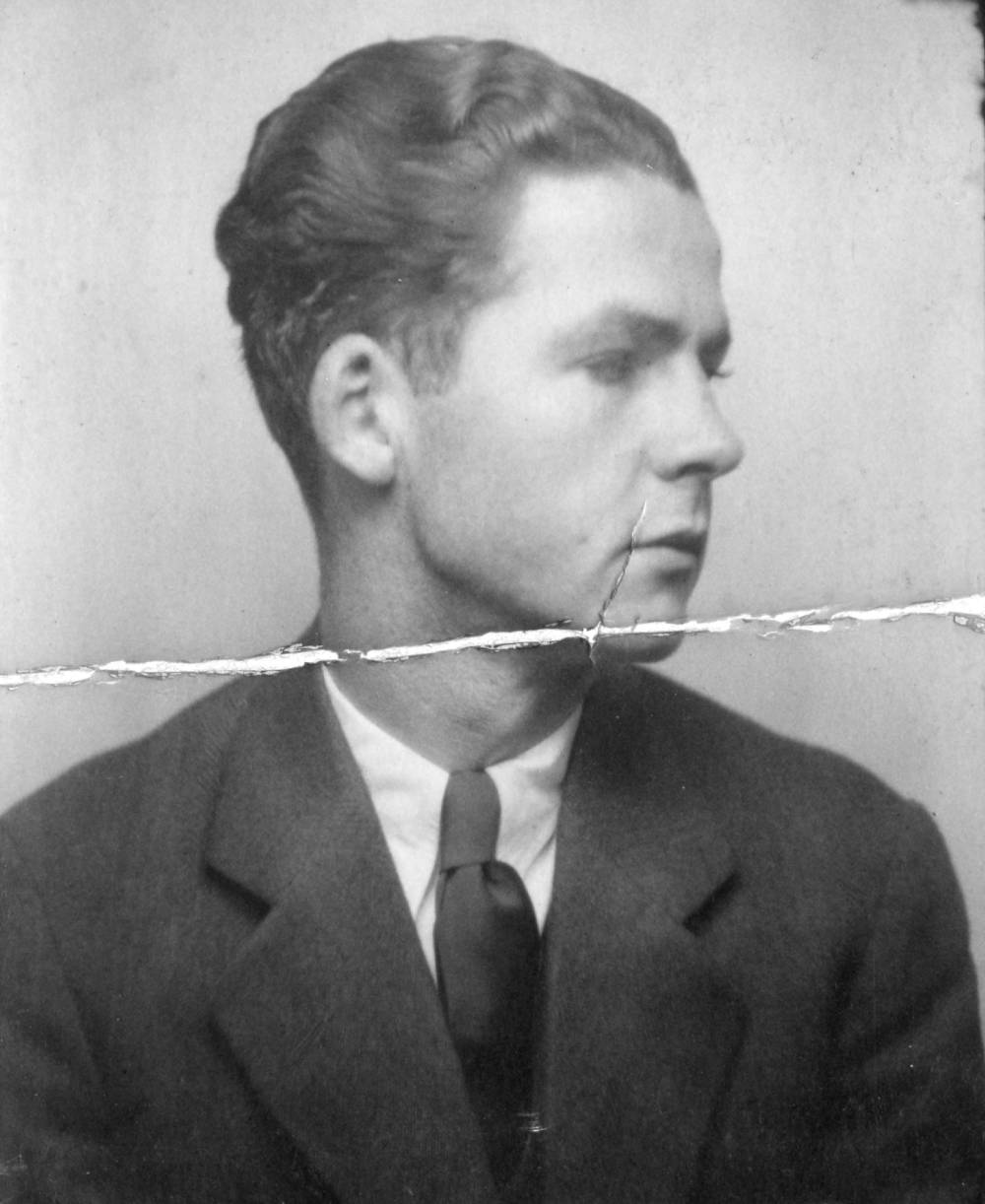
Early Life & Family
William Francis Lynn was born on July 14, 1908, at 209 West 6th Street in Wilmington, Delaware. He was the child of William Francis Lynn (1874–1934) and Mary Frances Lynn (née Duffy, 1878?–1961?). The Wilmington Morning News reported that the Lynn family undertaking business had been founded in Wilmington in 1835, and was one of the oldest continually operating businesses in the state by 1932. Lynn had an older sister, a younger sister, and a younger brother.
The Lynn family was recorded at 209 West 6th Street on the 1910 and 1920 censuses, which the Wilmington Morning News reported was also the location of the undertaking firm. On April 15, 1930, the Lynn family was recorded at 207 Linden Court. Lynn’s occupation was recorded as embalmer, presumably at his father’s business.
Lynn married Lucy F. Fucella (1909–1988) in Baltimore, Maryland, on December 11, 1930. The couple had one son, also named William Francis Lynn (1932–2005).
On June 27, 1934, Lynn was driving with his father and four aunts near Wilkes-Barre, Pennsylvania, when his father suffered a fatal heart attack.
He worked as an undertaker before entering the service.
Some fields in his enlistment data card may have been garbled when the document was digitized. He was described as having completed three years of high school. He was also listed as separated, without dependents, which may be supported by the fact that when he registered for the draft, Lynn listed his mother rather than his wife as a point of contact.
Lynn’s younger brother, John Patrick Lynn (1923–1968) served in Company “C,” 505th Parachute Infantry Regiment of the 82nd Airborne Division in the U.S. Army during World War II.
Military Career
After he was drafted, Lynn was inducted into the U.S. Army on December 22, 1942. His wife’s statement for the State of Delaware Public Archives Commission indicates that he went on active duty on December 29, 1942, at Fort Dix, New Jersey. Private Lynn was assigned to the Medical Department. His wife stated that her husband was stationed at Fort McClellan, Alabama, from January through April 1943. He then transferred to Fort Meade, Maryland, until September 1943, when he moved to Fort Bragg, North Carolina. She wrote that he remained there until March 1944, when he moved to Camp Kilmer, New Jersey. That suggests he went overseas from the New York Port of Embarkation in early 1944. The only unit she listed was the 45th Field Hospital, which was activated around September 1943 and arrived in England in March 1944. The hospital landed in France on June 10, 1944, four days after D-Day, and Belgium in September 1944.
Private Lynn went A.W.O.L. while assigned to the 238th Station Hospital at Fort George G. Meade, Maryland. He was apprehended and confined at Fort DuPont, Delaware, where a guard was dispatched to retrieve him on June 11, 1943.
On July 27, 1943, a set of orders came down from Headquarters 3rd Service Command in Baltimore, Maryland, which transferred a large portion of the 238th Station Hospital’s complement to the 239th Station Hospital, also stationed at Fort George G. Meade. On August 1, 1943, Private Lynn and 172 other men joined the 239th from the 238th.
As of September 6, 1943, when he began a nine-day furlough, Private Lynn was a member of the 239th Station Hospital at Fort Bragg. On January 22, 1944, Private Lynn transferred to the 45th Field Hospital, also stationed at Fort Bragg.
A morning report established Private Lynn’s military occupational specialty (M.O.S.) as 861, surgical technician.
Aside from morning reports, very few textual records for the 45th Field Hospital survive in the National Archives. Private Lynn is not mentioned in the hospital’s extant general orders. The only other set of textual records is a 1945 report by Major Max W. Wolf pertaining to the 45th Field Hospital’s First Hospitalization Unit. The report does not reveal the movements of additional hospitalization units nor its members. Morning report indexes suggest the hospital split into two or three hospitalization units in December 1944.
Private Lynn was probably, but not definitely, a member of First Hospitalization Unit, as its location matches the location where he reportedly died. The unit began 1945 in Fallais, Belgium, but moved to Malmédy on January 17. From January 19, 1945, until February 26, 1945, they treated casualties resulting from the American counteroffensive against the German advance known as the Battle of the Bulge. After John P. Lynn was wounded in the head by artillery shell fragments in January 1945, Lynn was able to visit his brother.
First Hospitalization Unit of the 45th Field Hospital moved to Euskirchen, Germany on March 8, 1945, where its members treated casualties from the Battle of Remagen, in which American forces captured the Ludendorff Bridge over the Rhine. Three days later, the unit moved closer to the Remagen bridgehead, setting up at Bad Neunahr, Germany. The 102st Evacuation Hospital took over for the unit on March 14, 1945, and they staged at nearby Ahrweiler until crossing the Rhine to Niederbieber on March 26, 1945.
Major Wolf wrote in his report:
On March 26 this unit moved to Neider Beiber, where we set up in tents in support of the 2nd Infantry Division. We received no casualties and the following day moved to Montabaur. Here we took over a german [sic] hospital containing about 115 recovered Allied Prisoners of War. In addition, we also functioned as an evacuation hospital, supporting troops from V-Corps.
According to a March 29, 1945, 45th Field Hospital morning report, Private Lynn died at 0100 hours from a coronary occlusion. He was just 36 years old.
Lucy Lynn remarried on September 21, 1946, in Wilmington to Lloyd S. Malzer.
Why on hold: Incorporating newspaper articles from prewar, and waiting for 1945 morning reports
Private Claude B. Wiles (1916–1942)
Early Life & Family
Claude B. Wiles was born on February 5, 1916, in Rock Creek Township or nearby Roaring River, both in Wilkes County, North Carolina. He was the 10th child of farmers Ambrose Wiles, Sr. () and Alice Wiles (née Privette or Prevett). Three older siblings died very young prior to his birth.
Wiles was recorded on the census in January 1920 living with his parents and four older siblings on a farm in Cecil County, Maryland. Census records indicate that Wiles and his family moved to Representative District 8 in unincorporated New Castle County, Delaware, prior to April 1, 1935. When the Wiles family was recorded there in April 1940, Wiles was unemployed. When he registered for the draft—the card was undated but it was presumably on or about October 16, 1940—Wiles was living in Eastburn Heights, Marshallton, Delaware, and working for the Reading Railroad Marine Department.
Wiles was living in Eastburn Heights when he entered the service. According to his enlistment data card, he was a chauffeur or driver before he joined the military.
Military Career
Wiles volunteered for military service. He enlisted in the U.S. Army in Wilmington, Delaware, on January 27, 1942. Like many soldiers who entered the service in Delaware, Private Wiles was initially stationed at Fort Dix, New Jersey. Many Delawareans spent about a week there before being transferred to other bases to attend basic training. He was not formally assigned to any unit but was attached to the 1229th Reception Center.
Wiles went absent without leave (A.W.O.L.) on February 9, 1942, and apparently made his way back to Delaware. On the afternoon of February 15, 1942, Private Wiles was discovered with a gunshot wound to his head. He was pronounced dead at Wilmington General Hospital. An autopsy concluded that he had died by suicide.
Journal-Every Evening reported that Wiles’s funeral “will take place [at] the Smith Funeral Home, Twenty-fifth and Market Streets, Thursday afternoon [February 19, 1942,] at 3 o’clock. Interment will be in St. James Cemetery, Stanton.”
Sergeant William L. Nelson (1918–1943)
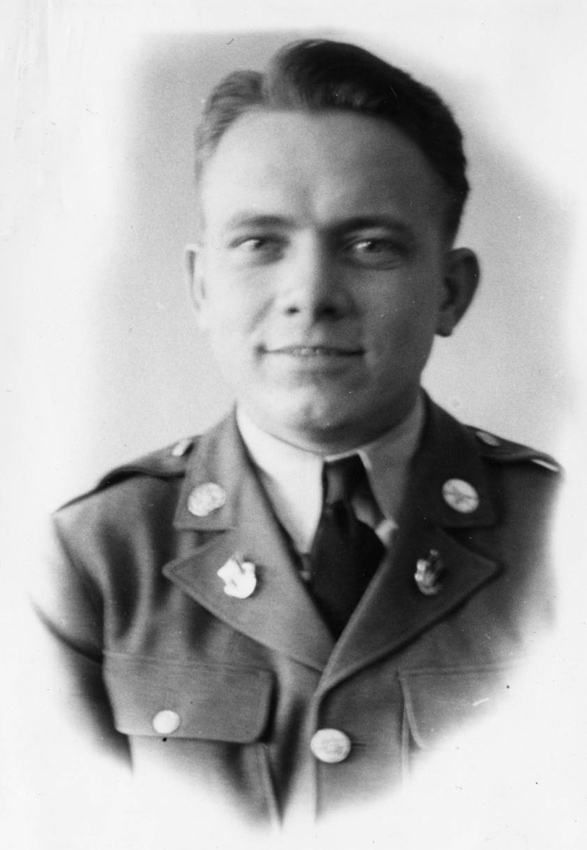
Early Life & Family
William Lloyd Nelson was born on the evening of February 22, 1918, near Dover, Delaware. He was the eldest child of John Clarence Nelson (a farmer, 1892–1983) and Carrie Nelson (née Phillips, 1895–1965). He had a younger sister, Dorothy M. Nelson (later Dorothy Davis and eventually Dorothy Davis McCafferty, 1920–2003).
The Nelson family was recorded on the census in January 1920 living on a farm outside Dover. (The census record said they were on the Dover and Hazelville Road, but it was most likely the Dover-Hazlettville Road). Nelson was recorded as Lloyd Nelson on the next census in April 1930. The family was living on a farm along Chesapeake City Road in unincorporated New Castle County, Delaware, south of Glasgow.
On April 29, 1932, Nelson’s parents purchased a farm along Cedar Lane Road between Jamison Corner and Armstrong Corner, north of Middletown, Delaware. Nelson was recorded living with his parents there at the time of the 1940 census. Later that year, when he registered for the draft on October 16, 1940, Nelson was working for the Hercules Powder Company in Wilmington. The registrar described him as standing five feet, 10 inches tall and weighing 155 lbs., with brown hair and blue eyes. He was Protestant.
Journal-Every Evening stated that Nelson “graduated from the Middletown High School and Beacom Business College and when drafted January, 1941, was employed in the Order Department of the Hercules Powder Company, Wilmington.” On the other hand, the 1940 census and Nelson’s enlistment data card described him as a high school graduate, not a college graduate. Nelson’s wife’s statement for the State of Delaware Public Archives Commission described him as an accounting clerk.
Military Career
Nelson was drafted before the U.S. entered World War II. He was inducted in Trenton, New Jersey, on January 9, 1941. His wife stated that her future husband spent 10 days at Fort Dix, New Jersey, before he was dispatched to Fort Bragg, North Carolina. Like many men joining the rapidly-expanding U.S. Army at that time, he was assigned directly to a unit for his initial training. In January 1941, he joined Company “H,” 60th Infantry Regiment, 9th Infantry Division. The June 1941 roster, the earliest to include duty codes, listed Private Nelson’s as 521, basic.
During a furlough back home to Delaware, Nelson married Rebecca Pyle at the First United Presbyterian Church in Wilmington on the evening of September 8, 1941.
A January 1942 roster listed a change in Nelson’s duty and military occupational specialty (M.O.S.) codes to 607, mortar gunner or light mortar crewman. The following month, he was promoted to private 1st class. The May 1942 roster indicated that Nelson had been promoted to corporal and reflected a change in his duty and M.O.S. codes to 603, gunner. (This seems to have been a blanket reclassification since no 607s were listed in the company roster for the month.) The June 1942 roster recorded another duty and M.O.S. code change to 653, squad leader. The July 1942 roster listed Nelson’s M.O.S. as 653 but his duty code as 228 (instrument man, surveying). There were no further changes recorded through September 1942, the last month on which duty and M.O.S. were recorded in extant rosters.
Combat in the Mediterranean Theater
Nelson was promoted to sergeant on January 7, 1943. He must have become a section leader at that point.
Journal-Every Evening reported Sergeant Nelson’s death on May 18, 1943.
Sergeant Nelson’s personal effects included a Bible, two prayer books, an Elgin wristwatch, a pair of glasses, a pipe, a French-English dictionary, a swimsuit, and a four-leaf clover.
Sergeant Nelson was initially buried in the II Corps cemetery on August 13, 1943. In 1947, Sergeant Nelson’s widow requested that his body be repatriated to the United States. Nelson’s casket returned to the New York Port of Embarkation aboard the Barney Kirschbaum.
Rebecca Pyle Nelson remarried.
During his career, Sergeant Nelson earned the Medal of Honor, the Purple Heart, the Good Conduct Medal, the American Defense Service Medal, and the European-African-Middle Eastern Campaign Medal with two bronze service stars for the Algeria-French Morocco and Tunisian campaigns. (Distinguished unit badge)
Aviation Cadet Leroy A. Wilkins (1921–1942)
Early Life & Family
Leroy Alvin Wilkins was born in Milford, Sussex County, Delaware, on the morning of August 3, 1921. He was the second child of Leroy Wilkins (a carpenter and later building manager at Milford High School, 1899–1993) and Nellie Wilkins (née Marvel, 1901–1965). He had an older sister, Doris Wilkins (later Greenly, 1919–2013). Wilkins was nicknamed Nehi, apparently after the soft drink.
Wilkins attended school with Charles D. Holzmueller, Jr. (1920–1942), destined to become Milford’s first serviceman lost during World War II when a U-boat sank his vessel on May 2, 1942. Journal-Every Evening reported:
Wilkins and Holzmueller graduated from Milford High School in 1939. Both were well known among sports fans in lower Delaware as members of a Milford school basketball team which was undefeated for two seasons. Wilkins was captain of the team in his senior year, and was also captain of the football team during that year. He was also a member of the town’s baseball team.
A June 13, 1939, Journal-Every Evening article stated:
At a meeting of the Milford High School Alumni Association held yesterday it was decided to present the scholarship fund to Leroy A. Wilkins of this year’s graduating class.
The association presents a sum of money to a member of the graduating class every year who is worthy and outstanding in school work to assist that scholar towards a higher education.
The paper later reported that “Wilkins attended the University of Delaware for a year where he also was active in athletics.” His enlistment data card stated that he had completed two years of college, and indeed, he would have needed two years of college to enlist as an aviation cadet at the time that he did.
The Wilkins family was recorded on the census in April 1930 living on East Front Street in Milford. On the next census in April 1940, the family was recorded living at 10 East 2nd Street in Milford.
Military Career
On December 18, 1941, just eight days after the attack on Pearl Harbor, Wilkins enlisted as an aviation cadet in the U.S. Army Air Forces in Wilmington, Delaware. Given the application process to become an aviation cadet, it is likely that he had already volunteered before the attack.
According to his sister’s statement for State of Delaware Public Archives Commission, Aviation Cadet Wilkins began his training at Maxwell Field, Alabama, where he remained until January 1942. He then moved to Ocala, Florida. In March 1942, he transferred to Greenville Army Flying School, Mississippi. She wrote that in May 1942, he transferred to Craig Field, near Selma, Alabama. On the other hand, The Selma Times-Journal reported that Wilkins had arrived at Craig Field on June 2, 1942. By July 9, 1942, he had accumulated 169 hours and 35 minutes of flight time, including 39 hours and 20 minutes in the North American AT-6A Texan trainer.
At Craig Field, Wilkins joined the Cadet Detachment, 382nd School Squadron.
The Wilmington Morning News reported on July 14, 1942, that the day before, “City stores were closed and the American flag in Plaza Square lowered to half-mast today during the funeral service for Leroy A. Wilkins, Jr.” The paper added:
The body arrived here yesterday [July 12, 1942], accompanied by Thomas Bennett, a classmate of Wilkins, who also is stationed at Craig Field. A military funeral was held previously at the Army base.
The Rev. Marion A. Hungerford, pastor of Calvary Methodist Church, conducted the service at the home of the youth’s parents, Mr. and Mrs. Leroy A. Wilkins, Sr.
His sister’s posthumous brother-in-law was Orlando Greenly.
Wilkins is honored at the University of Delaware’s World War II memorial in Newark, and at Veterans Memorial Park in New Castle, Delaware.
Why on hold: Flight records and looking for photo.
Private (John) Willard Chandler (1917–1943)
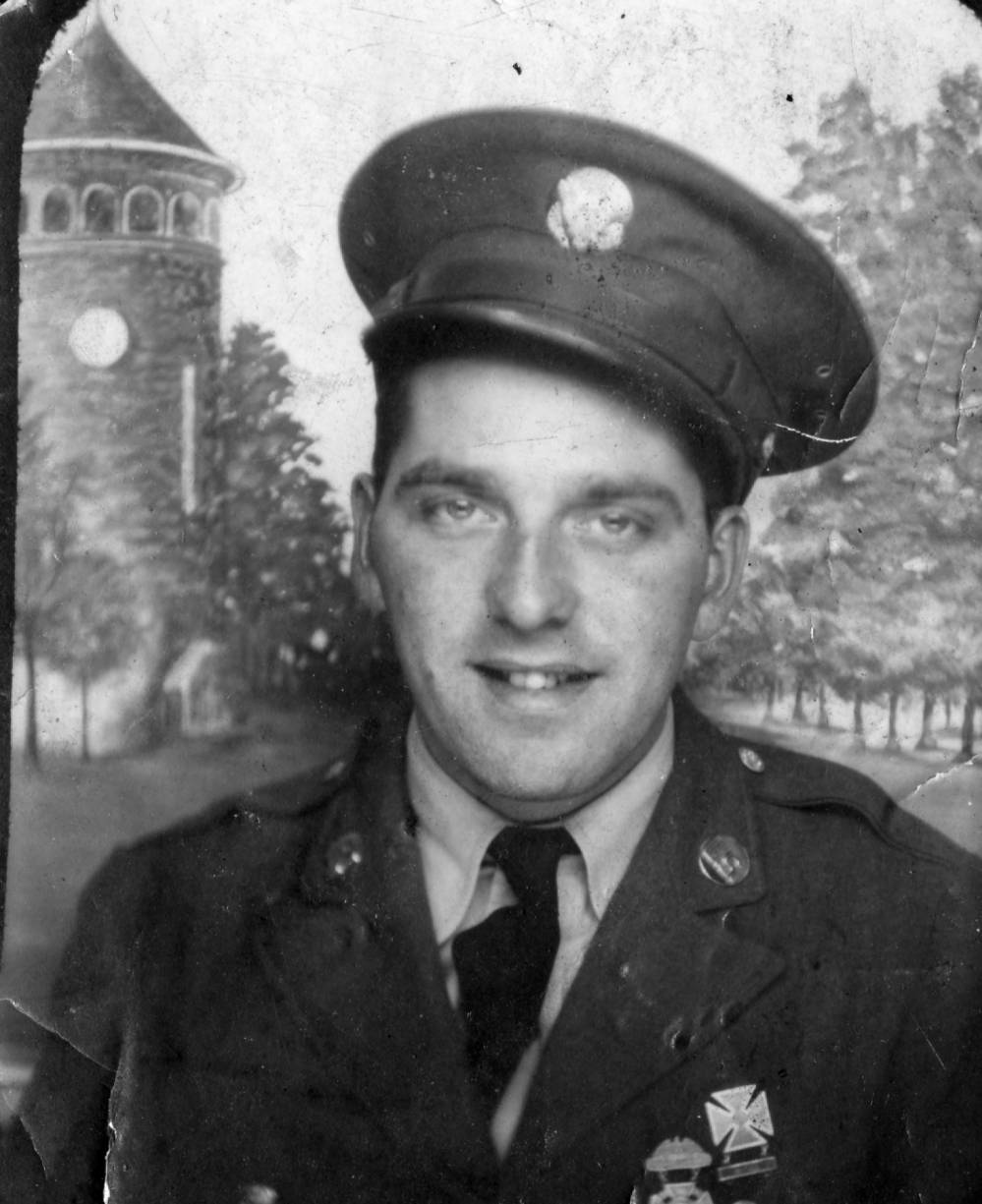
Military Career
After he was drafted, Chandler was inducted into the U.S. Army on April 2, 1941. His enlistment data card was one of approximately 13% that could not be digitized. However, his mother told the State of Delaware Public Archives Commission that her son joined the Army at Trenton, New Jersey. Indeed, selectees typically had their initial induction at Trenton and after a delay of a few days to a few weeks, went on active duty at Fort Dix, New Jersey. After a brief time at the reception center there, many were dispatched to basic training facilities, mostly in the South. Especially in the early 1940s, however, they sometimes were assigned directly to a unit for training.
A unit roster indicates that in May 1942, Private Chandler joined Battery “B,” 169th Field Artillery Battalion, 43rd Infantry Division at Camp Shelby, Mississippi. The 169th Field Artillery Battalion was activated there on February 19, 1942, following the breakup of the 103rd Field Artillery Regiment. At the time, all the noncommissioned officers in the unit were federalized guardsmen, as were many of the rest of the enlisted men. However, as time went on, vacancies were mostly replaced by draftees. The battalion was equipped with 105-mm howitzers.
Monthly rosters from June through September 1942 describe Private Chandler’s military occupational specialty (M.O.S.) code as 745, rifleman, suggesting he qualified as one during earlier training. However, since Field Artillery units did not have any riflemen, his duty code during those months was listed as 351. The usual meaning of that code was bookkeeping machine operator. It is unclear what a 351 would have done in the context of a Field Artillery unit. There were men who performed fire control computations, but these were in the headquarters batteries, and at a grade higher than private. Eventually, he probably requalified with an M.O.S. specific to Field Artillery, possibly whatever 351 meant.
Combat in the Pacific Theater
In a historical report, Lieutenant Colonel Wilber E. Bradt wrote:
On the 11–12 September 1943 the Battalion (less Battery “A”) moved from the New Georgia mainland to Piru Plantation on Ondongo Island and took over positions occupied by Batteries of the 140th Field Artillery Battalion. The occupation of position was most unusual in that the exchange of Batteries was effected without interfering with the firing. This was accomplished by substituting the base piece of the 140th Field Artillery Battalion Battery and while the remainder of the Battery of the 140th Field Artillery Battalion continued to fire, the base piece of the Battery of this Battalion was registered on the base point. The registration completed, the remaining three howitzers of each Battery were exchanged and the firing taken up by this Battalion. This procedure was employed both on the 11th September 1943, when Battery “B” relieved Battery “A”, 140th Field Artillery Battalion and on the 12th September 1943 when Battery “C”, relieved Battery “C”, 140th Field Artillery Battalion.
Ondongo is actually a peninsula rather than an island.
Private Chandler was killed in action early on September 12, 1943. In an operations report, Lieutenant Colonel Wilber E. Bradt wrote:
At 0330, 12 September, Battery “B” while engaged in firing a night harassing mission had a premature burst from the #4 howitzer. The round burst about 50 feet from the muzzle, killed one man, wounded three, and damaged the #3 howitzer. Shell high explosive, fuze M54 set for percussion action was being fired at the time and it is believed that the round had not been accurately set on safe. The battery had arrived at the position late in the afternoon and the ammunition had been prepared after dark.
The wounded were three federalized guardsmen from New England: Sergeant Halsey W. Buehler (1921–1967), Sergeant George W. Decoteaux (1917–1976), and Private Anthony DeMaio (1918–1999).
Technician 5th Grade Hiram J. McRae (1918–1945)
Hiram Johnson McRae was born in Alabama on March 23, 1918.
His foster mother was Louise McRae (later Louise McRae Crittendon) of Columbus, Georgia, sister Essie Bostic (born Alabama c. 1909, spouse Erelzia Bostic, children Dorthy and Erelzia Jr.) of Newark, New Jersey. He was Protestant according to his dog tags.
He was living in New Castle County, Delaware, when he entered the service. After McRae was drafted, he joined the U.S. Army in Camden, New Jersey, on July 23, 1942. Many selectees were briefly transferred to the Enlisted Reserve Corps on inactive duty for a few weeks to wrap up matters in their civilian lives. Private McRae went on active duty on or about August 5, 1942, when he was attached to Receiving Company “E,” 1229th Reception Center, Fort Dix, New Jersey.
Around August 18, 1942, he was attached unassigned to Company “C,” 8th Engineer Training Battalion, Engineer Replacement Training Center, Fort Belvoir, Virginia. He went absent without leave (A.W.O.L.) from October 5–9, 1942.
On October 24 or 25, 1942, Private McRae was released from attachment to Company “C.”
Payroll records indicate that McRae was paid at Camp Stoneman, California—staging area for the San Francisco Port of Embarkation—on November 2, 1942; November 30, 1942; and December 31, 1942. He went overseas on January 23, 1943.
On February 14, 1943, McRae joined Company “B,” 811th Engineer Aviation Battalion, a segregated unit with black enlisted men and white officers. The 811th had been activated at Langley Field, Virginia, on December 1, 1941. Enlisted cadre transferred into the unit from the 94th Engineer Battalion (Separate), as well as from Fort Leonard Wood, Missouri, and Fort Belvoir, Virginia. The unit went overseas soon after the attack on Pearl Harbor, shipping out on January 23, 1942. Their convoy arrived in Melbourne, Australia, on February 26, 1942. The following month, the battalion arrived at Nouméa, New Caledonia, which was under Free French control and would soon become one of the largest Allied bases in the South Pacific. The battalion primary built and maintained airfields. Occasionally they constructed roads and railroads, and transported crated aircraft from the port to assembly areas. Service in the South Pacific, at the end of very long supply lines, required a certain degree of improvisation, as a unit history observed at the conclusion of two years on New Caledonia:
Having fixed the roads, they drove their trucks over them for more than eleven million miles. The mechanics had their own opinion of those miles. It was their duty to keep in running order vehicles which had not been new when they were put aboard, and it was nothing unusual to see one trundling about with its third engine and its second speedometer. No one gave it a second thought, any more than they gave a second thought to using salvaged aircraft armor for patching material, or tailoring a truck motor to fit a grader when the grader’s own motor gave out.
McRae was promoted from private to technician 5th grade on April 8, 1943. Later that year, McRae was hospitalized at the 31st Station Hospital. His condition was severe enough that he was transferred to Detachment of Patients, 31st Station Hospital, effective November 29, 1943. After recovering, he was transferred back to his unit on December 31, 1943, rejoining Company “B” at 1300 hours that afternoon. On February 24, 1944, McRae was temporarily appointed to the grade of corporal. This was not a promotion per se, since both were the same pay grade, although by that time a corporal had the authority of a noncommissioned officer whereas a technician 5th grade did not.
On March 23, 1944, the 811th shipped out for Guadalcanal. A unit history stated that 72% of the unit “were charter members” who had been with the unit since 1941, meaning McRae was among the 28% of personnel who were replacements.
After arriving at Guadalcanal on April 1, 1944, the men of the 811th performed general construction work while assigned to the Thirteenth Air Force. Their projects included building a camp, a flagpole, quarters at a hospital, a bridge, runway maintenance, and a new tower at Carney Field. They also performed work improving the drainage at various installations. Perhaps tongue-in-cheek, the unit history for April 1944 recorded that “None of the projects were particularly noteworthy except one priority 1 AA – RUSH assignment which arrived at noon and instructed us to produce by four that afternoon, one volleyball court for the Commanding General.”
The battalion also built a tennis court and a baseball field, and a battalion garden for the unit’s men to supplement their rations by growing fresh produce for themselves. The unit history noted (A0246 pg. 193):
The battalion garden fulfilled its promise by providing sweet corn, watermelon, cantaloupe, egg plant and assorted greens to the mess tables. The corn was excellent, better in fact that much that is sold in markets at home, since this is fresh picked. The Battalion Surgeon found it expensive. A skeptic by instinct and training, he had bet five dollars that it would not come up to its name of “Sixty-Day Corn”, only to have a steaming ear set before him on the sixtieth day.
On June 18, 1944, men of the unit responded when a B-25 ditched near the Company “C” camp, helping to rescue the crewmembers half an hour before crash trucks and ambulances arrived.
A hospital admission card indicates McRae was briefly hospitalized for colic in July 1944.
The main body of the 811th shipped out for Honolulu, Hawaii, on September 21, 1944, aboard the U.S.A.T. Cape Meares, arriving there on October 4, 1944. The unit was briefly stationed at Hickam Field before moving to Bellows Field (apparently as a result of a false accusation that the men of the unit had been in involved in “a disturbance in the civilian workers barracks – half mile down the road from our location.”). The move was not reversed, though the unit did work all across Oahu at Kwaloa, Kipapa, Hickam, and Wheeler, as well as Bellows.
Company “B” began training at the Jungle Training Area (Jungle Unit Training Center?) beginning on December 10, 1944. This training included amphibious operations and the use of various weapons, including one just issued to the battalion: the M16 Multiple Gun Motor Carriage, a halftrack equipped with a quadruple .50 machine gun turret. The training, and extra firepower perhaps hinted that their next assignment would be more hazardous. (Unit records appear missing February – April 1945)
It appears that the unit shipped out from Hawaii on or about March 28, 1945, and arrived on Iwo Jima on April 20, 21, or 22, 1945, and was assigned to VII Fighter command. (A0246, pg. 217)
The unit history reported:
The announcement of peace was received here, as elsewhere on the Island, with a curious quiet. The first broadcast at 2200 woke the camp out of its slumbers and there was sporadic cheering as area after area got the news. Nobody slept much after that. Next day the radios were crowded with listeners. When the final announcement came through, most hearers heaved a deep sigh and walked off with a rather groggy expression. There was no work that day and very little the next. There were ball games, which were well attended, but for the most part everyone sat back and relaxed. Almost everyone complained of a hollow feeling inside, as though something important had vanished overnight.
Work continued, albeit “on a greatly curtailed schedule.”
Technician 5th Grade McRae suffered a skull fracture in a vehicle accident on Iwo Jima. He died on September 2, 1945, the same day Japanese representatives signed the instrument of surrender in Tokyo Bay. He was initially buried in the 4th Marine Division Cemetery on Iwo Jima on September 3, 1945.
His personnel effects included his wallet, a Lucite pendant, a deck of playing cards, his unemployment compensation and draft registration cards, two rings, two New Zealand florins, three Bibles, 19 cowrie shells, $116.34, and 269 personal letters.
The Army attempted to reach Technician 5th Grade McRae’s sister, and then his foster mother through the American Red Cross. The Red Cross contacted Louise McRae to have her fill out the disposition paperwork. She wrote a notarized letter to the Office of the Quartermaster General dated May 13, 1948:
After careful consideration I have decided that I would not have my son’s remains returned to the States.
He was my foster-son, and now that he has been interred overseas, I am satisfied with the arrangements.
I do not care to complete forms.
Edna Mattox of the American Red Cross wrote the Office of the Quartermaster General Memorial Division on October 13, 1948:
Our Columbus, Georgia, chapter worker advises that Mrs. Louise McRae Crittenden states the serviceman was never legally adopted by her. The decedent was given to her by a brother who had obtained him from the boy’s mother. Efforts to locate the boy’s mother have been unsuccessful.
McRae was buried at the National Memorial Cemetery of the Pacific in Hawaii on November 23, 1949.
Although McRae entered the service from Wilmington, Delaware, the Adjutant General’s Office report of death listed his home address as “Wilmington, N. C.” The error may have originally been due to some paperwork using N. C. as an abbreviation for New Castle County, or because Wilmington, North Carolina, is a better known city than Wilmington, Delaware. Regardless, his headstone erroneously lists North Carolina as his state of residence.
Why on hold: Waiting for release of 1945 morning reports to the National Archives Catalog to complete reconstruction of his military history
If you have materials that may help me finish any of these articles, please contact me.
Last updated on March 27, 2026
 Delaware's World War II Fallen