

| Residence | Civilian Occupation |
| Lewes, Delaware | Lighthouse keeper |
| Branch | Service Number |
| U.S. Coast Guard | 227-402 |
| Theater | Assignment |
| American | Harbor of Refuge Lighthouse (Coast Guard Group, Lewes, Delaware) |
Early Life & Family
Theodore William Simpler was born on April 22, 1891, in Zoar, a small unincorporated community in Indian River Hundred southeast of Georgetown in central Sussex County, Delaware. He was the child of Theodore William Simpler (a farmer, 1851–1921) and Hettie Ann Simpler (née Steel or Steele, 1862 or 1863–1935). He had an older sister, Mary E. Simpler (later Burton, 1881–1924), and an older brother, Ira Burton Simpler (1886–1959).
Simpler was recorded on census in June 1900 living in Indian River Hundred with his parents and two siblings. Simpler dropped out of school after completing the 8th grade (called 8th reader at the time). During the next census, taken in April 1910, he was living with his parents in the 10th Representative District in unincorporated Sussex County and working as a farmhand for the family.
On February 17, 1917, Simpler, then a farmer, married Edith Dorman (1900–1979) in Nassau, in unincorporated Sussex County near Lewes, Delaware. The couple raised one daughter, Thelma Mae Simpler (later Rickards, 1919–2006), born in Indian River Hundred early on June 25, 1919. The next census in January 1920 found Simpler living with his wife and daughter on their farm in the 8th Representative District in Sussex County. His father died on April 3, 1921.
Lighthouse Keeper
By the time he turned 32, Simpler was looking for new work. The Wilmington Morning News reported that on April 28, 1923, he was among a group of men who “took the examination for the rural mail route[.]” However, the following month, effective May 30, 1923, Simpler was hired by the U.S. Lighthouse Service. His probationary appointment was as an additional keeper with a salary of $660 per year (about $12,685 in 2025 dollars).
Simpler’s first assignment was to the Elbow of Cross Ledge Light. Compled in 1910, this was an isolated tower in the middle of Delaware Bay which warned of dangerous shoals midway between the Delaware and New Jersey shores almost due east of Dover, Delaware. On August 25, 1923, Simpler was promoted to 2nd assistant keeper of Elbow of Cross Ledge Light, with a salary of $720 (about $13,675).
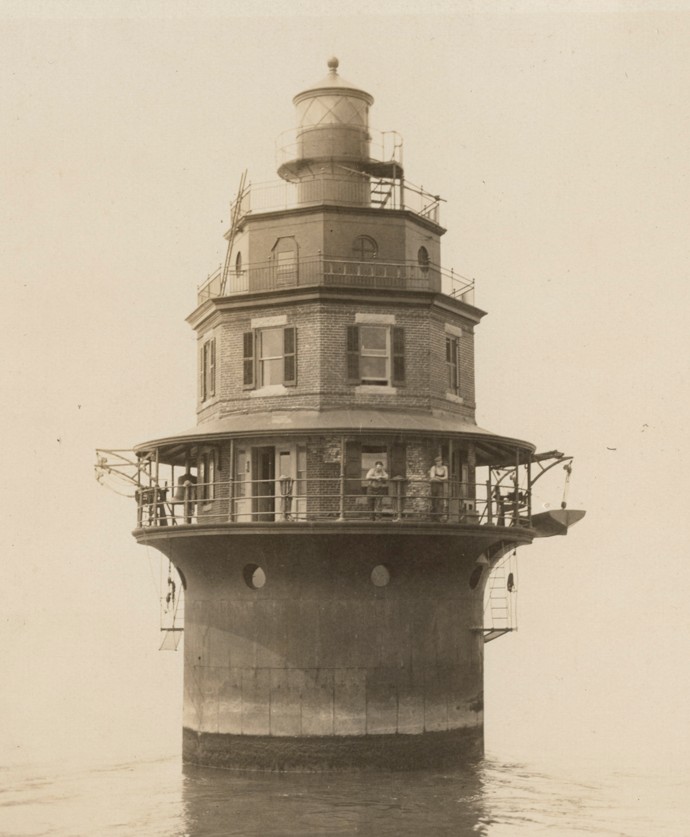

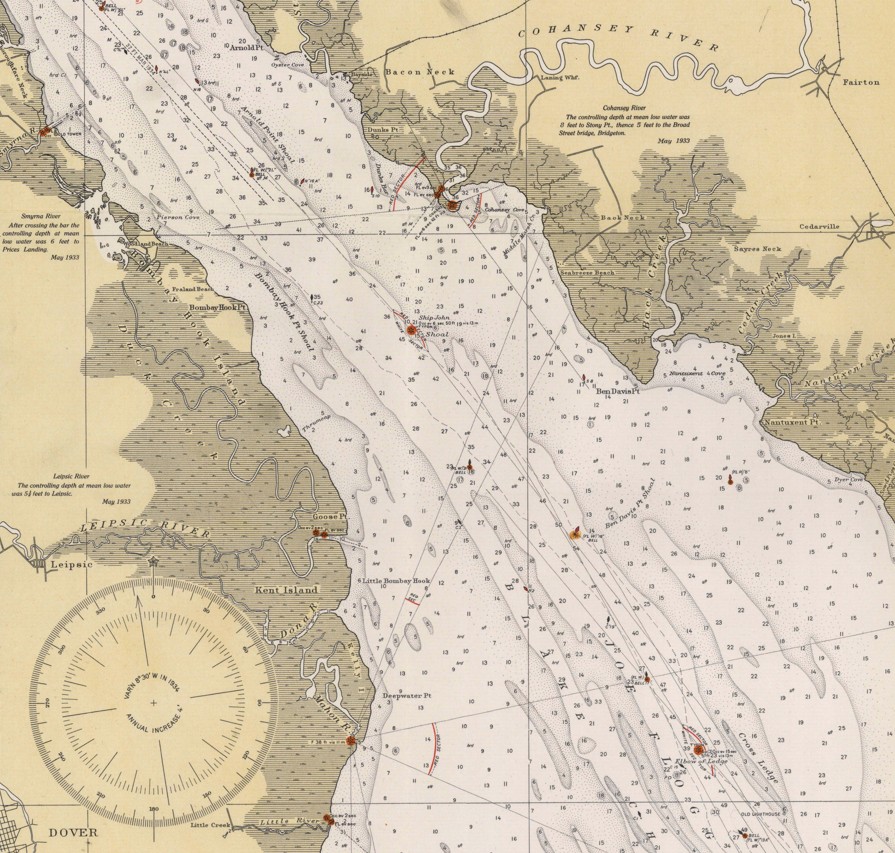
Later that year, on November 26, 1923, the Wilmington Morning News reported that “Lighthouse Keeper Theodore W. Simpler has been detained from his post at the lighthouse for two weeks on account of his wife and child suffering from measles.”
Tragedy struck the family early the following year. When Simpler’s sister had an operation for a bowel obstruction on January 28, 1924, the surgeon discovered that she had metastatic ovarian cancer. She died the night of February 17, 1924.
On May 1, 1924, Simpler transferred to become 2nd assistant keeper of Harbor of Refuge Light, with his annual pay increasing to $840 (about $16,050). Since his pay file discloses no transfers from 1924 to 1944, it appears that he served there continuously for over two decades. His new assignment was a shorter commute by boat than Elbow at Cross Ledge Light had been, though it still entailed long periods of time away from his family.
Harbor of Refuge Light sits on a breakwater at the south side of Delaware Bay north of Cape Henlopen, Delaware. The breakwater is not connected to the mainland and the lighthouse was accessible only by sea. Red Moulinier, past president of the Delaware River and Bay Lighthouse Foundation, writes that Harbor of Refuge had three lightkeepers, with two on duty at all times: “Their schedules rotated, so they were on the light for two weeks and off for one week.”
The original Harbor of Refuge Light had been damaged in storms and was dismantled in 1925. Presumably, Simpler and the keepers maintained the temporary beacon until a new, stout 76-foot-tall lighthouse was completed in 1926. At the time, the lighthouse was equipped with an incandescent oil vapor lamp fueled by kerosene. While serving at the lighthouse, Simpler was provided with a furnished room equipped with heat and light.


On July 1, 1924, he received a substantial raise to $1,380 (about $26,210). He received an additional raise to $1,440 (about $26,725) on January 1, 1927, and to $1,560 (about $29,630) on July 1, 1928.
In a document dated September 12, 1928, preserved in his personnel file, 2nd Assistant Keeper Simpler described his working time. His estimated that he spent 4% “Cleaning and adjusting apparatus” and another 4% doing “General work keeping tower and station clean.” He spent about 8% of his working time “Operating and caring for fog signal.” Another quarter of his time was devoted to standing watch. The remaining 59%, he wrote, was for “Standing by at station for all other purposes. This station is isolated. Communication is by boat. Men working at this station must have ability to operate an internal combustion engine and oil vapor light.”
Simpler was recorded on the census in April 1930 living on Market Street in Lewes with his wife, daughter, and his widowed mother. Simpler’s pay raises dried up after 1928, but with the deflationary effects of the Great Depression, his salary went further. The government added a $60 allowance for quarters on November 1, 1933, effectively bringing his pay to $1,620 (about $39,860).
The Wilmington Morning News reported that on the morning of Saturday, October 5, 1935, Simpler “returned home from work in the lighthouse service” to find his mother “dead on the floor of her home[.]”
In a personal history statement for the U.S. Lighthouse Service dated October 27, 1939, Simpler gave his address as 609 State Street in Lewes. (Technically, in 1937 State Street had been renamed Savannah Road, at least within city limits.) His only other work history was farming.
After the U.S. Lighthouse Service was merged into the U.S. Coast Guard on July 1, 1939, Simpler became a civilian employee of the Coast Guard with the title of keeper, 2nd assistant. In his book, Lighthouses & Keepers: The U.S. Lighthouse Service and its Legacy, Dennis L. Noble wrote that after the takeover, “very few civilian employees of the U.S. Lighthouse Service chose the option of becoming military personnel. Keepers probably felt they ran a risk of being removed from their light stations if they assumed military status.” He added that Coast Guard “boards decided which Lighthouse Service employees could volunteer for entry into the military service and what ranks and rates they should receive.”
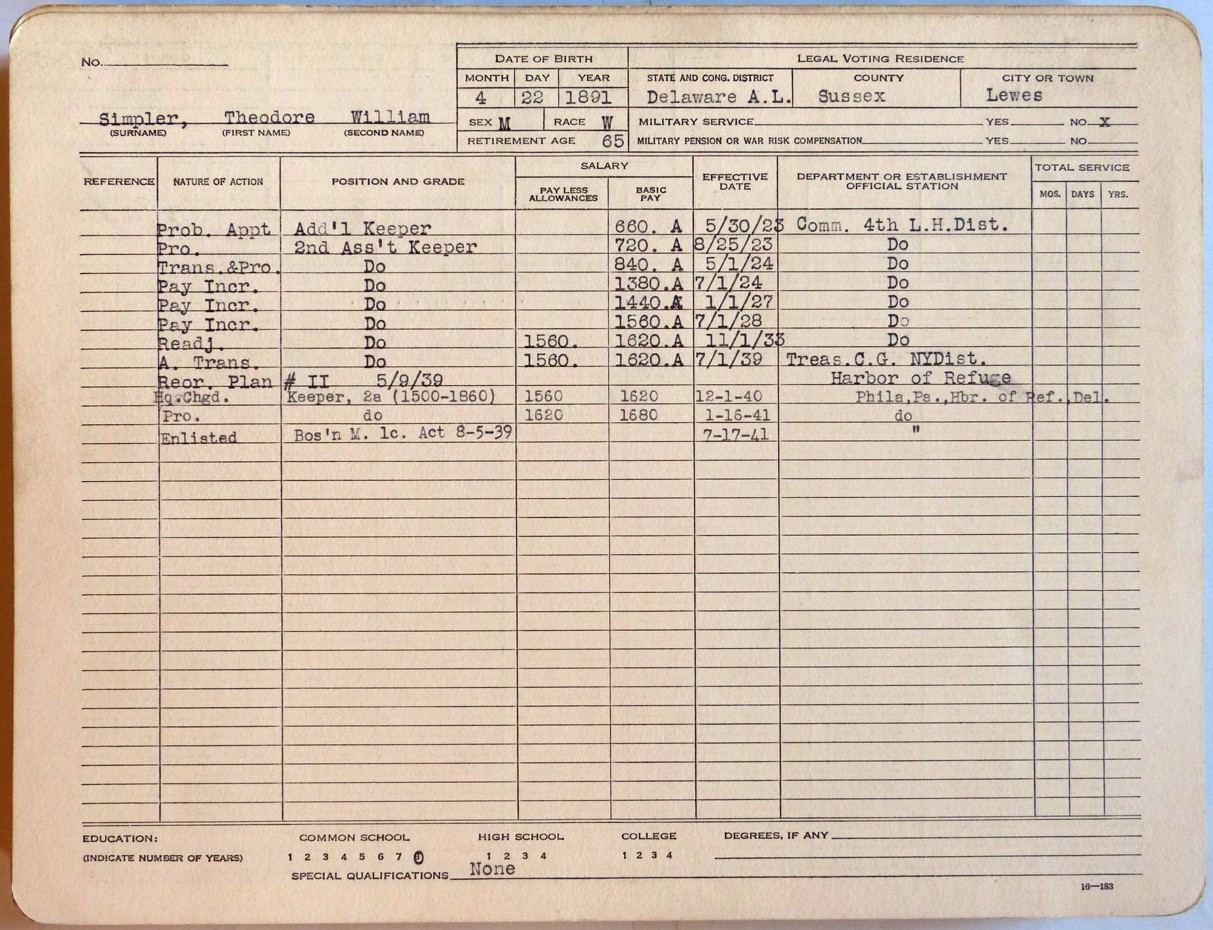
At the time of next census in April 1940, Simpler was living at 609 Savannah Road with his wife, his daughter (now working as a beautician), and a lodger. Effective January 16, 1941, his salary increased to $1,620 annually plus for $60 for quarters, totaling $1,680 and equivalent to about $38,700 in 2025 dollars.
On February 8, 1941, Simpler and his wife celebrated the marriage of their daughter to Richard F. Rickards (1920–1984) at the Brandywine Methodist Church in Wilmington, Delaware. The Wilmington Morning News reported that after a short honeymoon in Washington, D.C., the couple returned on the night of February 11 to Lewes, “where they will live for the present with the bride’s parents.”
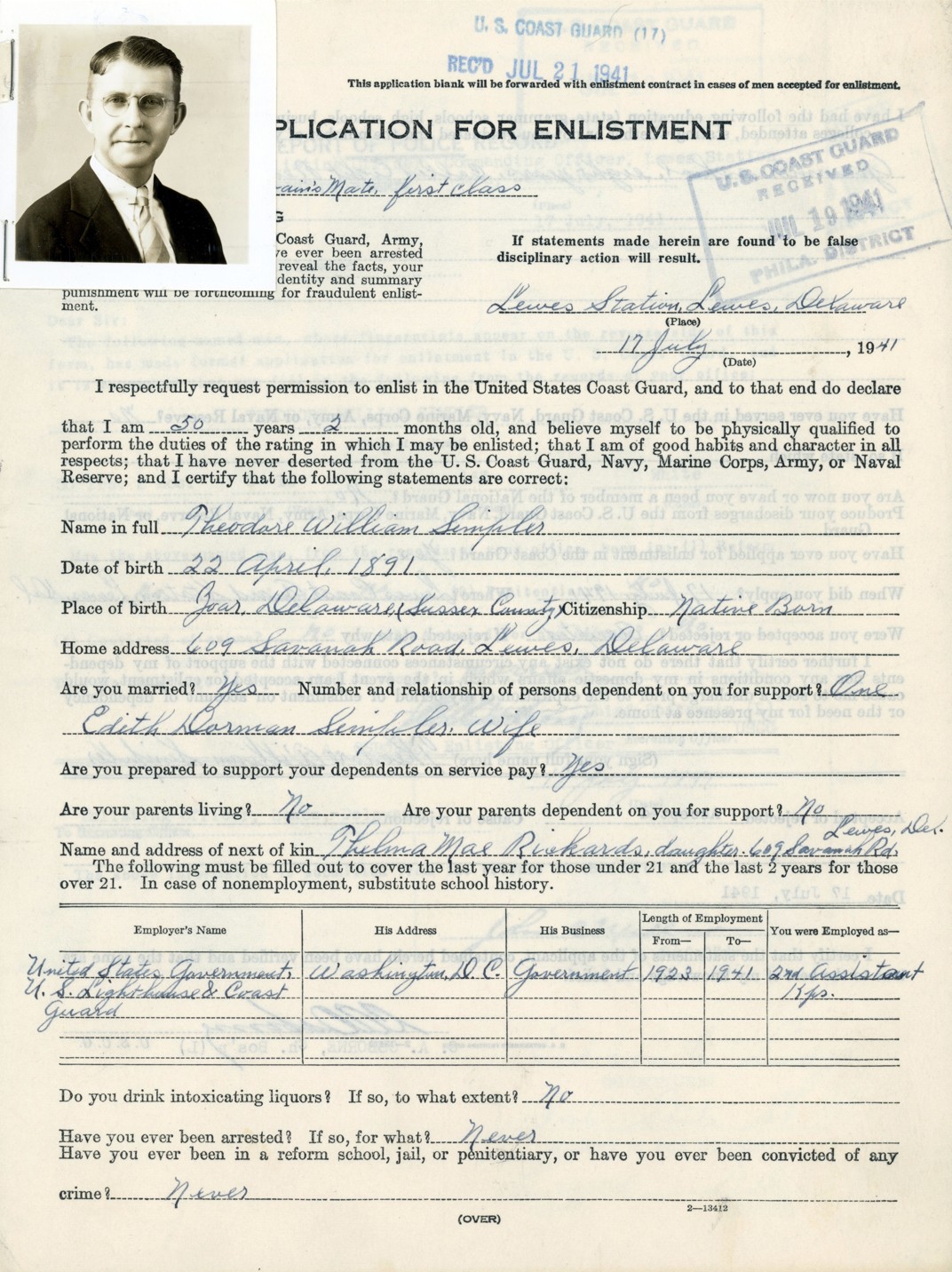
Later that year, on July 16, 1941, after 18 years, one month, and 17 days of government service, Simpler resigned as a civilian employee to enlist in the U.S. Coast Guard. Simpler was still living at 609 Savannah Road in Lewes when he enlisted. On his enlistment paperwork, he described his work experience: “Served as 2nd Assistant Keeper, U. S. Lighthouse Service, performing work such as, Maintaining Aids to Navigation, Repairs, Upkeep, Lighthouses & Boats.”
Military Career
Simpler enlisted for a three-year term in the U.S. Coast Guard on July 17, 1941, and was appointed to the rating of boatswain’s mate 1st class. At the time, he was described as standing five feet, 10 inches tall and weighing 165 lbs., with brown hair and blue eyes. His change from civilian to military status essentially raised his pay by $185.75 to $1865.75 (about $41,225 in 2025 dollars), though the breakdown was different: $1008 pay, $438 for rations, and $419.75 for quarters.
Simpler’s transition to military life appears to have been a smooth one. He was 50 years old at enlistment and was not required to attend boot camp, instead remaining on duty at the Harbor of Refuge Light Station, filling the position “left vacant by his resignation from the former Lighthouse Service on 16 July, 1941.”
Being in the military entitled him to medical care. Simpler was treated for severe dental issues at the U.S. Marine Hospital, Baltimore, Maryland, from October 27, 1941, through November 10, 1941. He was also entitled to 30 days of leave per year. He took that time off regularly, typically in increments between four and six days.
Fearful months followed the attack on Pearl Harbor on December 7, 1941, and the German declaration of war four days later. Even as U-boats sank ship after ship, American authorities were slow to implement countermeasures such as convoys and coastal blackouts. Although the harbor defenses—most notably the guns at nearby Fort Miles—must have been some comfort, Simpler and other lightkeepers must have been acutely aware how vulnerable they would be if a submarine captain decided to shell them with a deck gun. Anti-submarine indicator loops and controlled minefields soon brought increased protection and, in the event, no German submarine was foolhardy enough to attempt to penetrate Delaware Bay.
Simpler was hospitalized again at the U.S. Marine Hospital, Baltimore, Maryland, on December 15, 1943, for several inguinal hernias and a benign tumor. He was discharged on January 17, 1944, with his surgeon deeming him able to return to duty after eight weeks.
Simpler voluntarily extended his enlistment on July 17, 1944, which made him eligible for a $150 reenlistment allowance (about $2,750). That same day, he was authorized to wear the Good Conduct ribbon, though he was not actually presented with the Good Conduct Medal at that time.
The Coast Guard had vaccinated Simpler against smallpox and typhoid. There was no vaccine available, however, against the disease that would eventually claim his life.
The Wilmington Morning News reported that Simpler had been “in the woods on the first day of hunting season”—which for “rabbit, quail and pheasants opened” on November 15, 1944—when he discovered a dead rabbit.
According to his medical records, Simpler handled the animal, assuming that someone else had shot it. After skinning it, he realized the “Meat looked bad and he threw it away.” Not long after, around November 20, 1944, Simpler was on duty at the lighthouse when he came down with what he thought was a cold. He felt feverish, with a headache, backache, and aches in all four limbs. On November 22, 1944, he was admitted to the Coast Guard Infirmary, Rehoboth Beach, Delaware.
Simpler’s doctor diagnosed tularemia, commonly known as rabbit fever. Today, tularemia is extremely rare in the United States and has a good prognosis if the correct antibiotics are administered quickly, though without proper treatment it is fatal in over half of cases. The doctor put Simpler on a four-day regimen of sulfadiazine but his condition did not improve, with his fever running as high as 104°F.
Simpler’s lungs initially had been clear but by December 3, 1944, he had begun developing pneumonia. The following day, Simpler was transferred to a civilian facility, Beebe Hospital in Lewes. At the time of admission, he had a fever of 103°F and a slightly elevated pulse of 110 beats per minute. Physicians prescribed intravenous fluids. The following day, December 5, 1944, they administered a citrated blood transfusion and started a regimen of penicillin.
By December 10, 1944, Simpler had developed a pleural effusion and was having difficulty breathing. Oxygen therapy provided some limited relief but his condition continued to deteriorate. On December 12, 1944, his fever ranged between 102 and 103°F, with an extremely elevated pulse of 120–136, and his rate of respiration a dangerously high 40 per minute. His doctor noted that “Patient seems alert and anxious about his condition.”
The following day, December 13, 1944, Simpler’s temperature decreased to 101°F and his pulse to 108, closer to normal ranges, but evidently heralded decompensation rather than improvement in his overall condition. His doctor noted with disappointment: “There may be a slight penicillin influence but therapy has been regarded on the whole as inadequate. Patient’s condition critical.”
It is now known that both early antibiotics available at the time, sulfadiazine and penicillin, are ineffective in treating the Francisella tularensis bacterium. Though the antibiotics conceivably could have helped if his pneumonia was due to a coinfection by other pathogens, even after weeks of illness Simpler was still testing positive for tularemia.
Boatswain’s Mate 1st Class Simpler continued to fight for his life all day on December 14, 1944. Despite supplemental oxygen, his breathing became more labored and finally ceased altogether at 2220 hours. He was pronounced dead soon after. The Coast Guard reimbursed his widow for $143 in medical bills from Beebe Hospital (about $2,610). After services at the Melson Funeral Home on the afternoon of December 18, 1944, he was buried at the Bethel Methodist Cemetery in Lewes. His wife and daughter were buried there after their deaths.
Although Simpler was a lifelong Delawarean who died in the service, his name was overlooked by authorities compiling a list of Delaware fallen. As a result, his name was omitted from Veterans Memorial Park in New Castle, though his name is honored at the Fort Miles Museum.
Belatedly, on July 17, 1953, 12 years to the day of his enlistment, the Coast Guard sent Simpler’s widow the medals he was entitled to: the Good Conduct Medal, the American Defense Service Medal, the American Campaign Medal, and the World War II Victory Medal.
Notes
Name
Some records including his World War I draft card and delayed birth certificate give Simpler’s name as Theodore William Simpler, Jr. He served in the Lighthouse Service and Coast Guard without a suffix. His headstone also does not include a suffix.
Sibling
There was a Delaware birth certificate issued on February 22, 1886, describing a girl named Arria B. Simpler as the second child born to Theodore W. Simpler and Hettie Steel. Interestingly, the place of birth was Baltimore, Maryland. At the time, there was no field to record whether it was a plural birth (e.g., twin, triplet). Arria subsequently disappears from the historical record. In 1953, Ira B. Simpler applied for a delayed birth certificate. He also claimed to be the Simplers’ second child, born on February 22, 1886, near Dagsboro, Delaware. He presented a family Bible as proof and denied it being a plural birth. He also testified that Theodore was the third child in his family when Theodore was issued a birth certificate in 1940.
Given the similarities of the names Arria and Ira, their identical date of birth and middle initials, and the lack of evidence that they were twins, it appears that the Arria birth certificate was issued with erroneous information and referred to Ira. That said, Delaware vital records like births and deaths are incomplete and were not even required to be documented under state law until 1913, so it is theoretically possible that Arria was Ira’s twin but died young.
Acknowledgments
Special thanks Kraig Anderson of the United States Lighthouse Society and Red Moulinier of the Delaware River and Bay Lighthouse Foundation for information and documents. Thanks also go out to the Delaware Public Archives for the use of their photo.
Bibliography
Census Record for Theodore Simpler. April 16, 1930. Fifteenth Census of the United States, 1930. Record Group 29, Records of the Bureau of the Census. National Archives at Washington, D.C. https://www.familysearch.org/ark:/61903/3:1:33SQ-GR4Z-VYQ
Census Record for Theodore Simpler. April 25, 1940. Sixteenth Census of the United States, 1940. Record Group 29, Records of the Bureau of the Census. National Archives at Washington, D.C. https://www.familysearch.org/ark:/61903/3:1:3QS7-L9MR-M9NC
Census Record for Theodore Simpler. January 6, 1920. Fourteenth Census of the United States, 1920. Record Group 29, Records of the Bureau of the Census. National Archives at Washington, D.C. https://www.familysearch.org/ark:/61903/3:1:33SQ-GR6C-8NK
Census Record for Theodore W. Simpler. April 20, 1910. Thirteenth Census of the United States, 1910. Record Group 29, Records of the Bureau of the Census. National Archives at Washington, D.C. https://www.familysearch.org/ark:/61903/3:1:33S7-9RV6-5GJ
Census Record for Theodore W. Simpler. June 1, 1900. Twelfth Census of the United States, 1900. Record Group 29, Records of the Bureau of the Census. National Archives at Washington, D.C. https://www.familysearch.org/ark:/61903/3:1:S3HT-DCS4-CNS
Certificate of Birth for Arria B. Simpler. February 22, 1886. Record Group 1500-008-094, Birth Certificates. Delaware Public Archives, Dover, Delaware. https://www.familysearch.org/ark:/61903/3:1:S3HT-DWT7-Z7F
Certificate of Birth for Thelma M. Simpler. June 30, 1919. Record Group 1500-008-094, Birth Certificates. Delaware Public Archives, Dover, Delaware. https://www.familysearch.org/ark:/61903/3:1:S3HT-DTZW-XGB
Certificate of Birth for Theodore William Simpler, Jr. Undated, c. June 5, 1940. Record Group 1500-008-094, Birth Certificates. Delaware Public Archives, Dover, Delaware. https://www.familysearch.org/ark:/61903/3:1:S3HY-DYX3-QD
Certificate of Death for Mary E. Burton. February 18, 1924. Record Group 1500-008-092, Death Certificates. Delaware Public Archives, Dover, Delaware. https://www.familysearch.org/ark:/61903/3:1:3Q9M-C91C-N48T
Certificate of Marriage for Theodore W. Simpler and Edith Dorman. February 17, 1917. Record Group 1500-008-093, Marriage Certificates. Delaware Public Archives, Dover, Delaware. https://www.familysearch.org/ark:/61903/3:1:S3HT-6173-64K
Draft Registration Card for Theodore W. Simpler, Jr. June 5, 1917. World War I Selective Service System Draft Registration Cards, 1917–1918. National Archives at Washington, D.C. https://www.ancestry.com/imageviewer/collections/6482/images/005207031_05050
“Engagement Announced.” Wilmington Morning News, June 20, 1940. https://www.newspapers.com/article/185659109/
“Important Dates in United States Lighthouse History. Lighthouse Digest Magazine. https://www.lighthousedigest.com/history.cfm
“Lewes.” Wilmington Morning News, May 3, 1923. https://www.newspapers.com/article/185756331/
“Lewes.” Wilmington Morning News, November 26, 1923. https://www.newspapers.com/article/185720864/
“Lewes Streets to be Renamed.” Wilmington Morning News, March 3, 1937. https://www.newspapers.com/article/185410533/
Moulinier, Red. Email correspondence on November 26, 2025.
Noble, Dennis L. Lighthouses & Keepers: The U.S. Lighthouse Service and its Legacy. Naval Institute Press, 1997.
Official Military Personnel File for Theodore W. Simpler. Official Military Personnel Files, c. 1898–c. 2004. Record Group 26, Records of the U.S. Coast Guard. National Archives at St. Louis, Missouri.
“Postmaster To Head Veterans.” Journal-Every Evening, October 8, 1935. https://www.newspapers.com/article/185660792/
“Rabbit, Bird Hunting Will End Tomorrow.” Wilmington Morning News, December 29, 1944. https://www.newspapers.com/article/185647474/
“Rabbit Fever Victim, 53 Dies in Beebe Hospital.” Wilmington Morning News, December 16, 1944. https://www.newspapers.com/article/185647027/
Retirement Record Card for Theodore W. Simpler. Retirement Record Cards, 1907–51. Record Group 26, Records of the U.S. Coast Guard. National Archives at Washington, D.C. Courtesy of Kraig Anderson and the United States Lighthouse Society. https://archives.uslhs.org/sites/default/files/images/P1460549.JPG
“Sussex Church Marks Founding.” Wilmington Morning News, October 7, 1935. https://www.newspapers.com/article/185661542/
“Theodore W Simpler.” Find a Grave. https://www.findagrave.com/memorial/108798542/theodore-w-simpler
“Tularemia Antimicrobial Treatment and Prophylaxis: CDC Recommendations for Naturally Acquired Infections and Bioterrorism Response — United States, 2025.” Morbidity and Mortality Weekly Report, October 2, 2025. https://www.cdc.gov/mmwr/volumes/74/rr/pdfs/rr7402a1-H.pdf
Walding, Richard. “Anti-submarine Indicator Loop stations in the United States Cape Henlopen (Fort Miles) – Delaware.” Indicator Loops website. https://indicatorloops.com/usn_miles.htm
“Weddings.” Wilmington Morning News, February 13, 1941. https://www.newspapers.com/article/185648222/
Last updated on December 3, 2025
More stories of World War II fallen:
To have new profiles of fallen soldiers delivered to your inbox, please subscribe below.
 Delaware's World War II Fallen
