
| Residences | Civilian Occupation |
| Delaware, New York | Toggler for Allied Kid Company |
| Branch | Service Number |
| U.S. Army | 32205353 |
| Theater | Unit |
| European | Company “K,” 120th Infantry Regiment, 30th Infantry Division |
| Military Occupational Specialty | Campaigns/Battles |
| 504 (ammunition bearer) | Normandy |
Early Life & Family
Nathan Balick was born at 501 North Spruce Street in Wilmington, Delaware, on October 26, 1919. Nicknamed Nate, he was the fifth child of Jewish immigrants from the Russian Empire, Rubin Balick (also known as Riwen Belik and Reubin Balick, c. 1887–1958) and Jennie Balick (née Klein or Kline, c. 1897–1937). His father was a grocer and furrier. He grew up with two older sisters, Mina or Minnie Balick (1912–1935) and Anne Balick (later Schwartz, 1916–1972), an older brother, Hyman Balick (1914–1974 or 1975), and a younger brother, David Aaron Balick (1924–2014). Another older brother, Milton Balick (1917–1918), died before he was born.
The Balick family was recorded on the census in January 1920 living on East 6th Street in Wilmington. Around October 1923, the family moved to Brooklyn, New York. As of January 2, 1929, when Balick’s father, Rubin Balick, declared his intention to become an American citizen, the family was living at 522 East 2nd Street in Brooklyn. On July 21, 1933, when he petitioned for citizenship, the Balick family was living at the same address.
The Balick family had returned to Wilmington and were living at 1032 Lombard Street by 1934, when Balick’s father was listed as a grocer in the city directory. The following year, November 26, 1935, Balick’s older sister, Mina, a dental hygienist, died of tuberculosis. Another tragedy struck on March 7, 1937, when his mother died of uremia.
Balick’s father remarried to Shirley Cohen (Sarah in some records, c. 1894–1955), herself a widow. Balick gained a stepsister, Frances Klein (1911–1996), and a stepbrother, Milton Cohen (1924–2003). As of 1942, the Balick family was operating Balick’s Cutrate Market at 1032 Lombard Street.
Balick was a member of Aleph Zadik Aleph, a fraternity for Jewish teenagers, as well as the Young Men’s Hebrew Association in Wilmington. He graduated from Pierre S. duPont High School on June 25, 1937.
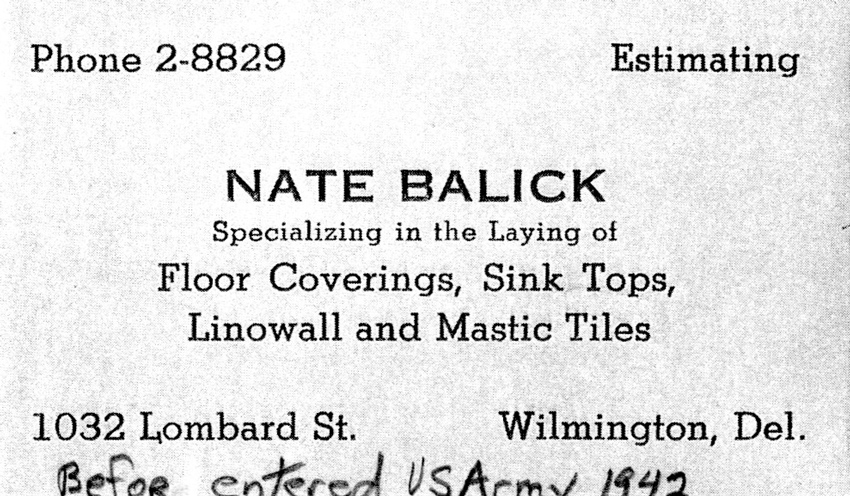
Balick was a leather worker for the Allied Kid Company at 11th and Poplar Streets in Wilmington. He told the Army that he spent two and a half years working as a toggler, stretching wet animal skins on a steel frame, earning $33 per week (about $690 in 2025 dollars). Items in the collection of the Jewish Historical Society of Delaware also indicate that Balick also had a business laying “Floor Coverings, Sink Tops, Linowall and Mastic Tiles” and worked in the family grocery store.

When he registered for the draft on July 1, 1941, Balick was still living at 1032 Lombard Street. The registrar described him as standing about five feet, 10 inches tall and weighing 160 lbs., with brown hair and hazel eyes.
When he joined the U.S. Army, Balick was described as standing five feet, 9½ inches tall and weighing 165 lbs., with brown hair and eyes.
Balick’s younger brother, Dave, also served in the U.S. Army while his stepbrother, Milton, served in the Army Air Forces during World War II.
Military Career
Balick’s personnel file survived the 1973 National Personnel Records Center fire largely intact, meaning there are greater details available about his career than many other servicemen.
Shortly after Pearl Harbor, on December 30, 1941, Wilmington Local Board No. 2 had Balick examined at Camden, New Jersey, finding him qualified for military service. He drafted soon after. On January 9, 1942, he was ordered to report to the Wilmington Armory at 0845 hours on January 28, 1942.

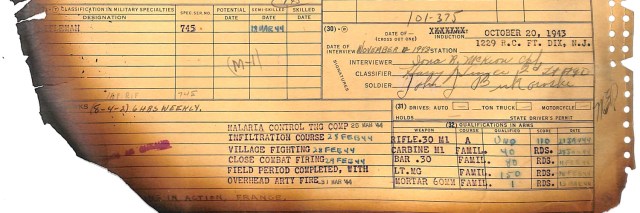
Balick complied with the order and was transported to Fort Dix, New Jersey, where he was examined further. Possibly due to his exposure to tuberculosis, physicians ordered a chest x-ray, which was clear. Balick was inducted and went on active duty the same day, attached unassigned to Company “I,” 1229th Reception Center, Fort Dix, New Jersey. He was issued uniforms, vaccinated, tested, and classified. He departed Fort Dix on February 2, 1942, bound for the Branch Immaterial Replacement Training Center, Fort McClellan, Alabama. That cohort included at least two other Delawareans destined to lose their lives in the service: Harold T. Hitchens (1915–1944) and John J. Paisley (1920–1944). They arrived two days later.
Private Balick attended basic training with Company “C,” 9th Training Battalion. He qualified at the marksman level on the rifle range on February 27, 1942, with a score of 135 on Course “C.” He also qualified at the expert level with the bayonet on April 3, 1942. Balick was transferred to the 26th Infantry Division and departed Fort McClellan on April 7, 1942.

On April 9, 1942, Balick joined Company “K,” 104th Infantry Regiment, 104th at Camp Edwards, Massachusetts. In a roster from the end of that month, his duty code was recorded as 521, basic. The following month, on May 18, 1942, Balick and his unit headed south by train. After passing through Washington, D.C., the following morning, they arrived at Homestead, Florida, on the morning of May 20, and spent the rest of the month stationed at nearby Camp Redland. Morning reports state that Company “K” was stationed at Camp Trout during June 1–10, 1942. Balick’s first M.O.S. was recorded as 745, rifleman, as of June 8, 1942.
Beginning on June 11, 1942, Company “K” was stationed at Camp Bell Haven, near Miami, Florida. They remained there through the summer. On Armistice Day, November 11, 1942, Balick’s unit participated in a parade at Miami Beach, Florida. The following day, they began an overnight training exercise in the Everglades.
On December 26, 1942, Company “K” moved north guard bridges and patrol beaches along a section of coastline including Palm Beach, Vero Beach, Melbourne, and Titusville. Soldiers regularly performed such duties early in the war, though they were largely pointless. The Germans lacked any amphibious capabilities capable of threatening the continental United States and landed only a handful of spies and saboteurs by submarine during the entire war.
Private Balick enjoyed being stationed in Florida. He later recalled in a letter:
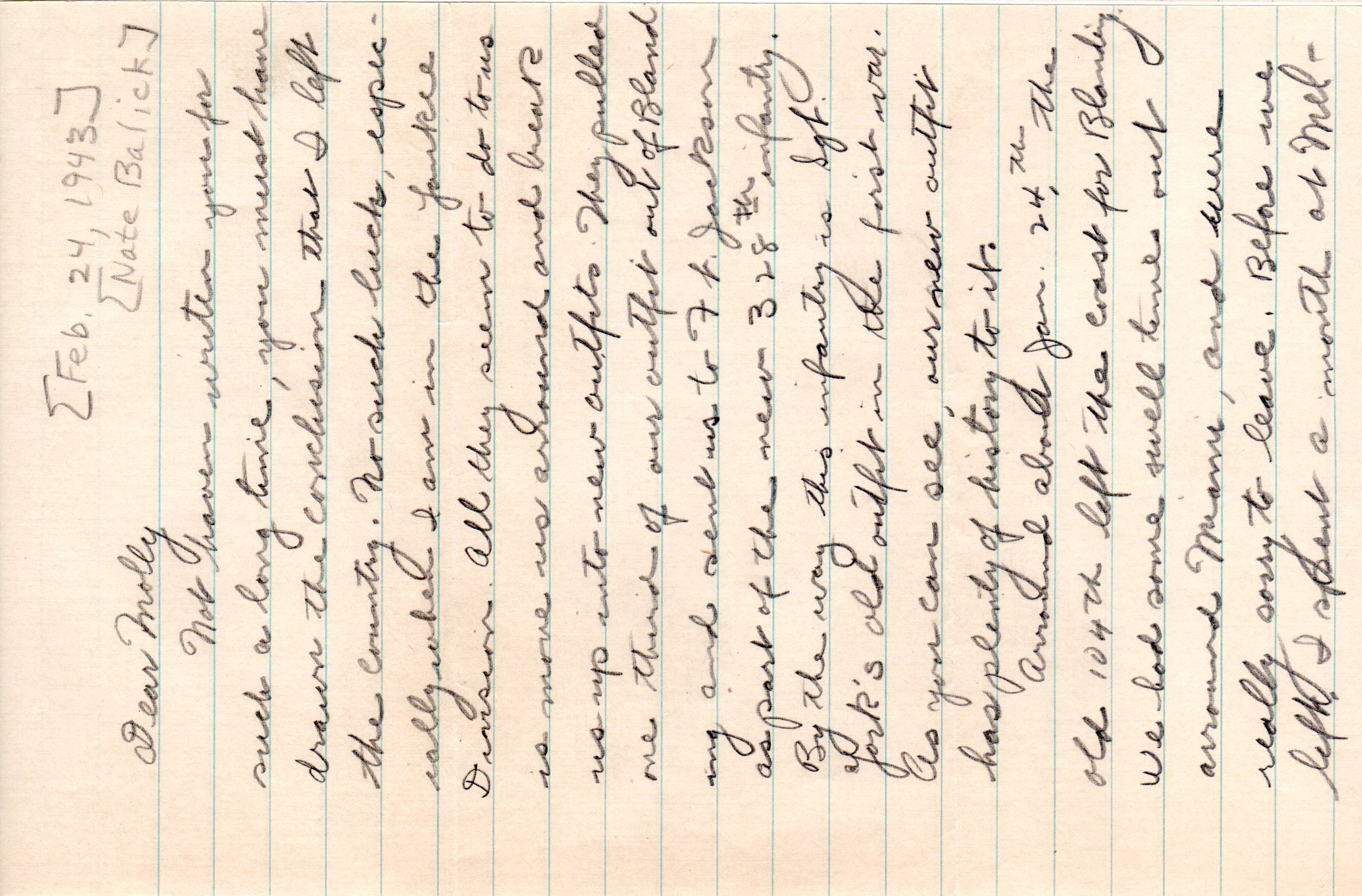
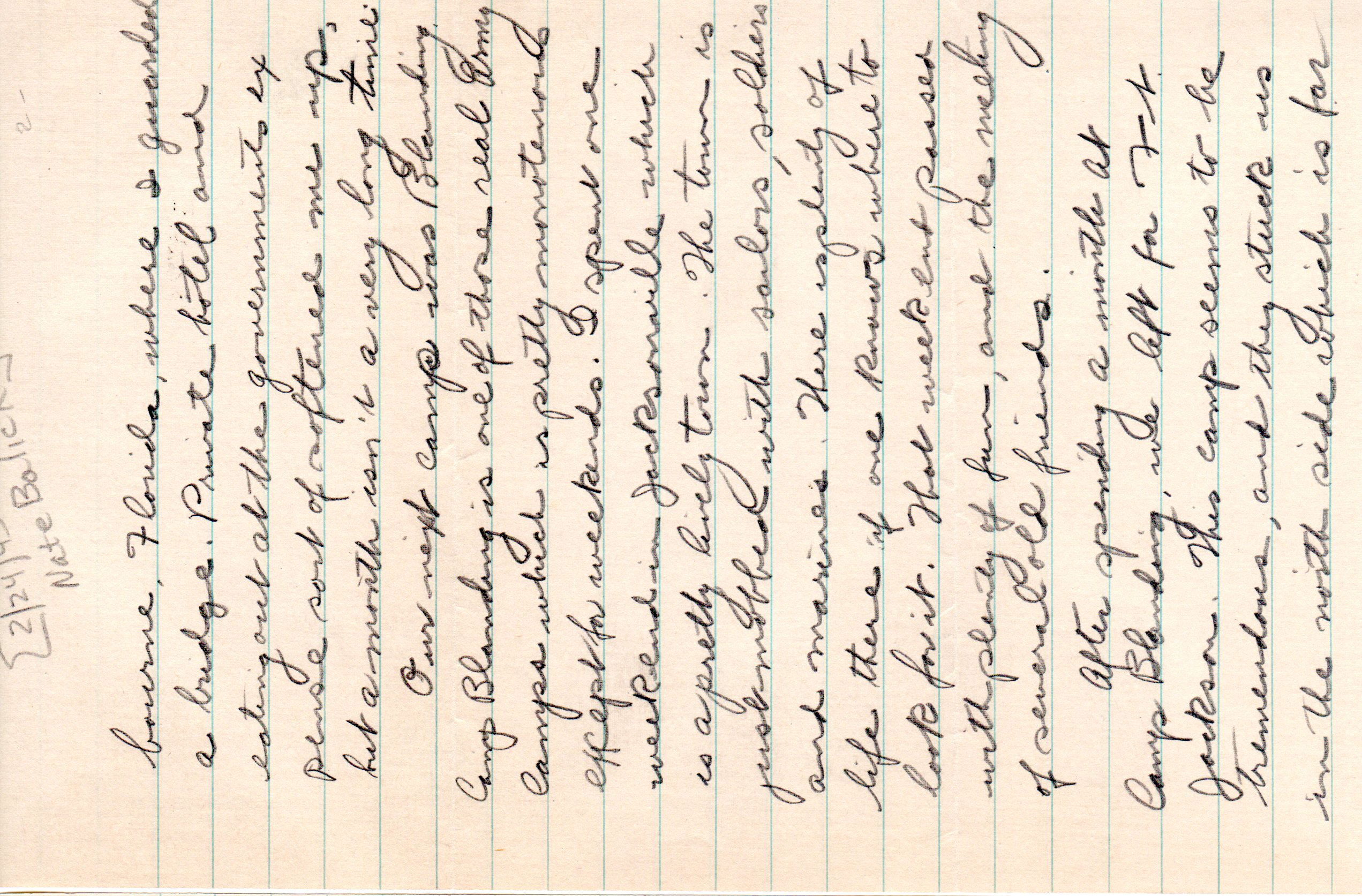
We had some swell times out around Miami, and were really sorry to leave. Before we left, I spent a month at Melbourne, Florida, where I guarded a bridge. Private hotel and eating out at the governments [sic] expense sort of softened me up, but a month isn’t a very long time.

On January 23, 1943, Balick’s unit moved to Miami, but departed there the following evening. They arrived at Camp Blanding, Florida, on the morning of January 25, 1943. Balick later wrote:
Camp Blanding is one of the real Army camps which is pretty monotonous except weekends. I spent one weekend in Jacksonville which is a pretty lively town. The town is just mobbed with sailors, soldiers and marines. There is plenty of life there if one knows where to look for it. That weekend passed with plenty of fun, and the meeting of several old friends.
Balick was transferred to the newly activated 328th Infantry Regiment, 26th Infantry Division per Special Orders No. 41, Headquarters 26th Infantry Division, dated February 15, 1943. He left Company “K,” 104th Infantry at 1900 hours on February 20, 1943. The following day, he joined Company “K,” 328th Infantry Regiment, 26th Infantry Division at Fort Jackson, South Carolina.
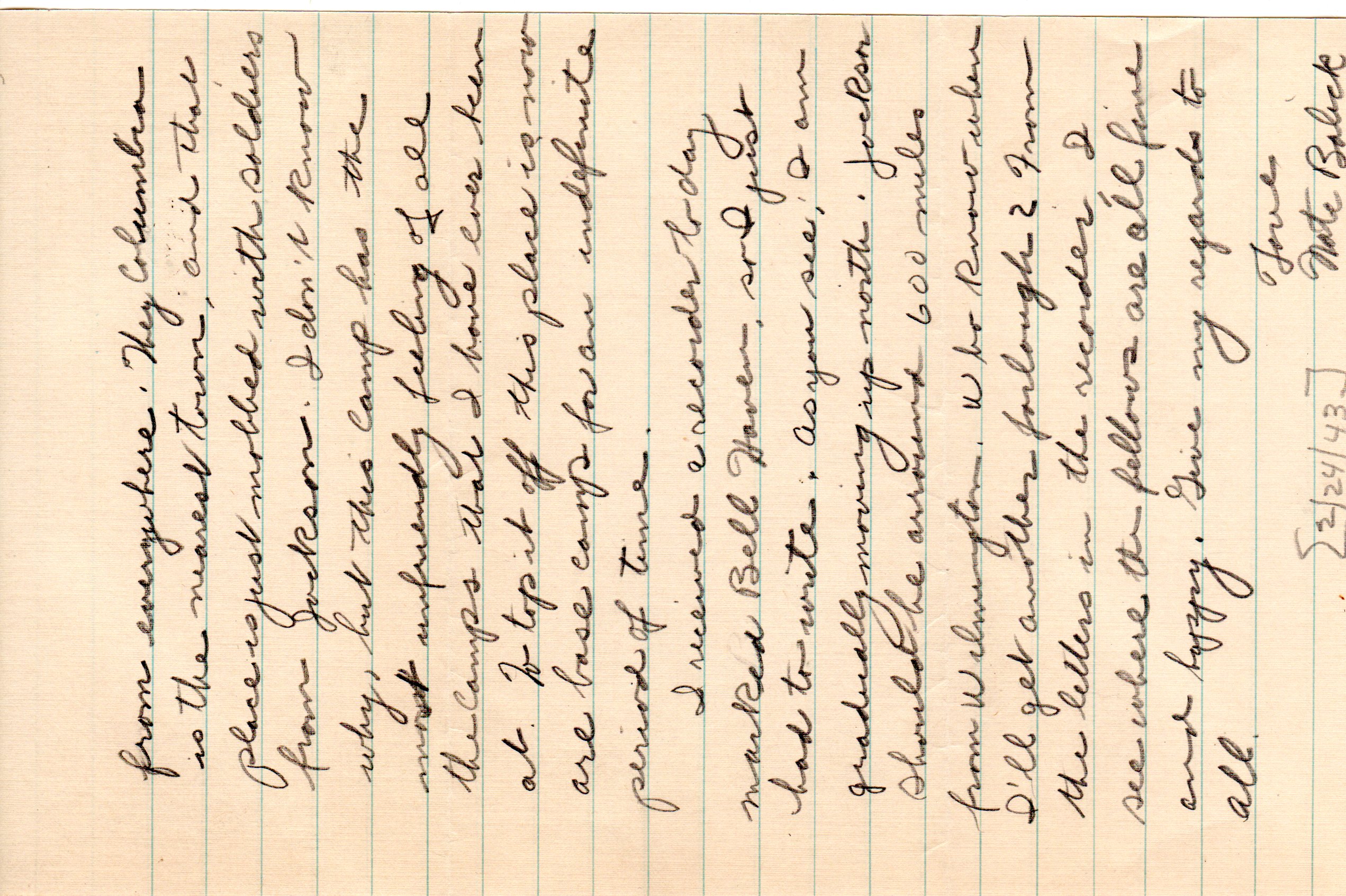
Shortly thereafter, on or about February 24, 1943, Balick wrote to Mollye Sklut (1906–2006), a Wilmington woman who corresponded with Delaware’s Jewish servicemen worldwide. He grumbled:
All they seem to do to us is move us around and break us up into new outfits. They pulled one third of our outfit out of Blanding and sent us to Ft. Jackson as part of the new 328th infantry [sic].
Fort Jackson also did not make nearly as favorable impression on Balick as his previous duty stations:
This camp seems to be tremendous, and they stuck us in the north side which is far from everywhere. […] I don’t know why, but this camp has the most unfriendly feeling of all the camps that I have ever been at.
On the evening of April 19, 1943, Private Balick and his unit boarded a train for the overnight journey to Camp Gordon, Georgia. He was promoted to private 1st class on May 6, 1943. The weather was good that month and Balick’s unit spent a lot of their time in the field.
Private 1st Class Balick qualified as an expert with the 60 mm mortar on May 15, 1943. Shortly thereafter, his M.O.S. changed to 504, ammunition bearer, with an excellent rating as of June 6, 1943. Given his recent qualification on the mortar, it is likely that he was an ammunition bearer for one of his company’s three mortar squads, which would have made him a member of his company’s 4th Platoon (Weapons Platoon). However, there were also ammunition bearers assigned to rifle and machine gun squads.
Balick completed a weeklong infiltration course on July 18, 1943. He went on furlough August 18–27, 1943.
Company “K” departed Camp Gordon by road on the morning of September 2, 1943. After stops at Cartersville, Georgia, and Fayetteville, Tennessee, the unit arrived at Camp Campbell, Kentucky, on September 11, 1943. Balick was awarded the Good Conduct Medal on November 4, 1943. He went on emergency furlough December 2–10, 1943. His M.O.S. was reclassified as 405, clerk-typist, on December 21, 1943. He was subsequently reclassified back to ammunition bearer on an unknown date prior to April 12, 1944.
Private 1st Class Balick was transferred for the final time on December 31, 1943. On January 1 or 2, 1944, he joined Company “K,” 120th Infantry Regiment, 30th Infantry Division at Camp Atterbury, Indiana. That unit was preparing to go overseas. Another Delawarean who transferred into Balick’s battalion around the same time was Private Robert L. Gamble (1915–1944), who joined Company “L.”

Balick’s last furlough before going overseas began on January 16, 1944. He returned to duty on January 22, 1944. On January 31, 1944, Balick and the other entrained for the overnight journey to Camp Myles Standish, Massachusetts, via Pittsburgh, Pennsylvania.
On February 9, 1944, Private 1st Class Balick and his regiment moved by train to the Boston Port of Embarkation, where they boarded the ocean liner turned troop transport S.S. Argentina. They shipped out on February 12, 1944, arriving 10 days later at Gourock, Scotland. Company “K” disembarked at 1710 hours on the evening of February 25, 1944, and boarded a train. It was another day before they arrived at their destination, Bognor Regis, West Sussex, on the south coast of England. With the invasion of Normandy about three months away, Balick and his comrades continued training. On March 26, 1944, Balick and the others moved to Warminster, Wiltshire, by road, returning on April 1. Five days after that, they moved by motor convoy to Hartwell House, Buckinghamshire.
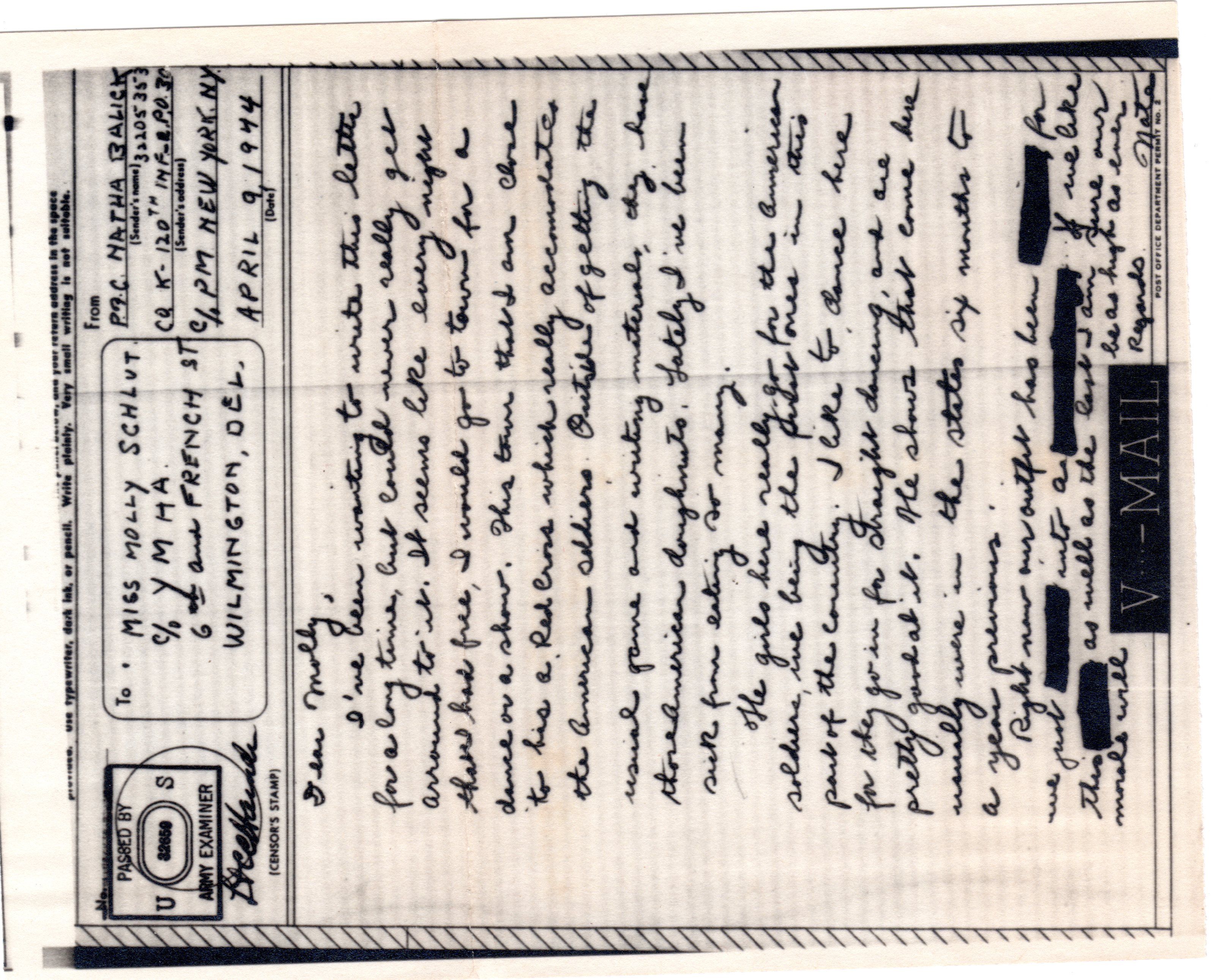
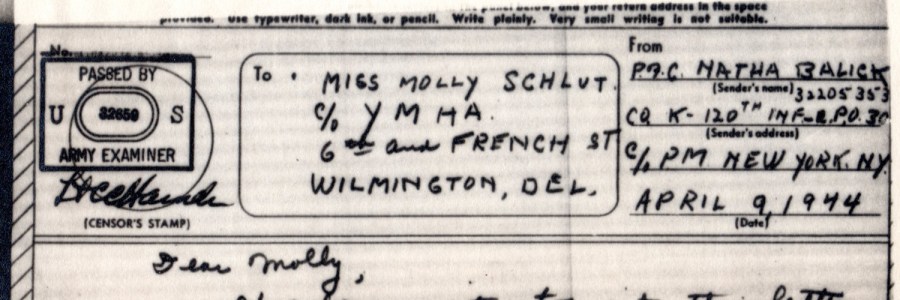
On April 9, 1944, Balick wrote to Mollye Sklut:
I’ve been wanting to write this letter for a long time, but could never really get arround [sic] to it. It seems like every night that I’ve had free, I would go to town for a dance or a show. This town that I am close to has a Red Cross which really accommodates the American soldiers. Outside of getting he usual game and writing materials, they have those American doughnuts. Lately I’ve been sick from eating so many.
The girls here really go for the American soldiers, we being the first ones in this part of the country. I like to dance here for they go in for straight dancing, and are pretty good at it. The shows that come here usually were in the states six months to a year previous.

On April 12, 1944, Balick and 2nd Lieutenant Wallis G. Nash went on a detached service with the British Army but rejoined Company “K” on April 26, 1944. On April 30, 1944, the company went to Darsham, Suffolk, for a field training exercise, returning to Hartwell House on May 2.
Combat in Normandy
On June 8, 1944, two days after D-Day in Normandy, Private 1st Class Balick and his unit moved by train to Hursley, Hampshire, near Southampton. Late on June 11, 1944, Company “K” boarded a Canadian vessel, H.M.C.S. LCI(L)-271. They sailed for the continent one day later, disembarking at Omaha Beach, Normandy, around 1930 hours on June 13. It was one week into the invasion and with the Battle of Normandy still raging, there was little delay in the 120th Infantry going into combat. The Allies were pouring men and equipment into the beachheads, while the German defenders fought tooth and nail for every hedgerow.
On June 14, 1944, the 120th Infantry took up positions north of the Carentan–Airel railroad line. 2nd and 3rd Battalions began their first attack at 0800 hours the following morning, June 15, 1944. 2nd Battalion’s objective was Montmartin-en-Graignes, while Balick’s 3rd Battalion’s objective was nearby La Comté. A regimental report stated:
The 3rd Battalion after pushing a half mile down the St.Lo [sic] road had been held up by MG [machine gun] and 88 [mm artillery] fire centered about a house near the bend in the road. Supported by Division Artillery, the battalion broke through here and pushed on to the junction of the Fourniere–Montmartin road, the important axis of lateral communications with the 2nd Battalion. This road was found to be mined and, in addition, sharp resistance was encountered from bicycle troops, single riflemen in trees, and small groups of riflemen fighting from the hedgerows.
Supported by armor and artillery, 3rd Battalion broke through this resistance and captured La Comté that afternoon. The day’s Company “K” morning report recorded casualties of two killed and eight wounded. During the next two days, the 120th Infantry completed their advance to the north side of the Canal de Vire et Taute, but the Germans continued to hold south side. The 120th Infantry spent the next three weeks patrolling along the canal and training. An after action report noted that “reserve units of the regiment conducted joint infantry-tank training with elements of the 743d Tank Battalion[.]”
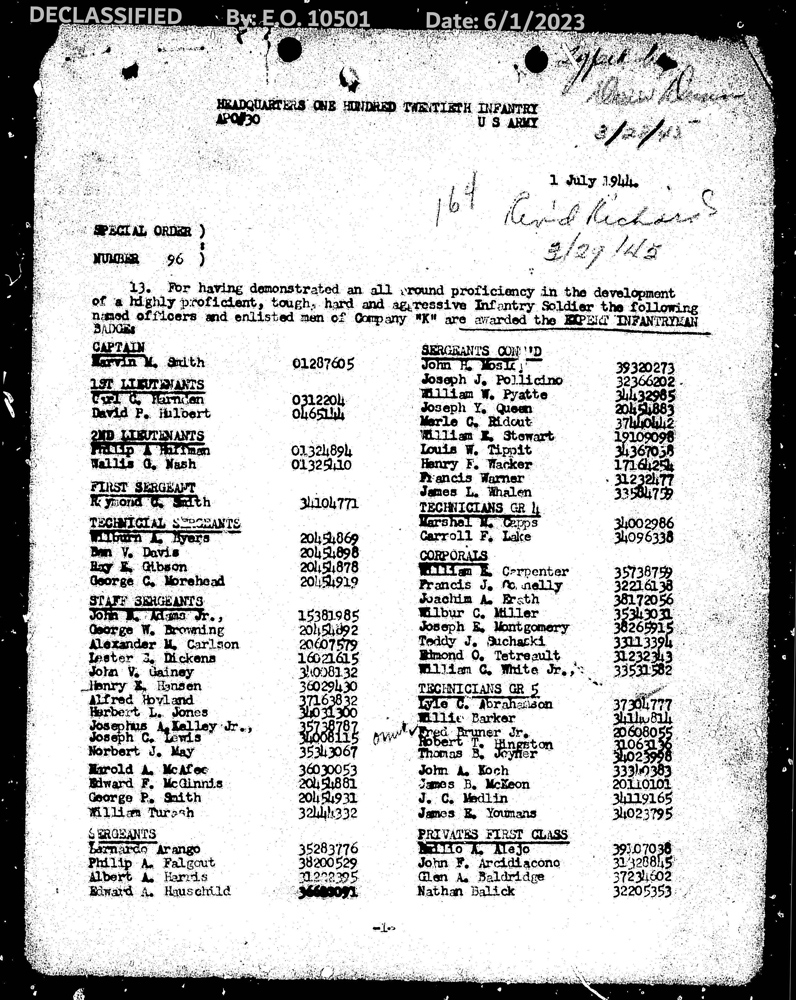
Private 1st Class Balick was awarded the Expert Infantryman Badge per Special Orders No. 96, Headquarters 120th Infantry, dated July 1, 1944. He also should have been eligible for the Combat Infantryman Badge but there is no indication that he ever received it.
On July 7, 1944, the 30th Infantry Division began a new offensive. At 1345 hours, 1st and 3rd Battalions of the 120th Infantry, with tank and engineer support, surged across the canal and fought their way south against heavy opposition, reaching the area southeast of Saint-Jean-de-Daye. They continued their advance the next day. The division after action report stated that on July 9, 1944, “3rd Battalion holding crest of hill North of [Le Dézert] received continuous pressure from enemy during day, was relieved by one Battalion of the 9th Infantry Division and moved to support 1st and 2d Battalions[.]”
At 1055 hours on July 10, 1944, the 120th Infantry, supported by the 743rd Tank Battalion, continued their advance south with “1st and 3d Battalions in column, against stubborn enemy resistance[.]”
The division after action report described a chaotic incident that occurred that night:
On the evening of 10 July, the 3d Battalion, 120th Infantry, moved into position at [Le Rocher] and dug-in, establishing road blocks and all around security. Unit had been informed that friendly tanks were in front of their position and during darkness on the [morning] of 11 July, a German tank and infantry column neared Battalion’s road block. The guards led them through because they believed the column was friendly. A few minutes later orders were heard in German and the Battalion Command Post was notified at once. The Battalion was alerted and proceeded to knock out and mop up everything that got through, and sent antitank riflemen and bazooka squads down the main column knocking out everything it could find. A count the next morning revealed that five tanks and 4 armored scout cars, two of which carried mounted flame throwers and the others mounting light field pieces, had been completed knocked out.
Despite their busy night, 3rd Battalion was ordered to resume their attack later that morning at 1100 hours. A postwar regimental history stated: “Shortly after the jump-off the air became heavy with shells when an artillery concentration saturated the area. German artillery was zeroing in from the Line of Departure back to the Battalion CP [command post].”
A German counterattack hit 3rd Battalion but the enemy did not press their attack. The history continued: “It was dark when finally the line became stabilized and the artillery died down. The battalion had gained a few hundred yards. It had been a hard day.”
Private 1st Class Balick was reported killed in action sometime that day, July 11, 1944. According to his emergency medical tag, he was struck in the back of the head by shell fragments and killed. He was posthumously awarded the Purple Heart.
Private 1st Class Balick was initially buried on July 15, 1944, in a temporary military cemetery at La Cambe, France. Unaware of what had happened, his brother, Private 1st Class Dave Balick of Company “A,” 294th Engineer Combat Battalion, wrote to Mollye Sklut on July 24, 1944, stating in part: “My brother Nate is near me but I am unable to see him just now. Maybe in the future we’ll get together.” He added: “Nate is just fine as I and in the best of health[.]”
On July 30, 1944, the War Department dispatched a condolence telegram to his father. The sad news was published in Journal-Every Evening the following day.
It took longer for word to reach Balick’s family members serving overseas.
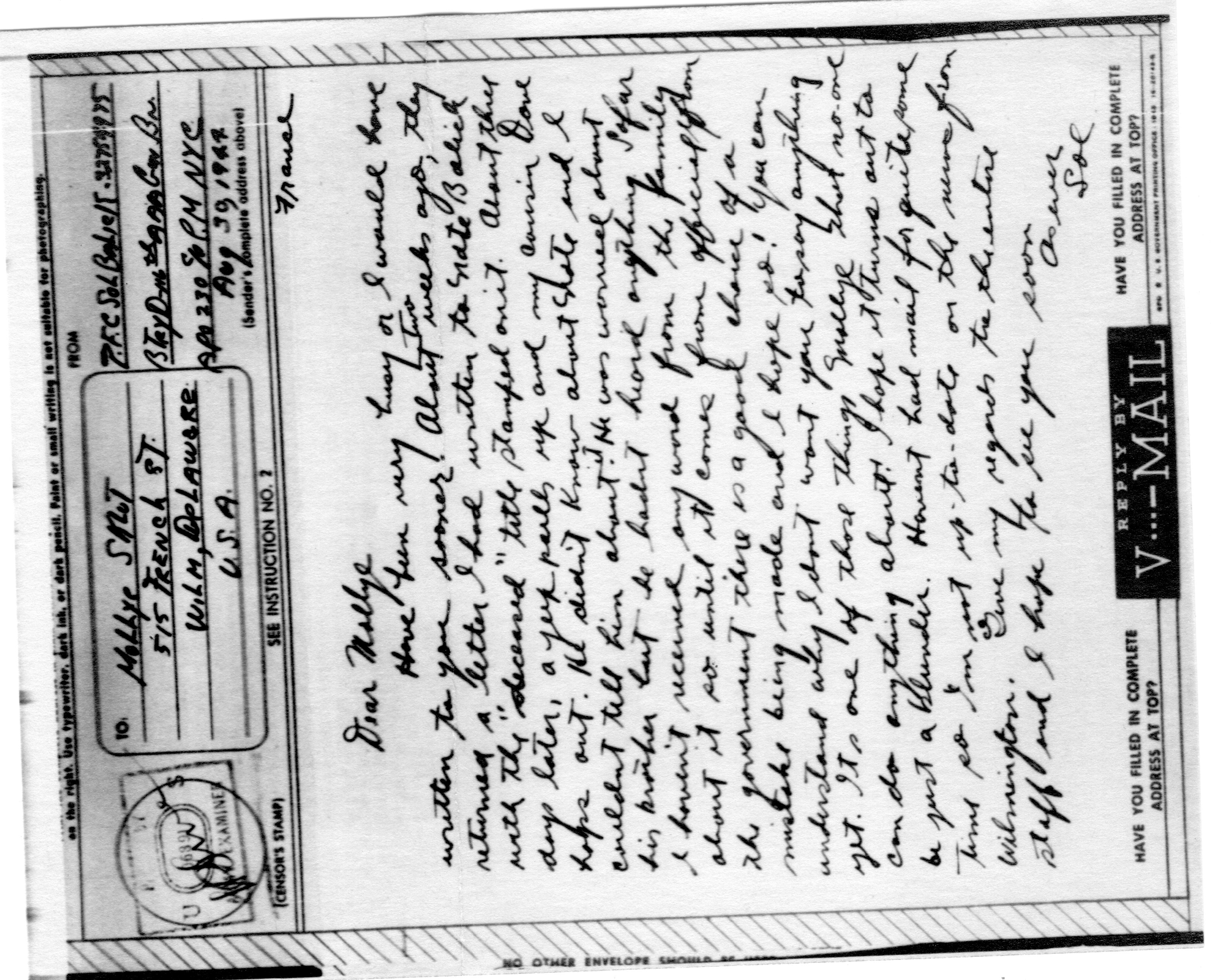
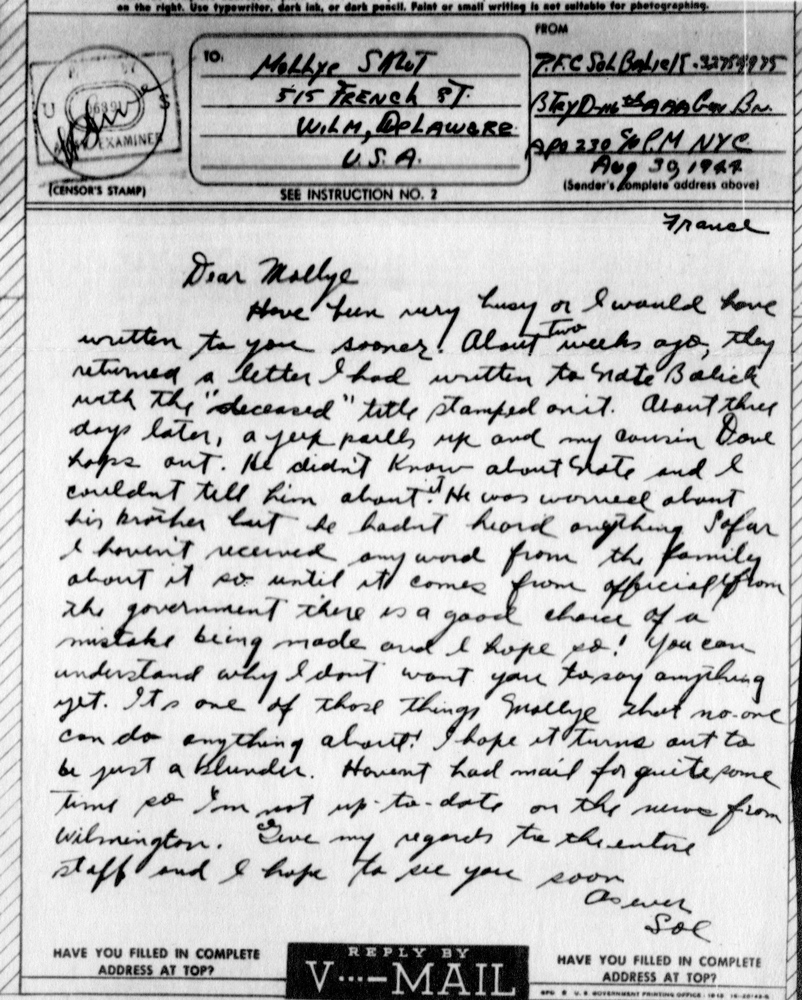
Balick’s first cousin, Private 1st Class Sol Balick (1924–2009) of Battery “D,” 116th Antiaircraft Gun Battalion, wrote to Sklut on August 30, 1944:
About two weeks ago, they returned a letter I had written to Nate Balick with the “deceased” title stamped on it. About three days later, a jeep pulls up and my cousin Dave hops out. He didn’t know about Nate and I couldn’t tell him about it. He was worried about his brother but he hadn’t heard anything. So far I haven’t received any word from the family about it so until it comes from official from the government there is a good chance of a mistake being made and I hope so!
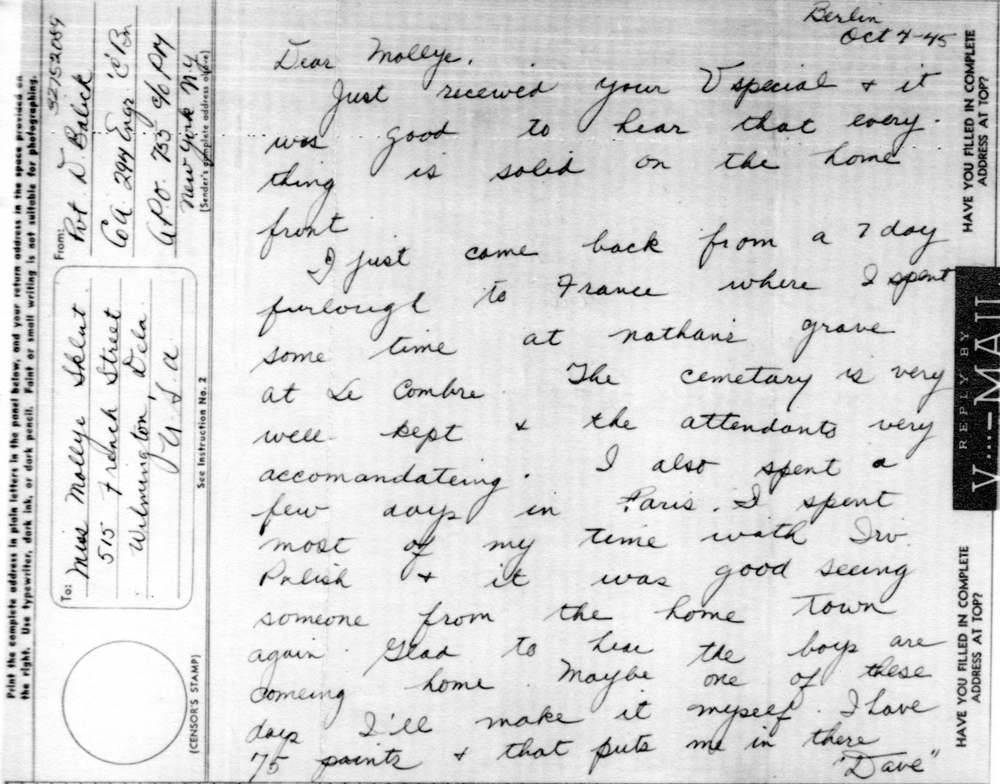
After the war was over on October 4, 1945, Balick’s brother wrote to Sklut:
I just came back from a 7 day furlough to France where I spent some time at Nathan’s grave at La Combre [sic]. The cemet[e]ry is very well kept & the attendants very [accommodating]. I also spent a few days in Paris.
In 1948, Balick’s father requested that his son’s body be repatriated to the United States. Later that year, his casket returned home from Cherbourg, France, to the New York Port of Embarkation aboard the Carroll Victory. After services at the Chandler Funeral Home in Wilmington on October 31, 1948, Balick was buried in the Jewish section of Lombardy Cemetery, now known as the Jewish Community Cemetery. His parents and several siblings are also buried there.
Private 1st Class Balick’s name is honored on a memorial at the Jewish Community Cemetery and at Veterans Memorial Park in New Castle, Delaware. He is also the namesake of Nathan Balick Post No. 747 of the Jewish War Veterans of the United States. He was also honored on a plaque displayed at Pierre S. duPont High School.
Acknowledgments
Special thanks to Jewish Historical Society of Delaware for contributing photos and letters, and to the Delaware Public Archives for the use of their photo.
Bibliography
“3 Delaware Men Killed in Normandy.” Journal-Every Evening, July 31, 1944. https://www.newspapers.com/article/90073931/
“299 Get Diplomas From du Pont High.” The Philadelphia Inquirer, June 26, 1937. https://www.newspapers.com/article/186031456/
“After Battle Report, Headquarters 30th Infantry Division, G-3 Section, Period 1 July 1944 – 31 July 1944.” Undated, c. 1944. 30th Infantry Division Old Hickory website. https://www.oldhickory30th.com/After%20Action%20report%2030th%20July%201-31%201944.pdf
Balick, David A. Letter to Mollye Sklut. July 24, 1944. Dear Mollye Letters. Courtesy of the Jewish Historical Society of Delaware. https://jhsdelaware.org/collections/digital/files/original/5ede115393f7676d4b00b5888dfb7f6d.jpg
Balick, David A. Letter to Mollye Sklut. October 4, 1945. Dear Mollye Letters. Courtesy of the Jewish Historical Society of Delaware. https://jhsdelaware.org/collections/digital/files/original/300f6d20df7bbbc1b256494534ffdb50.jpg
Balick, Nathan. Letter to Mollye Sklut. April 9, 1944. Dear Mollye Letters. Courtesy of the Jewish Historical Society of Delaware. https://jhsdelaware.org/collections/digital/files/original/718a800fd0d34a4c4b43421e55a6eb5a.jpg
Balick, Nathan. Letter to Mollye Sklut. Undated, c. February 24, 1943. Dear Mollye Letters. Courtesy of the Jewish Historical Society of Delaware. https://jhsdelaware.org/collections/digital/files/original/47225c423c71c5f78a9dad65a6151e50.jpg, https://jhsdelaware.org/collections/digital/files/original/dec3a4ebab9b101ae2df03030fcfe886.jpg, https://jhsdelaware.org/collections/digital/files/original/b0b7b5675845ed29e174eaaa196ccb00.jpg
Balick, Sol. Letter to Mollye Sklut. August 30, 1944. Dear Mollye Letters. Courtesy of the Jewish Historical Society of Delaware. https://jhsdelaware.org/collections/digital/files/original/4901e294c85589419fc70761faf09e0e.jpg
Census Record for Nathan Balck [sic]. April 15, 1940. Sixteenth Census of the United States, 1940. Record Group 29, Records of the Bureau of the Census. National Archives at Washington, D.C. https://www.familysearch.org/ark:/61903/3:1:3QSQ-G9MR-MSKC
Census Record for Nathan Beleck [sic]. January 3, 1920. Fourteenth Census of the United States, 1920. Record Group 29, Records of the Bureau of the Census. National Archives at Washington, D.C. https://www.familysearch.org/ark:/61903/3:1:33SQ-GR6C-XXM
Certificate of Birth for Nathan Bailicr [sic]. November 1919. Record Group 1500-008-094, Birth Certificates. Delaware Public Archives, Dover, Delaware. https://www.familysearch.org/ark:/61903/3:1:S3HT-D4X3-2P3
Certificate of Death for Jennie Balick. March 1937. Record Group 1500-008-092, Death Certificates. Delaware Public Archives, Dover, Delaware. https://www.familysearch.org/ark:/61903/3:1:3Q9M-CSMJ-Y715-Z
Certificate of Death for Joseph Cohen. July 1936. Record Group 1500-008-092, Death Certificates. Delaware Public Archives, Dover, Delaware. https://www.familysearch.org/ark:/61903/3:1:S3HT-6QNQ-WWD
Certificate of Death for Milton Balick. October 1918. Record Group 1500-008-092, Death Certificates. Delaware Public Archives, Dover, Delaware. https://www.familysearch.org/ark:/61903/3:1:3Q9M-C9BB-Q9KR-Q
Certificate of Death for Mina Balick. November 1935. Record Group 1500-008-092, Death Certificates. Delaware Public Archives, Dover, Delaware. https://www.familysearch.org/ark:/61903/3:1:S3HT-69BF-SL
Certificate of Death for Shirley Balick. June 27, 1955. Record Group 1500-008-093, Marriage Certificates. Delaware Public Archives, Dover, Delaware. https://www.familysearch.org/ark:/61903/3:1:3Q9M-CS9N-1Q99-N
“Death Notices.” Journal-Every Evening, October 30, 1948. https://www.newspapers.com/article/183023040/
Declaration of Intention for Rubin Balick. January 2, 1929. Declarations of Intention for Citizenship, 1817–1990. Record Group 21, Records of District Courts of the United States, 1685–2009. National Archives at Philadelphia, Pennsylvania. https://catalog.archives.gov/id/123669857?objectPage=1051
Declaration of Intention for Rubin Balick. May 4, 1917. Petitions for Naturalization, 1865–1991. Record Group 21, Records of District Courts of the United States, 1685–2009. National Archives at Philadelphia, Pennsylvania. https://www.familysearch.org/ark:/61903/3:1:3Q9M-CS98-F76S-N
Deed Between Rubin Balick and Jennie Balick, Parties of the First Part and Isadore Balick, Party of the Second Part. January 11, 1932. Delaware Land Records, 1677–1947. Record Group 2555-000-011, Recorder of Deeds, New Castle County. Delaware Public Archives, Dover, Delaware. https://www.ancestry.com/imageviewer/collections/61025/images/31303_257054-00401
Draft Registration Card for Dave Aaron Balick. June 30, 1942. Draft Registration Cards for Delaware, October 16, 1940 – March 31, 1947. Record Group 147, Records of the Selective Service System. National Archives at St. Louis, Missouri. https://www.familysearch.org/ark:/61903/3:1:3Q9M-CSMG-X9RT-J
Draft Registration Card for Milton Cohen. June 30, 1942. Draft Registration Cards for Delaware, October 16, 1940 – March 31, 1947. Record Group 147, Records of the Selective Service System. National Archives at St. Louis, Missouri. https://www.familysearch.org/ark:/61903/3:1:3Q9M-CSMG-X9D8-P
Draft Registration Card for Nathan Balick. July 1, 1941. Draft Registration Cards for Delaware, October 16, 1940 – March 31, 1947. Record Group 147, Records of the Selective Service System. National Archives at St. Louis, Missouri. https://www.familysearch.org/ark:/61903/3:1:3Q9M-CSMG-X9TW-N
“Draft Serial Numbers.” Journal-Every Evening, July 11, 1941. https://www.newspapers.com/article/183023349/
Enlistment Record for Nathan Balick. January 28, 1942. World War II Army Enlistment Records. Record Group 64, Records of the National Archives and Records Administration. National Archives at College Park, Maryland. https://aad.archives.gov/aad/record-detail.jsp?dt=893&mtch=1&cat=all&tf=F&q=32205353&bc=&rpp=10&pg=1&rid=2849072
“Frances M. Klein.” Find a Grave. https://www.findagrave.com/memorial/160701510/frances-m-klein
History of the 120th Infantry Regiment. Infantry Journal Press, 1947. https://digicom.bpl.lib.me.us/cgi/viewcontent.cgi?article=1221&context=ww_reg_his
Individual Deceased Personnel File for Nathan Balick. Individual Deceased Personnel Files, 1939–1953. Record Group 92, Records of the Office of the Quartermaster General, 1774–1985. National Archives at St. Louis, Missouri.
“Miss Mina Balick.” Journal-Every Evening, November 27, 1935. https://www.newspapers.com/article/185390506/
“Milton Cohen.” Find a Grave. https://www.findagrave.com/memorial/82949515/milton-cohen
“Monthly Personnel Roster Apr 30 1942 Company K 104th Inf Regt.” April 30, 1942. U.S. Army Muster Rolls and Rosters, November 1, 1912 – December 31, 1943. Record Group 64, Records of the National Archives and Records Administration. National Archives at St. Louis, Missouri. https://s3.amazonaws.com/NARAprodstorage/lz/st-louis/rg-064/85713803_1940-1943/85713803_1940-1943_Roll-1635/85713803_1940-1943_Roll-1635_15.pdf
“Montmartin-en-Grainges [sic] June 15, 16, 1944.” Undated, c. 1944. 30th Infantry Division Old Hickory website. https://www.oldhickory30th.com/120thJune1516Montmartin.pdf
“More Than 1,100 Delaware War Casualties Reported.” Journal-Every Evening, December 7, 1944. https://www.newspapers.com/article/183298010/
Morning Reports for Company “I,” 1229th Reception Center. February 1942. U.S. Army Morning Reports, c. 1912–1946. Record Group 64, Records of the National Archives and Records Administration. National Archives at St. Louis, Missouri. https://s3.amazonaws.com/NARAprodstorage/lz/partners/st-louis/rg-064/85713825-wwii/85713825_1940-01-thru-1943-07/85713825_1940-01-thru-1943-07_Roll-2854/85713825_1940-01-thru-1943-07_Roll-2854-08.pdf
Morning Reports for Company “K,” 104th Infantry Regiment. April 1942 – February 1943. U.S. Army Morning Reports, c. 1912–1946. Record Group 64, Records of the National Archives and Records Administration. National Archives at St. Louis, Missouri. https://s3.amazonaws.com/NARAprodstorage/lz/partners/st-louis/rg-064/85713825-wwii/85713825_1940-01-thru-1943-07/85713825_1940-01-thru-1943-07_Roll-1672/85713825_1940-01-thru-1943-07_Roll-1672-31.pdf, https://s3.amazonaws.com/NARAprodstorage/lz/partners/st-louis/rg-064/85713825-wwii/85713825_1940-01-thru-1943-07/85713825_1940-01-thru-1943-07_Roll-1672/85713825_1940-01-thru-1943-07_Roll-1672-32.pdf, https://s3.amazonaws.com/NARAprodstorage/lz/partners/st-louis/rg-064/85713825-wwii/85713825_1940-01-thru-1943-07/85713825_1940-01-thru-1943-07_Roll-1672/85713825_1940-01-thru-1943-07_Roll-1672-33.pdf
Morning Reports for Company “K,” 120th Infantry Regiment. January 1944 – July 1944. U.S. Army Morning Reports, c. 1912–1946. Record Group 64, Records of the National Archives and Records Administration. National Archives at St. Louis, Missouri. https://s3.amazonaws.com/NARAprodstorage/lz/partners/st-louis/rg-064/85713825-wwii/85713825_1944-01/85713825_1944-01_Roll-0173/85713825_1944-01_Roll-0173-08.pdf, https://s3.amazonaws.com/NARAprodstorage/lz/partners/st-louis/rg-064/85713825-wwii/85713825_1944-01/85713825_1944-01_Roll-0258/85713825_1944-01_Roll-0258-24.pdf, https://s3.amazonaws.com/NARAprodstorage/lz/partners/st-louis/rg-064/85713825-wwii/85713825_1944-02/85713825_1944-02_Roll-0638/85713825_1944-02_Roll-0638-24.pdf, https://s3.amazonaws.com/NARAprodstorage/lz/partners/st-louis/rg-064/85713825-wwii/85713825_1944-03/85713825_1944-03_Roll-0633/85713825_1944-03_Roll-0633-15.pdf, https://s3.amazonaws.com/NARAprodstorage/lz/partners/st-louis/rg-064/85713825-wwii/85713825_1944-03/85713825_1944-03_Roll-0633/85713825_1944-03_Roll-0633-16.pdf, https://s3.amazonaws.com/NARAprodstorage/lz/partners/st-louis/rg-064/85713825-wwii/85713825_1944-04/85713825_1944-04_Roll-0503/85713825_1944-04_Roll-0503-23.pdf, https://s3.amazonaws.com/NARAprodstorage/lz/partners/st-louis/rg-064/85713825-wwii/85713825_1944-05/85713825_1944-05_Roll-0463/85713825_1944-05_Roll-0463-21.pdf, https://s3.amazonaws.com/NARAprodstorage/lz/partners/st-louis/rg-064/85713825-wwii/85713825_1944-06/85713825_1944-06_Roll-0668/85713825_1944-06_Roll-0668-29.pdf, https://s3.amazonaws.com/NARAprodstorage/lz/partners/st-louis/rg-064/85713825-wwii/85713825_1944-07/85713825_1944-07_Roll-0501/85713825_1944-07_Roll-0501-28.pdf
Morning Reports for Company “K,” 328th Infantry Regiment. February 1943 – July 1943. U.S. Army Morning Reports, c. 1912–1946. Record Group 64, Records of the National Archives and Records Administration. National Archives at St. Louis, Missouri. https://s3.amazonaws.com/NARAprodstorage/lz/partners/st-louis/rg-064/85713825-wwii/85713825_1940-01-thru-1943-07/85713825_1940-01-thru-1943-07_Roll-1887/85713825_1940-01-thru-1943-07_Roll-1887-02.pdf, https://s3.amazonaws.com/NARAprodstorage/lz/partners/st-louis/rg-064/85713825-wwii/85713825_1940-01-thru-1943-07/85713825_1940-01-thru-1943-07_Roll-1887/85713825_1940-01-thru-1943-07_Roll-1887-03.pdf
Morning Reports for Company “K,” 328th Infantry Regiment. September 1943. U.S. Army Morning Reports, c. 1912–1946. Record Group 64, Records of the National Archives and Records Administration. National Archives at St. Louis, Missouri. https://s3.amazonaws.com/NARAprodstorage/lz/partners/st-louis/rg-064/85713825-wwii/85713825_1943-09/85713825_1943-09_Roll-0199/85713825_1943-09_Roll-0199-20.pdf
Official Military Personnel File for Nathan Balick. Official Military Personnel Files, 1912–1998. Record Group 319, Records of the Army Staff. National Archives at St. Louis, Missouri.
Petition for Citizenship for Rubin Balick. July 21, 1933. Petitions for Naturalization, 1865–1991. Record Group 21, Records of District Courts of the United States, 1685–2009. National Archives at Philadelphia, Pennsylvania. https://www.ancestry.com/imageviewer/collections/1554/images/32126_23176050591427-01051
Polk’s Wilmington (New Castle County, Del.) City Directory 1934-35. R. L. Polk & Company Publishers, 1934. https://www.ancestry.com/imageviewer/collections/2469/images/16084041
Schwartz, Anne. Individual Military Service Record for Nathan Balick. April 22, 1945. Record Group 1325-003-053, Record of Delawareans Who Died in World War II. Delaware Public Archives, Dover, Delaware. https://cdm16397.contentdm.oclc.org/digital/collection/p15323coll6/id/17580/rec/15
“Sol Balick.” The News Journal, January 3, 2010. https://www.newspapers.com/article/185348948/
“Special Order Number 96, Headquarters One Hundred Twentieth Infantry.” July 1, 1944. Army General Orders, 1940–1957. Record Group 64, Records of the National Archives and Records Administration. National Archives at St. Louis, Missouri. https://catalog.archives.gov/id/467315437?objectPage=185
Last updated on December 1, 2025
More stories of World War II fallen:









To have new profiles of fallen soldiers delivered to your inbox, please subscribe below.
 Delaware's World War II Fallen