
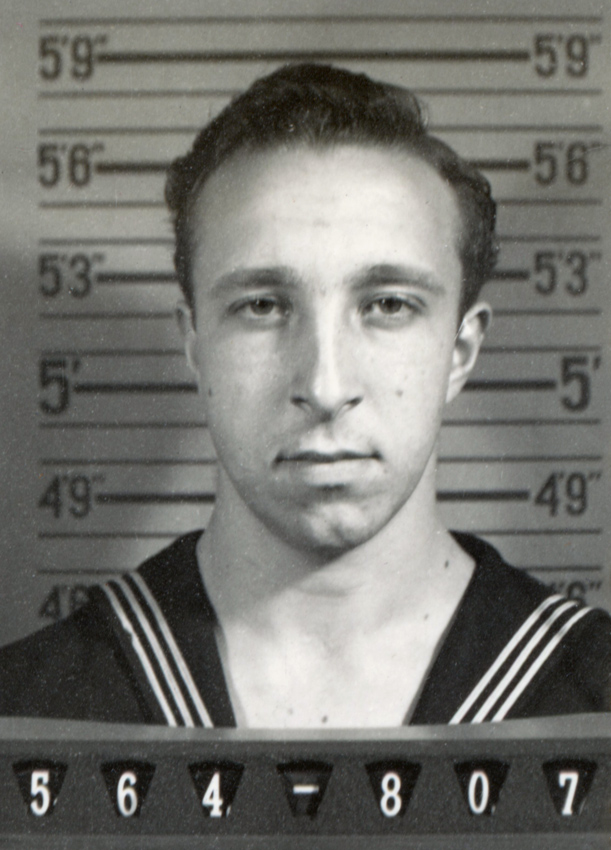
| Hometown | Civilian Occupation |
| Wilmington, Delaware | Rodman for Charles T. Main Engineering Company |
| Branch | Service Number |
| U.S. Coast Guard Reserve | 564-807 |
| Theater | Vessel |
| Mediterranean | U.S.S. Menges (DE-320) |
Author’s note: This article incorporates text from my previous piece, Fireman 1st Class Howard J. Woods (1922–1944), another Delawarean who served in the same damage control team aboard U.S.S. Menges (DE-320).
Early Life & Family
Joseph Lawrence Hoodock, Jr. was born at 306 South Claymont Street in Wilmington, Delaware, on July 30, 1923. He was the second child of Joseph Lawrence Hoodock, Sr. (a molder at a foundry and later a shipyard worker, 1891–after 1956) and Mabel Hoodock (née Mabel Mary Pemberton, c. 1891–1929). He had an older sister, Veronica Marie Hoodock (later Garyantes, 1913–1996). Hoodock was Catholic.
The family had moved to 517 South Heald Street in Wilmington prior to February 17, 1929, when Hoodock’s mother died from a chronic illness. He was just five years old.
A ninth birthday announcement printed in The Evening Journal on July 30, 1932, stated: “Joseph is a member of Christ Our King school. One of his great delights is to go fishing with his father.”
The 1930 and 1940 censuses recorded Hoodock as living with his father at 3021 Madison Street in Wilmington, the home of his uncle, John A. Hoodock (1885–1957), and his aunt, Bertha A. Hoodock (née Voelker, 1899–1960). Including his cousins, eight members of the Hoodock family shared the home.
Journal-Every Evening reported that Hoodock “had attended the Christ Our King Parochial School. He was an altar boy at that church.” He was an average student. Hoodock compiled a general average of 2.917 out of 4 while attending Pierre S. duPont High School, ranking 183rd of 280 students in his class. He graduated in June 1942.
Later that month, when Hoodock registered for the draft on June 30, 1942, he was still living at 3021 Madison Street. The registrar described him as standing about five feet, 10 inches tall and weighing 145 lbs., with brown hair and eyes.
The same month that he graduated, Hoodock began working for the Charles T. Main Engineering Company in Wilmington. His U.S. Coast Guard application stated that Hoodock was a rodman in a layout party for that company from June 22, 1942, to December 12, 1942, working at the Dravo Shipyard in Wilmington, and earning $32.30 per week. His supervisor, J. Hayden Fancy, described him as an “Honest and good worker[.]” Hoodock moved to 2001 West 4th Street prior to entering the service.
Coast Guard Career
Hoodock volunteered for the U.S. Coast Guard on November 27, 1942. Since he was 19, and the age of majority at the time was 21, his father had to consent to his enlistment. Hoodock joined the U.S. Coast Guard Reserve in Philadelphia, Pennsylvania, on December 3, 1942. He committed to serve a three-year term or the duration of the war. At the time, he was described as standing five feet, eight inches tall and weighing 150 lbs. That made him overweight by Coast Guard standards, but the service granted him a waiver after a physician assessed that it was “due to bone & muscle.”
Apprentice Seaman Hoodock was initially placed on inactive duty. He went on active duty on January 7, 1943, attending boot camp at the U.S. Coast Guard Training Station, Manhattan Beach, New York. Hoodock also attended Captain of the Port School there, indicating that he was trained for the Coast Guard’s role in providing harbor security and inspections. On April 2, 1943, he transferred to the Coast Guard Barracks, Providence, Rhode Island.
On April 7, 1943, Hoodock reported to Salisbury Beach Patrol in Hampton, New Hampshire. He was promoted to seaman 2nd class on April 12, 1943. Whether on foot or horseback, beach patrolmen watched the coast for enemy spies, saboteurs, and submarines as well as for friendly ships and aircraft in distress. It was a tedious and little heralded duty. Hoodock went on leave on May 14, 1943, returning to duty on May 22.
On June 2, 1943, Seaman 2nd Class Hoodock transferred to the Coast Guard Training Station, Groton, Connecticut, for additional training. His personnel file noted that on September 6, 1943, he “Satisfactorily completed course of instruction in Motor Machinist’s Mate School, with a mark of 80.9; and No. 53 in a class of 76.” The same day, he was appointed as a fireman 2nd class, a lateral move now that he was on an engine room career path.
On September 29, 1943, Fireman 2nd Class Hoodock arrived at the Naval Training Station, Norfolk, Virginia, presumably to prepare him for sea duty aboard a Coast Guard-crewed U.S. Navy destroyer escort. He trained there until October 23, 1943.
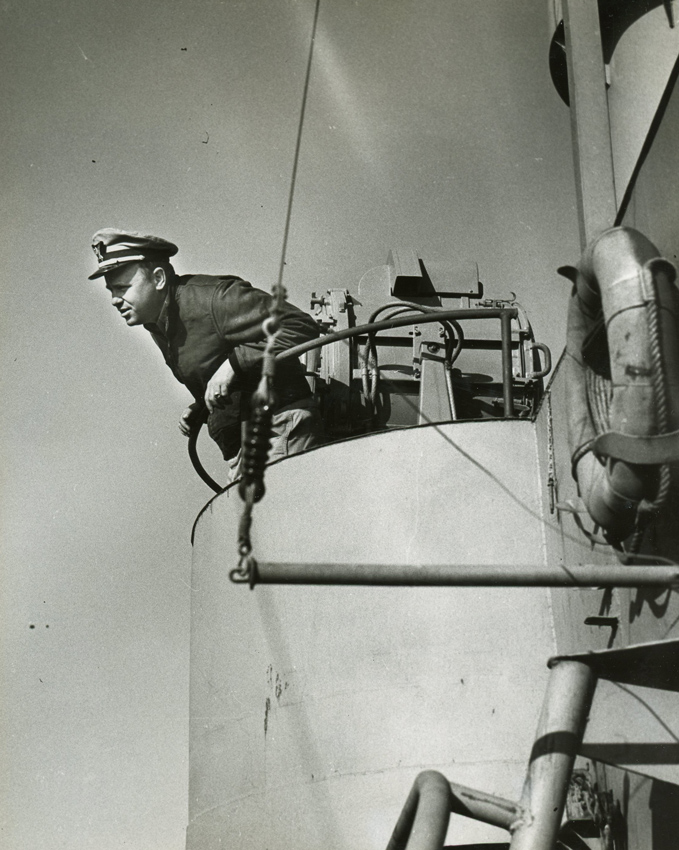
On October 26, 1943, Hoodock joined the crew of the new Edsall-class destroyer escort U.S.S. Menges (DE-320), which was commissioned that same day at the Consolidated Steel Company Corporation’s shipyard in Orange, Texas. Commanded by Lieutenant Commander Frank M. McCabe (1910–2007), Menges was a U.S. Navy ship but had a Coast Guard crew. One of his shipmates, who joined on the crew on the same day, was another Delawarean, Fireman 1st Class Howard John Woods (1922–1944).
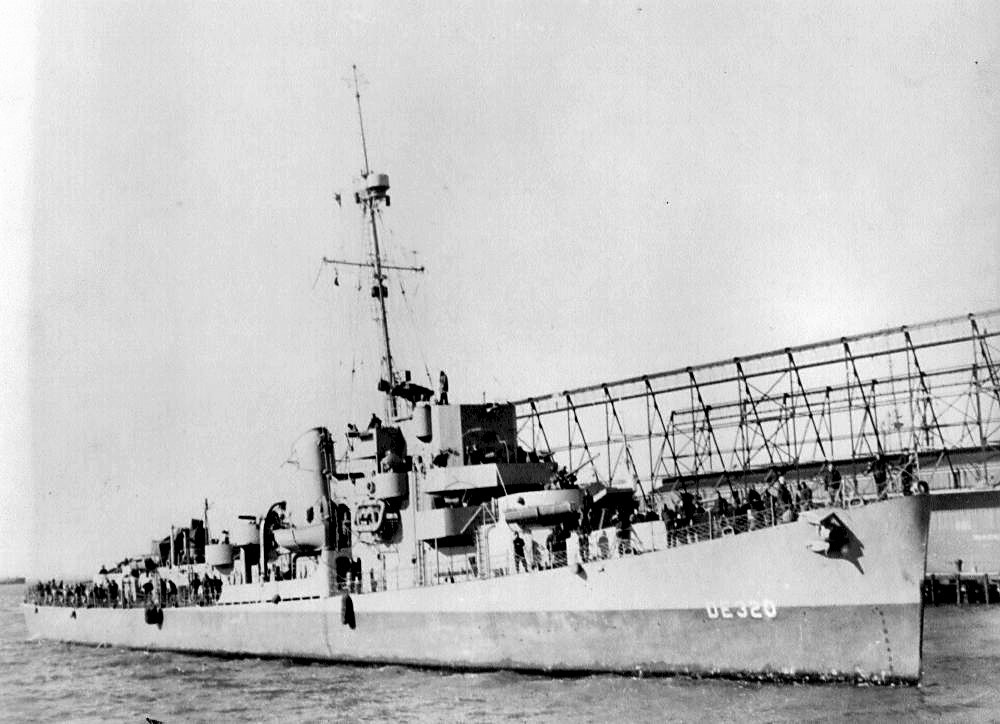
Menges operated out of Galveston, Texas, during sea trials from October 30, 1943, to November 7, 1943, when she sailed for New Orleans, Louisiana. One week later, she departed for a shakedown cruise to Bermuda with a short stop in Burwood, Louisiana. The vessel was at Charleston, South Carolina, beginning December 18, 1944. Hoodock and Woods were promoted to fireman 1st class on January 1, 1944. Two days later, Menges headed north. The ship operated out of Norfolk during January 6–28, 1944, conducting training in Chesapeake Bay.
Finally, Menges began regular convoy escort duty, starting on January 31, 1944, when she escorted part of UGS-32 on the run from New York City to Norfolk, arriving the following day. She then escorted the full convoy across the Atlantic beginning on February 3, 1944. Her commanding officer, Lieutenant Commander F. M. McCabe, summarized the next three months in a postwar service summary: “From 3 February until 3 May, 1944 MENGES was engaged in trans-Atlantic escort duty between New York, Norfolk and the Mediterranean. Ports visited were Gibraltar, Casablanca, Oran, Algiers and Bizerte.”

On March 4, 1944, Menges rescued a man who fell overboard from another ship in a convoy she was escorting. The following month, on the night of April 20, 1944, German bombers attacked the convoy she was escorting through the Mediterranean Sea, UGS-38. Among the men lost that night was another Delawarean, Corporal Joseph M. Vignola (1920–1944) of the 32nd Photo Reconnaissance Squadron, killed when the S.S. Paul Hamilton exploded and sank with all 580 men aboard.
After the air raid, Menges rescued over 100 survivors from the sunken American destroyer U.S.S. Lansdale (DD-426) as well as two downed German fliers. The following day, she landed the survivors at Algiers, Algeria, before rejoining the convoy. On April 22, 1944, Menges arrived in Bizerte, Tunisia.
Duel in the Mediterranean
On May 1, 1944, Menges departed Bizerte as one of 14 escorts for GUS-38, an 81-ship westbound convoy that was to sail through the Mediterranean Sea and on to the United States. Shortly after midnight on May 3, 1944, Menges was positioned 3,000 yards behind the convoy, which was east of Algiers and sailing at nine knots. At 0025 hours, Menges’s radar detected an unidentified vessel six nautical miles astern. The escort division commander ordered her to investigate. World War II submarines could travel faster on the surface than submerged and were harder to spot than most surface ships. For that reason, some submarine commanders attacked even well-defended convoys on the surface at night or moved around the perimeter of a convoy to get in position for a submerged attack after daybreak.
Menges was equipped with a pair of Foxer noisemakers, a countermeasure against German acoustic torpedoes that homed in on the sounds of Allied ships’ propellers. The Foxers were louder than the ships’ propellers and proved highly effective at drawing acoustic torpedoes away, although they reduced the effectiveness of the escorts’ sonar and could not protect the towing ships from every angle.
Menges accelerated to 15 knots, deployed her Foxers, and began zigzagging toward the contact, which had an estimated speed of 14 knots. Her crew manned their battle stations. Hoodock and Woods both stood by to perform damage control as members of Repair Party No. 3.
The contact was indeed a German submarine, U-371, under the command of Oberleutnant Horst-Arno Fenski (1918–1965). At 0104 hours, Menges accelerated to 20 knots. The moon was nearly full, but her lookouts could see no sign of the enemy submarine. The destroyer escort closed to about 3,200 yards before losing the radar contact at 0112 hours when U-371 submerged. At 0115 hours, Menges decelerated to 15 knots and began searching for the enemy submarine using sonar. Unbeknownst to the Americans, the German submarine had already fired a single G7es acoustic torpedo.
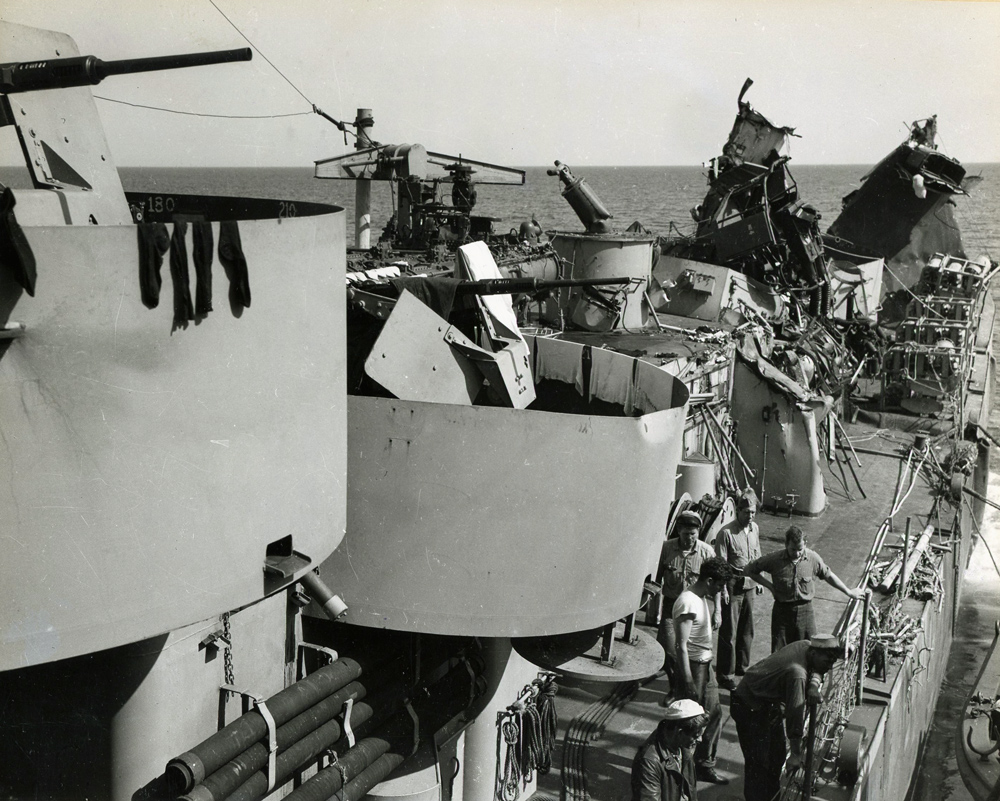
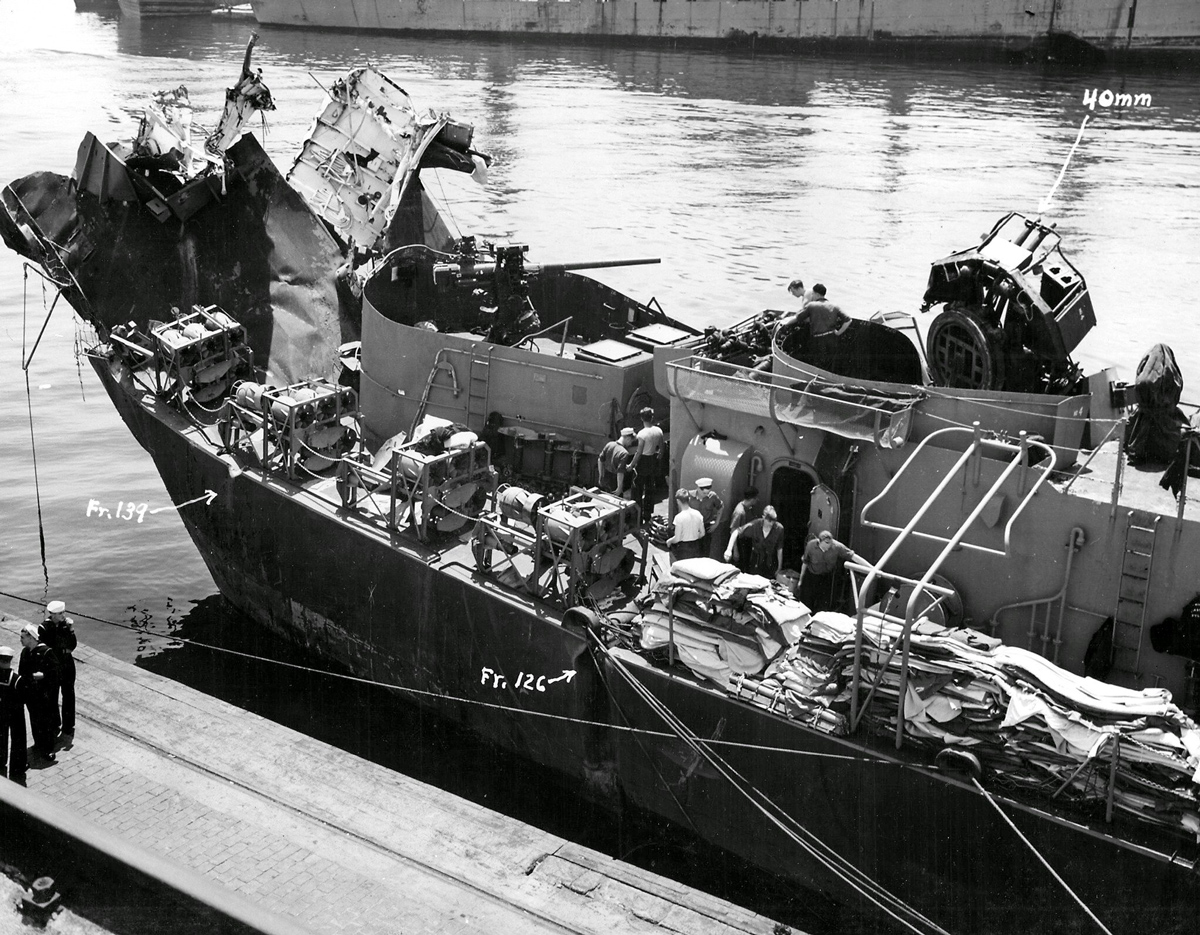
Commander McCabe wrote: “At 0118, a torpedo hit somewhere near the center of the stern with a terrific explosion. […] The explosion carried away both propellers and rudders, and seriously damaged the after 30 percent of the ship.” Menges’s position was approximately 37° 3’ North, 5° 25’ East when she was hit.
31 men were killed in the explosion. Casualties were very heavy among personnel manning the depth charges, torpedoes, and aft guns, as well as those responsible for the Foxer and steering gear. Among the dead were six men from Repair Party No. 3 including Hoodock and Woods.
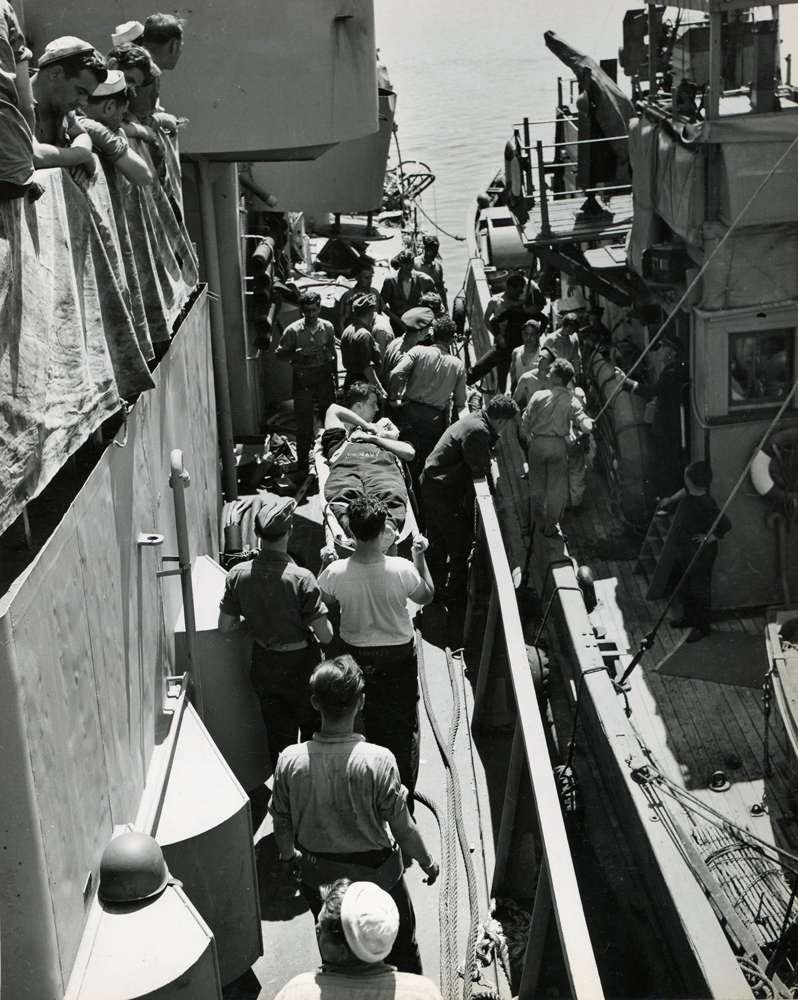
The crew rushed to repair the damage and treat the wounded. Hours before the attack, Menges’s doctor had been transferred to a merchant ship to treat an injured patient, so Chief Pharmacist’s Mate Harold Levy (1913–2003), who was later awarded the Legion of Merit, treated 25 wounded men virtually singlehandedly until a British doctor was dropped off from the destroyer H.M.S. Blankney the following morning. The British tug H.M.S. Aspirant towed Menges into Bougie, Algeria, where the dead and wounded were offloaded before the ship was towed to Algiers.


In the meantime, American, French, and British destroyers and destroyer escorts swarmed the area, damaging the submerged U-371 with depth charges and hounding her for the next day until the submarine’s batteries became so low that she was forced to surface. The Allied warships pounced on the fleeing submarine. U-371 managed to torpedo and damage the French destroyer escort Sénégalais before suffering such severe damage that her crew scuttled her around 0400 hours on May 4, 1944. Three German sailors drowned and 49 became prisoners of war.
Menges was eventually towed across the Atlantic to New York, where her shattered stern was removed and replaced with one from U.S.S. Holder (DE-401), another destroyer escort that had been out of service since she was torpedoed in April 1944.
Fireman 1st Class Hoodock was initially buried at a temporary military cemetery at Constantine, Algeria. He was posthumously awarded the Purple Heart. Journal-Every Evening reported that the Woods and Hoodock families were notified of the men’s deaths on May 8, 1944. The paper added that Hoodock’s “cousin, Private John F. Hoodock, with whom he had been reared almost as a brother, is now stationed in England and the two boys had not seen each other since they entered the service.”
Hoodock’s personal effects included a Westfield wristwatch, a migratory bird hunting stamp, and British and French currency. On June 3, 1944, the Wilmington Morning News reported:
Solemn requiem mass will be said for Joseph L. Hoodock, Jr., son of Joseph L. Hoodock, 3021 Madison Street, this morning at 9:30 o’clock in Christ-Our-King Church. The Rev. Joseph L. Leitch, Alexandria, Va., a cousin of the deceased, will be celebrant.
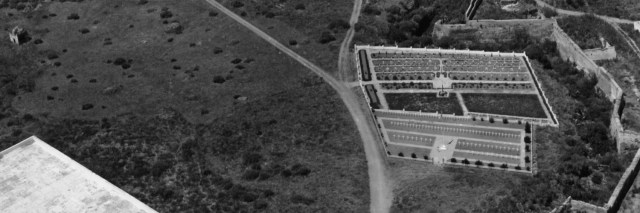
Hoodock was posthumously awarded the Purple Heart. In 1948, Hoodock’s father requested that his son’s body remain overseas in a permanent military cemetery. After the war, all the temporary American military cemeteries in Africa were consolidated into a single permanent cemetery near Carthage, Tunisia. Fireman 1st Class Hoodock’s body was reburied at that location, now known as the North Africa American Cemetery.
Acknowledgments
Special thanks to NavSource for the use of their photos.
Bibliography
Census Record for Joseph L. Hoodock, Jr. April 2, 1940. Sixteenth Census of the United States, 1940. Record Group 29, Records of the Bureau of the Census. National Archives at Washington, D.C. https://www.familysearch.org/ark:/61903/3:1:3QS7-89MR-M3QD
Census Record for Joseph L. Hoodock, Jr. April 14, 1930. Fifteenth Census of the United States, 1930. Record Group 29, Records of the Bureau of the Census. National Archives at Washington, D.C. https://www.familysearch.org/ark:/61903/3:1:33S7-9RHM-XXB
Certificate of Birth for Joseph Hoodock. Undated, c. July 30, 1923. Record Group 1500-008-094, Birth Certificates. Delaware Public Archives, Dover, Delaware. https://www.familysearch.org/ark:/61903/3:1:S3HT-D4FS-4V8
Certificate of Death for Mabel Hoodock. February 19, 1929. Delaware Death Records. Bureau of Vital Statistics, Hall of Records, Dover, Delaware. https://www.familysearch.org/ark:/61903/3:1:S3HT-DR53-7QX
The Coast Guard at War: Beach Patrol. Historical Section, Public Relations Division, U.S. Coast Guard Headquarters, 1945. https://media.defense.gov/2017/Jul/02/2001772325/-1/-1/0/USCGATWAR-BEACHPATROL.PDF
The Coast Guard at War: Port Security. Historical Section, Public Relations Division, U.S. Coast Guard Headquarters, 1949. https://media.defense.gov/2017/Jul/02/2001772335/-1/-1/0/USCGATWAR-PORTSECURITY.PDF
Draft Registration Card for Joseph Lawrence Hoodock, Jr. June 30, 1942. Draft Registration Cards for Delaware, October 16, 1940 – March 31, 1947. Record Group 147, Records of the Selective Service System. National Archives at St. Louis, Missouri. https://www.familysearch.org/ark:/61903/3:1:3Q9M-CSMG-D9LY-7
Green, Arthur. “Narrative by Arthur Green, PhoM2/c, USCG.” Interview on June 28, 1944. World War II Oral Histories, Interviews and Statements. Record Group 38, Records of the Office of the Chief of Naval Operations. National Archives at College Park, Maryland. https://catalog.archives.gov/id/278482612
Headstone Inscription and Interment Record for Joseph Lawrence Hoodock, Jr. Headstone Inscription and Interment Records for U.S. Military Cemeteries on Foreign Soil, 1942–1949. Record Group 117, Records of the American Battle Monuments Commission, 1918–c. 1995. National Archives at Washington, D.C. https://catalog.archives.gov/id/168971274?objectPage=1344
“Joseph Hoodock Dies At Sea.” Daily Press, May 10, 1944. https://www.newspapers.com/article/daily-press-hoodock-kia/174319951/
“Mass to be Said Today for J. L. Hoodock, Jr.” Wilmington Morning News, June 3, 1944. https://www.newspapers.com/article/174320290/
McCabe, Frank M. “Action Report of U.S.S. MENGES on 3 May, 1944 (against enemy submarine).” May 9, 1944. World War II War Diaries, 1941–1945. Record Group 38, Records of the Office of the Chief of Naval Operations. National Archives at College Park, Maryland. https://catalog.archives.gov/id/78527470
McCabe, Frank M. “History of U.S.S. MENGES (DE 320).” April 3, 1946. World War II War Diaries, 1941–1945. Record Group 38, Records of the Office of the Chief of Naval Operations. National Archives at College Park, Maryland. https://catalog.archives.gov/id/77667992
McCabe, Frank M. “War Diary for Month of April, 1944.” May 10, 1944. World War II War Diaries, 1941–1945. Record Group 38, Records of the Office of the Chief of Naval Operations. National Archives at College Park, Maryland. https://catalog.archives.gov/id/78422314
McCabe, Frank M. “War Diary for Month of February, 1944.” March 17, 1944. World War II War Diaries, 1941–1945. Record Group 38, Records of the Office of the Chief of Naval Operations. National Archives at College Park, Maryland. https://catalog.archives.gov/id/78336106
McCabe, Frank M. “War Diary for Month of January, 1944.” February 1, 1944. World War II War Diaries, 1941–1945. Record Group 38, Records of the Office of the Chief of Naval Operations. National Archives at College Park, Maryland. https://catalog.archives.gov/id/78276466
McCabe, Frank M. “War Diary for Month of May, 1944.” June 1, 1944. World War II War Diaries, 1941–1945. Record Group 38, Records of the Office of the Chief of Naval Operations. National Archives at College Park, Maryland. https://catalog.archives.gov/id/78448843
Official Military Personnel File for Joseph L. Hoodock, Jr. Official Military Personnel Files, c. 1898–c. 2004. Record Group 26, Records of the U.S. Coast Guard. National Archives at St. Louis, Missouri.
Silverman, Lowell. “Fireman 1st Class Howard J. Woods (1922–1944).” Delaware’s World War II Fallen website. November 19, 2023. https://delawarewwiifallen.com/2023/11/19/fireman-1st-class-howard-j-woods/
“Their Birthdays Today.” The Evening Journal, July 30, 1932. https://www.newspapers.com/article/the-evening-journal-hoodock-birthday/174320015/
“Three Added to List of Heroic Dead.” Journal-Every Evening, May 9, 1944. https://www.newspapers.com/article/174618203/
“Veronica M. Garyantes.” The News Journal, October 24, 1996. https://www.newspapers.com/article/the-news-journal-joseph-hoodock-sister-o/174322438/
Last updated on July 2, 2025
More stories of World War II fallen:










To have new profiles of fallen soldiers delivered to your inbox, please subscribe below.
 Delaware's World War II Fallen