

| Residences | Civilian Occupation |
| Bridgeville, Delaware; Felton, Delaware | Laborer for Felton Lumber Company |
| Branch | Service Number |
| U.S. Army | 32952427 |
| Theater | Unit |
| Mediterranean | Medical Detachment, 339th Infantry Regiment, 85th Infantry Division |
| Military Occupational Specialty | Campaigns/Battles |
| 657 (litter bearer) | Rome-Arno campaign |
Early Life & Family
Loran Charles Adams was born in Bridgeville, Delaware, on the morning of November 27, 1922. He was the first son of Charles Cannon Adams (a farmer, 1898–1925) and Mamie Adams (née Still, 1900–1991). He had a younger brother, Richard Francis Adams (1924–2012). Adams was Protestant.
Shortly before he turned three, Adams’s father died. By April 1930, when he was recorded on the census, Adams was living with his mother, brother, and maternal grandparents, Francis J. Still (1866–1949) and Mary E. Still (1875–1955), on his grandparents’ farm near Felton, Delaware. He was still living there at the time the next census in April 1940 recorded him working as a farmhand. By June 30, 1942, when he registered for the draft, he was working at the Felton Lumber Company.
Although the vast majority of U.S. Army personnel files from World War II were destroyed in the 1973 National Personnel Records Center fire, Adams’s induction and awards paperwork, as well as his service record booklet, survived intact. According to information from a Selective Service questionnaire that Adams filled out on December 9, 1942, which was copied onto his induction paperwork, Adams dropped out of high school after completing the third quarter of his junior year, presumably at Felton High School. He worked as a clerk and laborer for at the lumberyard, earning $95 a month “Keeping books, selling and delivering lumber[.]”
On February 10, 1943, in Harrington, Delaware, Adams was examined by a physician at the behest of Local Board No. 2, Kent County, who deemed him medically eligible for service. On February 16, 1943, the board classified him I-A, available for service. He was drafted a few months later.
Military Training
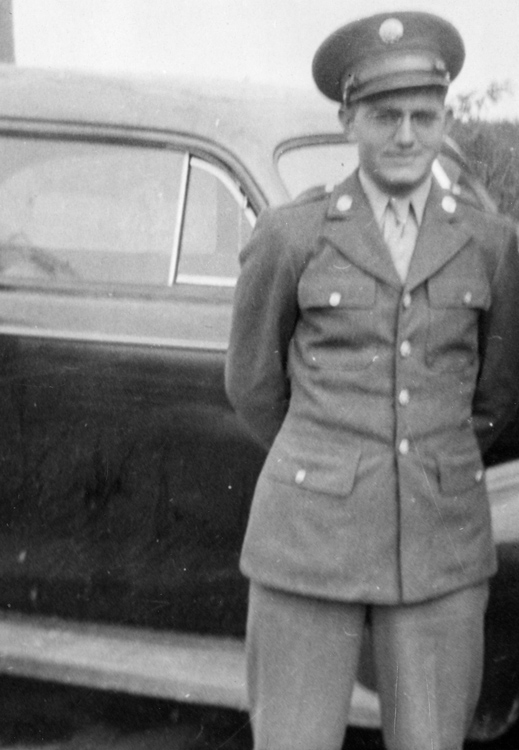
Adams was inducted into the U.S. Army at Camden, New Jersey, on June 22, 1943. Another medical examination performed at the induction station noted that Adams had a precordial systolic functional heart murmur, 1st degree pes planus (a mild case of flat feet), and a full set of upper dentures, but none of those findings disqualified him for military service. The paperwork described him as standing five feet, five inches tall and weighing 131 lbs., with brown hair and eyes. Curiously, although the exam described Adams as having uncorrected 20/20 vision in each eye with no abnormalities, photos of him in uniform show that he wore eyeglasses.

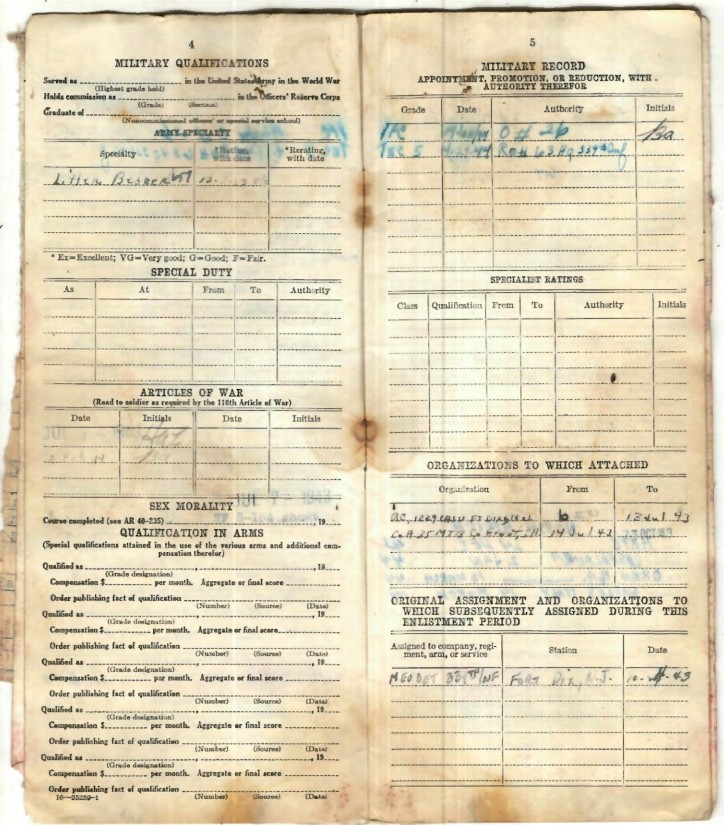
As was customary for selectees, Private Adams was briefly transferred to the Enlisted Reserve Corps on inactive duty. On July 6, 1943, he went on active duty at Fort Dix, New Jersey, where he was attached unassigned to Company “B,”1229th Reception Center. This holding unit included several other Delawareans who had been drafted on the same day, including at least three who would have similar career paths: Preston L. Dyer (1924–2018), Lynn E. Ritter, Jr. (1924–1944), and William G. Walls (1924–1982).
July 7, 1943, was an especially busy day for Adams. His service record booklet documents that he was read the military laws known as the Articles of War, completed the Sex Morality course, and was vaccinated to protect him against smallpox, typhoid, and tetanus. Based on the experiences of other soldiers, he also most likely took the Army General Classification Test and sat for a classification interview at Fort Dix.
On July 13, 1943, Adams, Dyer, Ritter, and Walls were among a group dispatched to the Medical Replacement Training Center at Camp Grant, Illinois. All four men attended basic training in the same battalion and later joined the 85th Infantry Division as medical personnel.
Upon arrival at Camp Grant on July 14, 1943, Private Adams was attached unassigned to and joined Company “A,” 35th Medical Training Battalion, 8th Medical Training Regiment.
After completing basic training, Private Adams began an eight-day furlough on October 6, 1943. Presumably, he went home to Delaware, before returning to duty on October 14.
On October 20, 1943, a set of orders came down from Headquarters 1663th Service Unit, Camp Grant, Illinois, transferring Private Adams to the 85th Infantry Division at Fort Dix, effective in about three days’ time. The document listed his military occupational specialty (M.O.S.) as 521, basic, indicating that he had not yet qualified in any M.O.S.
On October 23, 1943, Adams left Camp Grant for Fort Dix. The following day, he joined the Medical Detachment, 339th Infantry Regiment, 85th Infantry Division. Dyer, Ritter, and Walls joined the same division’s 310th Medical Battalion.
Private Adams’s personnel file recorded that in early December 1943, his M.O.S. was classified as 657, litter bearer.
Adams served as a link in a complex, multitiered chain of survival. Typically, when an infantryman was wounded in combat, first aid was provided by the medical aidman attached to each infantry platoon from the regimental medical detachment. Though universally referred to as medics, technically they held M.O.S. 861, surgical technician. Victims in need of additional care had to be evacuated to a collecting point or battalion aid station. If the patient was not ambulatory, a four-man team of litter bearers would carry them, sometimes over steep, difficult terrain. Litter bearers might also be called upon to provide medical care, fill out medical tags, and to help move aid stations.
The intermediate stage in the chain of survival was filled by the divisional medical battalion, who had many of the same types of medical personnel as the medical detachments, including more litter bearers. Medical battalion personnel would move the casualty to a collecting station, and from there to a clearing station. Finally, if the wound or injury was severe enough, the patient would be evacuated to a hospital.
On the evening of December 14, 1943, Private Adams and his unit boarded a train for the overnight journey to Camp Patrick Henry, Virginia. One week later, on December 23, 1943, Private Adams and 39 other men from the regimental medical detachment went on detached service as an as an advance party, presumably to the Hampton Roads Port of Embarkation, Virginia. The following day, Christmas Eve 1943, Adams and the others rejoined the main body and shipped out aboard the transport U.S.S. General A. E. Anderson (AP-111). After celebrating New Years at sea, they arrived in Casablanca, Morocco, on January 2, 1944. That afternoon, they disembarked and moved by truck to nearby Camp Don B. Passage.
Adams and his comrades departed Casablanca by train on the evening of January 4, 1944, arriving two days later at Saint-Denis-de-Sig, Algeria. Adams was promoted to private 1st class on January 14, 1944. After further training in the vicinity, he and his unit moved by truck to Port-aux-Poules, Algeria, on February 7, 1944. They had amphibious training there before returning to Saint-Denis-de-Sig by road on March 7.
Combat in the Mediterranean Theater
On the morning of March 10, 1944, Private 1st Class Adams and his unit moved by train to Oran, Algeria, where they boarded the British transport H.M.T. Letitia. They shipped out the same day, arriving four days later in Naples, Italy, joining the U.S. Fifth Army. After disembarking that evening, they moved northwest to a staging north of Casanova, roughly halfway between Naples and the front lines.
At the time, it was stalemate in Italy. Allied forces had spent months in grinding combat trying to break through the Germans’ Gustav Line south of Rome. The 339th Infantry was the first regiment from the 85th Infantry Division to go into combat during the war, albeit attached to the 88th Infantry Division. Beginning the night of March 17–18, 1944, and finishing the following night, the 339th Infantry relieved the 349th Infantry near Castelforte, a relatively quiet sector at the time. Even so, a week of patrolling, as well as enemy artillery and mortar rounds cost the 339th Infantry six men dead, 29 wounded, and two missing. They were pulled out of the line during the night of March 25–26, 1944.
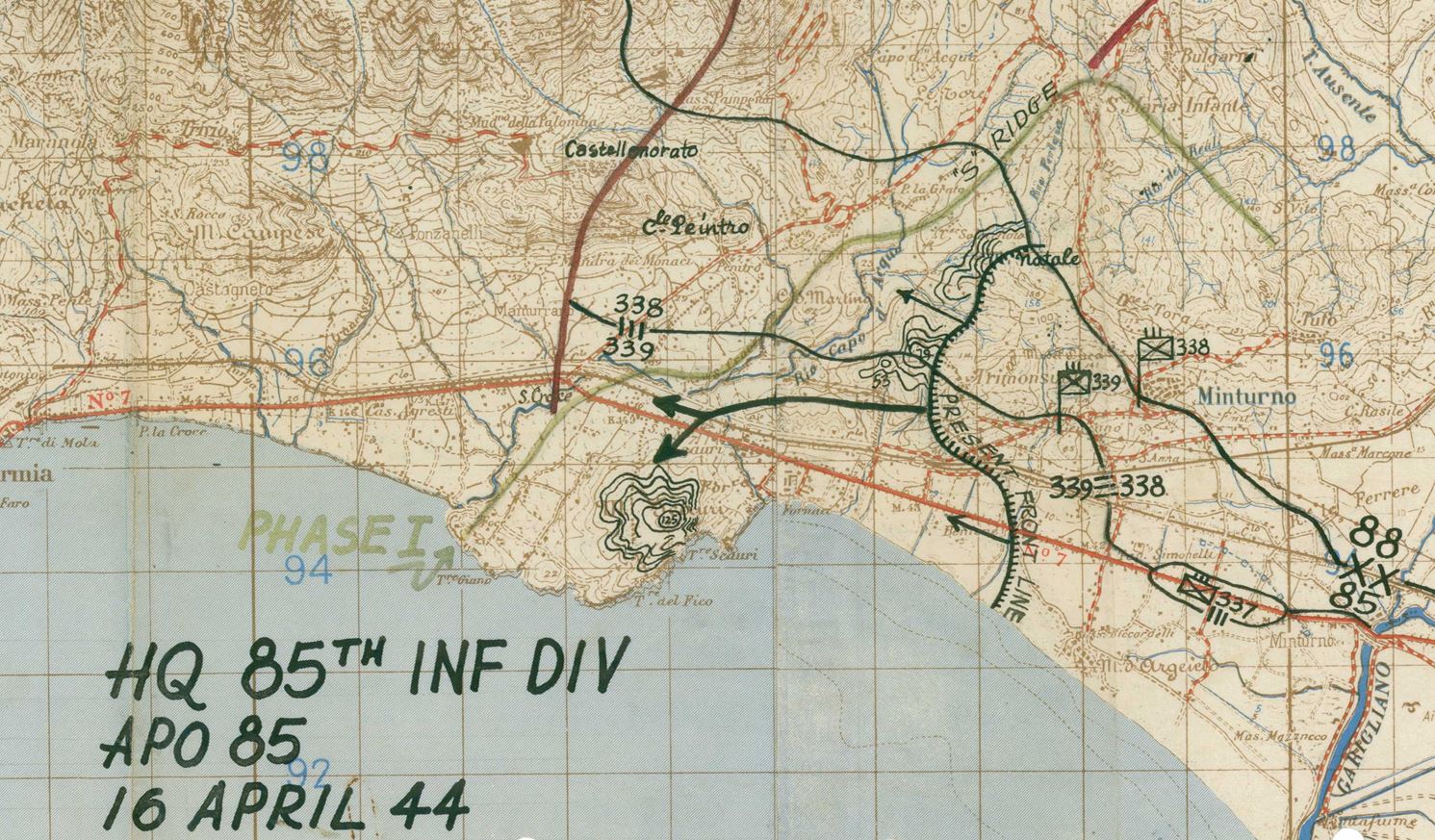
After briefly returning to Casanova, the 349th Infantry went back into the line near Minturno, close to the Tyrrhenian Sea, on March 29–30, 1944, and the following night. The last two days of March alone cost the regiment two dead and 14 wounded. On April 10, 1944, the 339th Infantry was detached from the 88th Infantry Division and returned to 85th Infantry Division control. The regiment was gradually relieved from the front lines over the course of four nights beginning April 21–22, 1944. The regimental history reported that, like the previous month, “Action during this period of occupation of front line positions was limited to patrols and frequent artillery and mortar fire by both sides.” Despite the lack of any significant offensive action by either side, the 339th Infantry recorded 28 men killed, 82 wounded, and one missing during the month of April. After coming off the line, the regiment went to a rest camp near Mondragone, Italy.

About three months after Adams entered the service, his younger brother had also been drafted. Private Richard Adams went overseas to Italy as a replacement rifleman. The Wilmington Morning News later reported that both brothers serving in Italy brought the possibility of Adams “accomplishing a reunion with his only brother, Private Richard F. Adams, 19, stationed just 15 miles away. Their last meeting was just before Private Adams entered the service.” It was not to be. Richard Adams was shipped to the Anzio beachhead, where he joined Company “C,” 157th Infantry Regiment, 45th Infantry Division on April 23, 1944.
Adams was promoted to technician 5th grade on April 29, 1944. That raises the possibility that he had changed duties, since under the tables of organization, a litter bearer in a regimental medical detachment was supposed to hold the grade of private or private 1st class. The Salisbury Times and the Wilmington Morning News described Adams a few months later as “a surgical technician, fifth grade” which suggests that Adams had become a medic. However, no change in M.O.S. was recorded in his personnel file. A medal citation later described Adams as being involved in “the evacuation of wounded soldiers” as of early June 1944, which is consistent with him being a litter bearer, though it does not necessarily rule out him performing another duty.
The 339th Infantry went back onto the line near Minturno on May 3, 1944. That same month, the Allies delivered a one-two punch intended to break the deadlock in Italy. In the first, Operation Diadem, which began May 11, 1944, Commonwealth, French, Polish, and American forces finally broke through the Gustav Line. The Germans retreated in good order. A May 13, 1944, morning report noted that the 339th Infantry’s “Aid men and aid stations [are] working night and day evacuating and caring for the casualties[.]” After costly fighting along the enemy main line of resistance, the 339th Infantry, on the far left of the Allied line, made continuous progress northwest along the coast, fighting the German rearguard. The aid stations had to relocate repeatedly to keep up with the advance.
The 339th Omfamtry kept the pressure up, moving to the area of Tremensuoli on May 15, to Scauri on May 16, and the vicinity of Trivio on May 17. The regiment then followed Highway No. 7 inland from Formia, reaching Itri on May 20, followed by Fondi on May 22.
On May 23, 1944, the same day that the 339th Infantry took Sonnino, the second Allied hammer blow of the month began when the Allied forces at the Anzio beachhead began their breakout, briefly threatening to trap the German forces withdrawing from the Gustav Line.
The 85th Infantry Division continued their advance until briefly being relieved by the 88th Infantry Division on May 28, 1944. After only a brief rest back on the coast at Saubaudia, most of the division was ordered back into action near Cori that night as the Americans advanced into the Alban Hills southeast of Rome. However, the 339th Infantry remained at Saubaudia a little longer. Once recalled to the north on May 31, the regiment remained as corps and then division reserve until June 1.
A 339th Infantry Regiment operations report stated that on June 1, 1944,
the Regiment passed through the town of Giulianello and encountering no resistance other than occasional fire from SP [self-propelled] artillery continued for several miles on the main road to the Northwest, then moving cross-country, by-passed the town of Lariano. In advancing through the heavily wooded area to the mountain top, small groups of the enemy offered slight resistance. The Regiment seized this objective on 1945 on 1 June.
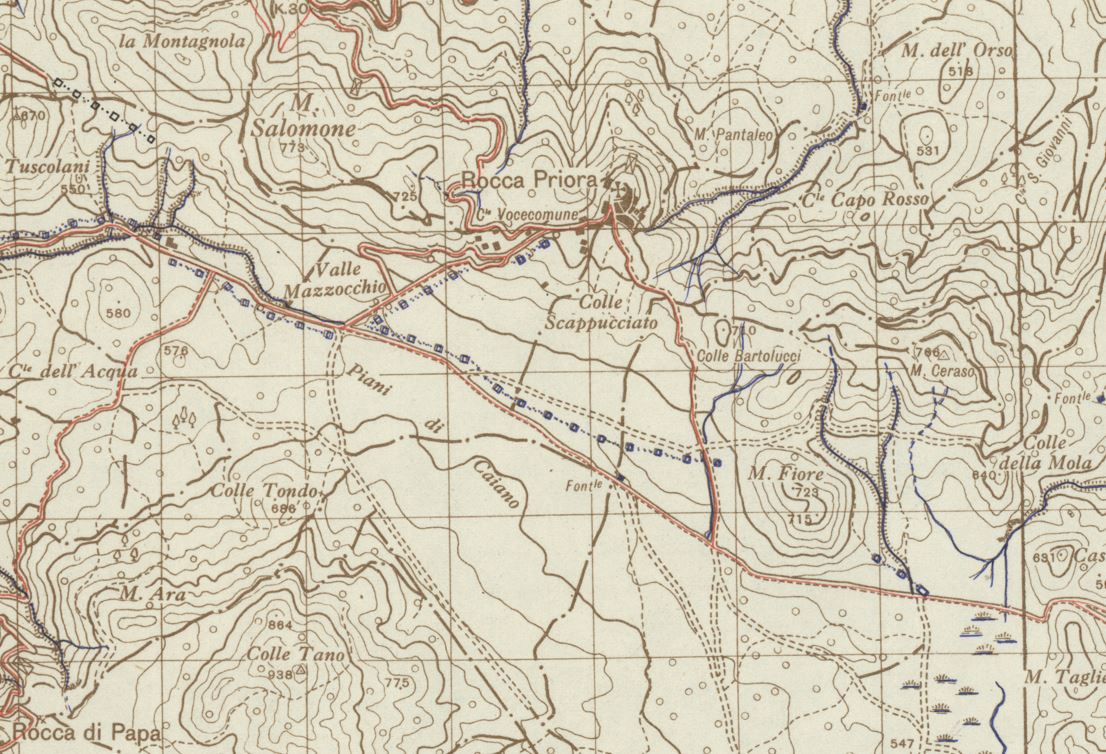
The report added that June 2, 1944, 1st and 2nd Battalions, with two companies of 4.2-inch mortars from the 2nd Chemical Battalion attached, “continued the attack to the Northwest with [Monte] Fiore and Hill 775, Southwest of the town of Rocca Priora as its objective. These objectives although heavily defended with artillery and mortars were promptly seized.”
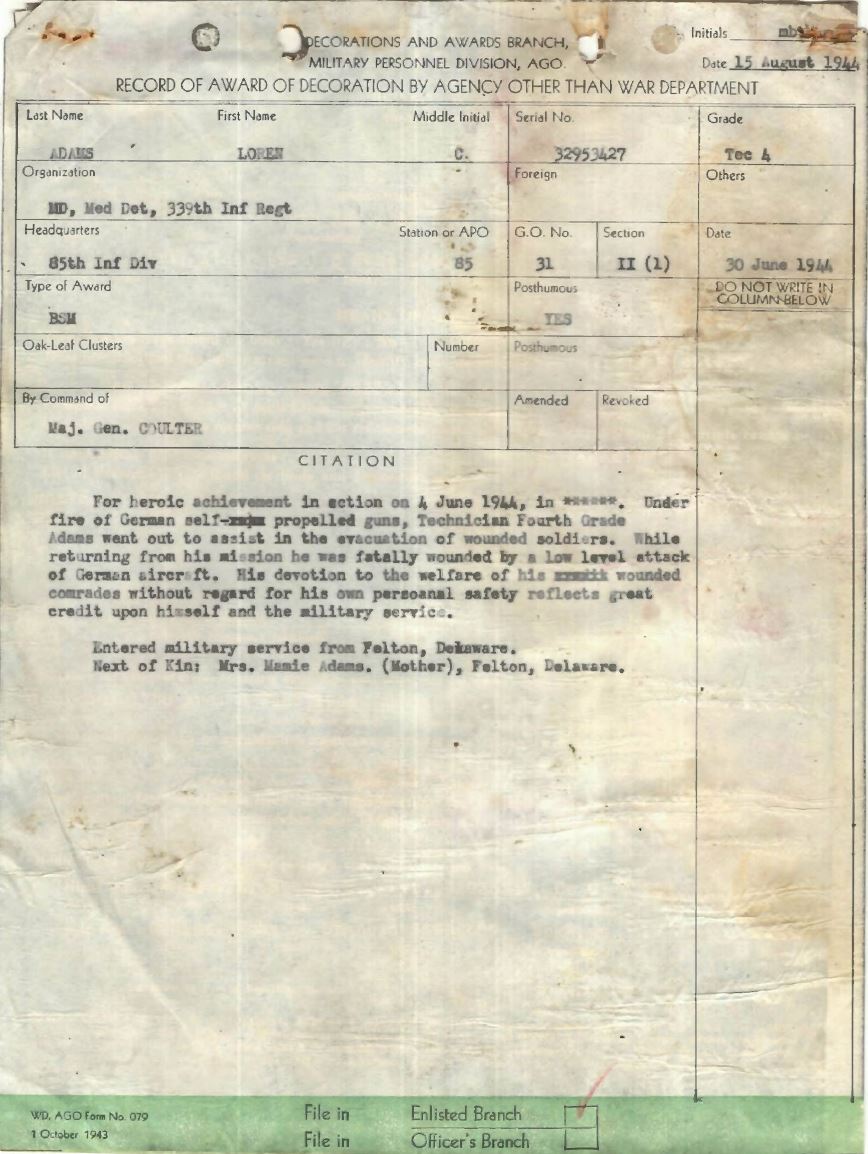
That day, June 2, 1944, Technician 5th Grade Adams distinguished himself under fire before he suffered fatal gunshot wounds to his chest and left arm from a strafing German plane. His burial report gave the location of his death as the vicinity of Velletri, Italy. It is unclear how close to Velletri he was killed, since that was about five miles south of where the regiment was fighting at that time. Adams was posthumously awarded the Bronze Star Medal per General Orders No. 31, Headquarters 85th Infantry Division, dated June 30, 1944. The citation stated in part:
For heroic achievement in action on 4 [sic] June 1944, in Italy. Under fire of German self-propelled guns, Technician Fourth [sic] Grade Adams went out to assist in the evacuation of wounded soldiers. While returning from his mission he was fatally wounded by a low level attack of German aircraft. His devotion to the welfare of his wounded comrades without regard for his own personal safety reflects great credit upon himself and the military service.
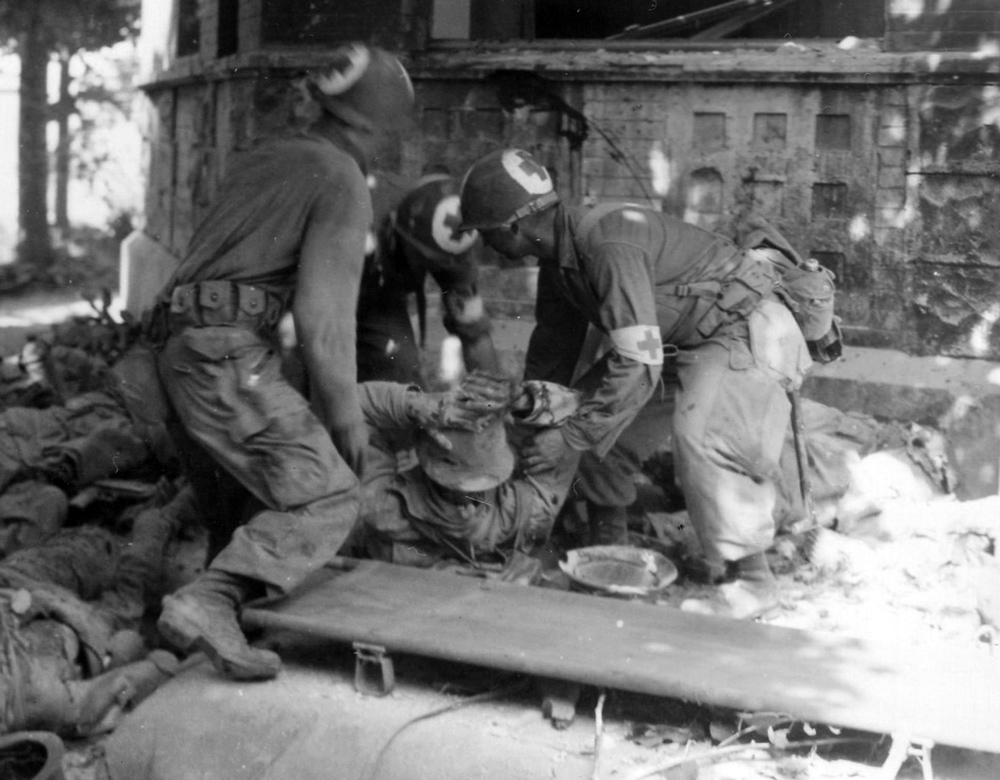
In the Mediterranean Theater and northwest Europe, both the Allied and Axis generally respected the Geneva Conventions and did not intentionally target the other side’s medical personnel. However, limitations in visibility on the battlefield and weapon accuracy meant that many medics inevitably became casualties. A fighter-bomber pilot attacking ground targets may have been able to avoid attacking a properly marked ambulance or aid station, especially if it was not shrouded in smoke, but he had little chance of spotting red cross markings on the helmets and sleeves of medical personnel accompanying the unit that he was targeting.
Personal effects found on Adams’s body included letters, a Bible, a watch, a comb, eyeglasses, his wallet, photos, souvenir money, and his Red Cross identification card. His other personal effects included a candle holder, eight greeting cards, 20 additional letters, and a sewing kit. Two days after Adams was killed, Rome fell to Allied forces. That day, Adams was buried at a military cemetery in Nettuno, near Anzio, Italy. Between May 11 and June 6, 1944, the 339th Infantry suffered about 1,000 casualties.
The Wilmington Morning News reported that, unaware of his brother’s death, “Private Adams wrote his mother that while attending a performance of ‘This is the Army’ in Rome, he met men from the older brother’s outfit, and they were planning to meet as soon as possible.” The younger Adams earned the Purple Heart and the Combat Infantryman Badge before he was captured by the Germans on January 21, 1945, though he was liberated at the end of the war.

Colonel Randolph Russell presented Mamie Adams with the Bronze Star that Technician 5th Grade Adams had earned during a ceremony at the Public Building in Wilmington, Delaware, on November 29, 1944. Adams was also awarded the Purple Heart. He met the criteria for the Combat Medical Badge which was introduced in January 1945 retroactive to the day prior to Pearl Harbor, but there is no indication that it was ever formally presented to his family. A 1947 policy also established that anyone who earned the Combat Medical Badge had also met the criteria for the Bronze Star. That would have added an oak leaf cluster to Adams’s Bronze Star, though there is no evidence that his family was ever presented with it. Given his clean disciplinary record, had he survived another five weeks, Adams would have also earned the Good Conduct Medal.
Journal-Every Evening reported on March 8, 1946, that a Veterans of Foreign Wars post in Felton was being named in honor of Technician 5th Grade Adams, Corporal Caleb O. Simpler (1917–1942), and Private John A. Ware (1925–1944):
Three Delaware men who died in World War II will be perpetuated in the memory of their home town and their schoolday friends when the Adams-Simpler-Ware Post of the Veterans of Foreign Wars is formally dedicated in Felton Sunday afternoon [March 10] at 2:30 o’clock.
On March 18, 1947, Adams’s mother wrote the Quartermaster Corps Memorial Division regarding the agonizing decision about whether to ask for his body to be returned or to remain buried overseas. She expressed concern over whether his body had been properly identified:
I really feel it an injustice to me as well as to Loran to bother him if you can not make me know if is Loran you send me. This is the greatest decision I have ever been asked to make under the conditions I have to make them. I miss Loran more as the days go by.
That June, after being reassured that he had been properly identified, Mamie Adams requested that her son’s body be repatriated to the United States. The following year, his casket departed Naples aboard the transport Carroll Victory. From the New York Port of Embarkation, it traveled by train to Felton. Following funeral services at the Berry Funeral Home in Felton on August 4, 1948, Adams was buried at Bridgeville Cemetery, where his father had been buried, and where his mother and maternal grandparents would be buried after their own deaths. His name is honored at Veterans Memorial Park in New Castle, Delaware.
Notes
Grade
On November 19, 1948, Mamie Adams wrote to the Quartermaster Corps Memorial Division for clarification of her son’s final grade, so that it would be reflected accurately on his headstone. She noted that he was referred to as a technician 4th grade in his Bronze Star citation, but as a technician 5th grade in all correspondence from the War Department. An investigation determined that technician 5th grade was correct.
Acknowledgments
Special thanks to Sean Hockens for providing documents and to the Delaware Public Archives for the use of their photos.
Bibliography
“10 Delaware Selective Service Boards List Latest Reservists.” Journal-Every Evening, June 30, 1943. https://www.newspapers.com/article/168420954/
Adams, Mamie S. Individual Military Service Record for Loran Charles Adams. January 11, 1945. Record Group 1325-003-053, Record of Delawareans Who Died in World War II. Delaware Public Archives, Dover, Delaware. https://cdm16397.contentdm.oclc.org/digital/collection/p15323coll6/id/17474/rec/1
Batens, Alain S. and Major, Ben. “The WW2 Medical Detachment Infantry Regiment.” WW2 US Medical Research Centre website. https://www.med-dept.com/articles/the-ww2-medical-detachment-infantry-regiment/
Badger, Charles L. “Report of Operation, 1 to 30 April 1944.” June 19, 1944. Ike Skelton Combined Arms Research Library Digital Library. https://cgsc.contentdm.oclc.org/digital/collection/p4013coll8/id/3744/rec/2
Badger, Charles L. “Report of Operations from 1 May to 31 May 1944.” June 21, 1944. Ike Skelton Combined Arms Research Library Digital Library. https://cgsc.contentdm.oclc.org/digital/collection/p4013coll8/id/3744/rec/2
Brady, Brooker W. “Extract of Unit History for April, 1944.” June 21, 1944. World War II Operations Reports, 1940–48. Record Group 407, Records of the Adjutant General’s Office. National Archives at College Park, Maryland. Courtesy of Sean Hockens.
Brady, Brooker W. “Operations Report for June 1944.” July 2, 1944. World War II Operations Reports, 1940–48. Record Group 407, Records of the Adjutant General’s Office. National Archives at College Park, Maryland. Courtesy of Sean Hockens.
Brady, Brooker W. “Report of Operations.” August 18, 1944. World War II Operations Reports, 1940–48. Record Group 407, Records of the Adjutant General’s Office. National Archives at College Park, Maryland. Courtesy of Sean Hockens.
Brady, Brooker W. “Unit History for the Month of March 1944.” April 2, 1944. World War II Operations Reports, 1940–48. Record Group 407, Records of the Adjutant General’s Office. National Archives at College Park, Maryland. Courtesy of Sean Hockens.
Census Record for Loran C. Adams. April 16, 1930. Fifteenth Census of the United States, 1930. Record Group 29, Records of the Bureau of the Census. National Archives at Washington, D.C. https://www.familysearch.org/ark:/61903/3:1:33S7-9R4B-ZZ7
Census Record for Loran C. Adams. April 21, 1940. Sixteenth Census of the United States, 1940. Record Group 29, Records of the Bureau of the Census. National Archives at Washington, D.C. https://www.familysearch.org/ark:/61903/3:1:3QS7-89MR-MS7
Certificate of Birth for Loran Charles Adams. November 28, 1922, updated November 6, 1944. Record Group 1500-008-094, Birth Certificates. Delaware Public Archives, Dover, Delaware. https://www.familysearch.org/ark:/61903/3:1:S3HT-D4FS-HC2
Draft Registration Card for Loran Charles Adams. June 30, 1942. Draft Registration Cards for Delaware, October 16, 1940 – March 31, 1947. Record Group 147, Records of the Selective Service System. National Archives at St. Louis, Missouri. https://www.familysearch.org/ark:/61903/3:1:3Q9M-CSMG-X39K
Enlistment Record for Richard F. Adams. September 17, 1943. World War II Army Enlistment Records. Record Group 64, Records of the National Archives and Records Administration. National Archives at College Park, Maryland. https://aad.archives.gov/aad/record-detail.jsp?dt=893&mtch=1&cat=all&tf=F&q=32958105&bc=&rpp=10&pg=1&rid=3453672
Enlistment Record for Loran C. Adams. June 22, 1943. World War II Army Enlistment Records. Record Group 64, Records of the National Archives and Records Administration. National Archives at College Park, Maryland. https://aad.archives.gov/aad/record-detail.jsp?dt=893&mtch=1&cat=all&tf=F&q=32952427&bc=&rpp=10&pg=1&rid=3448669
“Felton Rites Wednesday For Corp. L. C. Adams.” Journal-Every Evening, August 2, 1948. https://www.newspapers.com/article/169697460/
“Five More Men From This Area Are Casualties.” The Salisbury Times, July 10, 1944. https://www.newspapers.com/article/168425399/
“Four From State Listed as Killed in War Theatres.” Wilmington Morning News, July 10, 1944. https://www.newspapers.com/article/168754713/
Hospital Admission Card for 32958105. September 1944. U.S. WWII Hospital Admission Card Files, 1942–1954. Record Group 112, Records of the Office of the Surgeon General (Army), 1775–1994. National Archives at College Park, Maryland. https://www.fold3.com/record/704943826/adams-richard-f-us-wwii-hospital-admission-card-files-1942-1954
Individual Deceased Personnel File for Loran C. Adams. Individual Deceased Personnel Files, 1939–1953. Record Group 92, Records of the Office of the Quartermaster General, 1774–1985. National Archives at St. Louis, Missouri.
“Mamie Still Adams.” Find a Grave. https://www.findagrave.com/memorial/64595888/mamie-adams
Morning Reports for Company “B,” 1229th Reception Center. July 1943. U.S. Army Morning Reports, c. 1912–1946. Record Group 64, Records of the National Archives and Records Administration. National Archives at St. Louis, Missouri. https://s3.amazonaws.com/NARAprodstorage/lz/partners/st-louis/rg-064/85713825-wwii/85713825_1940-01-thru-1943-07/85713825_1940-01-thru-1943-07_Roll-2839/85713825_1940-01-thru-1943-07_Roll-2839-13.pdf
Morning Reports for Trainees, Company “A,” 35th Medical Training Battalion. July 1943. U.S. Army Morning Reports, c. 1912–1946. Record Group 64, Records of the National Archives and Records Administration. National Archives at St. Louis, Missouri. https://s3.amazonaws.com/NARAprodstorage/lz/partners/st-louis/rg-064/85713825-wwii/85713825_1940-01-thru-1943-07/85713825_1940-01-thru-1943-07_Roll-2096/85713825_1940-01-thru-1943-07_Roll-2096-28.pdf
Morning Reports for Trainees, Company “A,” 35th Medical Training Battalion. October 1943. U.S. Army Morning Reports, c. 1912–1946. Record Group 64, Records of the National Archives and Records Administration. National Archives at St. Louis, Missouri. https://s3.amazonaws.com/NARAprodstorage/lz/partners/st-louis/rg-064/85713825-wwii/85713825_1943-10/85713825_1943-10_Roll-0081/85713825_1943-10_Roll-0081-21.pdf, https://s3.amazonaws.com/NARAprodstorage/lz/partners/st-louis/rg-064/85713825-wwii/85713825_1943-10/85713825_1943-10_Roll-0081/85713825_1943-10_Roll-0081-22.pdf
Morning Reports for Company “C,” 157th Infantry Regiment. April 1944. U.S. Army Morning Reports, c. 1912–1946. Record Group 64, Records of the National Archives and Records Administration. National Archives at St. Louis, Missouri. https://s3.amazonaws.com/NARAprodstorage/lz/partners/st-louis/rg-064/85713825-wwii/85713825_1944-04/85713825_1944-04_Roll-0538/85713825_1944-04_Roll-0538-07.pdf
Morning Reports for Medical Detachment, 339th Infantry Regiment. December 1943 – June 1944. U.S. Army Morning Reports, c. 1912–1946. Record Group 64, Records of the National Archives and Records Administration. National Archives at St. Louis, Missouri. https://s3.amazonaws.com/NARAprodstorage/lz/partners/st-louis/rg-064/85713825-wwii/85713825_1943-12/85713825_1943-12_Roll-0233/85713825_1943-12_Roll-0233-16.pdf, https://s3.amazonaws.com/NARAprodstorage/lz/partners/st-louis/rg-064/85713825-wwii/85713825_1943-12/85713825_1943-12_Roll-0233/85713825_1943-12_Roll-0233-17.pdf, https://s3.amazonaws.com/NARAprodstorage/lz/partners/st-louis/rg-064/85713825-wwii/85713825_1943-12/85713825_1943-12_Roll-0707/85713825_1943-12_Roll-0707-29.pdf, https://s3.amazonaws.com/NARAprodstorage/lz/partners/st-louis/rg-064/85713825-wwii/85713825_1944-01/85713825_1944-01_Roll-0522/85713825_1944-01_Roll-0522-30.pdf, https://s3.amazonaws.com/NARAprodstorage/lz/partners/st-louis/rg-064/85713825-wwii/85713825_1944-02/85713825_1944-02_Roll-0463/85713825_1944-02_Roll-0463-29.pdf, https://s3.amazonaws.com/NARAprodstorage/lz/partners/st-louis/rg-064/85713825-wwii/85713825_1944-03/85713825_1944-03_Roll-0557/85713825_1944-03_Roll-0557-35.pdf, https://s3.amazonaws.com/NARAprodstorage/lz/partners/st-louis/rg-064/85713825-wwii/85713825_1944-04/85713825_1944-04_Roll-0544/85713825_1944-04_Roll-0544-29.pdf, https://catalog.archives.gov/id/474562696?objectPage=720, https://s3.amazonaws.com/NARAprodstorage/lz/partners/st-louis/rg-064/85713825-wwii/85713825_1944-06/85713825_1944-06_Roll-0521/85713825_1944-06_Roll-0521-18.pdf, https://s3.amazonaws.com/NARAprodstorage/lz/partners/st-louis/rg-064/85713825-wwii/85713825_1944-06/85713825_1944-06_Roll-0521/85713825_1944-06_Roll-0521-19.pdf
“New V.F.W. Post at Felton Will Bear Names of Three Dead.” Journal-Every Evening, March 8, 1946. https://www.newspapers.com/article/94602491/
Official Military Personnel File for Loran C. Adams. Official Military Personnel Files, 1912–1998. Record Group 319, Records of the Army Staff. National Archives at St. Louis, Missouri.
“Posthumous Awards Presented.” Wilmington Morning News, November 30, 1944. https://www.newspapers.com/article/110142322/
Prisoner of War Data for Richard F. Adams. World War II Prisoners of War Data File, December 7, 1941 – November 19, 1946. Record Group 389, Records of the Office of the Provost Marshal General. National Archives at College Park, Maryland. https://aad.archives.gov/aad/record-detail.jsp?dt=3159&mtch=1&cat=all&tf=F&q=32958105&bc=&rpp=10&pg=1&rid=351
“State Soldier Killed; Three Are Injured.” Journal-Every Evening, October 26, 1944. https://www.newspapers.com/article/169617926/
Last updated on April 7, 2025
More stories of World War II fallen:
To have new profiles of fallen soldiers delivered to your inbox, please subscribe below.
 Delaware's World War II Fallen