

| Residences | Civilian Occupation |
| Pennsylvania, New Jersey?, Delaware | Winder for Ludlow Manufacturing Company |
| Branch | Service Number |
| U.S. Navy | 2437056 |
| Theater | Unit |
| Pacific | Bombing Squadron 101 (VB-101) |
Early Life & Family
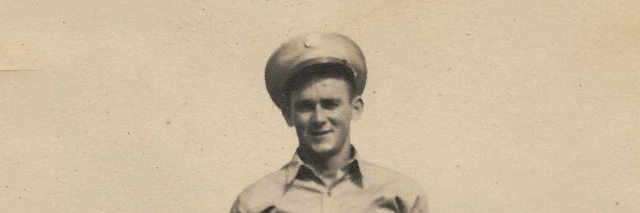
William John McQuiston was born in Philadelphia, Pennsylvania, on January 18, 1921. He was the son of Clarence Meech McQuiston (1895–1937) and Ella Louise McQuiston (née McMahon, later Poole, 1897–1981). McQuiston’s father served several stints in the U.S. Marine Corps totaling over 16 years, including during World War I.
McQuiston had three younger brothers: Robert Harry McQuiston (1923–1987), Francis Anthony McQuiston (1924–1998), and John Joseph McQuiston (1927–1998), all of whom also served in the U.S. Navy during World War II. McQuiston also had a younger half-sister from his mother’s second marriage.
The McQuiston family may have briefly lived in Lenola, New Jersey, where McQuiston’s youngest brother was born on May 18, 1927. They were recorded on the census in April 1930 living at 7031 Passyunk Avenue in Philadelphia. Census records indicate that the family had moved to Wilmington, Delaware, by April 1, 1935.
According to his personnel file, McQuiston completed the 9th grade at Wilmington High School during the 1935–1936 school year. He dropped out of school after completing half of his sophomore year of high school.
The family was living at 401 Walnut Street in Wilmington as of August 17, 1937, when McQuiston’s father was convicted of driving while intoxicated after reportedly leading the Delaware State Police on a pursuit the previous day. McQuiston was 16 when his father died from a pulmonary infarction on October 20, 1937, at the U.S. Naval Hospital, Philadelphia, Pennsylvania. The death certificate listed his father’s address as 401 Walnut Street, while the Wilmington Morning News listed 805 Jefferson Street. (McQuiston later reported to the Navy that he had lived at 805 Jefferson Street for three years.)
McQuiston’s mother remarried in Wilmington on November 22, 1939, to Henry Alan Poole. McQuiston remained in Delaware when his mother and two youngest brothers moved to 1215 East 9th Street in Eddystone, Pennsylvania.
Documents in McQuiston’s personnel file stated that he was a member of the Civilian Conservation Corps Company 3222 “at CAMP SCS-1, Wyoming, Delaware” until he was honorably discharged “on JANUARY 19, 1940 by reason of OBTAINING EMPLOYMENT.” McQuiston worked as a winder for the Ludlow Manufacturing Company for about one month before applying to join the U.S. Navy. He told the Navy that he did not have a trade and wanted to be a career sailor.
McQuiston was living at 613 West 9th Street in Wilmington when he entered the service. It is unclear whether he lived there before or only after leaving the C.C.C. He also told the Navy that he lived at two other locations in Wilmington: 806 West 9th Street for two months and at 805 Jefferson Street for three years.
According to his U.S. Navy personnel file, McQuiston stood five feet, 11½ inches tall and weighed 141 lbs., with light brown hair and blue eyes. He was Catholic.
Military Training
Prior to joining the U.S. Navy, McQuiston served in Battery “D,” 198th Coast Artillery Regiment (Antiaircraft), a Delaware National Guard unit based in Wilmington.
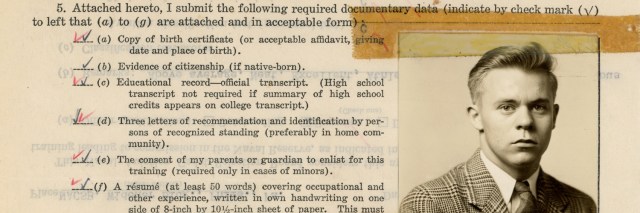
On March 21, 1940, McQuiston applied to enlist in the U.S. Navy at the U.S. Navy Recruiting Station, Wilmington, Delaware. Although he was 19 years old, the age of majority at the time was 21. His mother consented to his enlistment on April 2, 1940. In article about his enlistment, Journal-Every Evening remarked “Although he had completed only 10 [sic] grades of school, he made a better mark on the navy intelligence test than many high school graduates.”

On April 10, 1940, McQuiston was accepted as an apprentice seaman for a six-year term in the U.S. Navy, enlisting at the Navy Recruiting Station, Philadelphia, Pennsylvania. The following day, he began boot camp at the Naval Training Station, Newport, Rhode Island. He was a member of D&I Company No. 29 at Newport as of June 8, 1940, when he began a nine-day leave to visit his family at 1215 East 9th Street in Eddystone.
On June 28, 1940, Apprentice Seaman McQuiston was transferred to the U.S. Naval Air Station, Naval Operating Base Norfolk, Virginia, to attend Aviation Machinist’s Mate School. He began the 16-week course the following day. Topics included theory of flight, electrical equipment, as well as aircraft and engine maintenance.
Partway through the class, on August 10, 1940, McQuiston was promoted to seaman 2nd class. He graduated on October 26, 1940, with a score of 3.457 out of four and ranked 63rd in a class of 95.
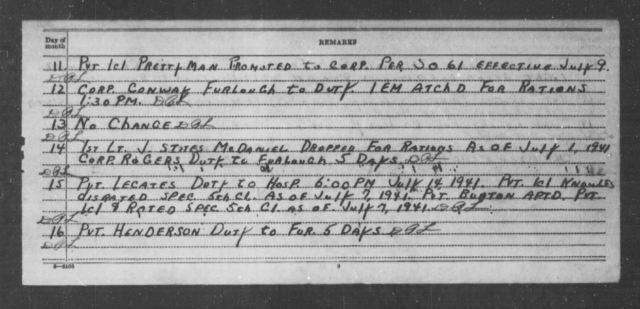
Seaman 2nd Class McQuiston was transferred to the Receiving Ship, San Diego, California, on October 26, 1940. He reported there on October 30, 1940, and spent the next few days awaiting his next assignment. On November 4, 1940, McQuiston was transferred to Cruiser Scouting Squadron 4 (VCS-4). He boarded the carrier U.S.S. Yorktown (CV-5), which sailed for Pearl Harbor the following day. On November 12, 1940, McQuiston reported for duty with VCS-4 aboard U.S.S. Indianapolis (CA-35). Cruisers carried seaplanes for reconnaissance and artillery spotting.
From January 1, 1941, until February 10, 1941, Seaman 2nd Class McQuiston served as a crew’s messman. He was promoted to seaman 1st class on February 16, 1941. His personnel file noted that on May 19, 1941, he was “Temporarily based ashore at Fleet Air Detachment, Naval Air Station, Pearl Harbor, T.H.”
On August 4, 1941, he passed an examination at Pearl Harbor qualifying him for the rating of aviation machinist’s mate 3rd class. He returned to duty aboard Indianapolis on August 13, 1941. On August 27, 1941, McQuiston began a week’s leave at Long Beach, California. In the meantime, approval for his promotion came through and on September 1, 1941, McQuiston was appointed to the rating of aviation machinist’s mate 3rd class. On October 13, 1941, McQuiston received a warning for “Insolence to & disobedience of Orders of a petty officer.”
On the morning of December 2, 1941, Aviation Machinist’s Mate 3rd Class McQuiston boarded the transport U.S.S. Henderson (AP-1) for transport to the West Coast. He was to be authorized leave to visit his mother in Eddystone prior to reporting to the commander of Patrol Wing 1 at the Naval Air Station, San Diego, California, no later than 0800 on December 22, 1941. (Curiously, other records indicate that Patrol Wing 1 was in Hawaii at this point. It is unclear if part or all of the wing would have been moving to San Diego had the Pacific War not intervened. That fall, some squadrons did return there briefly before shuttling aircraft back to Hawaii.)
When the attack on Pearl Harbor occurred on December 7, 1941, Henderson was sailing unescorted between Pearl Harbor and San Francisco, California. The transport arrived safely at San Francisco on the morning of December 11, 1941. With the start of the Pacific War, McQuiston’s leave was cancelled. Presumably, he continued his journey south by ground. On December 15, 1941, he reported at the Receiving Station, San Diego, California.
On December 21, 1941, McQuiston was dispatched to Hawaii to join to Patrol Wing 1, again traveling aboard U.S.S. Henderson back to Pearl Harbor. This phase of his career started inauspiciously. Since Henderson would not be sailing for a few days, McQuiston was able to go on liberty. Although he was due back at 0800 hours on December 25, 1941, he did not return until 1300 hours on December 27, 1941. He narrowly made it back in time to board Henderson, which sailed from San Francisco at 1326 hours the same day, this time as part of a convoy. The punishment levied at a captain’s mast on January 6, 1942, was mild: “Thirty (30) hours extra duty.”
Henderson arrived at Pearl Harbor on the morning of January 10, 1942. Two days later, Aviation Machinist’s Mate 3rd Class McQuiston joined Patrol Wing 1’s Patrol Squadron 14 (VP-14). VP-14 was equipped with the Consolidated PBY-5A Catalina.
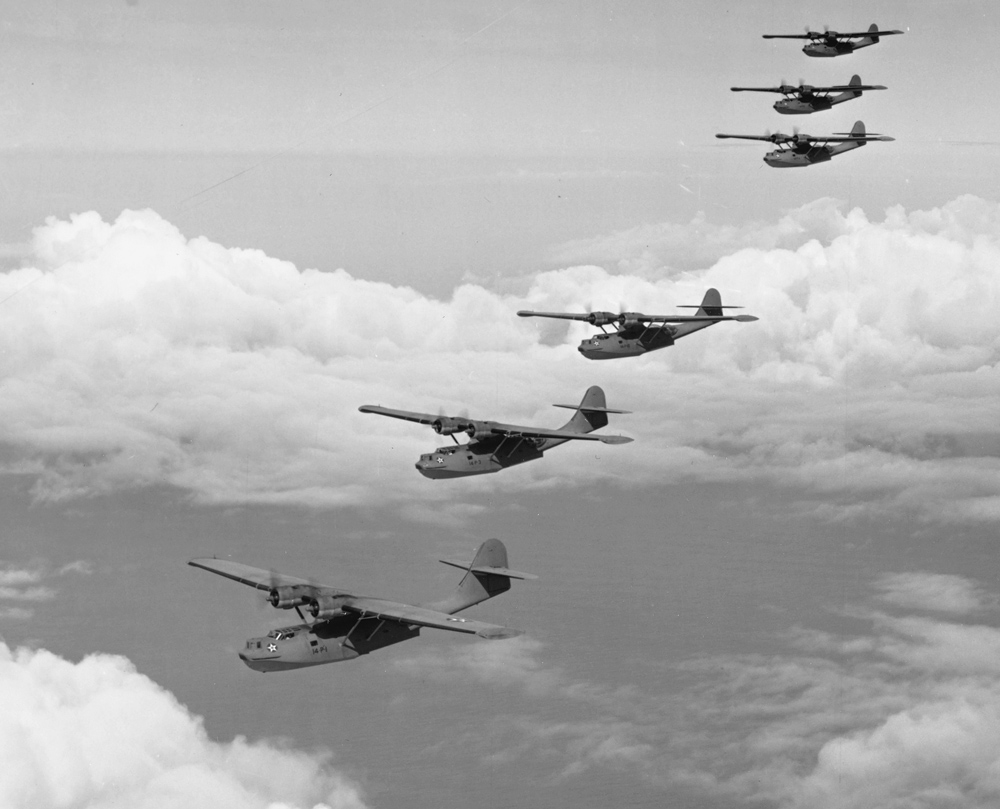
Some aviation machinist’s mates only worked on aircraft on the ground, while others also served as aircrew. A set of orders issued on March 1, 1942, at the Naval Air Station, Kaneohe Bay, Hawaii, stated that McQuiston was “hereby ordered to duty participating in regular and frequent aerial flights in aircraft[.]” McQuiston must have been acutely aware that this new duty was far more dangerous than his previous one. Previously he passed on the offer of National Service Life Insurance (N.S.L.I.) in which servicemembers could obtain up to a $10,000 policy with low premiums, though he had a smaller $2,000 Government Life Insurance policy. In April 1942, he applied for a $5,000 N.S.L.I. policy with his mother as the beneficiary.
On August 27, 1942, McQuiston “Completed course of instruction in Patrol Wing One aerial machine gun school.”
McQuiston was promoted to aviation machinist’s mate 2nd class effective December 1, 1942. A request for commutation of rations made around that time indicates he was living off-base at 415-C Joras Street, Kaneohe Bay, Hawaii.
Combat in the Pacific Theater
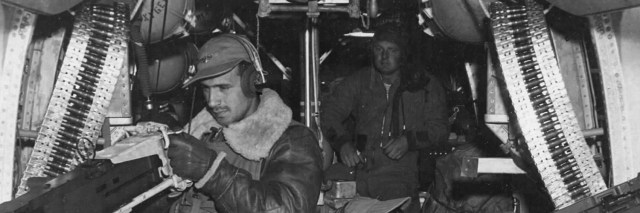
Effective February 15, 1943, Patrol Squadron 14 was redesignated, becoming Bombing Squadron 102 (VB-102), Fleet Air Wing 2. The squadron began converting to the Consolidated PB4Y-1 Liberator, the Navy’s version of the Army Air Forces’ B-24 Liberator.
Aviation Machinist’s Mate 2nd Class McQuiston was among a group of enlisted men from VB-102 who joined another squadron, Bombing Squadron 101 (VB-101) of Fleet Air Wing 1, on March 28, 1943. VB-101 was the first U.S. Navy unit equipped with the PB4Y-1. Unit records are incomplete, but the VB-101 commanding officer, Commander William Adger Moffett, Jr. (1910–2001), stated in an interview on November 8, 1943, that his squadron was based at Espiritu Santo in the New Hebrides Islands (modern Vanuatu) beginning on January 26, 1943, and then moved to Guadalcanal in the Solomon Islands on February 12, 1943. The squadron flew its first mission the following day.


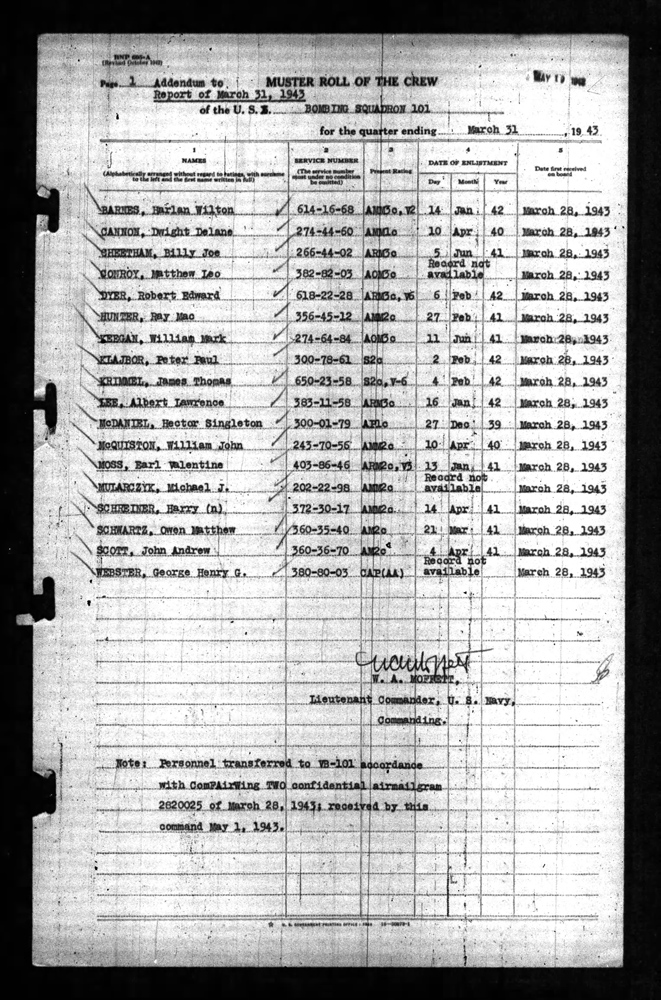
During its first month of combat, the squadron flew 12 missions, 10 of them night raids. They were short of both air and ground crews though Army personnel helped load the squadron’s ordnance. The air crews suffered attrition from tropical illnesses, forcing the remaining personnel to fly long, frequent missions against Japanese targets in the Solomon Islands as New Guinea with little rest. VB-101 lost three crews in as many weeks. It appears that VB-101 records from mid-March 1943 through April 1943 were not preserved, so there are few details of the week that McQuiston spent with the squadron.
On April 4, 1943, McQuiston was one of 11 men flying aboard PB4Y-1 Bureau No. 31969 on “routine patrol.” The plane had to ditch off Espiritu Santo due to fuel exhaustion.
According to a summary of the events in his personnel file:
At 1530, April 4, 1943, a PB4Y-1 airplane in which William John McQuiston, Aviation Machinist’s Mate second class, U. S. Navy, was acting as plane captain, made a forced landing in the water off Espiritu Santo. McQuiston and one other mechanic could not be located by the remaining nine survivors, although the plane remained awash for fifteen minutes, and repeated attempts were made to locate them. According to survivors, McQuiston remained at his station on the fuel transfer deck, an extremely hazardous location in the event of a water landing, in an effort to restore fuel flow to the engines when all engines failed.
Aviation Ordnanceman 3rd Class Peter Paul Klajbor (1923–1943), who “remained at his station in the bomb bay where the fuel selector valves are located,” was also killed. Two other men were severely injured: Aviation Machinist’s Mate 3rd Class Michael Joseph Mularczyk (probably 1919–2009) and Aviation Ordnanceman 3rd Class Matthrew Leo Conroy (1923–1964). All four men had joined VB-101 from VB-102 together.
An inventory of McQuiston’s personal effects included a rosary, a flight log, two pairs of swimming trunks, four decks of playing cards, a cribbage board, a Japanese helmet, a Kodak Brownie camera, and a box of photographs and stationery.
With no indication that he could have survived, the Navy issued a finding of death effective one year and one day after the crash: April 5, 1944. However, as of April 10, 1944, his mother had not been notified of that decision. In a letter that day to the Bureau of Naval Personnel, she requested an update, explaining:
Like any other devoted Mother, my heart has been very heavy, altho I try so hard to conceal my inner feeling—. This past year has been one of terrible anxiety and suspense. While I don’t want to be a nuisance to the Navy Department or my Government, still I am wondering whether there has been any more news of Bill – or whether his case has been decided.

Around July 11, 1943, Commander Moffett nominated Aviation Machinist’s Mate 2nd Class McQuiston and Aviation Ordnanceman 3rd Class Klajbor for the Navy and Marine Corps Medal. The proposed citation for McQuiston stated:
For meritorious achievement in the line of his profession as mechanic and aerial gunner in Bombing Squadron 101, while acting as plane captain of a Navy heavy bomber which made a forced landing at sea April 4, 1943. When a crash landing became imminent owing to stoppage of all engines, William John McQuiston, Aviation Machinist’s Mate second class, U. S. Navy, remained at his station, a hazardous location in the event of a forced landing, in an [sic] heroic attempt to restore fuel flow instead of retiring to a less dangerous position. This action is in keeping with the highest traditions of the Naval Service.
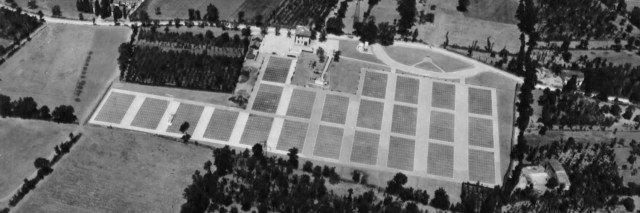
Commander Aircraft, South Pacific Force Aubrey W. Fitch (1883–1978) forwarded the nomination and recommended its approval. For some reason, no further action was taken until after the war. On January 27, 1947, the Board of Review for Decorations and Medals recommended that neither man be awarded any medal for actions on their last flight. In 1949, a board declared his remains to be non-recoverable. His name is honored at the Courts of the Missing at the National Memorial Cemetery of the Pacific in Hawaii.
Although McQuiston had lived in Delaware for several years prior to entering the service, it appears that the State of Delaware Public Archives Commission missed him when compiling their list of state casualties. Navy casualty books listed sailors based on the residence of their next of kin (Pennsylvania in this case) rather than their residence upon entering the service. McQuiston’s mother falsely told the Commonwealth of Pennsylvania that her son was residing with her at 1215 East 9th Street in Eddystone when he entered the service, evidently to claim the $500 bonus that Pennsylvania paid the next of kin of World War II fallen. McQuiston’s name was not honored in the Delaware memorial volume nor at Veterans Memorial Park in New Castle, though the Defense POW/MIA Accounting Agency correctly identifies him as being from Delaware.
Notes
Unit
Curiously, McQuiston’s personnel file listed him as a member of Patrol Squadron 14 at the time of his death. That was despite the fact that VP-14 had become VB-102 on February 15, 1943, and muster rolls indicate that he was transferred to VB-101 on March 28, 1943.
Both squadrons were redesignated several times during the war. VB-101 had been Patrol Squadron 51 (VP-51) until shortly before McQuiston joined.
Bibliography
“Addendum to Report of March 31, 1943 Muster Roll of the Crew of the U.S. BOMBING SQUADRON 101 for the quarter ending March 31, 1943.” Muster Rolls of U.S. Navy Ships, Stations, and Other Naval Activities, January 1, 1939 – January 1, 1949. Record Group 24, Records of the Bureau of Naval Personnel. National Archives at College Park, Maryland. https://www.fold3.com/image/313308697
Application for Headstone for Clarence M. McQuiston. January 26, 1938. Applications for Headstones for U.S. Military Veterans, 1925–1941. Record Group 92, Records of the Office of the Quartermaster General, 1774–1985. National Archives at Washington, D.C. https://www.ancestry.com/imageviewer/collections/2375/images/40110_285416-00754
Application for Headstone or Marker for Matthew L. Conroy. March 28, 1966. Applications for Headstones, January 1, 1925 – June 30, 1970. Record Group 92, Records of the Office of the Quartermaster General, 1774–1985. National Archives at St. Louis, Missouri. https://www.ancestry.com/imageviewer/collections/2375/images/2375_05_00018-01005
Application for World War II Compensation for Ella Louise Poole. World War II Veterans Compensation Applications. Record Group 19, Series 19.92, Records of the Department of Military and Veterans Affairs. Pennsylvania Historical and Museum Commission, Harrisburg, Pennsylvania. https://www.ancestry.com/imageviewer/collections/3147/images/43191_172028004419_0944-01885
Census Record for Ella L. Poole. April 9, 1940. Sixteenth Census of the United States, 1940. Record Group 29, Records of the Bureau of the Census. National Archives at Washington, D.C. https://www.ancestry.com/imageviewer/collections/2442/images/M-T0627-03491-00220
Census Record for William McQuiston. April 29, 1930. Fifteenth Census of the United States, 1930. Record Group 29, Records of the Bureau of the Census. National Archives at Washington, D.C. https://www.ancestry.com/imageviewer/collections/6224/images/4639467_01001
Certificate of Death for Clarence Meech McQuiston. October 1937. Death Certificates, 1906–1970. Record Group 19, Series 11.90, Records of the Pennsylvania Department of Health. Pennsylvania Historical and Museum Commission, Harrisburg, Pennsylvania. https://www.ancestry.com/imageviewer/collections/5164/images/42342_2321306652_0667-00484
Certificate of Marriage for Henry Alan Poole and Ella Louise McQuiston. November 22, 1939. Delaware Marriages. Bureau of Vital Statistics, Hall of Records, Dover, Delaware. https://www.ancestry.com/imageviewer/collections/61368/images/TH-267-12383-22626-22
“Clarence M. McQuiston.” Wilmington Morning News, October 22, 1937. https://www.newspapers.com/article/140022887/
“Father Was in Marines, Son Enlists in Navy.” Journal-Every Evening, April 10, 1940. https://www.newspapers.com/article/140024561/
Moffett, William A. “Air Operations of Bombing Squadron 101 During Period 12 February to 11 March, Comments and Recommendations Concerning.” March 12, 1943. World War II War Diaries, 1941–1945. Record Group 38, Records of the Office of the Chief of Naval Operations. National Archives at College Park, Maryland. https://catalog.archives.gov/id/134159911
Moffett, William A. “Interview of Commander W. A. Moffett, USN 8 months as Commanding Officer of VB-101 (Espiritu Santo and Guadalcanal).” November 8, 1943. World War II Oral Histories, Interviews and Statements. Record Group 38, Records of the Office of the Chief of Naval Operations. National Archives at College Park, Maryland. https://catalog.archives.gov/id/278490015
Official Military Personnel File for William J. McQuiston. Official Military Personnel Files, 1885–1998. Record Group 24, Records of the Bureau of Naval Personnel. National Archives at St. Louis, Missouri.
“Police Charge Driver as Drunk After Chase.” Wilmington Morning News, August 17, 1937. https://www.newspapers.com/article/140022860/
“Report of Passengers of U.S.S. YORKTOWN for the month ending 5th day of November, 1940, date of sailing from San Diego, California to Pearl Harbor, T.H.” November 5, 1940. Muster Rolls of U.S. Navy Ships, Stations, and Other Naval Activities, January 1, 1939 – January 1, 1949. Record Group 24, Records of the Bureau of Naval Personnel. National Archives at College Park, Maryland. https://www.fold3.com/image/302793463
Roberts, Michael D. Dictionary of American Naval Aviation Squadrons, Volume 2: The History of VP, VPB, VP(HL) and VP(AM) Squadrons. Naval Historical Center, 2000. https://www.history.navy.mil/content/dam/nhhc/research/histories/naval-aviation/dictionary-of-american-naval-aviation-squadrons-volume-2/pdfs/DictionaryAmericanNavalAviationSquadronsVol2.pdf
“War Diary U. S. S. Henderson From: 7 December 1941 To: 31 December 1941.” Undated, c. January 1942. World War II War Diaries, 1941–1945. Record Group 38, Records of the Office of the Chief of Naval Operations. National Archives at College Park, Maryland. https://www.fold3.com/image/268360959/war-diary-12742-to-53142-page-2-us-world-war-ii-war-diaries-1941-1945
“War Diary U. S. S. Henderson From: January 1, 1942 To: January 31, 1942.” Undated, c. February 1942. World War II War Diaries, 1941–1945. Record Group 38, Records of the Office of the Chief of Naval Operations. National Archives at College Park, Maryland. https://www.fold3.com/image/268360963/war-diary-12742-to-53142-page-6-us-world-war-ii-war-diaries-1941-1945
Last updated on February 8, 2025
More stories of World War II fallen:






















To have new profiles of fallen soldiers delivered to your inbox, please subscribe below.
 Delaware's World War II Fallen