
| Residences | Civilian Occupation |
| Delaware, Florida, Maryland | Truck driver |
| Branch | Service Number |
| U.S. Army | 14082104 |
| Theater | Unit |
| Mediterranean | Company “D,” 56th Medical Battalion, Motorized |
Author’s note: This article incorporates some text from my previous article about Private 1st Class Lynn E. Ritter, Jr., in describing how medical battalions were organized and operated.
Early Life & Family
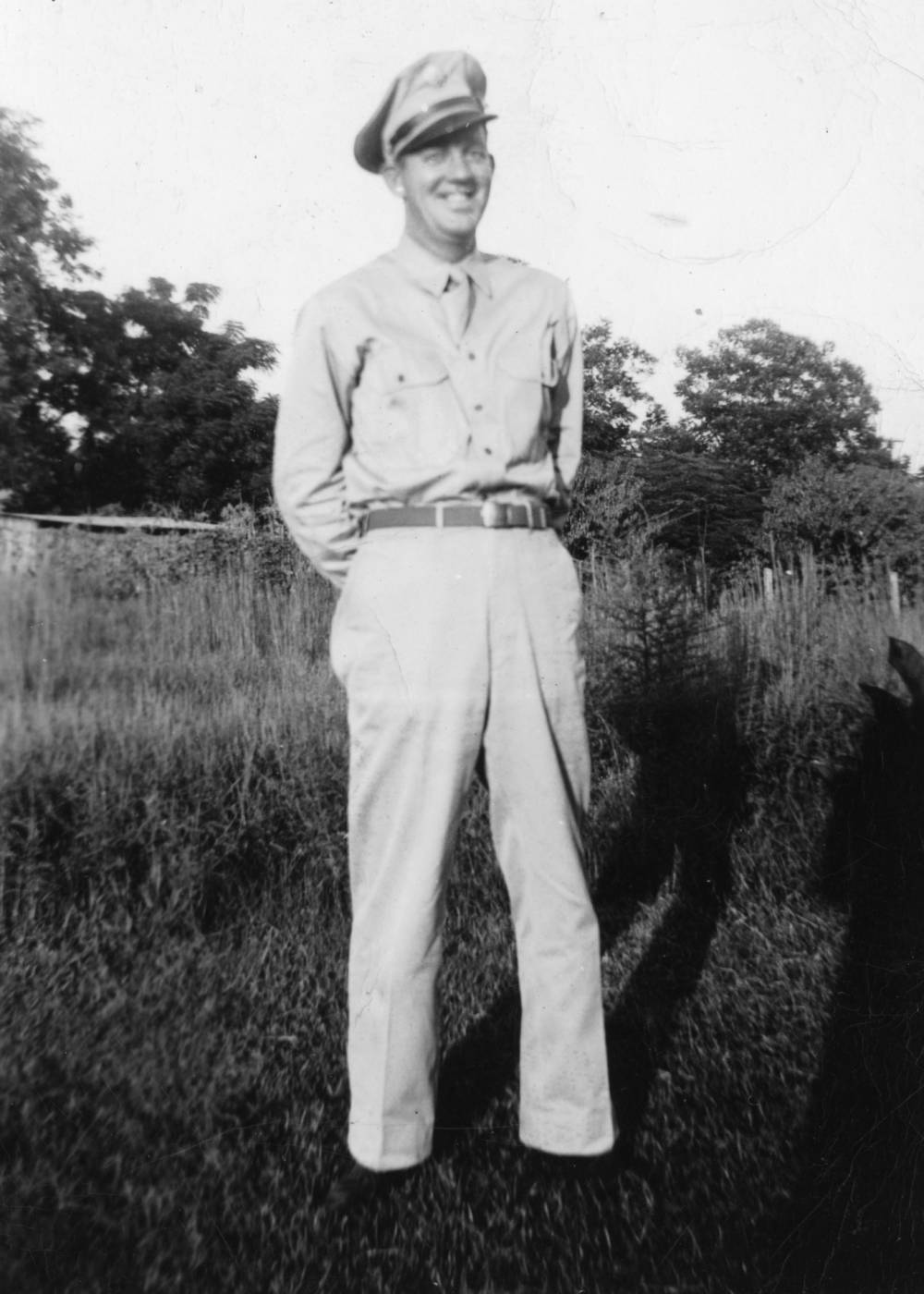
Ormal Clyde Leedom, Jr. was born on November 9, 1906, outside Wilmington, Delaware, at Pelleport, an estate built by William du Pont (1855–1928) and now the site of Christiana Care’s Eugene du Pont Preventative Medicine & Rehabilitation Institute. His mother later explained that her son was born “on the DuPont estate where his father was employed for many years.” He was the first son of Ormal Clyde Leedom, Sr. (a chauffeur and later a machinist, 1879–1953) and Rebecca Leedom (née Crothers, c. 1885–1957). Both father and son were referred to as Clyde Leedom in some records. Leedom had a younger sister and a younger brother.
The Leedom family was recorded on the census in April 1910 living on Kennett Pike in unincorporated New Castle County, Delaware, northwest of Wilmington, likely at or near the Pelleport estate. The Leedoms were recorded on the 1920 census living in Ashland Village, a few miles west of where they had been living a decade earlier. Leedom subsequently moved to Florida. He was listed as Clyde O. Leedom, Jr. in a 1926 Clearwater directory as a clerk living on Broadway. His parents were also listed in the same directory as living on Broadway.
Leedom subsequently moved back to Delaware, settling in Wilmington by the time he married Ethel Buford Cooper (1910–1987) there on the evening of October 24, 1929. His occupation was recorded as drug clerk on their marriage certificate. The St. Petersburg Times reported:
The Rev. P. M. Hosler of East Lake Presbyterian church in Wilmington, Del., uncle of the groom, officiated at the wedding ceremony. Mr. Leedom’s relatives entertained for the young couple with a reception immediately after the wedding.
Mr. Leedom is the son of Mr. and Mrs. Clyde Leedom of Dunedin. He attended Clearwater High school for two years before going to Wilmington, Del., where he is now employed by the Peoples’ Service Drug company.
In April 1930 the couple was recorded on the census living at 168 Academy Street in Newark, Delaware. Leedom was described as a manager of a retail chain store, while his wife was a clerk at a retail radio store. The couple apparently relocated to Maryland soon afterward, where their two children were born: Clyde Richard Leedom (1932–1950) and Virginia Ruth Leedom (later Patterson, c. 1935–2020?).
Leedom and his wife divorced around 1936. His mother later told the Army that her son had little contact with his children in the years before he entered the service. Leedom was not recorded in any known records from the 1940 census, though by the time he joined the military in 1942, Leedom had moved to Lakeland, Florida, close to where his parents were living. His mother described his occupation as truck driver.
Military Training & North Africa
Leedom volunteered for the U.S. Army, enlisting at Camp Blanding, Florida, on June 8, 1942. Curiously, he enlisted under the name Ornial C. Leedom, Jr. Private Leedom was assigned to the Medical Department and dispatched to the Medical Replacement Training Center, Camp Pickett, Virginia. On June 20, 1942, he was attached unassigned to Company “B,” 3rd Medical Training Battalion there for basic training. On July 30, 1942, he was released from attachment to Company “B” and transferred to Lawson General Hospital in Atlanta, Georgia.
Leedom’s mother told the State of Delaware Public Archives that her son was stationed at Lawson General Hospital until September 29, 1942, when he began a move to Fitzsimons General Hospital in Colorado. She wrote that he was promoted to private 1st class on October 7, 1942, and was stationed in Colorado until October 19, 1942, when he moved to Camp Kilmer, New Jersey. He was there only briefly before moving to Fort Dix, New Jersey. There, on October 24, 1942, he joined Company “D,” 56th Medical Battalion, Motorized.
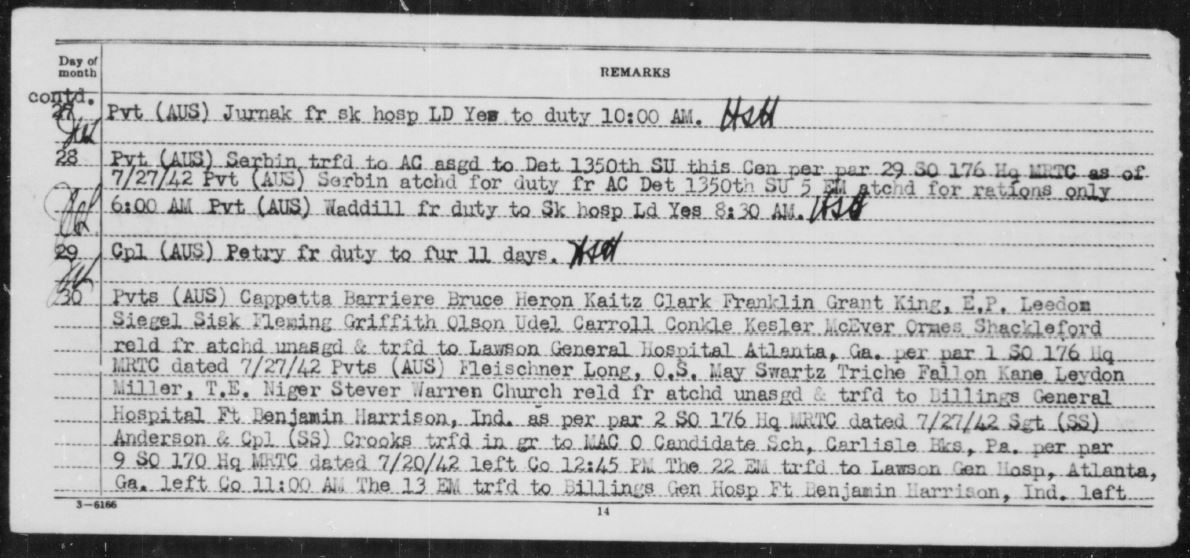
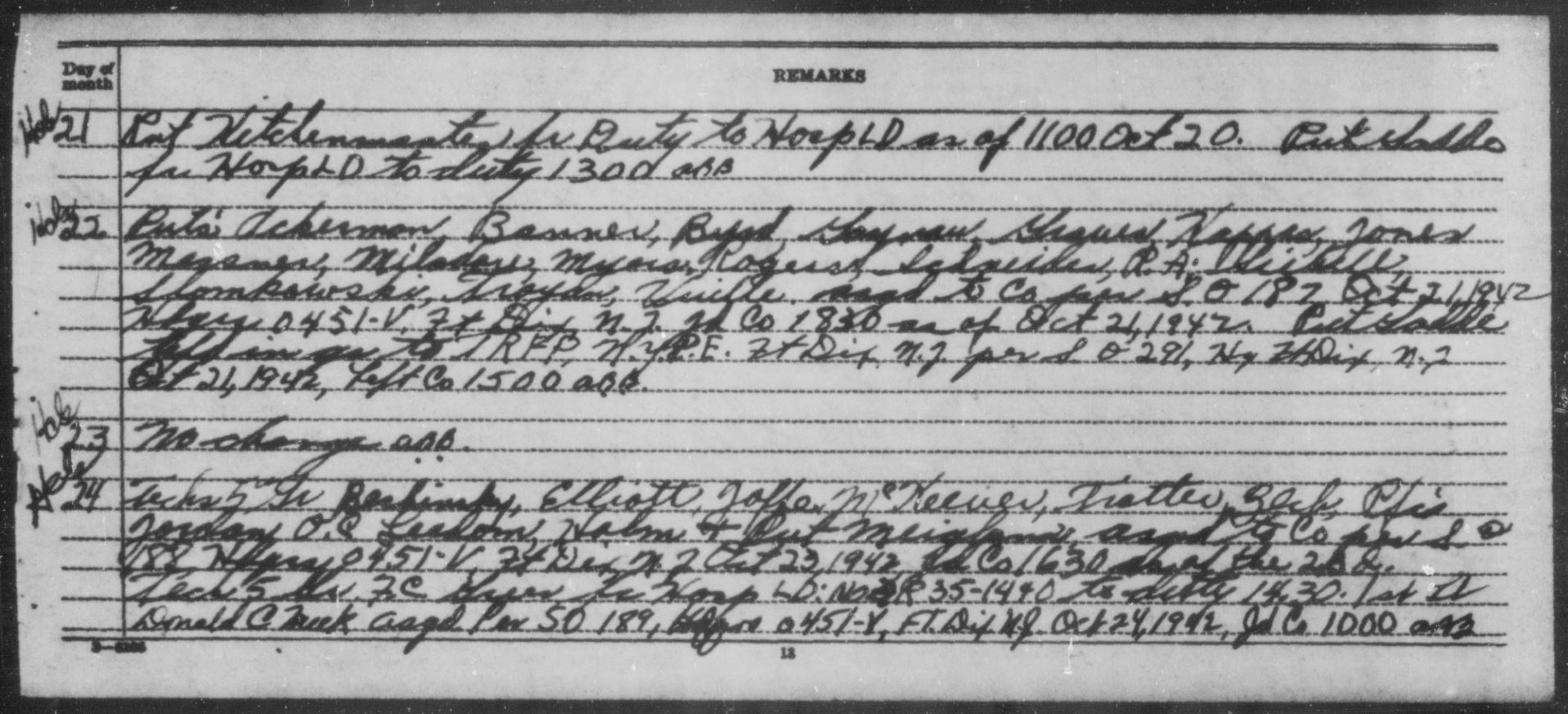
Usually, initial care for wounded soldiers was provided by members of their unit medical detachments. These detachments supplied medics to frontline units and operated aid stations. Medical battalions like Leedom’s represented an intermediate link in the chain of survival. Most medical battalions were organic to infantry divisions. The 56th Medical Battalion, on the other hand, was a separate corps-level asset, though it was sometimes attached to a particular division.
Each medical battalion had three collecting companies (“A,” “B,” and “C”). Leedom’s company was the battalion clearing company, Company “D.” Generally, litter bearers moved the wounded soldiers from the aid station to their company’s collecting station. At the collecting station, medical personnel cared for patients until they could be moved to the medical battalion’s clearing station (operated by the clearing company). There, patients were triaged, received further treatment, and if necessary, were evacuated by ambulance to a hospital.
Leedom’s military occupational specialty is unknown. Based on his grade, under the tables of organization for his unit, he was likely a light truck driver (his civilian occupation), a medical or surgical technician, or a ward attendant.
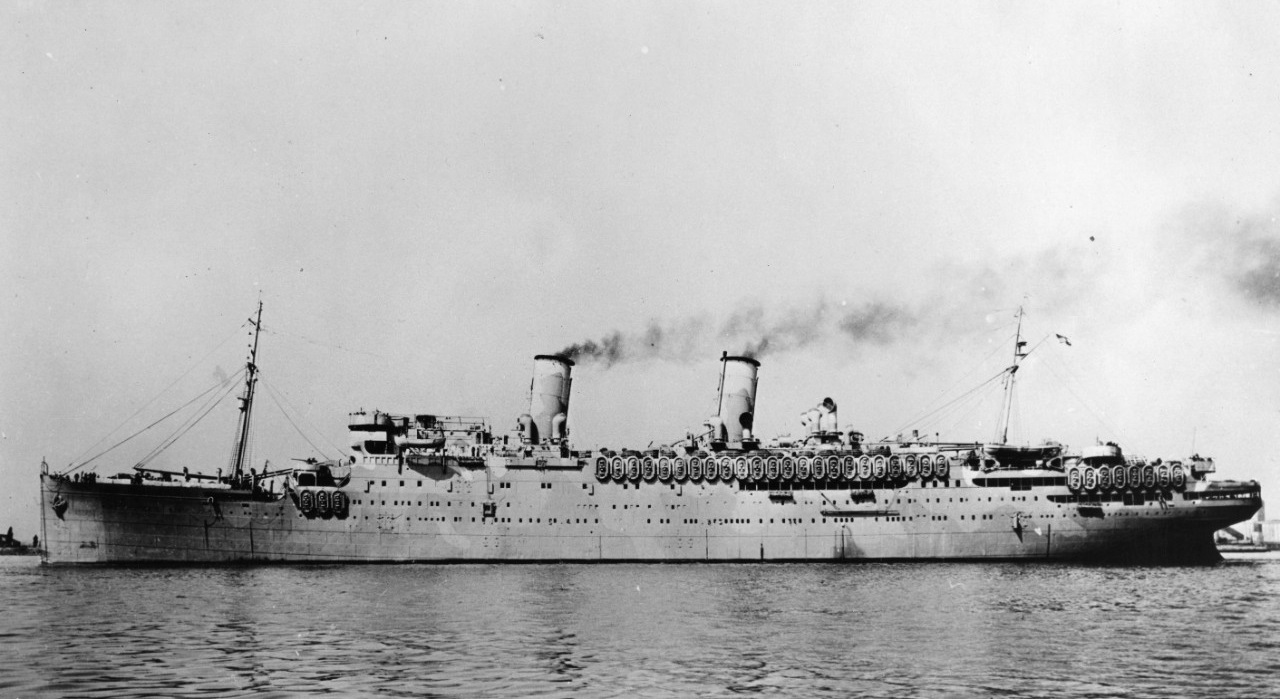
On the afternoon of November 1, 1942, Leedom and his comrades departed Fort Dix by train for Staten Island, New York. That evening, at the New York Port of Embarkation, they boarded a former Italian ocean liner—now an American troop transport—U.S.S. Monticello (AP-61). Leedom and his unit shipped out on November 2, 1942. While at sea, Allied forces launched Operation Torch, the invasion of French Morocco and Algeria, held by the Axis-aligned Vichy French forces. The fighting was over by the time Monticello arrived at Casablanca, Morocco, on November 18, 1942. Leedom and the rest of his unit disembarked the following day.
Company “D,” less 1st Platoon, moved to Meknes, Morocco, on December 9, 1942. The following day, 1st Platoon moved to the Marmora Forest (Al-Maamora Forest, near Rabat) and opened a clearing station. On December 13, 1942, the rest of the company moved to Guercif, Morocco, where they were attached for rations to Headquarters Company, 30th Infantry Regiment, 3rd Infantry Division, opening a clearing station the following day. 1st Platoon of Company “D” and the rest of the 56th Medical Battalion, less detachments, were attached to the 2nd Armored Division effective December 15, 1942. Strong circumstantial evidence indicates that Private 1st Class Leedom was already with 1st Platoon by this point.
On March 9, 1943, Leedom went on detached service with Headquarters Company, I Armored Corps in Rabat. The morning report for that date is a little unclear but appears to state that he was performing dispensary duty. He returned to his unit on March 24.
Headquarters Company “D” moved west and rejoined 1st Platoon on or about April 6, 1943. 2nd Platoon moved to Tlemcen, Algeria, on April 27, and to Arzew, Alergia, the following day. Headquarters Company “D” and 1st Platoon, along with the main body of the 56th Medical Battalion, moved to Guercif on April 28, to Tlemcen on April 29, and to the Amphibious Training Center five miles southwest of Mostaganum, Alergia, on April 30.
On or about May 1, 1943, all of Company “D” was reunited at Mostaganem. 1st Platoon spent the month operating a clearing station there, while 2nd Platoon remained in reserve.
The 56th Medical Battalion had been well behind the front lines during the Tunisian campaign. However, with the end of fighting in North Africa in May 1943, the unit was earmarked for the upcoming amphibious operation against Sicily. During June 1–4, 1943, the unit moved by road to the area of Ferryville (now Menzel Bourguiba), Tunisia.
Leading up to the operation, the 56th Medical Battalion saw frequent changes in the units it was attached to. On April 30, 1943, the 56th Medical Battalion was detached from the 2nd Armored Division and attached to the 3rd Infantry Division. However, the following day, the unit was detached from the 3rd Infantry Division and reassigned to I Armored Corps (Reinforced). Then, on June 4, 1943, the 56th Medical Battalion was attached back to the 3rd Infantry Division (Reinforced). The commanding general of the 3rd Infantry Division further attached the 56th to the 36th Engineer Beach Group on June 24, 1943. To cap off all this shuffling, effective July 10, 1943, the 56th Medical Battalion’s parent organization, I Armored Corps (Reinforced), was redesignated as the U.S. Seventh Army.
Service on Sicily
On June 20, 1943, Company “D” moved to Bizerte, Tunisia. The following day, Private 1st Class Leedom and his comrades boarded U.S.S. LST-327. They went to sea on June 24, 1943. Two days later, they returned to port and briefly moved back to Ferryville, but reboarded LST-327 on the afternoon of July 6, 1943. The following day, they went to sea again, this time bound for Sicily.
Litter bearers from the 56th Medical Battalion landed in southeastern Sicily early on July 10, 1943. Private 1st Class Leedom, who was almost certainly already a member of 1st Platoon, Company “D”—his assignment as of a week later—landed a few hours later. A battalion after action report stated: “At 1005 [hours] Lieutenant Colonel ROBERT J. GOLDSON, Battalion Commander, landed with personnel of the 1st Platoon, Company D, 56th Medical Battalion.” The report added that Colonel Goldson (1908–1972) and 1st Platoon “established headquarters in a draw” about three miles west of Falconara.
The report added:
The trucks carrying the equipment of the 1st Platoon were not unloaded from LST’s until about 1800. During this operation, the truck carrying the surgery was unloaded in about 7 feet of water, and this equipment, vital to the operation of the station, was recovered through the efforts beyond the normal call of duty of Lt. [Donald E.] CAUGHEY, Cpl Anderson, Cpl [Ernest C.] Bess, and Pvt [Jack] Reppert. Some of this equipment was damaged beyond serviceability, and several items were lost.
That evening, “At 2100 the 1st Platoon Clearing Station was established” at the same location as battalion headquarters. By midnight, “four patients had been admitted, one being an American Soldier, and three British Sailors.” The following day, July 11, 1943, however, the clearing station filled to capacity. The arrival of 2nd Platoon that afternoon, as well as the 10th Field Hospital beginning to accept patients west of Licata, helped relieve the pressure. 193 patients were admitted at the Company “D” clearing station on July 11: 143 American soldiers, 15 American sailors, a British serviceman, and 34 enemy prisoners of war. 142 patients were transferred for evacuation by the U.S. Navy. Four seriously wounded patients died of their injuries during July 10–11.
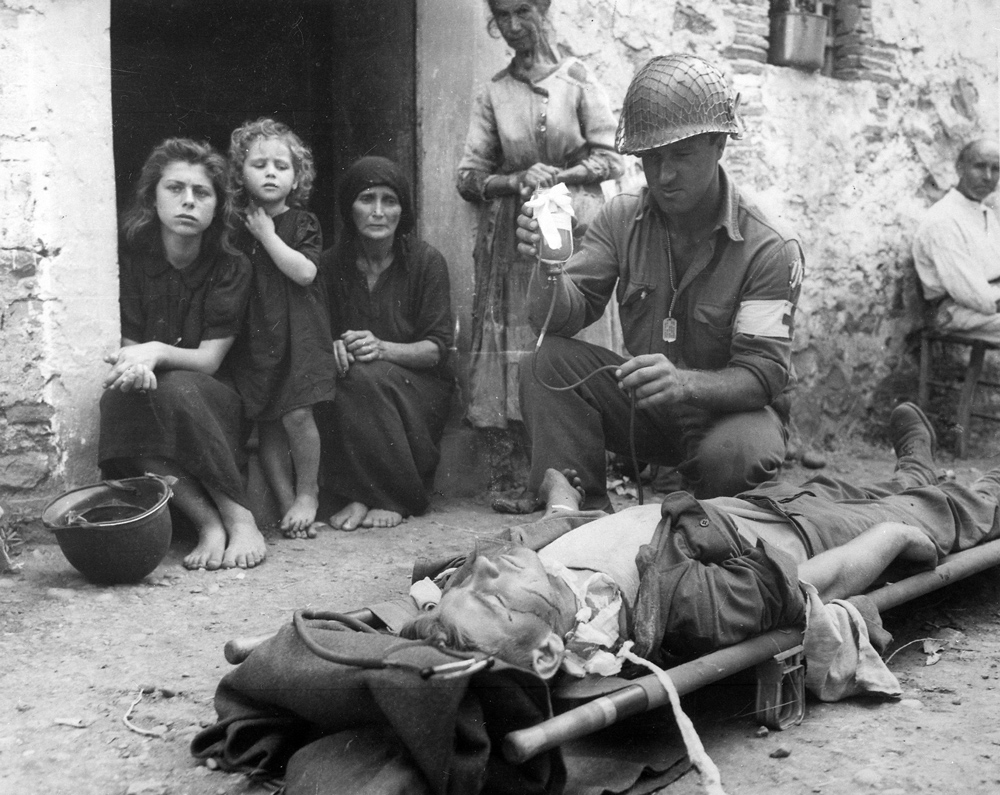
On July 12, 1943, the 56th Medical Battalion’s litter bearers rejoined the rest of the unit. 144 men were admitted to the clearing station for treatment and 133 evacuated to the beach. The following evening, the unit moved a short distance west due to the danger of a nearby ammunition dump, which indeed suffered an explosion shortly after the battalion’s departure. Despite that, another 88 men were admitted and 130 evacuated. Two patients died of their wounds.
On July 14, 1943, 96 men were admitted. 67 were evacuated, including 25 flown by the Royal Air Force. The following day, 88 men were admitted and an equal number evacuated. Company “D” split up again when 2nd Platoon was dispatched with Company “B” to support the 30th Infantry Regiment, 3rd Infantry Division.
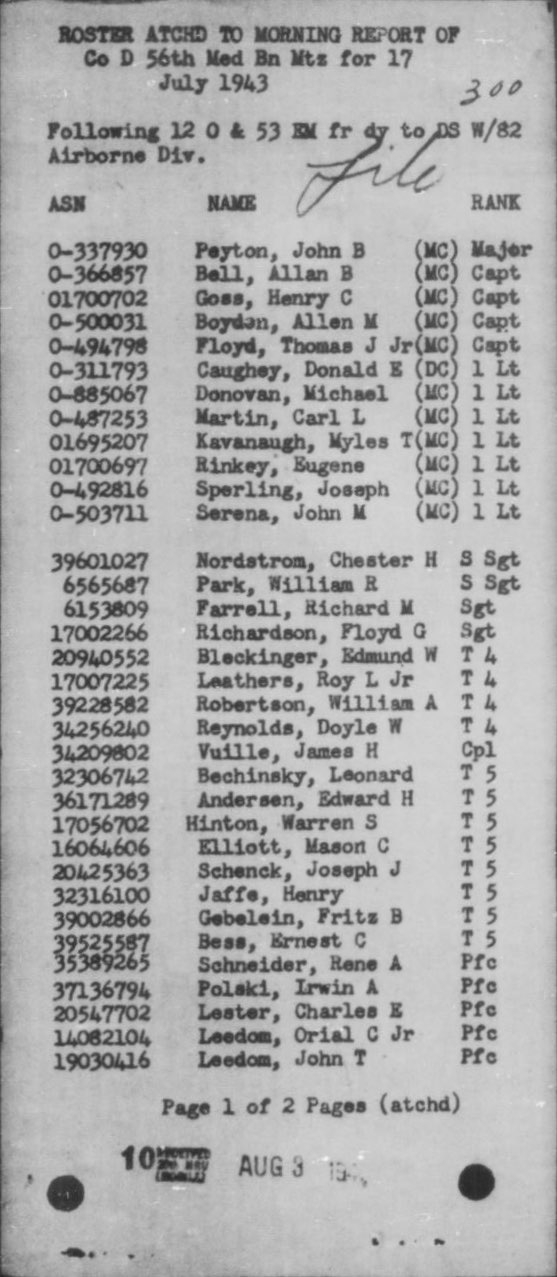
On the afternoon of July 17, 1943, eight days into the Sicily campaign, 1st Platoon, Company “D” was placed on detached service with the 82nd Airborne Division. The platoon consisted of 12 officers (11 doctors and one dentist) and 53 enlisted men, including Private 1st Class Leedom. Litter bearers from Company “C” were also attached to the 82nd Airborne Division. Airborne divisions had fewer men and vehicles as well as considerably less equipment than an equivalent infantry division. The 82nd had also taken heavy casualties during the first week of the campaign, some of them due to friendly fire. Attachments like Leedom’s platoon helped keep the paratroopers in the fight.
1st Platoon moved to Licata and then to the area west of Agrigento. During the next month, Leedom and the others operated a clearing station as the 82nd Airborne Division advanced northwest, moving to Ribera, Castelvetrano, Trapani, and Castellammare del Golfo.
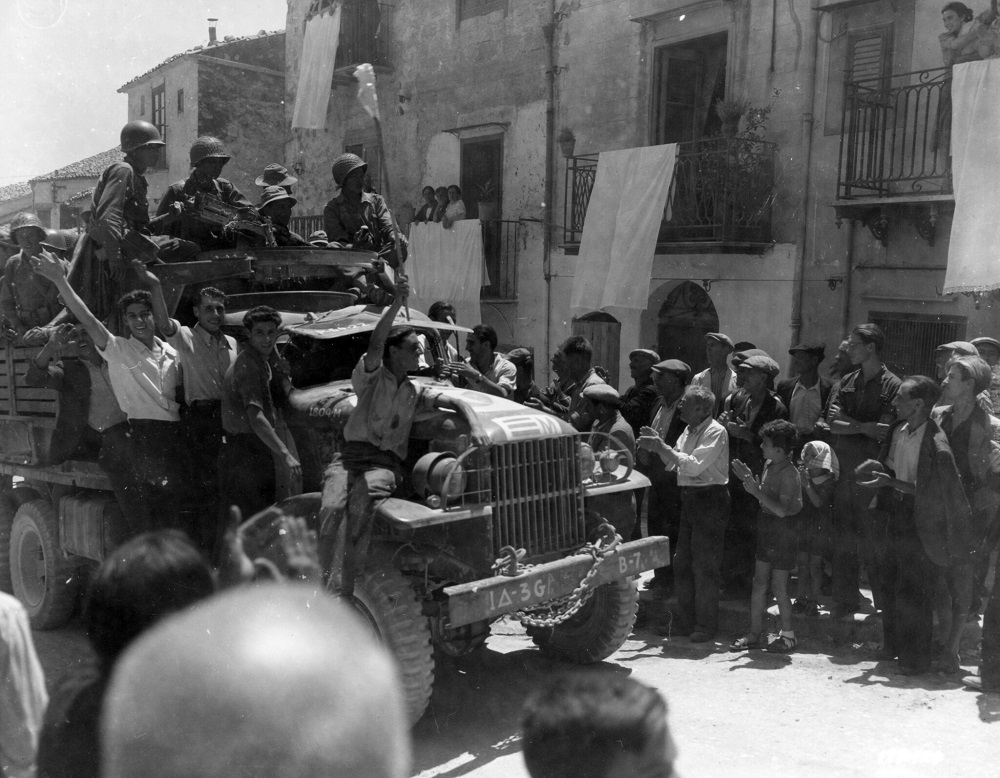
The Sicily campaign ended in an Allied victory on August 17, 1943. Allied forces now had a toehold in Europe, but unlike the conclusion of the Tunisian campaign, the Axis successfully evacuated a large portion of their forces from Sicily to the Italian mainland.
On August 20, 1943, 1st Platoon was released from detached service and placed on special duty with Company “C,” 56th Medical Battalion, then based at the Italian naval hospital, Trapani, Sicily.
On September 8, 1943, while still on special duty with Company “C,” Private 1st Class Leedom was severely injured in a motor vehicle collision. The crash fractured his skull as well as his right tibia and fibula. Leedom’s hospital admission card also indicates that he developed a hemothorax. He was rushed to the 128th Evacuation Hospital, located a few miles west of Castellammare del Golfo. Despite treatment there, Leedom died of his injuries on September 10, 1943.

His personal effects included his wallet, a Levrette wristwatch, a sweater, a flashlight, multiple photographs, two cigarette cases, a mirror, a glass cutter, his Florida driver’s license, and a baby ring. In accordance with Army policy, these personal effects were to be turned over to his eldest child. Leedom’s mother bitterly objected to this practice in a letter to the Army Effects Bureau dated December 15, 1943:
In fact his children hardly knew him. They didn’t bother to write or send him anything and what two children 9 and 11 would do with his things are more than I can see. My son’s personal things would [illegible] life its self [sic] for me. It was hard enough to have him taken away from me, but now what few little things of his that wouldn’t interest any one but me have to go to some one else. I surely would appreciate and thank you if I could have his belongings.
Ethel Leedom also wrote the Army Effects Bureau on December 20, 1943, asking them to turn her ex-husband’s personal effects over to her former mother-in-law. Despite that, Private 1st Class Leedom’s property was delivered to her in January 1944.
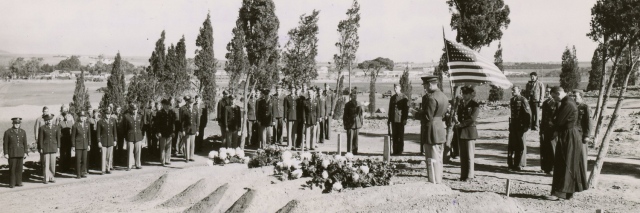
Leedom was initially buried on the afternoon of his death at the 2nd Armored Division Cemetery, Palermo, Sicily. On April 18, 1947, he was reburied at another military cemetery at Monte Soprano.
On October 7, 1947, Leedom’s father requested that his son’s body be interred in a permanent cemetery overseas. In the end, all American servicemembers buried in Italy were either repatriated or reburied at one of two permanent cemeteries. In 1949, Private 1st Class Leedom was reburied for the final time at Nettuno, Italy, in what is now known as the Sicily-Rome American Cemetery. His name is honored at Veterans Memorial Park in New Castle, Delaware.
Tragically, several years later, Leedom’s son, C. Richard Leedom, also sustained a severe head injury in an automobile accident. He died at Kent General Hospital in Dover, Delaware, on August 20, 1950, aged 17.
Notes
Name
In correspondence with the State of Delaware Public Archives Commission, both Leedom’s mother and ex-wife spelled his name Ormal. Likewise, in filling out the request for disposition of remains form, Leedom’s father stated: “The first name of the deceased should be ORMAL instead of ORNIAL.” The Quartermaster Corps Memorial Division wrote a letter informing him that his request was denied: “Army Regulations do not permit alterations in the recorded name of any person under which he first entered the service. The headstone will be inscribed with the name as recorded in this office.”
Although there is no documentation in his individual deceased personnel file regarding a reversal of this position, Leedom’s headstone at the Sicily-Rome American Cemetery does have the spelling that his family requested.
Divorce Date
A document written by Leedom’s wife placed their divorce around 1936. His mother told the Army in a 1943 affidavit that her son divorced in Wicomico County, Maryland, on August 6, 1940. However, Ethel Leedom was already listed as divorced on the census in April 1940. (She also gave an inaccurate marriage date in the same document). In a letter to the Army Effects Bureau, dated December 15, 1943, she stated of her son: “He has been separated from his family 7 years and divorced 4 years. In fact his children hardly knew him.” Of course, the approximate date that Leedom’s wife gave for the divorce is similar to that which Leedom’s mother gave for the couple’s separation.
Platoon Assignment
Morning reports indicate that by July 14, 1943, Leedom was a member of 1st Platoon, Company “D,” though he very well may have been a member of that platoon from the beginning. Indeed, his detached service assignment to Rabat in March 1943 suggests he was already with 1st Platoon. After all, 1st Platoon was based at Marmora Forest, near Rabat, while the rest of Company “D” was at Guercif, over 200 miles to the east.
Corporal Andersen
The Corporal Anderson mentioned as helping to recover equipment on the beach at Sicily was likely Technician 5th Grade Edward H. Andersen (1916–1982). Corporal Bess was also a technician 5th grade.
Ex-Wife
Ethel Cooper Leedom remarried on January 8, 1944, in Laurel, Delaware, to Richard Hopkins Marvil (1908–1968), himself a soldier.
Acknowledgments
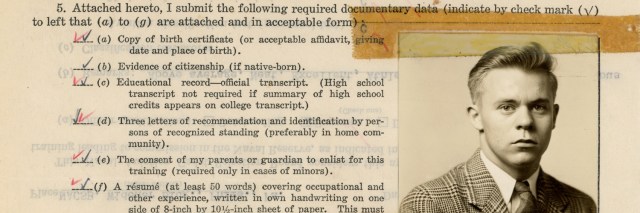
Thanks to the Delaware Public Archives for the use of their photo.
Bibliography
“82d Airborne Division in Sicily and Italy.” Undated, c. 1945. Ike Skelton Combined Arms Research Library Digital Library. https://cgsc.contentdm.oclc.org/digital/collection/p4013coll8/id/103/rec/1
Adams, J. G. “Annual Report.” January 6, 1944. World War II Operations Reports, 1940–48. Record Group 407, Records of the Adjutant General’s Office. National Archives at College Park, Maryland.
Census Record for Armal Leodom [sic]. March 23, 1920. Fourteenth Census of the United States, 1920. Record Group 29, Records of the Bureau of the Census. National Archives at Washington, D.C. https://www.familysearch.org/ark:/61903/3:1:33S7-9R6S-4Y
Census Record for Clyde Leedom. April 7, 1930. Fifteenth Census of the United States, 1930. Record Group 29, Records of the Bureau of the Census. National Archives at Washington, D.C. https://www.familysearch.org/ark:/61903/3:1:33SQ-GR41-9X
Census Record for Ethel B. Leedom. April 18, 1940. Sixteenth Census of the United States, 1940. Record Group 29, Records of the Bureau of the Census. National Archives at Washington, D.C. https://www.familysearch.org/ark:/61903/3:1:3QS7-89M1-ZF3W
Census Record for Ormal Leedom. April 26, 1910. Thirteenth Census of the United States, 1910. Record Group 29, Records of the Bureau of the Census. National Archives at Washington, D.C. https://www.familysearch.org/ark:/61903/3:1:33SQ-GRVW-JNJ
Certificate of Death for Clyde Leedom. August 21, 1950. Delaware Death Records. Bureau of Vital Statistics, Hall of Records, Dover, Delaware. https://www.familysearch.org/ark:/61903/3:1:3Q9M-CS9Z-796N-8
Certificate of Marriage for Ormal Clyde Leedom, Jr. and Ethen Buford Cooper. October 24, 1929. Delaware Marriages. Bureau of Vital Statistics, Hall of Records, Dover, Delaware. https://www.familysearch.org/ark:/61903/3:1:S3HT-6YK9-3Z1
Certificate of Marriage for Richard Hopkins Marvil and Ethel Cooper Leedom. January 8, 1944. Delaware Marriages. Bureau of Vital Statistics, Hall of Records, Dover, Delaware. https://www.familysearch.org/ark:/61903/3:1:S3HY-61WS-4SY
“Dr. R. Goldson, on Hub-area hospital staffs.” The Boston Globe, August 30, 1972. https://www.newspapers.com/article/the-boston-globe-obituary-for-robert-j/158898087/
Enlistment Record for Ornial C. Leedom, Jr. June 8, 1942. World War II Army Enlistment Records. Record Group 64, Records of the National Archives and Records Administration. National Archives at College Park, Maryland. https://aad.archives.gov/aad/record-detail.jsp?dt=893&mtch=1&cat=all&tf=F&q=14082104&bc=&rpp=10&pg=1&rid=921439
Goldson, Robert J. “Action of the 56th Medical Battalion From 10 July 1943 to 18 July 1943 (Both dates Inclusive).” August 16, 1943. World War II Operations Reports, 1940–48. Record Group 407, Records of the Adjutant General’s Office. National Archives at College Park, Maryland.
Goldson, Robert J. “Action of the 56th Medical Battalion From 19 July 1943 to 23 July 1943 (Both dates Inclusive).” August 17, 1943. World War II Operations Reports, 1940–48. Record Group 407, Records of the Adjutant General’s Office. National Archives at College Park, Maryland.
Goldson, Robert J. “Report After Action Against the Enemy.” August 20, 1943. World War II Operations Reports, 1940–48. Record Group 407, Records of the Adjutant General’s Office. National Archives at College Park, Maryland.
Headstone Inscription and Interment Record for Ormal C. Leedom, Jr. Headstone Inscription and Interment Records for U.S. Military Cemeteries on Foreign Soil, 1942–1949. Record Group 117, Records of the American Battle Monuments Commission, 1918–c. 1995. National Archives at Washington, D.C. https://catalog.archives.gov/id/169022194?objectPage=1826
Hospital Admission Card for 14082104. U.S. WWII Hospital Admission Card Files, 1942–1954. Record Group 112, Records of the Office of the Surgeon General (Army), 1775–1994. National Archives at College Park, Maryland. https://www.fold3.com/record/701816295/leedom-ornial-c-us-wwii-hospital-admission-card-files-1942-1954
Individual Deceased Personnel File for Ornial C. Leedom, Jr. Individual Deceased Personnel Files, 1939–1953. Record Group 92, Records of the Office of the Quartermaster General, 1774–1985. National Archives at St. Louis, Missouri.
Leedom, Rebecca. Individual Military Service Record for Ormal Clyde Leedom, Jr. July 10, 1947. Record Group 1325-003-053, Record of Delawareans Who Died in World War II. Delaware Public Archives, Dover, Delaware. https://cdm16397.contentdm.oclc.org/digital/collection/p15323coll6/id/19645/rec/2
Major, Ben. Medical Department Tables of Organization 1943. WW2 US Medical Research Centre, 2010.
“Miss Gates is Wed to Mr. Morris.” St. Petersburg Times, December 9, 1929. https://www.newspapers.com/article/158438082/
Morning Reports for 128th Evacuation Hospital. September 1943. U.S. Army Morning Reports, c. 1912–1946. Record Group 64, Records of the National Archives and Records Administration. National Archives at St. Louis, Missouri. https://s3.amazonaws.com/NARAprodstorage/lz/partners/st-louis/rg-064/85713825-wwii/85713825_1943-09/85713825_1943-09_Roll-0590/85713825_1943-09_Roll-0590-10.pdf
Morning Reports for Company “B,” 3rd Medical Training Battalion. June 1942. U.S. Army Morning Reports, c. 1912–1946. Record Group 64, Records of the National Archives and Records Administration. National Archives at St. Louis, Missouri. https://s3.amazonaws.com/NARAprodstorage/lz/partners/st-louis/rg-064/85713825-wwii/85713825_1940-01-thru-1943-07/85713825_1940-01-thru-1943-07_Roll-2081/85713825_1940-01-thru-1943-07_Roll-2081-07.pdf, https://s3.amazonaws.com/NARAprodstorage/lz/partners/st-louis/rg-064/85713825-wwii/85713825_1940-01-thru-1943-07/85713825_1940-01-thru-1943-07_Roll-2081/85713825_1940-01-thru-1943-07_Roll-2081-08.pdf
Morning Reports for Company “C,” 56th Medical Battalion, Motorized. August 1943 – September 1943. U.S. Army Morning Reports, c. 1912–1946. Record Group 64, Records of the National Archives and Records Administration. National Archives at St. Louis, Missouri. https://s3.amazonaws.com/NARAprodstorage/lz/partners/st-louis/rg-064/85713825-wwii/85713825_1943-08/85713825_1943-08_Roll-0553/85713825_1943-08_Roll-0553-36.pdf, https://s3.amazonaws.com/NARAprodstorage/lz/partners/st-louis/rg-064/85713825-wwii/85713825_1943-08/85713825_1943-08_Roll-0553/85713825_1943-08_Roll-0553-37.pdf, https://s3.amazonaws.com/NARAprodstorage/lz/partners/st-louis/rg-064/85713825-wwii/85713825_1943-09/85713825_1943-09_Roll-0581/85713825_1943-09_Roll-0581-23.pdf
Morning Reports for Company “D,” 56th Medical Battalion, Motorized. October 1942 – September 1943. U.S. Army Morning Reports, c. 1912–1946. Record Group 64, Records of the National Archives and Records Administration. National Archives at St. Louis, Missouri. https://s3.amazonaws.com/NARAprodstorage/lz/partners/st-louis/rg-064/85713825-wwii/85713825_1940-01-thru-1943-07/85713825_1940-01-thru-1943-07_Roll-2055/85713825_1940-01-thru-1943-07_Roll-2055-19.pdf, https://s3.amazonaws.com/NARAprodstorage/lz/partners/st-louis/rg-064/85713825-wwii/85713825_1940-01-thru-1943-07/85713825_1940-01-thru-1943-07_Roll-2055/85713825_1940-01-thru-1943-07_Roll-2055-20.pdf, https://s3.amazonaws.com/NARAprodstorage/lz/partners/st-louis/rg-064/85713825-wwii/85713825_1943-08/85713825_1943-08_Roll-0553/85713825_1943-08_Roll-0553-37.pdf, https://s3.amazonaws.com/NARAprodstorage/lz/partners/st-louis/rg-064/85713825-wwii/85713825_1943-09/85713825_1943-09_Roll-0581/85713825_1943-09_Roll-0581-23.pdf
Registration of Birth for Clyde Leedom, Jr. November 9, 1906. Registration of Births in the City of Wilmington, 1909–1912. Record Group 1500.205. Delaware Public Archives, Dover, Delaware. https://www.familysearch.org/ark:/61903/3:1:33S7-8BCK-JTX
Rottman, Gordon L. US Airborne Units in the Mediterranean Theater 1942–44. Osprey Publishing, 2006.
Last updated on January 11, 2025
More stories of World War II fallen:

























To have new profiles of fallen soldiers delivered to your inbox, please subscribe below.
 Delaware's World War II Fallen