
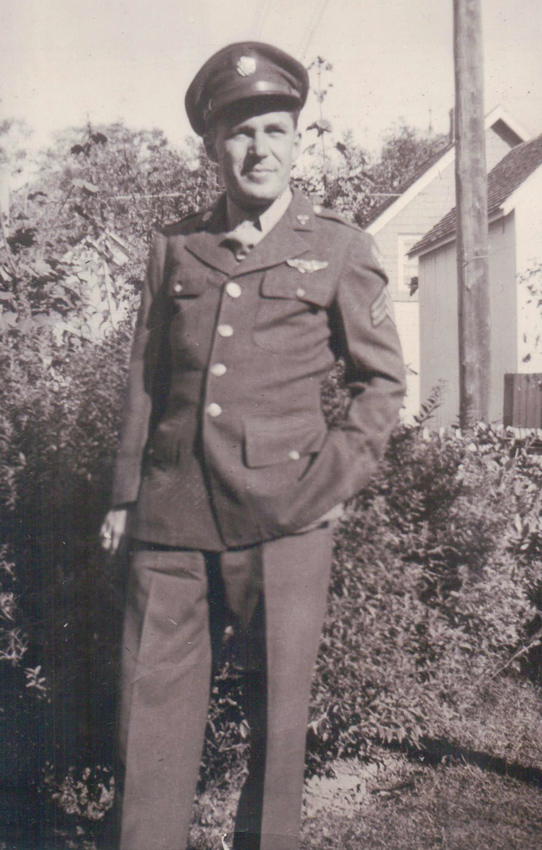
| Hometown | Civilian Occupation |
| Born in Harrington, Delaware, raised in Wilmington, Delaware | Clerk for the DuPont Company |
| Branch | Service Number |
| U.S. Army Air Forces | 13078765 |
| Theater | Unit |
| European | 506th Bombardment Squadron (Heavy), 44th Bombardment Group (Heavy) |
| Military Occupational Specialty | Campaigns/Battles |
| 612 (airplane armorer-gunner) | European air campaign |
Early Life & Family
Lester Davis Warren was born in Harrington, Delaware, on July 9, 1915. He was the first child of Elmer Davis Warren (1889–1970) and Anna M. Warren (née Bowen, 1895–1979). Warren’s father, then a farmer. Warren had a younger brother and two younger sisters. By June 5, 1917, when Warren’s father registered for the draft, the family was still living in Harrington, but the elder Warren was now working for the Philadelphia, Baltimore and Washington Railroad, a subsidiary of the Pennsylvania Railroad. The family had apparently moved to Wilmington, Delaware, by September 5, 1919, when Warren’s younger brother, Randall Bowen Warren (1919–1953) was born there.
Warren was recorded on the census in January 1920 living with his parents, brother, and aunt at 723 Bennett Street in Wilmington. His father was working as a railroad fireman. At the time of the next census in April 1930, Warren was living with his parents and three younger siblings at 839 Kirkwood Street in Wilmington. By the time of the 1940 census, the Warrens had moved to 200 East 24th Street in Wilmington. Warren’s father was still working as a railroad fireman and his mother as a seamstress. Warren and his younger brother were working as clerks for a manufacturer.
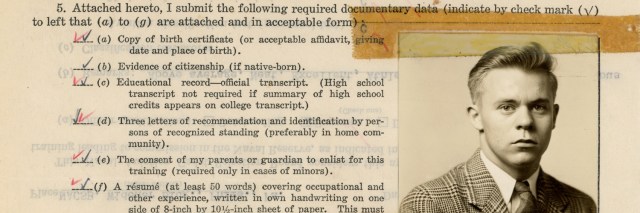
Warren graduated from the General Course at Wilmington High School on January 31, 1934. Journal-Every Evening reported that Warren also “attended the Wharton School at the University of Pennsylvania[.]” Warren’s enlistment data card described him as a high school graduate, perhaps suggesting that he did not complete a full year. However, other servicemen who were known to have attended business school were also described only as high school graduates on their enlistment data cards.
When he registered for the draft on October 16, 1940, Warren was living with his parents at 200 East 24th Street and working at DuPont at 11th and Market Streets. The registrar described him as standing five feet, 7½ inches tall and weighing 145 lbs., with brown hair and eyes. He was Protestant.
According to Warren’s mother’s statement for the State of Delaware Public Archives Commission, her son was an office clerk for the DuPont Company for eight years prior to entering the service.
Military Training & Marriage
Warren volunteered for the U.S. Army Air Forces, enlisting in Philadelphia, Pennsylvania, on May 1, 1942. It appears that he spent the next few months on inactive duty. Warren’s younger brother, Randall, followed him into the U.S.A.A.F., enlisting on October 10, 1942. Warren married Jane M. Sines (1919–1958), most likely on October 15, 1942, in Elkton, Maryland. In late 1943, she gave birth to the couple’s only child, a son, W. Michael Warren.
The Wilmington Morning News indicated that Warren went on active duty on October 19, 1942. He reported to the U.S.A.A.F. classification center in Nashville, Tennessee. The Wilmington Morning News reported on December 7, 1942, that Warren was one of six men from Wilmington who “reported to the Army Air Forces pre-flight school at Maxwell Field, Ala., from the classification center at Nashville, Tenn., to begin the second phase of their training to become pilots. After nine weeks of training they will be sent to a primary flying school.”

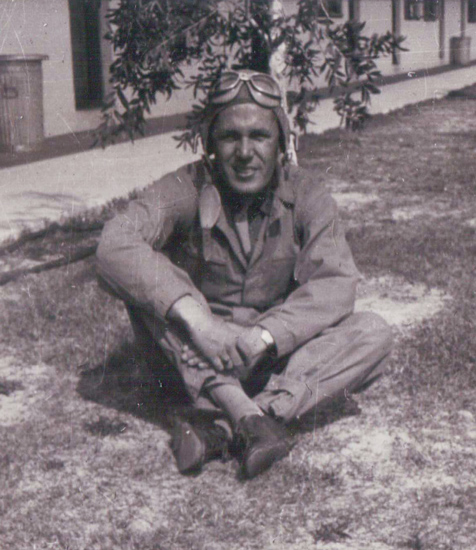
Aviation cadets who wanted to become pilots had to complete four phases before earning their wings: preflight, primary, basic, and advanced pilot training. Coursework was intense and attrition high for both academic and technical reasons. Of the six men from Wilmington in Warren’s preflight class at Maxwell, only two successfully became pilots. Some men who were dropped from pilot training switched to bombardier or navigator training. Indeed, one of the six men became a navigator. Two men proved unsuitable as aircrew and were shifted to ground assignments.
It is unclear how far Warren progressed in pilot training. His mother’s statement did not mention any training schools between his arrival in Nashville and when he reported for flexible gunnery school about six months later. Presumably, he was dropped from pilot training during the preflight or primary phases, since a document reported that prior to beginning crew training on September 30, 1943, he had 11 hours of flying time. That figure should have included both flight time accumulated during pilot training and later flexible gunnery training. It is unclear if Warren did any training to become a bombardier or navigator during early 1943.
At any rate, according to his mother’s statement, Warren began attending the Harlingen Aerial Gunnery School in Texas in May 1943, graduating in July. She reported that he was promoted to private 1st class the same month. Other military documents confirm that Warren was stationed at Harlingen Field and indicate that he was also stationed at Buckley Field, Colorado, and Buckingham Army Air Field, Florida.
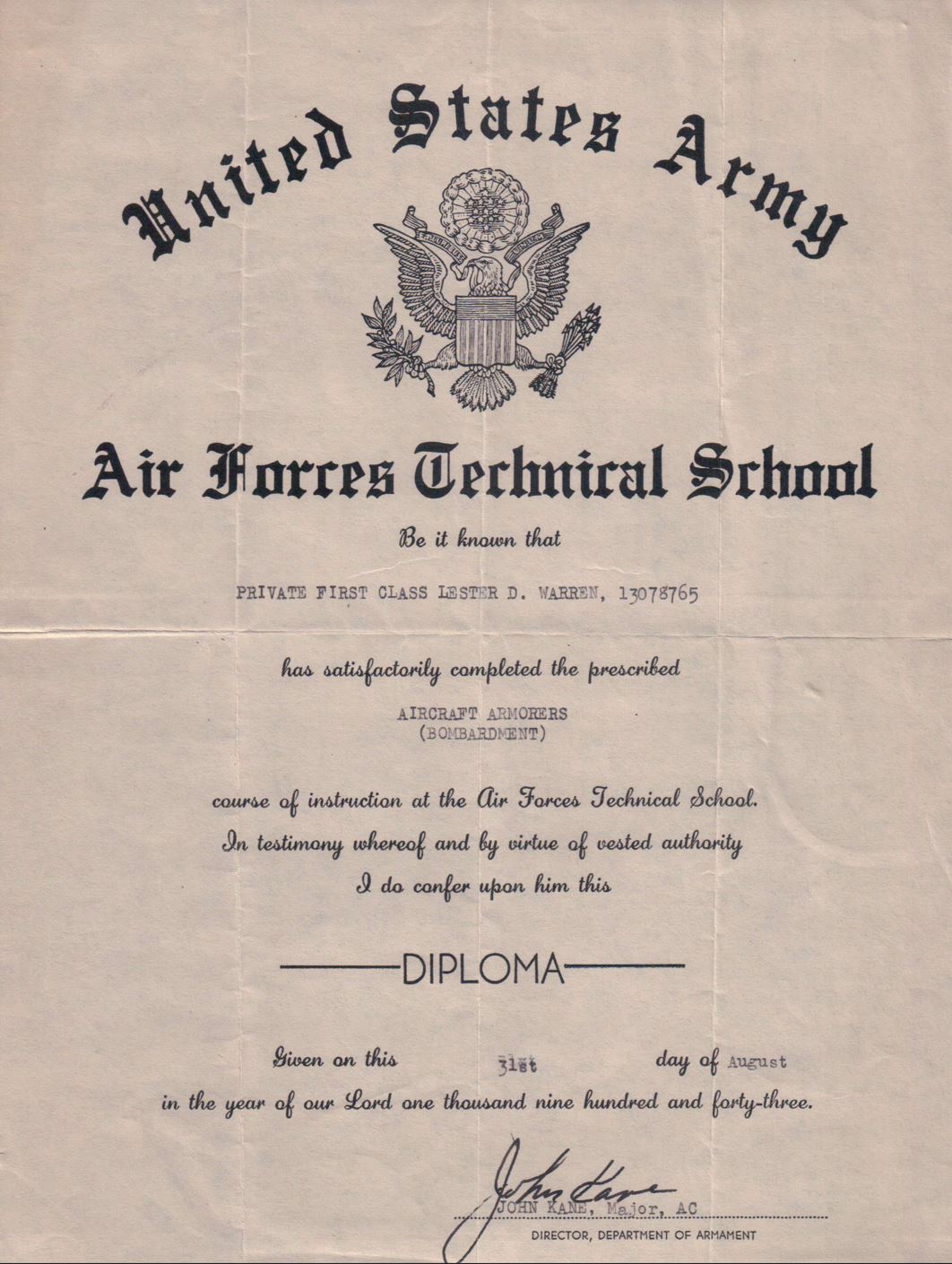
On the afternoon of July 18, 1943, Private 1st Class Warren was attached unassigned to the 21st Technical School Squadron, 38th Technical School Group at Lowry Field, Colorado, to take the Aircraft Armorers (Bombardment) class. Upon graduation on August 31, 1943, he was promoted to sergeant and his military occupational specialty code (M.O.S.) changed to 612, airplane gunner-armorer. That same day, he was transferred to the 18th Replacement Wing at the Army Air Base, Salt Lake City, Utah. On September 10, 1943, he was attached to the 39th Bombardment Group (Heavy) at Davis-Monthan Field, Arizona. On September 17, 1943, Sergeant Warren was further attached to the 402nd Bombardment Squadron (Heavy), a training squadron equipped with the Consolidated B-24 Liberator.
On September 30, 1943, Sergeant Warren was assigned to a crew at Davis-Monthan Field led by 2nd Lieutenant Bernie L. Scudday (1919–1944). During this first phase of crew training, he accumulated 14 hours and 15 minutes of flight time, during which he operated the ball turret twice and the top turret four times.

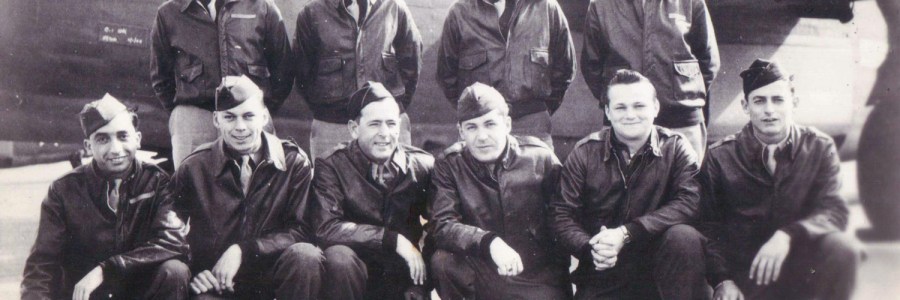
As of October 12, 1943, Warren’s crew, No. 39-8-182, consisted of nine members—there was no copilot assigned yet—six of whom would fly their final mission of World War II together some eight months later. At this time, Warren’s position was armorer-gunner.
Following a brief delay, on October 26, 1943, Sergeant Warren and his comrades reported for duty at the 7th Bombardment Squadron (Heavy), 34th Bombardment Group (Heavy), at Blythe Army Air Base, California.
On November 30, 1943, due to unit reorganization at Blythe A.A.B., Warren’s crew was released from attachment to the 7th Bomb Squadron and attached unassigned to the 358th Base Headquarters and Airbase Squadron. They were released from attachment to that organization on December 26, 1943, per Special Orders No. 25, Headquarters 34th Combat Crew Training School, dated December 24, 1943.
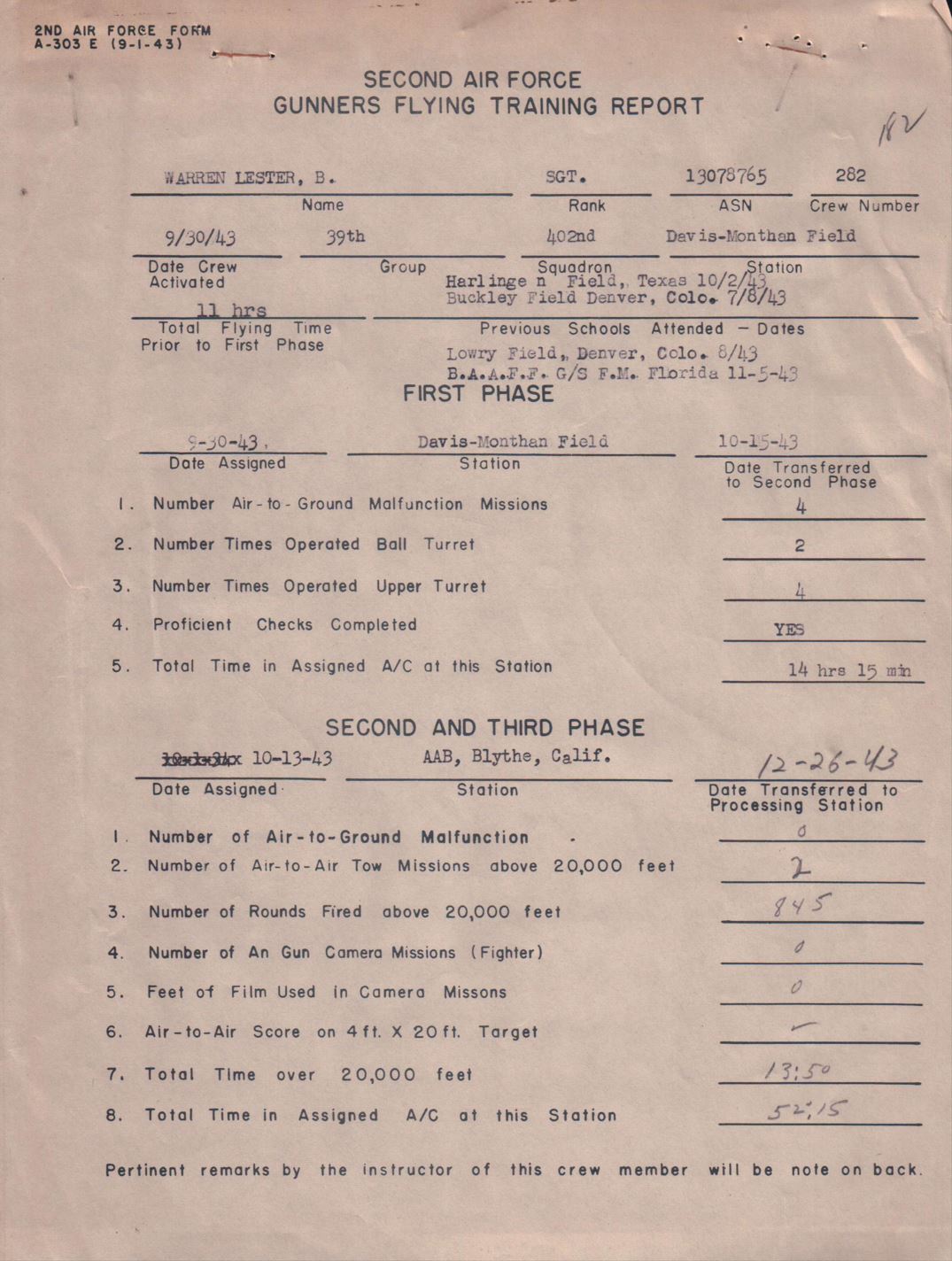

Sergeant Warren’s individual flight record for his time at Blythe A.A.B. stated that between October 31, 1943, and December 20, 1943, he accumulated 49 hours and 15 minutes of flight time aboard B-24s with 18 landings. His gunners flying training report gave a slightly different figure, 52 hours and 15 minutes in aircraft between October 13, 1943, and December 26, 1943. The report noted he had spent 13 hours and 50 minutes of flight time over the altitude of 20,000 feet, during which he had fired 845 rounds of ammunition.
During their time at Blythe, Crew No. 39-8-182 continued to take shape. A copilot, 2nd Lieutenant John A. Farrell (1917–1944), was assigned and two enlisted men were replaced. Other than the navigator, who was replaced overseas by another man after a few combat missions, the crew was complete. Like most World War II bomber crews, Warren’s comrades came from all over the country. The 10 men represented eight states, with ages ranging from 19 to 39. The youngest was the baby-faced flight engineer, a Pennsylvanian, Sergeant Joseph E. Wycheck (1924–1944). The oldest, a gunner from Tennessee, Staff Sergeant Coyle J. Acuff (1904–1977), had been an educator. He was already 38 years old when he volunteered for the U.S. Army and 40 when he entered combat, ancient for aircrew at the time.

In a letter dated December 25, 1943, Warren wrote to his mother:
Merry Xmas to you all. It seems like 4th of July here. – Very warm. We had turkey for dinner and it was pretty good. – but that tin mess kit did not help any. We are leaving tomorrow for Oklahoma City. And I understand it’s a nice field—Will Rogers Field is the name of it.
Around December 29 or 31, 1943, Sergeant Warren and his crew were attached unassigned to the 11th Combat Mapping Squadron, at Will Rogers Field, Oklahoma. A memorandum from the squadron, dated January 24, 1944, stated that Sergeant Warren had completed a 69-hour ground school in combat mapping, including 18 hours in the use of photographic equipment for that purpose.
On January 28, 1944, Warren and his crew were released from attachment to the 11th Combat Mapping Squadron and transferred to the 21st Bombardment Wing (Heavy) at Topeka Army Air Field, Kansas. That day they were attached unassigned to the 2nd Heavy Bombardment Processing Headquarters (Provisional Group No. 25) at Topeka.
In his Christmas 1943 letter, Sergeant Warren had mentioned: “There are still rumors of furloughs around here. –you can never tell.” Servicemen were often able to visit home before going overseas, and indeed the enlisted members of Warren’s crew went on furlough and the officers went on leave on February 13, 1944. It is likely but unconfirmed that he visited his family in Delaware. If so, it is presumably the only chance he had to meet his newborn son.
While they were away, another administrative shuffle took place and the crew was attached unassigned to the 3rd Heavy Bombardment Processing Headquarters, also at Topeka Army Air Field. Warren returned to duty on February 23, 1944. Four days later, a set of movement orders came down assigning Warren’s crew to Shipment FJ-200-BJ and dispatching them to Morrison Field, Florida, to go overseas, flying B-24J serial number 42-110029. A morning report indicates the crew departed from Topeka to begin their journey on March 1, 1944.
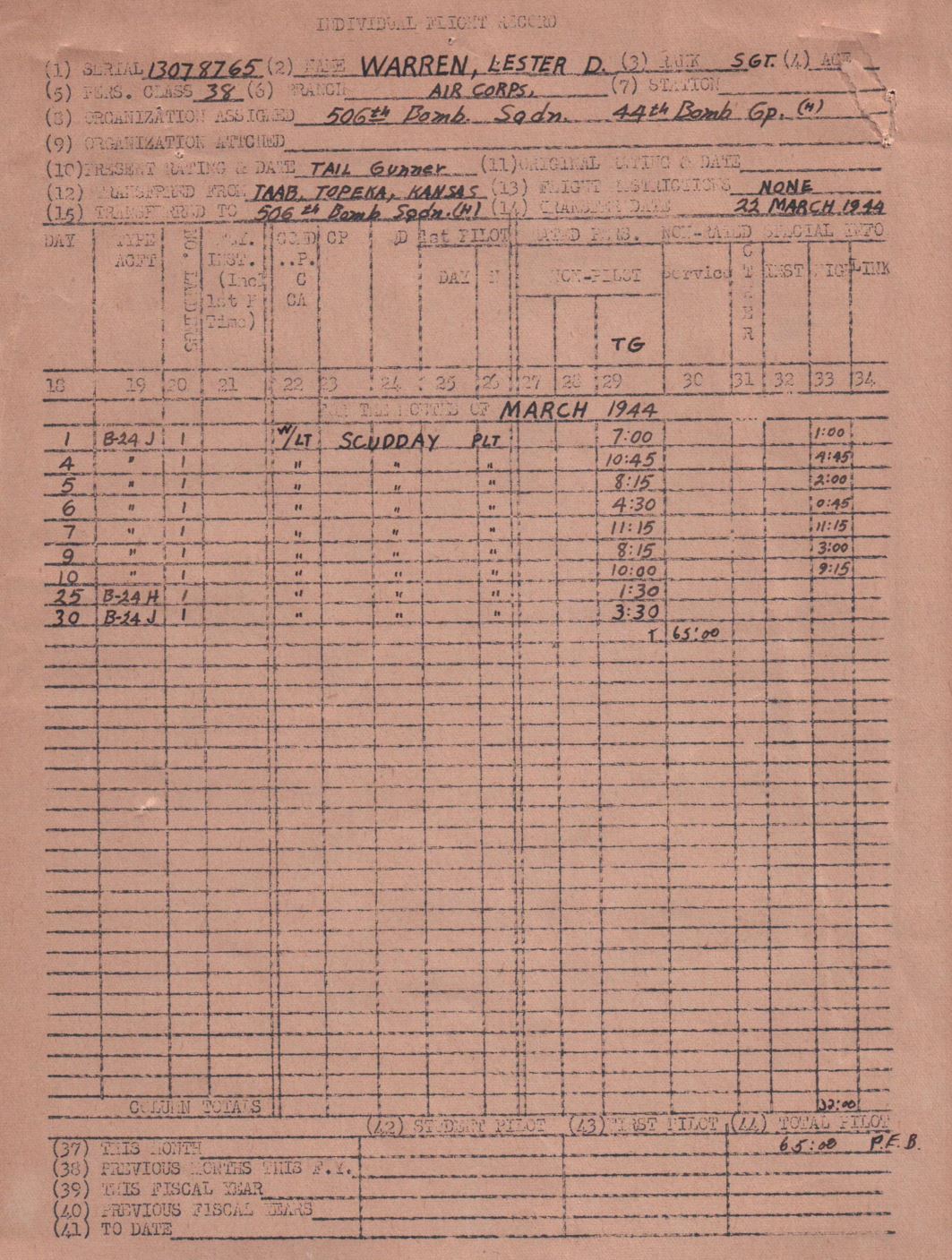
Warren’s mother stated that her son went overseas to the United Kingdom via the southern route (Florida to South America to Africa to England). The southern route took considerably more time than flying over the North Atlantic but was safer since crews had to fly a shorter distance over water and had more opportunities to divert in the event of mechanical problems. Warren’s flight record indicates that his journey involved seven flights aboard a B-24J during March 1–10, 1944, a total of 60 hours in the air.

Combat in the European Theater
After arriving in the United Kingdom, Warren and his comrades reported to the Eighth Air Force Replacement Depot at Stone, Staffordshire, England, on March 13, 1944. They were dispatched to the 44th Bombardment Group (Heavy) at Royal Air Force Shipdham, Norfolk, England, per Special Orders No. 79, Headquarters Eighth Air Force Replacement Depot, dated March 19, 1944.
On March 22, 1944, Warren and his crew joined the 506th Bombardment Squadron (Heavy), 44th Bombardment Group (Heavy) at R.A.F. Shipdham. The squadron had been in combat for one year. Most notably, it had contributed 10 aircraft to the legendary Operation Tidal Wave raid against Ploesti, Romania, on August 1, 1943, miraculously without loss to the squadron.
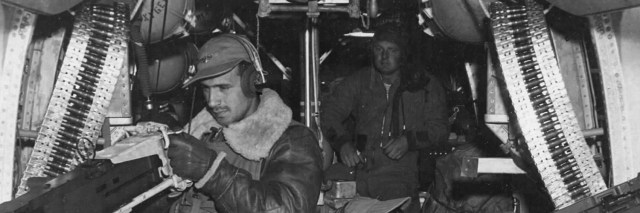
According to Warren’s individual flight records, he flew eight training and 22 combat missions after joining the 506th Bomb Squadron. All but one mission was with his regular pilot, Lieutenant Scudday. Shortly after the war, two survivors from his crew estimated Warren’s combat mission count as 22 and 23 respectively. A description of Warren’s missions compiled from unit records and published to The History of the 44th Bomb Group in Data are generally consistent with Warren’s personal records, but give him a total of 21 combat missions. A combat mission in his personal list dated May 4, 1944, is not mentioned in The History of the 44th Bomb Group in Data. There are also three missions in which the dates are inconsistent between the two sources. The 44th Bomb Group data listed Warren as tail gunner on all but one of his missions (April 27, 1944, when he was in the ball turret).
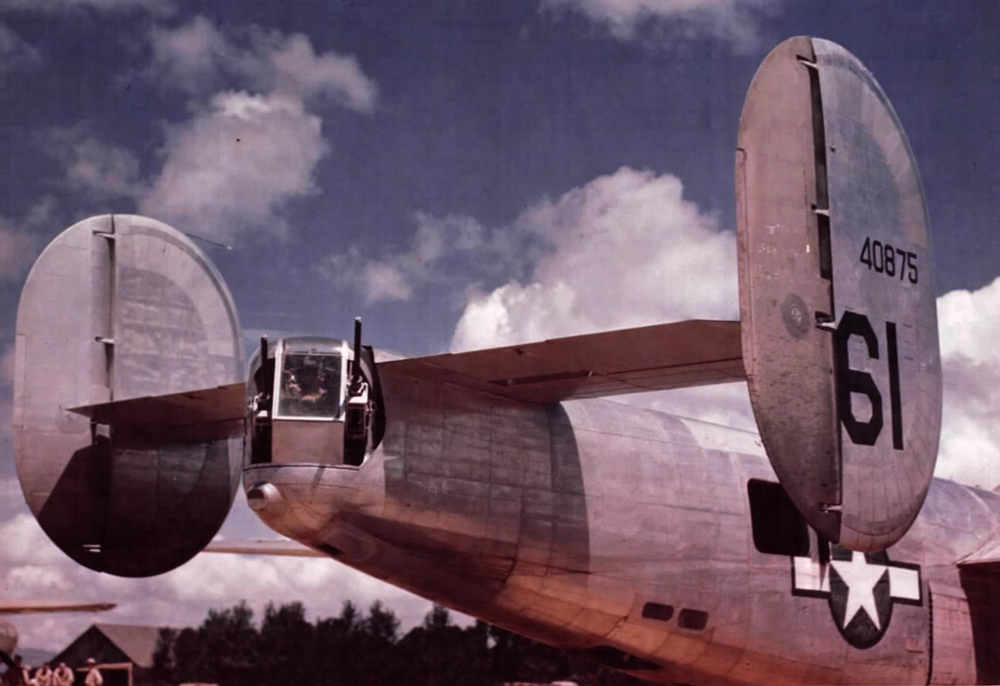

According to his personnel flight record, prior to entering combat, Warren went on three training flights in England, totaling nine hours and 15 minutes.
Sergeant Warren’s first combat mission, an April 8, 1944, raid against Braunschweig, Germany, was one of the 44th Bomb Group’s deadliest missions of the entire war. The group’s crews found both the primary and secondary targets shrouded by smokescreens, and instead bombed the airfield at Langenhagen, Germany. Results were assessed as excellent, but it was a poor trade for the loss of 11 aircraft and crews. The 506th Bomb Squadron’s losses were the heaviest in the group, with five crews going down over enemy territory. Fortunately, casualties were far lighter during subsequent missions.
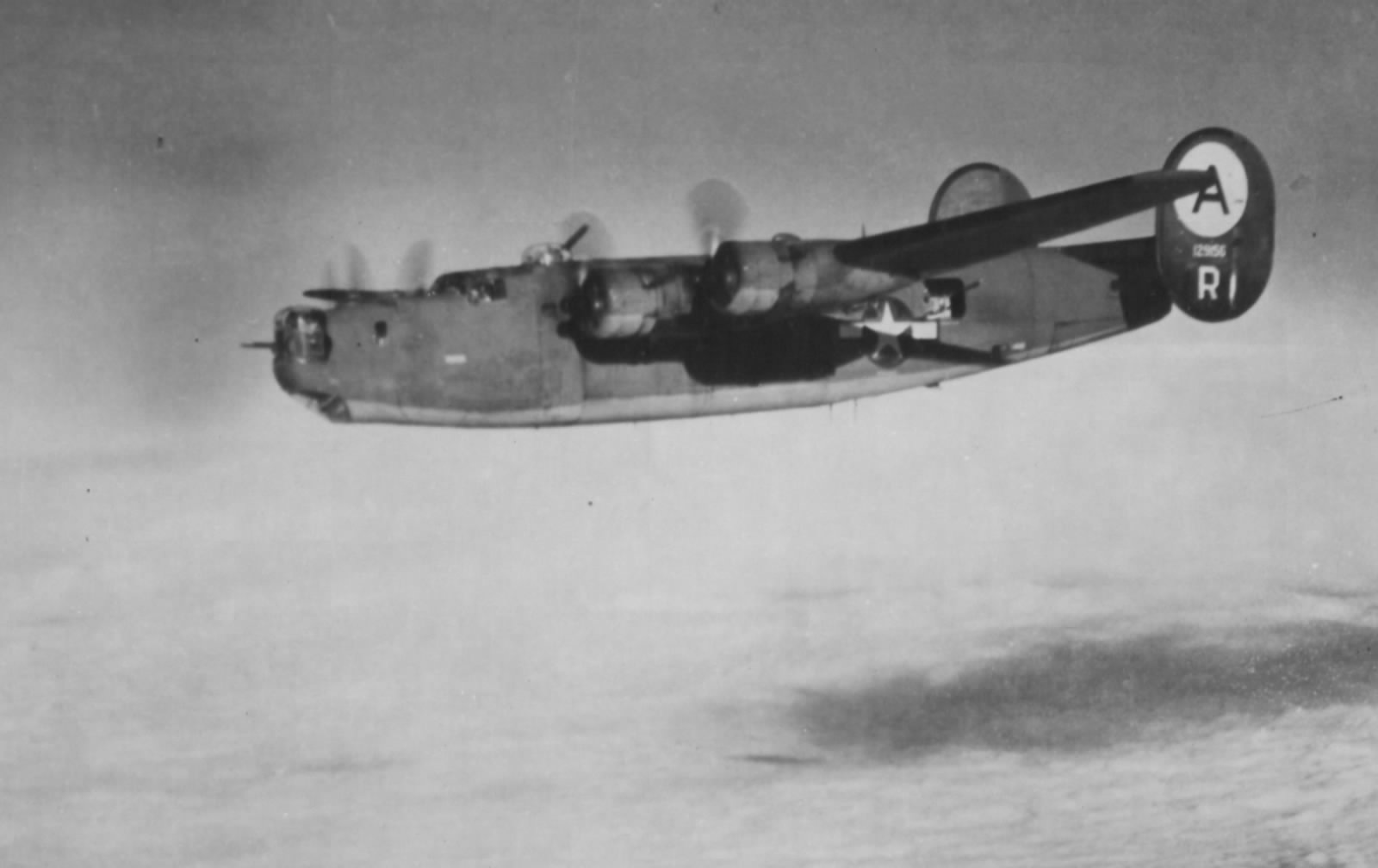
44th Bomb Group records place Warren aboard B-24H 41-29496, nicknamed Ram It Dammit (or Ram It-Damit!), for 18 of his combat missions. Enemy airfields and marshalling yards in occupied-France and Germany were the most common targets. His longest mission, April 29, 1944, raid on the German capital, Berlin, that lasted eight hours and 45 minutes. According to his personal records, Warren flew seven combat missions in April 1944, totaling 47¾ hours of flight time.
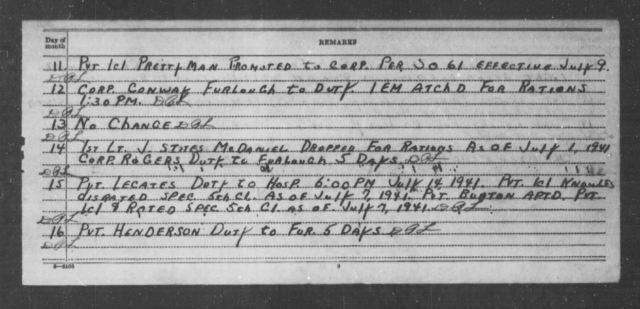
Sergeant Warren was promoted to staff sergeant around May 7, 1944. He was awarded the Air Medal effective May 12, 1944.
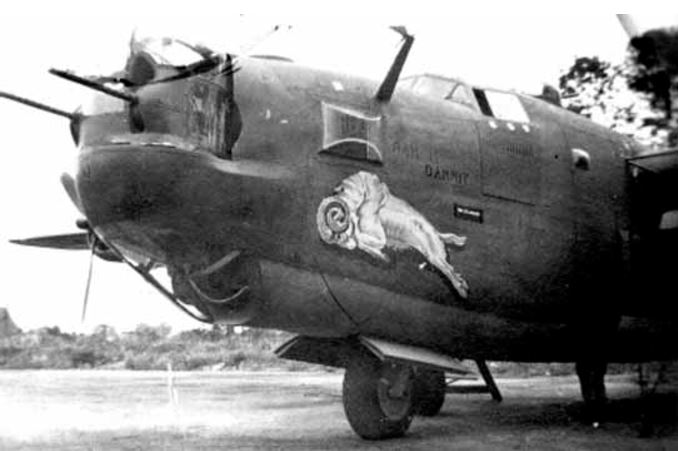


The raid against the airfield at Avord, France, on May 23, 1944, was Warren’s only mission flying with another crew, led by 1st Lieutenant Max D. Mendenhall (1917–1999). Warren’s individual flight record for May 1944 listed four training flights totaling 12¾ hours, and eight combat missions for a total of 44½ hours of flight time.
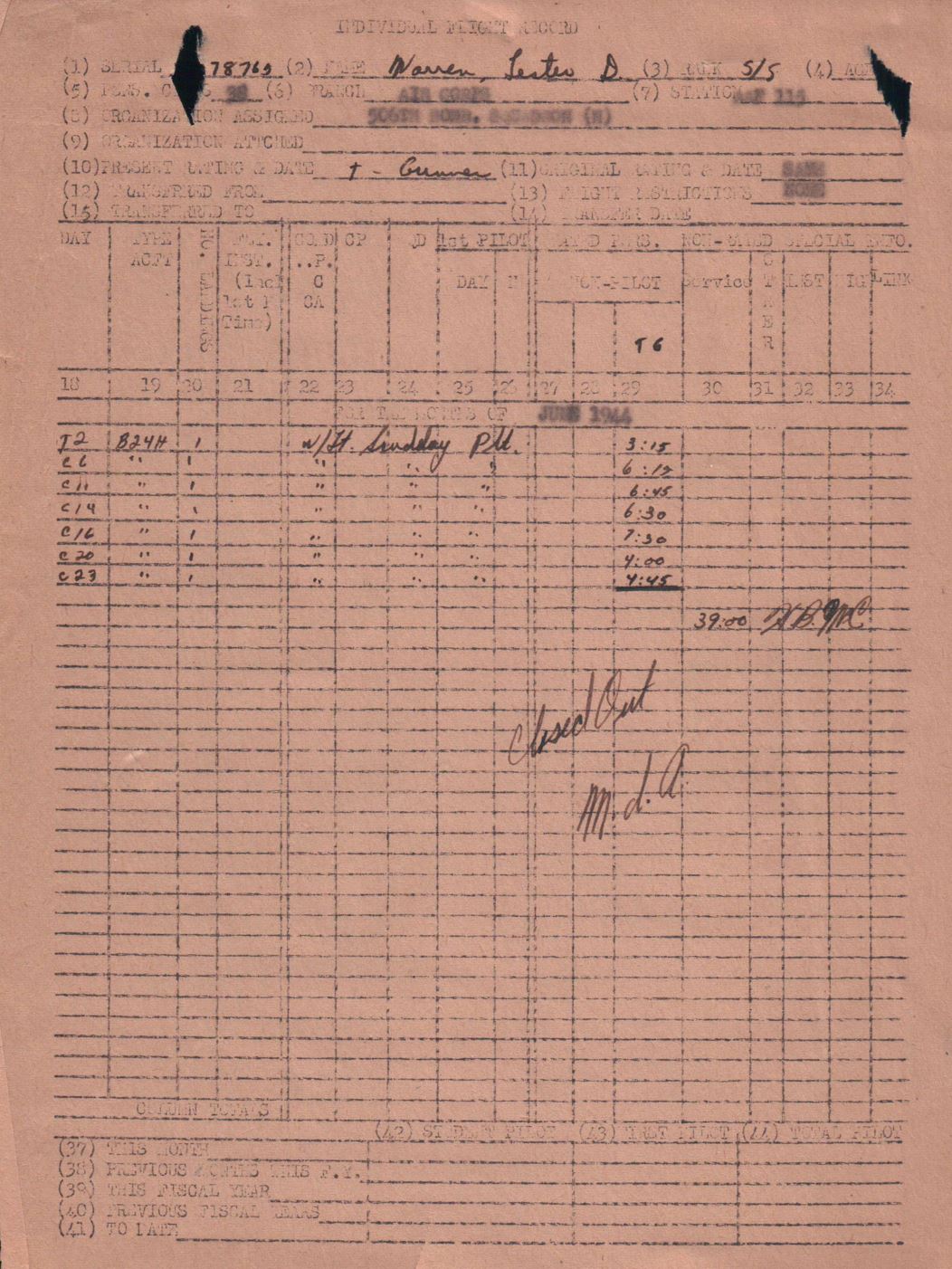
On June 6, 1944, Warren and his comrades supported the landings on Omaha Beach in Normandy, though heavy overcast rendered their bombing ineffective. His personal records for June 1944 listed one training flight lasting three hours and 15 minutes, and six combat missions totaling 35¾ hours, not including his final mission.
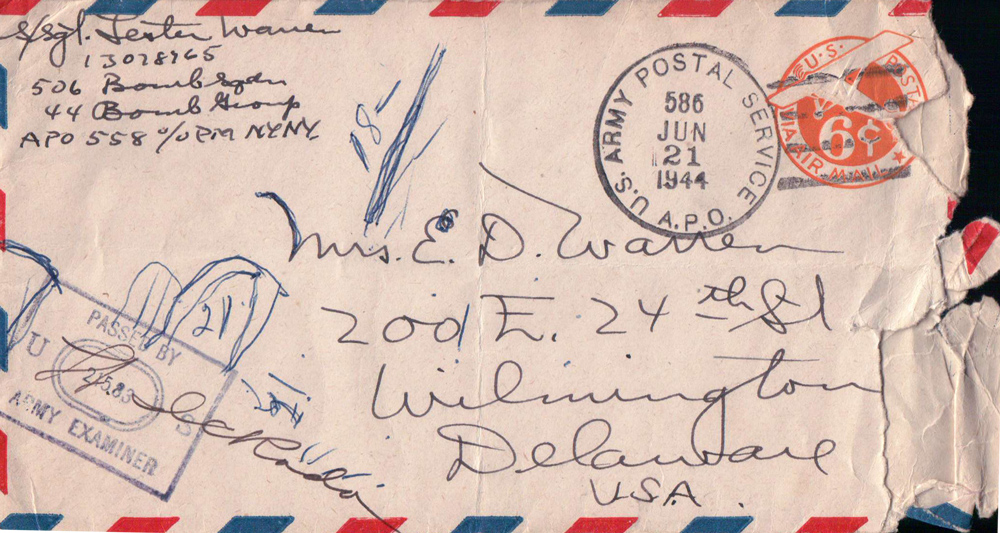
In a letter to his mother dated June 19, 1944, Staff Sergeant Warren mentioned receiving a “Journal”—presumably Journal-Every Evening, a hometown newspaper—adding: “They are about a month old but of course the news is new to me.” He also mentioned one of his buddies, likely Technical Sergeant Joseph Wycheck:
Joe bought a bicycle the other day so now our getting around problem is now solved. They sure come in handy because our chow, shower, show etc. is about 1½ miles from where we live. We can buzz over there in no time now.
That same day, he received an oak leaf cluster in lieu of a second Air Medal.
Final Mission
On June 27, 1944, Staff Sergeant Warren and his crew took off from R.A.F. Shipdham aboard Ram It Dammit for a mission to Creil, France. Decades later, the crew’s navigator, 1st Lieutenant Raymond Andrew McCormick (1921–1999), recalled:
We were on an unusually long bomb run from Rheims, France, straight into the target which was a bridge over the Seine River, just north of Paris. There was a G-H aircraft (radar controlled) in the lead, being vectored from England. In establishing the bomb run, he was all over the sky, and our bombardier, Paul Richardson, flying in the deputy lead slot, decided to go up on the flight deck because he said he could not follow the lead ship through the bomb sight.
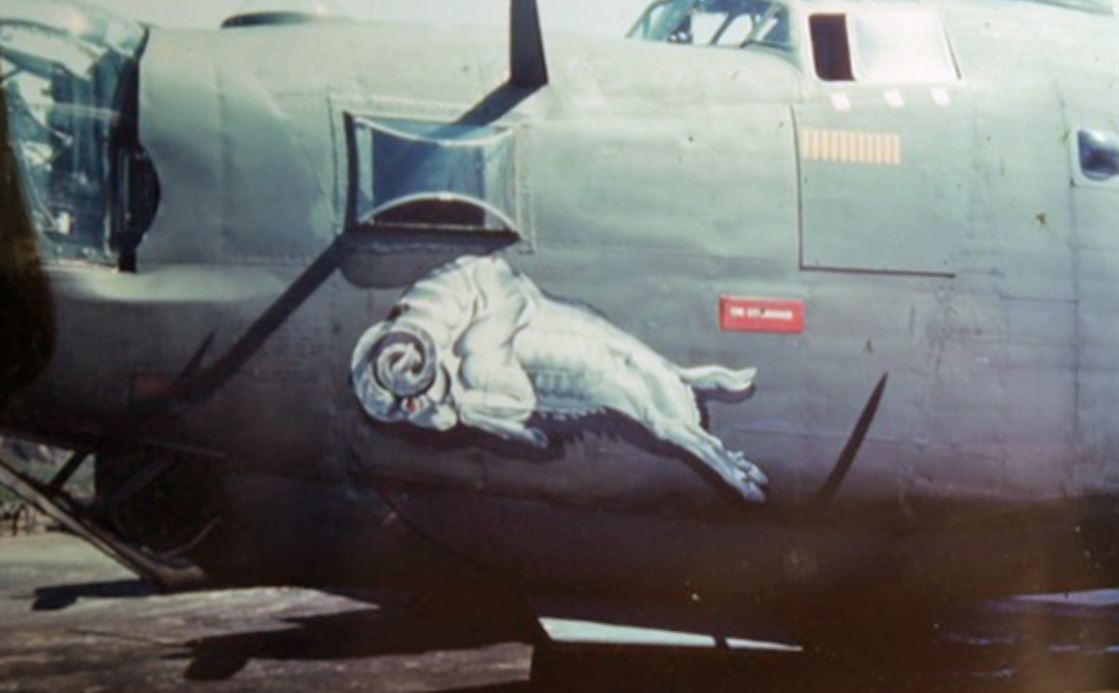
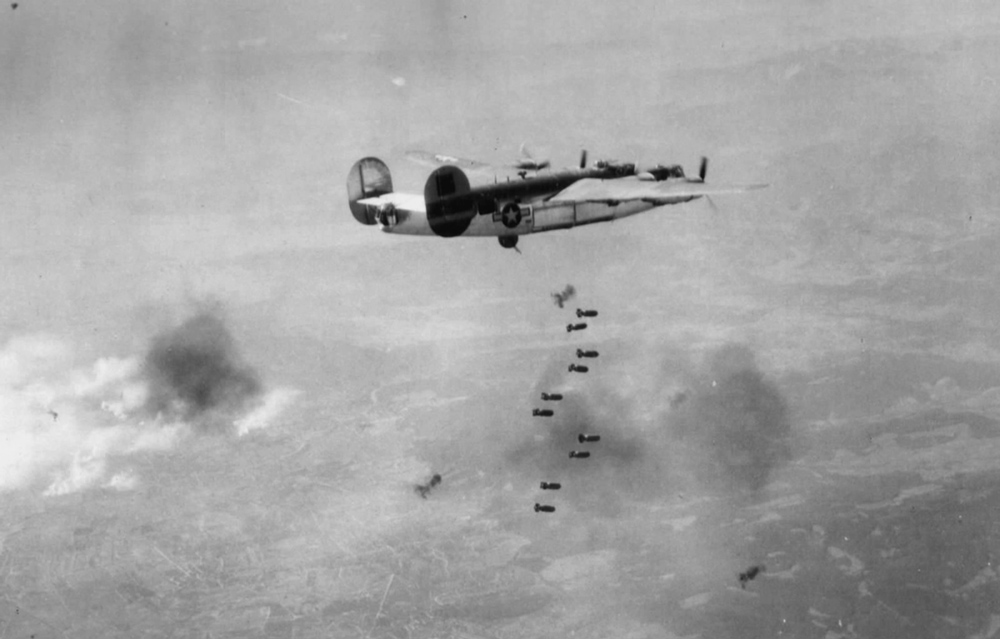
The B-24s were buffeted by intense flak, but Ram It Dammit had nearly made it to the target. Anticipating the imminent bomb release, the copilot, Lieutenant Farrell, announced over the intercom, “Let’s get the hell out of here, boys!”
Around 1912 hours, an enemy antiaircraft shell pierced the bottom of the fuselage behind the nosewheel and exploded in the flight deck, killing or incapacitating both pilots and the bombardier, radio operator, and flight engineer. The force of the explosion blew out the top turret and the roof of the flight deck. As the B-24 entered a dive, out of control, a fire broke out.
There is no indication from the survivors’ statements that anyone sent a bailout signal. The remaining five members of the crew, including Sergeant Warren in the tail gunner position, had only seconds to recognize that the aircraft was doomed, secure their parachutes to their harnesses—the parachute itself was too cumbersome to wear during most combat duties—and overcome the forces generated by the plunging aircraft to get to the nearest exit. As it neared the ground, the Liberator exploded in midair, the wreckage falling about half a kilometer south of the road between Creil and Chantilly.
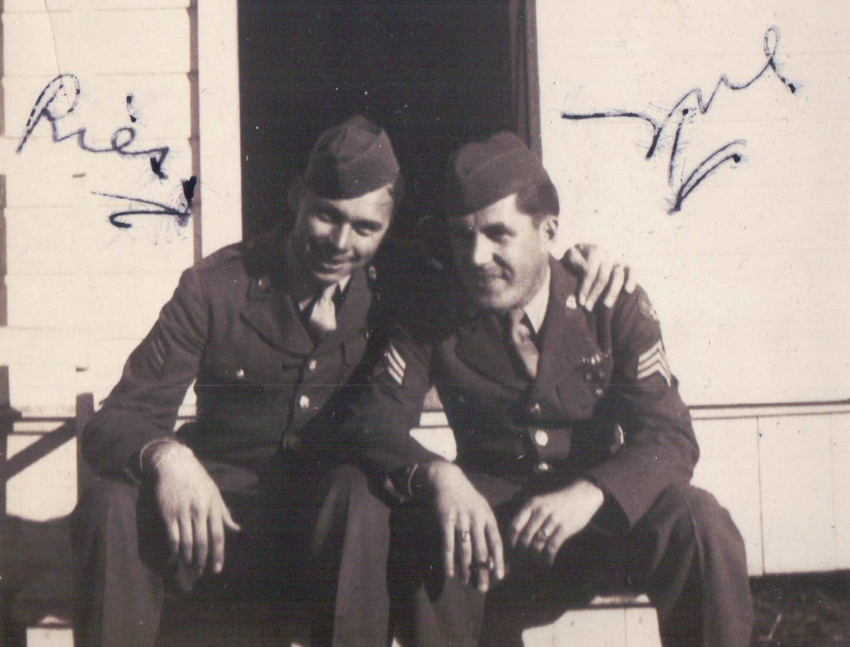
Only three members of the crew survived. The nose gunner, Staff Sergeant Carl W. Tepe (1923–2008), and navigator, 1st Lieutenant McCormick, were the only men in front of the aircraft who managed to bail out. McCormick later recalled that one additional member of the crew—likely Staff Sergeant Robert P. Ries (1922–1944), the left waist gunner, though it might have been Warren—managed to bail out, but his parachute was damaged and failed to slow his descent. Staff Sergeant Acuff was blown clear when the plane disintegrated but managed to open his parachute in time.
The three survivors were captured by the Germans, given medical aid, and were liberated from prisoner of war camps at war’s end.
Warren was initially buried in the civilian cemetery at Creil on June 29, 1944. The War Department held Staff Sergeant Warren as missing in action until August 2, 1944, after the Germans sent notification via the International Red Cross confirming his death. Journal-Every Evening reported his death on August 11, 1944.
During his career, Staff Sergeant Warren earned the Air Medal with one oak leaf cluster and the Purple Heart.
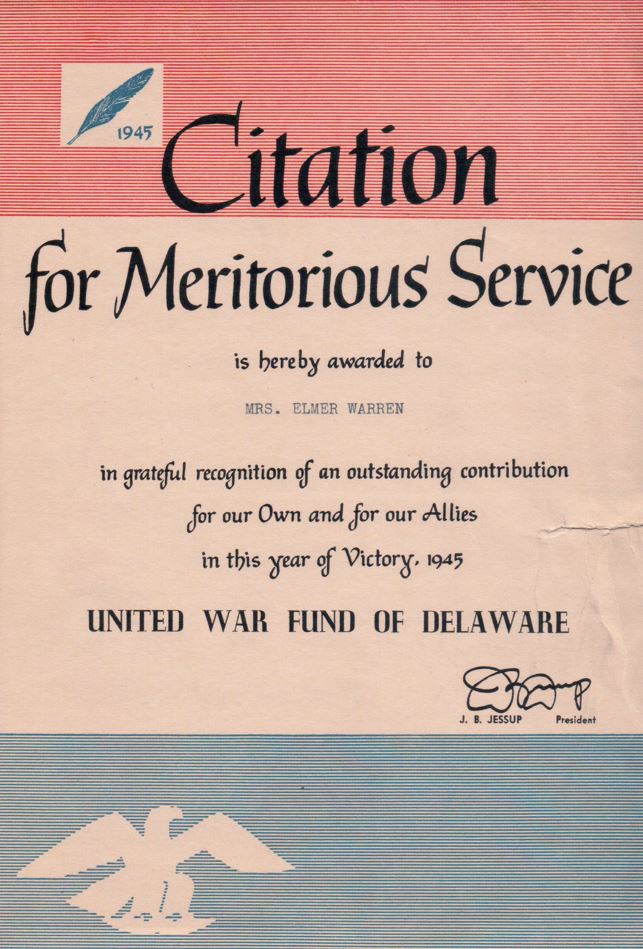
Warren’s mother threw herself into volunteer work to raise money for the war effort. Journal-Every Evening reported on December 2, 1944, that she and four other mothers of servicemen had, in 11 days, sold $4,775 in war bonds.
The “secret” of their success in sales is very simple:
Plenty of doorbell ringing and leg work and refuse to be discouraged. They are also bolstered by the fact that scores of people are just waiting to be asked to buy bonds.
“I’m doing what any mother should be willing to do” is the way modest Mrs. Warren describes her war bond sales from door to door.
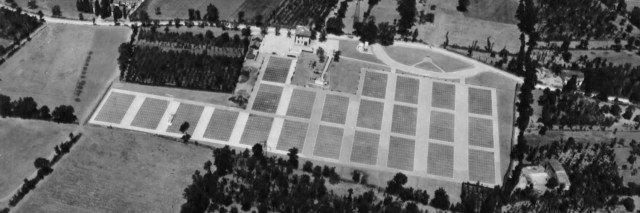
As the war in Europe drew to a close, Staff Sergeant Warren’s body was disinterred and identified from a dog tag and laundry marks on his clothing. He was temporarily reburied in a military cemetery on April 25, 1945, at a military cemetery at Saint-Maximin, France. After the war, in 1947, Warren’s parents initially requested that their son be repatriated to the United States for burial at Baltimore National Cemetery. Early the following year, they requested that he be returned for private burial instead.
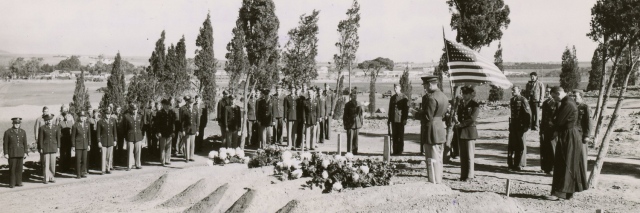
Warren’s funeral took place on October 23, 1948, at the Spicer Funeral Home at the corner of 24th and Market Streets in Wilmington. After the service, he was buried in Gracelawn Memorial Park in New Castle, Delaware. His parents and several siblings were also buried there after their deaths. Warren’s name is honored at Veterans Memorial Park nearby.
Warren’s widow, Jane, remarried in Wilmington, Delaware, to Harry Joseph Fox (1919–1976) on May 21, 1947. The couple raised Staff Sergeant Warren’s son and two children of their own.
Crew of B-24H Ram It Dammit on June 27, 1944
The following list is adapted from Missing Air Crew Report No. 6744 and 44th Bomb Group Roll of Honor and Casualties with grade, name, service number, position, and status (killed or captured).
1st Lieutenant Bernie L. Scudday, O-682906 (pilot) – K.I.A.
1st Lieutenant John A. Farrell, O-755660 (copilot) – K.I.A.
1st Lieutenant Raymond A. McCormick, O-689617 (navigator) – P.O.W.
1st Lieutenant Paul Richardson, O-752904 (bombardier) – K.I.A.
Technical Sergeant Joseph E. Wycheck, 13116002 (flight engineer) – K.I.A.
Technical Sergeant Anthony J. Ventura, 32551956 (radio operator) – K.I.A.
Staff Sergeant Carl W. Tepe, 18184357 (nose gunner) – P.O.W.
Staff Sergeant Robert P. Ries, 35669582 (right waist gunner) – K.I.A.
Staff Sergeant Coyle J. Acuff, 14134043 (left waist gunner) – P.O.W.
Staff Sergeant Lester D. Warren, 13078765 (tail gunner) – K.I.A.
Notes
Mother
Various documents are inconsistent about whether his mother’s middle name was Mae or May.
Marriage
A certified copy of Jane Warren’s marriage license application stated that her first marriage occurred in Elkton, Maryland, on October 15, 1942. Curiously, marriage announcements printed in Journal-Every Evening (on October 28, 1942) and in the Wilmington Morning News, stated that the couple married on September 15, 1942. The newspapers stated the announcement was from the bride’s sister. Similarly, information that Warren’s mother supplied to the Delaware Public Archives was that the couple married in Wilmington on September 15, 1942.
There is no sign of a marriage license for the couple among indexed Delaware records. Since the information about the Elkton marriage was supplied by the bride herself rather than a family member, it is also more likely to be correct.
Elkton once enjoyed a reputation for elopement, similar to Las Vegas’s today, due to its lack of a waiting period for marriage licenses. Though Delaware only had a one-day waiting period, a newspaper article indicates that Warren was due to report for duty in Tennessee only four days after the wedding.
Acknowledgments
Special thanks to Staff Sergeant Warren’s son, Mike, and to the Warren family for providing photos, documents, and information that were vital in telling his story. Thanks also go out to the Delaware Public Archives, Stephen Adams, and Brendan Wood for the use of their photos.
Bibliography
“1LT Bernie Lavoice Scudday.” Find a Grave. https://www.findagrave.com/memorial/75883554/bernie_lavoice-scudday
5 War Mothers Here Set Pace For 6th War Loan Canvassing.” Journal-Every Evening, December 2, 1944. https://www.newspapers.com/article/136956055/
Application for Headstone or Marker for Randall Bowen Warren. September 1, 1953. Applications for Headstones, January 1, 1925 – June 30, 1970. Record Group 92, Records of the Office of the Quartermaster General, 1774–1985. National Archives at St. Louis, Missouri. https://www.ancestry.com/imageviewer/collections/2375/images/40050_520306997_0429-03437
August, Melissa. “How One Small Maryland Town Became the Marriage Capital of the East Coast in the Early 20th Century.” Time, February 11, 2021. https://time.com/5938395/elkton-maryland-marriage-capital-east-coast/
Census Record for Lester D. Warren. January 9–10, 1920. Fourteenth Census of the United States, 1920. Record Group 29, Records of the Bureau of the Census. National Archives at Washington, D.C. https://www.familysearch.org/ark:/61903/3:1:33S7-9R6W-S51
Census Record for Lester D. Warren. April 1940. Sixteenth Census of the United States, 1940. Record Group 29, Records of the Bureau of the Census. National Archives at Washington, D.C. https://www.familysearch.org/ark:/61903/3:1:3QSQ-G9MR-M3S8
Census Record for Lester Warren. April 7, 1930. Fifteenth Census of the United States, 1930. Record Group 29, Records of the Bureau of the Census. National Archives at Washington, D.C. https://www.familysearch.org/ark:/61903/3:1:33S7-9RHM-L1X
Certificate of Birth for Lester Davis Warren. July 12, 1915. Record Group 1500-008-094, Birth Certificates. Delaware Public Archives, Dover, Delaware. https://www.familysearch.org/ark:/61903/3:1:S3HY-6SPW-M75
Certificate of Marriage for Harry J. Fox, Jr. and Jane Warren. May 24, 1947. Delaware Marriages. Bureau of Vital Statistics, Hall of Records, Dover, Delaware. https://www.familysearch.org/ark:/61903/3:1:S3HY-X9T6-1S
“Coyle Joel Acuff.” Find a Grave. https://www.findagrave.com/memorial/29472822/coyle-joel-acuff
“Delaware Casualty List of 11 Includes Three Killed in Action.” Journal-Every Evening, August 11, 1944. https://www.newspapers.com/article/136957520/
Draft Registration Card for Elmer D. Warren. June 5, 1917. World War I Selective Service System Draft Registration Cards, 1917–1918. National Archives at Washington, D.C. https://www.familysearch.org/ark:/61903/3:1:33S7-8B5L-CJ2
Draft Registration Card for Lester Davis Warren. October 16, 1940. Draft Registration Cards for Delaware, October 16, 1940 – March 31, 1947. Record Group 147, Records of the Selective Service System. National Archives at St. Louis, Missouri. https://www.familysearch.org/ark:/61903/3:1:3Q9M-CSMG-XSRG-D
Draft Registration Card for Randall Bowen Warren. October 16, 1940. Draft Registration Cards for Delaware, October 16, 1940 – March 31, 1947. Record Group 147, Records of the Selective Service System. National Archives at St. Louis, Missouri. https://www.familysearch.org/ark:/61903/3:1:3Q9M-CSMG-XSYF-4
“Elmer Davis Warren.” Find a Grave. https://www.findagrave.com/memorial/134918080/elmer_davis_warren
Enlistment Record for Lester D. Warren. May 1, 1942. World War II Army Enlistment Records. Record Group 64, Records of the National Archives and Records Administration. National Archives at College Park, Maryland. https://aad.archives.gov/aad/record-detail.jsp?dt=929&mtch=1&cat=all&tf=F&q=13078765&bc=&rpp=10&pg=1&rid=80609
Enlistment Record for Randall B. Warren. World War II Army Enlistment Records. Record Group 64, Records of the National Archives and Records Administration. National Archives at College Park, Maryland. https://aad.archives.gov/aad/record-detail.jsp?dt=929&mtch=1&cat=all&tf=F&q=13125455&bc=&rpp=10&pg=1&rid=92989
“Harry Joseph Fox.” Find a Grave. https://www.findagrave.com/memorial/107116064/harry-joseph-fox
Individual Deceased Personnel File for Lester D. Warren. Individual Deceased Personnel Files, 1939–1953. Record Group 92, Records of the Office of the Quartermaster General, 1774–1985. National Archives at St. Louis, Missouri. Courtesy of U.S. Army Human Resources Command.
“Jane M Fox.” Find a Grave. https://www.findagrave.com/memorial/135939542/jane-m-fox
Kiefer, Norman C. The Green-Nosed Flying 8 Balls: A History of the 506 Bomb Squadron. 506th History Publications, year of publication unknown. https://44thbombgroup.omeka.net/items/show/5131
“KU-2376.” 1944. Downed Allied Aircraft Kampfflugzeug Unterlagen (KU) Reports, c. 1943–1945. Record Group 242, National Archives Collection of Foreign Records Seized. National Archives at College Park, Maryland. https://s3.amazonaws.com/NARAprodstorage/lz/dc-metro/rg-242/A1-1022/Box-260/643795_Box260_FolderKU2376/643795_Box260_FolderKU2376.pdf
Lundy, Will. 44th Bomb Group Roll of Honor and Casualties. Revised ed. 2005. https://44thbombgroup.omeka.net/items/show/5129
“Max D. Mendenhall.” The Daily Herald, April 7, 1999. https://www.newspapers.com/article/159983837/
“McCormick, Dr. Raymond A.” Green Bay Press-Gazette, September 27, 1999. https://www.newspapers.com/article/159933542/
McCormick, Raymond A. Letter to Will Lundy. February 20, 1985.
Mission Records for Lester D. Warren. The History of the 44th Bomb Group in Data website. https://www.44thbombgroup.org/
Morning Reports for 2nd Heavy Bombardment Processing Headquarters (Provisional Group No. 25). January 1944 – February 1944. U.S. Army Morning Reports, c. 1912–1946. Record Group 64, Records of the National Archives and Records Administration. National Archives at St. Louis, Missouri. https://s3.amazonaws.com/NARAprodstorage/lz/partners/st-louis/rg-064/85713825-wwii/85713825_1944-01/85713825_1944-01_Roll-0123/85713825_1944-01_Roll-0123-15.pdf, https://s3.amazonaws.com/NARAprodstorage/lz/partners/st-louis/rg-064/85713825-wwii/85713825_1944-02/85713825_1944-02_Roll-0394/85713825_1944-02_Roll-0394-10.pdf
Morning Reports for 3rd Heavy Bombardment Processing Headquarters (Provisional Group No. 25). February 1944 – March 1944. U.S. Army Morning Reports, c. 1912–1946. Record Group 64, Records of the National Archives and Records Administration. National Archives at St. Louis, Missouri. https://s3.amazonaws.com/NARAprodstorage/lz/partners/st-louis/rg-064/85713825-wwii/85713825_1944-02/85713825_1944-02_Roll-0394/85713825_1944-02_Roll-0394-14.pdf, https://s3.amazonaws.com/NARAprodstorage/lz/partners/st-louis/rg-064/85713825-wwii/85713825_1944-03/85713825_1944-03_Roll-0272/85713825_1944-03_Roll-0272-05.pdf
Morning Reports for 7th Bombardment Squadron (Heavy), 34th Bombardment Group (Heavy). October 1943 – November 1943. U.S. Army Morning Reports, c. 1912–1946. Record Group 64, Records of the National Archives and Records Administration. National Archives at St. Louis, Missouri. https://s3.amazonaws.com/NARAprodstorage/lz/partners/st-louis/rg-064/85713825-wwii/85713825_1943-10/85713825_1943-10_Roll-0446/85713825_1943-10_Roll-0446-08.pdf, https://s3.amazonaws.com/NARAprodstorage/lz/partners/st-louis/rg-064/85713825-wwii/85713825_1943-10/85713825_1943-10_Roll-0446/85713825_1943-10_Roll-0446-09.pdf, https://s3.amazonaws.com/NARAprodstorage/lz/partners/st-louis/rg-064/85713825-wwii/85713825_1943-11/85713825_1943-11_Roll-0376/85713825_1943-11_Roll-0376-16.pdf
Morning Reports for 11th Combat Mapping Squadron, 2nd Photographic Group, Reconnaissance. January 1944. U.S. Army Morning Reports, c. 1912–1946. Record Group 64, Records of the National Archives and Records Administration. National Archives at St. Louis, Missouri. https://s3.amazonaws.com/NARAprodstorage/lz/partners/st-louis/rg-064/85713825-wwii/85713825_1944-01/85713825_1944-01_Roll-0304/85713825_1944-01_Roll-0304-10.pdf, https://s3.amazonaws.com/NARAprodstorage/lz/partners/st-louis/rg-064/85713825-wwii/85713825_1944-01/85713825_1944-01_Roll-0304/85713825_1944-01_Roll-0304-11.pdf
Morning Reports for 21st Technical School Squadron, 38th Technical School Group. July 1943 – August 1943. U.S. Army Morning Reports, c. 1912–1946. Record Group 64, Records of the National Archives and Records Administration. National Archives at St. Louis, Missouri. https://s3.amazonaws.com/NARAprodstorage/lz/partners/st-louis/rg-064/85713825-wwii/85713825_1940-01-thru-1943-07/85713825_1940-01-thru-1943-07_Roll-0131/85713825_1940-01-thru-1943-07_Roll-0131-05.pdf, https://s3.amazonaws.com/NARAprodstorage/lz/partners/st-louis/rg-064/85713825-wwii/85713825_1943-08/85713825_1943-08_Roll-0392/85713825_1943-08_Roll-0392-02.pdf, https://s3.amazonaws.com/NARAprodstorage/lz/partners/st-louis/rg-064/85713825-wwii/85713825_1943-08/85713825_1943-08_Roll-0392/85713825_1943-08_Roll-0392-03.pdf
Morning Reports for 66th Bombardment Squadron (Heavy), 44th Bombardment Group (Heavy). March 1944. U.S. Army Morning Reports, c. 1912–1946. Record Group 64, Records of the National Archives and Records Administration. National Archives at St. Louis, Missouri. https://s3.amazonaws.com/NARAprodstorage/lz/partners/st-louis/rg-064/85713825-wwii/85713825_1944-03/85713825_1944-03_Roll-0715/85713825_1944-03_Roll-0715-10.pdf
Morning Reports for 402nd Bombardment Squadron (Heavy). September 1943. U.S. Army Morning Reports, c. 1912–1946. Record Group 64, Records of the National Archives and Records Administration. National Archives at St. Louis, Missouri. https://s3.amazonaws.com/NARAprodstorage/lz/partners/st-louis/rg-064/85713825-wwii/85713825_1943-09/85713825_1943-09_Roll-0441/85713825_1943-09_Roll-0441-10.pdf
Morning Reports for 506th Bombardment Squadron (Heavy), 44th Bombardment Group (Heavy). March 1944. U.S. Army Morning Reports, c. 1912–1946. Record Group 64, Records of the National Archives and Records Administration. National Archives at St. Louis, Missouri. https://s3.amazonaws.com/NARAprodstorage/lz/partners/st-louis/rg-064/85713825-wwii/85713825_1944-03/85713825_1944-03_Roll-0718/85713825_1944-03_Roll-0718-10.pdf
Morning Reports for Classification Routing Pool, Army Air Base, Salt Lake City, Utah. September 1943. U.S. Army Morning Reports, c. 1912–1946. Record Group 64, Records of the National Archives and Records Administration. National Archives at St. Louis, Missouri. https://s3.amazonaws.com/NARAprodstorage/lz/partners/st-louis/rg-064/85713825-wwii/85713825_1943-09/85713825_1943-09_Roll-0451/85713825_1943-09_Roll-0451-04.pdf, https://s3.amazonaws.com/NARAprodstorage/lz/partners/st-louis/rg-064/85713825-wwii/85713825_1943-09/85713825_1943-09_Roll-0451/85713825_1943-09_Roll-0451-08.pdf
Morning Reports for IX-A Provisional Group No. 25 Adm Section, 34th Combat Crew Training School. November 1943 – December 1943. U.S. Army Morning Reports, c. 1912–1946. Record Group 64, Records of the National Archives and Records Administration. National Archives at St. Louis, Missouri. https://s3.amazonaws.com/NARAprodstorage/lz/partners/st-louis/rg-064/85713825-wwii/85713825_1943-11/85713825_1943-11_Roll-0376/85713825_1943-11_Roll-0376-11.pdf, https://s3.amazonaws.com/NARAprodstorage/lz/partners/st-louis/rg-064/85713825-wwii/85713825_1943-12/85713825_1943-12_Roll-0096/85713825_1943-12_Roll-0096-13.pdf
Morning Reports for Squadron “A,” 14th Replacement Control Depot. March 1944. U.S. Army Morning Reports, c. 1912–1946. Record Group 64, Records of the National Archives and Records Administration. National Archives at St. Louis, Missouri. https://s3.amazonaws.com/NARAprodstorage/lz/partners/st-louis/rg-064/85713825-wwii/85713825_1944-03/85713825_1944-03_Roll-0726/85713825_1944-03_Roll-0726-11.pdf, https://s3.amazonaws.com/NARAprodstorage/lz/partners/st-louis/rg-064/85713825-wwii/85713825_1944-03/85713825_1944-03_Roll-0726/85713825_1944-03_Roll-0726-12.pdf
“Sees Triumph for Spirit of Modern Youth.” Evening Journal, January 29, 1934. https://www.newspapers.com/article/160087056/
“Sergeant Warren Rites To Be Held Saturday.” Journal-Every Evening, October 20, 1948. https://www.newspapers.com/article/160087244/
Warren, Anna M. Individual Military Service Record for Lester Davis Waren. August 16, 1945. Record Group 1325-003-053, Record of Delawareans Who Died in World War II. Delaware Public Archives, Dover, Delaware. https://cdm16397.contentdm.oclc.org/digital/collection/p15323coll6/id/21279/rec/2
Warren, Lester D. Letter to Anna M. Warren. December 25, 1943. Courtesy of the Warren family.
Warren, Lester D. Letter to Anna M. Warren. June 19, 1944. Courtesy of the Warren family.
Weathers, George T. “Missing Air Crew Report No. 6744.” June 28, 1944. Record Group 92, Records of the Office of the Quartermaster General, 1774–1985. The National Archives at College Park, Maryland. https://catalog.archives.gov/id/91018108
“Weddings.” Wilmington Morning News, October 29, 1942. https://www.newspapers.com/article/136957316/
“With the Service Men and the Auxiliaries.” Wilmington Morning News, December 7, 1942. https://www.newspapers.com/article/136958330/
Last updated on December 3, 2024
More stories of World War II fallen:
























To have new profiles of fallen soldiers delivered to your inbox, please subscribe below.
 Delaware's World War II Fallen