| Hometown | Civilian Occupation |
| Dover, Delaware | Paymaster, payroll clerk, or timekeeper |
| Branch | Service Number |
| U.S. Army | 32485184 |
| Theater | Unit |
| Zone of Interior (American) | Company “A,” Army Specialized Training Station Complement Service Unit 1145 |
Early Life & Family
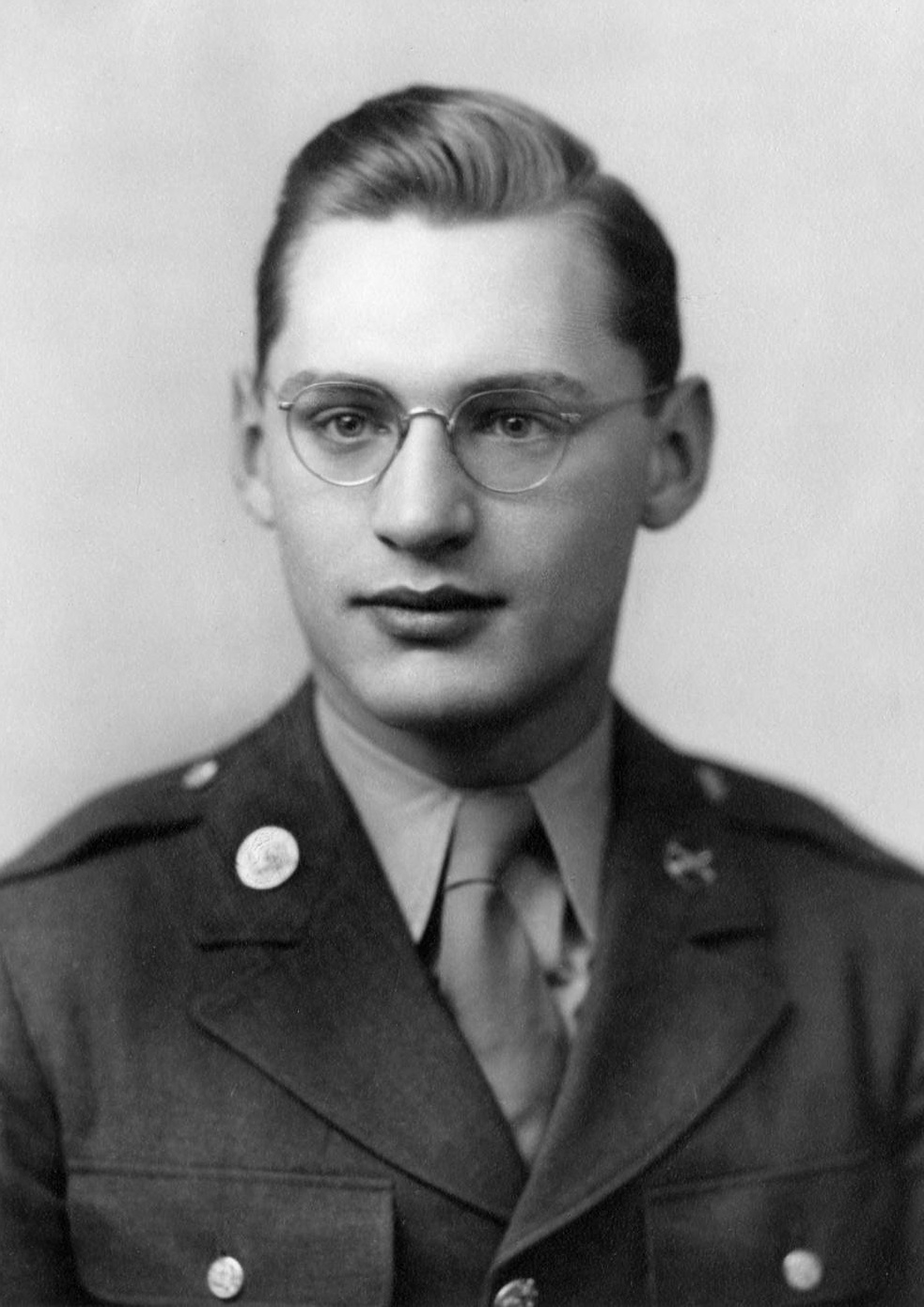
Thomas Marvel Gooden, III was born at the Marshall Hospital in Milford, Delaware, on the morning of October 16, 1922. He was the only child of Thomas Marvel Gooden, Jr. (1883–1964) and Mary Fisher Gooden (née Mary Louise Fisher, 1887–1954). His father’s occupation was listed as civil engineer on his birth certificate, newspaper merchant on the 1930 census, and employment commission manager on the 1940 census. (A 1944 newspaper article stated that the elder Gooden “is a member of the contracting firm of Gooden and Clark of Dover. Mr. Gooden has been a member of the Unemployment Compensation Commission since it was formed.”)
The Gooden family was recorded on the census in April 1930 living at 119 Reed Street in Dover, Delaware. Journal-Every Evening reported on October 20, 1934, that “Tommy Gooden, son of Mr. and Mrs. Thomas M. Gooden, Jr., was host of nine of his young friends at dinner and the movies last evening, in celebration of his twelfth birthday anniversary, which fell on Tuesday.”
In 1936, Gooden enrolled at the St. Andrew’s School, a boarding school in Middletown, Delaware. He graduated from high school there in 1942. Gooden’s yearbook revealed a constellation of nicknames: Tater, Tato, Tate, Tawm, and Tater-bug, adding:
His responsible and amiable personality has made him a favorite with the masters, but these good points have been thoroughly exploited and whenever there is dirty work to do, Tom is in the middle of it. Apparently he has never been much of a Cassanova, but we still want to know who that cute brunette on the table in his room could be. Tom has tried all the spring sports during his stay here and has finally wound up on the riding team where, as its leader, he keeps both stable and squad in good order.
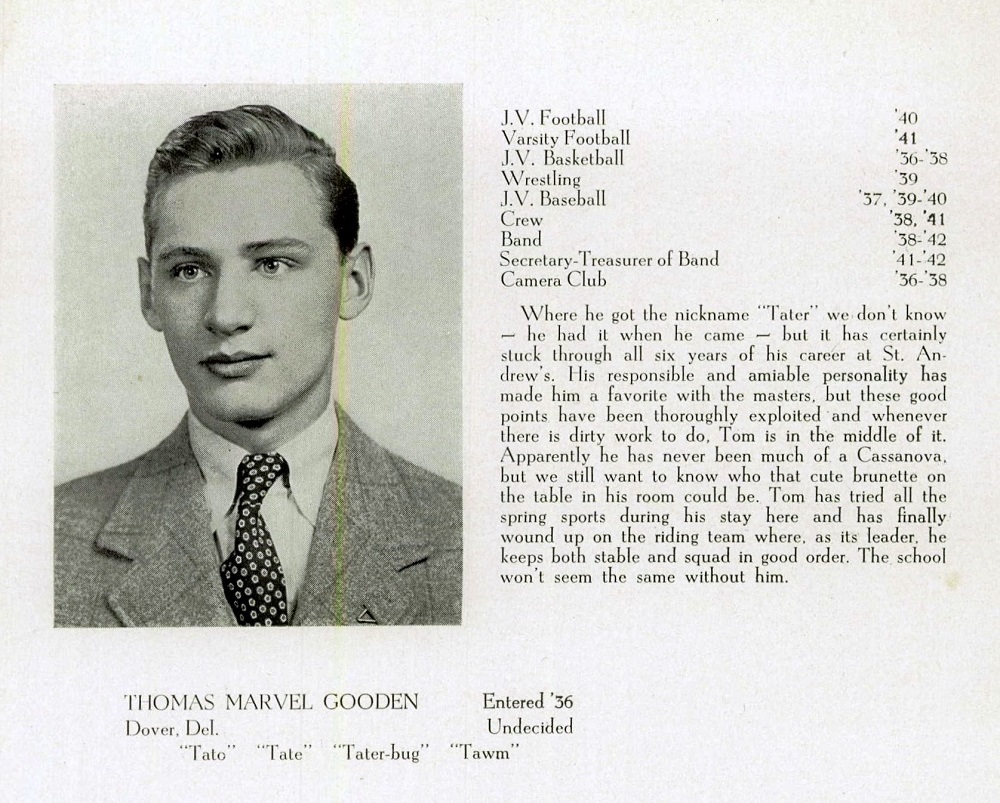
The yearbook recorded a busy set of extracurricular activities including Varsity Football and Junior Varsity Baseball and Basketball, as well as wrestling, crew, band, and Camera Club.
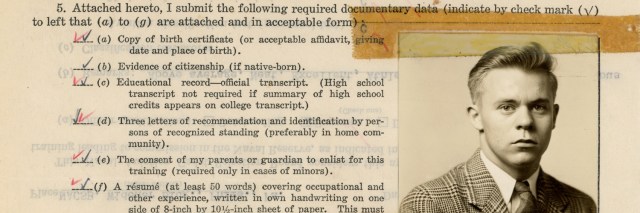
The census in April 1940 recorded the Gooden family living at 117 Reed Street in Dover, though Gooden himself must have been away at school. Gooden was living at that same address on June 30, 1942, when he registered for the draft. His employer was listed as George & Lynch on Hazel Road in Dover. The registrar described him as standing five feet, 10 inches tall and weighing 145 lbs., with brown hair and blue eyes. His enlistment data card described his occupation as paymaster, payroll clerk, or timekeeper.
Military Career
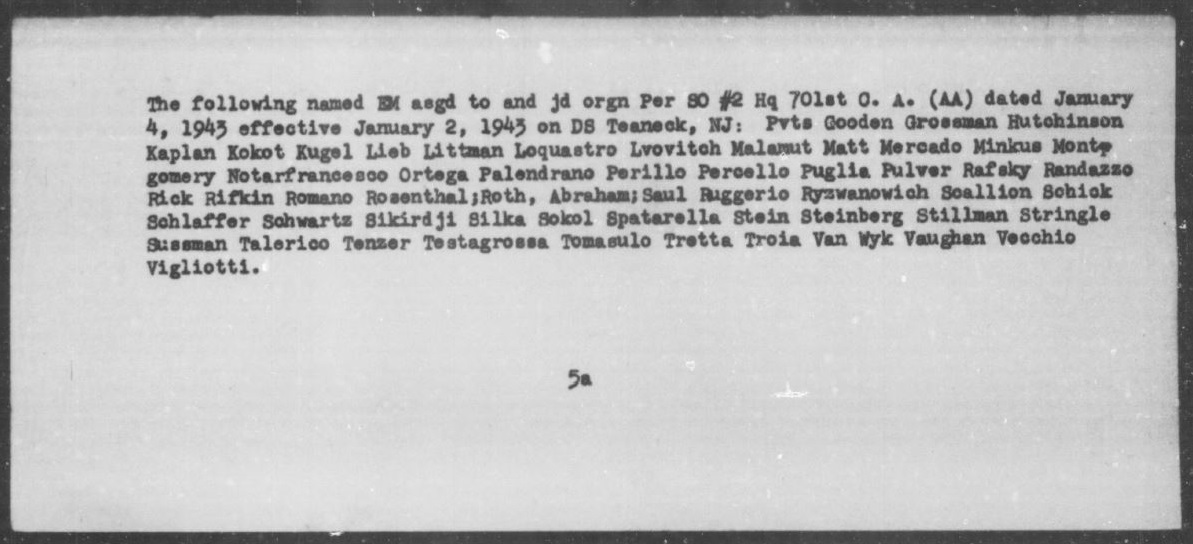
After he was drafted, Gooden was inducted into the U.S. Army in Camden, New Jersey, on December 19, 1942. The following month, on January 2, 1943, Gooden joined Battery “B,” 701st Coast Artillery Regiment (Antiaircraft). A document included in the battery morning reports stated that Gooden and a group of enlisted men were placed on detached service at Teaneck, New Jersey. On January 16, 1943, Gooden and the others moved to Fort Totten, New York. A morning report noted Gooden and the group’s duty assignment was with the Recruit Training Battalion there. It appears Gooden and the other recruits rejoined the main body of Battery “B” at Fort Wadsworth, New York, on February 23, 1943. The unit moved to Fort Totten on March 13, 1943, followed two days later by a move to Camp Myles Standish, Massachusetts.
Private Gooden completed his basic training on March 18, 1943. During March 25–29, 1943, he and the other men of his battery were at the Salisbury Beach Military Reservation, Massachusetts, where they fired their 90 mm guns. They then moved to a rifle range in Wakefield, Massachusetts, for small arms training, before returning to Camp Myles Standish on the evening of March 30.
On April 7, 1943, Private Gooden and 25 other enlisted men were detached for rations and quarters from Battery “B” and placed on special duty with Provisional Battery “C,” 701st Coast Artillery, located at Newport, Rhode Island. On June 1, 1943, a set of orders came down releasing Gooden from that special duty assignment and placing him on detached service with Specialized Training and Reassignment (S.T.A.R.) unit at the University of New Hampshire in Durham.
S.T.A.R. units evaluated candidates for the Army Specialized Training Program (A.S.T.P.), a new initiative in which some of the Army’s brightest men attended accelerated courses on college campuses. In the long run, these men held the promise of bringing valuable skills into the Army, particularly in the fields of foreign languages, the sciences, and medicine.
After passing the entrance testing, Private Gooden was among a group of soldiers who joined Company “A,” Army Specialized Training Service Complement Service Unit 1145 at the University of Maine in Orono on August 1, 1943. Another student-soldier who studied at the University of Maine at the same time Gooden was there was a fellow Delawarean, Wallace S. Wroten (1925–1944), who later distinguished himself during combat in Europe.
Gooden was hospitalized at the university’s infirmary on the evening of October 12, 1943, returning to duty on the morning of October 16.
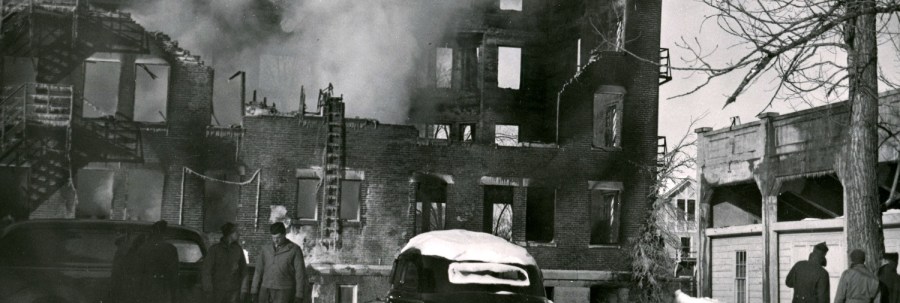
Due to projected manpower shortages, Army planners began a drastic reduction of the A.S.T.P. in early 1944, transferring virtually all trainees to regular units. In the last weeks of A.S.T.P. at the University of Maine, tragedy struck. Around 0115 hours on the morning of February 13, 1944, a fire broke out in the north wing of Hannibal Hamlin Hall (also known as North Hannibal), a dormitory that Private Gooden shared with 72 men from his company.
The Bangor Daily News described Hannibal Hamlin Hall as “a four-story building of brick and wood construction” built in 1911. The paper reported that the fire began on the first floor, while The Maine Alumnus stated that the fire originated between the first and second floors. Regardless, the blaze quickly spread to the upper floors and was well advanced by the time that University of Maine and Orono firefighters arrived. Some soldiers jumped from the windows of their rooms to escape.
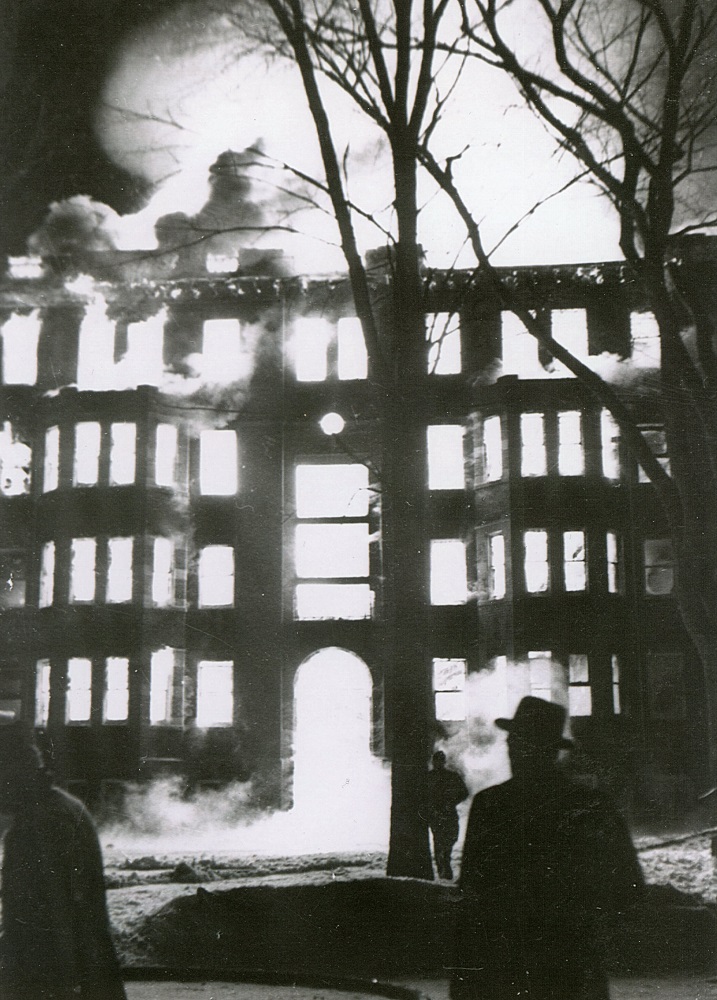
The A.S.T.P. men sprang into action, demonstrating the courage that many of them would later demonstrate on the battlefield. With no working phones in the vicinity, one commandeered a taxi to notify the fire department. Some attempted to fight the fire with extinguishers and helped man hose lines. Others improvised a fire net out of a blanket to break the falls of men who jumped.
The Bangor Daily News reported an explanation from an unidentified official that particularly acrid smoke was attributed to “cans of wax stored in the building and used to wax the floors.” The article added:
This official also called attention to the corridors on each floor of the dormitory which cut off the escape of soldiers living in the rooms at the front. He said that as the fire apparently swept up stairways and through these corridors with lightning rapidity, it prevented those soldiers in the front rooms from reaching the fire escapes on the rear. This official considered it a “miracle” that more of the student soldiers were not burned or otherwise injured in the terrific blaze.
In the aftermath of the fire, it was discovered the Private Gooden and Private Herbert E. Guenther (1924–1944) were missing. Survivors reported that Gooden was in his room on one of the upper floors of the building when the fire broke out. Guenther was incapacitated or killed by smoke before the flames reached him, and Gooden surely was as well.
One of the last men to escape the fire alive was Guenther’s roommate, Private Dewey T. Mills (probably 1921–2012). As smoke filled their room, Mills had tried without success to drag the unconscious Guenther to a window. In desperation, he climbed onto the window coping. A group of five A.S.T.P. men had tried to breach the firewall between North Hannibal and Center Hannibal with axes to reach the trapped men. Although they failed to break through the wall, they did manage to fashion a rope out of blankets tied together and successfully rescued Private Mills from his perch. Guenther’s body was found later that day.
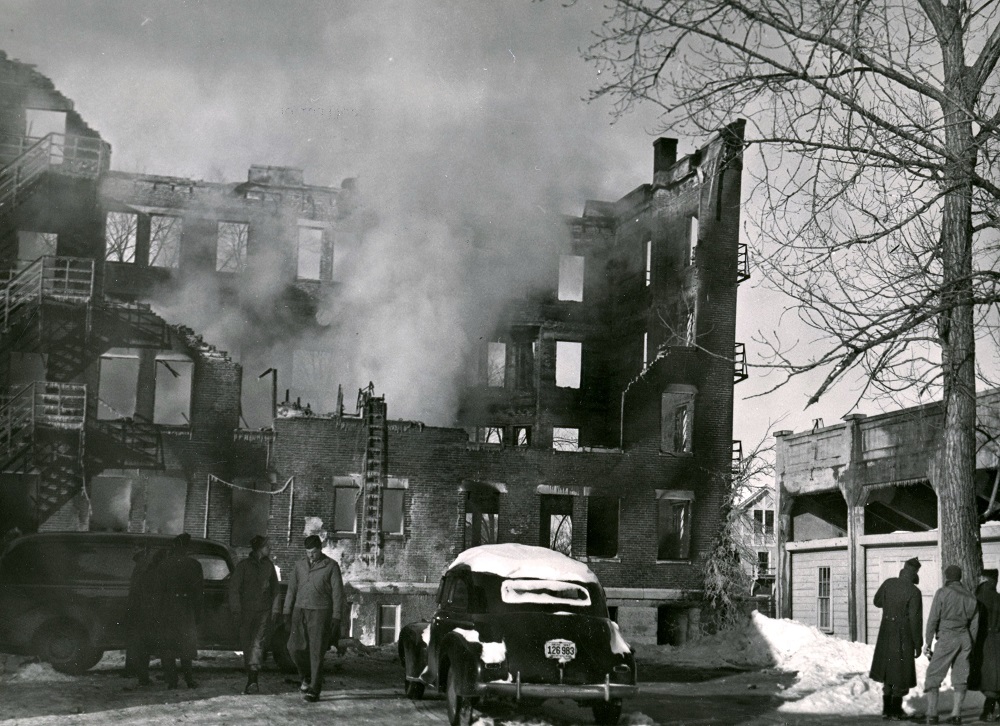

Journal-Every Evening reported on February 15, 1944, that Gooden was “thought to have perished” but that the “Search for Gooden’s body has been delayed because the safety of workers requires that the walls of the structure be razed first.” Gooden’s comrades joined the recovery effort, which the Bangor Daily News reported “was necessarily slow because of the tons of ice-coated debris that had to be probed. Student soldiers and their officers have worked unceasingly to locate the body[.]”
The Maine Campus reported: “A memorial service was held on Tuesday, February 15, at 7 p.m. in the Memorial Gymnasium to pay tribute to the two soldier-students, Thomas Gooden and Herbert Guenther, who lost their lives in the Hannibal Hamlin fire.”
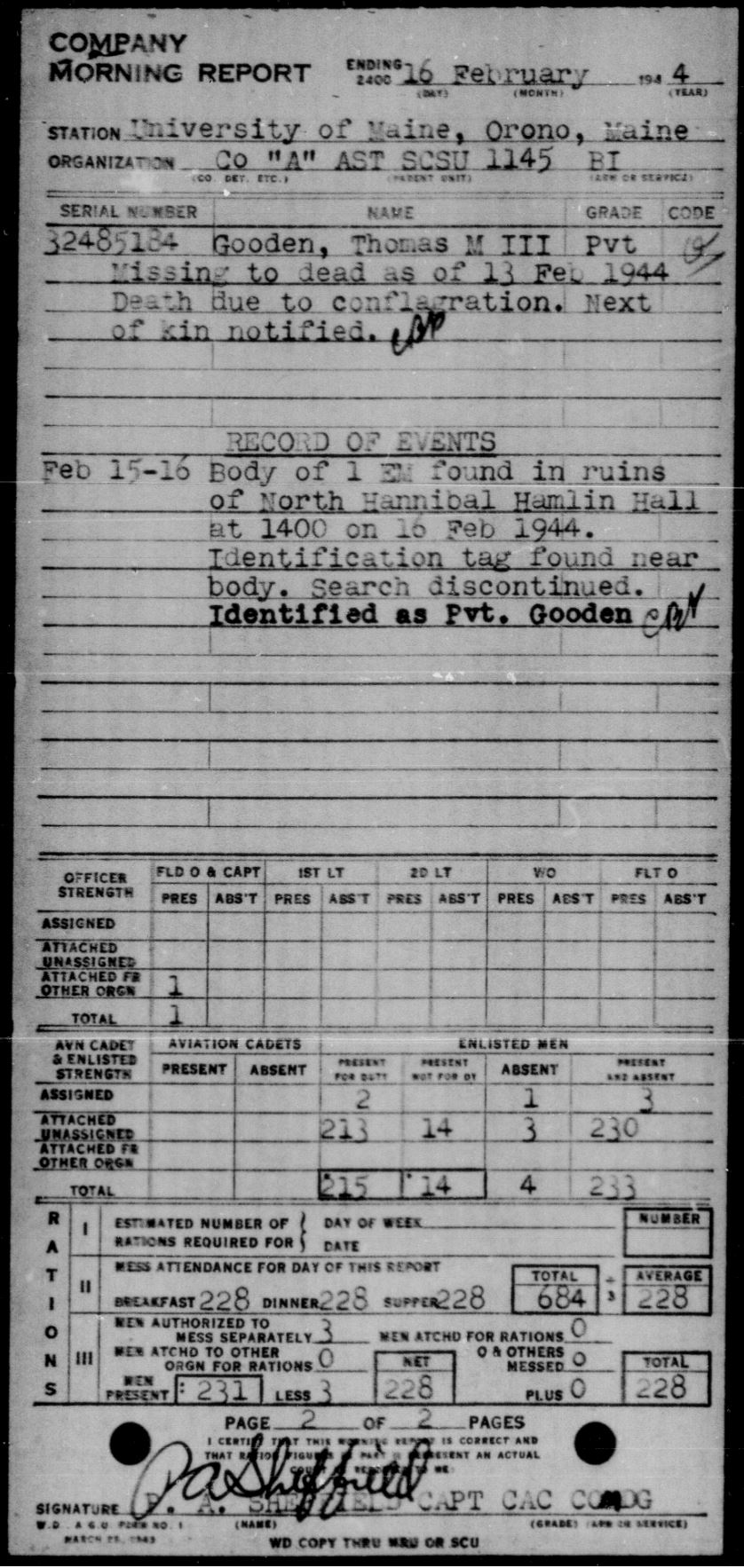
A company morning report recorded that a body was “found in ruins of North Hannibal Hamlin Hall at 1400 on 16 Feb 1944. Identification tag found near body. Search discontinued. Identified as Pvt. Gooden[.]”
The Wilmington Morning News reported that Private Gooden’s funeral was scheduled at “Christ Church on Saturday afternoon [February 19, 1944,] at 2 o’clock. The Rev. Walden Pell II, headmaster of St. Andrew’s School, Middletown, of which young Gooden was a graduate, will officiate.”
After the service, Gooden was buried at Lakeside Cemetery in Dover. His parents were also buried there after their deaths. His name is honored at Veterans Memorial Park in New Castle, Delaware, and on a plaque of fallen members of A.S.T.P. at the University of Maine dedicated in 2001.
Acknowledgments
Special thanks to the Delaware Public Archives and the University of Maine for the use of their photos.
Bibliography
1942 Criss Cross. Saint Andrew’s School Publications, 1942. https://www.ancestry.com/imageviewer/collections/1265/images/43134_b184190-00019
Census Record for Thomas M. Gooden. April 7, 1930. Fifteenth Census of the United States, 1930. Record Group 29, Records of the Bureau of the Census. National Archives at Washington, D.C. https://www.familysearch.org/ark:/61903/3:1:33SQ-GR4B-DJ4
Census Record for Thomas M. Gooden, 3rd. April 6, 1940. Sixteenth Census of the United States, 1940. Record Group 29, Records of the Bureau of the Census. National Archives at Washington, D.C. https://www.familysearch.org/ark:/61903/3:1:3QS7-89MR-MX
Certificate of Birth for Thomas Marvel Gooden 3rd. October 16, 1922. Record Group 1500-008-094, Birth Certificates. Delaware Public Archives, Dover, Delaware. https://www.familysearch.org/ark:/61903/3:1:S3HY-DYQ9-Q69
Draft Registration Card for Thomas Marvel Gooden, III. June 30, 1942. Draft Registration Cards for Delaware, October 16, 1940 – March 31, 1947. Record Group 147, Records of the Selective Service System. National Archives at St. Louis, Missouri. https://www.familysearch.org/ark:/61903/3:1:3Q9M-CSMG-X9XH-G
“Dover Soldier Believed Victim of College Fire.” Journal-Every Evening, February 15, 1944. https://www.newspapers.com/article/158290018/
Enlistment Record for Thomas M. Gooden 3rd. December 19, 1942. World War II Army Enlistment Records. Record Group 64, Records of the National Archives and Records Administration. National Archives at College Park, Maryland. https://aad.archives.gov/aad/record-detail.jsp?dt=893&mtch=1&cat=all&tf=F&q=32485184&bc=&rpp=10&pg=1&rid=3096520
“Evanston Army Student Dies in Dormitory Fire.” Chicago Daily Tribune, February 14, 1944. https://www.newspapers.com/article/158291659/
Gooden, Thomas M. Jr. Individual Military Service Record for Thomas Marvel Gooden III. January 4, 1945. Record Group 1325-003-053, Record of Delawareans Who Died in World War II. Delaware Public Archives, Dover, Delaware. https://cdm16397.contentdm.oclc.org/digital/collection/p15323coll6/id/18863/rec/1
“Herbert Guenther.” Find a Grave. https://www.findagrave.com/memorial/271130308/herbert-guenther
Jacobs, Dave. “Courageous Action, Discipline Seen During Dorm Tragedy.” The Maine Campus, February 17, 1944. https://digitalcommons.library.umaine.edu/cgi/viewcontent.cgi?article=3691&context=mainecampus
Michaud, Kelly. “WWII soldiers to reunite at UM.” The Maine Campus, September 27, 2001. https://digitalcommons.library.umaine.edu/cgi/viewcontent.cgi?article=5730&context=mainecampus
“MILLS, Dewey Toole.” Marietta Daily Journal, February 2, 2012.
Morning Reports for Battery “B,” 701st Coast Artillery Regiment (Antiaircraft). January 1943 – June 1943. U.S. Army Morning Reports, c. 1912–1946. Record Group 64, Records of the National Archives and Records Administration. National Archives at St. Louis, Missouri. https://s3.amazonaws.com/NARAprodstorage/lz/partners/st-louis/rg-064/85713825-wwii/85713825_1940-01-thru-1943-07/85713825_1940-01-thru-1943-07_Roll-0908/85713825_1940-01-thru-1943-07_Roll-0908-28.pdf, https://s3.amazonaws.com/NARAprodstorage/lz/partners/st-louis/rg-064/85713825-wwii/85713825_1940-01-thru-1943-07/85713825_1940-01-thru-1943-07_Roll-0908/85713825_1940-01-thru-1943-07_Roll-0908-29.pdf
Morning Reports for Battery “C,” 701st Coast Artillery Regiment (Antiaircraft). April 1943. U.S. Army Morning Reports, c. 1912–1946. Record Group 64, Records of the National Archives and Records Administration. National Archives at St. Louis, Missouri. https://s3.amazonaws.com/NARAprodstorage/lz/partners/st-louis/rg-064/85713825-wwii/85713825_1940-01-thru-1943-07/85713825_1940-01-thru-1943-07_Roll-0908/85713825_1940-01-thru-1943-07_Roll-0908-30.pdf
Morning Reports for Company “A,” Army Specialized Training Station Complement Service Unit 1145. August 1943. U.S. Army Morning Reports, c. 1912–1946. Record Group 64, Records of the National Archives and Records Administration. National Archives at St. Louis, Missouri. https://s3.amazonaws.com/NARAprodstorage/lz/partners/st-louis/rg-064/85713825-wwii/85713825_1943-08/85713825_1943-08_Roll-0066/85713825_1943-08_Roll-0066-19.pdf
Morning Reports for Company “A,” Army Specialized Training Station Complement Service Unit 1145. February 1944. U.S. Army Morning Reports, c. 1912–1946. Record Group 64, Records of the National Archives and Records Administration. National Archives at St. Louis, Missouri. https://s3.amazonaws.com/NARAprodstorage/lz/partners/st-louis/rg-064/85713825-wwii/85713825_1944-02/85713825_1944-02_Roll-0133/85713825_1944-02_Roll-0133-11.pdf
Morning Reports for Company “A,” Army Specialized Training Station Complement Service Unit 1145. October 1943. U.S. Army Morning Reports, c. 1912–1946. Record Group 64, Records of the National Archives and Records Administration. National Archives at St. Louis, Missouri. https://s3.amazonaws.com/NARAprodstorage/lz/partners/st-louis/rg-064/85713825-wwii/85713825_1943-10/85713825_1943-10_Roll-0243/85713825_1943-10_Roll-0243-16.pdf
“Pvt. Thomas Marvel Gooden III.” Find a Grave. https://www.findagrave.com/memorial/7631991/thomas-marvel-gooden
“Recover Body Of Second Soldier In Orono Fire Ruins.” Bangor Daily News, February 17, 1944. https://www.newspapers.com/article/158291117/
“Second Man Is Assumed Dead In Fire.” Portland Press Herald, February 15, 1944. https://www.newspapers.com/article/158290574/
“Social Happenings in Dover.” Journal-Every Evening, October 20, 1934. https://www.newspapers.com/article/158290424/
“Soldier Burned To Death, Another Believed Dead In U. of M. Blaze.” Bangor Daily News, February 14, 1944. https://www.newspapers.com/article/158356506/
“T. M. Gooden III, Rites Tomorrow in Dover.” Wilmington Morning News, February 18, 1944. https://www.newspapers.com/article/158290379/
“Two Die in Hannibal Fire.” The Maine Alumnus, March 1944. digitalcommons.library.umaine.edu/cgi/viewcontent.cgi?article=1348&context=alumni_magazines
“Two Probes Of Fatal Fire At The University; ‘Acid Smoke’ Explained.” Bangor Daily News, February 15, 1944. https://www.newspapers.com/article/158290616/
“Two Soldiers Burn To Death In Hannibal Fire.” The Maine Campus, February 17, 1944. https://digitalcommons.library.umaine.edu/cgi/viewcontent.cgi?article=3691&context=mainecampus
“University Service Observes Memory Of Fire Victims.” The Maine Campus, February 17, 1944. https://digitalcommons.library.umaine.edu/cgi/viewcontent.cgi?article=3691&context=mainecampus
Last updated on November 3, 2024
More stories of World War II fallen:























To have new profiles of fallen soldiers delivered to your inbox, please subscribe below.
 Delaware's World War II Fallen