
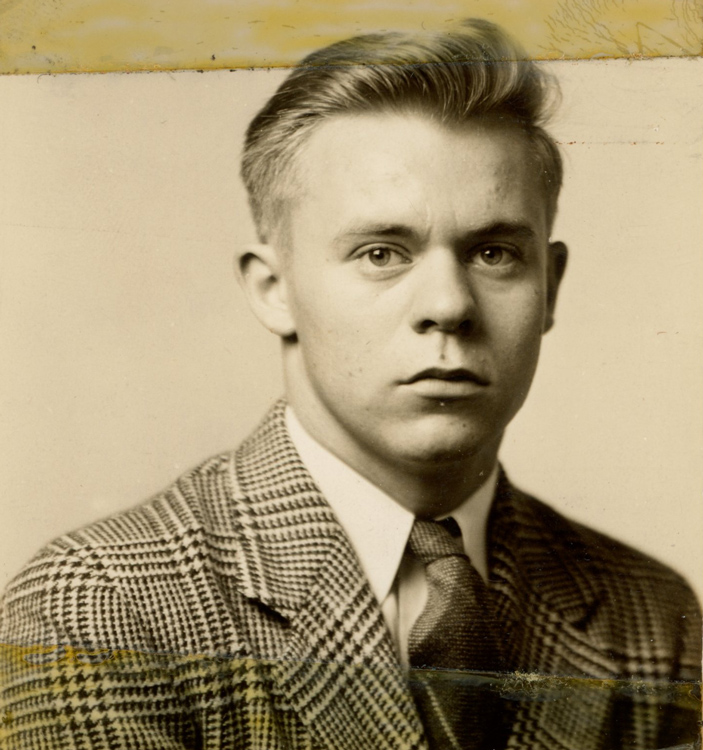
| Residences | Civilian Occupation |
| Delaware, Maryland, Pennsylvania | Tracer for Baldwin Locomotive Works |
| Branch | Service Number |
| U.S. Naval Reserve | 7204546 |
| Theater | Unit |
| American | Detachment D, Naval Aviation Cadet Selection Board, Los Angeles, California |
Early Life & Family
William Edwin Hairsine was born at the Physicians & Surgeons Hospital in Wilmington, Delaware, on the night of October 10, 1922. He was the only child of William Thomas Hairsine (1896–1986) and Helena Louise Hairsine (née Stierle, 1900–1981). At the time, his parents lived at 1039 Dupont Street in Wilmington. Hairsine’s father’s occupation was recorded as clerk for Bell Telephone. Years later, the Evening Journal reported that during his 45-year career in the industry, the elder Hairsine worked as a “repairman, installer, storekeeper, district storekeeper and installation foreman” for the Diamond State Telephone Company, a Bell affiliate.
On August 14, 1925, Hairsine’s parents purchased a property on Mattes Avenue in Elmhurst, southwest of Wilmington. The family was recorded on the 1930 census living at 209 Matthes Avenue. They were still there at the time of the next census in April 1940. A newspaper article stated that the Hairsine family was living at 123 West 34th Street in Wilmington as of September 14, 1940, though Hairsine’s parents did not sell the Matthes Avenue home until August 17, 1942.
On November 20, 1941, Hairsine’s parents purchased a new home, apparently still under construction, on Salisbury Drive in Edgemoor Terrace, east of Wilmington. They had moved to the home, 59 West Salisbury Drive, by April 27, 1942, when Hairsine’s father registered for the draft.
Hairsine and his family were members of the Episcopal Cathedral Church of St. John in Wilmington. In his resumé, dated September 26, 1942, Hairsine wrote that his main “hobbies are corresponding, sailing, archery, and swimming.”
An average student, Hairsine graduated from Henry C. Conrad High School on June 6, 1940. On September 14, 1940, he began attending the Tome Preparatory School in nearby Port Deposit, Maryland. In his resumé, Hairsine wrote:
Previous to my first year at Prep School I did not take in any extra curricular activities. At Tome School I regularly played golf, was made diver on the swimming team, and in the spring I played baseball with the school team. At the end of the school year I received honors in Machine Shop Work.
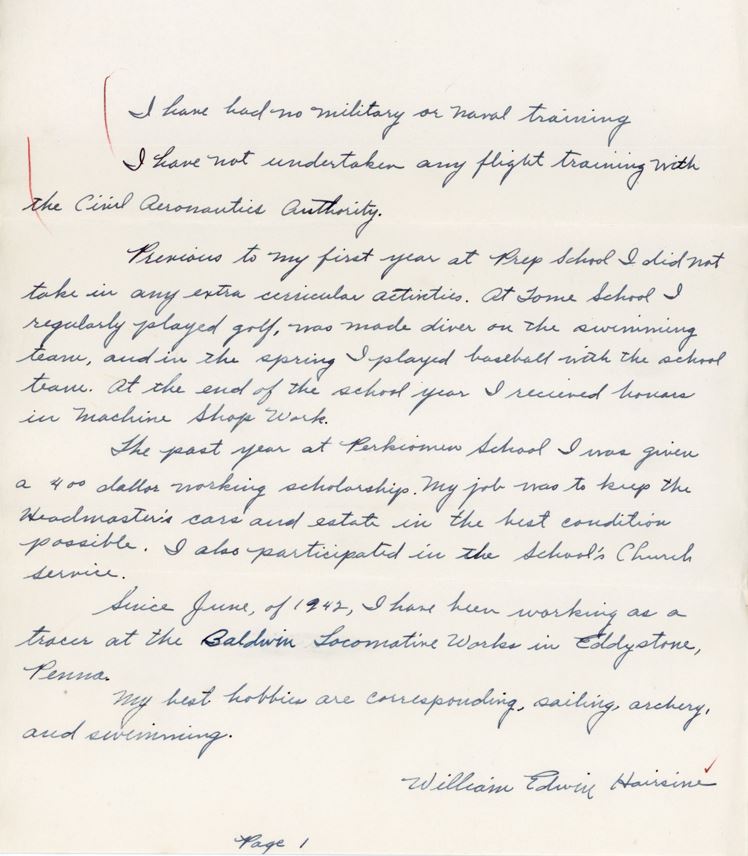
In September 1941, he began attending another college preparatory program at the Perkiomen School, a private school in Pennsburg, outside Philadelphia, Pennsylvania, where he studied algebra, economics, and American government. Hairsine wrote that “I was given a 400 dollar working scholarship. My job was to keep the Headmaster’s cars and estate in the best condition possible. I also participated in the School’s Church service.” Hairsine’s grades at Perkiomen were better than they had been at Conrad.
In a recommendation letter dated September 11, 1942, Perkiomen’s headmaster, Clarence Edwin Tobias, Jr. (1903–1984), wrote that Hairsine “is a boy of fine personality, unusual mechanical aptitude, and excellent citizenship. He is trustworthy, conscientious, and an all-around fine boy.”
In June 1942, Hairsine began working as a tracer at the Balwin Locomotive Works, a steam locomotive factory in Eddystone, Pennsylvania. He temporarily moved to Eddystone after he was hired there, but told the Navy that his permanent address was the family home in Wilmington. Hairsine’s personnel file described him as standing five feet, 6¼ inches tall and weighing 150 lbs., with light brown hair and green eyes.
Military Career
On September 26, 1942, Hairsine applied for the V-5 (Naval Aviation Cadet) program. Since he was under 21, the age of majority at the time, Hairsine’s father consented to his enlistment on September 30, 1942. He was examined and found qualified for the program on October 6, 1942.
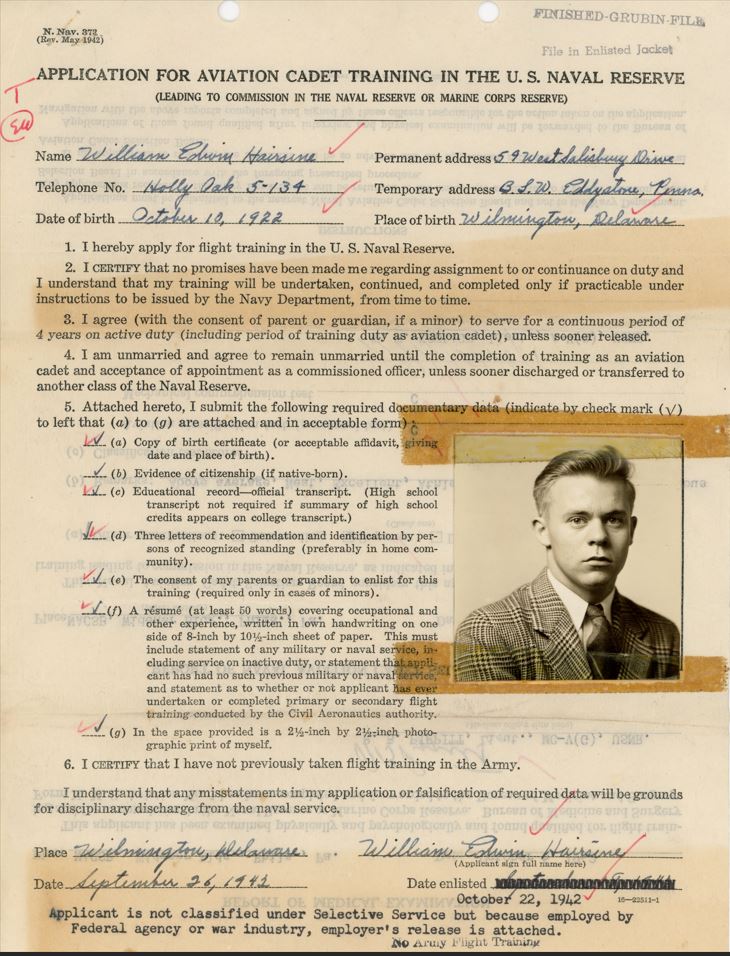
Hairsine enlisted for a four-year term in the U.S. Naval Reserve at the Naval Aviation Cadet Selection Board, Philadelphia, Pennsylvania, on October 22, 1942. Initially, he was placed on inactive duty until a training slot became available.
Aviation Cadet Hairsine went on active duty on February 8, 1943, at the Naval Aviation Cadet Selection Board, Philadelphia, Pennsylvania. That same day, he was dispatched along with 39 other aviation cadets to Prescott, Arizona, “on detached duty from Naval Aviation Cadet Selection Board, Los Angeles California, for purpose of undergoing CAAWTS [Civil Aeronautics Authority War Training Service], Elementary Training Program[.]”
With the rapid expansion of the U.S. armed forces, the armed forces’ training programs were insufficient to train all the pilots they would need. During the early years of the war, civilian flight schools and instructors trained thousands of military pilots, while colleges affiliated with the program provided some of the ground schooling. On February 12, 1943, Hairsine arrived at Prescott, where he joined Detachment D, Naval Aviation Cadet Selection Board, Los Angeles, California, for instruction by the Monrovia Flight School Extension (Monrovia Airport, Inc.) in association with Glendale Junior College.
By March 26, 1943, Aviation Cadet Hairsine had 26 hours of flight time under his belt, including nine hours of solo flying. The weather was excellent that morning. Around 1005 hours, Hairsine and his instructor, Alfred Loyal Mourton (c. 1906–1943), took off from Prescott Municipal Airport, also known as Love Field, in a Porterfield LP-65 trainer, registration NC25578. Mourton was not Hairsine’s usual instructor, and it is unclear if the two men had ever flown together before this “routine training flight.” A Civil Aeronautics Board investigation stated that Mourton “had accumulated about 832 hours of flying time, 117 of which were flown in the 90 days preceding the accident.”
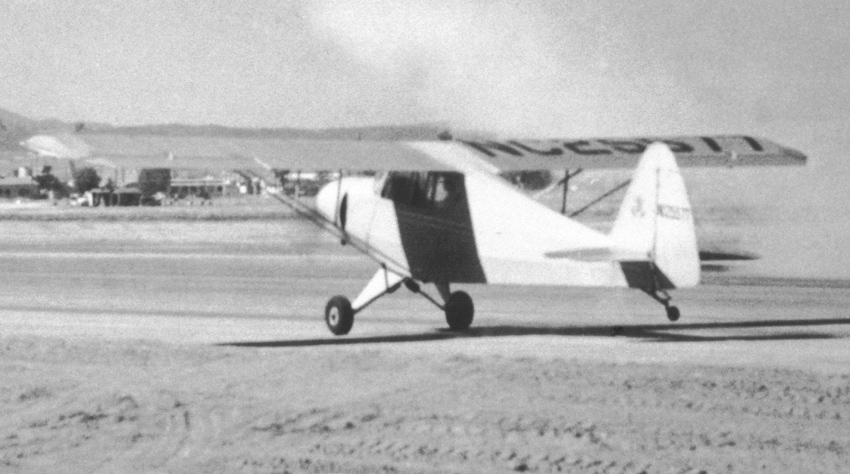
Circumstantial evidence suggests that Mourton directed Hairsine to perform a series of dangerous maneuvers at low altitude. At around 1045 hours, the LP-65 crashed in the Chino Valley about seven miles northwest of Love Field. The Civil Aeronautics Board investigation reported:
[W]itnesses in the practice area observed them executing simulated forced landings and wing-overs very close to the ground. At the peak of the climb of the last wing-over, the aircraft was stalled, fell off to the right and then dived to the ground, striking nose-first at an angle of about 45°.
The plane plunged from an altitude of about 300 feet, too low to bail out, though the investigation revealed that neither man was wearing a parachute anyway. Although a relatively low speed crash—Hairsine had “No external evidence of injury except small cuts and fractures of right leg”—both men were killed instantly.
The investigation suggested that had the wingover been performed at a higher altitude, Hairsine and Mourton would likely have had enough time to recover.:
Examination of the wreckage revealed no indication of failure of any part of the aircraft prior to impact. The switch was on and the throttle was fully advanced. The manner in which the propeller was broken indicated that considerable power was being developed at the time the plane struck the ground.
The investigation found that the probable cause of the accident was “Stall during an aerobatic maneuver performed at a dangerously low altitude” compounded by “Reckless flying.”
Another investigation summary written by Lieutenant Commander F. A. Brossy (probably Frederic Albert Brossy, 1902–1974), determined that the instructor had made two violations of C.A.A.-W.T.S. regulations:
(a) Instructor Mourton had arranged, without knowledge or consent of the chief pilot, with [Hairsine’s] regular instructor, Mr. Norman A. Kool, to act as instructor on the fatal flight in view of the fact that Kool was scheduled to give a check flight.
(b) Instructor Mourton failed to equip himself with a parachute as required by CAA regulations. This caused him to be seated in a lower-than-normal position in the airplane. There was no evidence of a cushion having been used in the seat in lieu of the parachute pack.
Brossy wrote:
In addition, there are strong indications that flight regulations were violated and that the airplane was engaged in wingovers at low altitude and after a short series of such maneuvers, the aircraft stalled at maximum climb at a height of about 300 feet and fell therefrom striking the ground at an angle of approximately 60 degrees.
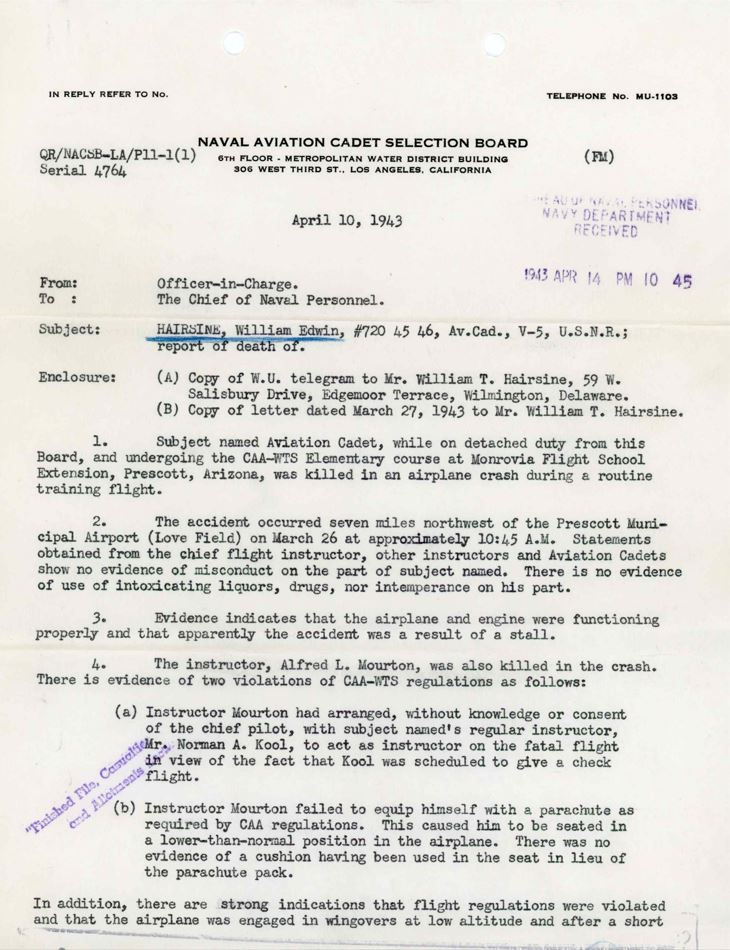
The Navy investigation concluded that Aviation Cadet Hairsine “was killed in the line of duty and not as a result of his own misconduct.”
The night of the tragedy, Hairsine’s parents spoke to an officer from the training detachment via phone, although it is unclear if this officer was the man who made the death notification, which was also sent by telegram that day.
An escort from the U.S. Navy Recruiting Station, Phoenix, Arizona, accompanied the casket back to Delaware. Journal-Every Evening reported on April 1, 1943, that Hairsine’s funeral “took place this morning. Services were held in the Cathedral Church of St. John, where he formerly served as an acolyte.” The paper added: “Taps and a salute by a firing squad from the New Castle Army Air Base paid tribute to their fellow airman at the interment in Gracelawn Memorial Park” in New Castle, Delaware.
In a condolence letter dated March 27, 1943, Lieutenant Commander F. A. Brossy wrote:
In this personal loss and sacrifice, you will be proud to know that Aviation Cadet Hairsine was considered by the officers and men of this activity who knew him to be an outstanding young man with high ideals, sincere patriotism, and a love for his country. Second only to your loss is that of the Naval service, which has a great need in such times as these for young men possessing the potential officer-like qualities of your son.
On April 12, 1943, Hairsine’s father wrote a letter back to Lieutenant Commander Brossy that read in part:
Mrs Hairsine and I wish to express our sincere thanks and appreciation to you as Officer-in-Charge, for the manner in which the Navy Dept. took care of our son A/C William Edwin Hairsine after his accident at Prescott.
The escort the Dept. assigned to the job of coming east was everything any one could expect at such a time. He was sympathetic[,] patient and above all a gentleman. […]
In as much as our son met with such misfortune we hope and pray that it was not in vain, and that if possible his fate may help to prevent the same thing form happening to some other boy.
Aviation Cadet Hairsine’s parents were also buried at Gracelawn after their deaths. He is honored at Veterans Memorial Park in New Castle and was honored on a plaque placed at the now-closed Cathedral of St. John in 1956.
Notes
Elmhurst or Richardson Park?
The nebulous boundaries of unincorporated communities in New Castle County apparently caused confusion in some records. The Matthes Avenue property was listed as Elmhurst in a 1925 property record. The 1930 census considered the area Richardson Park, while the 1940 census originally had Richardson Park listed before it was crossed out and Elmhurst substituted.
Bibliography
“30 Years With Firm.” Wilmington Morning News, November 27, 1946. https://www.newspapers.com/article/153983222/
“A/C William Edwin Hairsine.” Find a Grave. https://www.findagrave.com/memorial/135477873/william_edwin_hairsine
“Bishop to Confirm 2 Church Classes.” Wilmington Morning News, January 7, 1956. https://www.newspapers.com/article/153974665/
Census Record for W. Edwin Hairsine. April 19, 1940. Sixteenth Census of the United States, 1940. Record Group 29, Records of the Bureau of the Census. National Archives at Washington, D.C. https://www.familysearch.org/ark:/61903/3:1:3QS7-89MR-MX4
Census Record for William E. Hairsine. April 10, 1930. Fifteenth Census of the United States, 1930. Record Group 29, Records of the Bureau of the Census. National Archives at Washington, D.C. https://www.familysearch.org/ark:/61903/3:1:33S7-9RHM-QDY
Certificate of Birth for William Edwin Hairsine. Undated, c. October 10, 1922. Record Group 1500-008-094, Birth Certificates. Delaware Public Archives, Dover, Delaware. https://www.familysearch.org/ark:/61903/3:1:S3HY-DYQ1-T1
Deed Between William T. Hairsine and Helena L. Hairsine, Parties of the First Part, and Ralph A. Walker and May J. Walker, Parties of the Second Part. August 17, 1942. Delaware Land Records, 1677–1947. Record Group 2555-000-011, Recorder of Deeds, New Castle County. Delaware Public Archives, Dover, Delaware. https://www.ancestry.com/imageviewer/collections/61025/images/31303_257113-00334
Deed Between Wilmington Construction Company, Party of the First Part, and William T. Hairsine and Helena L. Hairsine, Parties of the Second Part. November 20, 1941. Delaware Land Records, 1677–1947. Record Group 2555-000-011, Recorder of Deeds, New Castle County. Delaware Public Archives, Dover, Delaware. https://www.ancestry.com/imageviewer/collections/61025/images/31303_257109-00508
Draft Registration Card for William Edwin Hairsine. June 30, 1942. Draft Registration Cards for Delaware, October 16, 1940 – March 31, 1947. Record Group 147, Records of the Selective Service System. National Archives at St. Louis, Missouri. https://www.familysearch.org/ark:/61903/3:1:3Q9M-CSMG-XW5G
Draft Registration Card for William Thomas Hairsine. April 27, 1942. Selective Service Registration Cards, World War II: Fourth Registration. Record Group 147, Records of the Selective Service System. National Archives at St. Louis, Missouri. https://www.ancestry.com/imageviewer/collections/1002/images/DE-2240356-1424
Indenture Between Raymond M. Foster and Alice M. Foster, Parties of the First Part, and William T. Hairsine and Helena L. Hairsine, Parties of the Second Part. August 14, 1925. Delaware Land Records, 1677–1947. Record Group 2555-000-011, Recorder of Deeds, New Castle County. Delaware Public Archives, Dover, Delaware. https://www.ancestry.com/imageviewer/collections/61025/images/31303_257000-00345
Individual Military Service Record for William Edwin Hairsine. Undated, c. 1945. Record Group 1325-003-053, Record of Delawareans Who Died in World War II. Delaware Public Archives, Dover, Delaware. https://cdm16397.contentdm.oclc.org/digital/collection/p15323coll6/id/18984/rec/1
Official Military Personnel File for William E. Hairsine. Official Military Personnel Files, 1885–1998. Record Group 24, Records of the Bureau of Naval Personnel. National Archives at St. Louis, Missouri.
“Report of the Civil Aeronautics Board on the Investigation of an Accident Involving Aircraft during a Local Instruction Flight.” September 24, 1943.
Standard Certificate of Death for Alfred Loyal Mourton. March 27, 1943. Arizona Death Records. Arizona Department of Health Services, Phoenix, Arizona. https://www.familysearch.org/ark:/61903/3:1:S3HT-6WGS-CQD
Standard Certificate of Death for William Edwin Hairsine. March 27, 1943. Arizona Death Records. Arizona Department of Health Services, Phoenix, Arizona. https://www.familysearch.org/ark:/61903/3:1:S3HT-6WGS-YBH
“Telephone Company Foreman Honored.” Evening Journal, December 12, 1961. https://www.newspapers.com/article/153984998/
“W. E. Hairsine Buried With Military Honors.” Journal-Every Evening, April 1, 1943. https://www.newspapers.com/article/153974031/
“Will Enter Tome School.” Wilmington Morning News, September 14, 1940. https://www.newspapers.com/article/153974211/
“William T. Hairsine.” The News Journal, July 4, 1986. https://www.newspapers.com/article/153984364/
Last updated on September 1, 2024
More stories of World War II fallen:
To have new profiles of fallen soldiers delivered to your inbox, please subscribe below.
 Delaware's World War II Fallen