

| Residences | Civilian Occupation |
| West Virginia, Delaware | Repairman for the Delaware Coach Company |
| Branch | Service Number |
| U.S. Army | 32950371 |
| Theater | Unit |
| Mediterranean | Company “F,” 135th Infantry Regiment, 34th Infantry Division |
| Military Occupational Specialty | Campaigns/Battles |
| 745 (rifleman) | Battle of Monte Cassino |
Early Life & Family
Ralph Gerald Henretty was born in Duffields, West Virginia, on February 14, 1925. He was the son of Marshall Edgar Henretty, Sr. (a telegraph lineman, 1901–1983) and Beulah Margaret Henretty (née Snyder, 1903–1995). He had an older brother, three younger brothers, and three younger sisters. Tragedy struck the family when Henretty’s younger sister, Doris Imogene Henretty, died on December 28, 1929, aged five months.
Henretty was recorded on the census in April 1930 living in Shenandoah Junction, near Charles Town, West Virginia, living at his paternal grandparents’ home with his parents and older brother.
Henretty moved to Delaware after October 11, 1940, when a Charles Town newspaper, the Farmer’s Advocate, mentioned a party at his parents’ home in Shenandoah Junction, and no later than January 18, 1942, when he was one of five new members who attended a service at Marshallton Methodist Church, as reported the following day in Journal-Every Evening. The Farmer’s Advocate stated that “Henretty attended Charles Town schools before leaving the county” and moving to Delaware around 1941. A 1942 Wilmington city directory listed Henretty as a resident of Marshallton working as a leather worker for J. E. Rhoads & Sons. Although no known documentation lists his full address, some of his U.S. Army paperwork described Henretty’s parents as living on Capitol Trail in Marshallton.
When Henretty registered for the draft on February 15, 1943, the day after his 18th birthday, he was living with his parents in Marshallton and working for the Delaware Coach Company in Wilmington. The registrar described him as standing five feet, 7½ inches tall and weighing 145 lbs., with brown hair and blue eyes. He was Protestant.
Henretty’s enlistment data card described him as having completed two years of high school and listed his occupation as plumber, gas fitter, or steam fitter. Journal-Every Evening reported: “Upon leaving the Conrad High School, Private Henretty was employed as a repairman with the Delaware Coach Company before induction.” His older brother, Marshall Edgar Henretty, Jr. (1923–1999), also served in the U.S. Army during World War II.
Military Career
After he was drafted, Henretty was inducted into the U.S. Army at Camden, New Jersey, on May 19, 1943. He went on active duty at the 1229th Reception Center, Fort Dix, New Jersey, on or about June 3, 1943. On the night of June 8, 1943, Private Henretty was one of 206 enlisted men from Fort Dix attached unassigned for basic training to Company “D,” 11th Infantry Training Battalion, Infantry Replacement Training Center, Camp Wheeler, Georgia.
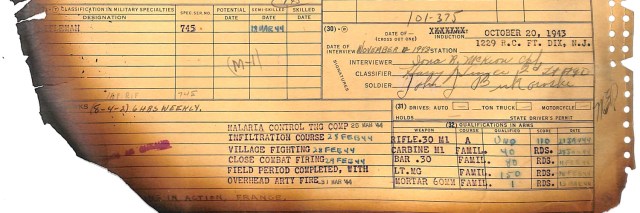
At the completion of basic training, Private Henretty’s military occupational (M.O.S.) was reclassified as 745, rifleman. Effective October 14, 1943, he was transferred to the Army Ground Forces Replacement Depot No. 1, Fort George G. Meade, Maryland, but authorized a seven-day delay in reporting there to visit Marshallton. Journal-Every Evening later reported that during his visit home, “his engagement to Miss Jean Sturgis, Cranston Heights, was announced.”

On October 23, 1943, Private Henretty was attached unassigned to Company “A,” 1st Replacement Battalion, 1st Replacement Regiment, Army Ground Forces Replacement Depot No. 1, Fort George G. Meade, Maryland. He was assigned to 1st Platoon, Company “A,” Shipment No. GI-633-A. He departed Fort George G. Meade by train on November 13, 1943, arriving the following morning at Camp Patrick Henry, Virginia. Groups of men from his shipment departed Camp Patrick Henry for the Hampton Roads Port of Embarkation, on November 17, 18, 22, and 24, with the majority of men leaving on November 18.
On the night of December 9, 1943, after crossing the Atlantic Ocean, Private Henretty was attached unassigned to Company “B,” 7th Replacement Battalion, 8th Replacement Depot, in Algeria. On January 1, 1944, he was reassigned to Personnel Center No. 6 in Italy. On January 10, 1944, after reporting for duty at Personnel Center No. 6, he was attached unassigned to Company “C,” 3rd Replacement Battalion. He was transferred to the 34th Infantry Division per Special Order No. 12, Headquarters 2nd Replacement Depot, dated January 12, 1944, though he remained at Personnel Center No. 6 for another two days.
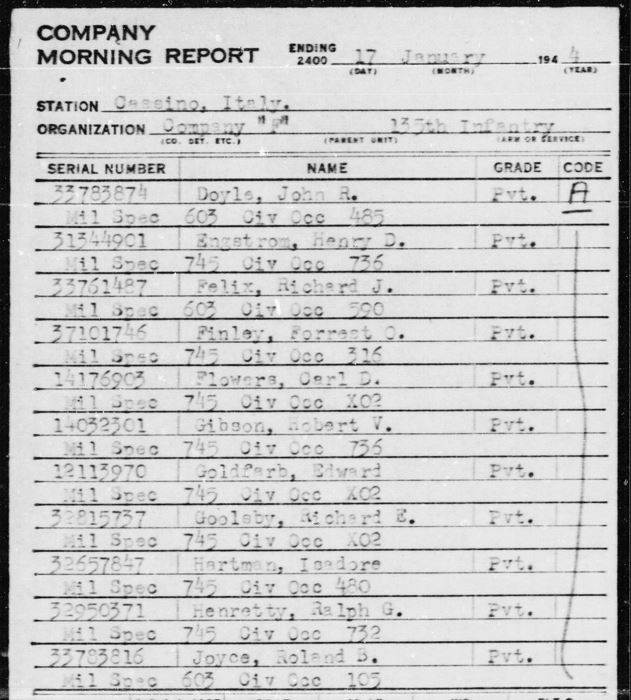
Private Henretty was one of 59 men who were assigned to Company “F,” 135th Infantry Regiment, 34th Infantry Division on January 14, 1944, and joined that unit southeast of Cassino two days later. Journal-Every Evening summarized a letter written during the next three weeks: “Private Henretty said he was very busy and told his parents not to worry if they did not hear from him regularly. He said he was part of the Fifth Army which he described as a ‘good man’s outfit’ to be in.” Henretty and most of his fellow replacements were riflemen, since rifle company casualties were very high during the grinding combat against the Gustav Line. Henretty’s 2nd Battalion had sustained significant casualties while taking Hill 189 on January 13, 1944. Hill 189 opened the door to Monte Trocchio, which fell to the 135th and 168th Infantry Regiments soon after.
Henretty’s unit remained on Monte Trocchio until January 25, 1944, except for performing brief feints in support of the 36th Infantry Division’s efforts to cross the Gari River (attacks better known, albeit incorrectly, as the Battle of the Rapido River). Across the valley from Monte Trocchio lay more strategic terrain where German forces were heavily entrenched: Monte Cairo and the Abbey of Monte Cassino loomed over the town of Cassino. An amphibious operation at Anzio intended to bypass the Gustav Line proved ineffective and intense combat continued in the Cassino sector.

The regimental history reported that on January 26, 1944, the 135th Infantry relieved the 133rd Infantry, taking its positions to the north, though 2nd Battalion remained in reserve. There was another diversionary movement the following day, but on January 29, the 133rd Infantry relieved the 135th. On January 30, 1944, Private Henretty and his company moved to San Michele, where they had a brief rest while the regiment’s officers finished reconnoitering and planning the next assault. The regimental monthly history report stated that in the early morning darkness on February 1, 1944, 2nd Battalion “marched five miles from a point east of the Rapido River to its assembly area in the vicinity of Hill 213, South of Caira.”
The report continued:
A coordinated attack by the 3rd and 2nd Battalions was scheduled to jump off at 0630A, with the initial objective of the 2nd Battalion being Hills 382 and 481, otherwise known as Mt. Maiola.
When daybreak arrived, the 2nd and 3rd Battalions had crossed their respective lines of departure at the designated time and were committed to the task at hand. […] Under the concealment provided by a heavy fog on the mountains, the two battalions were able to come upon the enemy almost undetected and the element of surprise was fully exploited.
Although 2nd Battalion came under fire from machine gun, artillery, and self-propelled guns, “the 2nd Battalion had won its objective by 0945A.”
On February 2, 1944, “the attack of the regiment was continued to the south, the purpose of the maneuver being to seize the high ground in the rear of Cassino and cut Highway #6, the main highway running from Cassino to Rome.” The enemy’s command of the high ground meant “our troops were constantly subjected to accurately fired artillery, mortar, and Nebelwerfer [rocket mortar] concentrations.” In accordance with their doctrine, the Germans launched strong counterattacks against the American penetrations of their lines.
At the end of the fourth day of fighting, February 4, 1944, “some of the rifle companies in the regiment were down to approximately 50% of their fighting strength.” The regimental report added:
By the end of the 4th of February, the 2nd Battalion erron[e]ously reported that they had penetrated to Hill 593 […] It was later ascertained that [Lieutenant Colonel Jerome Kessner,] the CO of the 2nd Battalion, 135th Infantry, had erred in his calculations and his battalion was not on Hill 593 as he had previously reported. This permitted the enemy to fire enfilade fire from an exposed right flank. The Battalion Commander was relieved and Major [Donald C.] Landon placed in command.
Private Henretty was recorded as killed in action on February 4, 1944. No specific cause of death was recorded in his burial reports. The company morning report that day stated that the unit “Moved from Mt. Maiola to base of Hill 593.” Company casualties were listed as four killed and one wounded. It was not until February 6, 1944, that 2nd Battalion captured Hill 593 after frantic fighting that saw the hill change hands three times in a matter of hours. 2nd Battalion barely managed to hold its positions against withering counterattacks. Despite the sacrifice of Private Henretty and his comrades, the Gustav Line would not be broken decisively until May 1944.

Journal-Every Evening stated that Henretty’s parents were notified of his death on February 28, 1944. The same paper reported on March 8, 1944:
A special offering for the Red Cross will be received at services in the Marshallton Methodist Church Sunday in honor of Pfc. Ralph G. Henretty, who was killed in action in Italy on Feb. 4. A memorial service for Private Henretty, who is the son of Mr. and Mrs. Marshall E. Henretty, was held Sunday afternoon when a gold star was placed on the service flag which now bears 47 blue stars.
It appears that American troops were able to retrieve some personal effects from Henretty’s body (including a Social Security plate, an employee identification card, and his Delaware driver’s license), but not bury him prior to withdrawing. Henretty was initially buried in an isolated grave, most likely by British or Commonwealth troops who found his body in what was called the “Bowl,” on March 29, 1944. On September 7, 1944, his body was disinterred and was reburied the following day at the American military cemetery at Marzanello Nuovo.
Private Henretty was posthumously awarded the Purple Heart.
After the war, Private Henretty’s family requested that his body be repatriated to the United States. His casket was shipped from Naples aboard the Carroll Victory to the New York Port of Embarkation. Spirit of Jefferson Farmer’s Advocate reported that his body reached Charles Town on September 28, 1948, adding: “Services were conducted in the Melvin T. Strider Co. Funeral Parlor Wednesday[, September 29, 1948,] at 2 p. m. Full military rites were rendered by a detachment from Jackson-Perks Post 71, American Legion.”
Private Henretty was buried at Edge Hill Cemetery in Charles Town, where two of his younger sisters had been laid to rest. His parents were also buried there after their deaths. His name is honored at Veterans Memorial Park in New Castle.
Notes
Photo Enhancement
The photo at the top of this page was digitally enhanced using tools on the Remini website. This software is useful in instances where the only known photograph is of limited resolution (in this case, because of loss of detail when the family photographed the original print). I believe this to be an accurate reconstruction, but the software could potentially introduce errors by misinterpreting fuzzy details in the original photograph. A comparison of the original and enhanced versions of the photos can be viewed below.

Fiancée
Although the only information about the identity of his fiancée is a newspaper article naming Jean Sturgis of Cranston Heights, she was most likely Jean Virginia Sturgis (later Lutton, 1927–2014), a girl from Cranston Heights who was his classmate at Conrad High School.
Personnel File
Private Henretty’s official military personnel file was heavily damaged in the 1973 National Personnel Records Center fire which destroyed the majority of U.S. Army personnel files from the World War II era. Unfortunately, his service record booklet, which would have provided more information about his career, was either not preserved or was lost in the fire.
Maiola
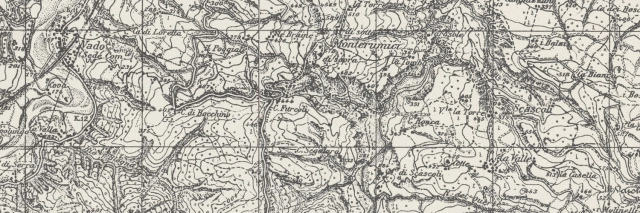
Both contemporary and modern maps label Maiola as a hill (Colle Miola) though contemporary American reports refer to it as Mt. Maiola.
Acknowledgments
Special thanks to the Henretty family for the use of their photo.
Bibliography
“4 Casualties Listed in State.” Journal-Every Evening, February 29, 1944. https://www.newspapers.com/clip/121636500/ralph-g-henretty-kia/
Application for Headstone or Marker for Ralph G. Henretty. September 30, 1948. Applications for Headstones, January 1, 1925 – June 30, 1970. Record Group 92, Records of the Office of the Quartermaster General, 1774–1985. National Archives at St. Louis, Missouri. https://catalog.archives.gov/id/113118742?objectPage=3516
“Birthday Party for Two.” Farmer’s Advocate, October 11, 1940. https://books.google.com/books?id=p0EzAAAAIBAJ
Census Record for Ralph G. Henretty. April 18, 1930. Fifteenth Census of the United States, 1930. Record Group 29, Records of the Bureau of the Census. National Archives at Washington, D.C. https://www.familysearch.org/ark:/61903/3:1:33S7-9RZP-56V
Census Record for Ralph Henretty. Sixteenth Census of the United States, 1940. April 16, 1940. Record Group 29, Records of the Bureau of the Census. National Archives at Washington, D.C. https://www.familysearch.org/ark:/61903/3:1:3QS7-89M1-Y77T
“Doris Imogene Henretty.” Find a Grave. https://www.findagrave.com/memorial/143836994/doris_imogene_henretty
Draft Registration Card for Ralph Gerald Henretty. February 15, 1943. WWII Draft Registration Cards for Delaware, October 16, 1940 – March 31, 1947. Record Group 147, Records of the Selective Service System. National Archives at St. Louis, Missouri. https://www.familysearch.org/ark:/61903/3:1:3Q9M-CSMG-D99D-G
Enlistment Record for Ralph G. Henretty. May 19, 1943. World War II Army Enlistment Records. Record Group 64, Records of the National Archives and Records Administration. National Archives at College Park, Maryland. https://aad.archives.gov/aad/record-detail.jsp?dt=893&mtch=1&cat=all&tf=F&q=32950371&bc=&rpp=10&pg=1&rid=3446761
Henretty, Marshall E., Sr. Ralph G. Henretty Individual Military Service Record. Undated, c. June 10, 1945. Record Group 1325-003-053, Record of Delawareans Who Died in World War II. Delaware Public Archives, Dover, Delaware. https://cdm16397.contentdm.oclc.org/digital/collection/p15323coll6/id/19101/rec/1
Individual Deceased Personnel File for Ralph G. Henretty. Individual Deceased Personnel Files, 1939–1953. Record Group 92, Records of the Office of the Quartermaster General, 1774–1985. National Archives at St. Louis, Missouri.
“Jean V. ‘Lutty’ Sturgis Lutton.” Find a Grave. https://www.findagrave.com/memorial/139727731/jean_v-lutton
“Killed In Action.” Farmer’s Advocate, March 10, 1944. https://books.google.com/books?id=Qh8lAAAAIBAJ
“Marshallton—” Journal-Every Evening, March 8, 1944. https://www.newspapers.com/article/145771584/
Morning Reports for Company “A,” 1st Battalion, 1st Replacement Regiment. October 1943. U.S. Army Morning Reports, c. 1912–1946. Record Group 64, Records of the National Archives and Records Administration. National Archives at St. Louis, Missouri. https://s3.amazonaws.com/NARAprodstorage/lz/partners/st-louis/rg-064/85713825-wwii/85713825_1943-10/85713825_1943-10_Roll-0001/85713825_1943-10_Roll-0001-01.pdf
Morning Reports for Company “B,” 7th Replacement Battalion, 8th Replacement Depot. December 1943 – January 1944. U.S. Army Morning Reports, c. 1912–1946. Record Group 64, Records of the National Archives and Records Administration. National Archives at St. Louis, Missouri. https://s3.amazonaws.com/NARAprodstorage/lz/partners/st-louis/rg-064/85713825-wwii/85713825_1943-12/85713825_1943-12_Roll-0635/85713825_1943-12_Roll-0635-21.pdf, https://s3.amazonaws.com/NARAprodstorage/lz/partners/st-louis/rg-064/85713825-wwii/85713825_1944-01/85713825_1944-01_Roll-0487/85713825_1944-01_Roll-0487-03.pdf
Morning Reports for Company “C,” 3rd Replacement Battalion. January 1944. U.S. Army Morning Reports, c. 1912–1946. Record Group 64, Records of the National Archives and Records Administration. National Archives at St. Louis, Missouri. https://s3.amazonaws.com/NARAprodstorage/lz/partners/st-louis/rg-064/85713825-wwii/85713825_1944-01/85713825_1944-01_Roll-0491/85713825_1944-01_Roll-0491-15.pdf, https://s3.amazonaws.com/NARAprodstorage/lz/partners/st-louis/rg-064/85713825-wwii/85713825_1944-01/85713825_1944-01_Roll-0491/85713825_1944-01_Roll-0491-16.pdf
Morning Reports for Company “D,” 11th Infantry Training Battalion. June 1943 – July 1943. U.S. Army Morning Reports, c. 1912–1946. Record Group 64, Records of the National Archives and Records Administration. National Archives at St. Louis, Missouri. https://s3.amazonaws.com/NARAprodstorage/lz/partners/st-louis/rg-064/85713825-wwii/85713825_1940-01-thru-1943-07/85713825_1940-01-thru-1943-07_Roll-1995/85713825_1940-01-thru-1943-07_Roll-1995-04.pdf
Morning Reports for Company “D,” 11th Infantry Training Battalion. October 1943. U.S. Army Morning Reports, c. 1912–1946. Record Group 64, Records of the National Archives and Records Administration. National Archives at St. Louis, Missouri. https://s3.amazonaws.com/NARAprodstorage/lz/partners/st-louis/rg-064/85713825-wwii/85713825_1943-10/85713825_1943-10_Roll-0288/85713825_1943-10_Roll-0288-24.pdf
Morning Reports for Company “F,” 135th Infantry Regiment. January 1944 – February 1944. U.S. Army Morning Reports, c. 1912–1946. Record Group 64, Records of the National Archives and Records Administration. National Archives at St. Louis, Missouri. https://s3.amazonaws.com/NARAprodstorage/lz/partners/st-louis/rg-064/85713825-wwii/85713825_1944-01/85713825_1944-01_Roll-0515/85713825_1944-01_Roll-0515-27.pdf, https://s3.amazonaws.com/NARAprodstorage/lz/partners/st-louis/rg-064/85713825-wwii/85713825_1944-02/85713825_1944-02_Roll-0450/85713825_1944-02_Roll-0450-07.pdf
Morning Reports for Detachment, Shipment No. GI-633-A. November 1943. U.S. Army Morning Reports, c. 1912–1946. Record Group 64, Records of the National Archives and Records Administration. National Archives at St. Louis, Missouri. https://s3.amazonaws.com/NARAprodstorage/lz/partners/st-louis/rg-064/85713825-wwii/85713825_1943-11/85713825_1943-11_Roll-0518/85713825_1943-11_Roll-0518-27.pdf
“Narrative History – 1 February 1944 – 29 February 1944.” 135th Infantry Regiment. World War II Operations Reports, 1940–48. Record Group 407, Records of the Adjutant General’s Office. National Archives at College Park, Maryland.
“Narrative History – 1 January 1944 – 31 January 1944.” 135th Infantry Regiment. World War II Operations Reports, 1940–48. Record Group 407, Records of the Adjutant General’s Office. National Archives at College Park, Maryland.
Polk’s Wilmington (New Castle County, Del.) City Directory 1942. R. L. Polk & Company Publishers, 1942. https://www.ancestry.com/imageviewer/collections/2469/images/16105635
“Pvt. Henretty Services Wednesday.” Spirit of Jefferson Farmer’s Advocate, September 30, 1948. https://books.google.com/books?id=euwkAAAAIBAJ
“Pvt. Ralph G. Henretty.” Wilmington Morning News, September 27, 1948. https://www.newspapers.com/article/145771359/
Last updated on November 28, 2024
More stories of World War II fallen:
























To have new profiles of fallen soldiers delivered to your inbox, please subscribe below.
 Delaware's World War II Fallen