
| Residences | Civilian Occupation |
| Pennsylvania, Delaware | Worker for Sun Shipbuilding & Dry Dock Company and usher at Loew’s Theatre |
| Branch | Service Number |
| U.S. Naval Reserve | 7225631 |
| Theater | Unit |
| American (Zone of Interior) | Torpedo Squadron 80 (VT-80) |
Early Life & Family
William Allen Funk was born in Chester, Pennsylvania, on July 3, 1922. Nicknamed Bill, he was the son of Russell Allen Funk (1896–1963) and Mary J. Funk (née Illingworth, 1893–1964). During World War I, Funk’s father had served in the U.S. Army in France with Troop “B,” 6th Cavalry, and by 1930 he was working as an electrician. Funk had an older sister, Dorothy Funk (later Fellenbaum, 1920–1994).
The Funk family was recorded on the 1930 census as living on Middletown Road in Chester Township, Pennsylvania. As of February 28, 1934, when Funk’s father applied for veterans’ compensation from the Commonwealth of Pennsylvania, the Funks were living in or near Chester.
Journal-Every Evening reported that the Funk family moved to Delaware around 1935. Indeed, census records indicate that the family was living in Wilmington as of April 1, 1935. A 1938 Wilmington directory listed Funk’s father as a resident of 1608 West 14th Street, employed as an electrician for Delaware Power & Light. The family was recorded on the census in April 1940, living at the same address.
According to his U.S. Navy personnel file, Funk was a high school graduate. Journal-Every Evening reported that Funk “attended Warner Junior High School and was graduated in 1941 from Brown Vocational High School, in the first class to be graduated from the school.”
When he registered for the draft on June 30, 1942, Funk was living at 1917 Gilpin Avenue in Wilmington and working for the Sun Shipbuilding & Dry Dock Company in Chester. Journal-Every Evening stated that in addition to working for Sun, Funk “had been for a time employed at the Wadman Service Station, Pennsylvania Avenue and Clayton Street.” Another article stated Funk “was an usher at Loew’s Theatre for two years.” In a statement for the State of Delaware Public Archives Commission, Funk’s father listed his son’s civilian occupation as electrician, while the shipping articles in his personnel file stated he was unemployed when he entered the service.
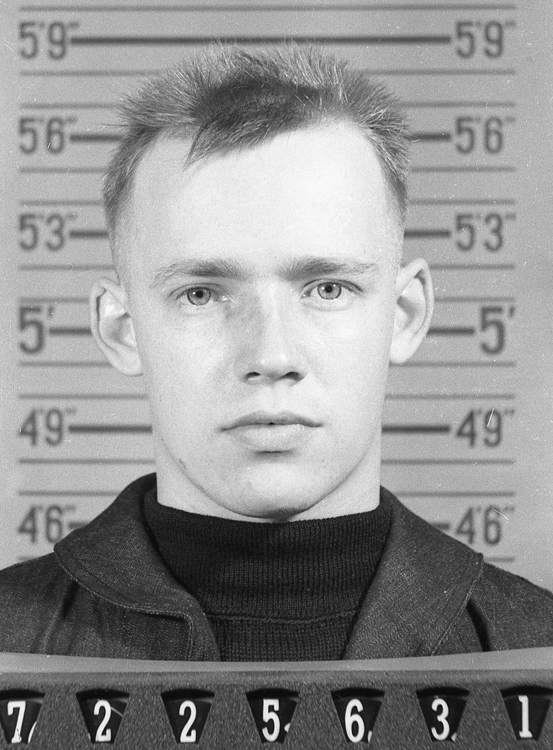
Funk’s personnel file described him as standing five feet, 8½ inches tall and weighing 158 lbs., with brown hair and blue eyes. He was Protestant.
Military Career
After volunteering for naval service, Funk was accepted as an apprentice seaman in the U.S. Naval Reserve at the Navy Recruiting Station, Wilmington, Delaware, on November 6, 1942. He went on active duty on November 9, 1942, and was dispatched for boot camp at the U.S. Naval Training Station, Newport, Rhode Island. After completing boot camp, he was promoted to seaman 2nd class on December 17, 1942. Five days later, he was transferred to the U.S. Naval Training Center (Aviation Maintenance), Memphis, Tennessee. He did not report there until December 31, 1942, suggesting he took the customary recruit leave first.
There is a slight discrepancy in his personnel file pertaining to his activities in early 1943 at what was now known as the U.S. Naval Air Technical Training Center, Memphis, Tennessee. One document stated that Seaman 2nd Class Funk went on leave from during February 13–23, 1943. Another stated that on February 22, 1943, Seaman 2nd Class Funk began the 21-week Class “A” Aviation Machinist’s Mate School.
Some aviation machinist’s mates were responsible for aircraft engine maintenance on the ground or aboard aircraft carriers, while others were also trained as aircrew. On February 26, 1943, Funk signed a statement: “I hereby volunteer for Aerial Free Gunnery.” On July 17, 1943, Funk graduated ranked 32nd in his class of 198, with a final score of 86.45 out of 100, and was duly promoted to the rating of aviation machinist’s mate 3rd class.
Aviation Machinist’s Mate 3rd Class Funk remained in Memphis and began the two-week Aviation Radar Operators School on July 19, 1943. On August 2, 1943, he graduated from the class with a score of 95 out 100, qualifying him as an airborne radar operator. That same day, he reported to the Naval Air Gunners School, Jacksonville, Florida. He completed the gunnery course on September 11, 1943, and was transferred to the U.S. Naval Air Station, Jacksonville, Florida, to train as aircrew aboard a torpedo bomber.
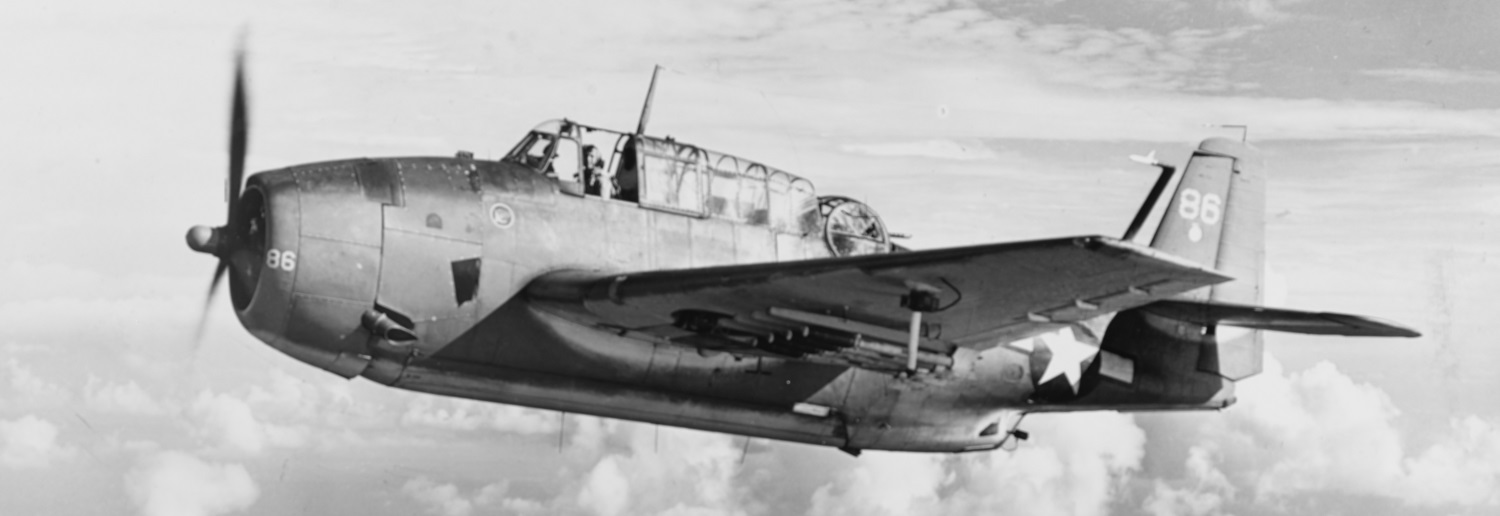
On October 28, 1943, Aviation Machinist’s 3rd Class Funk completed a five-week course in an operational training unit, qualifying him as a combat air crewman aboard the Grumman TBF-1/TBM-1 Avenger. That same day, he was transferred to Carrier Air Service Unit 24 at the U.S. Naval Air Station, Wildwood, New Jersey. He was permitted 10 days’ leave (with two extra days’ travel time) to visit home in Wilmington before reporting to Wildwood on November 10, 1943.
On January 15, 1944, Funk was transferred to Carrier Aircraft Service Unit 22. On January 26, 1944, Funk was placed in charge of a group of 15 enlisted men during a move to join the C.A.S.U. 22 Separate Detachment, Westerly, Rhode Island, “for temporary duty in connection with fitting out Torpedo Squadron EIGHTY and on board that squadron for duty when commissioned.”
Aviation Machinist’s Mate 3rd Class Funk officially joined Torpedo Squadron 80 (VT-80) on February 1, 1944, the day the unit was commissioned at the U.S. Naval Auxiliary Air Facility, Westerly, Rhode Island. Some of the pilots were fresh out of flight training while others were new to the Avenger. The pilots qualified for carrier landings aboard the old training carrier U.S.S. Ranger (CV-4).
On March 10, 1944, Funk “Satisfactorily completed a course in Physiology of High Altitude Flying and Use of Oxygen Equipment and qualified for high altitude flying this date.”
On March 24, 1944, VT-80 left Westerly, arriving on March 26 at the U.S. Naval Auxiliary Air Facility, Boca Chica, Florida. According to a squadron history, at Boca Chica: “The squadron made numerous training flights, dropping dummy blocks and live torpedoes. Besides this intensive torpedo training, the squadron carried out regular tactical problems which included gunnery practice, navigation, night flying, and glide bombing.”
The squadron suffered its first loss when a plane crashed at sea during a training mission on the night of April 12–13, 1944, killing three men. On April 17, 1944, VT-80 began the move to the U.S. Naval Auxiliary Air Facility, Oceana, Virginia. There, VT-80 became one of three squadrons in Carrier Air Group 80, earmarked for U.S.S. Ticonderoga (CV-14), a new Essex-class carrier which would be commissioned on May 8, 1944, at the Norfolk Navy Yard in Portsmouth, Virginia. On April 29, 1944, Funk completed a six-day refresher at the Aerial Free Gunnery Training Unit, Dam Neck, Virginia.
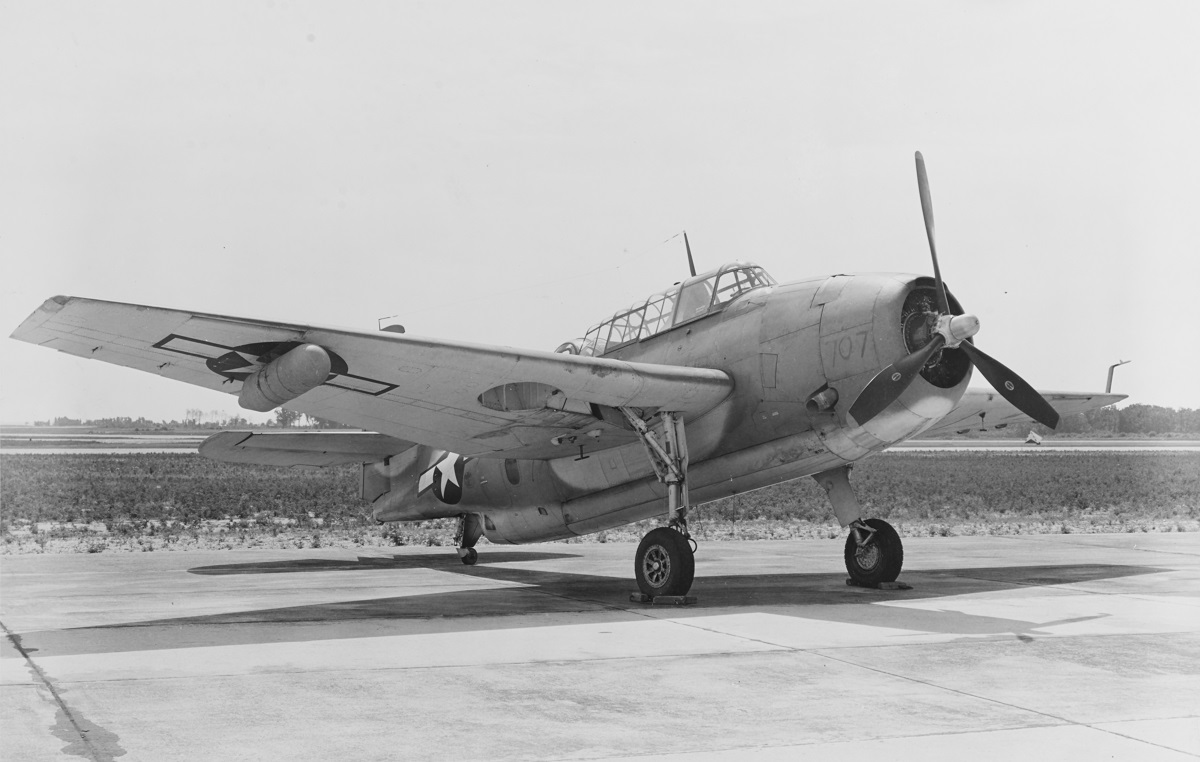
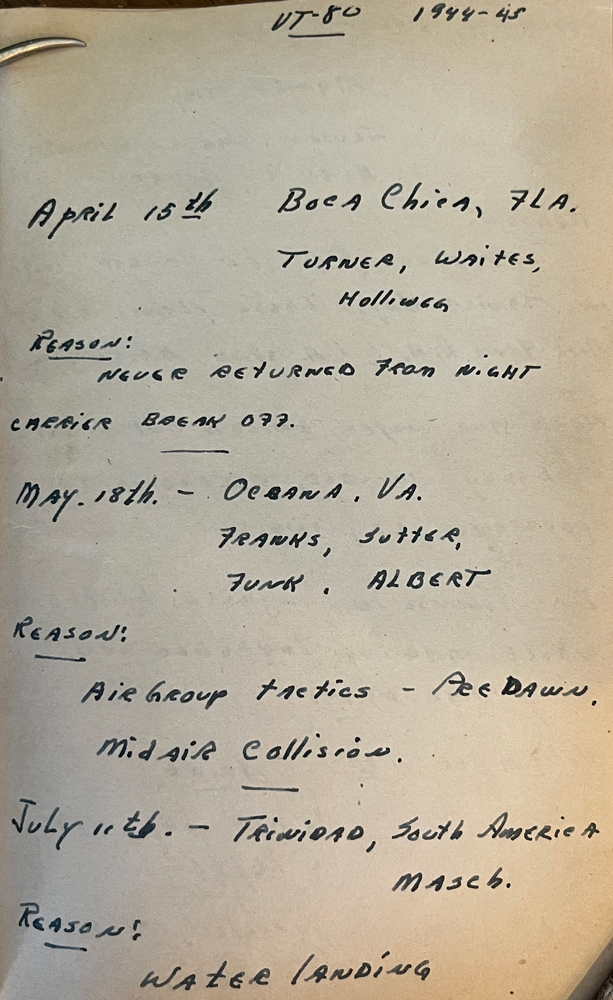
At approximately 0421 hours on May 18, 1944, Aviation Machinist’s Mate 3rd Class Funk was killed in the line of duty during a night training flight. At an altitude of about 1,200 feet, his plane, TBM-1C Bureau No. 45490, was involved in a midair collision and crashed at Miller’s Farm near Kempsville, “approximately six miles west of Oceana, Va.” The squadron history stated:
On the join-up after a pre-dawn take off in conjunction with an amphibious support flight, a mid-air collision took place which resulted in the death of one pilot, Lt. Charles A. Albert, Jr, and three aircrewmen: Franks, Loiel Hellman, AMM3c; Funk, William Allen, AMM3c; Sutter, Dean Edward, ARM3c. Ensign J. A. Woody, pilot of the second plane involved, escaped by parachuting to safety at an altitude of less than 800 feet.
Funk and Sutter were aboard Lieutenant Albert’s aircraft, while Franks was aboard Ensign Woody’s plane.
The Navy notified Funk’s parents the same day. At his father’s request, the Navy sent Funk’s body to the McCrery Funeral Home in Wilmington. Another Wilmingtonian from the squadron, William D. Tussey (1923–1994), served as an escort. Tussey’s daughter, Calista T. Wiley, recalls:
My father spoke of this incident and his friend, Bill Funk. Dad said it occurred in a training exercise and upon takeoff. He accompanied the body home and attended the funeral. Dad and the casket rode in the box car back to Wilmington. He said it was one of the hardest things he had had to do so far in his life.
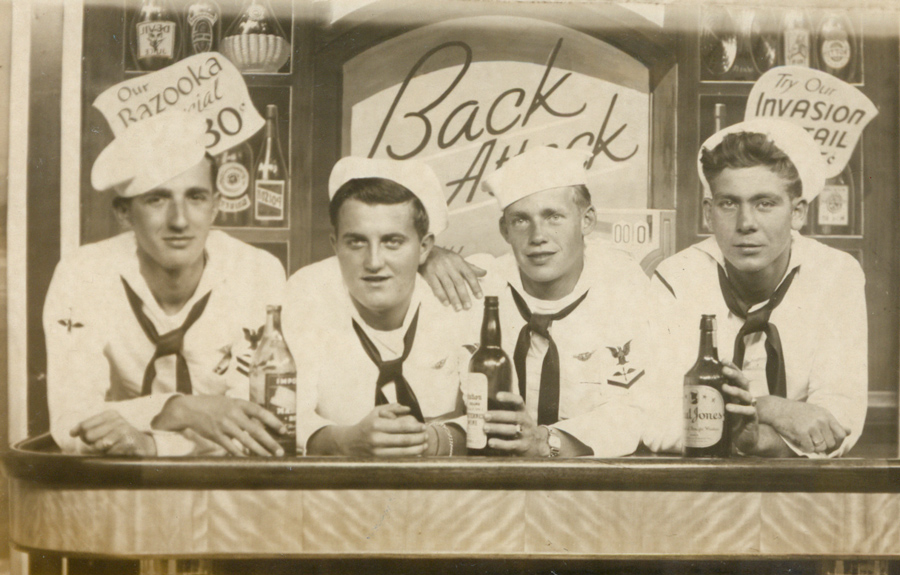
After his funeral on May 23, 1944, Aviation Machinist’s Mate 3rd Class Funk was buried at Silverbrook Cemetery in Wilmington. His parents, sister, and brother-in-law were also buried there after their deaths.
In a letter to Funk’s parents dated May 22, 1944, Lieutenant Commander Charles William Shattuck (1911–1994), Funk’s commanding officer, wrote in part:
The news of your son’s accident must have been a great shock to you. All of the officers and men of the squadron share your sadness for William was not only a splendid crewman but a fine friend and gentleman. Your son’s record in the squadron was excellent. He was placed in charge of the first group of crewmen that reported to the squadron and his work and attitude have been outstanding since that time.
The accident occurred in an early morning flight when two planes collided in the air. Your son’s pilot, Lt. Albert, was killed in the crash as was the other crewman in the plane and a crewman in the second plane.
I trust that your wishes relative to the shipman of the remains were fully carried out. We were glad to be able to send William D. Tussey one of your son’s hometown friends and fellow crewman as an escort.
On January 14, 1945, Mary J. Funk wrote a letter to the Bureau of Naval Personnel thanking them for an “inscription” (likely a certificate) honoring Aviation Machinist’s Mate 3rd Class Funk:
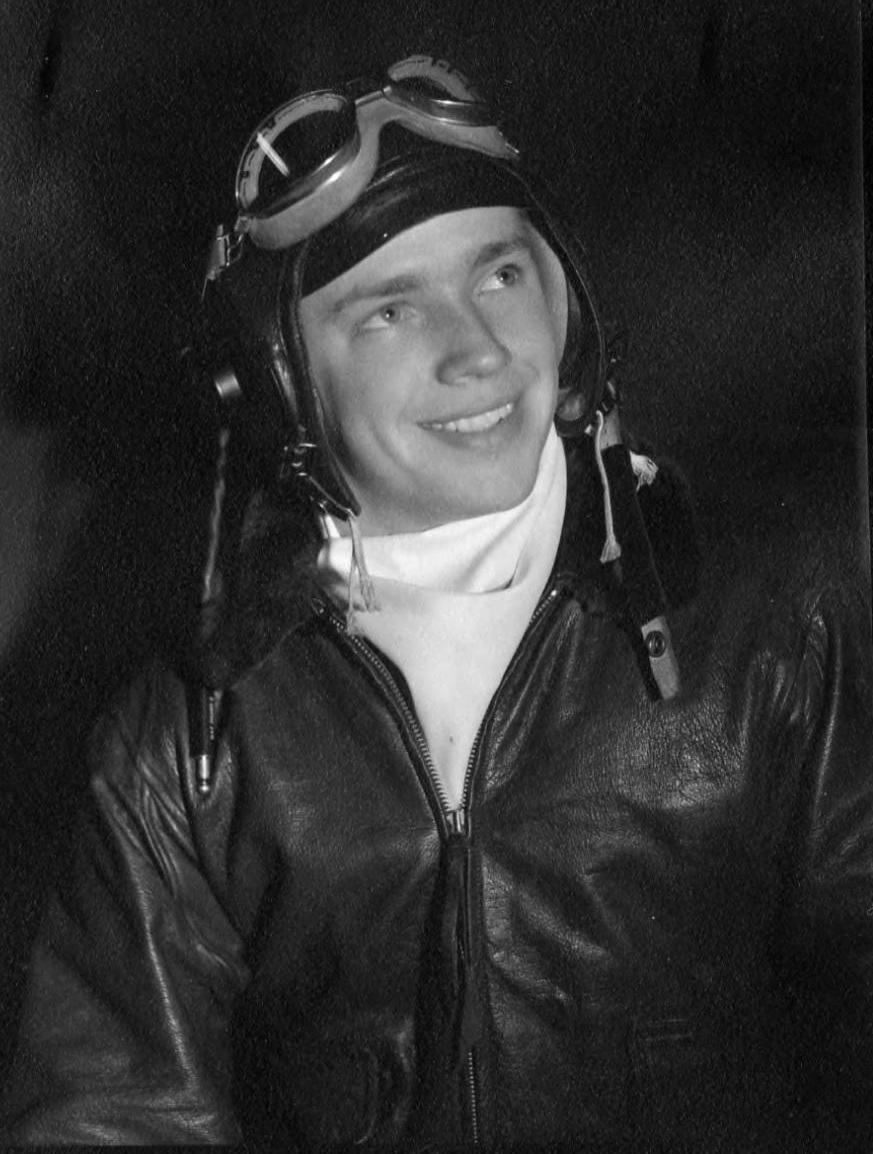
This was the greatest sorrow of our lives. One consolation, he loved every minute of the 18 months he had in service, and had a grand record. This inscription, together with his photograph, in flight gear are my two most treasured possessions, Thank you.
Aviation Machinist’s Mate 3rd Class Funk is honored at Veterans Memorial Park in New Castle, Delaware.

Acknowledgments
Special thanks to Calista T. Wiley for contributing her memories and to the Delaware Public Archives for the use of their photo.
Bibliography
Certificate of Death for William Allen Funk. Virginia Deaths, 1912–2014. Virginia Department of Health, Richmond, Virginia. https://www.ancestry.com/imageviewer/collections/9278/images/43006_162028006071_0094-00368
Draft Registration Card for William Allen Funk. June 30, 1942. Draft Registration Cards for Delaware, October 16, 1940 – March 31, 1947. Record Group 147, Records of the Selective Service System. National Archives at St. Louis, Missouri. https://www.ancestry.com/imageviewer/collections/2238/images/44003_10_00003-00614
Evans, Thomas H. “History of Torpedo Squadron Eighty From 1 February 1944 to 1 April 1945.” World War II War Diaries, 1941–1945. Record Group 38, Records of the Office of the Chief of Naval Operations. National Archives at College Park, Maryland. https://catalog.archives.gov/id/77680107?objectPage=3
Fifteenth Census of the United States, 1930. Record Group 29, Records of the Bureau of the Census. National Archives at Washington, D.C. https://www.ancestry.com/imageviewer/collections/6224/images/4639361_00328
“Four Navy Men Die in Crash Of Two Planes.” Norfolk Virginian-Pilot, May 19, 1944. https://www.newspapers.com/article/138105392/
Funk, Russell A. Individual Military Service Record for William Allen Funk. December 31, 1944. Record Group 1325-003-053, Record of Delawareans Who Died in World War II. Delaware Public Archives, Dover, Delaware. https://cdm16397.contentdm.oclc.org/digital/collection/p15323coll6/id/18756/rec/9
Official Military Personnel File for William A. Funk. Official Military Personnel Files, 1885–1998. Record Group 24, Records of the Bureau of Naval Personnel. National Archives at St. Louis, Missouri.
Polk’s Wilmington (New Castle County, Del.) City Directory 1938. R. L. Polk & Company Publishers, 1938. https://www.ancestry.com/imageviewer/collections/2469/images/16149992
“RADM Charles William Shattuck.” Find a Grave. https://www.findagrave.com/memorial/1172614/charles-william-shattuck
“Sailor Killed In Plane Crash.” Journal-Every Evening, May 19, 1944. https://www.newspapers.com/article/138108467/
Sixteenth Census of the United States, 1940. Record Group 29, Records of the Bureau of the Census. National Archives at Washington, D.C. https://www.ancestry.com/imageviewer/collections/2442/images/m-t0627-00550-00524
Veteran’s Compensation Application for Russell Allen Funk. March 2, 1934. World War I Veterans Service and Compensation File, 1934–1948. Record Group 19, Series 19.91. Pennsylvania Historical and Museum Commission, Harrisburg Pennsylvania. https://www.ancestry.com/imageviewer/collections/60884/images/41744_182029006040_0887-03341
Wiley, Calista T. Email correspondence, January 5, 2024.
“William Allen Funk.” Journal-Every Evening, May 22, 1944. https://www.newspapers.com/article/138444247/
“William D. Tussey.” The News Journal, November 30, 1994. https://www.newspapers.com/article/138094473/
Last updated on March 10, 2024
More stories of World War II fallen:


























To have new profiles of fallen soldiers delivered to your inbox, please subscribe below.
 Delaware's World War II Fallen