

| Residences | Civilian Occupation |
| Maryland, Delaware | Worker at DuPont Nylon factory |
| Branch | Service Number |
| U.S. Army Air Forces | 32359853 |
| Theater | Unit |
| European | 545th Bombardment Squadron (Heavy), 384th Bombardment Group (Heavy) |
| Military Occupational Specialty | Entered the Service From |
| 501 (administrative and technical clerk) | Seaford, Delaware |
Early Life & Family
James Arthur Moore was born in Betterton, in Kent County on the Eastern Shore of Maryland, on June 28, 1921. He was the son of Carlton Casper Moore (listed as a fisherman and merchant in various records, 1887–1937) and Gertrude E. Moore (née Gertrude Evelyn Emerson, 1891–1944). He had an older brother, Herbert Emerson Moore (1915–2003, who served in the U.S. Army during World War II). Moore likely went by his middle name since he was listed as Arthur on the 1930 and 1940 censuses. He was recorded on the census on April 18, 1930, living with his family in Kent County, Maryland.
Moore was a teenager when his father died in 1937. Two years later, in 1939, Moore graduated from Chestertown High School. The following year, he was recorded on the census on April 9, 1940, living with his mother in Betterton and working as a storekeeper.
Moore was hired by the DuPont Company’s Seaford, Delaware, facility on April 30, 1941. The company opened a Nylon factory there in 1939. When Moore registered for the draft on February 16, 1942, he was living on Front Street in Seaford. The registrar described him as standing about five feet, six inches tall and weighing 140 lbs., with black hair and brown eyes. His enlistment data card described Moore as working in “unskilled occupations in production of rayon and allied products.”
Military Career
After he was drafted, Moore was inducted into the U.S. Army in Camden, New Jersey, on August 20, 1942. There are few details about the early part of his military career, but most Delawareans who were drafted into the Army spent a brief period at Fort Dix, New Jersey, for classification. Moore was assigned to the U.S. Army Air Forces, but his training locations prior to joining his final unit are unknown. However, it appears he was trained to serve in a squadron’s administrative apparatus.
Per Special Orders No. 38, Headquarters 384th Bomb Group, on February 15, 1943, Private Moore was assigned to and joined the 545th Bombardment Squadron (Heavy), 384th Bombardment Group (Heavy). Curiously, an April 1943 roster stated that he was promoted to private 1st class per 545th Bomb Squadron S.O. No. 9, dated February 1, 1943, and thus he was due pay for the difference between private and private 1st class for the month of February 1943. That suggests he was already with the squadron by February 1, 1943, but that because of the large number of personnel transfers into the new unit, his was missed in the paperwork until S.O. 38 was issued.
The 545th Bomb Squadron had been activated on December 28, 1942, and was stationed at Wendover Field, Utah, for a few months beginning on January 2, 1943. The unit was equipped with the Boeing B-17 Flying Fortress. Moore was promoted to corporal on April 1, 1943. That same day, Moore and the rest of his squadron’s ground echelon began the move to Sioux City, Iowa, arriving on April 3, 1943. On May 9, 1943, the ground echelon entrained for Camp Kilmer, New Jersey, a staging area for the New York Port of Embarkation. The air echelon would across the Atlantic Ocean by air and meet them in the United Kingdom.
On May 26, 1943, the 384th Bomb Group’s ground personnel boarded the fast ocean liner-turned troop transport R.M.S. Queen Elizabeth, shipping out from the New York Port of Embarkation the following afternoon. Their ship arrived in Scotland on June 2, 1943. The following morning, they entrained for their new base of operations, Royal Air Force Grafton Underwood, Northamptonshire, England, arriving there that night. A squadron roster dated June 13, 1943, listed Corporal Moore’s military occupational specialty (M.O.S.) code as 501, administrative and technical clerk. An April 1944 document described him as a communications clerk.
The 384th Bomb Group wasted no time getting into action, flying its first combat mission on June 22, 1943. During its time in combat, the squadron had an authorized strength of 18 combat crews at any one time, with turnover due to combat losses and crews completing a tour (initially 25 missions) and being rotated back to the United States. On the other hand, ground personnel like Corporal Moore generally stayed with their squadron for a much longer period, often the duration of the war.
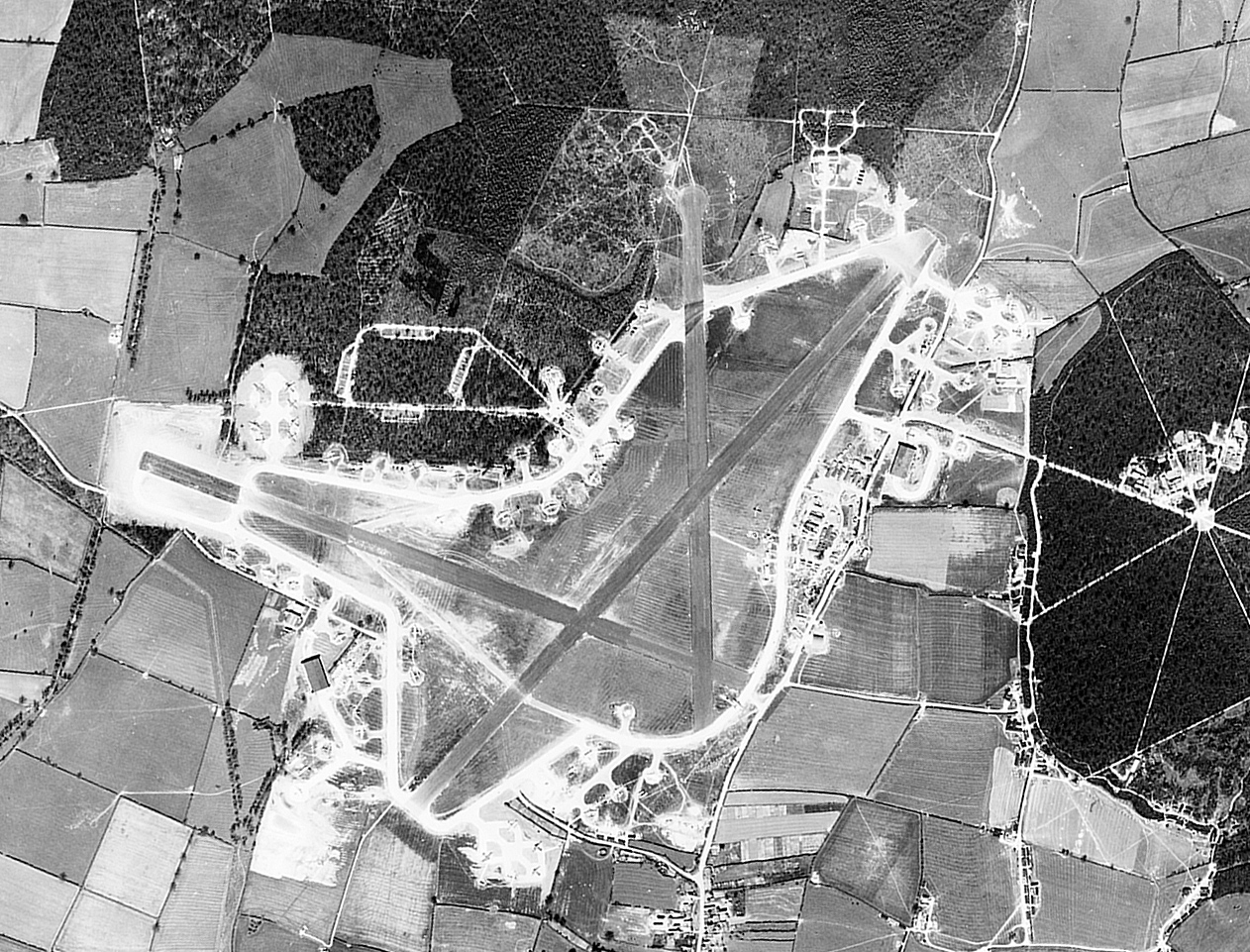
As a group history recounted, in the months that followed, R.A.F. Grafton Underwood
was constantly growing. Already, by the end of September, there had been a great many changes in its condition since the arrival of the 384th. What had then been mere woodland paths had become concrete roads; the original roads had widened, and three large buildings had gone up behind Group Headquarters which were to house Operations, Intelligence, Communications, the teletype operator– –in fact, all the vital nerve centers of the base.
In addition, there was a
Red Cross Aero Club[,] a large recreation building where everyone could enjoy himself. There was a snack bar (which sometimes served real American hamburgers, and had a jukebox), a large room for pin pong and pool, a lounge with papers, magazines and comfortable chairs, a game room with sets of dominoes, checkers and other amusements, and a library well stocked with all kinds of books.
During 1943, work began on a baseball diamond at the base. It proved challenging, as the site could not be leveled until a bulldozer could be acquired and the first backstop had to be dismantled after personnel inadvertently used valuable Norwegian pine poles. Unfortunately, the delays meant the group got little use out of the baseball field in 1943 before the weather turned cold and wet.
Still, for soldiers in wartime, Corporal Moore and his comrades’ lot was not a bad one. There were regular movies, dances, shows, opportunities for education through evening classes, self-study, or correspondence classes via the U.S. Armed Forces Institute. Although the base itself had plenty of recreational pursuits to offer, the men also availed themselves of the opportunity to enjoy the hospitality of the nearby towns when issued passes. One such outing on the night of April 18, 1944, led to a tragedy that cost the lives of six young servicemen.
At around 2300 hours, Corporal Moore, Staff Sergeant David Kent Ollre (1921–1944), and Corporal Teddy Raymond Potocki (1921–1944) were returning to Grafton Underwood by bicycle after an evening on the town. All three men were from the 545th Bomb Squadron. Staff Sergeant Ollre, like Moore, was in communications, while Corporal Potocki was an aircraft mechanic.
In his article, “A Night Long Forgotten – 18th April 1944,” Matt Smith wrote:
At the same time an RAF Short Stirling of 1657 Heavy Conversion Unit (HCU) was completing a series of night time ‘touch and goes’ – also known as ‘circuits and bumps’ – as part of a student training syllabus for new RAF Bomber Crews. The Short Stirling was the first of the RAF’s four engine bombers but by this stage of the war had been overtaken in performance and available numbers by both the Avro Lancaster and the Handley Page Halifax and generally retired from front line duties. Those aircraft retired now found themselves filling the essential role as the last part of the training programme for new crews to gain experience in operating large and complex aircraft similar to those they would be expected to fly over occupied Europe once fully fledged Bomber Command Aircrew.
S/Sgt Ollre and his colleagues must have been aware of the aircraft; the 384th History states the aircraft was on its fourth pass when the accident occurred so, with each circuit taking in the region of 4-5 minutes it could have been in the area for around 20 minutes. Assuming they were indeed returning from Geddington and that the previous circuits had all been on the same runway the Stirling would have passed over them numerous times as they approached the field.
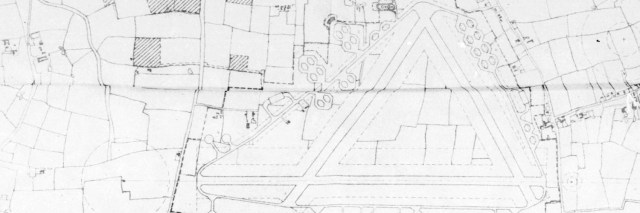
Despite that, Corporal Moore and the others decided to ride their bikes across the No. 2 Runway to return to their quarters. Crossing an active runway was both dangerous and against regulations. Why they did so is unknown, though if the men visited pubs in town, their risky decision was presumably made under the influence of alcohol. As Smith wrote: “The assumption is they were returning from Geddington, possibly even the Star or the White Hart after a pleasant evening relaxing, when they turned to take a shortcut across the airfield presumably back to their billets.”
While still on the runway, all three men were struck and killed as the Stirling performed another touch and go. The impact of the men and bicycles also damaged the plane. The pilot, Flight Lieutenant Hugh Charles Wilkie (1923–1944) of the Royal New Zealand Air Force, diverted to another field, R.A.F. Woodbridge. On the way, an engine fire broke out—likely but not definitely caused by damage sustained by striking Moore and the others.
Flight Lieutenant Wilkie did his best to hold the plane steady while the other men, mostly trainees, bailed out. Sergeant Frederick Thomas George Atkins (1924–1944) of the Royal Air Force Volunteer Reserve was killed when his parachute did not open. The other members of the crew managed to parachute to safety except Flight Lieutenant Wilkie and Warrant Officer William Alexander “Sandy” Watson (c. 1919–1944), a R.A.F. flight engineer. Smith wrote that both men were killed when “before they could successfully abandon the aircraft it crashed just outside the village of Little Glemham, Suffolk, which is around ten miles North of the sanctuary of Woodbridge’s emergency runway.”
The three Americans killed in the accident were initially buried in Cambridge, England, on April 20, 1944.
The Chestertown Transcript reported in an article printed May 5, 1944, that Corporal Moore’s mother was notified of his death on April 29, 1944. The paper added:
Those who knew him will always remember his lovable disposition in his boyhood and later in the promise of youth and young manhood. Envy and malice had no part in his make up. He possessed those sterling qualities of loyalty, kindheartedness and generosity which drew him close to others and made him a sincere friend. Always thoughtful of others, the record of his life runs like a vine around his memory and every sweet unselfish act of his life is now a perfumed flower. He stood for the best things in life and consistently followed the pathway of right living. He passed away without the record of a single unkind act that was intended to hurt another.
Journal-Every Evening reported on May 13, 1944:
One of the most impressive Mother’s Day services scheduled for Kent County churches tomorrow will be in the form of a memorial for Corp. James Arthur Moore, U. S. A., son of Mrs. Carlton C. Moore and the late Mr. Moore of Betterton, who gave his life in the service of his country on April 18.
The service will be held in the Betterton Methodist Church at 8 o’clock on Sunday evening under the direction of the pastor, the Rev. Harvey B. Flater.
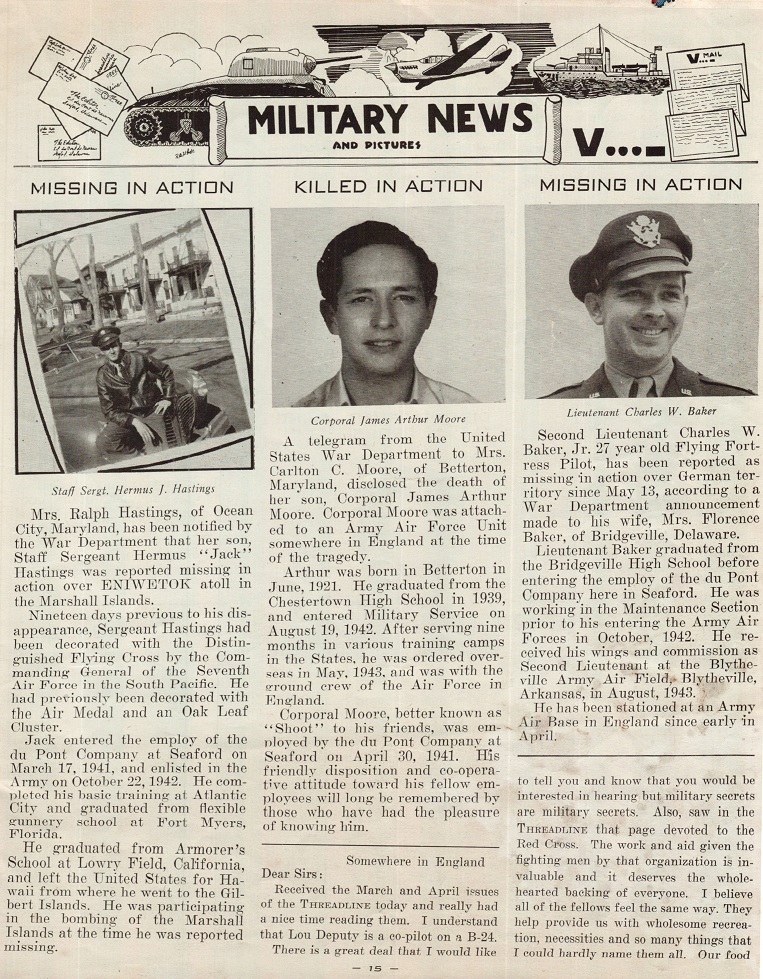
The DuPont Seaford factory newsletter, Threadline, eulogized him in the July 1944 issue:
Corporal Moore, better known as “Shoot” to his friends, was employed by the du Pont Company at Seaford on April 30, 1941. His friendly disposition and co-operative attitude toward his fellow employees will long be remembered by those who have had the pleasure of knowing him.
Corporal Moore’s mother wanted his body brought home, but she would not live to see it. Gertrude Moore died five months after her son. The following spring, Journal-Every Evening reported on April 17, 1945, that Corporal Moore was one of three deceased servicemen who were members of the Betterton Methodist Church honored with gold stars on a church service flag.
After the war, it fell to H. Emerson Moore to submit the paperwork ensuring that his brother’s body was repatriated to the United States. Corporal Moore’s casket returned to the New York Port of Embarkation aboard the Lawrence Victory. In July 1948, he was buried at Still Pont Cemetery in Maryland, where his parents’ bodies also rested. His brother was also buried there after his death.
Although Corporal Moore was living in Seaford when he entered the service, and his name appeared on the official 1946 U.S. Army casualty list for Sussex County, Delaware, his name was not included in the Delaware memorial volume or at Veterans Memorial Park in New Castle. He was, however, honored on a plaque of DuPont employees who died during World War II first displayed at the Seaford DuPont factory beginning in 1948, and now located at the Seaford Museum.
Acknowledgments
Special thanks to Jim Bowden for the Threadline photos and articles, as well as to Fred Preller, Keith Ellefson, John Edwards, and Matt Smith of 384th Bomb Group, Inc., for their help in reconstructing the details of Corporal Moore’s career and death.
Bibliography
Applications for Headstones, January 1, 1925 – June 30, 1970. Record Group 92, Records of the Office of the Quartermaster General, 1774–1985. National Archives at St. Louis, Missouri. https://www.ancestry.com/imageviewer/collections/2375/images/40050_1220705228_0396-00119
Draft Registration Cards for Delaware, October 16, 1940 – March 31, 1947. Record Group 147, Records of the Selective Service System. National Archives at St. Louis, Missouri. https://www.ancestry.com/imageviewer/collections/2238/images/44003_09_00007-00209
Fifteenth Census of the United States, 1930. Record Group 29, Records of the Bureau of the Census. National Archives at Washington, D.C. https://www.ancestry.com/imageviewer/collections/6224/images/4606973_00453
“Group History 384th Bombardment Group (H) AAF Station No. 106.” Reel B0373. Courtesy of the Air Force Historical Research Agency.
Individual Deceased Personnel File for James A. Moore. Army Individual Deceased Personnel Files, 1942–1970. Record Group 92, Records of the Office of the Quartermaster General, 1774–1985. National Archives at St. Louis, Missouri. Courtesy of U.S. Army Human Resources Command.
“James Arthur Moore.” Chestertown Transcript, May 5, 1944.
“Military News and Pictures.” Threadline, July 1944. Courtesy of Jim Bowden.
“Moore, James Arthur.” 384th Bombardment Group (Heavy) website. https://384thbombgroup.com/_content/_pages/person.php?PersonKey=4508
Morning Reports for 545th Bombardment Squadron (Heavy). February 1943 – April 1944. U.S. Army Morning Reports, c. 1912–1946. Record Group 64, Records of the National Archives and Records Administration. National Archives at St. Louis, Missouri. 384th Bombardment Group (Heavy) website. https://photos.384thbombgroup.com/picture.php?/224497/category/5078, https://photos.384thbombgroup.com/picture.php?/224536/category/5076
“Mother’s Day Services to Take Form of Memorial for Soldier.” Journal-Every Evening, May 13, 1944. https://www.newspapers.com/article/135391145/
“Roosevelt Given Gold Star on Md. Church’s Banner.” Journal-Every Evening, April 17, 1945. https://www.newspapers.com/article/135390878/
Sixteenth Census of the United States, 1940. Record Group 29, Records of the Bureau of the Census. National Archives at Washington, D.C. https://www.ancestry.com/imageviewer/collections/2442/images/M-T0627-01552-00615
Smith, Matt. “A Night Long Forgotten – 18th April 1944.” 384th Bombardment Group (Heavy) website. https://384thbombgroup.com/_content/Stories/18th%20April%201944.pdf
“Squadron History Activation 28 Dec 1942 to 5 Jan 1944.” 1944. 545th Bombardment Squadron (H). Reel A0640. Courtesy of the Air Force Historical Research Agency.
Strong, George V., Jr. “Squadron History Activation 545th Bombardment Squadron (H).” February 1, 1946. Reel A0640. Courtesy of the Air Force Historical Research Agency.
“Watson, William Alexander.” International Bomber Command Centre Losses Database. https://losses.internationalbcc.co.uk/loss/229617
“WO William Alexander ‘Sandy’ Watson.” Find a Grave. https://www.findagrave.com/memorial/130738290/william-alexander-watson
World War II Army Enlistment Records. Record Group 64, Records of the National Archives and Records Administration. National Archives at College Park, Maryland. https://aad.archives.gov/aad/record-detail.jsp?dt=893&mtch=1&cat=all&tf=F&q=32359853&bc=&rpp=10&pg=1&rid=2982711
Last updated on January 15, 2024
More stories of World War II fallen:
To have new profiles of fallen soldiers delivered to your inbox, please subscribe below.
 Delaware's World War II Fallen