

| Hometown | Civilian Occupation |
| Dover, Delaware | Sales clerk |
| Branch | Service Number |
| U.S. Army Air Forces | Enlisted 12013953 / Officer O-776804 |
| Theater | Unit |
| Mediterranean | 741st Bombardment Squadron (Heavy), 455th Bombardment Group (Heavy) |
| Awards | Campaigns/Battles |
| Air Medal, Purple Heart | European air campaign (three missions) |
Early Life & Family
Edward William Ruyter was born in Dover, Delaware, on April 11, 1922. He was the third child of Dirk Ruyter (a life insurance agent, c. 1870–1957) and Emma Margaret Ruyter (née Heller, 1888–1955). Both of his parents were immigrants from Europe: His father was Dutch and emigrated to the United States in 1895, while his mother was Swiss. His father was naturalized as a U.S. citizen in 1901 or 1902 and his mother became a citizen by marriage in 1909. Ruyter had an older sister, Margaret Ruyter (later Richter, 1911–1999) and an older brother, Frederick Christian Ruyter (1916–2011). Whether through genealogy or family lore, his father’s family traced their lineage to famed Dutch Admiral Michiel Adriaenszoon de Ruyter (1607–1676).
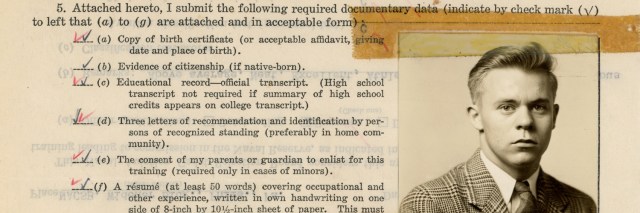
The Ruyter family was recorded on the 1920, 1930, and 1940 censuses living at 412 North Bradford Street in Dover. Ruyter graduated from Dover High School on June 13, 1941. His enlistment data card stated that he was a sales clerk before entering the service.
A flight physical dated June 5, 1944, described Ruyter as standing five feet, 11½ inches tall and weighing 150 lbs.
Military Career
Ruyter volunteered for military service in Dover before the attack on Pearl Harbor, enlisting as a private in the U.S. Army Air Forces on August 12, 1941. According to a statement by his father for the State of Delaware Public Archives Commission, Ruyter was initially stationed at Mitchel Field, New York. His father stated that Ruyter was promoted to corporal at some point, presumably before he was selected for flight training. He was later stationed at Nashville, Tennessee, followed by Wickenburg, Arizona.
After graduating from bombardier school at Deming Army Air Field, New Mexico, Ruyter was commissioned as a 2nd lieutenant in the U.S. Army Air Forces on April 29, 1944. According to documents in his Individual Deceased Personnel File (I.D.P.F.), Ruyter was stationed at Lincoln, Nebraska, in May 1944, at Mountain Home, Idaho, for combat crew training in June 1944, and Topeka, Kansas, in August 1944. Ruyter was assigned to a Consolidated B-24 Liberator crew as a bombardier. His father stated that Lieutenant Ruyter went overseas in September 1944.
Lieutenant Ruyter and his crew were assigned to the U.S. Fifteenth Air Force in Italy, joining the 741st Bombardment Squadron (Heavy) of the 455th Bombardment Group (Heavy) at San Giovanni Field, part of the Foggia Airfield Complex. At the time, Fifteenth Air Force bomber crews had to complete 50 combat missions to finish a tour of duty and be rotated back to the United States. Ruyter’s crew did not fly as a complete crew with a pilot assigned to the crew stateside. Instead, they flew with 1st Lieutenant John Noske, Jr. (1922–1944), who already had approximately 32 missions under his belt.
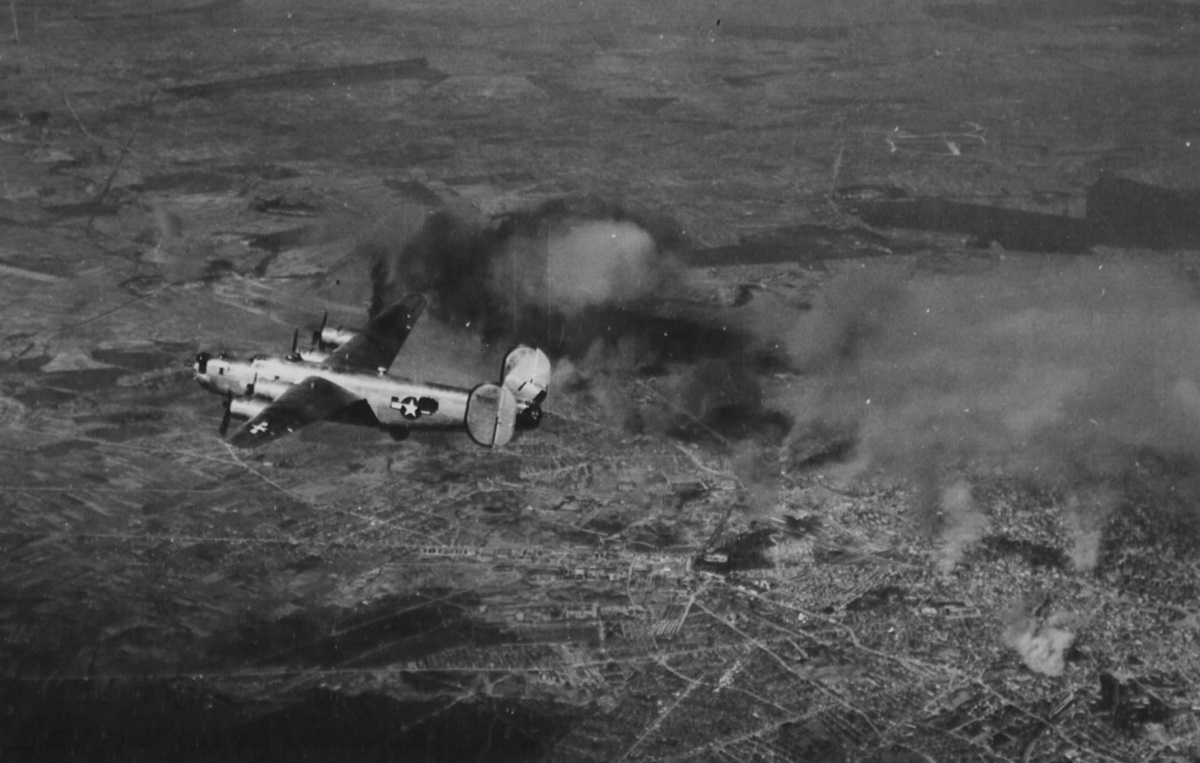
Lieutenant Ruyter’s first combat mission took place on October 11, 1944. The 455th Bomb Group dispatched 40 B-24s, escorted by 12 Lockheed P-38 Lightning fighters, on a raid against a munitions factory in Bologna, in German-occupied northern Italy. No enemy fighters rose to oppose them. The only opposition came from inaccurate enemy antiaircraft fire and the bombers returned without loss.
The following morning, the 455th launched two separate missions, with Ruyter’s crew among 20 B-24 attacking railroad rolling stock at the Székesfehérvár Marshalling Yards, Hungary. Although flying unescorted, they encountered no enemy opposition.
The next mission, a deep penetration raid, would not be so easy. At around 0820 hours on October 14, 1944, Ruyter and his crew took off aboard B-24J serial number 42-51912, piloted by 1st Lieutenant Noske and 2nd Lieutenant Walter Shostack (1921–2009). They joined 39 other B-24s from the 455th, escorted by P-51 and P-38 fighters, for a raid on the synthetic oil plant in Odertal, Germany (present day Zdzieszowice, Poland). The mission was part of the so-called oil campaign, intended to deprive the Axis war machine of fuel.
Five bombers aborted due to mechanical problems, but Ruyter’s crew pressed on to the target. The bomb run on the oil plant would last seven minutes. A group history reported that the “Target [was] partially obscured by smoke.” In addition, the report noted: “Intense, very accurate, heavy flak experienced at the target.”

According to statement by an eyewitness in another plane, Private George J. Huber (probably 1924–1988), Ruyter’s plane “received a direct flak hit in the nose, severing part of the nose, directly over the target at 1233 hours at 20,000 feet.” Lieutenant Ruyter and the nose gunner, Corporal John J. Stella (1916–1944), were both killed instantly.
Another member of the crew, Sergeant (then Corporal) Jack R. Keopple (1923–2008), later recalled in a statement that over the target, he heard Lieutenant Ruyter “say ‘bombs away’ and then we were hit.” He added that the flight engineer, Corporal Robert E. Spicer (1924–1944), “told me over interphone Ruyter and Stella had both been killed by flak over target. He went to the nose to see what was wrong and saw the nose all shot and both of our fellows dead.”
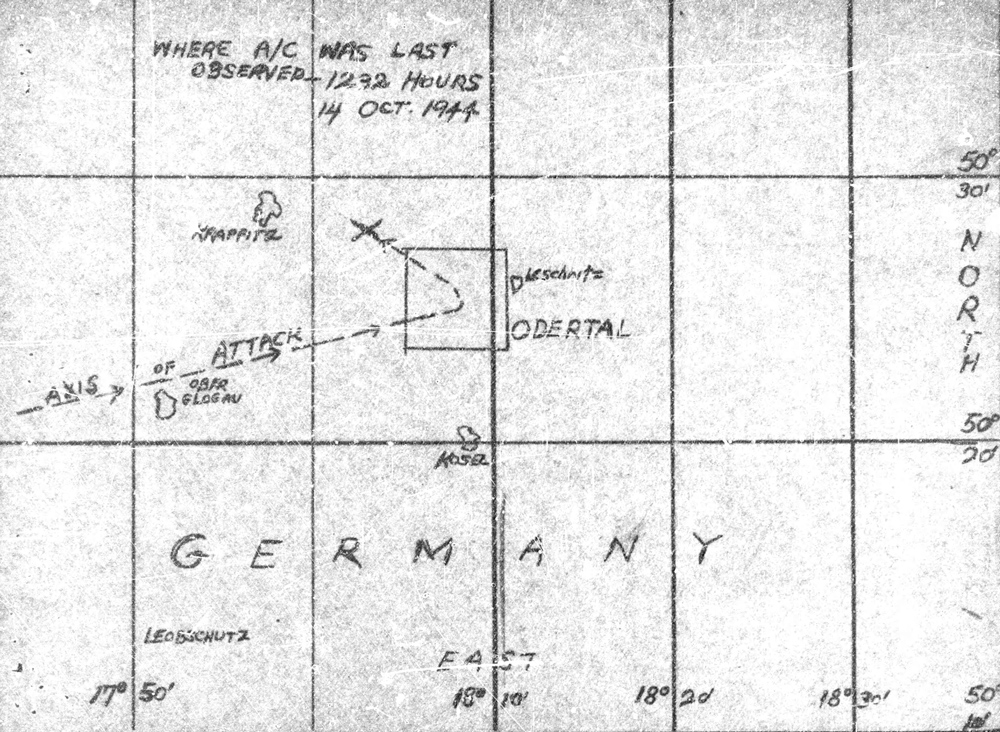
The stricken bomber lost altitude, dropping out of formation, but Lieutenants Noske and Shostack were able to maintain control and nursed the plane southwest for another 90 minutes or so. In a 2006 article, Svatopluk Vaculik quoted Shostack: “Our plane was split in the front like a banana, our windshield was gone, and so were our rudder and throttle controls. We still had elevator and aileron control, so we could stay aloft, but only at full throttle, which used up most of our fuel.”
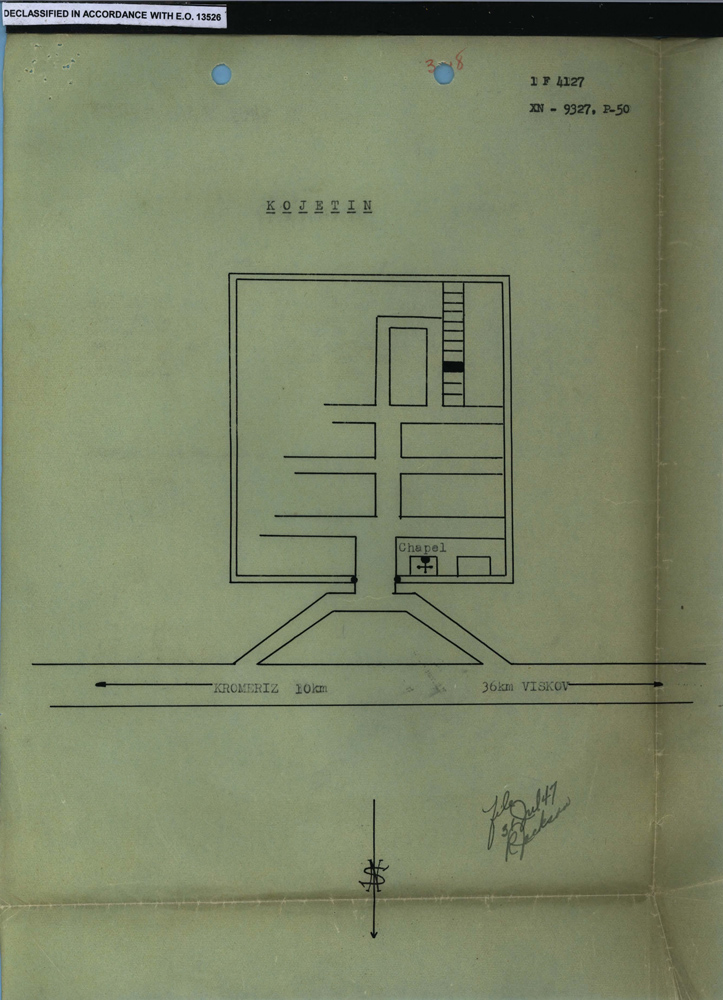
Unbeknownst to any member of the crew, during the return flight Lieutenant Ruyter’s body fell from the shattered nose of the B-24, landing in a field near Kojetín, in German-occupied Czechoslovakia (present day Czech Republic). In a statement written after the war by D. Švestková and her students at Masaryk Secondary School, to accompany a box of items they were returning to the Ruyter family, the authors recalled that “All people working in the fields came immediately to help, but it was too late.” They added:
After [a] few minutes the German patrol came and sent everybody away. Some young boys from the secondary school got near the dead body and took a few things which it was possible to take unseen away. These are in the box.
As the B-24 approached the Karawanks, a mountain range along the modern Austria-Slovenia border, damage prevented the crew from transferring fuel and the pilots concluded that the bomber would never make friendly territory. The surviving eight members of the crew bailed out before the B-24 crashed near Lettenstätten, west of Bleiburg, Austria. Corporal Robert E. Brewer (1925–1944), the tail gunner, had a damaged parachute. One of the survivors, 2nd Lieutenant Elijah Ostrander, Jr. (1922–2015), later wrote that “Spicer said he would take Brewer with him. The chute opened ok and as far as I could see they stayed together. I did not see them again.” However, it appears that Corporal Brewer either fell to his death or did not survive the landing.
Three of the survivors, including Lieutenant Noske and Corporal Spicer, fell into the hands of the S.S. They were interrogated and executed. The other four men survived as prisoners of war.

Meanwhile, back in Kojetín, Švestková and her students wrote:
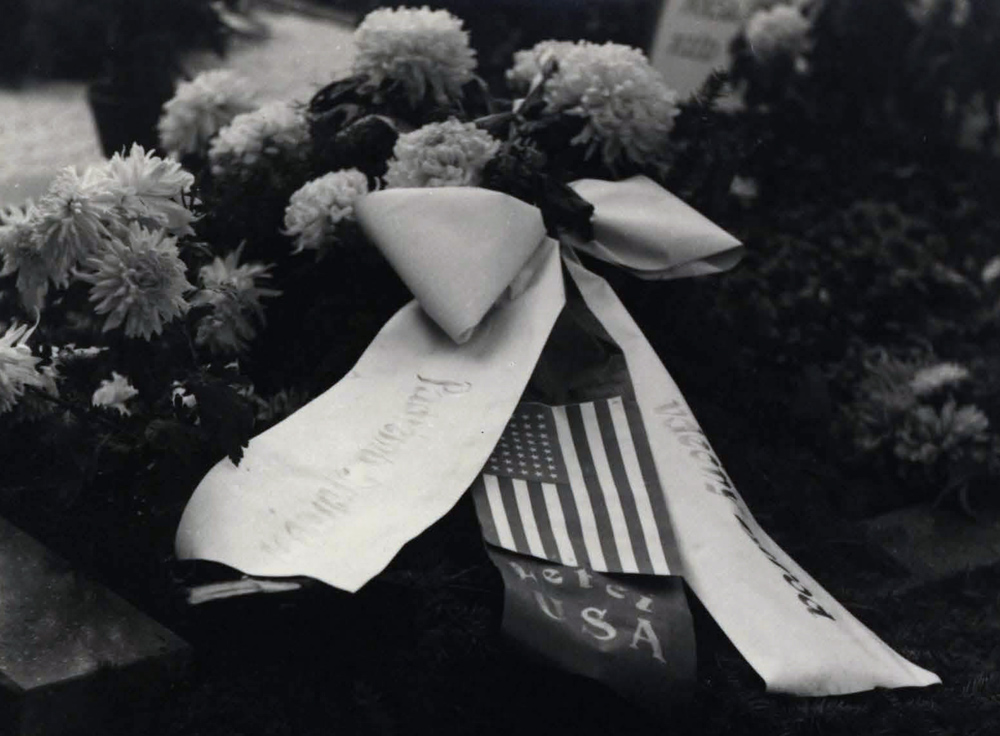
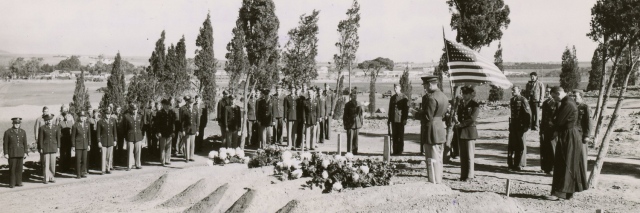
The German patrol took the dead body to the [Cemetery] of Kojetin and put a sentry at the gates. On the following night some boys got to the [Cemetery] and put a lot of flowers on the prepared grave, but in the morning the Germans took them away.
The Funeral was on the 16th of October,1944, at 8:30 a.m. by assistance of the Mayor of the town of Kojetín, the Chaplain and six S.S. men. The [Cemetery] was closed and nobody got permission to get in for all that day.
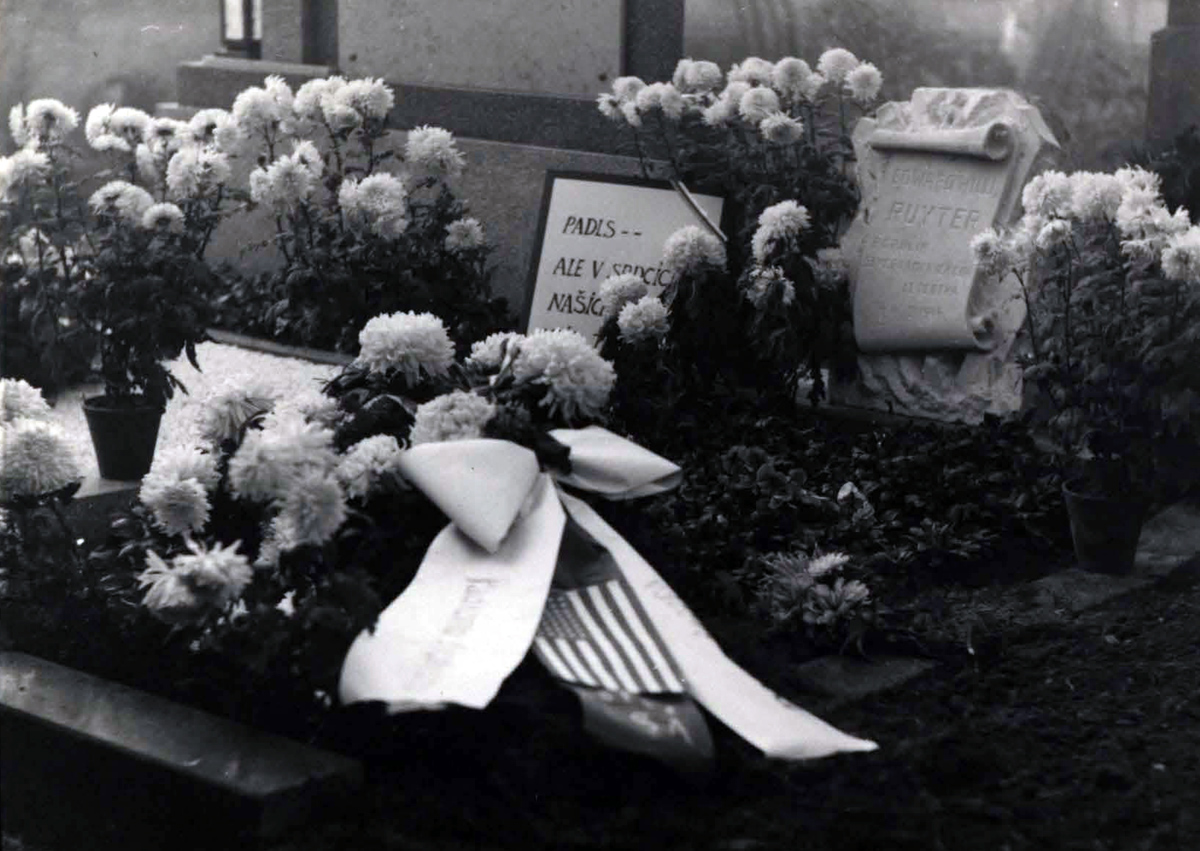
At night the boys from the school put a lot of flowers on the grave again. On the following days a lot of people from the town came to his grave, to pay the last tribute to the Hero. They put flowers on the grave but Germans took them away every day.
On All Saints Day,1944, the people from the town put a lot of candles and flowers on the grave and on Christmas the boys from school put a little Christmas Tree on the grave.
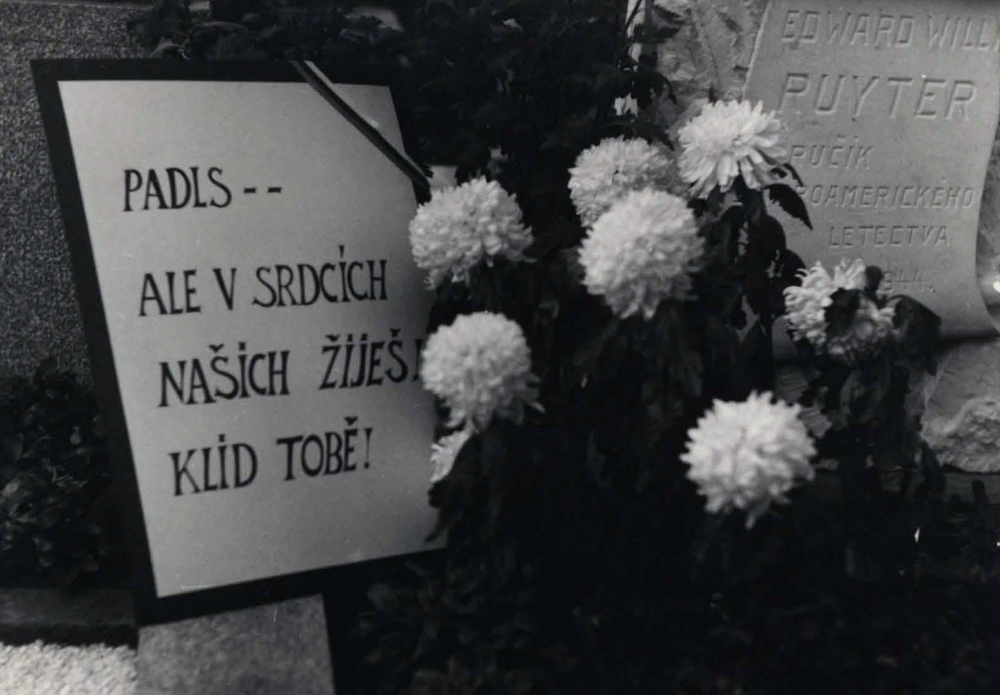
The townspeople erected a headstone for “EDWARD WILLI RUYTER” identifying him, in Czech, as a lieutenant in the “North American Air Force.” In a photo, apparently taken on All Saints Day, a nearby placard attached to a bouquet of flowers stated: “You died– but in our hearts you live! Rest in peace!”

Švestková and her students continued:
Now when we are free again we assure you that we shall take great care of the grave of the Hero who sacrificed his life for the freedom of all the countries, including Czechoslovakia. With flowers we put on his grave we wish to express him all the sympathy of our people. We keep and we shall always keep him in our memory.
Lieutenant Ruyter’s body was disinterred on September 10, 1946, examined to confirm his identity, and reburied in an American military cemetery at Saint-Avold, France. His parents requested that he be buried in a permanent U.S. military cemetery overseas. On December 16, 1948, Lieutenant Ruyter was reburied for the final time at Saint-Avold, now known as the Lorraine American Cemetery.
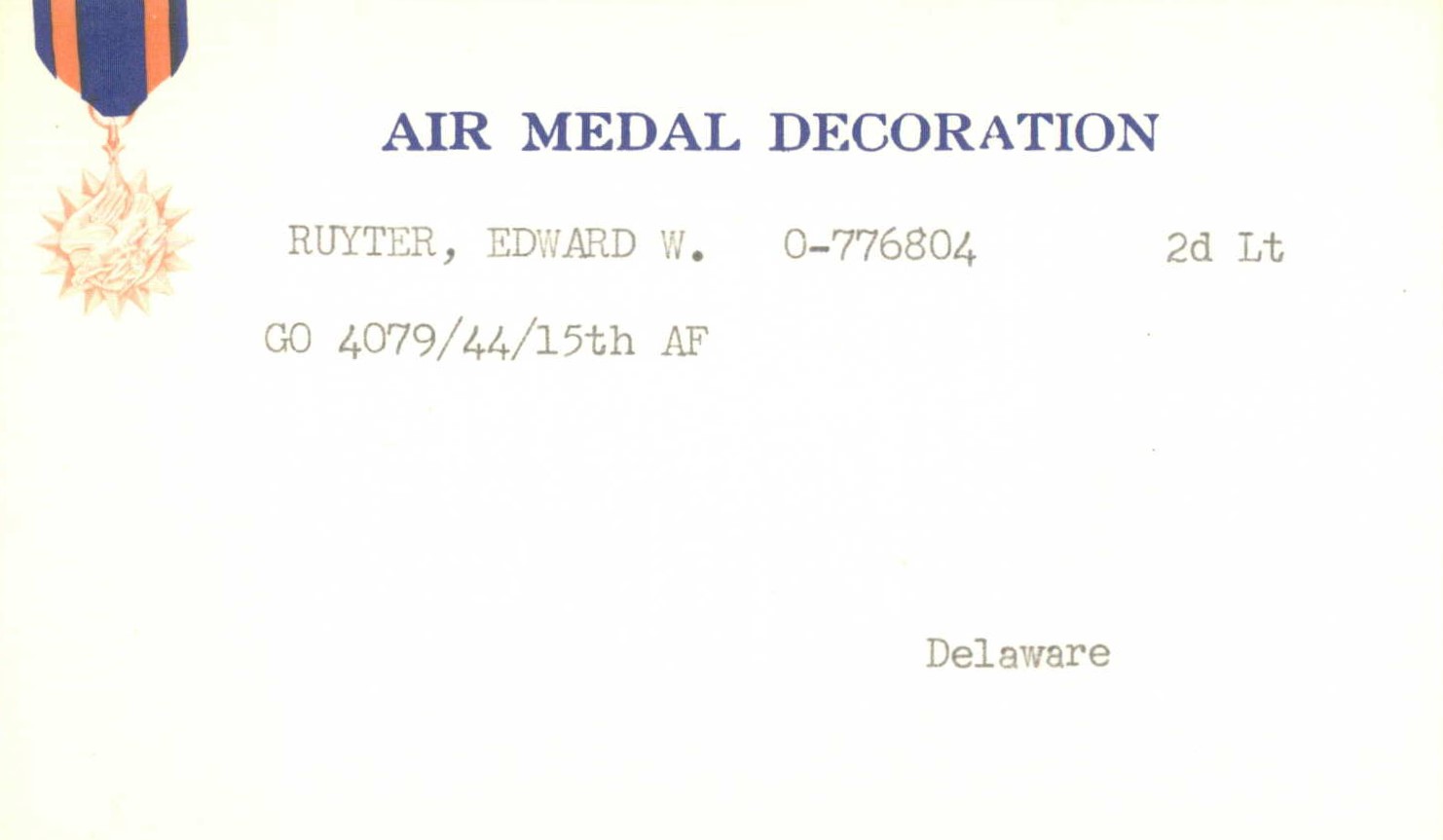
During his career, Lieutenant Ruyter earned the Air Medal and the Purple Heart. His name is honored on the World War II memorial in Dover and at Veterans Memorial Park in New Castle, Delaware.

Crew of B-24J 42-51912 on October 14, 1944
The following list is based on Missing Air Crew Report No. 9130 with grade, name, service number, position, and status (killed in action, prisoner of war, or died as prisoner of war). All enlisted men in the crew were considered gunners in addition to their other duties.
1st Lieutenant John Noske, Jr., O-713874 (pilot) – D.P.W.
2nd Lieutenant Walter Shostack, O-711256 (co-pilot) – P.O.W.
2nd Lieutenant Elijah Ostrander, Jr., O-2057992 (navigator) – P.O.W.
2nd Lieutenant Edward W. Ruyter, O-776804 (bombardier) – K.I.A.
Corporal Alexander Dubetz, 35231661 (radio operator) – P.O.W.
Corporal Jack R. Keopple, 37657027 (flight engineer) – P.O.W.
Corporal Robert E. Spicer, 16081722 (flight engineer) – D.P.W.
Corporal Charles T. Shropshire, 20234097 (armorer) – D.P.W.
Corporal Robert E. Brewer, 18184521 (tail gunner) – K.I.A.
Corporal John J. Stella, 31325818 (nose gunner) – K.I.A.
Notes
Father’s Year of Birth
Dirk Ruyter’s headstone and some records give his year of birth as 1870, while others list 1872.
Missions
Crew questionnaires indicated that Odertal was Ruyter’s third or fourth mission. Unit records indicate that he was killed on his third mission. His last letter home, written the day before his death, also indicated that he had flown two missions.
Corporal John J. Stella
Walter Shostack told Svatopluk Vaculik decades after the war that:
My engineer checked on Ed Ruyter and John Stella. He said they were both dead but did not say they were gone. I don’t know when they fell out or when they were blown out of the plane – it was a very bumpy ride.
In fact, Corporal Stella’s Individual Deceased Personnel File (I.D.P.F.) establishes that his body was still aboard the B-24 when it crashed near Lettenstätten. His body was initially buried at Sankt Michael ob Bleiburg, reburied at Saint-Avold, France, and eventually repatriated to Winsted, Connecticut.
Acknowledgments
Special thanks to Svatopluk Vaculik for providing information and translations of text in the historic photos, and to the Delaware Public Archives for the use of their photo.
Bibliography
“455BG, 741BS – B-24J 42-51912.” 455th Bombardment Group (H) website. https://455th.org/Stories/PDFs/42-51912.pdf
Air Force Award Cards. Record Group 64, Records of the National Archives and Records Administration. National Archives at St. Louis, Missouri. https://catalog.archives.gov/id/143824052?objectPage=239
Certificate of Birth for Edward William Ruyter. Record Group 1500-008-094, Birth Certificates. Delaware Public Archives, Dover, Delaware. https://www.familysearch.org/ark:/61903/3:1:S3HT-D4FS-WYT
Davis, John F. “Missing Air Crew Report No. 9130.” Record Group 92, Records of the Office of the Quartermaster General, 1774–1985. The National Archives at College Park, Maryland. https://catalog.archives.gov/id/91066269?objectPage=2
“Delaware Flier, GI Give Lives; Three Injured.” Journal-Every Evening, February 3, 1945. https://www.newspapers.com/article/132616033/
Delaware Marriages. Bureau of Vital Statistics, Hall of Records, Dover, Delaware. https://www.ancestry.com/imageviewer/collections/1673/images/31297_212345-00062
Fifteenth Census of the United States, 1930. Record Group 29, Records of the Bureau of the Census. National Archives at Washington, D.C. https://www.ancestry.com/imageviewer/collections/6224/images/4531890_00136
Fourteenth Census of the United States, 1920. Record Group 29, Records of the Bureau of the Census. National Archives at Washington, D.C. https://www.ancestry.com/imageviewer/collections/6061/images/4295768-00275
Headstone Inscription and Interment Records for U.S. Military Cemeteries on Foreign Soil, 1942–1949. Record Group 117, Records of the American Battle Monuments Commission, 1918–c. 1995. National Archives at Washington, D.C. https://www.ancestry.com/imageviewer/collections/9170/images/42861_647350_0544-01940
“History of 455th Bomb Gp (h) Oct. 1 Thru Oct. 31, 1944.” Reel B0602. Courtesy of the Air Force Historical Research Agency.
“In Memoriam Edward William Ruyter 1922 – 1944.” Undated. Courtesy of Svatopluk Vaculik.
Individual Deceased Personnel File for Edward W. Ruyter. Army Individual Deceased Personnel Files, 1942–1970. Record Group 92, Records of the Office of the Quartermaster General, 1774–1985. National Archives at St. Louis, Missouri. Courtesy of U.S. Army Human Resources Command.
Individual Deceased Personnel File for John J. Stella. Army Individual Deceased Personnel Files, 1942–1970. Record Group 92, Records of the Office of the Quartermaster General, 1774–1985. National Archives at St. Louis, Missouri. Courtesy of U.S. Army Human Resources Command.
Individual Deceased Personnel File for John Noske, Jr. Army Individual Deceased Personnel Files, 1942–1970. Record Group 92, Records of the Office of the Quartermaster General, 1774–1985. National Archives at St. Louis, Missouri. Courtesy of U.S. Army Human Resources Command.
“Loading List.” 741st Bombardment Squadron (H) AAF, 455th Bombardment Group (H) AAF. October 12, 1944. 455th Bombardment Group (H) website. https://455th.org/Missions/October%201944/PDFs/441012.pdf
“Loading List.” 741st Bombardment Squadron (H) AAF, 455th Bombardment Group (H) AAF. October 13, 1944. 455th Bombardment Group (H) website. https://455th.org/Missions/October%201944/PDFs/441013B.pdf
“Our Men and Women In Service.” Journal-Every Evening, May 9, 1944. https://www.newspapers.com/article/132614879/
Ruyter, Dirk. Individual Military Service Record for Edward William Ruyter. February 20, 1946. Record Group 1325-003-053, Record of Delawareans Who Died in World War II. Delaware Public Archives, Dover, Delaware. https://cdm16397.contentdm.oclc.org/digital/collection/p15323coll6/id/20652/rec/2
Sixteenth Census of the United States, 1940. Record Group 29, Records of the Bureau of the Census. National Archives at Washington, D.C. https://www.ancestry.com/imageviewer/collections/2442/images/m-t0627-00544-00165
Vaculik, Svatopluk. “Clarification of a Sixty-Two-Year-Old Case.” Cerignola Connection, Spring 2007. https://455th.org/Newsletter/PDFs/Spring%202007.pdf
World War II Army Enlistment Records. Record Group 64, Records of the National Archives and Records Administration. National Archives at College Park, Maryland. https://aad.archives.gov/aad/record-detail.jsp?dt=893&mtch=1&cat=all&tf=F&q=12013953&bc=&rpp=10&pg=1&rid=484565
Last updated on November 15, 2023
More stories of World War II fallen:
























To have new profiles of fallen soldiers delivered to your inbox, please subscribe below.
 Delaware's World War II Fallen