
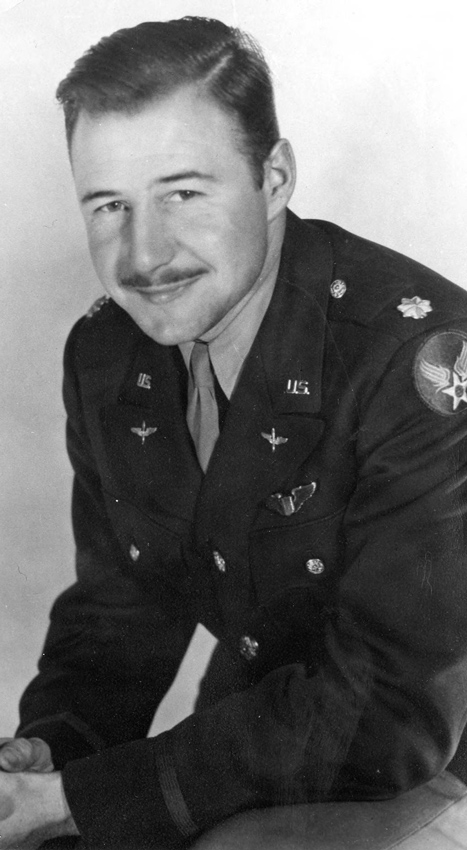
| Hometown | Civilian Occupation |
| Wilmington, Delaware | College student |
| Branch | Service Numbers |
| U.S. Army Air Forces | Enlisted 12012476 / Officer O-435705 |
| Theater | Unit |
| European | Headquarters Squadron, 95th Combat Bombardment Wing |
| Awards | Campaigns/Battles |
| Distinguished Flying Cross, Air Medal with three Oak Leaf Clusters | Antisubmarine campaign, European air campaign (28 missions) |
Early Life & Family
Clinton Frederick Schoolmaster was born at the Homeopathic Hospital at 1501 North Van Buren Street in Wilmington, Delaware, on the morning of August 9, 1919. He was the son of Fred or Frederick Albert Schoolmaster (an interior decorator and paper hanger, 1875–1940) and Elizabeth “Bessie” Schoolmaster (née McAllister, 1898–1983).
Schoolmaster had an older half-brother, Henry Harrison McAllister, (1916–1999), and a younger brother, Joseph McAllister Schoolmaster (1926–1994). Joseph Schoolmaster served in the Merchant Marine and then the U.S. Navy during World War II. H. Harrison McAllister also served in the Navy during the war.
Schoolmaster moved many times during his childhood, but all his known addresses were in Wilmington prior to his military service. When Schoolmaster was born, his parents were living at 610 West Street. The family was recorded at that address on the census taken in January 1920. By the time his younger brother was born on March 9, 1926, Schoolmaster’s family had moved to 701 West Street. The family was recorded on the next census in April 1930, living at 406 West 30th Street.
Schoolmaster was a Boy Scout.
Schoolmaster’s father died of cancer and heart failure on February 1, 1940. Shortly thereafter, in April 1940, the rest of the family was recorded on the census living at 1804 Washington Street. Schoolmaster’s mother was working as a waitress at a hotel, presumably the Hotel DuPont, her later employer.
After graduating from Pierre S. duPont High School in 1938, Schoolmaster enrolled in the University of Delaware in nearby Newark, though he continued to live in Wilmington. His future wife, Janet Marilyn Balster (1920–2019), a student at the Women’s College of Delaware—an affiliate of Schoolmaster’s school prior to 1945, when the schools merged—later recalled that “Clint and I commuted together to the Univ. of Del. for three years.” She added that “Clint’s best friend Bob Coleman owned a car and they picked me up at home each morning as a paying passenger.”
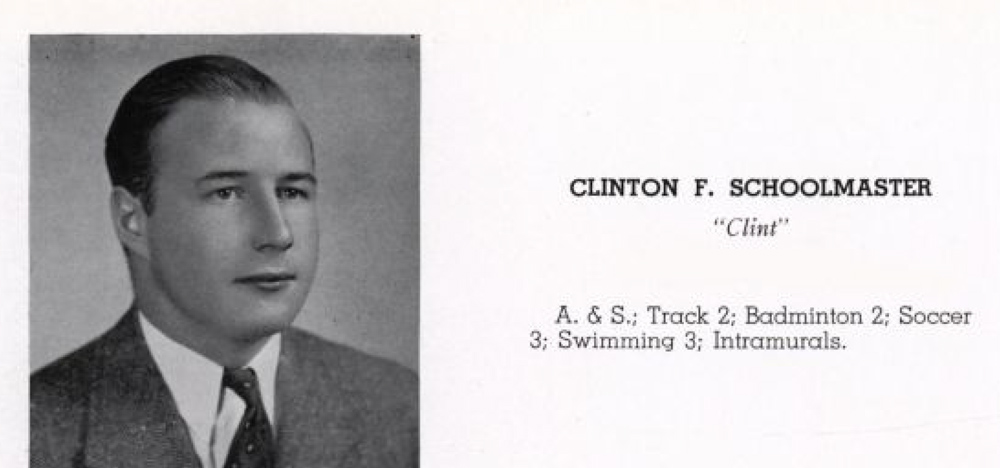
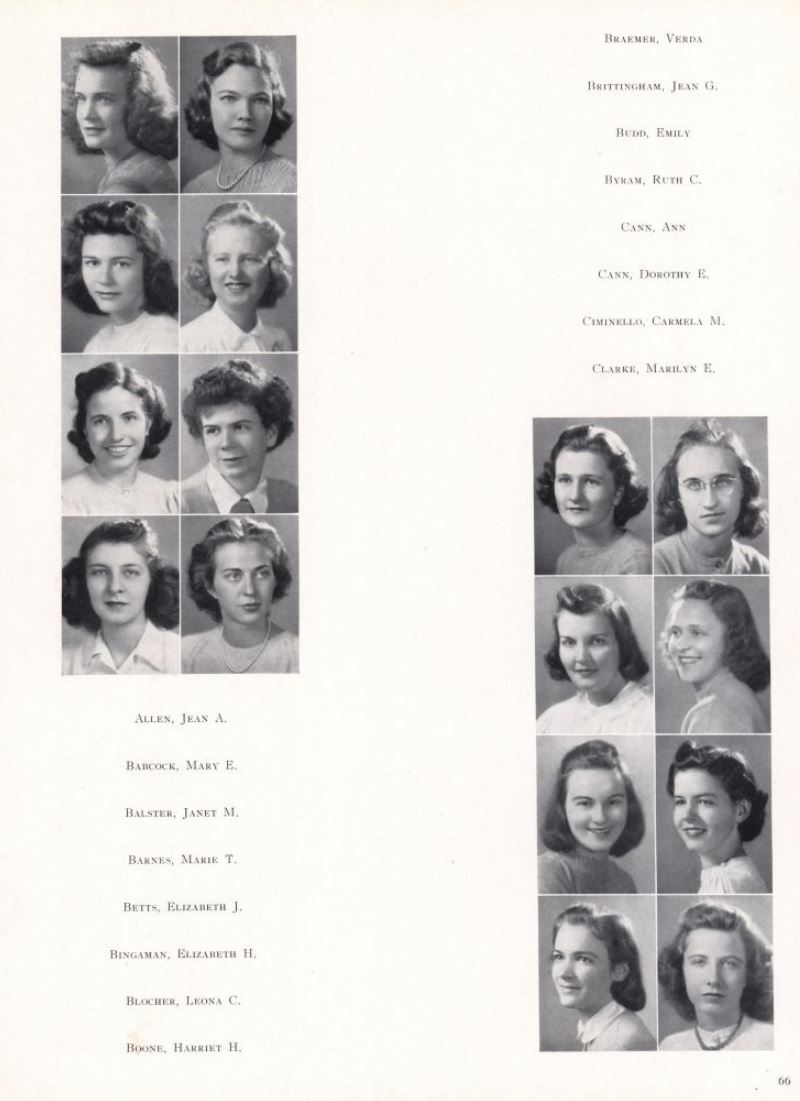
Journal-Every Evening reported that “Schoolmaster majored in physical education, obtaining six varsity letters in athletics.” The article added that he “was on the varsity swimming, track, soccer, and gymnasium teams, and captured the Delaware state diving championship for three successive years.”
When he registered for the draft on October 16, 1940, the registrar described Schoolmaster as standing about five feet, 8½ inches tall and weighing 155 lbs., with blond hair and brown eyes. He was Protestant according to his military paperwork.
Military Training & Marriage
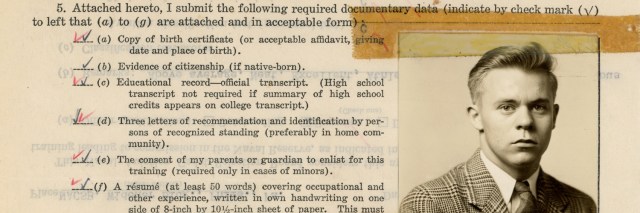
Schoolmaster was a cadet in the Reserve Officers’ Training Corps (R.O.T.C.) at the University of Delaware. During his junior year of college, on April 30, 1941, the Wilmington Morning News reported that Schoolmaster and his friend, Robert L. Coleman (1919–1943), were among 19 local men, 12 of them University of Delaware students, who had passed testing and been recommended for appointment as aviation cadets in the U.S. Army Air Corps (later the Army Air Forces). Neither man finished college. Schoolmaster was accepted as an aviation cadet in Wilmington on July 21, 1941. Coleman became an aviation cadet on September 3, 1941, and served as a B-24 pilot in the Pacific before he was killed in a plane crash in the Pacific in December 1943.
According to a statement by his mother for the State of Delaware Public Archives Commission, Aviation Cadet Schoolmaster began his training at Pine Bluff, Arkansas, before moving to Augusta, Georgia, in September 1941. She wrote that he moved to Barksdale Field, Louisiana, for his advanced flight training in November 1941. After completing his pilot training, Schoolmaster was commissioned as a 2nd lieutenant on February 6, 1942.
Details about the next year of Schoolmaster’s career are abundant, but fragmented. A document in Schoolmaster’s individual deceased personnel file (I.D.P.F.) indicates he was stationed at McDill Field, Florida, at least between March 21, 1942, and May 6, 1942. His mother’s statement reported that he was a four-engine bomber instructor there between February and May 1942. Another I.D.P.F. document establishes that Schoolmaster was at New Orleans Air Base, Louisiana, during June 5–10, 1942. Similarly, his mother stated that her son performed antisubmarine patrols out of New Orleans during May and June 1942. The I.D.P.F. also establishes that he was stationed in Boise, Idaho, by the end of July 1942.
Schoolmaster’s mother did not specify the dates but added that her son was also stationed in Tucson, Arizona; Kansas City, Missouri; El Paso, Texas; and Alamogordo, New Mexico.
In June 1942, around the time Janet Balster graduated from the Women’s College of Delaware, she and Schoolmaster were engaged. They married in New Mexico on August 29, 1942. The Wilmington Morning News reported: “The wedding took place on Aug. 29 in St. John’s Episcopal Church; Alamogordo, New Mexico. The ceremony was performed by the Rev. W. H. Martin. The couple was attended by First Lieut. and Mrs. Roderick L. Francis.” The article added: “After a wedding trip to Ruidoso, N. M., the couple returned to El Paso, where Lieutenant Schoolmaster is stationed.”
1st Lieutenant Schoolmaster may have joined the 330th Bombardment Group (Heavy) around August 5, 1942, which the group surgeon, Major Holland, later recalled was the date they met.
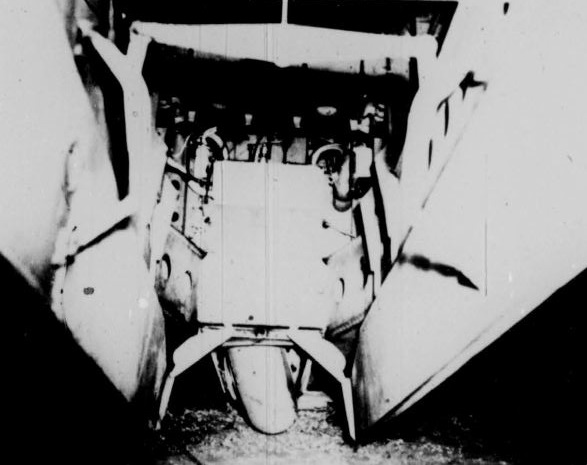
On the afternoon of September 16, 1942, 1st Lieutenant Schoolmaster had a close call. At the time, he was a member of the 459th Bombardment Squadron (Heavy), 330th Bombardment Group (Heavy), at Biggs Field, Texas. He had accumulated about 525 hours of flight time as a first pilot, including 164 hours and 15 minutes during the previous 90 days. At 1730 hours, he took off for a familiarization flight, flying the Douglas A-20C Havoc for the first time, with two passengers aboard. According to the accident report, “During take-off the ground crew noticed something fall from the front of the airplane. They picked up the object which had fallen and found it to be the rubber covering of the nose wheel tire.”
The tower radioed Lieutenant Schoolmaster “that he had nose wheel trouble and to stand by for further instructions.” His superiors were worried about the safety of Corporal Bruce Compton, who was riding in the bombardier’s compartment in nose of the A-20. It was impossible to move from the compartment to any other part of the plane in flight. If the nose gear collapsed on landing, he would likely have been hurt or killed. Schoolmaster’s superiors decided that Corporal Compton must bail out before Schoolmaster attempted to land. Although Schoolmaster’s radio abruptly failed in flight, he was advised of the plan by light signal. Corporal Compton parachuted to safety.
The unusual circumstances of the incident revealed a design flaw in the A-20. Corporal Compton
pulled the emergency release letting the hatch swing free attached only by the rear hinge. The force of the air against the hatch forced it backward and when the wheels were lowered for a landing, the door, still attached, prevented the nose gear assembly from reaching the full forward position and locking.
Ironically, Lieutenant Colonel J. R. Sutherland wrote, “The nose wheel had not blown but all the rubber had been stripped from the outside of the tire” and the decision to have Corporal Compton bail out had caused the very event that Schoolmaster’s superiors had been worried about. Lieutenant Colonel Sutherland confirmed that Schoolmaster did his best to hold “the nose up as long as possible” and concluded that “In my opinion the landing was very expertly done.” The report stated:
The plane made a normal low approach and landing; however, the nose gear assembly retracted upon contact with the ground, causing the nose of the plane to strike the ground with considerable force. The plane slid a short distance on the nose and made approximately a 180 [degree] turn to the right before coming to a stop.
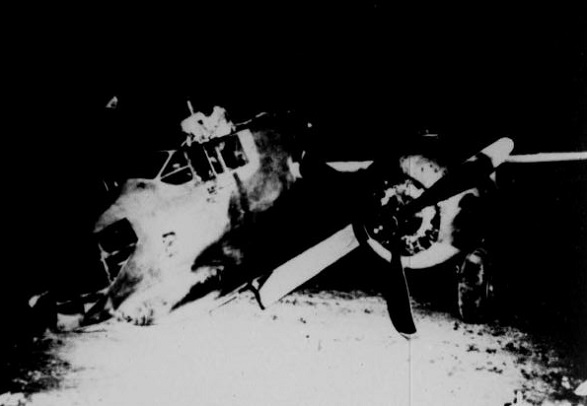
The crash damaged the A-20’s nose and fuselage, wrecked both engines and propellers, and broke both wing spars, but Schoolmaster and his other passenger were unhurt. The investigation committee recommended “that the emergency release mechanism on the escape hatch in the Bombardier’s compartment of this type aircraft be redesigned to let the hatch fall free from the aircraft when the emergency release handle is pulled.” They added that “material failures of the nose wheel tire and the radio were contributing factors to this accident.”
Squadron Operations Officer
Although he had joined military mere months before the attack on Pearl Harbor, the massive expansion of the armed forces following the U.S. entry into World War II—and presumably his own abilities—provided Schoolmaster the opportunity for rapid advancement. On January 14, 1943, less than a year after he was commissioned, Schoolmaster had been promoted to captain.
By January 24, 1943, Captain Schoolmaster was a member of the 39th Bombardment Group (Heavy) at Davis–Monthan Field, Arizona. A set of orders that date assigned him to the 566th Bombardment Squadron (Heavy) of the 389th Bombardment Group (Heavy). The orders stated he would be a flight commander in his new squadron but temporarily left him attached to the 39th Bomb Group. It is unclear if he ever joined the 389th, but if he did, he was a member of that unit only briefly.
A roster dated March 15, 1943, stated that Schoolmaster was the operations officer in the 578th Bombardment Squadron (Heavy) at Biggs Field, Texas. The squadron, under the command of Captain Warren A. Polking (1917–2000), was part of the 392nd Bombardment Group (Heavy). First activated that January, the 392nd Bomb Group was equipped with the Consolidated B-24 Liberator. Curiously, a set of orders dated March 27, 1943, stated that Schoolmaster had been serving as a flight commander in the 578th Bomb Squadron and became the 578th’s operations officer on that date.
Captain Schoolmaster was stationed in or near Orlando, Florida, around April 8, 1943, when the Wilmington Morning News reported that his in-laws had visited him and his wife there. Presumably, during the visit he was attending the Army Air Forces School of Applied Tactics (A.A.F.S.A.T.) at Orlando Army Air Base. His squadron moved to Alamogordo, New Mexico, on April 18, 1943.
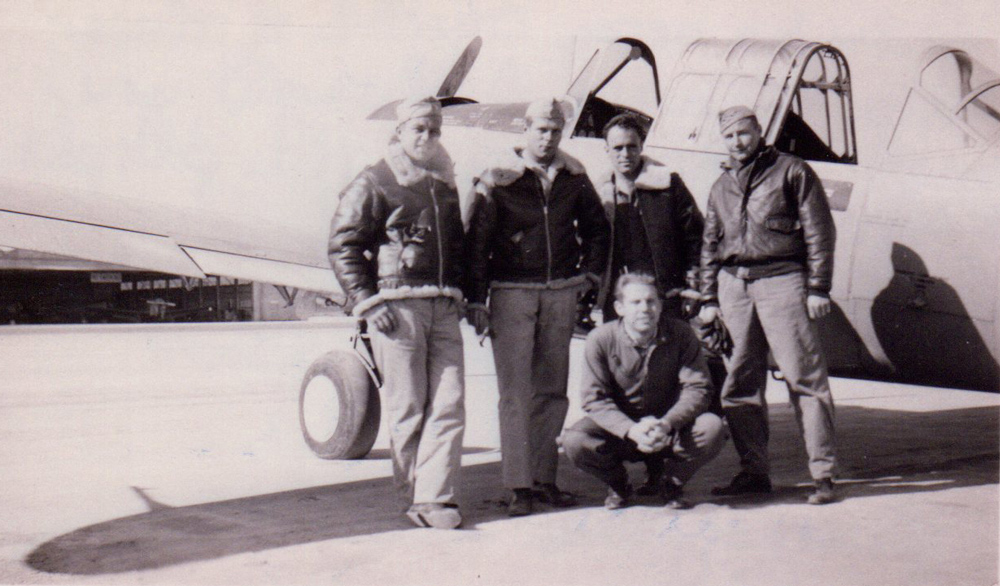
In a 2003 letter to Schoolmaster’s wife, Colonel Lawrence G. Gilbert (1918–2009) wrote:
In another note to you some time ago I believe I related how highly regarded Clint was in the Group, by his Squadron C.O. and all of us who knew him. I remember well our training days in El Paso and Albuquerque when a visiting inspection team from higher headquarters made a surprise visit and requested a sample briefing of a combat mission. We “passed the buck” to the 578th Sq.CO who in turn called upon Clint to do the job. Needless to say Clint carried it out in an outstanding fashion and we all quietly applauded.
A note in the 578th Bomb Squadron history dated May 22, 1943, stated: “The squadron now has its compliment of nine crews. Pilots are being checked out by Major Polking and Captain Schoolmaster.” That summer, the 392nd Bomb Group was ordered to join the Eighth Air Force in the United Kingdom. A squadron history stated that the combat crews “left for Topeka to pick up new ships […] and to head overseas” on July 14, 1943.
Topeka, Kansas, was the last base that Janet Schoolmaster could accompany her husband to before he went overseas. She later recalled: “Clint was a Phys. Ed. major and Delaware State Diving Champion for three years. That last hot month in Topeka we use to take the bus to the local swimming pool and I had the pleasure of seeing him dive, just for me.”
On August 10, 1943, orders came down from Headquarters Topeka Army Air Base dispatching some crews overseas, with Captain Schoolmaster accompanying a crew led by 1st Lieutenant Douglas R. Steinmetz (1920–1943) aboard B-24H serial number 42-7490. According to his mother’s statement, Captain Schoolmaster went overseas on August 13, 1943. A group history stated that “most of the 578th and 577th flew directly from Gander to Scotland.” The 578th’s ground echelon shipped out for England by sea on July 25. All but one crew had arrived at U.S.A.A.F. Station 118, Royal Air Force Wendling, by August 22, 1943.
As the squadron operations officer, Captain Schoolmaster was not assigned to a permanent combat crew. Most of his duties involved planning and he was not expected to fly every mission. However, during his career, flew 28 combat missions, beginning on September 6, 1943. The 392nd Bomb Group was eased into combat during its first two months in Europe. Many of their early missions were diversionary, intended to confuse the Germans about other units’ objectives and draw enemy fighters away from the strike aircraft. While less dangerous than flying against actual targets, unless they were attacked diversions did not count towards the missions that bomber crewmembers had to fly to complete a tour of duty.
In many missions, Schoolmaster flew as a third pilot aboard a bomber tasked with coordinating his unit and its formation. Failure to maintain the formation would leave the B-24s vulnerable to fighters and increase the risk of a midair collision. Captain Schoolmaster also flew some missions as a pilot or copilot, substituting for a crew’s regular pilot during raids on Wilhelmshaven and Munster.
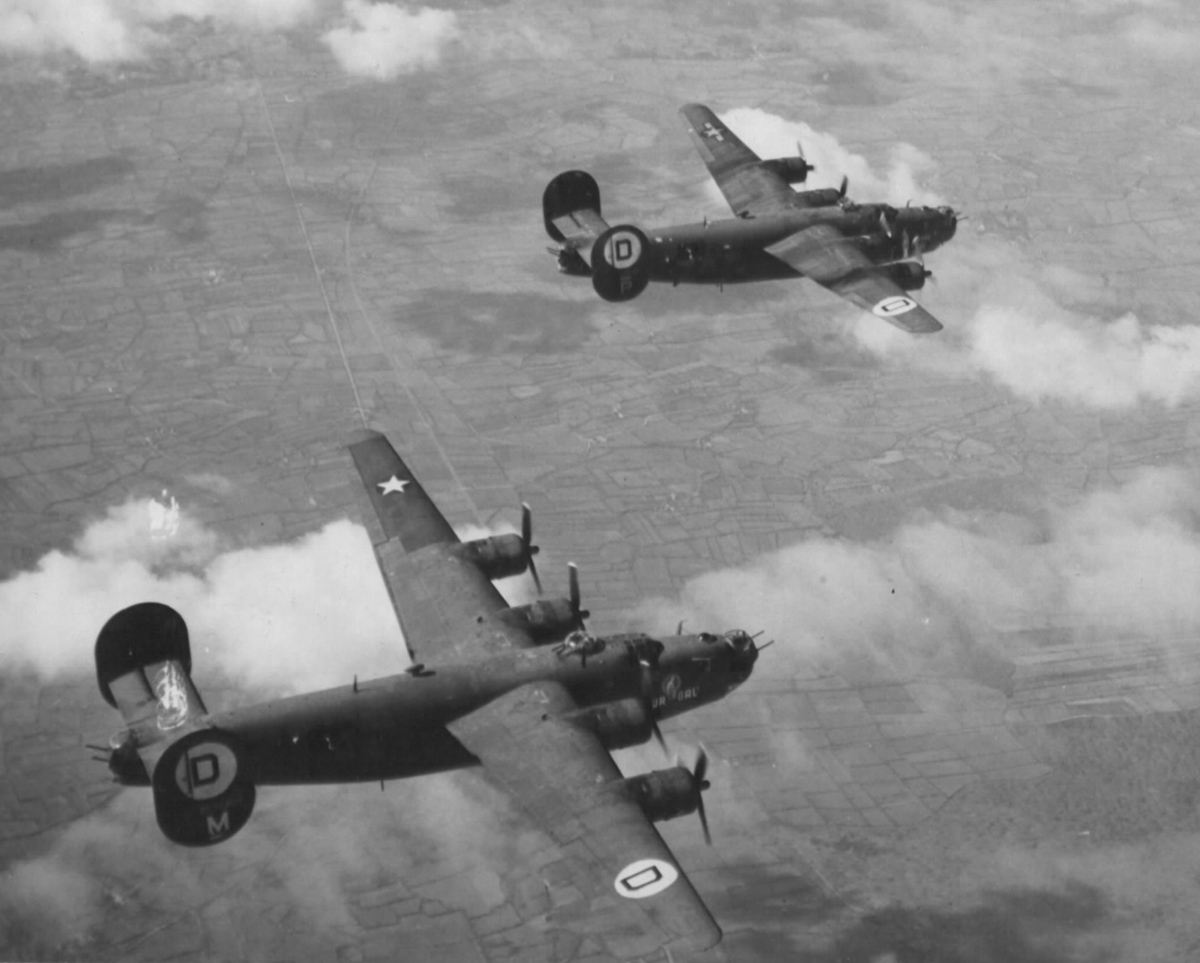
In a letter dated October 10, 1943, Captain Schoolmaster wrote his wife about a mission two days earlier:
We hit Vegesack. Our first raid on Germany. Boy; it sure was exciting — I can sure say that I’ll have some stories to tell our grandchildren. The flak is something to talk about, let alone the fighters. We had our first loss in the 578th – – Lost Lt. [John G.] Buschman & his crew right over the heart of Germany – they saw everybody bail out so I suppose they’re OK.
Captain Schoolmaster survived a raid on Münster November 5, 1943, his last with the 578th Bomb Squadron. Among the losses that day was the B-24 and crew that Schoolmaster had flown across the Atlantic Ocean with three months earlier. 1st Lieutenant Steinmetz and his entire crew were killed, though when Schoolmaster wrote his wife six days later he still had reason to hope: “A really rough one – the good old 578th lost another crew, Lt. Steinmetz – a good boy, seen going down under control, with several parachutes coming out.”
Squadron Commander
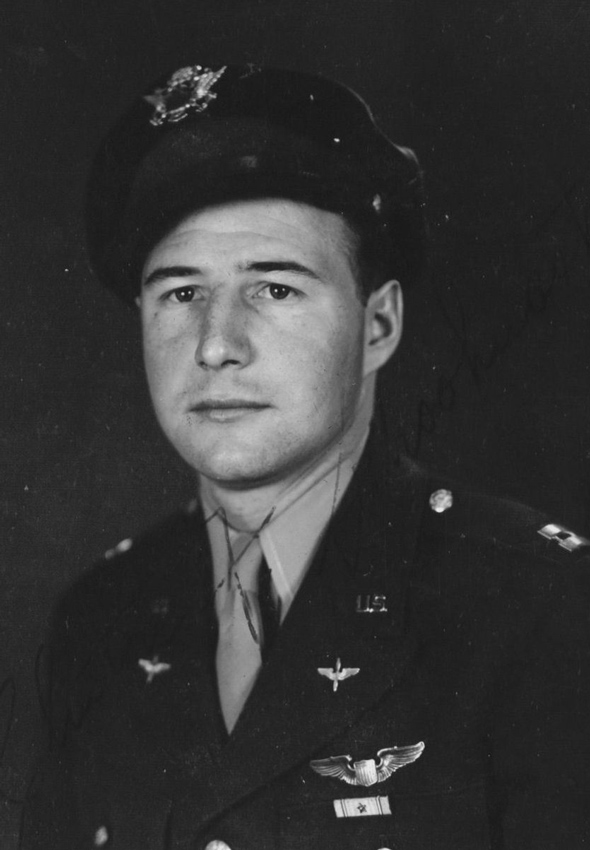
On November 10, 1943, Captain Schoolmaster transferred to and assumed command of another of the 392nd Bomb Group’s squadrons, the 577th Bombardment Squadron (Heavy). Like operations officers, squadron commanders were not part of regular bomber crews and flew only a portion of the missions. Schoolmaster flew his first mission as commanding officer on November 16, 1943, acting as copilot on a raid against German-occupied Norway. The primary target was socked in by clouds but 392nd Bomb Group attacked the secondary target, a hydroelectric plant at Rjukan.
Schoolmaster flew four more missions that year including two raids on Bremen, Germany, the first of which took place on November 26, 1943. The next day, he wrote his wife cheerfully:
Work at hand is kinda rugged — Ye olde bomb dropping association – at work again – over Northwest Germany this time. — It was a nice trip tho–just like a country trip in the U.S. — only except for the flak, very disconcerting – and of course the enemy fighters – they get mad at us boys! Can you imagine?
The 577th Bomb Squadron’s losses under Schoolmaster’s command started off relatively light. Two ten-man crews were lost in November 1943 but none in December. Captain Schoolmaster was awarded the Air Medal per General Orders No. 43, Headquarters 2nd Bombardment Division, dated December 3, 1943. In 1944 he was awarded three oak leaf clusters in lieu of additional Air Medals.
On December 26, 1943, Schoolmaster wrote his wife:
We didn’t have such a bad Christmas— Christmas is a home & family affair, you just can’t get away from (it) and most of the boys felt it too! The best thing of all has been the weather these past few days – a regular pea souper- not even the birds are flying much less the USAAF- – thank God! That’s what really made our Christmas what it was!
The 577th’s good fortune didn’t last. During its first mission of the new year, a raid on Kiel on January 4, 1944, the 577th lost three crews. One of these crews was interned in neutral Sweden but there were no survivors from the other two. In a letter to his wife that day, Captain Schoolmaster tried to put a cheery face on what he described in understated fashion as “sort of a rough day”: “It sure is a tough lick to take – but we’ll come back with twice the effort, of that I’m positive – in fact, we must!—tonight is a pretty sober & hard hit 392nd—.” Another 577th crew was killed that month in a midair collision and four more lost during a mission on February 24, 1944.
Schoolmaster was promoted to major on January 20, 1944. He flew three missions that month, two in February, three in March, and three in April. The missions included the German targets in Friedrichshafen, Braunschweig, and Dernbach. Schoolmaster wrote his wife on March 17, 1944, about the previous day’s mission to Friedrichshafen:
Quite a long ride that one – took a little trip over France, down into Germany – even crossed over the border and I could have spit on Switzerland (if I hadn’t my oxygen mask on and we weren’t dropping bombs right at that moment)
He added that “the Alps were covered with snow and very beautiful and also very rugged looking[.]” That beauty would be lost on the men of the 392nd Bomb Group who returned to Friedrichshafen on March 18, 1944. Though the raid two days earlier had been lossless for the 392nd, the second was the single most costly mission the group flew during the entire war. A staggering 14 crews were lost—half of those dispatched—including four from the 577th Bomb Squadron. Schoolmaster’s squadron lost another six crews in April 1944.
Senior Controller & Final Flight
Schoolmaster was awarded the Distinguished Flying Cross per General Orders No. 324, Headquarters Eighth Air Force, dated April 30, 1944. Already a major and squadron commander at age 24, Schoolmaster was on the fast track in the U.S. Army Air Forces.

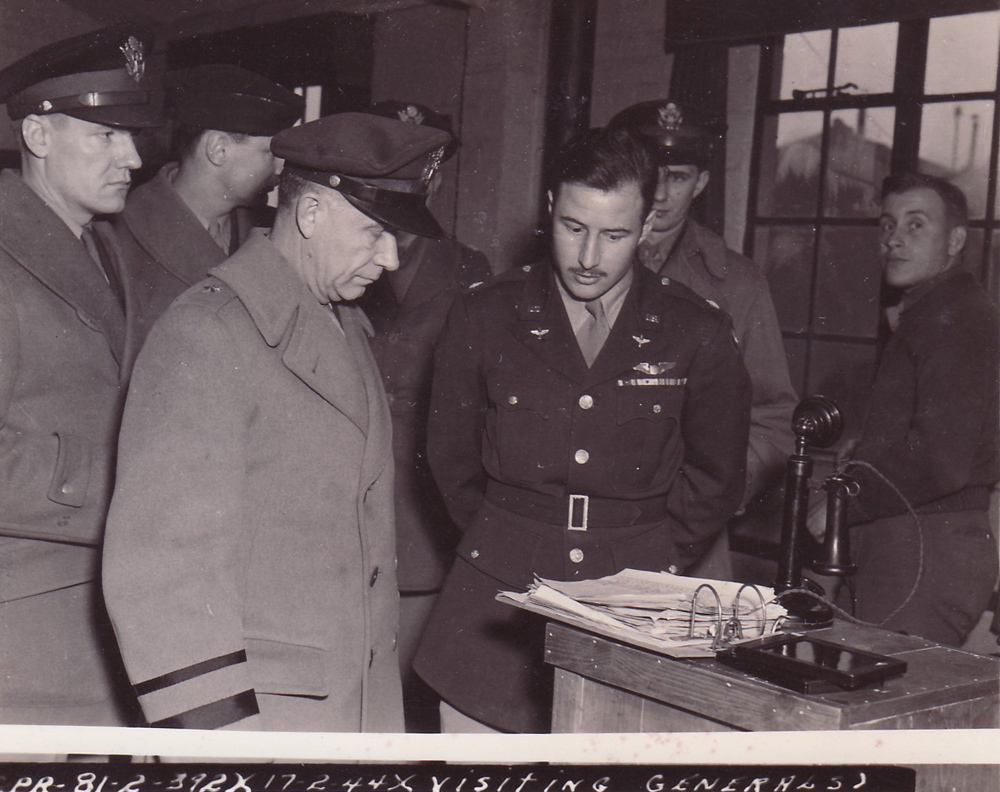
During the spring of 1944, Major Schoolmaster found himself in a tug-of-war between the commander of the new 95th Combat Bombardment Wing (Heavy), Colonel Frederick R. Dent, Jr. (1908–1961), and the 392nd Bomb Group commanding officer, Colonel Irvine A. Rendle (1909–1974). In a May 2, 1944, letter to his wife, Schoolmaster wrote:
Had another (rather insistent) offer to move — this time to be Wing Opn’s Officer of a new Combat Wing being formed under Col. Dent. I’m sorta neutral about the whole thing personally, Col. Rendle says, no, to the Gen’s, he won’t let me go— that in itself is great satisfaction that whether he says so or not, I feel like I’m doing the job! In any case I’ve worked damn hard to have the smooth running org. I have and to enjoy some of the privileges of a Sq. C.O. and the other job would call for double time in work— I’m physically & mentally tired even now and don’t particularly relish the other so I think I’ll hold the line in its present position for the time.
In the end, though, Colonel Dent won the war of wills and the transfer went through. Major Schoolmaster flew his last combat mission with the 392nd Bomb Group on May 15, 1944, aboard a pathfinder aircraft during a mission to Siracourt, France. Four days later, Major Schoolmaster wrote his wife:
You ask whether my [transfer] will mean staying over any longer – Yes; it probably will–but in any case I would have been kept over anyhow–they need experience very badly.–but the opportunity of working in the 95th Wing is a break I believe.
On May 22, 1944, Major Schoolmaster joined the 95th Combat Bomb Wing as senior controller. Officially activated on December 11, 1943, a unit history stated that “the Wing existed only on paper until 1 April 1944 when Colonel FRED R. DENT JR. assumed command.” The wing was headquartered “at Holton, near Halesworth[,] Suffolk, England. The base, AAF Station 365, was known as Halesworth.”
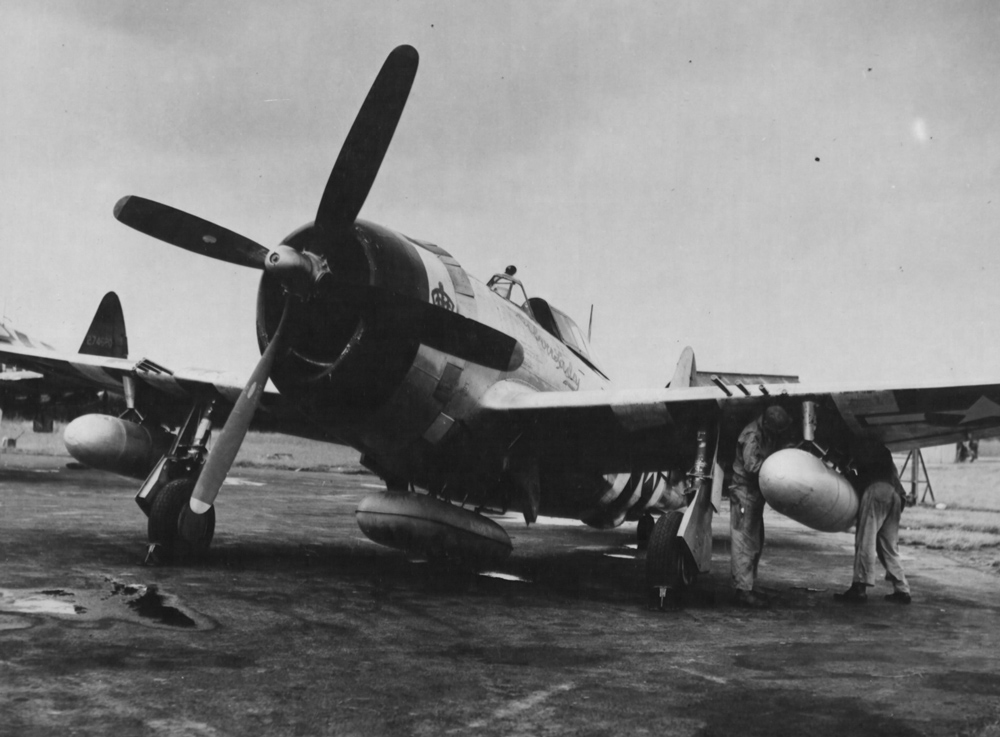
At 0907 hours on May 25, 1944, Major Schoolmaster took off from Halesworth in a Republic P-47D Thunderbolt, serial number 42-74661. According to a report, he “was helping aircraft of this Division form for an operational mission and then was to return to his home station.” Schoolmaster supervised the formation but he never returned to base. Given the low probability that a crash on land would go unnoticed, authorities suspected that he had crashed at sea. A potential clue was a report “that a fisherman saw a similar type airplane dive into the water in the Wash, an inlet of the North Sea off the northeast coast of En[g]land, and that an oil slick was the only remaining trace of the aircraft.”
Similarly, a 95th Combat Bomb Wing history stated:
The P-47 was last reported by the formation as being seen east of Birmingham. The only report that could be connected with his disappearance was that of a fisherman who docked the following day. He reported seeing a Spitfire diving into the Wash on the morning before. As no Spitfires were lost that day, it may be assumed that it was a P-47—probably that in which Major Schoolmaster was flying. His loss was a great one for the Wing, for his experience would have been a real asset to the headquarters and the Groups under its command.
The probable crash site, the Wash, was east of where Major Schoolmaster was last seen and northwest of Halesworth. During the subsequent year, no further details came to light concerning his disappearance. Given that there was no evidence that Major Schoolmaster had landed elsewhere or become a prisoner of war, authorities issued a finding of death, making his presumed date of death May 26, 1945, a year and a day after his disappearance. His body was also declared non-recoverable.

Janet Balster Schoolmaster remarried to Herbert Frederick Engelmann (c. 1920–1989) on March 30, 1946.
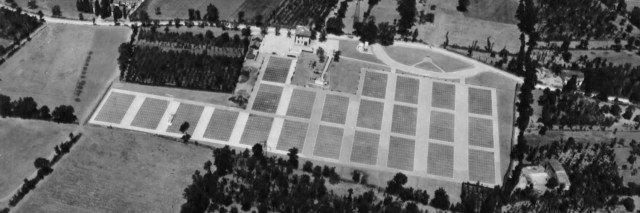
During his career, Major Schoolmaster earned the Distinguished Flying Cross and the Air Medal with three oak leaf clusters. His name is honored on the Tablets of the Missing at the Cambridge American Cemetery, England; at Veterans Memorial Park in New Castle, Delaware; at the University of Delaware’s World War II memorial in Newark, Delaware; on a plaque honoring World War II fallen in the Union Park Gardens neighborhood in Wilmington, Delaware; and at the Wall of Honor at the Smithsonian National Air and Space Museum’s Steven F. Udvar-Hazy Center near Washington Dulles International Airport, Virginia.
Notes
Orlando
That Captain Schoolmaster attended the Army Air Forces School of Applied Tactics is conjecture, but a 392nd Bomb Group history stated that the group’s “key personnel of the Flying Echelon were sent to attend AAFSAT, at Orlando, Florida, during the month of March.”
Mother’s Statement
It is a little difficult to parse some of Schoolmaster’s mother’s statement regarding his service history. She wrote that he was “Instructor in B-17” at McDill Field, Florida, from February to May 1943. She must have meant February to May 1942. A newspaper article also mentioned that he was a four-engine bomber instructor, though Schoolmaster presumably would have needed at least some transition training before becoming an instructor in them. She wrote that he was on “Sub-marine patrol” in New Orleans from May to July 1, 1943. Again, this would have been 1942.
Mission Count
Schoolmaster flew 28 combat missions. Officially, he was credited with 21 because he did not receive official credit for six diversionary missions and one raid where his plane aborted.
Acknowledgments
Special thanks to Annette Tison and B24.net for providing valuable correspondence, information, and photos. Thanks also go out to the Delaware Public Archives for the use of their photos.
Bibliography
“7 More Scouts Get Eagle Rank.” Evening Journal-Every Evening, November 15, 1933. https://www.newspapers.com/article/130271535/
“19 Youths Pass Air Corps Tests.” Wilmington Morning News, April 30, 1941. https://www.newspapers.com/article/130285888/
1941–1942 Blue Hen. Unknown publisher, 1942. https://udspace.udel.edu/bitstream/handle/19716/9811/1941_01_Personalities.pdf
Air Medal Decoration Card for Clinton F. Schoolmaster. Air Force Award Cards. Record Group 64, Records of the National Archives and Records Administration. National Archives at St. Louis, Missouri. https://catalog.archives.gov/id/143831354?objectPage=327
Alexander, Holmes M. “History of 578th Sqd; 392nd Bombardment Group (H).” Reel A0644. Courtesy of the Air Force Historical Research Agency.
“Among Local Folk.” Wilmington Morning News, April 8, 1943. https://www.newspapers.com/article/130279834/
The Blue and Gold 1940–41. https://udspace.udel.edu/bitstreams/fcccbf4a-cc50-4587-a5dd-99777aff8586/download
Census Record for Clinton Schoolmaster. April 18, 1930. Fifteenth Census of the United States, 1930. Record Group 29, Records of the Bureau of the Census. National Archives at Washington, D.C. https://www.ancestry.com/imageviewer/collections/6224/images/4531893_00505
Census Record for Clinton Schoolmaster. April 18, 1940. Sixteenth Census of the United States, 1940. Record Group 29, Records of the Bureau of the Census. National Archives at Washington, D.C. https://www.ancestry.com/imageviewer/collections/2442/images/m-t0627-00551-00611
Census Record for Clinton Schoolmaster. January 8, 1920. Fourteenth Census of the United States, 1920. Record Group 29, Records of the Bureau of the Census. National Archives at Washington, D.C. https://www.ancestry.com/imageviewer/collections/6061/images/4295769-00824
“C. F. Schoolmaster Promoted to Major.” Wilmington Morning News, February 19, 1944. https://www.newspapers.com/article/130287274/
Certificate of Birth for Clinton Schoolmaster. August 20, 1919. Record Group 1500-008-094, Birth Certificates. Delaware Public Archives, Dover, Delaware. https://www.familysearch.org/ark:/61903/3:1:S3HT-DTZW-V4T
Certificate of Birth for Janet Balster. November 20, 1920. Record Group 1500-008-094, Birth Certificates. Delaware Public Archives, Dover, Delaware. https://www.familysearch.org/ark:/61903/3:1:S3HT-D4WS-72D
Certificate of Birth for Joseph McAllister Schoolmaster. Undated, c. March 9, 1926. Record Group 1500-008-094, Birth Certificates. Delaware Public Archives, Dover, Delaware. https://www.familysearch.org/ark:/61903/3:1:33S7-9YQM-Q67V
Certificate of Death for Fred A. Schoolmaster. February 1, 1940. Delaware Death Records. Delaware Public Archives, Dover, Delaware. https://www.familysearch.org/ark:/61903/3:1:33S7-9BCN-G9T
“Delawareans in the Service.” Journal-Every Evening, February 5, 1943. https://www.newspapers.com/article/130286854/
Distinguished Flying Cross Card for Clinton F. Schoolmaster. Air Force Award Cards. Record Group 64, Records of the National Archives and Records Administration. National Archives at St. Louis, Missouri. https://catalog.archives.gov/id/133436835?objectPage=337
Draft Registration Card for Clinton Frederick Schoolmaster. October 16, 1940. WWII Draft Registration Cards for Delaware, October 16, 1940 – March 31, 1947. Record Group 147, Records of the Selective Service System. National Archives at St. Louis, Missouri. https://www.ancestry.com/imageviewer/collections/2238/images/44003_09_00009-01068
Engelmann, Janet. Letter to Annette Tison, c. 1996. Courtesy of B24.net.
Engelmann, Janet. Letter to Annette Tison, July 6, 1996. Courtesy of B24.net.
Enlistment Record for Clinton F. Schoolmaster. July 21, 1941. World War II Army Enlistment Records. Record Group 64, Records of the National Archives and Records Administration. National Archives at College Park, Maryland. https://aad.archives.gov/aad/record-detail.jsp?dt=893&mtch=1&cat=all&tf=F&q=schoolmaster%23clinton&bc=&rpp=10&pg=1&rid=483654
“Former U. of D. Athletic Star Commands Liberator Squadron.” Journal-Every Evening, January 3, 1944. https://www.newspapers.com/article/130271402/
“Fred A Schoolmaster.” Find a Grave https://www.findagrave.com/memorial/224798195/fred-a-schoolmaster
Gilbert, Lawrence G. Letter to Janet Engelmann, November 29, 2003. Courtesy of B24.net.
“History 95th Combat Bombardment Wing (H) 11 December 1943 through 2 June 1944.” Reel C0060. Courtesy of the Air Force Historical Research Agency.
“History From Activation–Jan. 1943 through Feb 1944 392nd Bombardment Group (H) (And Auxiliary Units) 2nd Combat Wing 2nd Bombardment Division Eighth Air Force.” Reel B0445. Courtesy of the Air Force Historical Research Agency.
“History of 577th Bomb Sq. (H).” Reel A0644. Courtesy of the Air Force Historical Research Agency.
“History of 577th Bomb. Sq. (H) March and April 1944.” Reel A0644. Courtesy of the Air Force Historical Research Agency.
“History of 577th Bomb Squadron (H) Jan. and Feb. 1944.” Reel A0644. Courtesy of the Air Force Historical Research Agency.
Individual Deceased Personnel File for Clinton F. Schoolmaster. Army Individual Deceased Personnel Files, 1942–1970. Record Group 92, Records of the Office of the Quartermaster General, 1774–1985. National Archives at St. Louis, Missouri. Courtesy of U.S. Army Human Resources Command.
“Maj Clinton F. Schoolmaster USAF.” National Air and Space Museum website. https://airandspace.si.edu/support/wall-of-honor/maj-clinton-f-schoolmaster-usaf
“MG Frederick Rodgers Dent Jr.” Find a Grave. https://www.findagrave.com/memorial/41322012/frederick-rodgers-dent
“Missing Pilot’s Brother Recent Navy Inductee.” Journal-Every Evening, October 7, 1944. https://www.newspapers.com/article/130275021/
“Report of Aircraft Accident 43-9-16-39.” Reel 46124. Courtesy of the Air Force Historical Research Agency.
Schoolmaster, Clinton F. “Excerpts from letters written from England during his time of service with the 392nd B.G. World War II – Sept. 43 – May 44.” Transcribed by Janet M. Engelmann. Courtesy of B24.net.
Schoolmaster, Elizabeth M. Individual Military Service Record for Clinton Frederick Schoolmaster. April 24, 1947. Record Group 1325-003-053, Record of Delawareans Who Died in World War II. Delaware Public Archives, Dover, Delaware. https://cdm16397.contentdm.oclc.org/digital/collection/p15323coll6/id/20696/rec/2
“Special Orders No. 24, Headquarters Davis-Monthan Field.” January 24, 1943. Courtesy of B24.net.
“Special Orders No. 220, Headquarters Topeka Army Air Base.” August 10, 1943. Courtesy of B24.net.
“Squadron Orders No. 5, 578th Bombardment Squadron (H) AAF.” March 27, 1943. Courtesy of B24.net.
“Two Aviation Cadets Advance in Training.” Wilmington Morning News, December 15, 1941. https://www.newspapers.com/article/130279958/
“Union Park Gardens Plaque To 7 War Dead Dedicated.” Wilmington Morning News, April 20, 1953. https://www.newspapers.com/article/130272310/
“Weddings.” Wilmington Morning News, September 14, 1942. https://www.newspapers.com/article/130278243/
Last updated on August 25, 2024
More stories of World War II fallen:

























To have new profiles of fallen soldiers delivered to your inbox, please subscribe below.
 Delaware's World War II Fallen