
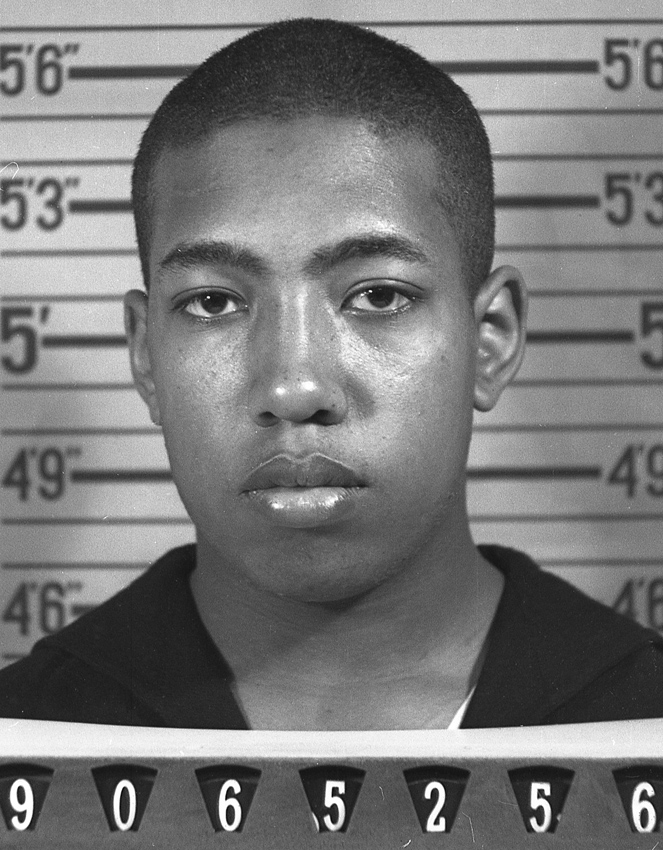
| Residences | Civilian Occupation |
| Georgia, Delaware | Worker for Eastern Malleable Iron Company |
| Branch | Service Number |
| U.S. Naval Reserve | 9065256 |
| Theater | Vessel |
| Pacific | U.S.S. Gilmer (APD-11) |
Early Life & Family
John Bryant was born in Baxley, Georgia, on May 16, 1925. He was the son of Elton and Lily (also spelled Lillie or Lilly) Bryant (née Cooper). He had at least two siblings, Rose (also known as Rosa or Rosie) and William Bryant. His brother also served in the U.S. Navy during World War II.
Census records indicate that the family moved to Wilmington, Delaware, by April 1, 1935. Bryant’s parents were listed in the 1938 Wilmington directory as living at 1132 Chippey Street.
Bryant was recorded on the census on April 11, 1940, living with his parents at 625 West 7th Street in Wilmington. His father was listed as working at a service station garage and his mother as a maid. He dropped out of school in 1941 after completing the 9th grade at Howard High School.
When he registered for the draft on May 17, 1943, Bryant was living with his mother at 1001 B Street in the Southbridge neighborhood of Wilmington. According to his personnel file, Bryant’s hobbies included pool. He was Baptist.
From around May 1942 until November 1943, Bryant worked as a bench molder for the Eastern Malleable Iron Company on New Castle Avenue in Wilmington, earning $300 a month. His qualification record stated that he “MADE MOLDS ON BENCH BY HAND. PACKED & RAMMED SAND AROUND PATTERNS. SMOOTHED SAND. ALSO POURED STEEL INTO MOLD.” Before he was drafted, Bryant briefly worked as an overlay surfacing operator at a factory that manufactured asphalt shingles and roll roofing.
On January 13, 1944, at the direction of Wilmington Local Board No. 4, Bryan was examined to evaluate suitability for military service. At the time, he was described as standing five feet, five inches tall and weighing 169 lbs. The board classified Bryant as I-A, and he was drafted soon after.
Military Career
After he was drafted, Bryant requested naval service, making him what the U.S. Navy termed a “selective volunteer.” Bryant joined the U.S. Naval Reserve in Camden, New Jersey, on March 20, 1944, and was appointed a steward’s mate 3rd class. The same day, he reported for five weeks of training at the U.S. Naval Training Station, Bainbridge, Maryland. The U.S. armed forces were segregated during the World War II era. Black sailors like Bryant typically had limited career paths open to them. With few exceptions, they could serve only as cooks and stewards for officers. There was almost no opportunity to become a petty officer.
After completing boot camp on April 24, 1944, Bryant was promoted to steward’s mate 2nd class and received recruit leave until May 3, 1944. On May 9, he was ordered to head west to the Training and Distribution Center, Shoemaker, California, located southeast of Oakland. He reported for duty there five days later.
On July 6, 1944, Steward’s Mate 2nd Class Bryant transferred to Pre-Embarkation Barracks, U.S. Naval Training and Distribution Center, Treasure Island, California, located in San Francisco Bay. During September 7–13, 1944, he was hospitalized at the U.S. Naval Hospital, Treasure Island, California. On September 14, 1944, he was transferred back to Shoemaker.
Steward’s Mate 2nd Class Bryant joined the crew of the U.S.S. Gilmer (APD-11) on September 28, 1944. Gilmer had originally been commissioned as destroyer in 1919 but was converted to a high-speed transport during World War II. Like many other high-speed transports, Gilmer served as an Underwater Demolition Team (U.D.T.) base of operations. When Bryant was assigned to her crew, Gilmer had just arrived back at the Mare Island Navy Yard, California, following the Marianas campaign. U.D.T.s performed beach reconnaissance and cleared obstacles in advance of amphibious operations.
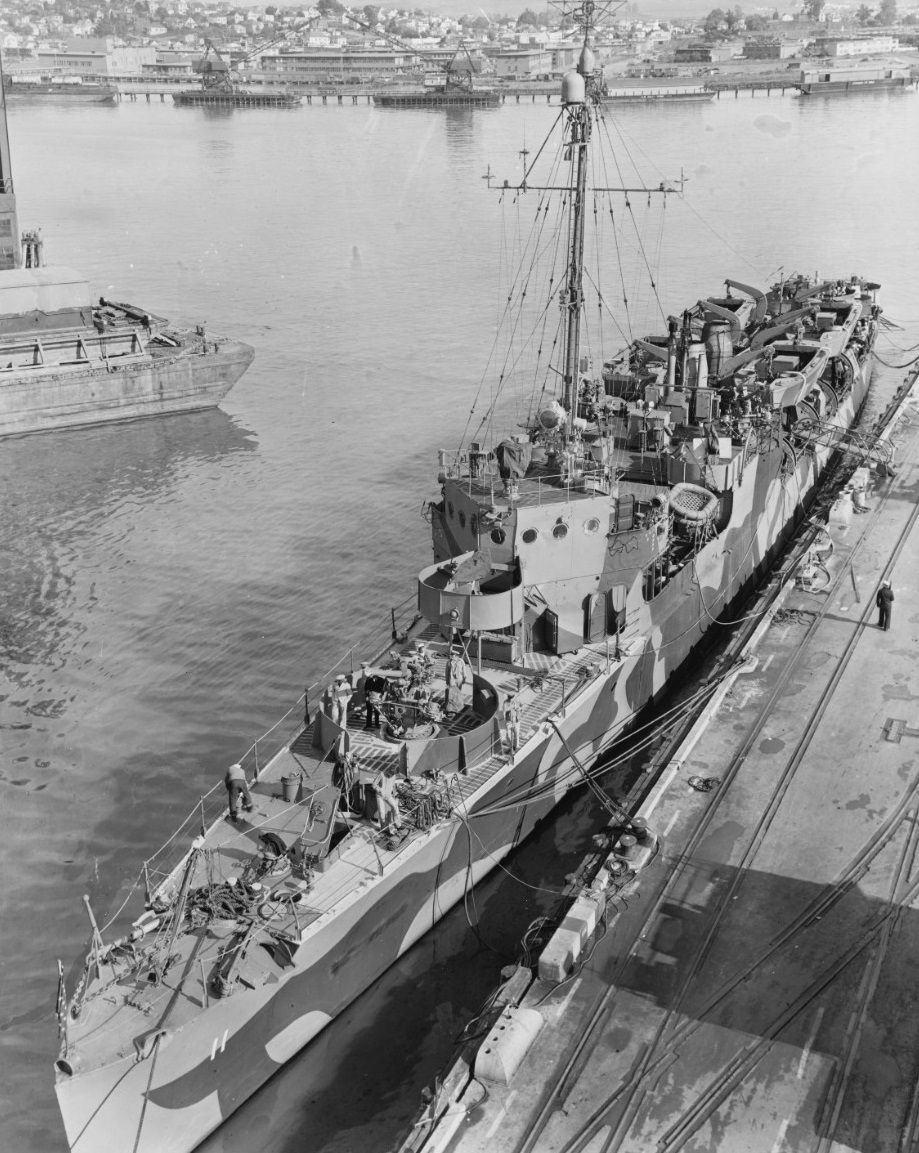
Bryant left his ship on leave at noon on October 27, 1944. He apparently headed east to visit his family, but for some reason he did not begin his return journey as his leave drew to a close. Although he was due back to his ship in California at noon on November 11, Bryant instead surrendered at the Receiving Station, Philadelphia, Pennsylvania, at 1100 hours the same day. Two hours later, he left Philadelphia en route to Mare Island, California. He arrived at 0600 on November 15 and was charged with being absent over leave by three days and 18 hours.
During a captain’s mast on November 15, 1944, Bryant was sentenced to four days confinement. He served his sentence at the Naval Prison, Mare Island Navy Yard, California, during November 15–18, 1944, and then rejoined his crew.
Iwo Jima & Okinawa
Following its overhaul, Gilmer operated with Transport Division 101 of the U.S. Fifth Fleet as the flagship of ComUDTsPhibsPac (Commander Underwater Demolition Teams, Amphibious Forces Pacific Fleet), Captain Byron Hall Hanlon (1900–1977). Hanlon and his staff coordinated multiple Underwater Demolition Teams and support units.
Gilmer’s crew participated in several rehearsals for the upcoming invasion of Iwo Jima. The first set of rehearsals took place off Maui, Hawaii, from December 30, 1944, through January 2, 1945. Bryant was promoted to steward’s mate 1st class on February 1, 1945. Soon after, Gilmer took part in further rehearsals at the major American base of Ulithi in the Caroline Islands on February 3 and 6, 1945, followed by Saipan in the Marianas on February 12–13, 1945.
U.S.S. Gilmer arrived off Iwo Jima at 0700 hours on February 16, 1945. Beach reconnaissance began the following day. On the evening of February 18, 1945, Gilmer rushed to the aid of another high-speed transport, U.S.S. Blessman (APD-48), which had been bombed by a Japanese plane, killing 40 men. For hours, Gilmer’s crew fought fires and evacuated the wounded.
On March 9, 1945, off Leyte, Philippine Islands, the Gilmer participated in rehearsals for the upcoming invasion of Okinawa. Then, on March 21, Gilmer sailed from Ulithi, arriving off the Ryukyu Islands at 0645 on March 25.
Although career opportunities for black sailors were sharply limited, in combat, every member of the crew had a battle station. Bryant was assigned to a gun station by the galley deckhouse.
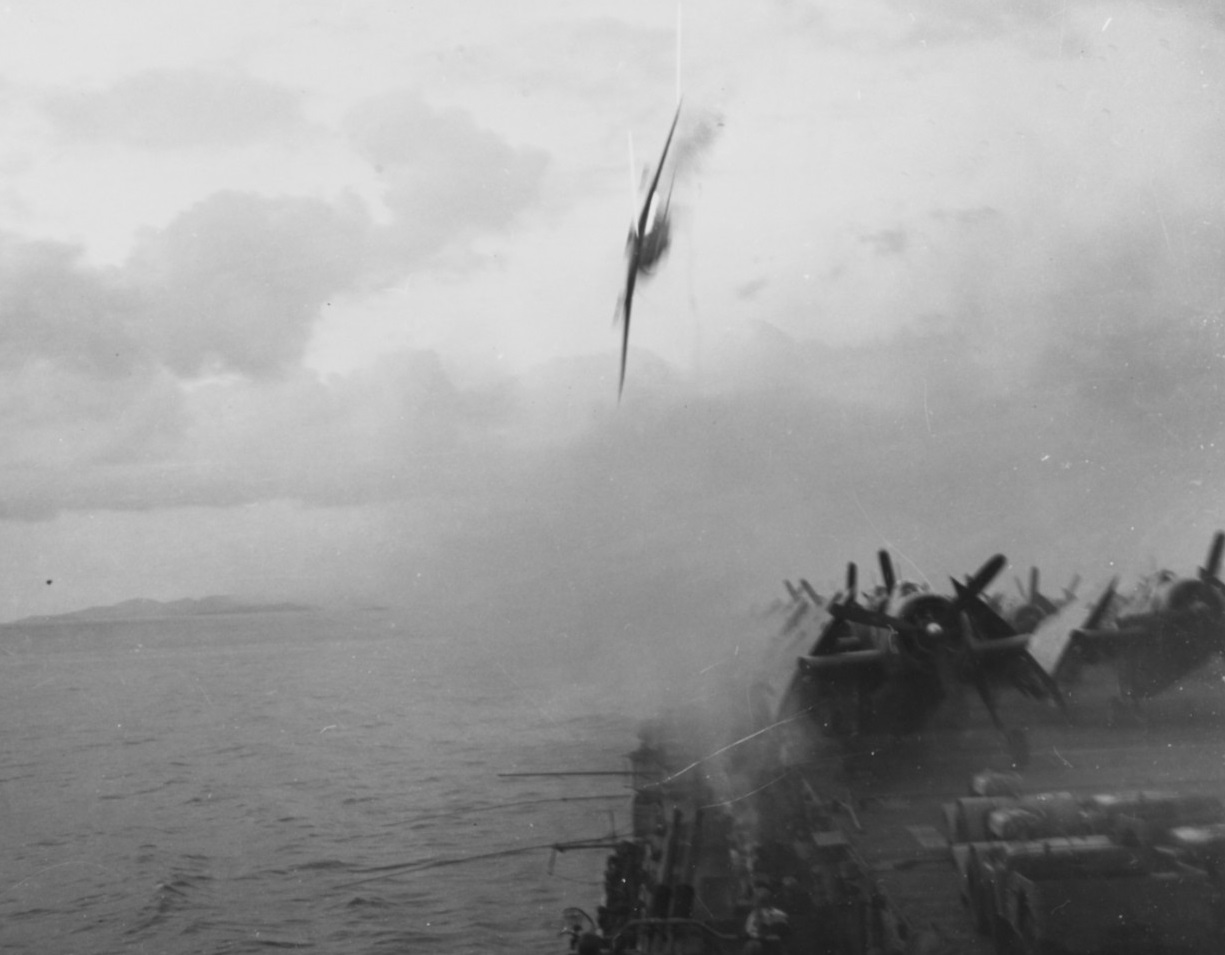
On March 26, 1945, U.S.S. Gilmer was sailing along with other high-speed transports near Okinawa when she came under attack by a Japanese Kawasaki Ki-61 “Tony.” It was three days before Underwater Demolition Team operations would commence in preparation for the main landings on April 1. For the past several months, the Japanese had employed aircraft not only for conventional attacks but also as suicide planes, referred to by the Americans as kamikazes. Gilmer’s war diary stated:
At 0625, two enemy planes were sighted. One TONY approached this vessel from starboard bow passing overhead from bow to stern under partial cloud concealment. The plane made a complete circle, banking to attack run when again off starboard bow – – range 1500 yards, altitude 2500 feet, elevation 40 degrees. GILMER opened fire with 3″/50 and automatic weapons shortly before plane banked to attack course.
In his action report, Gilmer’s commanding officer, Lieutenant Walter Charles Quant (1919–1993), wrote that the transport increased speed but could not perform any other evasive maneuvers due to the proximity of nearby vessels. The kamikaze strafed the ship during its attack run. Quant wrote that the “gun crews continued to man and fire their guns in the face of, both a certain suicider and strafing, until their guns would no longer bear.” The transport’s crew observed some of their .50 machine gun rounds strike the enemy plane, but the kamikaze pilot pressed the attack.
Quant continued in his report:
When plane had nearly reached this ship it winged over, severing main radio antenna and both the whistle and siren cords. Plane then literally skidded across galley deckhouse superstructure striking 3″/50 cal. ready service chest, parting port life line, and plunging over the side[.]
Although Gilmer sustained only light damage during the attack, Bryant was killed. In his summary of facts on Bryant’s death certificate, Lieutenant (Junior Grade) Leonard Troast, Gilmer’s medical officer, wrote that Bryant “was at his gun station at the time of the” strike. The impact of the enemy plane inflicted “gross injury to the head, neck, shoulders, and arms.” The attack also wounded three of Bryant’s shipmates. Steward’s Mate Johnnie Leroy Crawford (c. 1925–2017), Seaman 2nd Class William Jerome Mowbray, Jr. (1917–2014), and Signalman 3rd Class Charles William Strickland (1925–1986) all sustained minor lacerations.
Bryant was buried at sea the following day. The March 27 war diary reported: “At 1700, stopped all engines and held burial service for stewards mate John BRYANT, who was killed in yesterday’s action.”
Steward’s Mate 1st Class Bryant was posthumously awarded the Purple Heart. For the collective performance of her crew during seven operations, including Iwo Jima and Okinawa, U.S.S. Gilmer was awarded the Navy Unit Commendation.
Since Steward’s Mate 1st Class Bryant was buried at sea, his name was included on the Courts of the Missing at National Memorial Cemetery of the Pacific in Hawaii. He is also honored at the Peace Park Memorial on Okinawa and at Veterans Memorial Park in New Castle, Delaware.
Bibliography
Delaware Marriages. Bureau of Vital Statistics, Hall of Records, Dover, Delaware. https://www.ancestry.com/imageviewer/collections/61368/images/TH-267-12445-31065-25
“History of the U.S.S. Gilmer.” January 1946. Muster Rolls of U.S. Navy Ships, Stations, and Other Naval Activities, 1/1/1939–1/1/1949. Record Group 24, Records of the Bureau of Naval Personnel. National Archives at College Park, Maryland. https://www.fold3.com/image/302049974/war-history-page-1-wwii-war-diaries
Muster Rolls of U.S. Navy Ships, Stations, and Other Naval Activities, 1/1/1939–1/1/1949. Record Group 24, Records of the Bureau of Naval Personnel. National Archives at College Park, Maryland. https://www.ancestry.com/imageviewer/collections/1143/images/32859_242885-00404 (September 1944), https://www.ancestry.com/imageviewer/collections/1143/images/32859_242885-00422 (November 1944), https://www.ancestry.com/imageviewer/collections/1143/images/32859_242885-00462 (February 1945), https://www.ancestry.com/imageviewer/collections/1143/images/32859_242885-00470 (March 1945)
Official Military Personnel File for John Bryant. Official Military Personnel Files, 1885–1998. Record Group 24, Records of the Bureau of Naval Personnel. National Archives at St. Louis, Missouri.
Polk’s Wilmington (New Castle County, Del.) City Directory 1938. R. L. Polk & Company Publishers, 1938. https://www.ancestry.com/imageviewer/collections/2469/images/16149922
Quant, Walter C. “Action Report 1–45, Iwo Jima Operation, 16 to 24 February, 1945.” March 18, 1945. World War II War Diaries, 1941–1945. Record Group 38, Records of the Office of the Chief of Naval Operations. National Archives at College Park, Maryland. https://www.fold3.com/image/295416358/rep-of-ops-in-support-of-the-invasion-of-iwo-jima-bonin-is-216-2445-page-1-wwii-war-diaries
Quant, Walter C. “Action Report 2–45 – Ryukyu Islands Operation.” April 25, 1945. World War II War Diaries, 1941–1945. Record Group 38, Records of the Office of the Chief of Naval Operations. National Archives at College Park, Maryland. https://www.fold3.com/image/296589249/rep-of-opers-in-the-invasion-of-the-okinawa-gunto-ryukyu-islands-32545-4945-page-2-wwii-war-diaries
Quant, Walter C. “War Diary – U.S.S. GILMER (APD 11).” April 20, 1945. World War II War Diaries, 1941–1945. Record Group 38, Records of the Office of the Chief of Naval Operations. National Archives at College Park, Maryland. https://www.fold3.com/image/295796225
Sixteenth Census of the United States, 1940. Record Group 29, Records of the Bureau of the Census. National Archives at Washington, D.C. https://www.ancestry.com/imageviewer/collections/2442/images/m-t0627-00549-00784
“Southbridge Man Killed in Pacific.” Wilmington Morning News, May 30, 1945. https://www.newspapers.com/clip/120765636/john-bryant-kia/
WWII Draft Registration Cards for Delaware, 10/16/1940–3/31/1947. Record Group 147, Records of the Selective Service System. National Archives at St. Louis, Missouri. https://www.ancestry.com/imageviewer/collections/2238/images/44003_08_00001-01636
Last updated on August 16, 2023
More stories of World War II fallen:























To have new profiles of fallen servicemembers delivered to your inbox, please subscribe below.
 Delaware's World War II Fallen