| Residences | Civilian Occupation |
| Pennsylvania, Delaware | Faculty at the Sunny Hills School |
| Branch | Service Number |
| U.S. Army Air Forces | 13046298 |
| Theaters | Unit |
| European, Mediterranean | 32nd Bombardment Squadron (Heavy), 301st Bombardment Group (Heavy) |
| Awards | Entered the Service From |
| Air Medal with two oak leaf clusters, Purple Heart (presumed) | Hockessin, Delaware |
Early Life & Family
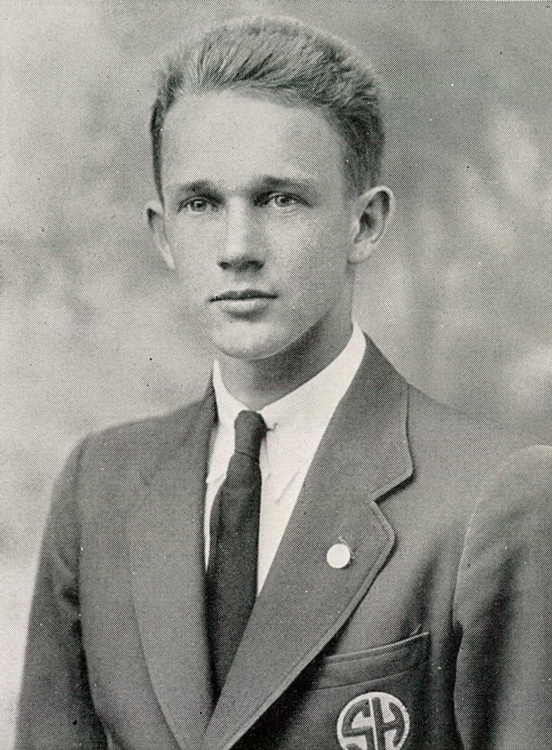
William Thompson Stewart, III was born on December 12, 1917, likely in Ardmore, Pennsylvania. He was the only child of William Thompson Stewart, Jr. (1887–1948) and Margaret Belcher Stewart (1888–1948).
The Stewart family was recorded on the census on January 26, 1920, living at 75 Cooperstown Road in Haverford Township, Delaware County, Pennsylvania. His father was working as an insurance agent at the time. Stewart was not recorded on any indexed 1930 census records, but the following census stated that he was living in Philadelphia as of April 1, 1935. That September, as a high school junior, Stewart began attending Sunny Hills School, a boarding school in Hockessin, Delaware. Sunny Hills had officially opened in 1930, but its high school, known as the Upper School, was new during the 1935–1936 school year. (Sunny Hills still exists as a private school, now known as the Sanford School.)
At Sunny Hills, Stewart met his future wife, Barbara Frances Kelsey (1919–2001). Kelsey was born in Washington, D.C., and raised in Grosse Pointe, Michigan. She arrived in Delaware in June 1935. The class was small and tight-knit, with just two boys and three girls during their junior year, later increased to three boys and four girls during senior year, including Barbara’s brother, Harry Mitchell Kelsey (1920–1994).
In a class history included in their yearbook, The Chrysalis, Wilbert B. Swift and Harry M. Kelsey wrote that “within half an hour of their assembling, in spite of being total strangers, the members of the class were found dancing together like old friends.” They added that “BK, as Barbara soon came to be known, and Stewie, né Bill Stewart, found out for the first time the joys of organized sports[.]”
Swift and Harry Kelsey continued:
In June [1936] the first Gavel Banquet was held. At a farewell dinner at the end of the year Mother [school founder Ellen Quigley Sawin] unexpectedly made it known that she was going to present a gavel to the boy and girl of the junior class who was most worthy of the ideals of the school, who were to take the responsibility of the boys and girls in their senior year. The gavel, amid many cheers, was presented to BK and Stewie.
During his senior year, Stewart played center on the school football team (which apparently numbered just 11 boys!), while Barbara Kelsey played on the field hockey team. The yearbook recorded miscellaneous memories from their senior year, including “Stewie wading around in the lake planting lilies” and “climbing one of the pines to get a picture of a baseball game, and dropping his camera from the top[.]” Stewart’s page in the yearbook described him:
He is a good leader, and quick to grasp a situation. He is brilliant at mechanics, and enjoys art, particularly etching, and has served as Art Editor of “The Chrysalis.” In digging deep into things that interest him, and in his willingness and cooperation, combined with a will to do things, he always gets to the top.
Shortly before the end of the school year, the seniors spent a weekend at Rehoboth Beach, Delaware. Stewart and his six classmates were the first graduating class at Sunny Hills School in 1937.
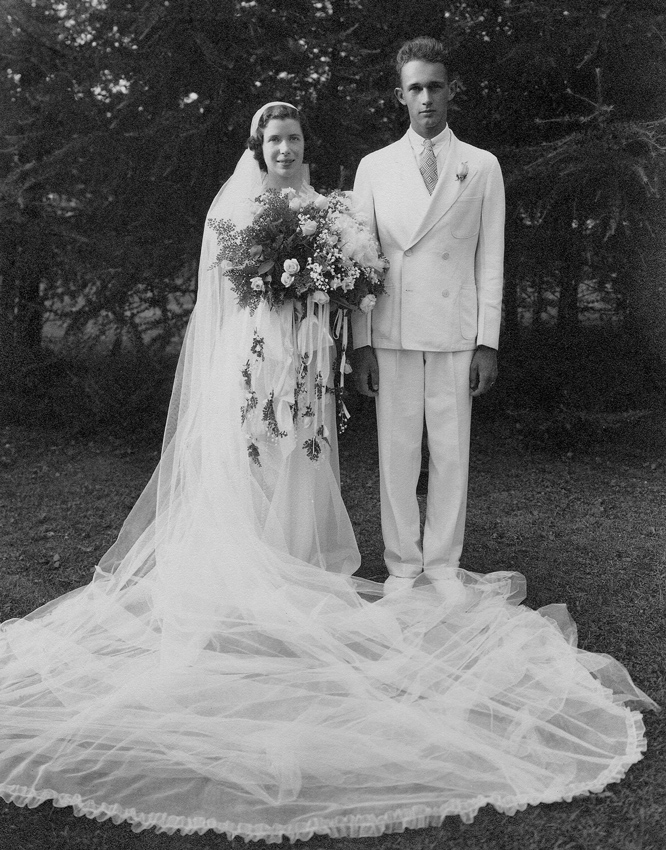
The Detroit Free Press announced Stewart’s engagement to Barbara Kelsey on May 18, 1938. The couple wed on the lawn at Sunny Hills School on the evening of June 17, 1938. The Wilmington Morning News reported:
After a honeymoon in Rehoboth Beach the couple will reside at Sunny Hills School where the bridegroom is assistant to the treasurer. The bride will be a member of the kindergarten faculty in the fall. Both young people are graduates of Sunny Hills School and will return before July 1 to assist with the summer school and camp there.
On October 20, 1939, the Stewarts’ only child, Barbara Ellen Stewart (1939–2019), was born in Wilmington, Delaware. The family was recorded on the census on April 30, 1940, living at the Sunny Hills School along with other staff members. Stewart was described as working in the maintenance department and his wife as a teacher at the school. Later that year, when he registered for the draft on October 16, 1940, Stewart was still living and working at Sunny Hills. The registrar described him as standing five feet, 10 inches tall and weighing 135 lbs., with brown hair and blue eyes. He was Protestant according to his military paperwork.
Journal-Every Evening reported on March 11, 1941, that Stewart was the chairman of a new Boy Scout troop at Sunny Hills School.
Military Career
About a month after the attack on Pearl Harbor, Stewart volunteered for the U.S. Army Air Forces. He enlisted as a private in Philadelphia, Pennsylvania, on January 6, 1942. His wife and daughter moved to be with the Kelsey family in Michigan.
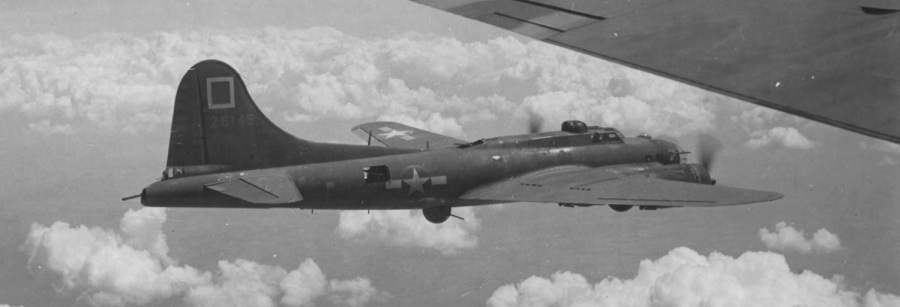
Documents in Stewart’s Individual Deceased Personnel File (I.D.P.F.) summarized his stateside service. Private Stewart attended basic training at Sheppard Field, Texas, during January and February 1942. He then moved to Fort Logan, Colorado. Private Stewart was with the 23rd School Squadron there as of March 18–28, 1942. In April 1942, he transferred to Geiger Field, Washington. There, he joined the 32nd Bombardment Squadron (Heavy) of the 301st Bombardment Group (Heavy). The unit was equipped with Boeing B-17 Flying Fortresses. A squadron roster dated May 2, 1942, listed Private Stewart as a clerk.
In May 1942, Stewart moved to Alamogordo, New Mexico, with the rest of his unit’s ground echelon. He was stationed at Fort Dix, New Jersey, during July and August 1942 before going overseas that same month. He likely shipped out from Bayside, Long Island, aboard the troop ship S.S. Uruguay, on August 6, 1942, arriving at Swansea, Wales, on August 18.

The 301st Bomb Group was briefly assigned to the Eighth Air Force and flew its first mission from England against Rouen in occupied France on September 5, 1942. However, on September 14, the group was transferred to the Twelfth Air Force, which was scheduled to be deployed to the Mediterranean Theater after the beginning of Operation Torch, the invasion of French North Africa, in November 1942. A few weeks after the invasion, the 32nd Bomb Squadron moved to Algeria, with the ground echelon following by sea.
During subsequent months, the squadron mainly flew missions against targets in Tunisia, though there were a few missions to Libya, Sardinia, and Sicily. As the Tunisian campaign drew to a close in the spring of 1943, missions began to focus more heavily on Sardinia, Sicily, Pantelleria, and mainland Italy.
By April 6, 1943, Stewart had been promoted to sergeant. At some point, he became an aerial photographer. He was promoted to staff sergeant prior to September 1, 1943. (On that date he was reduced to the grade of sergeant, apparently for administrative reasons, though the reduction was later revoked, restoring him to the grade of staff sergeant. See the Notes section for further information.)
While overseas, he encountered another Sunny Hills alumnus and future newspaperman, Sergeant James Allen Gallery, Jr. (1922–1988), a B-17 tail gunner who was wounded during a mission flown from North Africa in April 1943.
In early August 1943, the 32nd Bomb Squadron moved to Oudna Airfield No. 2, Tunisia. On October 1, 1943, squadron launched its first raid on Germany. That fall, the 32nd conducted raids on northern Italy, Greece, Austria, and France. At the beginning of November 1943, the 301st Bomb Group was transferred to the newly organized Fifteenth Air Force.
Final Mission
On the morning of November 2, 1943, Sergeant Stewart took off from Oudna aboard B-17F 42-30111, flying as an aerial photographer with a crew led by 1st Lieutenant John N. Gibson, Jr. (1918–1943), for a raid against the aircraft factory at Wiener Neustadt, Austria. There were 23 B-17s from the 301st Bomb Group assigned to the mission, of which three aborted due to mechanical issues.
Personnel effects that Stewart left behind at the airfield included a Mimo wristwatch, a New Haven pedometer, a Shaeffer fountain pen, a souvenir knife from North Africa, a box of photographs, and a box of 128 souvenir coins.
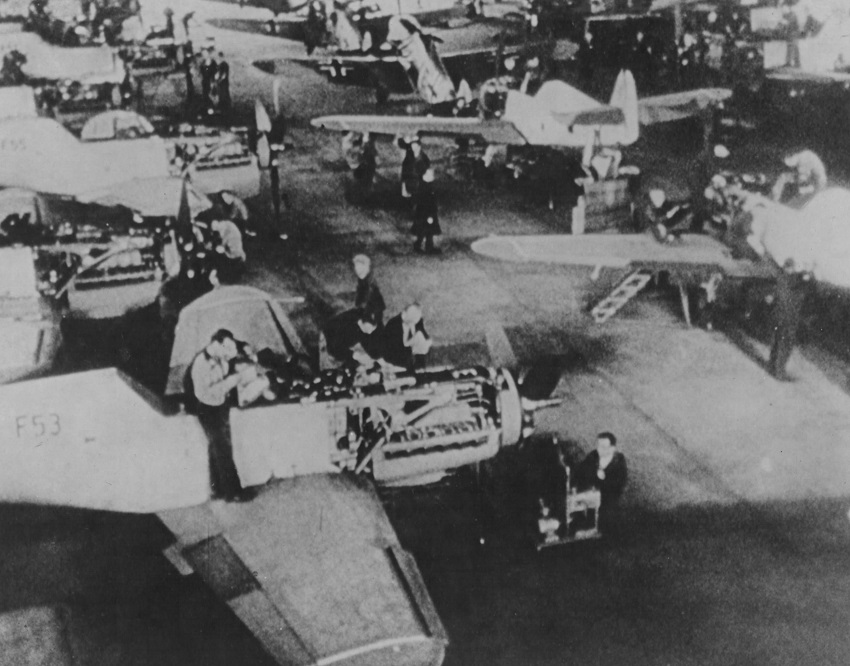
20 minutes from the target, German fighters pounced. Roughly 40 to 45 Messerschmitt Bf 109s and Focke-Wulf Fw 190s pressed their attacks all the way to the target. German fighters shot down four B-17s, including Stewart’s, all of them from the 32nd Bomb Squadron. The plane went down around 1315 hours, apparently just after bombing the target.
A participant in the mission, Staff Sergeant Kenneth R. Bayless, later wrote:
I was flying Tail Gun on A/C 42-30333 and A/C #42-30111 was leading the second element of our squadron. The fighters came in on 111’s tail and I believe the Tail Gunner was killed in the first attack as the whole tail was completely in shreds from the attack.
Staff Sergeant Alexander Walker, ball turret gunner aboard Bayless’s plane, wrote:
The Fighters attacked A/C 42-30111 and sprayed the whole plane from tail to Cock-pit and the plane slipped to the left and fell quite aways [sic] behind. The Fighters then left this plane alone believing it was going down and started attacking A/C 42-3391 which they hit and knocked down, and 111 came back up into the position vacated by 391 and flew in this position for about two (2) minutes and the Fighters attacked him again[.]
Another witness, Sergeant Howard B. Campbell, wrote that during the second attack, “I believe they put a 20MM [cannon shell] in the Cock-pit possibly killing the Pilot and Co-Pilot[.]”
Staff Sergeant Walker continued:
111 slipped over to the right going over our tail almost taking off our stabilizer, the plane was out of control and then went down under the tail of 343, and it went into a big circle and circle kept tightening up as he went down and plane turned over on it’s [sic] back and started into a real tight spin. The right wing came off right next to the fuselage and then about half of the left wing fell off.
The B-17 crashed west of Prebuch, Austria. All 10 men aboard the B-17 were killed, including Sergeant Stewart. In total, the 301st Bomb Group lost 26 men killed and 11 men captured from the four downed B-17s. There were also two men wounded aboard the 19 planes that returned, eight of which were damaged by fighters and/or flak.
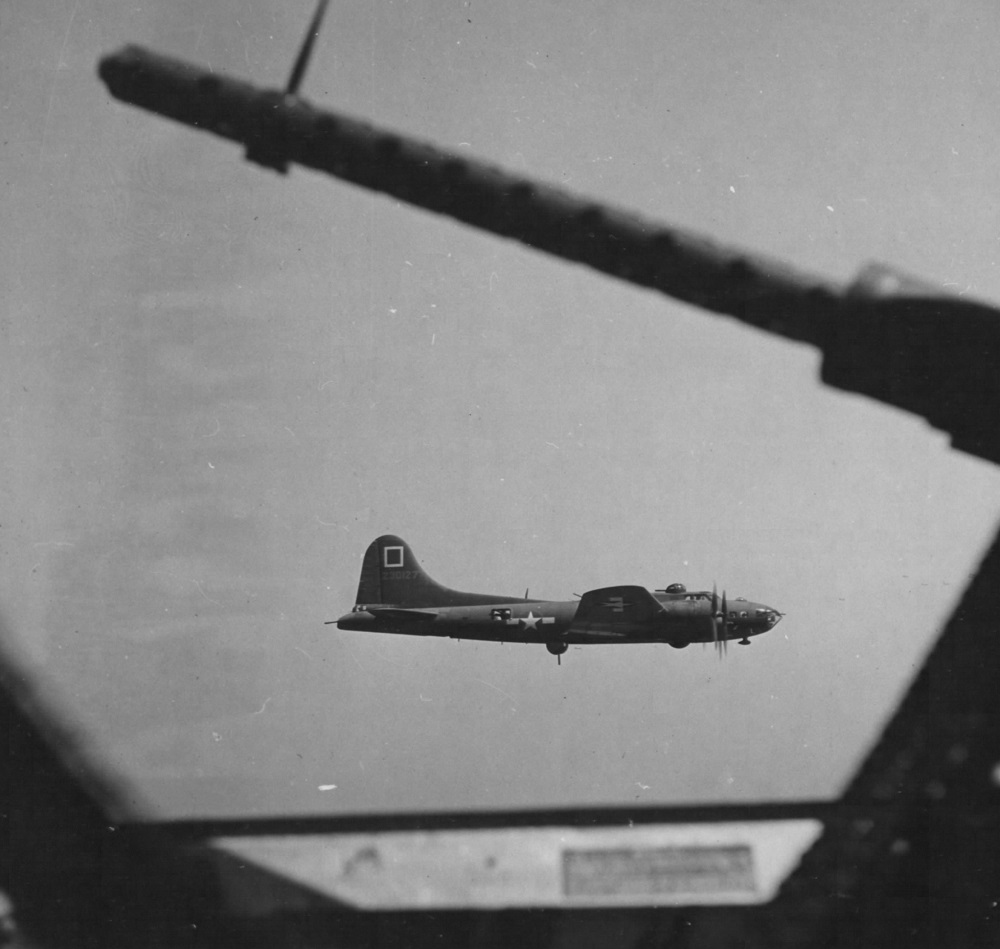
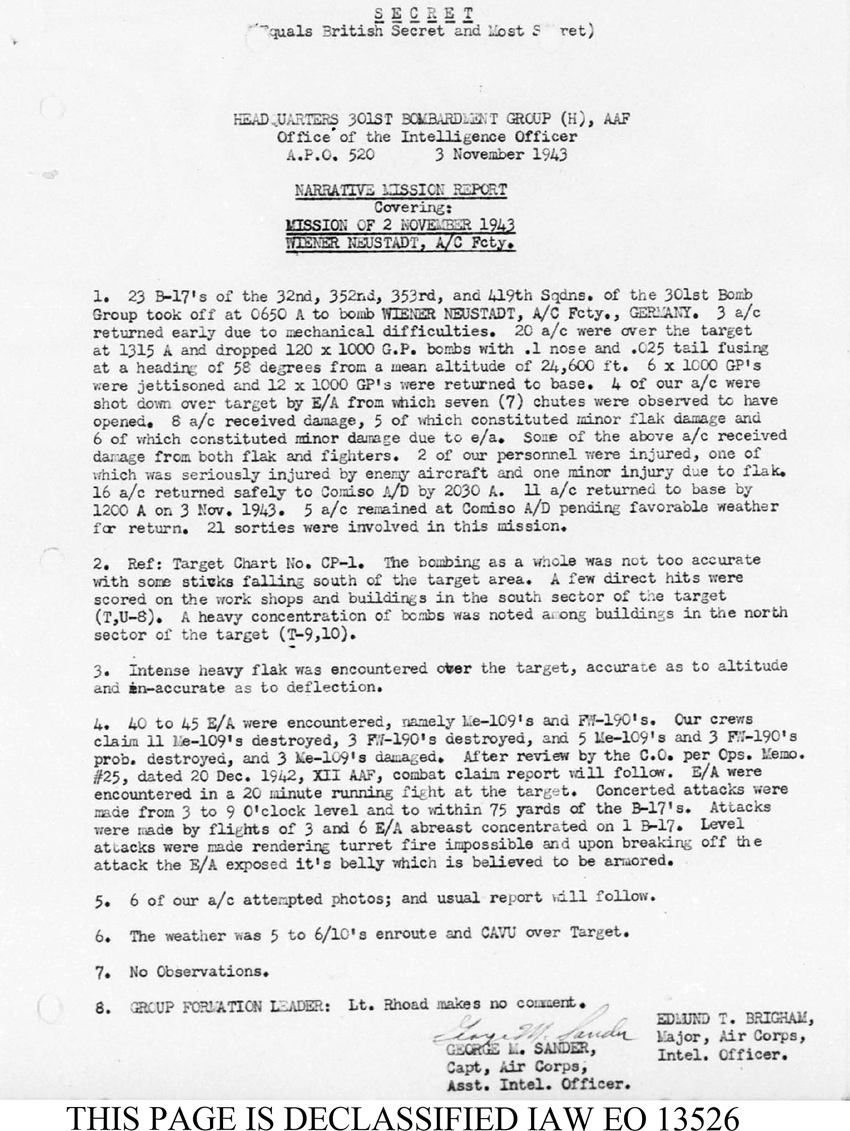
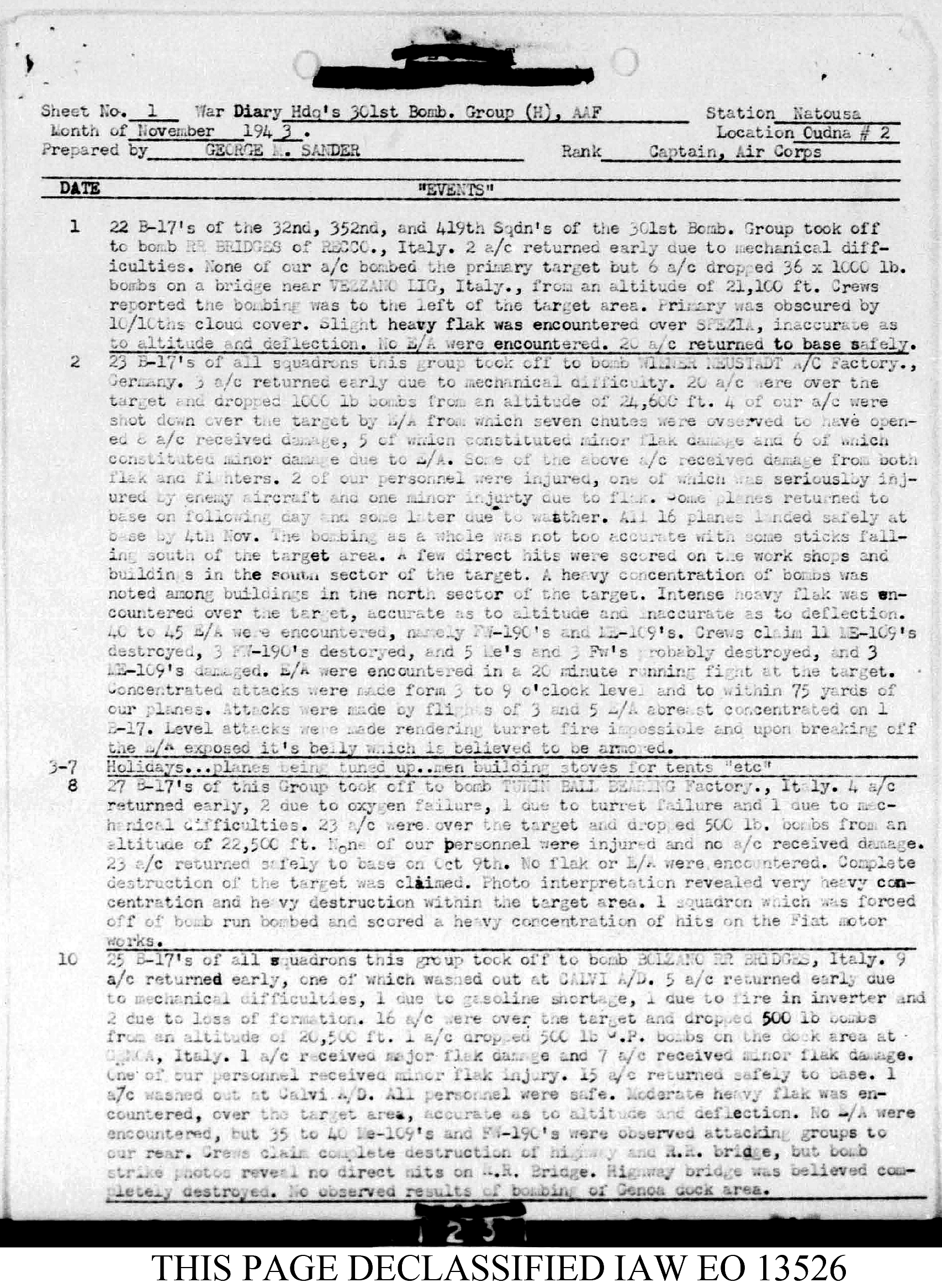
Considering the heavy casualties, the effect on the enemy’s war effort was disappointing. The group’s gunners claimed 14 enemy fighters destroyed and eight fighters probably destroyed, but such claims were typically inflated. The group war diary described the results of the mission:
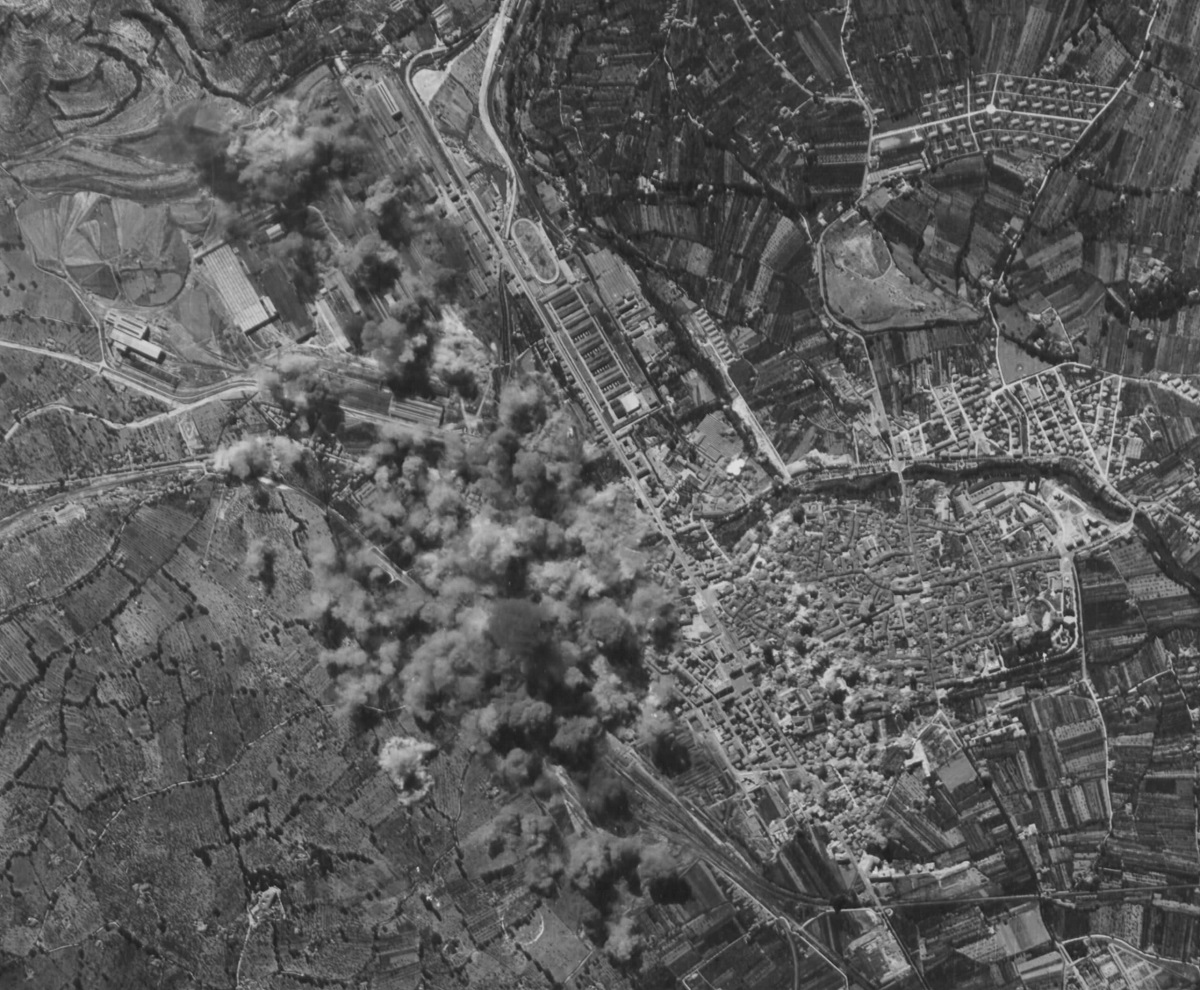
The bombing as a whole was not too accurate with some sticks falling south of the target area. A few direct hits were scored on the work shops and buildings in the south sector of the target. A heavy concentration of bombs was noted among buildings in the north sector of the target.
According to Stewart’s I.D.P.F., the crew was buried in a civilian cemetery at St. Ruprecht (presumably Sankt Ruprecht an der Raab). Later identification efforts may have been complicated because at least five men’s dog tags were removed before they were buried.
Given the facts of the case, in which several witnesses saw Stewart’s plane crash but no parachutes, and that no survivors were reported as prisoners of war by the Germans during the months after the crash, the military issued a finding of death, which legally declared Stewart dead a year and a day after his disappearance.
After the war, graves registration personnel recovered the remains of the crew and reburied them at a U.S. military cemetery at Saint-Avold, France. A member of the Quartermaster Corps Memorial Division wrote to Sergeant Stewart’s widow in a letter dated October 24, 1949, that remains had been recovered from her husband’s crew but since individual identification proved impossible for all but one man, the rest of the crew would be buried as a group at Zachary Taylor National Cemetery in Kentucky. They were reburied there for the final time on February 20, 1950.
Sergeant Stewart was posthumously awarded the Air Medal with two oak leaf clusters in lieu of additional awards per General Orders No. 21, Headquarters Fifth Wing, dated November 17, 1943. At the time, bomber aircrew in the Fifth Wing were typically awarded an Air Medal or oak leaf cluster for every five combat missions, suggesting that Sergeant Stewart had completed at least 15 missions prior to his death. Presumably, he was also awarded the Purple Heart.
Likely due to wife and daughter’s return to Michigan—and because his parents were Pennsylvanians—Stewart’s fate was not reported in the Delaware newspapers. Although the State of Delaware Public Archives Commission learned of his name from the official U.S. Army casualty list published after the war, its staff was unable to confirm that he was a Delawarean and omitted him from both the Delaware memorial volume and the list of names honored at Delaware Memorial Park.
Staff Sergeant Stewart’s widow remarried to E. Paul Madison (1922–1972) in Detroit, Michigan, on August 31, 1949. The couple raised Stewart’s daughter and three children of their own.
Crew of B-17F 42-30111 on November 2, 1943
The following list is based on Missing Air Crew Report No. 1093 with grade, name, service number, position, and status. Stewart served in the military without a suffix. Grades reflect the final one inscribed on their headstone, which is one grade higher than what is listed in the M.A.C.R. for Kirsch, Helm, Davis, and Stewart. Davis’s service number is also corrected from what was in the M.A.C.R. Sergeant Massone was the only member of the crew who was individually identified. He was buried at Saint John Cemetery in Middle Village, New York.
1st Lieutenant John N. Gibson, Jr., O-794653 (pilot) – K.I.A.
Flight Officer Robert L. Green, T-175 (copilot) – K.I.A.
2nd Lieutenant Bernard N. Brown, O-673473 (navigator) – K.I.A.
1st Lieutenant Roy H. Kirsch, Jr., O-738921 – K.I.A.
Technical Sergeant Clark J. Pugh, 35381495 (top turret gunner) – K.I.A.
Technical Sergeant Thomas J. Helm, 18083283 (radio operator) – K.I.A.
Staff Sergeant Walter E. Dessart, 12034670 (ball turret gunner) – K.I.A.
Sergeant Anthony J. Massone, 32312920 (waist gunner) – K.I.A.
Staff Sergeant Edward C. Davis, 31138877 (tail gunner) – K.I.A.
Staff Sergeant William T. Stewart, 13046298 (photographer) – K.I.A.
Notes
Birth and Residence Location
The Pennsylvania birth index listed Stewart’s place of birth as Montgomery County, supported by his high school yearbook, which stated he was born in Ardmore. Curiously, his draft card listed his place of birth as Philadelphia.
The 1938 engagement announcement described Stewart as a resident of Ardmore, Pennsylvania, though his marriage certificate listed his residence as nearby Upper Darby. It is unclear if he was commuting from Pennsylvania to Hockessin at that time.
Grade
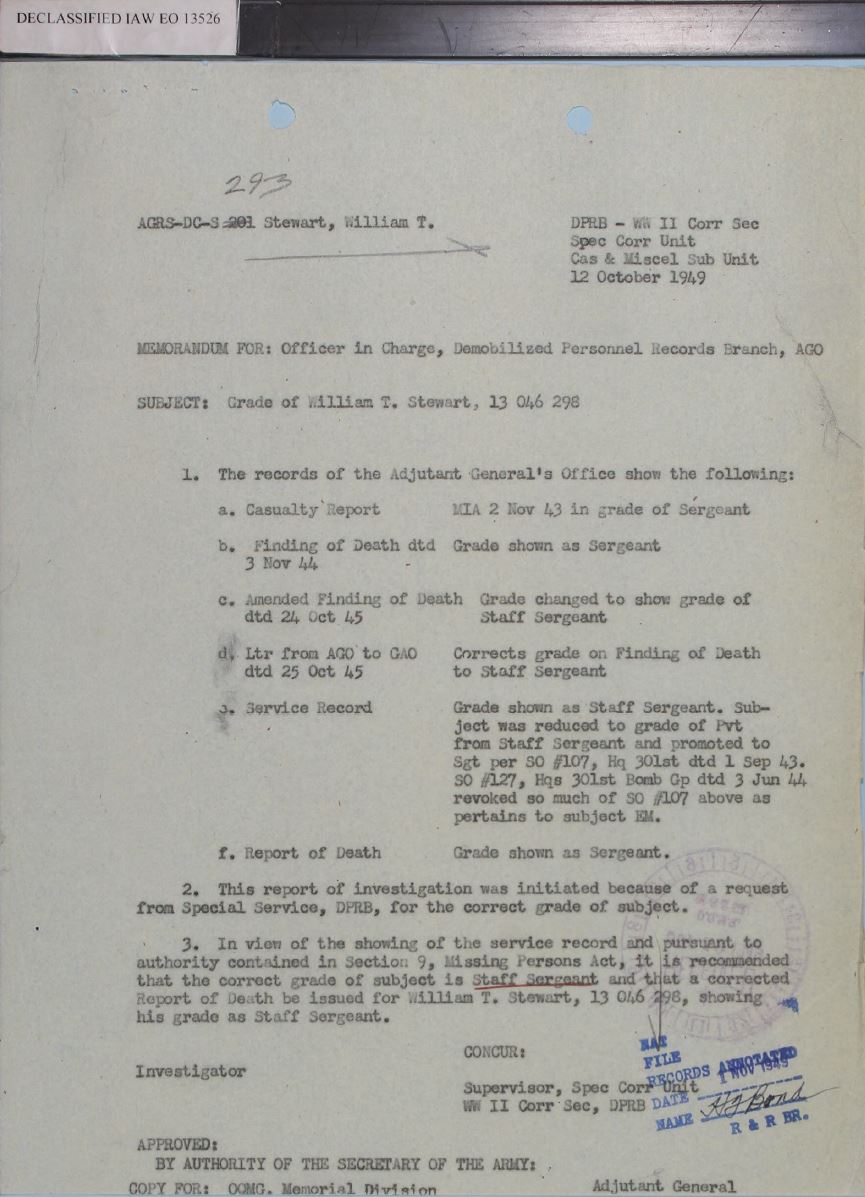
Stewart was listed as a sergeant in several records, including Missing Air Crew Report No. 1093 and the official U.S. Army casualty list published in 1946. The discrepancy was investigated after the war. The investigation found that he had been a staff sergeant as of September 1, 1943. Special Orders No. 107, Headquarters 301st Bombardment Group reduced him to private and then promoted him to sergeant. The reduction to private was a formality since an enlisted men could technically not just be reduced one grade. However, they could be reduced to private and immediately re-promoted. That this occurred in the same order suggested that the change was administrative (such as a change in the unit’s tables of organization) rather than due to misconduct.
Special Orders No. 127 dated June 3, 1944, revoked the portion of Special Orders No. 107 pertaining to Stewart. In effect, this posthumously returned him to the grade of staff sergeant, though as far as his status was concerned, Stewart was still missing in action since the finding of death was not issued until a year and a day after his plane was shot down.
Sequence of Events
The eyewitness statements attached to Missing Air Crew Report No. 1093 do not make it clear whether Stewart’s B-17 was shot down before or after reaching the target. The report stated the plane was seen to crash at 1315 hours. The mission narrative report stated that 20 B-17s (i.e., all the planes that did not abort the mission) reached the target at the same time, 1315. The report stated that enemy fighters hounded the bombers for 20 minutes approaching the target but did not whether they pressed the attack after bombs away.
The crash site was about 50 miles south of the target, a minimum of 10 minutes of flying time for a B-17. If the mission report is correct that all the B-17s reached the target, then Stewart’s B-17 was shot down while returning to base.
Acknowledgments
Special thanks to Jean Makin Brown for the use of her photo, which originally came from the collection of Sergeant Stewart’s aunt, Dorothy Belcher Makin.
Bibliography
“1917 Births.” Pennsylvania Historical & Museum Commission. https://www.phmc.pa.gov/Archives/Research-Online/Documents/1917-S.PDF
Air Force Award Cards. Record Group 64, Records of the National Archives and Records Administration. National Archives at St. Louis, Missouri. https://catalog.archives.gov/id/143857581?objectPage=785
“City Gunner Home With Family After 20 Missions Against Nazis.” Journal-Every Evening, February 24, 1944. https://www.newspapers.com/clip/118412592/sunny-hills-school-alumni-in-usaaf/
Delaware Marriages. Bureau of Vital Statistics, Hall of Records, Dover, Delaware. https://www.familysearch.org/ark:/61903/3:1:S3HT-61G9-Z9V
“Engagement Told.” Detroit Free Press, May 18, 1938. https://www.newspapers.com/clip/118410759/stewart-kelsey-engagement/
Fourteenth Census of the United States, 1920. Record Group 29, Records of the Bureau of the Census. National Archives at Washington, D.C. https://www.ancestry.com/imageviewer/collections/6061/images/4384989_00195
Graves, G. A. “Special Outline History.” Thirty Second Bombardment Squadron, November 22, 1943. Reel B0209. Courtesy of the Air Force Historical Research Agency.
“Group History 301st Bombardment Group (H), AAF Covering Period: 24 May, 1942 – 1 October, 1942.” Reel B0208. Courtesy of the Air Force Historical Research Agency.
Henry, Stephen W. “Missing Air Crew Report No. 1093.” Record Group 92, Records of the Office of the Quartermaster General, 1774–1985. The National Archives at College Park, Maryland. https://catalog.archives.gov/id/90901098?objectPage=2
Index to WWII Deceased Servicemen. Delaware Public Archives, Dover, Delaware. https://www.familysearch.org/ark:/61903/3:1:3Q9M-CS3B-6Q9X-Z
Interment Control Forms, 1928–1962. Record Group 92, Records of the Office of the Quartermaster General, 1774–1985. National Archives at College Park, Maryland. https://www.ancestry.com/imageviewer/collections/2590/images/40479_1521003240_0533-01982
Kelsey, Barbara F. “History of Sunny Hills.” The Chrysalis 1937. https://www.ancestry.com/imageviewer/collections/1265/images/43135_b173091_00026
“Miss Barbara Kelsey Mr. William T. Stewart III.” Wilmington Morning News, June 15, 1938. https://www.newspapers.com/clip/118411912/kelsey-stewart-wedding/
“New Boy Scout Troop Formed at Sunny Hills.” Journal-Every Evening, March 11, 1941. https://www.newspapers.com/clip/118417815/stewart-boy-scouts-at-sunny-hills/
“Rosters of 32nd Personnel on March 12th and May 2nd, 1942.” 32nd Bomb Squadron website. https://www.32ndbombsquadron.org/roster-1942.html
Sander, George M. and Brigham, Edmund T. “Narrative Mission Report Covering: Mission of 2 November 1943 Wiener Neustadt, A/C Fcty.” Headquarters 301st Bombardment Group (H), AAF, November 3, 1943. Reel B0209. Courtesy of the Air Force Historical Research Agency.
Sixteenth Census of the United States, 1940. Record Group 29, Records of the Bureau of the Census. National Archives at Washington, D.C. https://www.ancestry.com/imageviewer/collections/2442/images/m-t0627-00546-00046
Swift, Wilbert B. and Kelsey, Harry M. “1937 Class History.”The Chrysalis 1937. https://www.ancestry.com/imageviewer/collections/1265/images/43135_b173091_00012
William T. Stewart Individual Deceased Personnel File. Courtesy of U.S. Army Human Resources Command.
World War II Army Enlistment Records. Record Group 64, Records of the National Archives and Records Administration. National Archives at College Park, Maryland. https://aad.archives.gov/aad/record-detail.jsp?dt=893&mtch=1&cat=all&tf=F&q=13046298&bc=&rpp=10&pg=1&rid=703042
WWII Draft Registration Cards for Delaware, 10/16/1940–3/31/1947. Record Group 147, Records of the Selective Service System. National Archives at St. Louis, Missouri. https://www.ancestry.com/imageviewer/collections/2238/images/44003_11_00005-01584
Last updated on August 22, 2023
More stories of World War II fallen:
To have new profiles of fallen soldiers delivered to your inbox, please subscribe below.
 Delaware's World War II Fallen