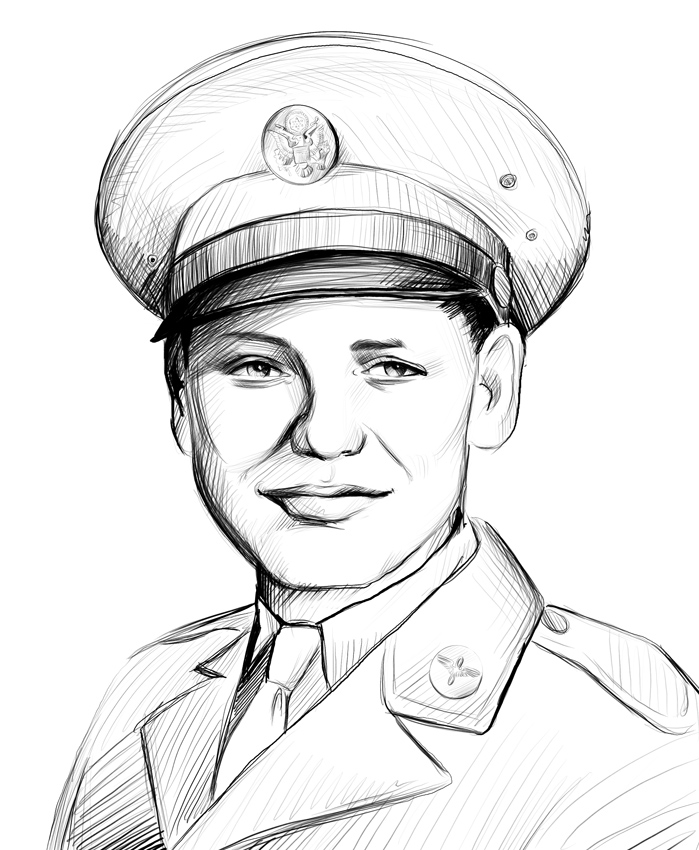
| Residences | Civilian Occupation |
| Maryland, Delaware | Worker for the Pusey & Jones Corporation |
| Branch | Service Number |
| U.S. Army Air Forces | 32752292 |
| Theater | Unit |
| Pacific | 6th Radar Calibration Detachment |
| Military Occupational Specialty | Entered the Service From |
| 748 (airplane mechanic-gunner) | Wilmington, Delaware |
Early Life & Family
Arthur Johnston, Jr. was born on October 28, 1923, in Betterton, on Maryland’s Eastern Shore. He was the son of Arthur Johnston (a farmer, 1899–1982) and Rosalie Virginia Johnston (née Luthringer, 1898–1973). He had two older sisters, Gertrude Johnston (later Eveland, 1919–2013) and Daisy Johnston (later Torrance, 1921–2010), as well as a younger brother, Robert William Johnston (1925–2002). The Johnstons were living in Camden, Delaware, when the family’s youngest child was born on November 12, 1925.
Around 1927, the family moved to Chesapeake City, Maryland, where the elder Johnston began working on the Two Rivers Farm. The Johnston family was recorded on the census on April 9, 1930, living in Cecil County, Maryland. The next census, taken on April 24, 1940, recorded the family living on a farm on Port Herman Road in Chesapeake City, Maryland. Johnston graduated from Chesapeake City High School.
When he registered for the draft on June 30, 1942, Johnston was living at 1109 West 7th Street in Wilmington, Delaware, and working at the nearby Pusey & Jones shipyard. He moved to 2005 Delaware Avenue in Wilmington prior to entering the service.
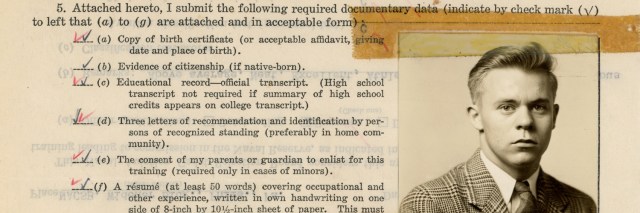
According to his military paperwork, Johnston stood five feet, eight inches tall and weighed 143 lbs., with brown hair and blue eyes. He was Protestant.
Military Career
In early 1943, Johnston was drafted by Board No. 1, Wilmington. He was inducted into the U.S. Army on February 23, 1943. According to a document in his individual deceased personnel file (I.D.P.F.), Johnston was stationed at the U.S. Army Air Forces Miami Beach Training Center in Florida from March 7, 1943, to April 15, 1943. However, another document in his I.D.P.F. showed Private 1st Class Johnston was already with the 781st Technical School Squadron at Lincoln Army Air Field, Nebraska, by April 7, 1943, when he had a dental exam. On April 28, 1943, the Wilmington Morning News reported Private Johnston’s transfer to Lincoln A.A.F., Nebraska. Journal-Every Evening reported that Johnston “had airplane mechanic’s training” at Lincoln, followed by gunnery training at Fort Myers, Florida.
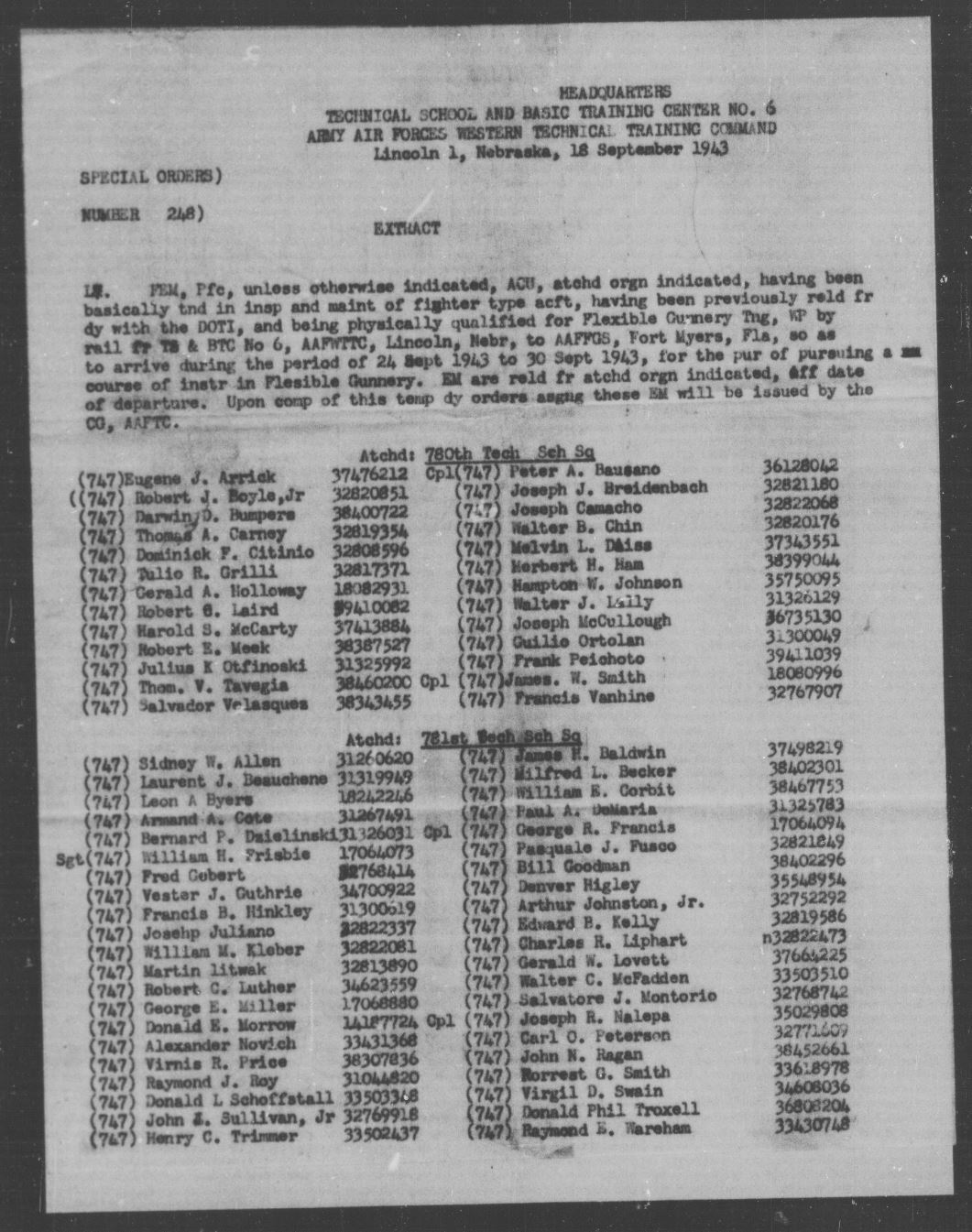
Special Orders No. 248, Headquarters Technical School and Basic Training Center No. 6, Army Air Forces Western Technical Training Command at Lincoln, Nebraska, stated that Johnson was among men who had successfully completed training in fighter-type aircraft inspection and maintenance, while attached to the 781st Technical School Squadron. His military occupational specialty (M.O.S.) code was listed as 747, airplane and engine mechanic. The orders dispatched him and other trainees by rail to the Army Air Forces Flexible Gunnery School, Fort Myers, Florida.
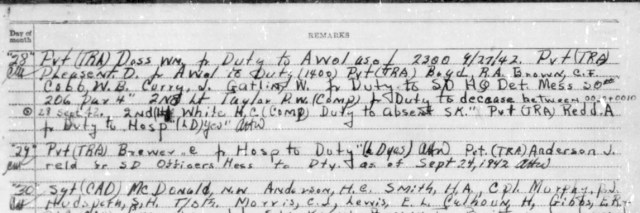
Johnston’s I.D.P.F. stated that he was stationed at Fort Myers beginning on September 23, 1943. A morning report states that he was attached to Headquarters & Headquarters Squadron, 38th Flexible Gunnery Training Group there effective September 26, 1943.
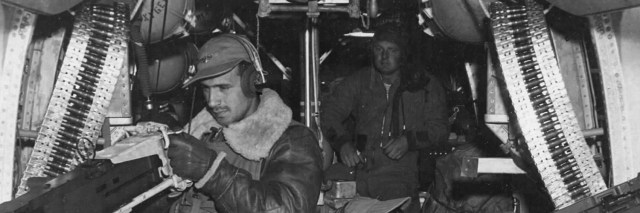
Special Orders No. 327, Headquarters Buckingham Army Air Field, Fort Myers, Florida, stated that Private 1st Class Johnston was among a group of 14 or 15 enlisted men who had graduated from Aerial Gunnery School there on November 23, 1943, “as Specialists on Martin Power Operated Gun Turrets and B-26 Armament[.]” Johnston and the others were promoted to sergeant and transferred to the 12th Radar Calibration Detachment at Fort Dix Army Air Base, New Jersey. The document noted a change in Johnston’s M.O.S. to 748, airplane mechanic-gunner.
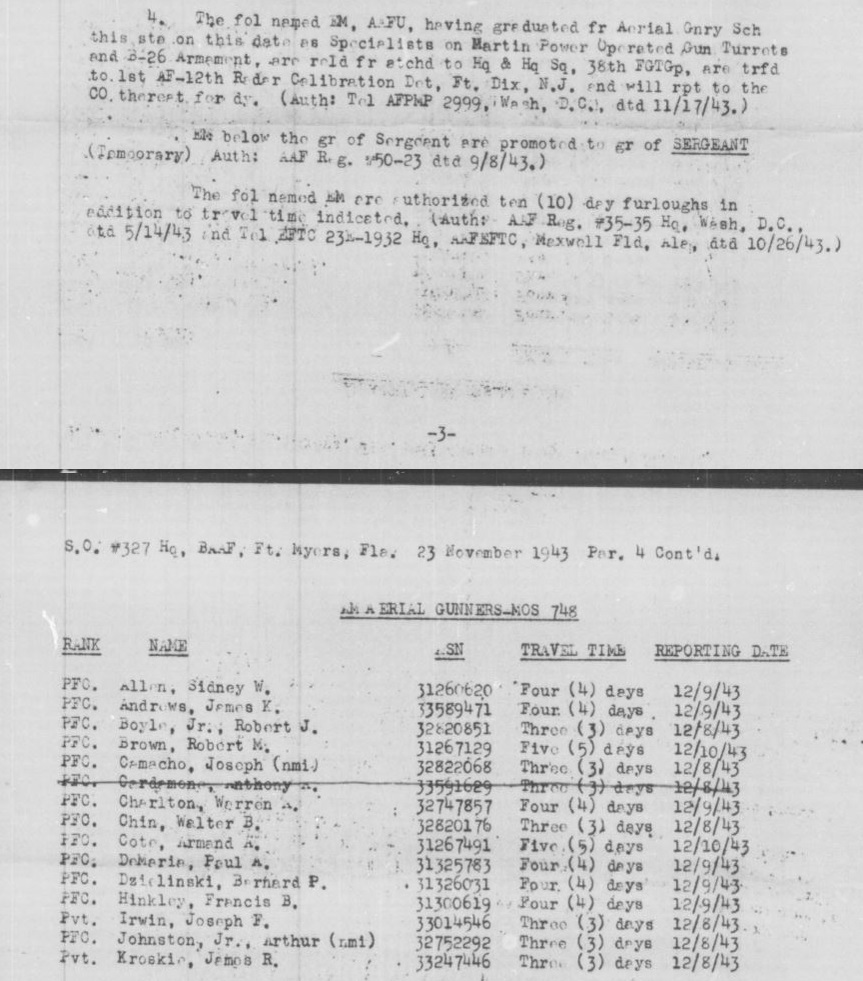
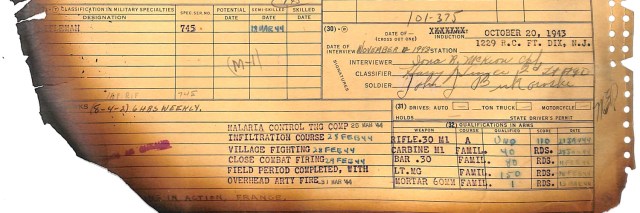
As an added bonus, Johnston was given a reporting date of December 8, 1943, following a 10-day furlough plus four days’ travel time. He reported as ordered, but on December 12, 1943, Sergeant Johnston transferred to the 6th Radar Calibration Detachment, also located at Fort Dix Army Air Base.
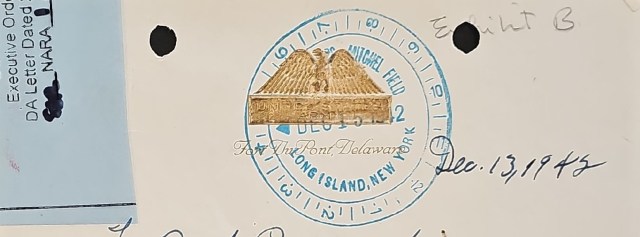
The 6th Radar Calibration Detachment had been activated at Mitchel Field, New York, on August 20, 1943. It was a small unit with an authorized strength of just 35 men. The unit moved to Fort Dix, New Jersey, on September 28, 1943, and began training after reaching full strength on December 20, 1943.

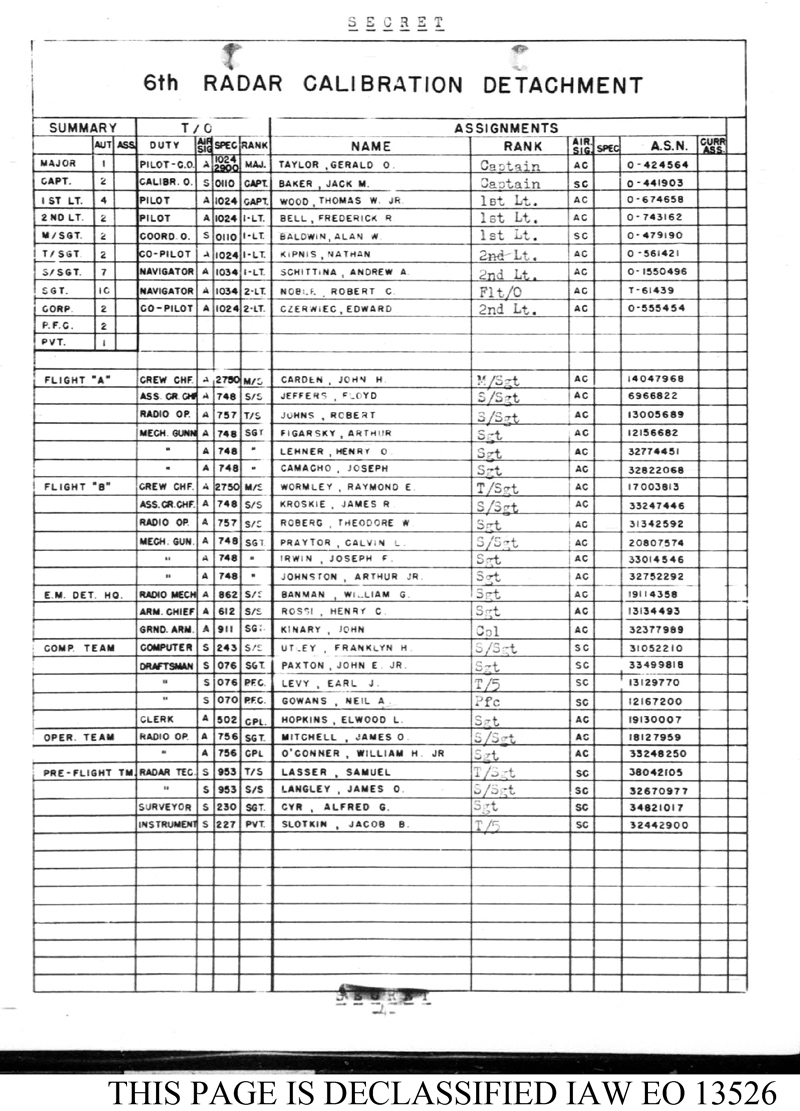
According to a report by 1st Lieutenant Thomas Warren Wood, Jr. (1922–1944), “History of the 6th Radar Calibration Detachment 20 August 1943 to 1 July 1944,” the unit’s mission was “to furnish information to the proper authorities as to the exact coverage capabilities of a ground radar unit, and the reasons for its limitations if any.”
Doing so was a painstaking process. At each radar site, detachment personnel inspected the equipment and then performed a series of calibration flights. Wood wrote that on average, it took about 18 flights and 30 hours of flight time to complete each assessment.
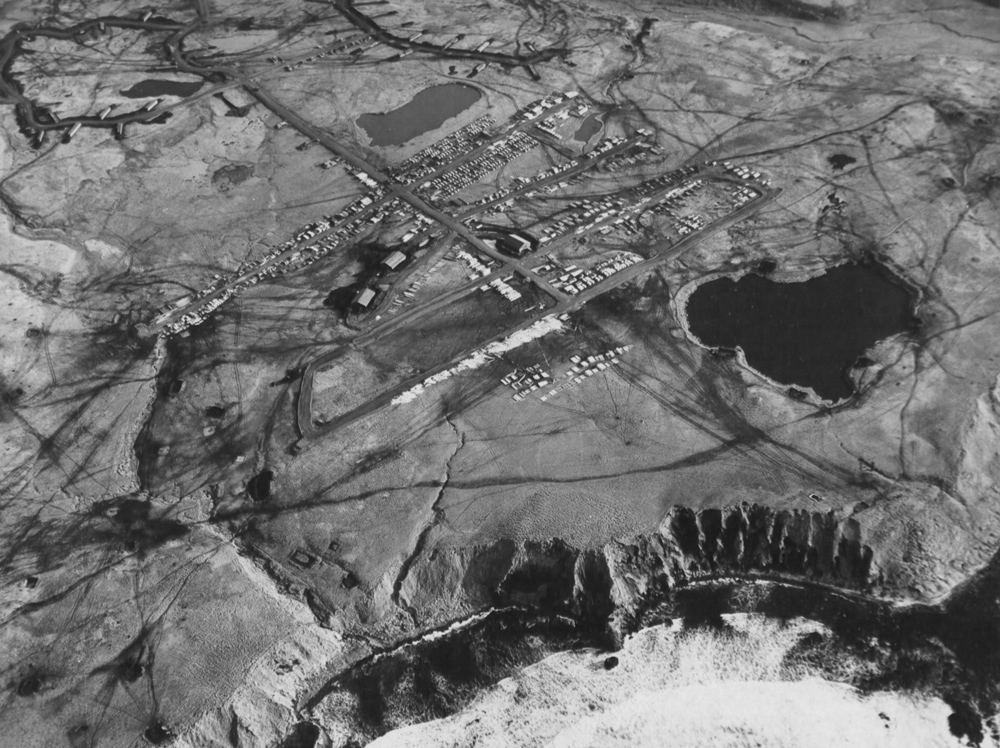
Around February 22, 1944, the 6th Radar Calibration Detachment departed from Fort Dix by train, arriving around February 25 at Fort Lawton, Washington. On March 6, 1944, the unit shipped out from the Seattle Port of Embarkation. That same month, the detachment was assigned to the Eleventh Air Force. On March 25, 1944, the unit arrived at Attu in Alaska’s Aleutian Islands. Located at the far western end of the chain—closer to the Japanese-held Kurile Islands than the Alaska mainland—Attu had been one of two islands in the Aleutians captured by the Japanese in June 1942 and recaptured by the Americans the following year.

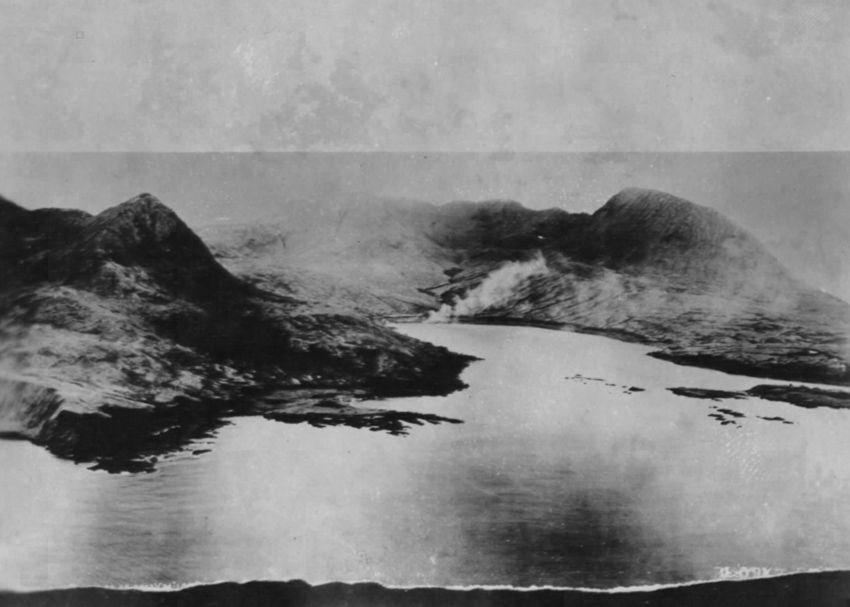
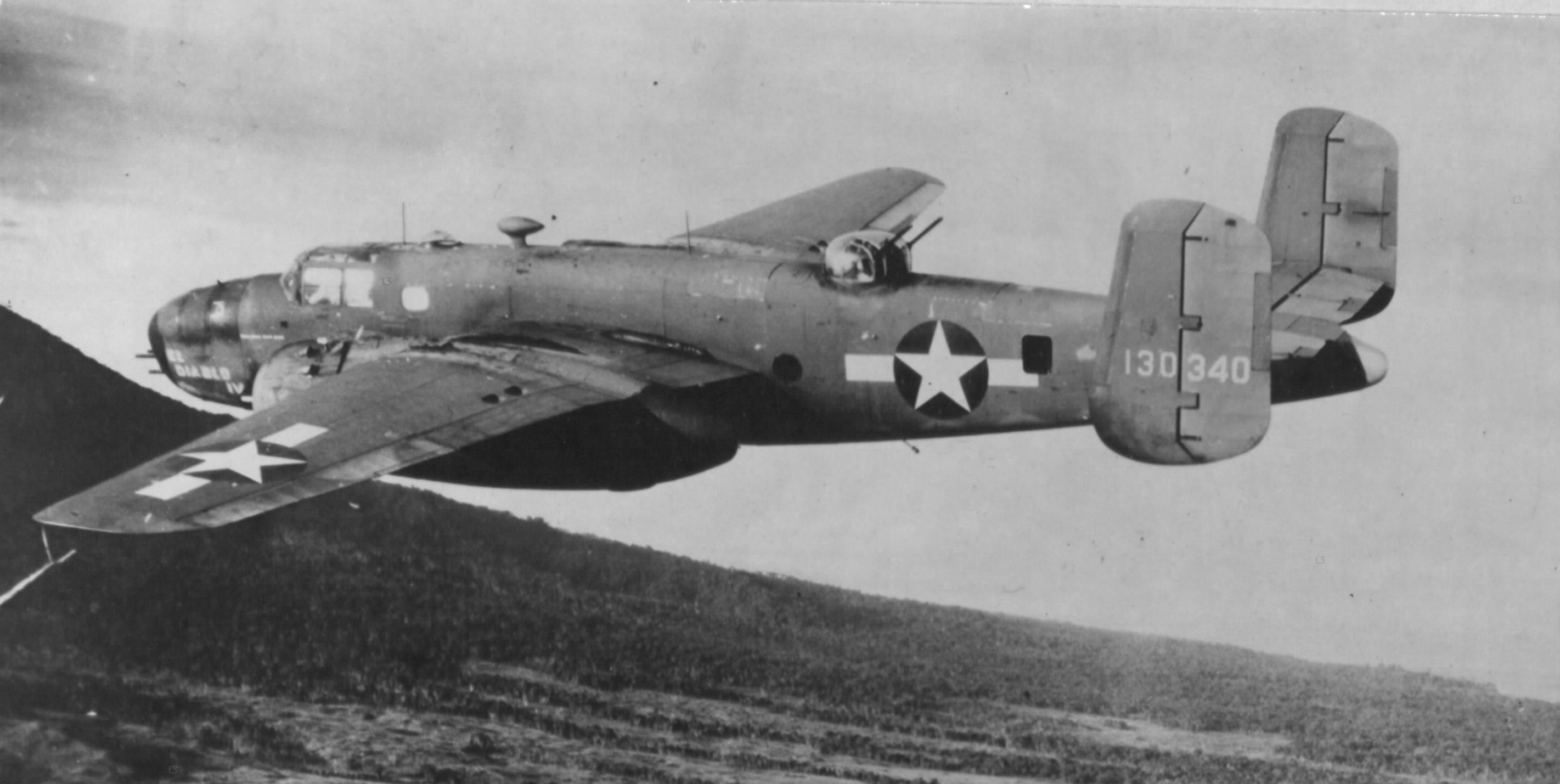
The unit faced significant challenges upon arrival in Alaska. Although the detachment trained on Consolidated B-24 Liberators and was supposed to have a pair of them (one for each flight), initially the only aircraft available was a single war-weary North American B-25 Mitchell (serial number 41-29753) loaned by the 77th Bombardment Squadron (Medium). Wood wrote that “It is very difficult to obtain the desired results with a B-25 type airplane.” Only one pilot in the detachment was qualified on B-25s, requiring hasty transition training. The B-25’s lower ceiling and shorter range also hampered the detachment. Eventually, the detachment had a fuel tank installed in the bomb bay as an improvised method of increasing their B-25’s range.
The weather and remoteness of the radar stations also caused difficulties. Wood noted in his report that although calibration was supposed to be done during clear weather so the aircraft could be sure of its position relative to the radar station, in the Aleutians the weather was almost always cloudy. The unit found that they could still do their work by relying on radio navigation.
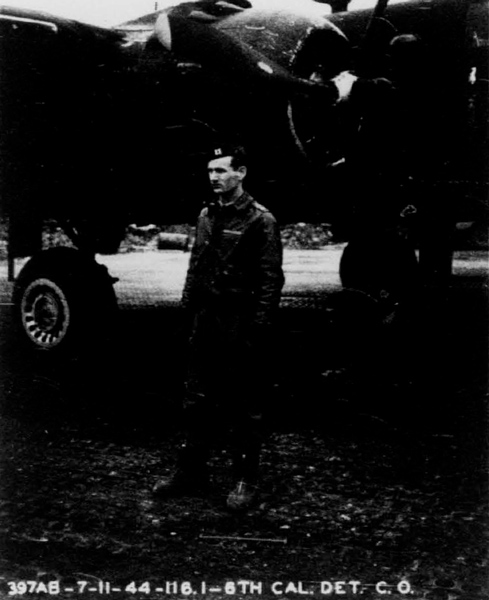

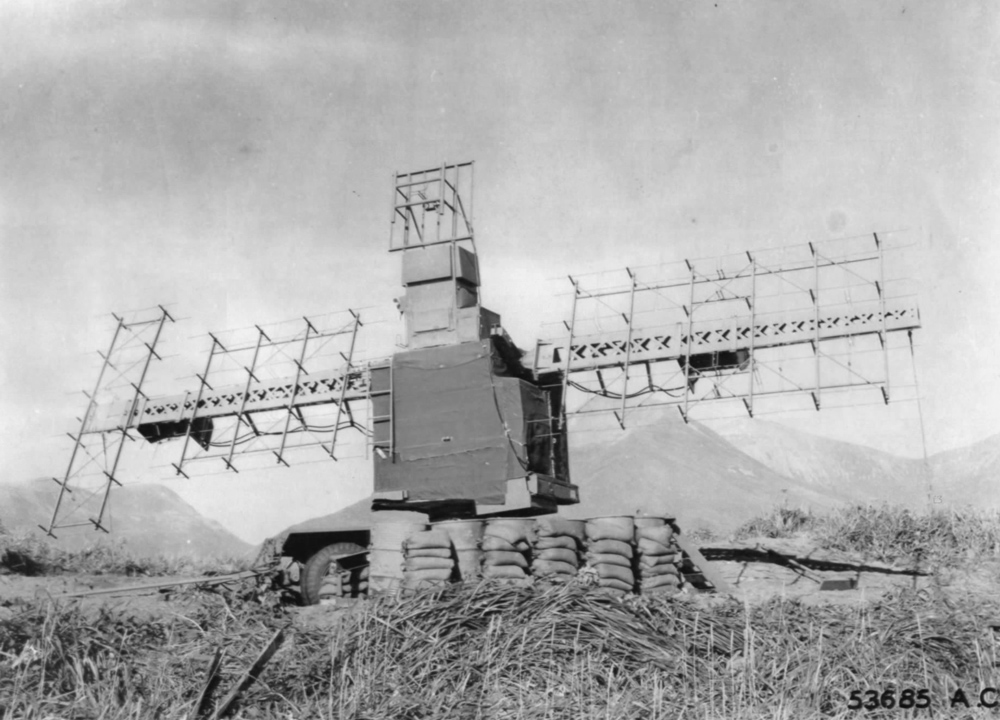
In April 1944 the detachment calibrated radar stations at Chichangof Harbor, on the east end of Attu, and on Shemya Island. The next station, Kresta Point, on the northwest side of Attu, was so remote that it took two weeks to find a way to get the ground team there by boat. It took another two weeks after that before the weather improved enough to fly there. The work was finally completed during May 24–29, 1944.
The unit calibrated Nevidiskov, on the south side of Attu, during June 21–28, 1944. Horrendous weather hampered work at Amchitka, in the Rat Islands group, from July 22, 1944, to August 12, 1944. Some good news arrived that month when the unit finally received one of its allotted B-24s, although the old B-25 stayed in service pending the arrival of a second Liberator.
Johnston was promoted to sergeant on an unknown date prior to July 1, 1944. Sergeant Johnston was listed on a detachment roster compiled around that date as an airplane mechanic-gunner assigned to Flight “B.”
Final Flight
1st Lieutenant Alan W. Baldwin wrote in a report that the unit began a move to Adak on August 16, 1944. Piloted by 1st Lieutenant Wood and 2nd Lieutenant Edward Czerwiec (1920–1944), the B-25D took off from Casco, Attu, at around 1530 hours, bound for Adak. The plane had a crew of seven men, including Johnston, and two passengers, as well as some of the unit’s equipment. The aircraft arrived at 1740 hours, but the tower instructed them not to land because “there was blasting [close to] the runway.”
While the B-25 circled, the field became completely socked in. Control eventually instructed the B-25 to land at Tanaga Air Field, on another island just to the west, and to assist a P-40 piloted by 1st Lieutenant John Clifford Norman (1916–1944) of the 54th Troop Carrier Squadron with “an instrument let down.” Though the field reported a ceiling of 300 feet, investigators determined that the ceiling was closer to 100 feet. Both planes made two unsuccessful attempts to land. Lieutenant Norman later recalled that on his second pass, “I almost hit the radio tower and just pulled up in time.” It was now around 2000 hours.

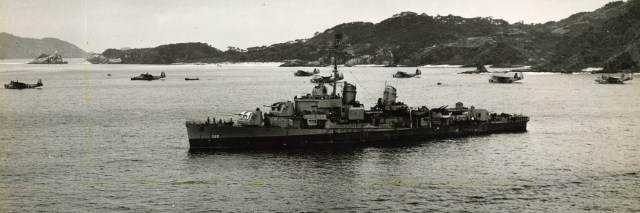
Ensign Walter K. Stirewalt (1908–1985), U.S. Naval Reserve, a witness aboard the gunboat U.S.S. Charleston (PG-51) later wrote about the B-25:
I first observed the plane a few minutes prior to the crash flying quite low as the ceiling in the vicinity of the ship was about 300 feet. The plane came out of the fog heading in our direction approaching to within about one half mile before banking to the left and to general direction of Tanaga [sic] air strip disappearing in the fog. It reappeared a few moments later heading away from the Tanaga air strip and then went in to a near vertical dive, striking the water with the right wing first. It was not spinning. It sank within a few seconds.
A rescue party from the gunboat and a U.S. Army barge responded to the scene in Tanaga Bay. They found a floating debris field and recovered some equipment from the plane but found no sign of the nine men aboard. The P-40 pilot abandoned his attempts to land and bailed out over Andrew’s Lagoon on Adak. He was rescued by a Navy crash boat.


The reason for the B-25’s crash is unclear. There was no indication of an in-flight fire or explosion and Ensign Stirewalt wrote that he could hear “the roar of the motors” at the time of the crash, which would tend to rule out engine failure or fuel exhaustion. Investigators found no evidence of mechanical failure. The board of officers suggested that the crash was due to a lack of situational awareness by the pilots compounded by the poor weather:
Apparently pilot did not realize his close proximity to the water and continued to let down. Plane either stalled or mushed in just before striking water. Witnesses[’] statements lead this board to believe that pilot applied full power, but could not pull up.
Lieutenant Wood’s instrument card was expired at the time of the crash. In the immediate aftermath of the crash, the 6th Radar Calibration Detachment’s surviving pilots were ordered to the Eleventh Air Force’s instrument school.
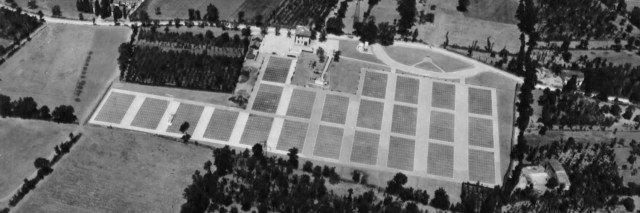
Sergeant Johnston was initially listed as missing in action, but he was declared dead as a non-battle casualty on October 17, 1944. Several years after the war, a board of officers declared that the bodies of Sergeant Johnston and the other men killed in the crash were non-recoverable. Although Johnston entered the service from Delaware, his name was omitted from the Delaware memorial volume and Veterans Memorial Park in New Castle. He and the other members of the B-25 are honored at the Courts of the Missing at the National Memorial Cemetery of the Pacific in Hawaii.

Crew & Passengers Aboard B-25D 41-29753 on August 16, 1944
The following list was adopted from Missing Air Crew Report No. 7861 with grade, name, and position.
1st Lieutenant Thomas Warren Wood, Jr., O-674658 (pilot)
2nd Lieutenant Edward Czerwiec, O-555454 (copilot)
Flight Officer Robert Carl Noble, T-61439 (navigator)
Master Sergeant John Harwood Carden, 14047968 (flight engineer)
Staff Sergeant James Ernest Mitchell, 18127959 (radio operator)
Sergeant Joseph Francis Irwin, 33014546 (gunner)
Sergeant Arthur Johnston, Jr., 32752292 (gunner)
Captain Jack Myer Baker, O-441903 (passenger)
Staff Sergeant James O’Brien Langley, 32670977 (passenger)
Notes
Why Did the B-25 Not Divert to Another Airfield?
Investigators faulted the pilots for not flying to the field at North Shore on Umnak, which was less than three hours’ flying time away. The investigators stated that North Shore “was reporting open conditions while plane was attempting a landing at Tanaga. Ample gas was aboard to arrive at that field.”
However, Lieutenant Norman testified that around 1910, the “controller told me that North Shore had closed in and my best bet was Tanaga.” In a transcript of the P-40 pilot’s testimony to the board of investigators, a Major Huttig (identified as the regional controller, Aircraft Warning Service) stated: “We reported the weather to you as we got it from North Shore. This was later found to be incorrect. I suppose Weather read the wrong line when giving us the report.”
It is unclear if this same erroneous report was relayed to the B-25’s pilots as well.
1st Lieutenant Norman
The P-40 pilot, John C. Norman, survived the incident, only to vanish less than a month later on September 9, 1944, while flying a C-47 (serial number 42-23870) from Umnak to Shemya in the Aleutians.
Acknowledgments
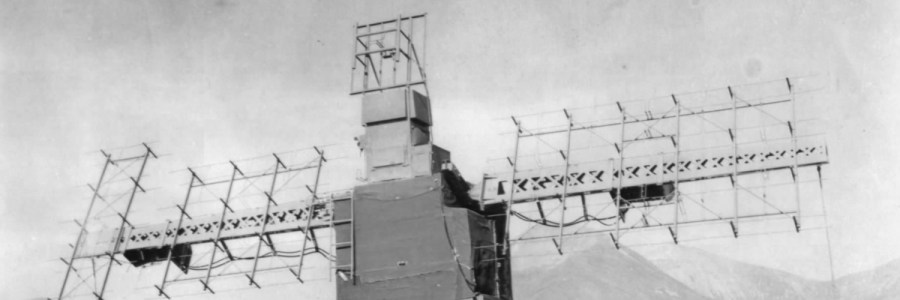
Special thanks to Lieutenant Colonel Scott Taylor for providing a pilot’s insight into the mysterious circumstances of the crash documented in various reports and to Bob Webster for the use of his photo.
Bibliography
“Arthur Johnston.” The Morning News, July 28, 1982. https://www.newspapers.com/clip/117422899/arthur-johnston-father-obit/
Baldwin, Alan W. “History of the 6th Radar Calibration Detachment 1 August 1944 to 31 August 1944.” Reel A0231. Courtesy of the Air Force Historical Research Agency.
Braman, Arthur H., Woolley, Nathan, and Silberstein, Irving S. “Report of Aircraft Accident 45-8-16-505.” September 5, 1944. Reel 46411. Courtesy of the Air Force Historical Research Agency.
Braman, Arthur H., Woolley, Nathan, and Williams, Jack P. “Report of Aircraft Accident 45-8-16-503.” August 19, 1944. Reel 46411. Courtesy of the Air Force Historical Research Agency.
Census Record for Arthur Johnston. April 9, 1930. Fifteenth Census of the United States, 1930. Record Group 29, Records of the Bureau of the Census. National Archives at Washington, D.C. https://www.ancestry.com/imageviewer/collections/6224/images/4606970_00083
Census Record for Arthur Johnston. April 24, 1940. Sixteenth Census of the United States, 1940. Record Group 29, Records of the Bureau of the Census. National Archives at Washington, D.C. https://www.ancestry.com/imageviewer/collections/2442/images/M-T0627-01545-00103
Certificate of Birth for Robert William Johnston. Undated, c. November 12, 1925. Record Group 1500-008-094, Birth certificates. Delaware Public Archives, Dover, Delaware. https://www.familysearch.org/ark:/61903/3:1:33SQ-GYQM-Q928
Draft Registration Card for Arthur Johnston, Jr. June 30, 1942. Draft Registration Cards for Delaware, October 16, 1940 – March 31, 1947. Record Group 147, Records of the Selective Service System. National Archives at St. Louis, Missouri. https://www.ancestry.com/imageviewer/collections/2238/images/44003_05_00004-00111
“Four More Boards Announce Those Recently Inducted.” Journal-Every Evening, February 26, 1943. https://www.newspapers.com/clip/117421413/johnston-drafted/
Individual Deceased Personnel File for Arthur Johnston, Jr. Individual Deceased Personnel Files, 1939–1953. Record Group 92, Records of the Office of the Quartermaster General, 1774–1985. National Archives at St. Louis, Missouri.
Morning Reports for 6th Radar Calibration Detachment. December 1943. U.S. Army Morning Reports, c. 1912–1946. Record Group 64, Records of the National Archives and Records Administration. National Archives at St. Louis, Missouri. https://s3.amazonaws.com/NARAprodstorage/lz/partners/st-louis/rg-064/85713825-wwii/85713825_1943-12/85713825_1943-12_Roll-0263/85713825_1943-12_Roll-0263-18.pdf
Morning Reports for 12th Radar Calibration Detachment. December 1943. U.S. Army Morning Reports, c. 1912–1946. Record Group 64, Records of the National Archives and Records Administration. National Archives at St. Louis, Missouri. https://s3.amazonaws.com/NARAprodstorage/lz/partners/st-louis/rg-064/85713825-wwii/85713825_1943-12/85713825_1943-12_Roll-0263/85713825_1943-12_Roll-0263-19.pdf
Morning Reports for Headquarters & Headquarters Squadron, 38th Flexible Gunnery Training Group. November 1943. U.S. Army Morning Reports, c. 1912–1946. Record Group 64, Records of the National Archives and Records Administration. National Archives at St. Louis, Missouri. https://s3.amazonaws.com/NARAprodstorage/lz/partners/st-louis/rg-064/85713825-wwii/85713825_1943-11/85713825_1943-11_Roll-0339/85713825_1943-11_Roll-0339-04.pdf
Morning Reports for Headquarters & Headquarters Squadron, 38th Flexible Gunnery Training Group. September 1943. U.S. Army Morning Reports, c. 1912–1946. Record Group 64, Records of the National Archives and Records Administration. National Archives at St. Louis, Missouri. https://s3.amazonaws.com/NARAprodstorage/lz/partners/st-louis/rg-064/85713825-wwii/85713825_1943-09/85713825_1943-09_Roll-0394/85713825_1943-09_Roll-0394-04.pdf
Schittina, Andrew A. “History of the 6th Radar Calibration Detachment 1 May 1944 to VJ-Day.” Reel A0231. Courtesy of the Air Force Historical Research Agency.
Toye, Stanley E. “Missing Air Crew Report No. 7861.” Record Group 92, Records of the Office of the Quartermaster General, 1774–1985. The National Archives at College Park, Maryland. https://catalog.archives.gov/id/91042583
“Two Cecil Fliers on Casualty List.” The Midland Journal, December 8, 1944. https://www.newspapers.com/clip/117421240/arthur-johnston-killed/
“Two Cecil Fliers’ Fatalities Top Shore War List; 6 Wounded.” Journal-Every Evening, November 30, 1944. https://www.newspapers.com/clip/117421907/arthur-johnston-death-confirmed/
Warner, Frederick M. “Missing Air Crew Report No. 8877.” August 22, 1944. Missing Air Crew Reports (MACRs), 1942–1947. Record Group 92, Records of the Office of the Quartermaster General, 1774–1985. The National Archives at College Park, Maryland. https://catalog.archives.gov/id/91061788?objectPage=2
“With the Service Men And The Auxiliaries.” Wilmington Morning News, April 28, 1943. https://www.newspapers.com/clip/117421547/arthur-johnston-training/
Wood, Thomas W., Jr. “History of the 6th Radar Calibration Detachment 20 August 1943 to 1 July 1944.” Reel A0231. Courtesy of the Air Force Historical Research Agency.
Last updated on November 8, 2024
More stories of World War II fallen:






















To have new profiles of fallen soldiers delivered to your inbox, please subscribe below.
 Delaware's World War II Fallen