| Hometown | Civilian Occupation |
| Wilmington, Delaware | Accounts receivable clerk for the DuPont Company |
| Branch | Service Numbers |
| U.S. Army Air Forces | Enlisted 12012731 / Officer O-676762 |
| Theater | Unit |
| Pacific | 310th Fighter Squadron, 58th Fighter Group |
| Military Occupational Specialty | Campaigns/Battles |
| 1055 (fighter pilot, single-engine) | New Guinea, Luzon (1945) |
| Awards | Entered the Service From |
| Air Medal with one oak leaf cluster, Purple Heart | Wilmington, Delaware |
Early Life & Family
Joseph Andrew Dugan was born on the evening of July 23, 1920, at 1220 Pearl Street in Wilmington, Delaware. He was the fifth child of Alphonsus Joseph Dugan (1885–1955) and Mary Agnes Dugan (née McNespy, 1885–1954). His father was an iron works foreman. Dugan had three older sisters, an older brother, and a younger sister.
Dugan’s family had moved to 523 South Heald Street in Wilmington by January 13, 1925, when his youngest sister was born. They were recorded at the same address on the census in April 1930. Census records indicate that the family had moved to 507 South Heald Street by April 1, 1935, and were still living there as of April 1940.
The Wilmington Morning News reported that Dugan “was a graduate of Wilmington High School and attended the Wharton School of Finance, University of Pennsylvania.” His enlistment data card described him as a general office clerk who had completed one year of college. In a statement for the State of Delaware Public Archives Commission, Dugan’s mother wrote that her son worked in accounts receivable for the DuPont Company.
According to his military paperwork, Dugan stood five feet, eight inches tall and weighed 129 lbs., with brown hair and blue eyes. He was Catholic.
Military Training & Marriage

Shortly after the attack on Pearl Harbor, Dugan volunteered for the Army Air Forces, enlisting in Wilmington on January 14, 1942. He was briefly attached unassigned to the 1229th Reception Center, Fort Dix, New Jersey. On or about January 17, 1942, he was dispatched to Jefferson Barracks, Missouri, for basic training. Following basic, Dugan trained as an aircraft mechanic at Chanute Field, Illinois, where he was attached unassigned to the 36th School Squadron at 1700 hours on March 30, 1942. At 0600 on June 17, 1942, he was detached from that unit and attached unassigned to the 4th Technical School Squadron (Special), also stationed at Chanute Field.
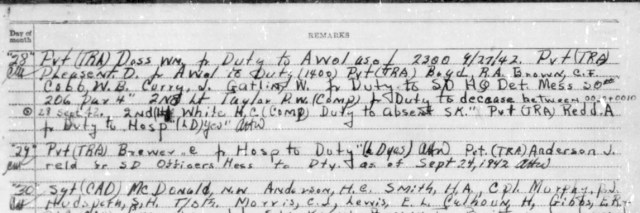
Dugan volunteered for flight training. A 4th Technical School Squadron morning report stated with remarkable precision that Private Dugan transferred to Kelly Field at 1136 hours. He had arrived by the following day, according to a flight physical.
Dugan, now an aviation cadet, began preflight training at Kelly Field on or about August 15, 1942. On October 10, 1942, he was dispatched to Corsicana, Texas, for primary flight training with the 301st Army Air Forces Flying Training Detachment, accumulating 60 hours and two minutes of flight time. He transferred to the Army Air Forces Basic Flying School, Randolph Field, Texas, on December 14, 1942. At Randolph Field, he flew another 83 hours and 35 minutes. As of February 14, 1943, he had 143 hours and 37 minutes under his belt, including 55 hours, 57 minutes flying with an instructor and 87 hours, 40 minutes soloing. At Eagle Pass, between February 17, 1943, and April 22, 1943, he flew another 66.9 hours solo, plus 10 hours in an instrument trainer.
During his training in Texas, Dugan met and soon married Virginia T. Trumbature (1921–2022), a native of Houston.
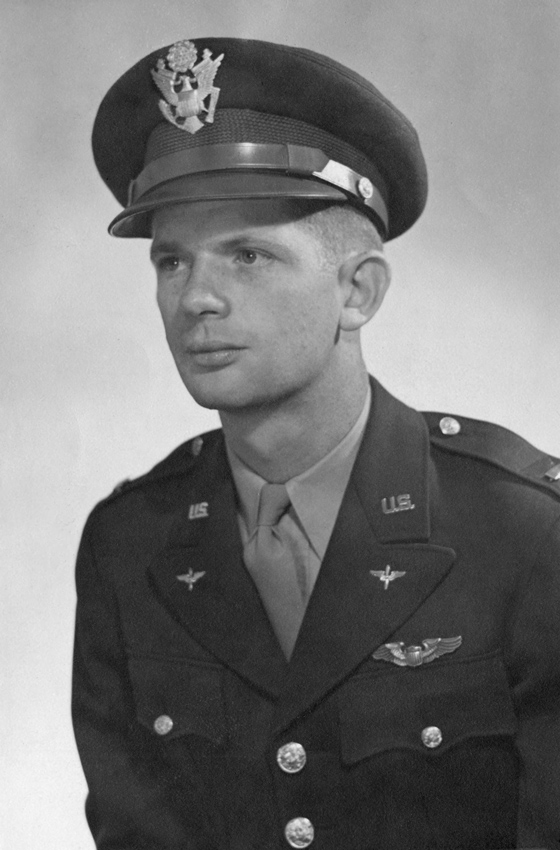
Upon graduation from Class 43-D at Eagle Pass on April 22, 1943, Dugan was commissioned as a 2nd lieutenant. He was briefly stationed at Mitchel Field, New York, but did not do any flying there. At 1300 hours on May 9, 1943, he joined the 321st Fighter Squadron, 326th Fighter Group, a replacement training unit, at Westover Field, Massachusetts. He accumulated another 21.4 hours flying old Republic RP-47B and RP-47C Thunderbolts with the squadron. Even though the squadron was not in combat, training flights still had their hazards. In the span of eight days that May, the 321st Fighter Squadron lost two pilots killed in separate crashes.
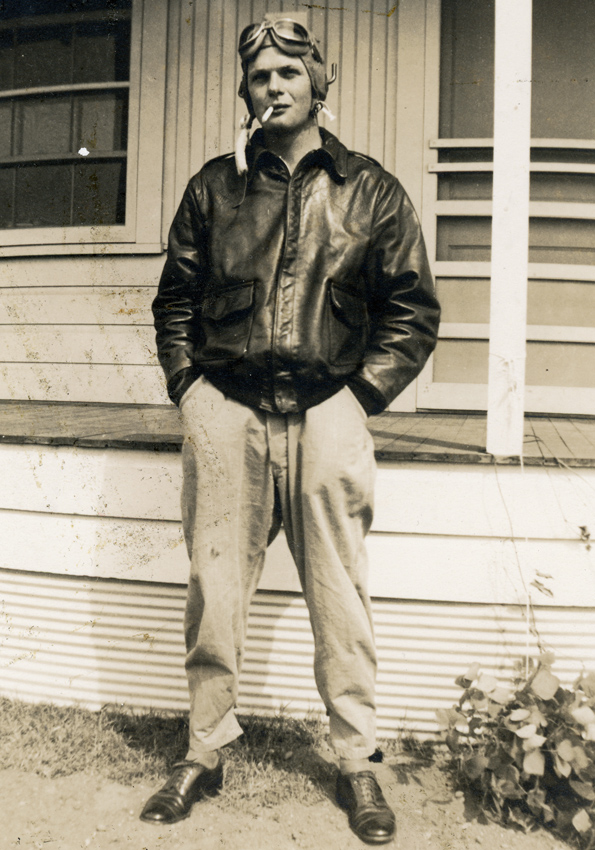
Dugan was transferred and left the 321st Fighter Squadron at 1700 hours on May 31, 1943. Soon after, 2nd Lieutenant Dugan joined the 310th Fighter Squadron at Hillsgrove Army Airfield (Green Field), Rhode Island.
The 310th Fighter Squadron had been activated on February 9, 1942, in Baton Rouge, Louisiana, and assigned to the 58th Fighter Group of the Third Air Force. The next two years saw several moves and a transfer of the entire group to the First Air Force. Initially equipped with P-39s, the unit reequipped with P-40s, and eventually, Republic P-47 Thunderbolts. Although nominally tasked with the air defense of the continental United States, the 310th’s main job was training its pilots for future combat. The unit moved to Hillsgrove in April 1943.
According to his flight records, 2nd Lieutenant Dugan flew on almost a daily basis with the 310th, mainly in P-47C and P-47D Thunderbolts. He accumulated another 191.6 hours flying with the squadron through October 4, 1943.
The 310th Fighter Squadron moved to Grenier Field, New Hampshire, in September 1943. The squadron departed Grenier on the evening of October 22, 1943, arriving at Camp Stoneman, California, six days later. On November 1, 1943, the squadron shipped out for the Pacific Theater from the San Francisco Port of Embarkation aboard the S.S. Nieuw Amsterdam.
When Dugan went overseas, his wife was pregnant. In the spring of 1944, she gave birth to a son, Charles J. Dugan, who never had the chance to meet his father.
Combat in the Pacific Theater
S.S. Nieuw Amsterdam arrived at Wellington, New Zealand, on the morning of November 15, 1943. Members of the squadron were able to stretch their legs ashore before continuing their voyage the following day to Sydney, Australia. On November 19, the unit arrived in Australia. Most of the unit, including Lieutenant Dugan, staged at Warwick Farm for a few days before moving to Camp Doomben, Brisbane, on November 23.
On December 1, 1943, 2nd Lieutenant Dugan was one of 12 officers from his squadron who went on detached service to an unspecified unit based in or near Port Moresby, New Guinea, probably the 348th Fighter Group. His first combat mission was recorded on December 6, 1943. He flew missions on December 13 and 18, but by Christmas Eve 1943 he was back in Australia.
In the Southwest Pacific Area of Operations, the 58th Fighter Group was assigned to the 86th Fighter Wing, V Fighter Command, Fifth Air Force. An advance party from the 310th Fighter Squadron arrived at Dobodura, New Guinea, on November 22, 1943. Dugan was one of 21 pilots tasked with ferrying P-47Ds there during February 16–19, 1944. His flight records list the route as Brisbane to Townsville to Cairns to Horn Island to Port Moresby to Dobodura.
The 310th Fight Squadron finally became operational at Dobodura on February 24, 1944. Dugan flew his first combat mission with the squadron the following day, patrolling over New Britain during an amphibious operation.
The squadron found itself in quiet areas for the rest of the year. Missions included alert scrambles to investigate unidentified aircraft, fighter sweeps, escorting transport and rescue aircraft, and providing cover for amphibious operations. The squadron history recorded that although the 310th’s pilots yearned to engage Japanese fighters, the only enemy resistance they encountered while flying from Dobodura was antiaircraft fire. (Tellingly, Anthony J. Kupferer’s book about the 58th Fighter Group in World War II was entitled No Glamour…No Glory!)
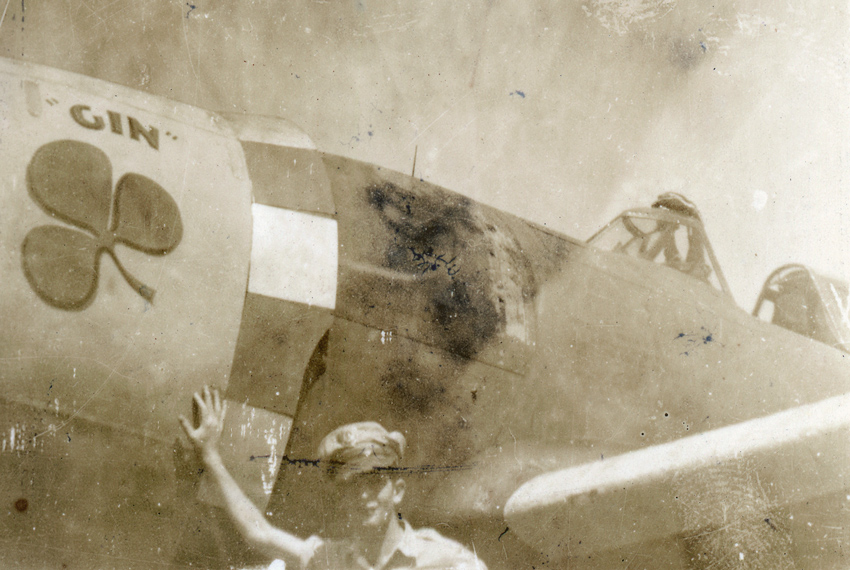

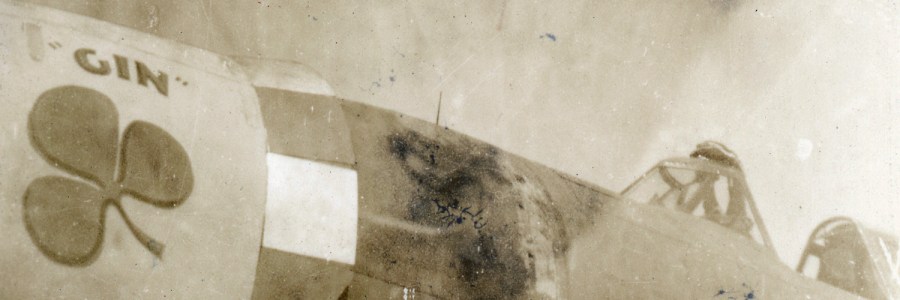
On April 1, 1944, the squadron began moving to the new airfield at Saidor, New Guinea. During the next few months, they continued escort missions, scrambles, weather reconnaissance, and fighter sweeps, as well as ground attack missions against Japanese installations such as Wewak and Hansa Bay. 2nd Lieutenant Dugan was assigned an additional duty, assistant adjutant of his squadron, effective May 23, 1944. He was promoted to 1st lieutenant on June 10, 1944, per Special Orders No. 160, Headquarters United States Army Air Forces in the Far East.
The 310th’s operations at Saidor ended on August 22, 1944. The air echelon rested while part of the squadron moved to Noemfoor, Dutch East Indies (now Numfor, Indonesia) to begin setting up for operations there.
Between missions, and while waiting to move bases, the men of the squadron amused themselves playing softball and volleyball. The squadron history stated that during its time on New Guinea, the squadron fielded a team, the Apes, in “the finals of the Pop Glunt Softball League finals[.]”
Lieutenant Dugan and the rest of the air echelon moved to Kornasoren on Noemfoor on September 6, 1944. The squadron history stated:
Living conditions at the new camp proved to be equal if not superior to those enjoyed at any previous locations. An attractive Group movie area, a large, screened-in Squadron mess hall, an enlisted men’s day room, public address system, coral roads, showers, electricity from portable power units, etc.—all made for comfortable living.
In addition to ground attack missions, the 310th provided cover to the invasion fleet landing at Morotai. Although they had yet to tangle with Japanese fighters, the 310th did notice some Japanese aircraft on the ground while attacking enemy airfields, and the Japanese did attempt regular night harassment air raids against Noemfoor, which did little damage “except a loss of sleep.”
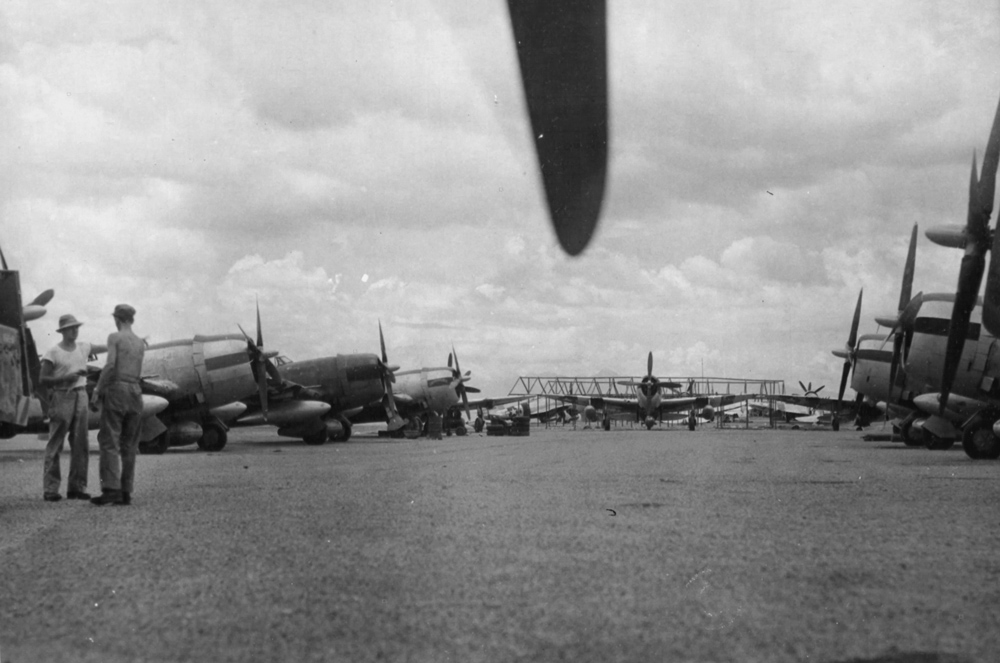
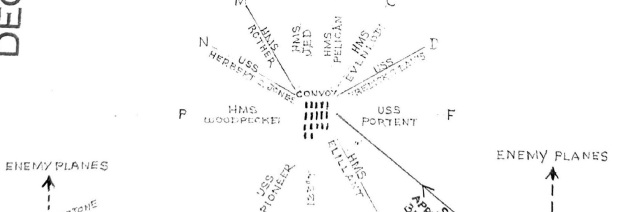
On December 19, 1944, about two months after Allied forces began the campaign to recapture the Philippines, the 310th Fighter Squadron began the move to San Jose, Mindoro. Any doubt that the Philippines would be a more active sector than New Guinea or Noemfoor must have been dispelled when the ground echelon’s convoy came under attack by Japanese kamikazes on December 21, 1944. At least three ships in the convoy were damaged. The ground echelon arrived at San Jose the following day, where several airfields were under construction.
The 310th’s air echelon departed Noemfoor on December 23, 1944, arriving at Hill Field on Mindoro four days later. As with their last station, Japanese aircraft made regular nuisance raids at night. That month, word arrived that 1st Lieutenant Dugan was among several pilots awarded the Air Medal per General Orders No. 220, Headquarters Far East Air Forces, dated September 25, 1944, for missions between December 6, 1943, and July 19, 1944.
First Aerial Victory & Final Mission
During the end of December and early January 1945, the 310th Fighter Squadron performed a variety of missions, including patrol, convoy cover, fighter sweeps, ground attack, and escorting bombers. On January 3, 1945, the squadron strafed enemy aircraft at Clark Field on Luzon, though Dugan did not participate in that mission. The following day, 2nd Lieutenant Fred D. Shipley (1922–1989) scored the squadron’s first confirmed aerial victory while escorting a friendly convoy near Tubile (Tubili) Point, Mindoro.
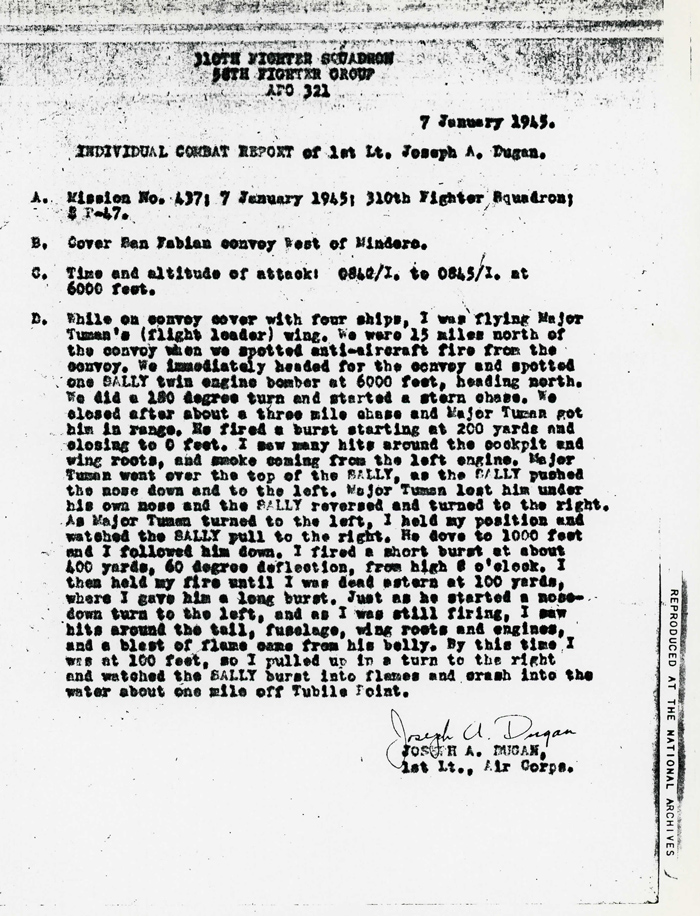
Lieutenant Dugan was credited with the 310th Fighter Squadron’s second confirmed aerial victory on January 7, 1945, while flying as the wingman for his squadron commander, Major Howard A. Tuman (1919–2012). According to his flight records, it was his 56th combat mission. The P-47s took off at 0717 hours to provide cover for a convoy sailing west of Mindoro. The Thunderbolts arrived over the ships around 0730. Around 0840, a Mitsubishi Ki-21 bomber, known to the Allies as a Sally, appeared. In his report, Lieutenant Dugan wrote:
We were 15 miles north of the convoy when we spotted anti-aircraft fire from the convoy. We immediately headed for the convoy and spotted one SALLY twin engine bomber at 6000 feet, heading north. We did a 180 degree turn and started a stern chase. We closed after about a three mile chase and Major Tuman got him in range. He fired a burst starting at 200 yards and closing to 0 feet. I saw many hits around the cockpit and wing roots, and smoke coming from the left engine. Major Tuman went over the top of the SALLY, as the SALLY pushed his nose down to the left.
Dugan continued:
As Major Tuman turned to the left, I held my position and watched the SALLY pull to the right. He dove to 1000 feet and I followed him down. I fired a short burst at about 400 yards, 60 degree deflection from high 8 o’clock. I then held my fire until I was dead astern at 100 yards, where I gave him a long burst. Just as he started a nose-down turn to the left, and as I was still firing, I saw hits around the tail, fuselage, wing roots and engines, and a blast of flame came from his belly. By this time I was at 100 feet, so I pulled up in a turn to the right and watched the SALLY burst into flames and crash into the water about one mile off Tubile Point.
The entire engagement had lasted only five minutes. The squadron intelligence officer, Captain Arnold F. Schoen, Jr. (1917–1985), noted in his report that “Lt. Dugan believed enemy pilot lacking in experience. Displayed no unusual evasive action.”
With that mission, 1st Lieutenant Dugan had accumulated 699 hours and 25 minutes of flight time, including 475 hours and 55 minutes since he had gotten his wings.
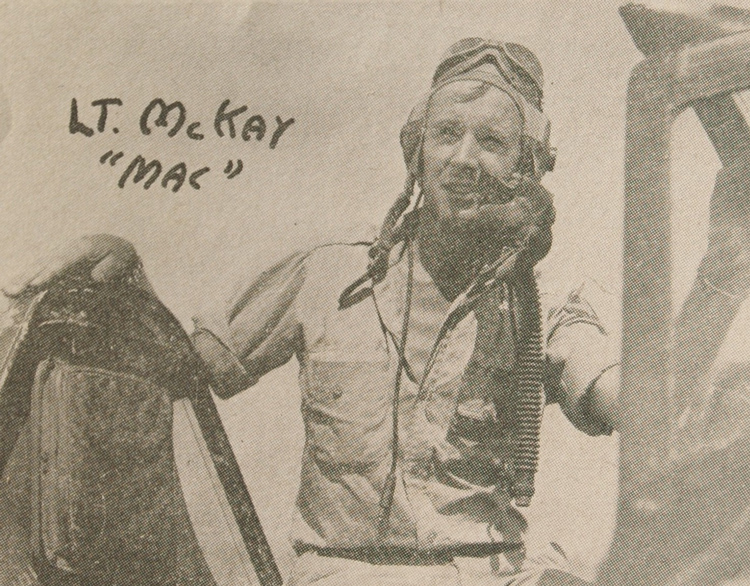
On January 10, 1945, three days after scoring his first victory and one day after American forces began landing in Lingayen Gulf, Lieutenant Dugan took off in a P-47D (serial number 42-23220) for a mission over central Luzon that would eventually bring him to the vicinity of Muñoz. His Thunderbolt was painted green, with a yellow nose and white wing stripes. The other three members of his flight were Captain Don V. Booty (1919–1998), 2nd Lieutenant Paul M. McKay (1921–1945), and 2nd Lieutenant Shipley.
Captain Booty wrote in a statement the following day:
On 10 January 1945, I was leading a flight of 4 P-47’s, callsign Curfew Green, on a strafing sweep up the Central Plains of Luzon. My radio went out and Lt. Dugan took over the flight, I continued as element leader. We went up the valley, finding no targets, climbed to 5000 feet below the Agno River, and prepared to let down and continue our search for ground targets. There were numerous Navy ships in our vicinity, 2 TBF’s and 4 Wildcats above us, and 2 artillery spotters (L-5’s) in the distance.
As usual, there were no signs of enemy aircraft. 12 days after the mission, Major Tuman wrote to Virginia Dugan that “Joseph’s flight had just spotted a motor truck on the highway and as he was putting his flight into a position to strafe the truck, his flight was jumped from above by four unidentified aircraft.”
Major Tuman concealed a tragic truth from Lieutenant Dugan’s wife: The attackers were positively identified as American, not Japanese. Lieutenant McKay wrote that about 1435 hours, they were at an altitude of about 1500 feet
when we sighted a formation of four U.S. Navy “Wildcats” at 4 o’clock high. We tried to contact them by radio and r[o]cked our wings to indicate our being friendly. They broke formation; and one of them flew close enough to me, I believe, to read the numbers on my tail.
Captain Booty continued:
We turned southeast and were at 1200 feet in the vicinity of Munoz when I heard machine gun fire, observing tracers going by and numerous strikes on my aircraft. I immediately made a violent left skid and wing over[,] coming out on the deck [very low altitude].
2nd Lieutenant Shipley wrote later:
On 10 January 1945, while on an intruder mission in the Lingayen Valley, strafing targets of opportunity, we were attacked by four Navy Wildcats in the vicinity of Munoz. Lt. Dugan was leading the mission of our Curfew Green flight and I was flying his wing. The Navy planes attacked us at 1200 feet. The lead plane attacked Lt. Dugan, one other of the four attacking me. Lt. Dugan and I both yelled over the radio that we were Army P-47’s, and violently rocked our wings. The plane attacking Lt. Dugan continued the attack and opened fire at 100 yards, getting strikes around the cockpit. At the same time, the plane attacking me opened fire from 150 yards. I continued to call the Navy pilots to identify ourselves, as I racked the plane out of danger from his fire. Because of this turn, I lost sight of Lt. Dugan under my wings, but the last vision I had of him, his plane was in a nearly vertical dive, about 900 feet from the ground.
Lieutenant Shipley added:
At the time of the Navy planes attacking us, and my calling them that we were Army planes, their controller, “Blue Base”, called to “Jackal Flight” saying, “Check the bandits closely, we believe we have Army P-47’s in the vicinity”. I heard no return answer from the Jackal Flight. Then, after they had finally broken away from us, “Blue Base” called another unidentified flight or controller and reported something like this: “I’m afraid that plane our chickens destroyed was not a Tojo. It may be an Army P-47.” […] The last radio chatter we heard was from “Blue Base”, saying a member of Jackal flight reported the pilot may have bailed out.
The U.S. Navy pilots had misidentified the P-47s as Nakajima Ki-44s, known to the Allies as Tojos. Those planes had similar silhouettes. Still, Dugan’s P-47 was a “razorback” Thunderbolt that looked less like a Ki-44 than “bubbletop” Thunderbolt, and if nothing else the U.S. national insignia painted on the P-47s’ wings and fuselages should have been visible at the point-blank ranges described by McKay and Shipley. Captain Booty limped back to base with a damaged hydraulic system and Lieutenant Shipley with a .50 round in his rudder, but the rest of Dugan’s flight landed safely.


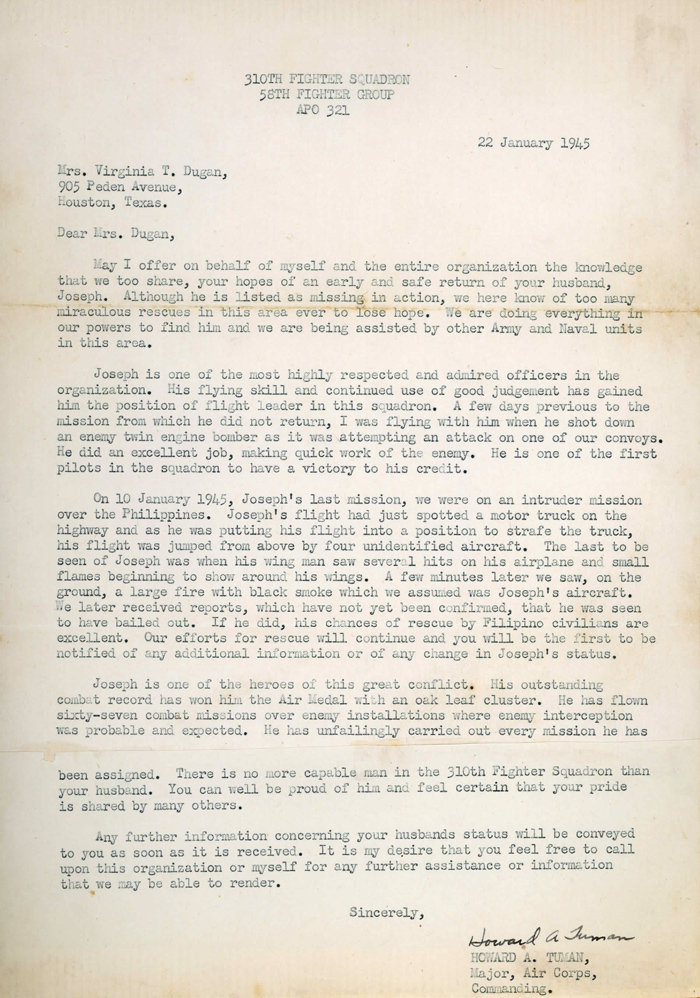
On January 22, 1945, Lieutenant Dugan’s squadron leader, Major Tuman, wrote to Virginia Dugan to express his sympathies and explain the circumstances by which her husband became missing in action, adding:
Joseph is one of the heroes of this great conflict. His outstanding combat record has won him the Air Medal with an oak leaf cluster. He has flown sixty-seven combat missions over enemy installations where enemy interception was probable and expected. He had unfailingly carried out every mission he has been assigned. There is no more capable man in the 310th Fighter Squadron than your husband. You can well be proud of him and feel certain that your pride is shared by many others.

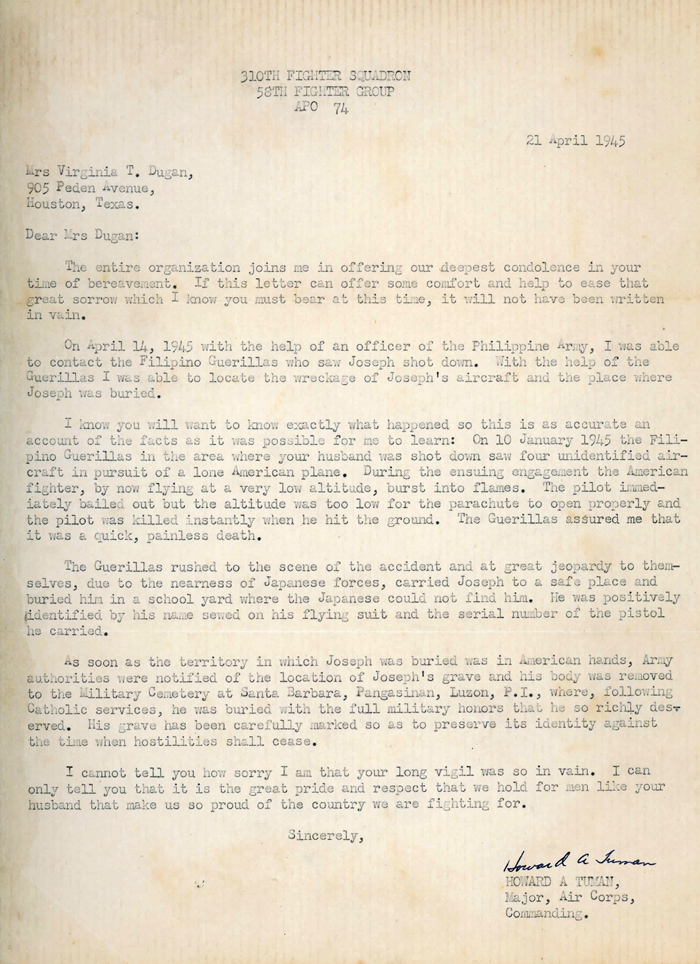
On April 14, 1945, word reached the 310th Fighter Squadron confirming Lieutenant Dugan’s death. One week later, Major Tuman wrote to Virginia Dugan:
The entire organization joins me in offering our deepest condolence in your time of bereavement. If this letter can offer some comfort and help to ease that great sorrow which I know you must bear at this time, it will not have been written in vain.
On April 14, 1945 with the help of an officer of the Philippine Army, I was able to contact the Filipino Guerillas who saw Joseph shot down. With the help of the Guerillas I was able to locate the wreckage of Joseph’s aircraft and the place where Joseph was buried.
I know you will want to know exactly what happened so this is an accurate an account of the facts as it was possible for me to learn: On 10 January 1945 the Filipino Guerillas in the area where your husband was shot down saw four unidentified aircraft in pursuit of a lone American plane. During the ensuing engagement the American fighter, by now flying at a very low altitude, burst into flames. The pilot immediately bailed out but the altitude was too low for the parachute to open properly and the pilot was killed instantly when he hit the ground. The Guerillas assured me that it was a quick, painless death.
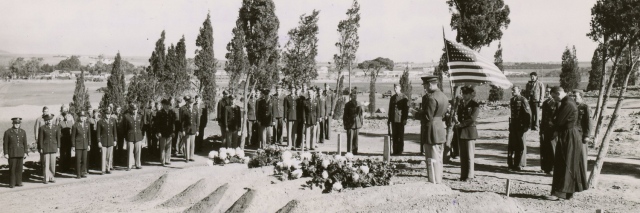
The Guerillas rushed to the scene of the accident and at great jeopardy to themselves, due to the nearness of Japanese forces, carried Joseph to a safe place and buried him in a school yard where the Japanese could not find him. He was positively identified by his name sewed on his flying suit and the serial number of the pistol he carried.
Dugan was initially buried by the guerillas at the Barrio School, Calbueg, Pangasinan, Luzon. On February 26, 1945, he was reburied at the U.S. Military Cemetery Santa Barbara, Pangasinan, Luzon. Remarkably, although his death had been confirmed by American authorities in the Philippines by the end of February, the War Department did not immediately change Lieutenant Dugan’s status from missing in action to killed in action. As late as May 8, 1945, the Adjutant General’s Office reported to Virginia Dugan that the office had received no additional information about her husband’s disappearance.
This prolonged his family’s agony, as heartbreakingly documented in a May 10, 1945, letter from Dugan’s mother to Virginia Dugan: “It’s way past midnight and I can’t sleep. Four long months since Jan 10. [L]ike you I can’t understand why there isn’t word from the War Dept. […] I’ll never understand why this had to happen to Joe.” She added that someone had made her a miniature “of the picture he had taken when he was here (you remember) the one smiling, it’s just wonderful but I could almost die when I look at it Virginia.”
It was only on May 17, 1945, that the War Department officially confirmed Lieutenant Dugan’s death. He was posthumously awarded an oak leaf cluster in lieu of a second Air Medal per General Orders No. 1116, Headquarters Far East Air Force, dated June 11, 1945. Dugan was also awarded the Purple Heart.
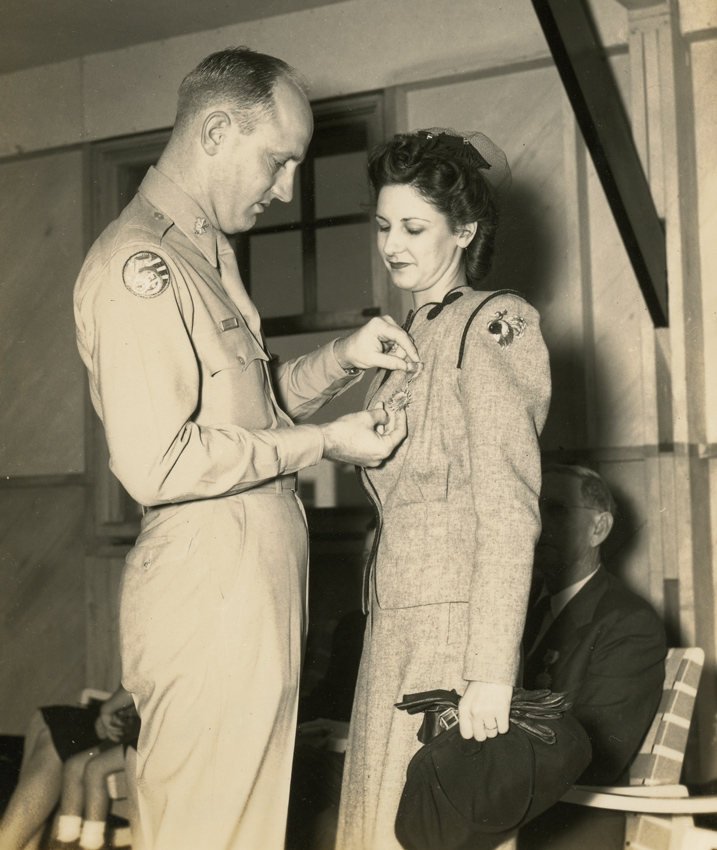

On November 17, 1945, in San Antonio, Texas, Virginia Dugan remarried to Captain Lee Roy M. Chadwell (1921–1989), who had been a fighter pilot in Lieutenant Dugan’s squadron. The couple raised Lieutenant Dugan’s son and four children of their own.
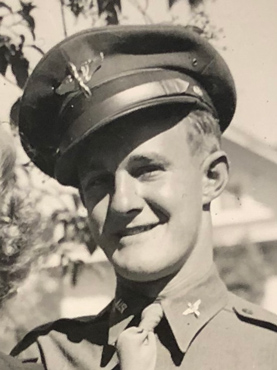
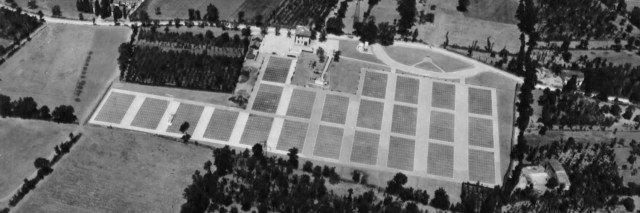
In 1949, the military requested that Lieutenant Dugan’s parents choose whether his body should be repatriated or remain buried overseas. His parents initially decided to have him buried at Cathedral Cemetery in Wilmington but changed their minds. Mary Dugan explained in a note: “After signing the enclosed papers, we feel it is more than we could bear to go through with those plans.” Lieutenant Dugan was subsequently buried at the military cemetery at Fort McKinley, now known as the Manila American Cemetery. Dugan’s name is honored at Veterans Memorial Park in New Castle, Delaware, and on his parents’ headstone at Cathedral Cemetery in Wilmington.
Notes
Mother’s Summary
As originally published, this article included a summary of Dugan’s training that his mother provided to the State of Delaware Public Archives Commission. Although flight records and morning reports have provided more precise dates, her overall summary was accurate to within a few days. Dugan’s mother wrote that her son attended primary pilot training at Corsicana, Texas (October 12, 1942 – December 12, 1942), basic pilot training at Randolph Field, Texas (December 12, 1942 – February 11, 1943), and advanced pilot training at Eagle Pass, Texas (February 11, 1943 – April 22, 1943).
She wrote that Lieutenant Dugan moved to Providence, Rhode Island, on May 30, 1943, and to Manchester, New Hampshire, on September 9, 1943.
Acknowledgments
Special thanks to Lieutenant Dugan’s son, Charles J. Dugan, for contributing documents and photographs that were vital to telling his father’s story. Thanks also go out to Julie Diehl, the Chadwell family, and the Delaware Public Archives for the use of their photos, and to Matt LeMasters for obtaining Dugan’s flight records.
Bibliography
“2 Delaware Men Killed, One Hurt.” Wilmington Morning News, June 8, 1945. https://www.newspapers.com/clip/116362906/dugans-death-confirmed/
Air Medal Decoration for Joseph A. Dugan. Award Cards, 1942–1963. Record Group 64, Records of the National Archives and Records Administration. National Archives at St. Louis, Missouri. https://catalog.archives.gov/id/138788621?objectPage=190
Census Record for Joseph Dugan. April 9, 1930. Fifteenth Census of the United States, 1930. Record Group 29, Records of the Bureau of the Census. National Archives at Washington, D.C. https://www.familysearch.org/ark:/61903/3:1:33SQ-GR4C-FFR
Census Record for Joseph Dugan. April 11, 1940. Sixteenth Census of the United States, 1940. Record Group 29, Records of the Bureau of the Census. National Archives at Washington, D.C. https://www.familysearch.org/ark:/61903/3:1:3QSQ-G9MR-M926
Certificate of Birth for Helen Dugan. January 23, 1925. Record Group 1500-008-094, Birth certificates. Delaware Public Archives, Dover, Delaware. https://www.familysearch.org/ark:/61903/3:1:33S7-9YQM-QC6Y
Certificate of Birth for Joseph Dugan. July 30, 1920. Record Group 1500-008-094, Birth certificates. Delaware Public Archives, Dover, Delaware. https://www.familysearch.org/ark:/61903/3:1:S3HT-D4WS-QTK
“Doctor’s Name Memorialized By Rest Camp.” Journal-Every Evening, October 23, 1945. https://www.newspapers.com/clip/116362626/cheff-rest-camp-1/
Dugan, Joseph A. “Individual Combat Report of 1st Lt. Joseph A. Dugan.” January 7, 1945. National Archives, courtesy of Charles J. Dugan.
Dugan, Mary A. Individual Military Service Record for Joseph Andrew Dugan. March 19, 1946. Record Group 1325-003-053, Record of Delawareans Who Died in World War II. Delaware Public Archives, Dover, Delaware. https://cdm16397.contentdm.oclc.org/digital/collection/p15323coll6/id/18543/rec/1
Dugan, Mary A. Letter to Virginia T. Dugan. May 10, 1945. Courtesy of Charles J. Dugan.
The Eagles Forty-Three-D. Courtesy of the Army Air Forces Collection website. https://aafcollection.info/items/detail.php?key=891&pkg=bf!field!32!891!1!title!up!20
Enlistment Record for Joseph A. Dugan. January 14, 1942. World War II Army Enlistment Records. Record Group 64, Records of the National Archives and Records Administration. National Archives at College Park, Maryland. https://aad.archives.gov/aad/record-detail.jsp?dt=893&mtch=1&cat=all&tf=F&q=12012731&bc=&rpp=10&pg=1&rid=483908
“Fighter Pilot Dies in Action in Philippines.” Journal-Every Evening, June 7, 1945. https://www.newspapers.com/clip/116362334/joseph-dugan-death/
Headstone Inscription and Interment Record for Joseph A. Dugan. Headstone Inscription and Interment Records for U.S. Military Cemeteries on Foreign Soil, 1942–1949. Record Group 117, Records of the American Battle Monuments Commission, 1918–c. 1995. National Archives at Washington, D.C. https://catalog.archives.gov/id/168950398?objectPage=117
“History of the 310th Fighter Squadron.” Reel A0770. Courtesy of the Air Force Historical Research Agency.
“Howard A. Tuman.” Find a Grave. https://www.findagrave.com/memorial/107371342/howard-a-tuman
Individual Deceased Personnel File for Joseph A. Dugan. Individual Deceased Personnel Files, 1939–1953. Record Group 92, Records of the Office of the Quartermaster General, 1774–1985. National Archives at St. Louis, Missouri. Courtesy of U.S. Army Human Resources Command.
Individual Flight Record for Joseph A. Dugan. October 1942 – January 1945. Individual Flight Records, 1911–1958. Record Group 64, Records of the National Archives and Records Administration. National Archives at St. Louis, Missouri. Courtesy of Matt LeMasters.
Morning Reports for Company “H,” 1229th Reception Center. January 1942. U.S. Army Morning Reports, c. 1912–1946. Record Group 64, Records of the National Archives and Records Administration. National Archives at St. Louis, Missouri. https://s3.amazonaws.com/NARAprodstorage/lz/partners/st-louis/rg-064/85713825-wwii/85713825_1940-01-thru-1943-07/85713825_1940-01-thru-1943-07_Roll-2851/85713825_1940-01-thru-1943-07_Roll-2851-01.pdf
Morning Reports for 4th Technical School Squadron (Special). June 1942 – July 1942. U.S. Army Morning Reports, c. 1912–1946. Record Group 64, Records of the National Archives and Records Administration. National Archives at St. Louis, Missouri. https://s3.amazonaws.com/NARAprodstorage/lz/partners/st-louis/rg-064/85713825-wwii/85713825_1940-01-thru-1943-07/85713825_1940-01-thru-1943-07_Roll-0096/85713825_1940-01-thru-1943-07_Roll-0096-24.pdf
Morning Reports for 36th School Squadron. March 1942 – June 1942. U.S. Army Morning Reports, c. 1912–1946. Record Group 64, Records of the National Archives and Records Administration. National Archives at St. Louis, Missouri. https://s3.amazonaws.com/NARAprodstorage/lz/partners/st-louis/rg-064/85713825-wwii/85713825_1940-01-thru-1943-07/85713825_1940-01-thru-1943-07_Roll-0153/85713825_1940-01-thru-1943-07_Roll-0153-03.pdf, https://s3.amazonaws.com/NARAprodstorage/lz/partners/st-louis/rg-064/85713825-wwii/85713825_1940-01-thru-1943-07/85713825_1940-01-thru-1943-07_Roll-0153/85713825_1940-01-thru-1943-07_Roll-0153-04.pdf
Morning Reports for 310th Fighter Squadron. December 1943. U.S. Army Morning Reports, c. 1912–1946. Record Group 64, Records of the National Archives and Records Administration. National Archives at St. Louis, Missouri. https://s3.amazonaws.com/NARAprodstorage/lz/partners/st-louis/rg-064/85713825-wwii/85713825_1943-12/85713825_1943-12_Roll-0627/85713825_1943-12_Roll-0627-05.pdf
Morning Reports for 321st Fighter Squadron. May 1943. U.S. Army Morning Reports, c. 1912–1946. Record Group 64, Records of the National Archives and Records Administration. National Archives at St. Louis, Missouri. https://s3.amazonaws.com/NARAprodstorage/lz/partners/st-louis/rg-064/85713825-wwii/85713825_1940-01-thru-1943-07/85713825_1940-01-thru-1943-07_Roll-0240/85713825_1940-01-thru-1943-07_Roll-0240-19.pdf
Morning Reports for Group XIII – Squadron I, Army Air Forces Preflight School (Pilot). August 1942. U.S. Army Morning Reports, c. 1912–1946. Record Group 64, Records of the National Archives and Records Administration. National Archives at St. Louis, Missouri. https://s3.amazonaws.com/NARAprodstorage/lz/partners/st-louis/rg-064/85713825-wwii/85713825_1940-01-thru-1943-07/85713825_1940-01-thru-1943-07_Roll-0511/85713825_1940-01-thru-1943-07_Roll-0511-01.pdf
Morning Reports for Group XIII – Squadron I, Army Air Forces Preflight School (Pilot). October 1942. U.S. Army Morning Reports, c. 1912–1946. Record Group 64, Records of the National Archives and Records Administration. National Archives at St. Louis, Missouri. https://s3.amazonaws.com/NARAprodstorage/lz/partners/st-louis/rg-064/85713825-wwii/85713825_1940-01-thru-1943-07/85713825_1940-01-thru-1943-07_Roll-0511/85713825_1940-01-thru-1943-07_Roll-0511-01.pdf
“Pacific Pilot is Promoted.” Journal-Every Evening, August 4, 1944. https://www.newspapers.com/clip/116362675/dugan-promotion/
Roach, Charles C. “Missing Air Crew Report No. 12201.” January 11, 1945. Record Group 92, Records of the Office of the Quartermaster General, 1774–1985. The National Archives at College Park, Maryland. https://catalog.archives.gov/id/91122908?objectPage=2
Schoen, Arnold F., Jr. “Unit Narrative Combat Report.” Reel A0770. Courtesy of the Air Force Historical Research Agency.
Tuman, Howard A. “Change of Status Casualty Report.” April 21, 1945. Reel A0770. Courtesy of the Air Force Historical Research Agency.
Tuman, Howard A. Letter to Virginia T. Dugan. January 22, 1945. Courtesy of Charles J. Dugan.
Last updated on September 2, 2025
More stories of World War II fallen:
























To have new profiles of fallen soldiers delivered to your inbox, please subscribe below.
 Delaware's World War II Fallen