| Residences | Civilian Occupation |
| Pennsylvania, New Jersey, Delaware | Worker in a print shop? |
| Branch | Service Number |
| U.S. Army | 20255980 |
| Theater | Unit |
| European | Detachment “C,” 328th Harbor Craft Company |
| Military Occupational Specialty | Campaigns/Battles |
| 065 (seaman) | Normandy campaign |
Early Life & Family
Robert Albert Wescoat was born at Warren Emergency Hospital in Warren, Pennsylvania, early on the morning of July 1, 1910. He was the fourth child of Robert Charles Wescoat (1881–1940), and Laura Hann Wescoat (née McKergin, 1882–1942), who were living in Sheffield, Pennsylvania. He had at least ten siblings. Two older siblings died prior to his birth and at least two younger sisters died very young. Wescoat’s father was listed as a glassblower at a bottle factory (1910 census), as a carpenter (1918 draft card), as a laborer at a powder mill (1920 census), and as a house carpenter (1930 census).
Based on the death certificate for Wescoat’s younger sister, Laura Angeline Wescoat, the family moved to Alexandria, Virginia, after August 28, 1911, and prior to July 4, 1912. It appears the family had relocated to New Jersey by the end of October 1913, when Wescoat’s younger brother, Wilmer, was born in Paulsboro. The family was recorded on the state census on June 10, 1915, living on East Broad Street in Paulsboro. The family was recorded on the federal census in January 1920 living at 15 Jefferson Street West in Paulsboro. The next census, taken in April 1930, found the Wescoats living at 129 Pierson Avenue in Somers Point, New Jersey.
Wescoat’s enlistment data card stated that he had a grammar school education and recorded his civilian occupation as “Unskilled occupations in printing and publishing.” His military paperwork described him as standing five feet, 4½ inches tall and weighing 120 lbs., with brown hair and blue eyes.
It is unclear when he moved to Delaware, but Wescoat was a resident of New Castle County and a member of the 198th Coast Artillery Regiment (Antiaircraft) of the Delaware National Guard by September 1940. The Wilmington Morning News reported that he lived at 6 East Summit Avenue in Richardson Park, southwest of downtown Wilmington, for “about eight years” prior to his military service. That suggested that he was there from 1932 or 1934 onward, but he was not recorded at that address on the 1940 census (or on any known indexed census record from that year).
Military Career
As of September 16, 1940, Private 1st Class Wescoat was a member of Battery “A,” 198th Coast Artillery Regiment (Antiaircraft). That day, he went on active duty in the U.S. Army when the 198th Coast Artillery was federalized in Wilmington. He served at Camp Upton, New York, and Camp Edwards, Massachusetts. A roster indicates that Wescoat was promoted to corporal in February 1941, but was reduced to private the following month. As of September 30, 1941, his military occupational specialty was listed on a roster as 698, acoustic corrector operator.
Private Wescoat was discharged from the U.S. Army just prior to November 18, 1941. The exact reason for his discharge is unclear, but he may have requested it due to his age based on a policy announced on August 19, 1941. In his book, The Rise of the G.I. Army, 1940–1941, Paul Dickson wrote that
the Associated Press in a totally unexpected story revealed that despite the provisions of the draft extension bill, the Army was planning to release a selected 200,000 draftees, Guardsmen, and Reservists before Christmas, meaning that these men would have served, on average, less than 18 months rather than the 30 months just authorized by Congress. […] These early releases were not automatic; men had to request them. Those with a proven hardship would be released first, followed by married men and those who would be 28 years of age or older by July 1, 1942.
After his discharge, Wescoat returned to Delaware. When he registered for the draft on November 18, 1941, he was unemployed and living at 6 East Summit Avenue in Richardson Park.
Following the attack on Pearl Harbor, Wescoat was recalled to active duty in the U.S. Army effective January 15, 1942. According to a document in his individual deceased personnel file (I.D.P.F.), Wescoat served with the 716th Military Police Battalion at Fort Wadsworth, New York, from January 26, 1942, to July 24, 1942. However, other documentation shows that the 716th moved to New Jersey at some point that year.
Wescoat was promoted to corporal prior to July 11, 1942, when the Wilmington Morning News reported:
Corp. Robert A. Wescoat of the 716th M. P. Battalion, Jersey City, N. J., is visiting Mr. And Mrs. William Nixon, 6 East Summit Avenue, Richardson Park, on a five-day furlough. Prior to entering the Army, Corporal Wescoat lived about eight years at the Richardson Park address. He expects to enter officers’ training school upon his return to the Army.
There is no indication in surviving records that Wescoat ever attended Officer Candidate School (O.C.S.). However, a document establishes that Wescoat had been promoted to sergeant and was a member of Company “C,” 716th Military Police Battalion, stationed at Jersey City, New Jersey, as of July 20, 1942. That day, Sergeant Wescoat was among a group of men from his battalion transferred as cadre for the new 975th Military Police Company (Aviation), at Camp Ripley, Minnesota. His M.O.S. code at the time was recorded as 677, military policeman.
The 975th was officially activated at Camp Ripley on July 26, 1942, with four officers and 100 enlisted men. Wescoat transferred out of the unit on August 12, 1942, joining the 7th Service Command Detachment at Camp Ripley (also known as Headquarters Detachment, Station Complement 1742). He was demoted to private on December 7, 1942. Wescoat was sick in quarters during December 8–9, 1942. He and two other men from his company were transferred to Camp Phillips, Kansas, on December 14, 1942.
Private Wescoat and his comrades reported for duty at Camp Phillips at 0300 hours on December 16, 1942. At 1000 hours, they joined the Concentration & Rehabilitation Center there. It appears this unit was known as the Detention & Rehabilitation Center, Camp Phillips, Kansas, as of January 1943.
On February 16, 1943, Private Wescoat was transferred to the Quartermaster Detachment, Camp Phillips, Kansas. Wescoat and 12 other enlisted men from his detachment were transferred to the Charleston Port of Embarkation, South Carolina, on May 18, 1943. His I.D.P.F. indicates he reported for duty there the following day. Private Wescoat was one of 246 enlisted men assigned to the 328th Harbor Craft Company, a U.S. Army Transportation Corps unit, upon activation on May 28, 1943. During June 22–25, 1943, Wescoat went on detached service to Fort Jackson, South Carolina. He later went overseas with his unit to the United Kingdom. He was also promoted back to private 1st class.
Overseas Service
According to documents in his individual deceased personnel file (I.D.P.F.), Wescoat was a deckhand aboard the small tug ST-75, under the command of Warrant Officer (Junior Grade) Vatroslav E. Hollos (1916–1999). Hollos later recalled that Wescoat joined the crew on May 23, 1944. Morning reports shows that the same date, Detachment “C,” 328th Harbor Craft Company was activated and late that evening departed the main body of the 328th, which had been based at Waterloo, England. With a complement of four officers and 159 enlisted men, including Private 1st Class Wescoat, Detachment “C” represented about 68% of the 328th’s personnel. A detachment roster listed Wescoat’s military occupational specialty as 065, seaman.
Detachment “C” boarded a train at Waterloo, arriving at Southampton, England, on the morning of May 24, 1944. Hollos wrote that he assumed command of the ST-75 around June 1, 1944.
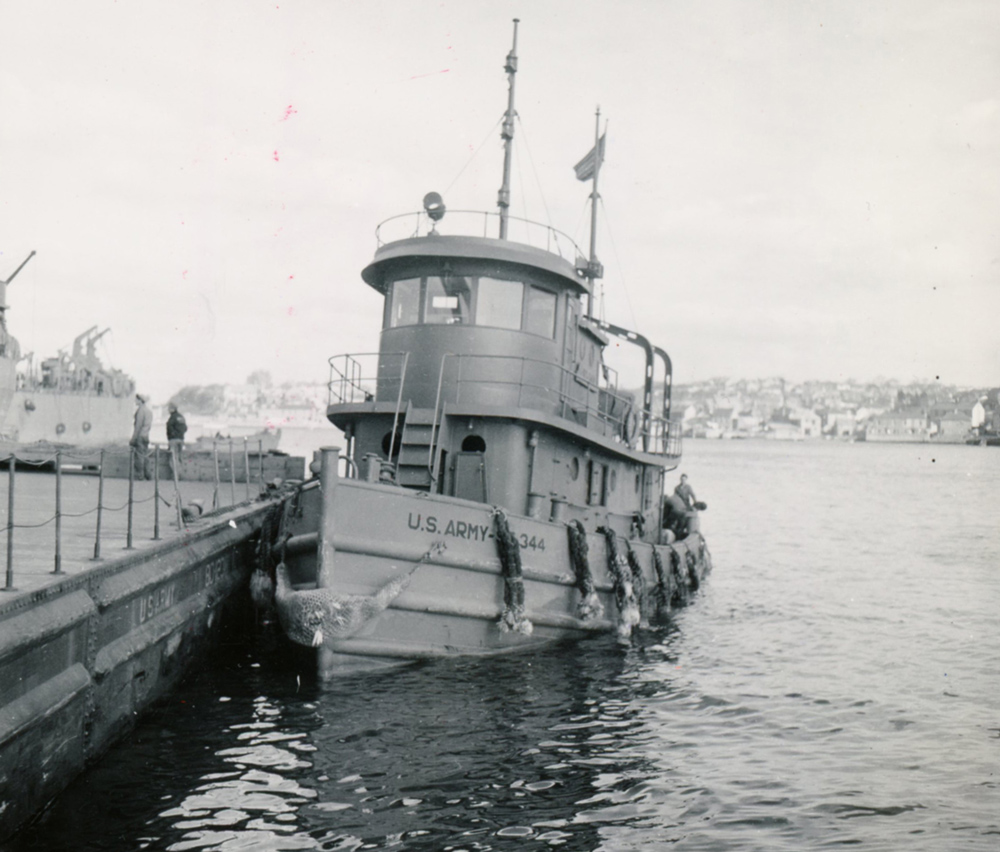
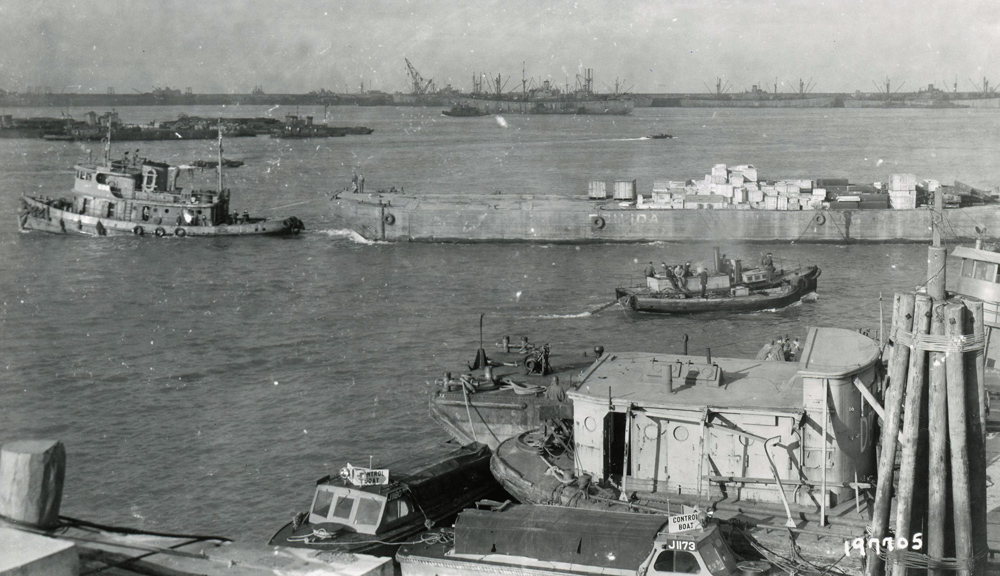
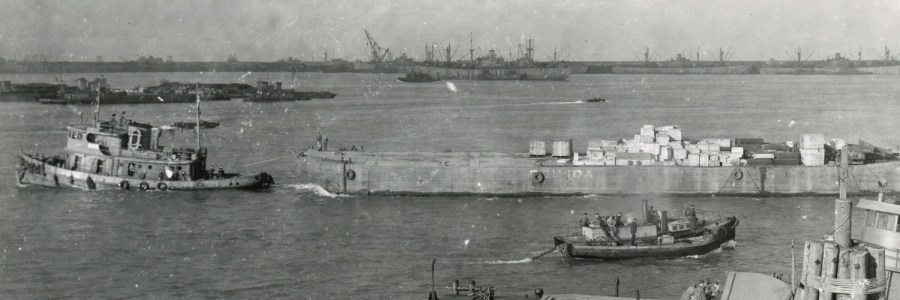
Around 1500 hours on July 18, 1944, ST-75 sailed from England in a convoy. Detachment “C” was relocating to Cherbourg, France, to rejoin the rest of the 328th Harbor Craft Company there. A contemporary document about Transportation Corps port unit losses in Normandy during July 1944 stated:
Late on the afternoon of July 18th Harbor Craft Cos. 328 and 335, together with one other company attached to another port, sailed from Southampton for Cherbourg in a convoy of about 67 small boats under the protection of an escort from the Royal Navy. About the middle of the night the boats got separated in a dense fog and some of them got lost. All either reached Cherbourg on the 19th in safety, or returned to England, with the exception of ST – 75 of the 328th Harbor Craft Co. Five of the boats, including the ST – 75 were in a group together and sighted land at 1000 hrs, the following morning but were fired upon as they approached the shore. The craft turned away, put to land again at another point and were driven off the second time by shell fire. The maters, who did not have charts or accurate compasses, then realized they were in the channel islands and set a course to the north.
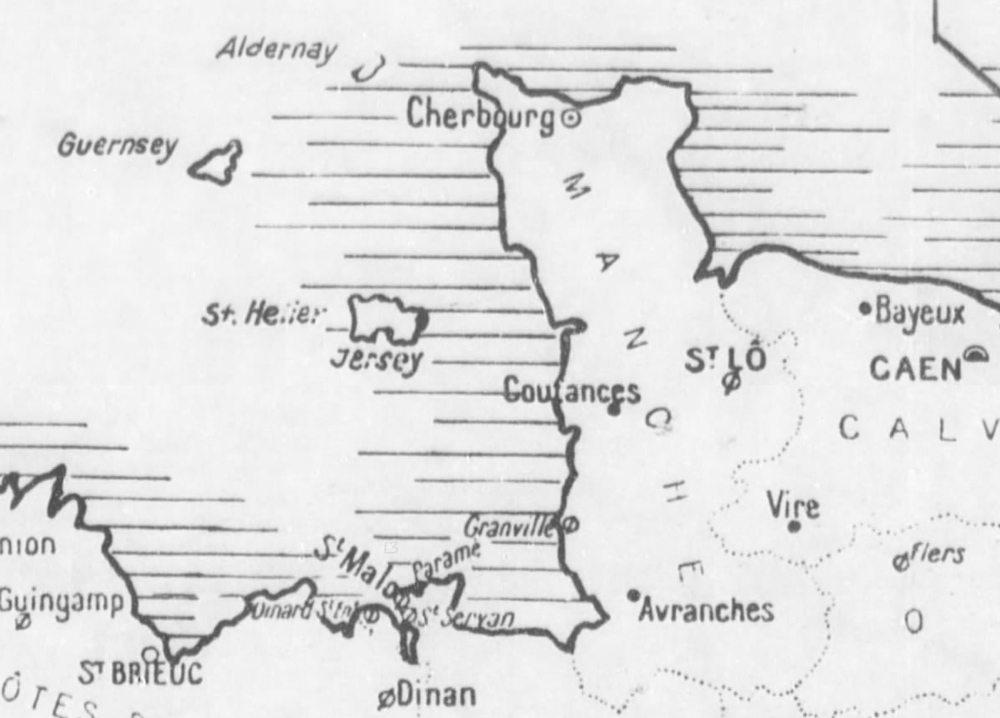
The Channel Islands were a British possession in the English Channel, off the coast of Normandy. After the fall of France in 1940, the British considered the islands indefensible. The Germans soon occupied and began fortifying the islands. Even after the invasion of Normandy, Allied planners elected to bypass the islands and they remained under German control until the end of the war. The document continued:
Just as they started off fire was again opened by shore guns at about 2000 yards. The first round took off the aftermast of the ST-75; part of the second round send fragments thru the wheelhouse of another boat, the crew of which saw the ST-75 receive two more hits, one in the galley and the other amidships setting her on fire.
In a statement dated June 2, 1945, Hollos (now a 2nd lieutenant) recalled that the tug was hit off Alderney at around 1520 hours and that he ordered the crew to abandon the tug five minutes later. He continued:
While the crew was abandoning the ship I went back to my cabin to destroy any secret papers in my file. When I came back on deck I called to members of my crew, Sgt Byrd and Pfc Young to give a hand to throw the life raft overboard and start immediately gathering the crew on the raft and the wounded engineer M/Sgt Gardner was first. After having put all the men on the raft we saw that Pfc Wescoat was missing and then we saw him standing on the deck and screaming. Everybody on the raft kept calling him and telling him to jump in the water and I gave him a direct order to do so – but he did not pay any attention and instead of that he went up on the upper deck and began waving a white sheet.
There was continuous enemy fire and as the strong current was separating the raft from the burning ship it was impossible to go back to the ship and force Pfc Wescoat into the water.
I also realized the danger of losing nine lives instead of one because of the large amount of fuel stored on boar[d] which was subject to direct hits from enemy shore batteries, it would mean sure death to everybody on the raft thus we had to get away from the ship as soon as possible.
Master Sergeant Jeffrie T. Gardner (1917–1944) died in the raft prior to rescue. ST-75’s survivors were rescued by the Canadian escort destroyer H.M.C.S. Qu’Appelle. After the war, in 1947, American authorities consulted French naval experts in Cherbourg about the case. They stated that due to strong currents, it was likely that ST-75 “has drifted away or is completely covered with sand and debris at this time” and that even if the wreck could be located, it would be too dangerous for a diver to attempt to find Private 1st Class Wescoat’s body. The War Department declared his body non-recoverable.
Journal-Every Evening reported on October 16, 1947, that Wescoat would be memorialized on “A bronze plaque in memory of the members of the Independent Order of Odd Fellows in Delaware who lost their lives in World War II” at Odd Fellows Hall in Wilmington. Private 1st Class Wescoat is also honored on the Tablets of the Missing at the Brittany American Cemetery and at Veterans Memorial Park in New Castle, Delaware.
Notes
Wife
Puzzlingly, Wescoat’s military paperwork listed his next of kin as a wife, Anna L. Wescoat, of 6 East Summit Avenue in Wilmington. The State of Delaware Public Archives sent a questionnaire to the Nixons at that address with her name filled in, but Mrs. Nixon wrote: “No such person as his wife, Anna.”
Military Career
As originally published on December 7, 2022, this article had many gaps in Wescoat’s military history. Some of these gaps were filled in with an update on June 20, 2024, based on some newly released rosters from the National Archives. More were filled in with another update on October 16, 2024, after the National Archives released microfilmed morning reports from 1940–1943. Unfortunately, it appears that morning reports from the Battery “A,” 198th Coast Artillery Regiment from 1940–1942 and the 716th Military Police Battalion from the entire war went missing before they could be digitized.
Time of Engagement
One document suggests that the ST-75 was sunk during the morning given that the enemy short batteries engaged the convoy at 1000 hours. On the other hand, documents in Wescoat’s I.D.P.F. suggested that the tug was lost in fog until the afternoon, was hit at 1520 hours, and “sank at 2100 hours.”
Bibliography
Census Record for Robert A. Wescoat. April 17–18, 1930. Fifteenth Census of the United States, 1930. Record Group 29, Records of the Bureau of the Census. National Archives at Washington, D.C. https://www.ancestry.com/imageviewer/collections/6224/images/4660847_00358
Census Record for Robert Wescoat. January 5, 1920. Fourteenth Census of the United States, 1920. Record Group 29, Records of the Bureau of the Census. National Archives at Washington, D.C. https://www.ancestry.com/imageviewer/collections/6061/images/4313320-00715
Certificate of Birth for Robt. Albert Wescoat. Undated, c. July 1, 1910. Pennsylvania Birth Certificates, 1906–1913. Record Group 11, Series 11.89, Records of the Department of the Pennsylvania Department of Health. Pennsylvania Historical and Museum Commission, Harrisburg, Pennsylvania. https://www.ancestry.com/imageviewer/collections/60484/images/47550_2421401755_0187-03336
“Cherbourg Notes, Freight Section.” Administrative History Collection, Historical Section, ETOUSA. Record Group 498, Records of Headquarters, European Theater of Operations, United States Army 1942–1947. National Archives at College Park, Maryland. https://www.fold3.com/image/290419636
“Delaware Soldiers.” Journal-Every Evening, September 19, 1940. https://www.newspapers.com/article/140371683/
Dickson, Paul. The Rise of the G.I. Army 1940–1941: The Forgotten Story of How America Forged a Powerful Army Before Pearl Harbor. Atlantic Monthly Press, 2020.
Draft Registration Card for Robert Albert Wescoat. November 18, 1941. Draft Registration Cards for Delaware, October 16, 1940 – March 31, 1947. Record Group 147, Records of the Selective Service System. National Archives at St. Louis, Missouri. https://www.ancestry.com/imageviewer/collections/2238/images/44003_04_00009-01020
Enlistment Record for Robert A. Wescoat. September 16, 1940. World War II Army Enlistment Records. Record Group 64, Records of the National Archives and Records Administration. National Archives at College Park, Maryland. https://aad.archives.gov/aad/record-detail.jsp?dt=893&mtch=1&cat=all&tf=F&q=20255980&bc=&rpp=10&pg=1&rid=1897843
Individual Deceased Personnel File for Robert A. Wescoat. Individual Deceased Personnel Files, 1939–1953. Record Group 92, Records of the Office of the Quartermaster General, 1774–1985. National Archives at St. Louis, Missouri. Courtesy of U.S. Army Human Resources Command.
“Monthly Personnel Roster Feb 28 1941 Btry A 198th Coast Arty.” February 28, 1941. U.S. Army Muster Rolls and Rosters, November 1, 1912 – December 31, 1943. Record Group 64, Records of the National Archives and Records Administration. National Archives at St. Louis, Missouri. https://s3.amazonaws.com/NARAprodstorage/lz/st-louis/rg-064/85713803_1940-1943/85713803_1940-1943_Roll-0494/85713803_1940-1943_Roll-0494_14.pdf
“Monthly Personnel Roster Mar 31 1941 Btry A 198th CA Regt AA.” March 31, 1941. U.S. Army Muster Rolls and Rosters, November 1, 1912 – December 31, 1943. Record Group 64, Records of the National Archives and Records Administration. National Archives at St. Louis, Missouri. https://s3.amazonaws.com/NARAprodstorage/lz/st-louis/rg-064/85713803_1940-1943/85713803_1940-1943_Roll-0494/85713803_1940-1943_Roll-0494_14.pdf
“Monthly Personnel Roster Sep 30 1941 Btry A 198th Coast Arty.” September 30, 1941. U.S. Army Muster Rolls and Rosters, November 1, 1912 – December 31, 1943. Record Group 64, Records of the National Archives and Records Administration. National Archives at St. Louis, Missouri. https://s3.amazonaws.com/NARAprodstorage/lz/st-louis/rg-064/85713803_1940-1943/85713803_1940-1943_Roll-0494/85713803_1940-1943_Roll-0494_14.pdf
Morning Reports for 7th Service Command Detachment. August 1942. U.S. Army Morning Reports, c. 1912–1946. Record Group 64, Records of the National Archives and Records Administration. National Archives at St. Louis, Missouri. https://s3.amazonaws.com/NARAprodstorage/lz/partners/st-louis/rg-064/85713825-wwii/85713825_1940-01-thru-1943-07/85713825_1940-01-thru-1943-07_Roll-3024/85713825_1940-01-thru-1943-07_Roll-3024-32.pdf
Morning Reports for 328th Harbor Craft Company. July 1944. U.S. Army Morning Reports, c. 1912–1946. Record Group 64, Records of the National Archives and Records Administration. National Archives at St. Louis, Missouri. https://s3.amazonaws.com/NARAprodstorage/lz/partners/st-louis/rg-064/85713825-wwii/85713825_1944-07/85713825_1944-07_Roll-0481/85713825_1944-07_Roll-0481-28.pdf
Morning Reports for 328th Harbor Craft Company. May 1943. U.S. Army Morning Reports, c. 1912–1946. Record Group 64, Records of the National Archives and Records Administration. National Archives at St. Louis, Missouri. https://s3.amazonaws.com/NARAprodstorage/lz/partners/st-louis/rg-064/85713825-wwii/85713825_1940-01-thru-1943-07/85713825_1940-01-thru-1943-07_Roll-2715/85713825_1940-01-thru-1943-07_Roll-2715-09.pdf
Morning Reports for 328th Harbor Craft Company. May 1944. U.S. Army Morning Reports, c. 1912–1946. Record Group 64, Records of the National Archives and Records Administration. National Archives at St. Louis, Missouri. https://s3.amazonaws.com/NARAprodstorage/lz/partners/st-louis/rg-064/85713825-wwii/85713825_1944-05/85713825_1944-05_Roll-0508/85713825_1944-05_Roll-0508-13.pdf
Morning Reports for 975th Military Police Company (Aviation). July 1942 – August 1942. U.S. Army Morning Reports, c. 1912–1946. Record Group 64, Records of the National Archives and Records Administration. National Archives at St. Louis, Missouri. https://s3.amazonaws.com/NARAprodstorage/lz/partners/st-louis/rg-064/85713825-wwii/85713825_1940-01-thru-1943-07/85713825_1940-01-thru-1943-07_Roll-2215/85713825_1940-01-thru-1943-07_Roll-2215-16.pdf
Morning Reports for Detachment “C,” 328th Harbor Craft Company. July 1944. U.S. Army Morning Reports, c. 1912–1946. Record Group 64, Records of the National Archives and Records Administration. National Archives at St. Louis, Missouri. https://s3.amazonaws.com/NARAprodstorage/lz/partners/st-louis/rg-064/85713825-wwii/85713825_1944-07/85713825_1944-07_Roll-0481/85713825_1944-07_Roll-0481-28.pdf
Morning Reports for Detachment “C,” 328th Harbor Craft Company. May 1944. U.S. Army Morning Reports, c. 1912–1946. Record Group 64, Records of the National Archives and Records Administration. National Archives at St. Louis, Missouri. https://s3.amazonaws.com/NARAprodstorage/lz/partners/st-louis/rg-064/85713825-wwii/85713825_1944-05/85713825_1944-05_Roll-0508/85713825_1944-05_Roll-0508-13.pdf
Morning Reports for Headquarters Detachment Detached Enlisted Men’s List, Camp Phillips, Kansas. December 1942. U.S. Army Morning Reports, c. 1912–1946. Record Group 64, Records of the National Archives and Records Administration. National Archives at St. Louis, Missouri. https://s3.amazonaws.com/NARAprodstorage/lz/partners/st-louis/rg-064/85713825-wwii/85713825_1940-01-thru-1943-07/85713825_1940-01-thru-1943-07_Roll-3010/85713825_1940-01-thru-1943-07_Roll-3010-15.pdf
Morning Reports for Headquarters Detachment, Station Complement 1742. December 1942. U.S. Army Morning Reports, c. 1912–1946. Record Group 64, Records of the National Archives and Records Administration. National Archives at St. Louis, Missouri. https://s3.amazonaws.com/NARAprodstorage/lz/partners/st-louis/rg-064/85713825-wwii/85713825_1940-01-thru-1943-07/85713825_1940-01-thru-1943-07_Roll-3024/85713825_1940-01-thru-1943-07_Roll-3024-31.pdf
Morning Reports for Quartermaster Detachment, Camp Phillips, Kansas. February 1943 – May 1943. U.S. Army Morning Reports, c. 1912–1946. Record Group 64, Records of the National Archives and Records Administration. National Archives at St. Louis, Missouri. https://s3.amazonaws.com/NARAprodstorage/lz/partners/st-louis/rg-064/85713825-wwii/85713825_1940-01-thru-1943-07/85713825_1940-01-thru-1943-07_Roll-3010/85713825_1940-01-thru-1943-07_Roll-3010-29.pdf
“MSgt. Jeffrie T Gardner.” Find a Grave. https://www.findagrave.com/memorial/56353403/jeffrie-t-gardner
Nixon, Ella B. Individual Military Service Record for Robert A. Wescoat. September 1, 1949. Record Group 1325-003-053, Record of Delawareans Who Died in World War II. Delaware Public Archives, Dover, Delaware. https://cdm16397.contentdm.oclc.org/digital/collection/p15323coll6/id/21609/rec/1
“Odd Fellows Plan Tribute.” Journal-Every Evening, October 16, 1947. https://www.newspapers.com/clip/109949003/wescoat-ioof/
“With the Service Men.” Wilmington Morning News, July 11, 1942. https://www.newspapers.com/clip/109948177/wescoat-furlough/
Last updated on January 3, 2025
More stories of World War II fallen:

























To have new profiles of fallen soldiers delivered to your inbox, please subscribe below.
 Delaware's World War II Fallen