| Residences | Occupation |
| Delaware, Virginia, Georgia | Career soldier |
| Branch | Service Numbers |
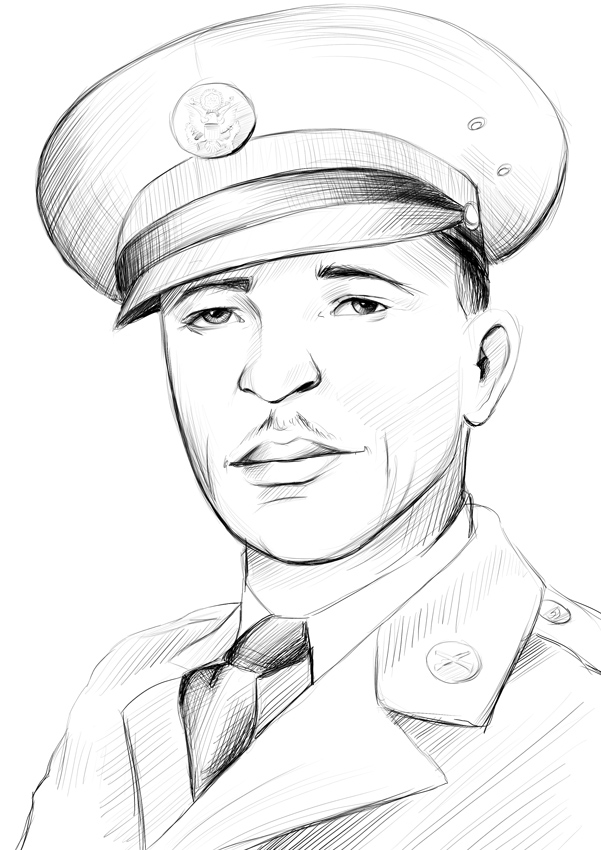
| U.S. Army | Enlisted 6034127 / Warrant Officer W-2122575 |
| Theater | Unit |
| Pacific | Headquarters Battery, 742nd Antiaircraft Artillery Gun Battalion |
| Military Occupational Specialty | Entered the Service From |
| 9312 (reconnaissance officer) / Communications officer per letter from his commander | Wilmington, Delaware |
Early Life & Family
Information about Russell Theodore Crawford’s early life and family is fragmentary and contradictory. According to a statement to the State of Delaware Public Archives Commission—apparently based on information supplied by his brother, Frank—Crawford was born in Wilmington, Delaware, around 1904, the eldest child of Frank and Maud Crawford (née Robinson, later Brown). His father was a plumber born in North Carolina, while his mother was from Lexington, Virginia. The Evening Journal reported their marriage on September 24, 1904:
Coming to this city about six weeks ago without knowing a person here, pretty Maud Brown has outdistanced many Wilmington girls in lovemaking and was married yesterday in Media[, Pennsylvania] to Frank Crawford, an employe[e] of Ryan and Kelley, railroad contractors.
It was a case of love at first sight with the couple. The first evening that Crawford saw the girl at the boarding house No. 225 East Front street, where they both lived he felt sure she was his affinity. His love was reciprocated. In a few days they were together constantly. As the time passed the love grew until they saw they could not live without one another and accordingly the ceremony was performed that made them one.
The Wilmington birth register recorded the birth of a black male child at the Homeopathic Hospital on December 31, 1904. The birth was reported by the superintendent the following year. He was unable to provide the child’s full name but stated that he was the first born to George Crawford, a laborer from Virginia, and Maude (unknown last name), a 20-year-old woman from Delaware. If both the newspaper article and birth register refer to the correct family, Crawford’s mother was already pregnant when she arrived in Wilmington.
It appears that Crawford was living at 1130 East 15th Street when a younger sister, Alice, was born on October 24, 1905. Tragically, she died five days later. The following year, his younger brother, Frank Columbus Crawford (1906–1977), was born at 225 East Front Street. Records suggest that Frank and Maud Crawford divorced prior to 1909. Crawford’s mother remarried, to Robert Singleton, on an unknown date and eventually moved to New Jersey. It appears that Russell Crawford had at least 12 half-siblings, three of whom served in the U.S. Army during World War II: Alvin, Jack, and Willard Singleton.
At the time of the 1910 census, Russell and his brother, Frank, were living with their maternal grandmother, Alice Alexander, and their step-grandfather in Lexington, Virginia. A Russell Crawford appears on the 1st and 2nd grade honor rolls at the Lexington Colored Graded School in 1912. The 1940 census stated that Crawford had completed two years of high school. Crawford’s family’s statement to the Delaware Public Archives Commission stated that he was living at 330 Tatnall Street in Wilmington when he entered the service.
Military Career & Marriage
Crawford volunteered for the U.S. Army, enlisting in Washington D.C. on May 20, 1920. Strong circumstantial evidence suggests that he was only 15 years old when he enlisted, but claimed to be 20 by giving his date of birth as December 31, 1899.
In the years following World War I, isolationist sentiment and budget cuts, later exacerbated by the Great Depression, drastically shrank the size of the Army. Opportunities for advancement were extremely limited and transfers often came with a demotion to private. To make matters worse, the U.S. Army was segregated. Black soldiers like Crawford could only be members of all-black units, often commanded by white officers. According to his family’s statement, Crawford was stationed at Fort Benning, Georgia, for 22 years.
Private Crawford joined the Infantry School Service Detachment (Colored) at Benning on May 23, 1920. Records from July 1920 onward refer to his unit as the Infantry School Detachment (Colored), from January 1921 as Company “A” (Provisional), Infantry School Detachment (Colored), and from July 1921 as Company “A,” Infantry School Detachment (Colored).
On December 1, 1921, Private Crawford was transferred to Company “I,” 24th Infantry Regiment, also stationed at Camp Benning. The 24th Infantry Regiment’s history dated back to 1869, with service in the Indian Wars, the Spanish-American War, the Philippine-American War, and World War I.
On February 13, 1922, Private Crawford transferred to Headquarters Company, 3rd Battalion, 24th Infantry Regiment. After the transfer, he was promoted to private 1st class, specialist 6th class. He was reduced to the grade of private in June 1922. Private Crawford transferred to Company “L,” 24th Infantry Regiment on September 25, 1922. On November 6, 1923, Private Crawford reenlisted and rejoined Company “L.” He was promoted to private 1st class in January 1924, and to corporal in March 1924.
Corporal Crawford transferred in grade to Company “F,” 24th Infantry Regiment on February 11, 1925, but was reduced back to private in June 1926. He was discharged at the end of his term of service on November 5, 1926.
Private Crawford reenlisted in the U.S. Army on July 30, 1927, and joined Company “E,” 24th Infantry Regiment. Private Crawford transferred to Service Company, 24th Infantry Regiment on January 11, 1930. Private Crawford was discharged at the end of his term of service on July 29, 1930. He reenlisted the following day and joined Company “E,” 24th Infantry Regiment. He remained with that company for the entire three-year enlistment. After reenlisting, Private Crawford rejoined Company “E,” 24th Infantry on July 30, 1933. The Columbus Ledger reported that Crawford was among a group of enlisted men scheduled to begin a communications course at The Infantry School, Fort Benning, Georgia, beginning on March 4, 1935. Private Crawford transferred to Headquarters Company, 24th Infantry Regiment on September 1, 1935.
Crawford was promoted two grades to corporal in July 1936. Corporal Crawford went on detached service at Camp F-16 in Wiggins, Mississippi, on July 1, 1938, but rejoined his old unit on August 17, 1938. Corporal Crawford reenlisted on July 30, 1939. Corporal Crawford was still in Headquarters Company, 24th Infantry Regiment as of December 31, 1939.
According to the family statement for the State of Delaware Public Archives Commission, Crawford married his wife, Jesse, an Alabamian, in Columbus, Georgia, in 1930. On the other hand, Crawford was listed on the 1930 census as a 27-year-old who had been married since he was 25.
The Crawfords were recorded on the census on April 20, 1940, living at 304 Dragg Street. The location was a community known as Bozemans near Columbus, Georgia. Crawford’s wife, listed as Jessie Mae Crawford, was described as a 24-year-old maid. Both were listed as having lived in the same house as of April 1, 1935. A 1945 newspaper article reported that the couple had one daughter, Margaret, although she was not included in the list of his next of kin in his individual deceased personnel (I.D.P.F.), nor did she appear on the 1950 census. That suggests that she died young or that the newspaper was in error.
Journal-Every Evening reported on January 24, 1940, that “Frank C. Crawford has returned from a visit with his brother, Russell T. Crawford, at Fort Bennington [sic] near Columbia [sic], Ga. It was the first time the brothers had met in 25 years.”
The U.S. Army’s rapid expansion following the outbreak of war in Europe meant that there was an increased demand for experienced noncommissioned officers in new units.
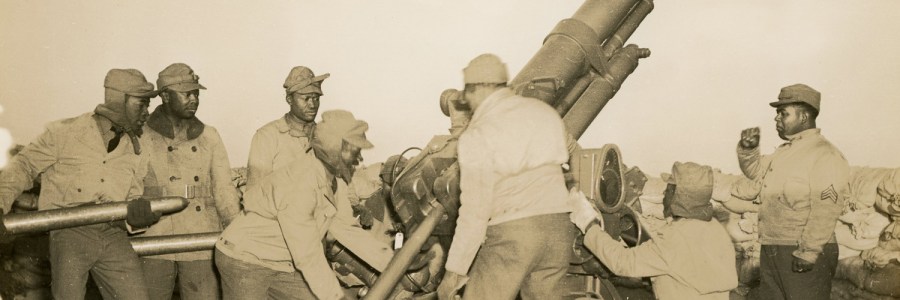
Corporal Crawford was transferred to the 76th Coast Artillery Regiment (Antiaircraft) on August 9, 1940. Crawford was cadre for a new unit, so the transfer came with a promotion to sergeant. 1st Battalion of the regiment was activated at Fort Bragg (located near Fayetteville, North Carolina) on August 1, 1940. The initial cadre included 109 men transferred from other units (including 13 from the 24th Infantry Regiment). All enlisted personnel were black and all officers were white. The rest of the 76th Coast Artillery Regiment was activated on February 10, 1941.
On August 10, 1940, Sergeant Crawford joined Headquarters Battery, 76th Coast Artillery at Fort Bragg. He transferred to Battery “D” in the same regiment on September 1, 1940, remaining with that battery through the end of 1940. Sergeant Crawford appeared on the January 1941 roster for Headquarters Battery, 1st Battalion, 76th Coast Artillery. The following month, he transferred back to the regimental Headquarters Battery.
In May 1941, Crawford was promoted to 1st sergeant. Crawford was promoted to master sergeant in August 1941, the highest enlisted grade in the U.S. Army at the time. It was a remarkable rise: In the first 20 years of his career, Crawford had advanced only three grades but he was promoted four grades in the span of about a year.
Service During World War II
According to the regimental history, on December 8, 1941, the 76th Coast Artillery was dispatched to Philadelphia in the immediate aftermath of the attack on Pearl Harbor. The unit arrived in Philadelphia on December 11, 1941. Despite his promotion, Master Sergeant Crawford’s duty code remained 585 (1st sergeant) on rosters until February 1942, when it was listed as 177 (radio operator). The regiment was ordered west to Burbank, California, on May 20, 1942, arriving five days later. Although Crawford’s military occupational specialty was listed as 177 on a June 1942 roster, his duty changed to 178 (radio engineer).


The 76th arrived at Camp Stoneman, California, on July 30, 1942, and shipped out from the San Francisco Port of Embarkation on August 10, 1942, aboard the transport U.S.A.T. Mormacsea. The unit participated in traditional ceremonies upon crossing the equator for the first time on August 19, 1942. The ship arrived at the major Allied base at Espiritu Santo, New Hebrides (now Vanuatu), on September 1, 1942. It was three weeks into the Guadalcanal campaign in the nearby Solomon Islands.
A Headquarters Battery roster from early 1943 stated that Crawford was one of five men promoted to warrant officer (junior grade). A document in Crawford’s individual deceased personnel file (I.D.P.F.) indicates that he became a warrant officer on February 19, 1943. On or about February 26, 1943, Crawford joined Headquarters Company, 2nd Battalion, 76th Coast Artillery Regiment (Antiaircraft) and assumed the duty of supply officer.
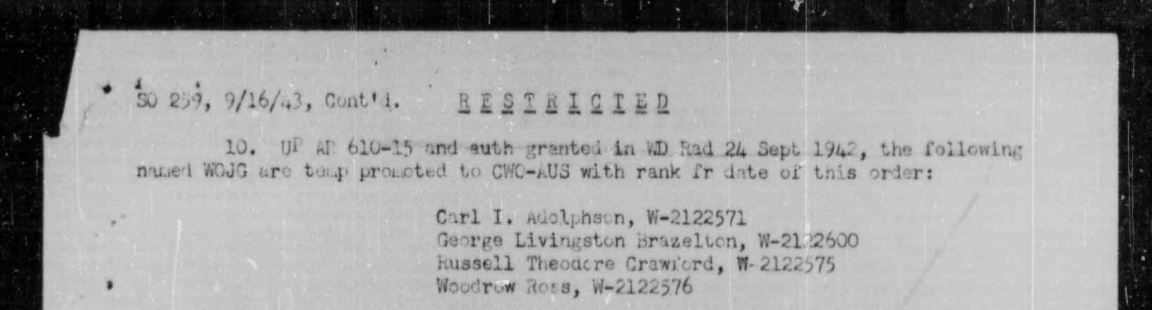
Crawford was promoted to chief warrant officer on September 16, 1943.

On November 1, 1943, the 76th Coast Artillery Regiment (Antiaircraft) was broken up, with 2nd Battalion being redesignated as the 933rd Antiaircraft Artillery Automatic Weapons Battalion (Semimobile). Crawford became a member of the new battalion’s headquarters. On November 2, 1943, he was assigned the duty of reconnaissance officer.
On November 10, 1943, the 933rd was alerted to prepare to leave Espiritu Santo. On December 7, 1943, the second anniversary of the beginning of the Pacific War, Chief Warrant Officer Crawford and his comrades boarded M.V. Poelau Laut. They set sail on the morning of December 9, 1943, arriving northwest of Guadalcanal in the Russell Islands three days later.
On March 4, 1944, Chief Warrant Officer Crawford was released from duty as battalion reconnaissance officer and became the battalion communications officer. On July 13, 1944, Crawford was relieved as communications officer and became reconnaissance officer again. He remained with the 933rd at least through July 30, 1944, but was eventually attached unassigned to 14th Antiaircraft Command by early March 1945, when he transferred to the 742nd Antiaircraft Artillery Gun Battalion.
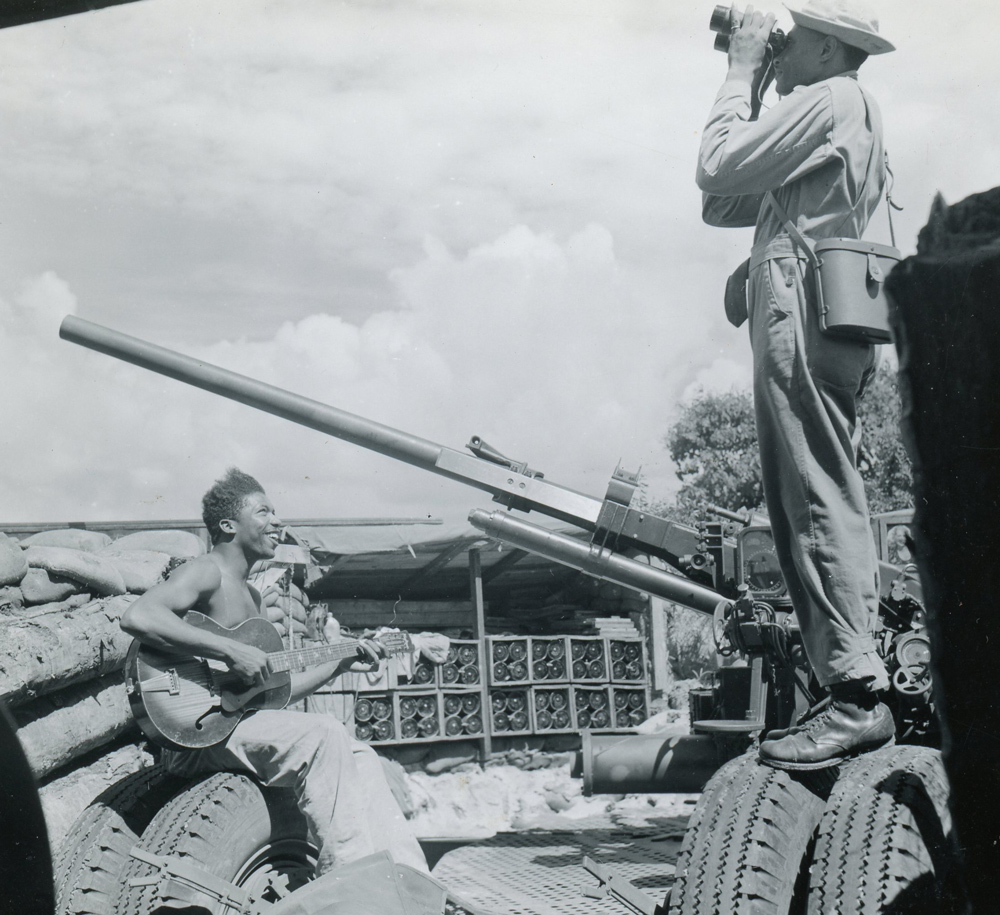

The 742nd was activated at Camp Stewart, Georgia, on January 20, 1943, and shipped out from the San Francisco Port of Embarkation aboard the U.S.A.T. Maui on September 29, 1943. The unit was equipped with 90 mm antiaircraft guns. The battalion arrived in Espiritu Santo on October 16 or 17, 1943. The unit departed Espiritu Santo on May 5, 1944, arriving on New Britain on May 20, 1944. The battalion shipped out from Cape Gloucester on November 19, 1944, arriving two days later at Finschhafen in eastern New Guinea. On March 6 or 7, 1945, the unit’s white officers transferred out and a new group of black officers transferred in. These 29 officers (including seven warrant officers) had been attached unassigned to 14th Antiaircraft Command:
Major Eaton and staff were relieved on 7 March by Lt Col De Maurice Moses, formerly of the 207th AAA AW Battalion, and a new staff of officers. This marked the first and only 90 MM Gun Battalion in the Southwest Pacific completely staffed with colored officer personnel.
According to a unit morning report, on March 6, 1945, Chief Warrant Officer Crawford joined Headquarters Battery, 742nd Antiaircraft Gun Battalion. His duty code was listed as reconnaissance officer. Another morning report stated that on April 15, 1945, Crawford was released from the unit and attached unassigned “to Rotation Detachment Base F” (Finschhafen) for temporary duty in the continental United States.
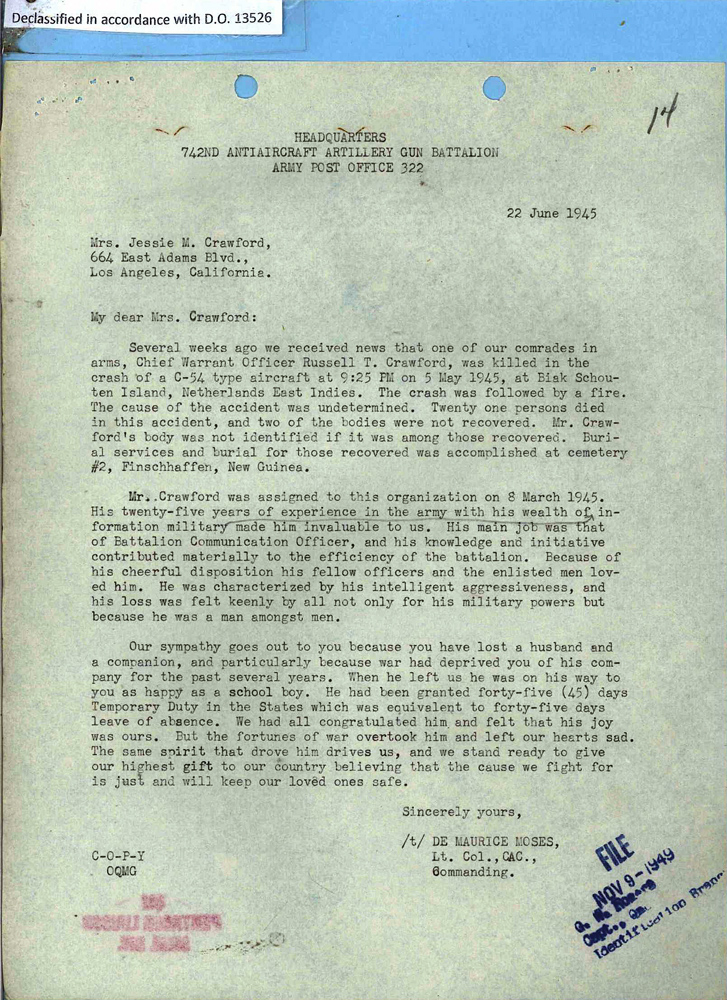
In a letter to Crawford’s wife dated June 22, 1945, Lieutenant Colonel Moses (1900–1965) wrote:
Mr. Crawford was assigned to this organization on 8 March 1945. His twenty-five years of experience in the army with his wealth of military information made him invaluable to us. His main job was that of Battalion Communication Officer, and his knowledge and initiative contributed materially to the efficiency of the battalion. Because of his cheerful disposition his fellow officers and the enlisted men loved him. He was characterized by his intelligent aggressiveness, and his loss was felt keenly by all not only for his military powers but because he was a man amongst men. […]
When he left us he was on his way to you as happy as a school boy. He had been granted forty-five (45) days Temporary Duty in the States which was equivalent to forty-five days leave of absence. We had all congratulated him and felt that his joy was ours. But the fortunes of war overtook him and left our hearts sad.
Tragedy on Biak
In the three weeks after leaving the 742nd Antiaircraft Gun Battalion, Chief Warrant Officer Crawford had made only modest progress toward the United States, but he finally had a seat for his transpacific journey. On the night of May 5, 1945, Crawford was at Sorido Airfield on Biak, an island northwest of New Guinea. The temperature was a pleasant 79°F, with a gentle breeze and unlimited visibility, though the moon was not up yet. Around 2100 hours, he boarded an Air Transport Command Pacific Division C-54E (serial number 44-9043) with 20 other men, mostly U.S. Army Air Forces and U.S. Navy personnel. Their destination was Mokerang Airfield, on Los Negros in the Admiralty Islands. Their eventual destination was Hamilton Field, California, where the aircraft and crew were based, suggesting that Crawford was being rotated back to the United States. The manifest recorded that Crawford and his cabin luggage weighed 143 lbs. and that he stowed a bag weighing 35 lbs.
The lead pilot, Captain William V. Mudra (1900–1945), had 3,452 hours of flying time under his belt including 271 hours in that type.
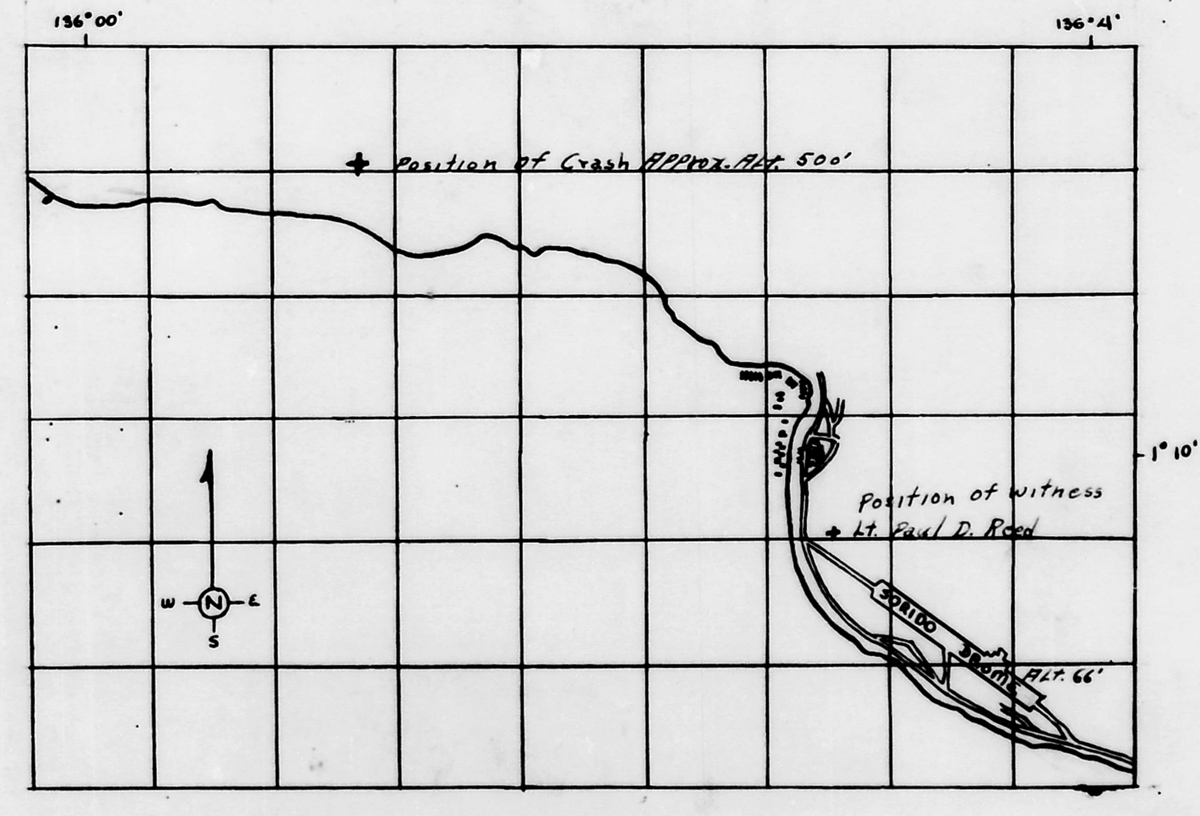
The Sorido tower cleared the aircraft for departure around 2115 hours local time. The airfield operations log recorded that the C-54 took off at 2122 hours. Approximately two minutes after takeoff, about five miles from the end of the runway, the plane struck trees on an approximately 500-foot-high ridge and crashed. At 2126, the Sorido operations log recorded a fire on the other side of the bay. Rescuers reached the scene about five hours later but found no survivors. The investigation indicated that all 21 men aboard were killed instantly.
An investigation did not reveal the cause of the accident with certainty. The C-54 had recently been serviced and no mechanical problems found that would explain the crash. The weight was well under limits. Weather and fuel problems were also ruled out. The aircraft appeared to be in controlled, level flight with its flaps up. The ridge that the C-54 struck was straight ahead of the runway.
1st Lieutenant Robert A. Wegner, who flew a test flight in the ill-fated accident after servicing on the same day as the crash, stated that the plane “flew perfectly.” He also testified that when flying from Sorido, he never attempted to climb over the ridge, explaining that instead he turned his aircraft out to sea once he had enough altitude. He explained that “had a check ride with a stateside man” who told him that “about two miles from the runway make a turn to avoid the ridge.” Lieutenant Wegner testified that the practice was not one he was formally briefed on and it is unclear if Captain Mundra was aware of the danger that the ridge presented.


Witnesses disagreed about some of the facts. Technical Sergeant Francis Mitchneck, operating the control tower at Sorido, testified that the C-54 “took off in the normal way and with normal climb.”
On the other hand, another witness, Technical Sergeant Victor C. Westbrook, a flight chief, testified that “On his takeoff he made an exceptionally long run—way down the runway before he lifted it off. He didn’t climb very high.” Another witness, Technical Sergeant Russell A. Leigh agreed that “He didn’t seem to be in any hurry about getting it up. He used most of the runway.”
Another pilot, 1st Lieutenant Paul D. Reed, testified that the plane “appeared to make a normal takeoff” but that “The only thing I noticed was that he didn’t gain any altitude.” Lieutenant Reed added that “The color of the exhaust flame seemed abnormal. I could only see the two right engines and I noticed that the exhaust flame was white, just a little more than the normal exhaust flame.” Reed suggested that this indicated “An abnormally lean mixture” and added that “it sounded like he wasn’t getting as much power as usual. It sounded as though he might be taking off on automatic lean.” However, Reed added that he was a C-46 pilot and had never flown a C-54. The board of investigators discounted his statement that the engines were “torching,” concluding that “However as this is a common occurrence with this type engine at take-off power and would not necessarily indicate loss of power, little credence is given this statement.”
Captain Herbert C. Kuhn, a C-54 pilot, testified that his “conclusion was that the landing gear was down” when the plane crashed. Although the gear had been severely damaged by the crash, he noted that the left main landing “gear was in a down position” when found. Captain Kuhn was unable to provide any explanation for why the pilots wouldn’t have retracted their landing gear, explaining that “the gear is customarily pulled up as soon as contact with the ground is broken and it is determined that the plane will remain airborne.”
Major James M. Smith, the station aircraft maintenance officer, testified that “In my opinion, final upping of the flaps caused the plain to settle slightly, which is characteristic of the C-54. This caused the left wing to strike a tree, which tore the wing from the plane.” Major Smith disputed the notion that the plane’s landing gear was down, “because if it had been, parts of the gear, such as tires and wheels, would have been thrown from the aircraft on the first point of contact.”
The board conceded that
No definite decision as to the position of the gear could be reached, due to the condition of the wreckage. Although photo #2 showed gear in down locked position, impact could have snapped gear down. It is believed that had the gear been extended it could have been sheared off by impact with trees prior to contact with ground.

After the crash, investigators had a similarly loaded C-54 take off on the same course and raised the flaps at 500 feet. 1st Lieutenant Harry C. Ross, Jr. testified that two minutes into the flight, the plane had attained an altitude of 780 feet, enough to clear the ridge. On another flight, with the gear left down until shortly before the crash site, their altitude was only 500 feet. They concluded that if the aircraft had its landing gear down, the increased drag would have likely prevented the plane from clearing the ridge. Lieutenant Ross testified similarly to Lieutenant Wegner that
I was given a route check on my second trip from this field and the check pilot said it wasn’t standard procedure to make a turn to the left at night. However, he considered it a good practice and passed it on to me.
Lieutenant Ross also testified that he had known Captain Mudra for 14 years and flown with him before. He described Mundra’s performance as average and noted that Mudra “was inclined not to take advice from other people.” However, he added that “On no occasion did I see anything wrong with his flying ability. In my experience of knowing the man, I have never known him to be guilty of any violation of flying safety rules” either as a military or civilian pilot.
The board admitted that “it was impossible to determine the exact cause of this accident.” Its recommendations were:
1. Stress to all pilots the importance of attaining 1000′ minimum altitude before retracting flaps during night operation in this type aircraft.
2. That pilots thoroughly acquaint themselves with terrain in vicinity of airports at which they land and take-off so that they can plan their flight paths with a thought of clearing all obstructions.
In addition, procedures were changed at Sorido to brief pilots on the obstructions and to have all aircraft taking off to the west make a turn out to sea within 45 seconds of takeoff.
Although all the belongings he was traveling with were destroyed in the crash, personnel effects left with his unit and later shipped to his widow included a Bible, a greeting card, a postcard, two photographs, two cigarette lighters, six books, and a Kleenex box.
In his letter to Jessie Crawford, Lieutenant Colonel Moses wrote:
Our sympathy goes out to you because you have lost a husband and a companion, and particularly because war had deprived you of his company for the past several years. […] The same spirit that drove him drives us, and we stand ready to give our highest gift to our country believing that the cause we fight for is just and will keep our loved ones safe.
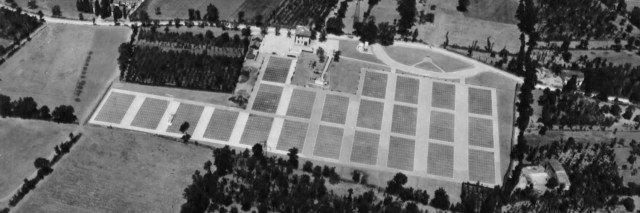
Individual identification of eight men proved impossible. On March 23, 1952, Chief Warrant Officer Crawford and the other unidentified crash victims’ remains were buried at Jefferson Barracks National Cemetery in Missouri (Section 85, Grave 70). He is honored at Veterans Memorial Park in New Castle, Delaware.
Notes
Age
Although Crawford seems to have been born around 1904 (likely December 31, 1904), the report of interment at Jefferson Barracks National Cemetery and his I.D.P.F. gave his date of birth as December 31, 1899, suggesting that was the date of birth listed in his military records. Indeed, the hospital admission card filled out under his service number (as a formality even though he was killed instantly in the crash) listed his age as 46 at the time of his death. Crawford’s mother appears to have been still in Lexington, Virginia—and without children—in 1900. It is likely that Crawford added five years to his real date of birth in order to enlist underage.
Brother
I believe the birth register entry for Frank Columbus Crawford, dated October 31, 1906, is accurate. Later records, such as his draft card, gave his date of birth as October 31, 1905. Discrepancies like these have proven common in my research.
Specialist
The U.S. Army introduced the specialist rating in 1920 and discontinued it in 1942. Specialist 6th class was the lowest and should not be confused with the specialist 6 or specialist ranks used after World War II.
Master Sergeant and 1st Sergeant
Crawford was promoted from 1st Sergeant to Master Sergeant in 1941. The following year, the Army moved 1st sergeant from 2nd grade to 1st grade, thus becoming the same paygrade as master sergeant.
Wounded in Action?
As originally published, this article suggested that Crawford was hospitalized in the United States prior to returning to the Pacific Theater. That was based on a newspaper article in Journal-Every Evening printed on March 20, 1943:
Tech. Sergt. Russell T. Crawford is recovering in Burbank, Calif., from wounds received in action in the South Pacific, according to word received here by his brother, Frank C. Crawford, 811 Lombard Street. His wife, Mrs. Jessie Jackson Crawford, is visiting him.
Subsequent research indicates that there was no interruption in Crawford’s service in the South Pacific from 1942 until his death in 1945, and suggests he was not wounded in 1943.
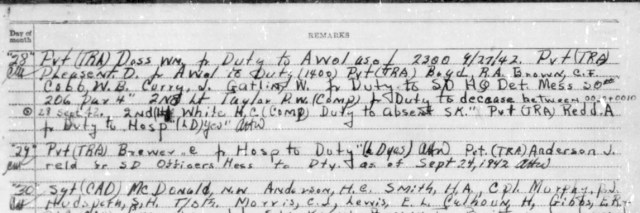
According to the 76th Coast Artillery Regiment history, two men (Technician 5th Grade Lonzo Wilkins and Private Edmon Collins) were wounded by bomb fragments during an enemy air raid on January 23, 1943, but no wounds to Crawford were mentioned. No hospital admission card for Crawford’s service number exists for this period, though an extant data card does not exist for every hospitalization. Unit morning reports mention Crawford on February 26, 1943, but not again until May 28, 1943. Although morning reports did not mention a soldier unless there was some kind of change in status, there is no mention of Crawford being hospitalized or dropped from the battery’s rolls in the interim, nor did the number of warrant officers present for duty decrease during that time.
Notwithstanding the rank error and slight inaccuracy in enlistment year, the Russell T. Crawford mentioned in the newspaper would seem to be the correct man, given that his brother’s name is correct and documents in Crawford’s I.D.P.F. establish that Jessie Crawford resided in Los Angeles, California, at the time of her husband’s death. However, it appears that Frank Crawford or Journal-Every Evening received inaccurate information.
Date Crawford Joined 742nd Antiaircraft Gun Battalion
The company history stated that the exchange of officers occurred on March 7, 1945. Unit morning reports show the exchange as occurring one day earlier, on March 6. On the other hand, the morning report includes an extract of Special Orders No. 63, Headquarters 14th Antiaircraft Command, which stated that the assignment was to be effective date concerning morning report March 7, 1945. Lieutenant Colonel Moses wrote that Crawford joined on Mach 8, 1945.
Flight Location
Several websites erroneously describe the crash as taking place after takeoff from Lorengau Airfield on Manus while en route to Biak. In fact, the plane crashed after takeoff from Sorido Airfield on Biak en route to Mokerang Airfield. The source of the error is unclear since the missing air crew report (M.A.C.R.) established that the plane crashed on Biak, not Manus. In addition, the crash investigation report establishes beyond any doubt that the plane crashed on takeoff from Sorido.
Personnel Killed in Crash
The M.A.C.R. listed eight crew and 14 passengers, for a total of 22 men aboard. The accident report, on the other hand, listed 21 men aboard: seven crew members and 14 passengers. It appears that the M.A.C.R. may have counted Flight Officer Arthur A. Houghton twice, as both passenger and crew.
Acknowledgments
Special thanks to Grace Yuhasz for digging deeper into the Russell family genealogy, discovering his probable date of birth, an article about his parents’ marriage, newspaper articles about his time in Lexington, and that Alvin, Jack, and Willard Singleton were his half-brothers.
Bibliography
Carlisle, Thomas G. et al. “Army Air Forces Report of Major Accident No. 45-5-5-505.” 1945. Aviation Archeology.
Clay, Steven E. U.S. Army Order of Battle 1919–1941, Volume 2. The Arms: Cavalry, Field Artillery, and Coast Artillery, 1919–41. Combat Studies Institute Press, 2010. https://cgsc.contentdm.oclc.org/digital/collection/p16040coll3/id/197/rec/2
Census Record for Jessie M. Crawford. April 8, 1950. Seventeenth Census of the United States, 1950. Record Group 29, Records of the Bureau of the Census. National Archives at Washington, D.C. https://www.ancestry.com/imageviewer/collections/62308/images/43290879-California-072662-0017
Census Record for Maud Robertson. June 5, 1900. Twelfth Census of the United States, 1900. Record Group 29, Records of the Bureau of the Census. National Archives at Washington, D.C. https://www.ancestry.com/imageviewer/collections/7602/images/4117900_00648
Census Record for Maude L. Singleton. January 24, 1920. Fourteenth Census of the United States, 1920. Record Group 29, Records of the Bureau of the Census. National Archives at Washington, D.C. https://www.ancestry.com/imageviewer/collections/6061/images/4313368-00342
Census Record for Russell Crawford. April 22, 1910. Thirteenth Census of the United States, 1910. Record Group 29, Records of the Bureau of the Census. National Archives at Washington, D.C. https://www.ancestry.com/imageviewer/collections/7884/images/4454832_00177
Census Record for Russell T. Crawford. April 5, 1930. Fifteenth Census of the United States, 1930. Record Group 29, Records of the Bureau of the Census. National Archives at Washington, D.C. https://www.ancestry.com/imageviewer/collections/6224/images/4531966_00620
Census Record for Russell T. Crawford. April 20, 1940. Sixteenth Census of the United States, 1940. Record Group 29, Records of the Bureau of the Census. National Archives at Washington, D.C. https://www.ancestry.com/imageviewer/collections/2442/images/M-T0627-00698-01035
“Final Statement of Russell T. Crawford, 6034127, Pvt. Company L, 24th Infantry.” November 5, 1923. Individual Pay Vouchers, c. 1926–1963. Record Group 64, Records of the National Archives and Records Administration. National Archives at St. Louis, Missouri.
“Foreign Service Pay Roll HQS & HQS BATTERY Seventy-Sixth Coast Artillery, (AA).” February 1943. U.S. Army Muster Rolls and Rosters, November 1, 1912 – December 31, 1943. Record Group 64, Records of the National Archives and Records Administration. National Archives at St. Louis, Missouri. https://s3.amazonaws.com/NARAprodstorage/lz/st-louis/rg-064/85713803_1940-1943/85713803_1940-1943_Roll-0461/85713803_1940-1943_Roll-0461_08.pdf
Hospital Admission Card for W2122575. U.S. WWII Hospital Admission Card Files, 1942–1954. Record Group 112, Records of the Office of the Surgeon General (Army), 1775–1994. National Archives at College Park, Maryland. https://www.fold3.com/record/702882281/blank-us-wwii-hospital-admission-card-files-1942-1954
Individual Deceased Personnel File for Russell T. Crawford. Individual Deceased Personnel Files, 1939–1953. Record Group 92, Records of the Office of the Quartermaster General, 1774–1985. National Archives at St. Louis, Missouri.
“Initial Historical Report 742nd Antiaircraft Artillery Gun Battalion Overseas Service September 1943 – August 1945.” Undated, c. September 1945. World War II Operations Reports, 1940–48. Record Group 407, Records of the Adjutant General’s Office. National Archives at College Park, Maryland.
“Jessie Mae Crawford.” Social Security Application and Claims Index, 1936–2007. https://www.ancestry.com/discoveryui-content/view/42294105:60901
“Lexington Colored Graded School Honor Roll.” The Lexington Gazette, March 13, 1912.
“Lexington Colored Graded School Honor Roll.” The Lexington Gazette, November 13, 1912.
“Meet After 25 Years.” Journal-Every Evening, January 24, 1940. https://www.newspapers.com/clip/94871835/brother-reunion/
“Missing Air Crew Report No. 15693.” Undated, c. May 5, 1945. Missing Air Crew Reports (MACRs), 1942–1947. Record Group 92, Records of the Office of the Quartermaster General, 1774–1985. The National Archives at College Park, Maryland. https://catalog.archives.gov/id/91169150?objectPage=3
“Monthly Personnel Roster Aug 31 1941 HQ-HQ Battery 76th Coast Arty.” August 31, 1941. U.S. Army Muster Rolls and Rosters, November 1, 1912 – December 31, 1943. Record Group 64, Records of the National Archives and Records Administration. National Archives at St. Louis, Missouri. https://s3.amazonaws.com/NARAprodstorage/lz/st-louis/rg-064/85713803_1940-1943/85713803_1940-1943_Roll-0461/85713803_1940-1943_Roll-0461_07.pdf
“Monthly Personnel Roster Feb 28 1941 HQ-HQ Battery 76th Coast Arty.” February 28, 1941. U.S. Army Muster Rolls and Rosters, November 1, 1912 – December 31, 1943. Record Group 64, Records of the National Archives and Records Administration. National Archives at St. Louis, Missouri. https://s3.amazonaws.com/NARAprodstorage/lz/st-louis/rg-064/85713803_1940-1943/85713803_1940-1943_Roll-0461/85713803_1940-1943_Roll-0461_07.pdf
“Monthly Personnel Roster Feb 28 1942 HQ-HQ Battery 76th Coast Arty.” February 28, 1942. U.S. Army Muster Rolls and Rosters, November 1, 1912 – December 31, 1943. Record Group 64, Records of the National Archives and Records Administration. National Archives at St. Louis, Missouri. https://s3.amazonaws.com/NARAprodstorage/lz/st-louis/rg-064/85713803_1940-1943/85713803_1940-1943_Roll-0461/85713803_1940-1943_Roll-0461_07.pdf
“Monthly Personnel Roster May 31 1941 HQ-HQ Battery 76th Coast Arty.” May 31, 1941. U.S. Army Muster Rolls and Rosters, November 1, 1912 – December 31, 1943. Record Group 64, Records of the National Archives and Records Administration. National Archives at St. Louis, Missouri. https://s3.amazonaws.com/NARAprodstorage/lz/st-louis/rg-064/85713803_1940-1943/85713803_1940-1943_Roll-0461/85713803_1940-1943_Roll-0461_07.pdf
“Monthly Personnel Roster Jun 30 1942 HQ-HQ Btry 76th C A AA.” June 30, 1942. U.S. Army Muster Rolls and Rosters, November 1, 1912 – December 31, 1943. Record Group 64, Records of the National Archives and Records Administration. National Archives at St. Louis, Missouri. https://s3.amazonaws.com/NARAprodstorage/lz/st-louis/rg-064/85713803_1940-1943/85713803_1940-1943_Roll-0461/85713803_1940-1943_Roll-0461_07.pdf
“Monthly Personnel Roster Jan 31 1941 HQ-HQ Btry 1 Bn 76th Coast Arty.” January 31, 1941. U.S. Army Muster Rolls and Rosters, November 1, 1912 – December 31, 1943. Record Group 64, Records of the National Archives and Records Administration. National Archives at St. Louis, Missouri. https://s3.amazonaws.com/NARAprodstorage/lz/st-louis/rg-064/85713803_1940-1943/85713803_1940-1943_Roll-0461/85713803_1940-1943_Roll-0461_09.pdf
“Monthly Roster Btry. ‘D’, 76th C. A. (AA).” September 30, 1940. U.S. Army Muster Rolls and Rosters, November 1, 1912 – December 31, 1943. Record Group 64, Records of the National Archives and Records Administration. National Archives at St. Louis, Missouri. https://s3.amazonaws.com/NARAprodstorage/lz/st-louis/rg-064/85713803_1940-1943/85713803_1940-1943_Roll-0461/85713803_1940-1943_Roll-0461_18.pdf
“Monthly Roster Hq. Btry. 76th C.A.(AA).” August 31, 1940. U.S. Army Muster Rolls and Rosters, November 1, 1912 – December 31, 1943. Record Group 64, Records of the National Archives and Records Administration. National Archives at St. Louis, Missouri. https://s3.amazonaws.com/NARAprodstorage/lz/st-louis/rg-064/85713803_1940-1943/85713803_1940-1943_Roll-0461/85713803_1940-1943_Roll-0461_07.pdf
Morning Reports for Company “F,” 131st Engineer Combat Regiment. September 1943. U.S. Army Morning Reports, c. 1912–1946. Record Group 64, Records of the National Archives and Records Administration. National Archives at St. Louis, Missouri. https://s3.amazonaws.com/NARAprodstorage/lz/partners/st-louis/rg-064/85713825-wwii/85713825_1943-09/85713825_1943-09_Roll-0655/85713825_1943-09_Roll-0655-05.pdf
Morning Reports for Headquarters & Headquarters Battery, 742nd Antiaircraft Gun Battalion. March 1945 – April 1945. U.S. Army Morning Reports, c. 1912–1946. Record Group 64, Records of the National Archives and Records Administration. National Archives at St. Louis, Missouri.
Morning Reports for Headquarters 933rd Antiaircraft Artillery Automatic Weapons Battalion. November 1943 – July 1944. U.S. Army Morning Reports, c. 1912–1946. Record Group 64, Records of the National Archives and Records Administration. National Archives at St. Louis, Missouri. https://s3.amazonaws.com/NARAprodstorage/lz/partners/st-louis/rg-064/85713825-wwii/85713825_1943-11/85713825_1943-11_Roll-0540/85713825_1943-11_Roll-0540-31.pdf, https://s3.amazonaws.com/NARAprodstorage/lz/partners/st-louis/rg-064/85713825-wwii/85713825_1943-12/85713825_1943-12_Roll-0722/85713825_1943-12_Roll-0722-27.pdf, https://s3.amazonaws.com/NARAprodstorage/lz/partners/st-louis/rg-064/85713825-wwii/85713825_1944-01/85713825_1944-01_Roll-0660/85713825_1944-01_Roll-0660-20.pdf, https://s3.amazonaws.com/NARAprodstorage/lz/partners/st-louis/rg-064/85713825-wwii/85713825_1944-02/85713825_1944-02_Roll-0567/85713825_1944-02_Roll-0567-05.pdf, https://s3.amazonaws.com/NARAprodstorage/lz/partners/st-louis/rg-064/85713825-wwii/85713825_1944-03/85713825_1944-03_Roll-0500/85713825_1944-03_Roll-0500-27.pdf, https://s3.amazonaws.com/NARAprodstorage/lz/partners/st-louis/rg-064/85713825-wwii/85713825_1944-04/85713825_1944-04_Roll-0654/85713825_1944-04_Roll-0654-14.pdf, https://s3.amazonaws.com/NARAprodstorage/lz/partners/st-louis/rg-064/85713825-wwii/85713825_1944-05/85713825_1944-05_Roll-0524/85713825_1944-05_Roll-0524-27.pdf, https://s3.amazonaws.com/NARAprodstorage/lz/partners/st-louis/rg-064/85713825-wwii/85713825_1944-05/85713825_1944-05_Roll-0524/85713825_1944-05_Roll-0524-28.pdf, https://s3.amazonaws.com/NARAprodstorage/lz/partners/st-louis/rg-064/85713825-wwii/85713825_1944-06/85713825_1944-06_Roll-0648/85713825_1944-06_Roll-0648-02.pdf, https://s3.amazonaws.com/NARAprodstorage/lz/partners/st-louis/rg-064/85713825-wwii/85713825_1944-06/85713825_1944-06_Roll-0648/85713825_1944-06_Roll-0648-03.pdf, https://s3.amazonaws.com/NARAprodstorage/lz/partners/st-louis/rg-064/85713825-wwii/85713825_1944-07/85713825_1944-07_Roll-0512/85713825_1944-07_Roll-0512-17.pdf
Morning Reports for Headquarters Battery, 2nd Battalion, 76th Coast Artillery Regiment (Antiaircraft). February 1943 – October 1943. U.S. Army Morning Reports, c. 1912–1946. Record Group 64, Records of the National Archives and Records Administration. National Archives at St. Louis, Missouri. https://s3.amazonaws.com/NARAprodstorage/lz/partners/st-louis/rg-064/85713825-wwii/85713825_1940-01-thru-1943-07/85713825_1940-01-thru-1943-07_Roll-0812/85713825_1940-01-thru-1943-07_Roll-0812-09.pdf, https://s3.amazonaws.com/NARAprodstorage/lz/partners/st-louis/rg-064/85713825-wwii/85713825_1940-01-thru-1943-07/85713825_1940-01-thru-1943-07_Roll-0812/85713825_1940-01-thru-1943-07_Roll-0812-10.pdf, https://s3.amazonaws.com/NARAprodstorage/lz/partners/st-louis/rg-064/85713825-wwii/85713825_1943-08/85713825_1943-08_Roll-0501/85713825_1943-08_Roll-0501-15.pdf, https://s3.amazonaws.com/NARAprodstorage/lz/partners/st-louis/rg-064/85713825-wwii/85713825_1943-09/85713825_1943-09_Roll-0534/85713825_1943-09_Roll-0534-01.pdf, https://s3.amazonaws.com/NARAprodstorage/lz/partners/st-louis/rg-064/85713825-wwii/85713825_1943-09/85713825_1943-09_Roll-0534/85713825_1943-09_Roll-0534-02.pdf, https://s3.amazonaws.com/NARAprodstorage/lz/partners/st-louis/rg-064/85713825-wwii/85713825_1943-10/85713825_1943-10_Roll-0540/85713825_1943-10_Roll-0540-17.pdf
Our Men and Women In Service. Journal-Every Evening, March 20, 1943. https://www.newspapers.com/clip/94872703/crawford-wounded/
“Post Course Ready to Open.” The Columbus Ledger, March 3, 1935. https://www.newspapers.com/article/159152938/, https://www.newspapers.com/article/159153042/
“Regimental History.” November 6, 1942. World War II Operations Reports, 1940–48. Record Group 407, Records of the Adjutant General’s Office. National Archives at College Park, Maryland.
Report of Interment for Russell T. Crawford. 1952. Interment Control Forms, 1928–1962. Record Group 92, Records of the Office of the Quartermaster General, 1774–1985. National Archives at College Park, Maryland. https://www.ancestry.com/imageviewer/collections/2590/images/40479_2421402106_0458-00500
Shaw, V. E. Individual Military Service Record for Russell T. Crawford. November 7, 1947. Record Group 1325-003-053, Record of Delawareans Who Died in World War II. Delaware Public Archives, Dover, Delaware. https://cdm16397.contentdm.oclc.org/digital/collection/p15323coll6/id/18270/rec/1
“Southland Pilots of Years in Air Help Canada Train British Flyers.” Los Angeles Times, August 20, 1940. https://www.newspapers.com/clip/96548859/william-v-mudra-later-usaaf/
Stanton, Shelby L. World War II Order of Battle: An Encyclopedic Reference to U.S. Army Ground Forces from Battalion through Division 1939–1946. Revised ed. Stackpole Books, 2006.
“Table of Organization and Equipment No. 44-116: Headquarters and Headquarters Battery, Antiaircraft Artillery Gun Battalion, Semimobile.” April 26, 1944. Courtesy of the Military Research Service website.
“’Twas a Short Courtship.” The Evening Journal, September 24, 1904. https://www.newspapers.com/clip/111590109/frank-and-maud-robinson-marriage/
U.S. Army Enlisted and Officer Rosters, July 1, 1918 – December 31, 1939. Record Group 64, Records of the National Archives and Records Administration. National Personnel Records Center, St. Louis, Missouri. https://www.familysearch.org/ark:/61903/3:1:3QHV-F3C6-YX83 (May 1920), https://www.familysearch.org/ark:/61903/3:1:3QHV-X3C6-YVFM and https://www.familysearch.org/ark:/61903/3:1:3Q9M-C3H5-93FK-1 (December 1921), https://www.familysearch.org/ark:/61903/3:1:3Q9M-C3H5-9SY5-Q and https://www.familysearch.org/ark:/61903/3:1:3Q9M-C3H5-93CH-J (February 1922), https://www.familysearch.org/ark:/61903/3:1:3Q9M-C3H5-9S58-Q (September 1922), https://www.familysearch.org/ark:/61903/3:1:3Q9M-C3H5-9SBP-2 (November 1923), https://www.familysearch.org/ark:/61903/3:1:3Q9M-C3H5-93ZR-S and https://www.familysearch.org/ark:/61903/3:1:3Q9M-C3H5-9SRJ-H (February 1925), https://www.familysearch.org/ark:/61903/3:1:3Q9M-C3H5-9SHV-4 (September 1926), https://www.familysearch.org/ark:/61903/3:1:3Q9M-C3H5-9S6V-H (November 1926), https://www.familysearch.org/ark:/61903/3:1:3Q9M-C3H5-9S2V-F (August 1927), https://www.familysearch.org/ark:/61903/3:1:3Q9M-C3H5-9S21-2 (January 1930), https://www.familysearch.org/ark:/61903/3:1:3Q9M-C3H5-9SZT-G and https://www.familysearch.org/ark:/61903/3:1:3Q9M-C3H5-9SHR-Q (July 1930), https://www.familysearch.org/ark:/61903/3:1:3Q9M-C3H5-9SHP-J (July 1933), https://www.familysearch.org/ark:/61903/3:1:3Q9M-C3H5-9SZ8-B (January 1936), https://www.familysearch.org/ark:/61903/3:1:3Q9M-C3H5-9SJQ-4 (July 1938), https://www.familysearch.org/ark:/61903/3:1:3Q9M-C3H5-9SVP-X (August 1938), https://www.familysearch.org/ark:/61903/3:1:3Q9M-C3H5-9SFC-K (July 1939), https://www.familysearch.org/ark:/61903/3:1:3Q9M-C3H5-9S6X-B (December 1939)
White, L. A. “History of 76th AAA Group, Ending 31 Dec 1943.” January 1, 1944. World War II Operations Reports, 1940–48. Record Group 407, Records of the Adjutant General’s Office. National Archives at College Park, Maryland.
Wilmington Birth Register, 1904–1909. Record Group 1500.205. Delaware Public Archives, Dover, Delaware. https://www.familysearch.org/ark:/61903/3:1:33SQ-GBCK-JNG
Last updated on April 13, 2025
More stories of World War II fallen:
























To have new profiles of fallen soldiers delivered to your inbox, please subscribe below.
 Delaware's World War II Fallen