
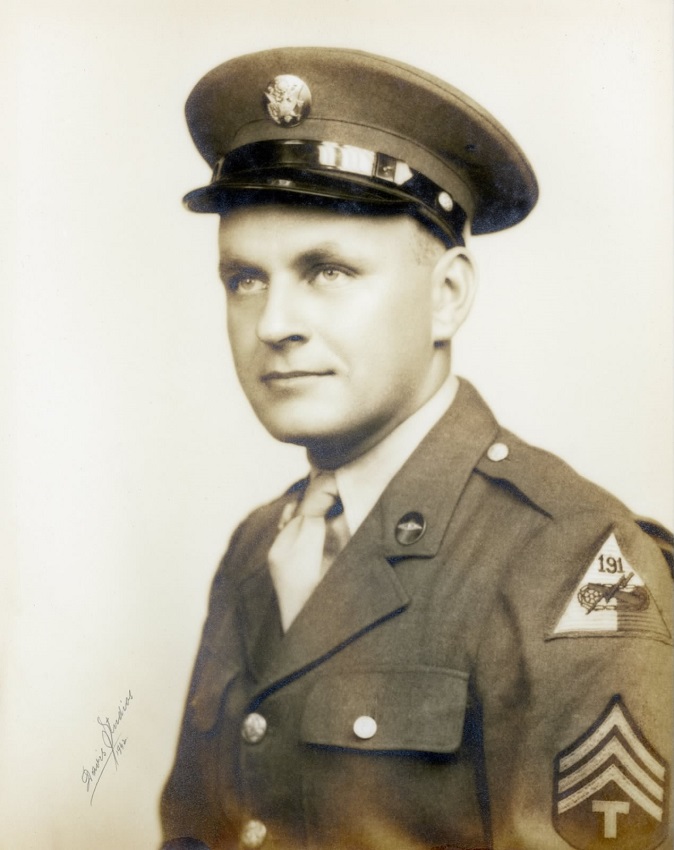
| Residences | Civilian Occupation |
| Pennsylvania, Delaware | Florist |
| Branch | Service Number |
| U.S. Army | 32071544 |
| Theater | Unit |
| Mediterranean | Company “A,” 191st Tank Battalion |
| Awards | Campaigns/Battles |
| Purple Heart | Italy including Salerno landings, Volturno River, and Anzio |
| Military Occupational Specialty | Entered the Service From |
| 651 (platoon sergeant) | Newark, Delaware |
Early Life & Family
Harold D. Kirk was born in Chambersburg, Pennsylvania, on September 18, 1913. He was the son of John Little Kirk (a farmer at the time, 1875–1941) and Emma Disert Kirk (1876–1965). Nicknamed Mike, Harold had three older brothers, an older sister, and a younger sister. The Kirk family moved to Delaware after February 24, 1915—when the family’s youngest child, Bertha, was born in Chambersburg—and prior to September 12, 1918, when Kirk’s father registered for the draft. The family briefly lived on a farm near New Castle, where they were recorded on the census in January 1920.
By April 1930, when the Kirks were recorded on the next census, the family had moved to the Foxden Farm on what is now known as Fox Den Road, north of downtown Newark, Delaware. At the time, Kirk was working as farmhand. Census records indicate that he completed eighth grade, while his enlistment data stated that he finished one year of high school.
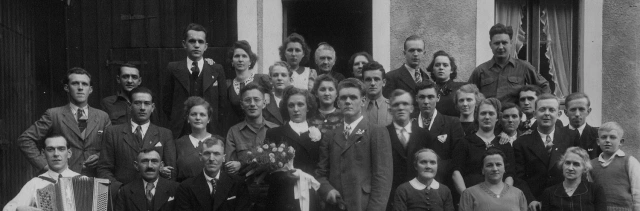
Around 1934, the family opened a new business, Kirk’s Flowers, in the Lumbrook area of Newark off Capitol Trail. By 1941, the Kirks had three greenhouses in operation growing plants for the business. Kirk’s Flowers, though no longer owned by the Kirk family, is still in operation today. The next census recorded that as of April 22, 1940, Kirk was living in White Clay Creek Hundred (likely his prewar address of 316 Capitol Trail) and working as a florist with his father and older brother, James. When he registered for the draft on October 16, 1940, Kirk was described as standing five feet, five inches tall and weighing 165 lbs., with brown hair and gray eyes. He was Protestant according to his military paperwork and dog tags.
Two of Kirk’s siblings served in the military during World War II. His sister, Bertha May Kirk (later Boronski, 1915–2004), joined the U.S. Navy Nurse Corps in November 1941. She retired in 1965 at the grade of lieutenant commander. His brother, John Howard Kirk (1906–2000), served in the U.S. Army from 1943–1945.
Stateside Service & Marriage
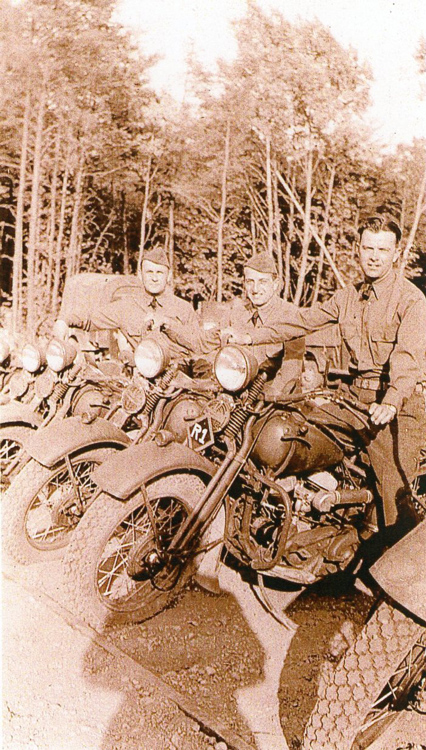
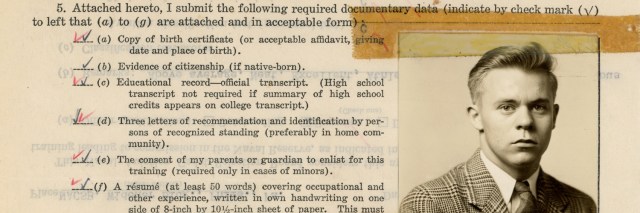
Kirk was drafted before the attack on Pearl Harbor and inducted into the U.S. Army in Camden, New Jersey, on April 14, 1941. It appears he went on active duty the same day and was initially assigned to Company “L,” 2nd Receiving Battalion, 1229th Reception Center, Fort Dix, New Jersey. He and 42 other draftees were transferred to the center’s Company “I” on April 21, 1941.
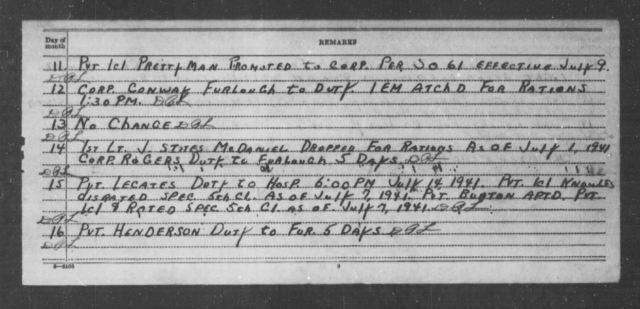
As the U.S. Army rapidly expanded, men were often assigned directly to units to begin their training rather than first going through basic training at a replacement training center. Kirk was one of 33 recruits from Fort Dix who joined Company “A,” 191st Tank Battalion at Fort George G. Meade, Maryland, at 1330 hours on May 1, 1941. The July 19, 1941, morning report stated that Kirk and his comrades’ basic training was complete and that all recruits would henceforth hold the grade of private.
The 191st Tank Battalion was one of the so-called separate tank battalions, which could be attached by higher headquarters to other units, typically infantry units, as needed. The separate tank battalions were distinguished from tank battalions that were assigned to armored divisions. The battalion history book, 191 Tank Bn.,stated that the unit was originally composed of federalized “National Guard tank companies from New York, Massachusetts, Virginia, [and] Connecticut” which were first stationed together at Fort George G. Meade beginning in February 1941.
On the morning of August 11, 1941, the 191st Tank Battalion headed south to the Louisiana Maneuver Area, arriving near Fulton three days later. During the subsequent weeks, Private Kirk and his comrades participated in the Louisiana Maneuvers, one of several large-scale exercises held that year to hone the rapidly expanding U.S. Army. On September 5, 1941, Private Kirk was rated as a specialist 4th class. (Specialist ratings, which came with extra pay, should not be confused with the postwar specialist grades and were eliminated in favor of technician grades in mid-1942.)
On October 1, 1941, Company “A” departed Tioga, Louisiana, by rail departed, arriving at Rockingham, North Carolina, three days later. More maneuvers followed in the vicinity of Norman, North Carolina. On October 15, 1941, Private Kirk and three other men from his company went on a special duty assignment to the 30th Ordnance Company in Marston, North Carolina. He returned to Company “A” three days later. The company participated in maneuvers in South Carolina during October 20–23, 1941, and then spent a week at Morven, North Carolina, before returning to Norman.
Company “A” moved to Darby, North Carolina, on November 11, 1941. The following day, Private Kirk’s father died. There is no indication in the unit’s morning reports that he managed to obtain a furlough to obtain the funeral. The company kept up an exhausting schedule through the end of the month, with moves to Ingram, North Carolina; Norwood, North Carolina; Ansonville, North Carolina; Wadesboro, North Carolina, Chesterfield, South Carolina; Jefferson, South Carolina; and finally back to Norman, North Carolina.
On December 3, 1941, Company “A” headed north by train and truck, arriving back at Fort George G. Meade the following day, three days before the attack on Pearl Harbor. Now back at its home station, it finally became possible for the men of Company “A” to obtain furloughs. Kirk’s furlough began at precisely 0001 hours on December 26, 1941. The following evening, he married Eleanor Rebecca Young (1917–1977), a nurse at Wilmington General Hospital, at the Church of the Brethren in Richardson Park, a neighborhood outside Wilmington, Delaware. The newlyweds had only a short time together before Private Kirk returned to duty at 0600 on January 2, 1942.
Effective February 7, 1942, Private Kirk was rated as a specialist 3rd class in lieu of his previous rating as a specialist 4th class. On March 8, 1942, he began another furlough, returning to duty on March 15. Kirk was hospitalized on the morning of March 20, 1942, returning to duty five days later.
On May 1, 1942, Kirk celebrated one year with Company “A” with a three-grade promotion to technician 4th grade. This rank was at the same pay grade—and addressed as—sergeant.
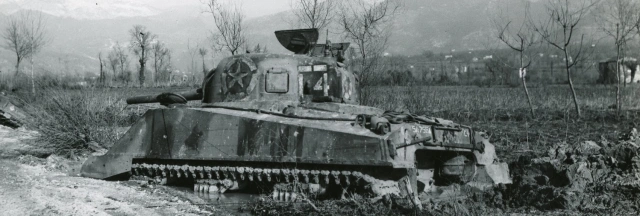
On July 9, 1942, most of Company “A” headed south, arriving the following day at Jefferson, South Carolina. Several weeks of exercises followed in the North Carolina Maneuver Area. This time, however, the 191st Tank Battalion would not be returning to Fort George G. Meade. On the afternoon of July 30, 1942, Technician 4th Grade Kirk and his comrades departed Ansonville by train, bound for Indio, California. They arrived on the morning of August 4, 1942, and moved to nearby Camp Young, which was part of a large maneuver area known as the Desert Training Center. While in California, Company “A” transitioned from the M3 medium tank to the M4 medium tank (popularly known as the Sherman). The M4 would be the 191st Tank Battalion’s primary vehicle for the rest of the war.
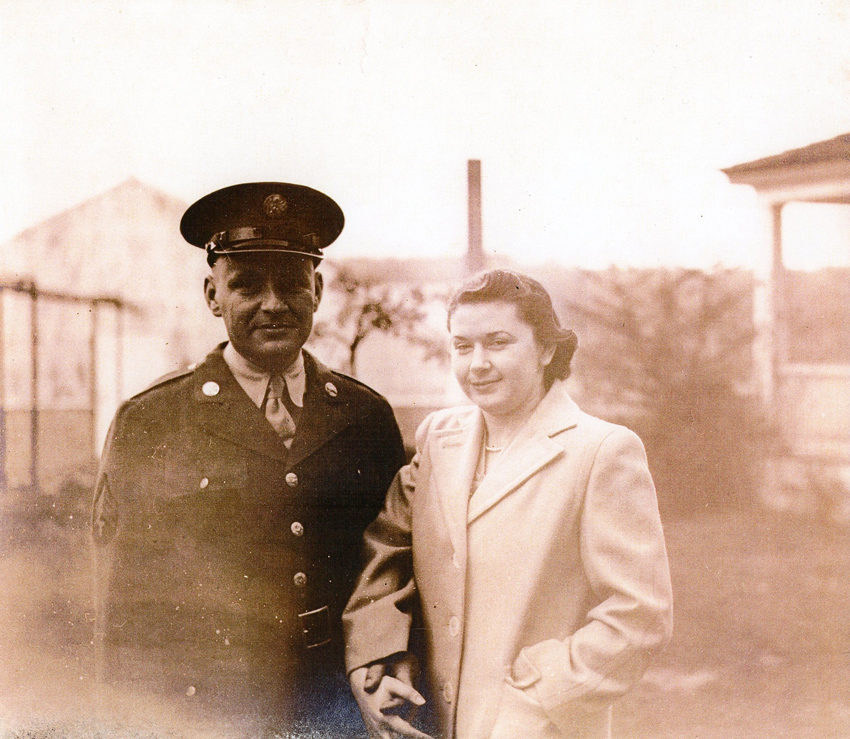
Technician 4th Grade Kirk began a furlough on October 26, 1942, returning to duty on November 10, 1942. Strong circumstantial evidence suggests he returned home to Delaware during that time since a pair of undated photographs taken in Wilmington and Newark show him wearing his technician 4th grade stripes.
Company “A” headed east again by train on December 28, 1942, arriving at Fort Benning, Georgia, on January 2, 1943. Kirk was appointed to the grade of sergeant on February 1, 1943. This was not a promotion per se, since technician 4th grade and sergeant were in the same pay grade. It is unclear whether this was due to a change in the tables of organization or a change in Kirk’s military occupational specialty. For instance, tank drivers often held technician status, while tank commanders were sergeants. (If not before, Kirk was serving as a tank commander by the fall of 1943.)
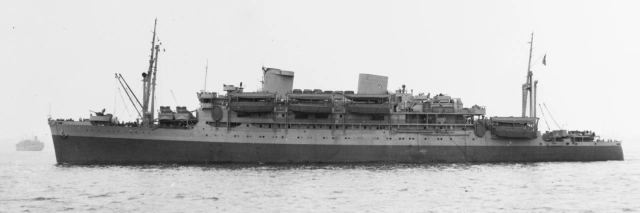
After additional training, the unit headed north to Fort Dix, New Jersey, on February 22, 1943, arriving the following night. Five days later, Sergeant Kirk and his comrades boarded the British troopship Andes at the New York Port of Embarkation. They sailed on February 28, 1943, for an undisclosed destination.

Service in North Africa & Combat in Italy

The 191st Tank Battalion arrived in Casablanca, Morocco, on March 9, 1943. Two days later, Sergeant Kirk wrote to his mother that he had arrived in North Africa. Unable to discuss much about the war due to censorship, his letters home mainly discussed family and the flower business. On April 25, 1943, he wrote his mother: “Today is Easter and I imagine you are very tired after the rush[,] you said that the tulips were early so it must have been hard getting enough plants and flowers to go around”.
Extant correspondence indicates that Sergeant Kirk frequently sent some of his pay to his mother. Although he frequently expressed his longing for home, the only thing he asked her to send from home were cigars, something hard to come by in the war zone.
The 191st Tank Battalion did not participate in the Tunisian or Sicily campaigns, but U.S. Army planners selected the unit for the next scheduled amphibious operation: the invasion of mainland Italy. The battalion staged in Bizerte, Tunisia, during preparations for the operation. On September 3, 1943, elements of the 191st Tank Battalion (including Sergeant Kirk’s Company “A”) loaded their vehicles aboard a group of six L.C.T.s (Landing Craft, Tank). On September 9, 1943, they landed under heavy German fire at Paestrum, Italy.
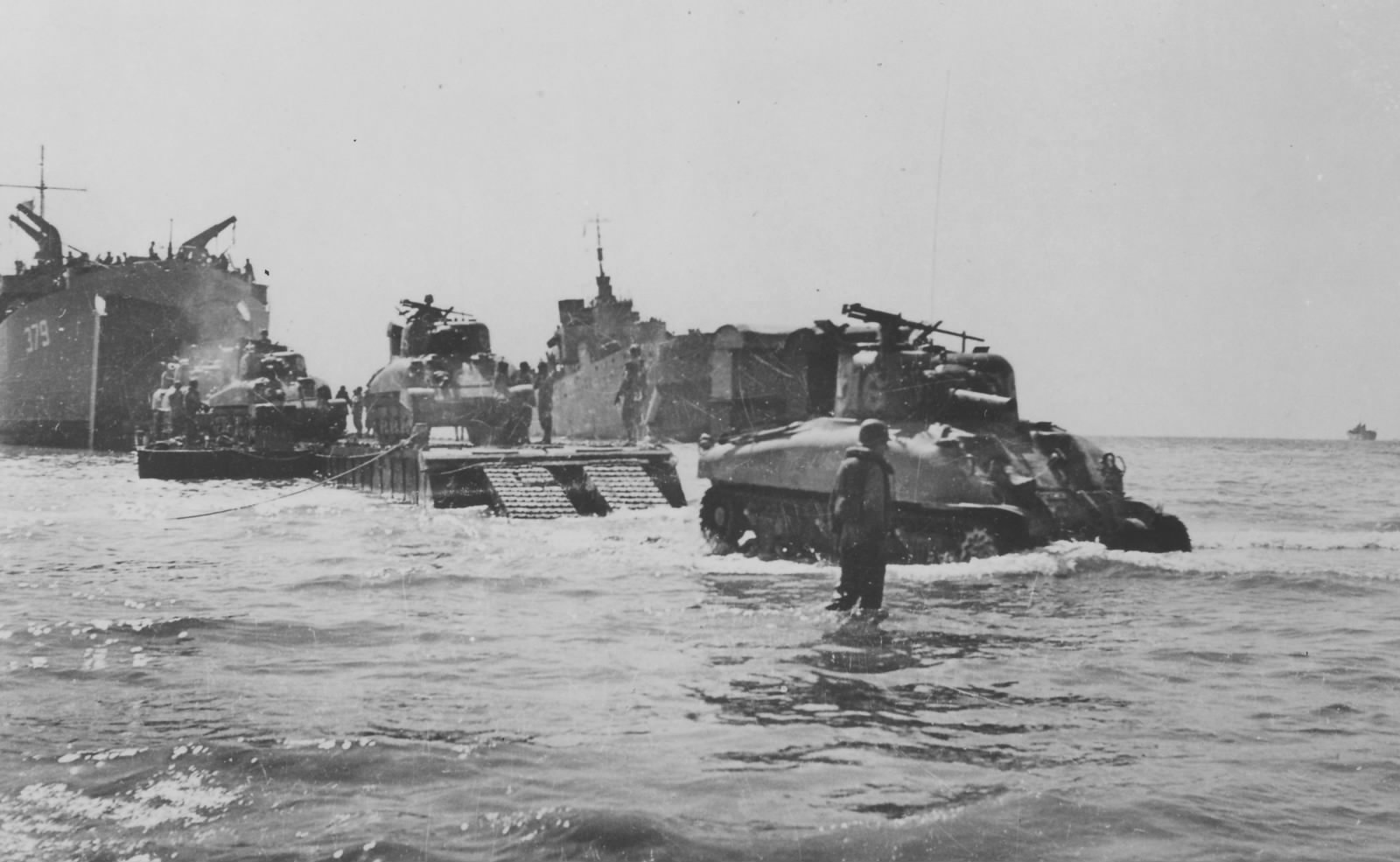
The battalion supported the 45th Infantry Division and later the 34th Infantry Division during the drive north in the fall of 1943. Among other battles, the battalion participated in combat at the infamous Volturno River.
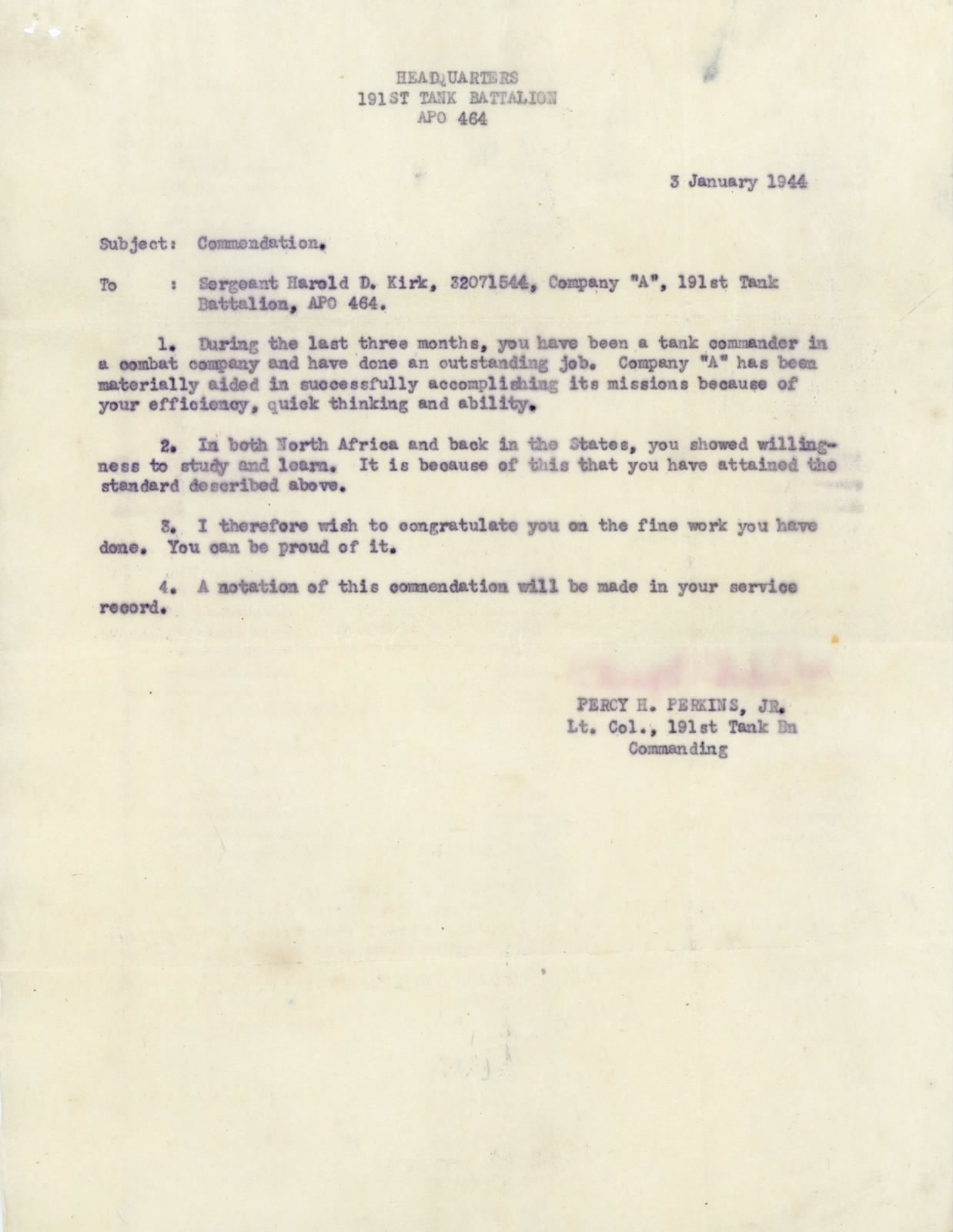
A January 3, 1944, letter of commendation to Sergeant Kirk from the 191st Tank Battalion’s commanding officer, Lieutenant Colonel Percy H. Perkins, Jr., stated in part:
1. During the last three months, you have been a tank commander in a combat company and have done an outstanding job. Company “A” has been materially aided in successfully accomplishing its missions because of your efficiency, quick thinking and ability.
2. In both North Africa and back in the States, you showed willingness to study and learn. It is because of this that you have attained the standard described above.
3. I therefore wish to congratulate you on the fine work you have done. You can be proud of it.
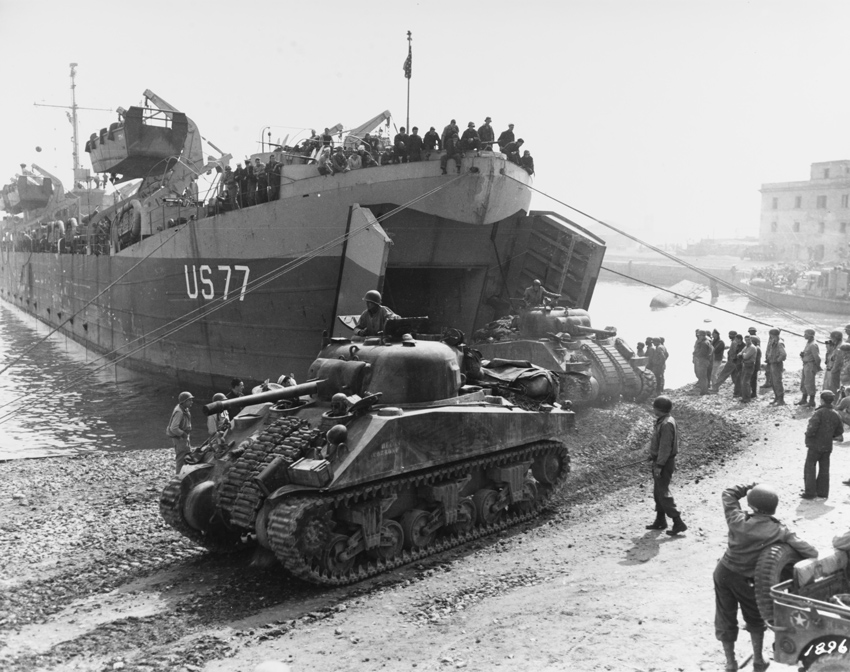
The Anzio Beachhead
Sergeant Kirk was awarded the Good Conduct Medal on January 25, 1944. That same month, his battalion was attached to the 1st Armored Division in preparation for another amphibious operation, this time at Anzio. The battalion arrived on January 31, 1944, nine days after the landings began. Shortly after arriving, the 191st was assigned to support the 3rd Infantry Division, though it supported the 45th Infantry Division later in the campaign.
Sergeant Kirk’s battalion helped stop a German counterattack on February 16, 1944. In his book, The Infantry’s Armor: The U.S. Army’s Separate Tank Battalions in World War II, Harry Yeide wrote that “the 191st Tank Battalion counted fifteen panzers positively destroyed at the cost of seven Shermans.”
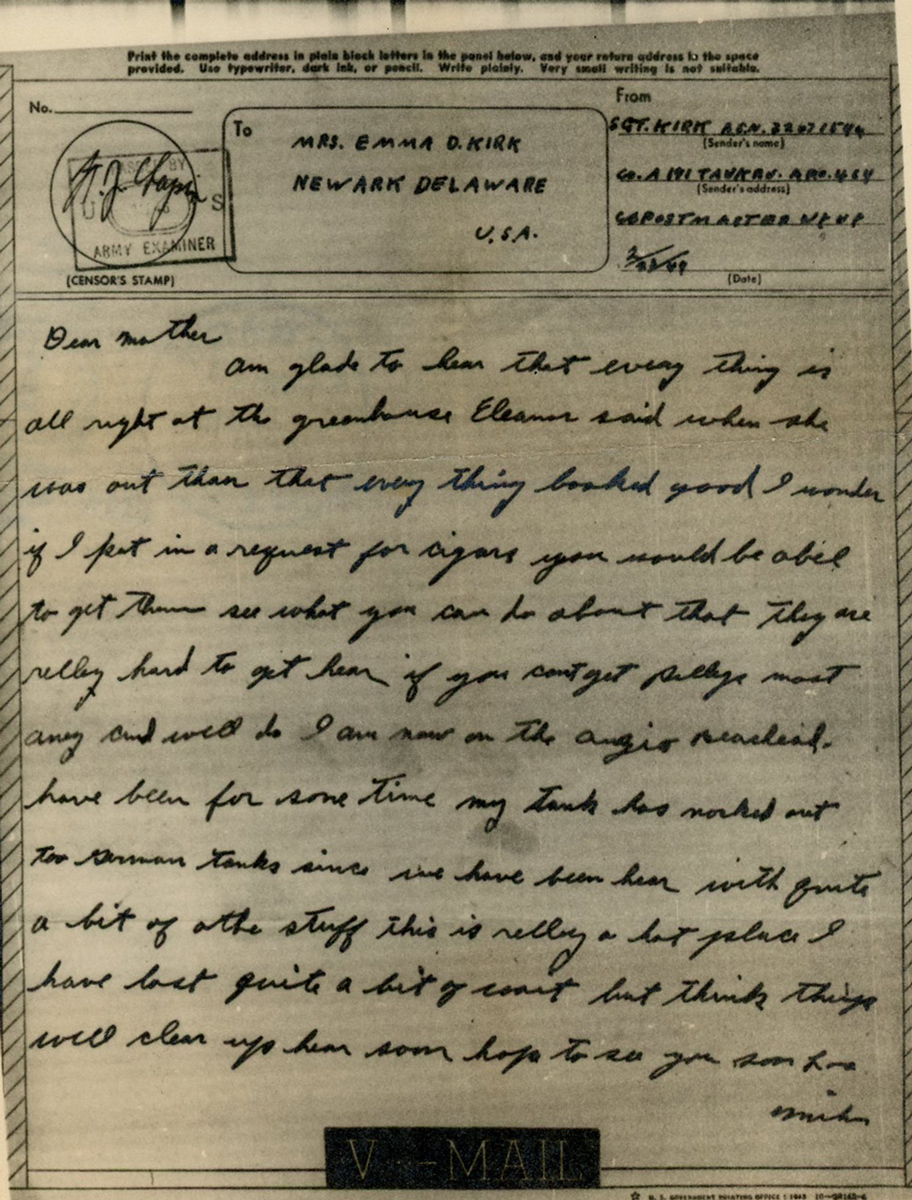
On February 23, 1944, Sergeant Kirk wrote his mother (edited for clarity, see Notes section below for original text):
I am now on the Anzio beachhead, have been for some time. My tank has knocked out two German tanks. […] This is really a hot place. I have lost quite a bit of weight but think things will clear up here soon.
Months of stalemate followed the German counterattack. 191 Tank Bn. described Anzio as follows:
Fighting on the line was violent and costly. Heroic deeds became common place. There were no “Rear Areas.” The beachhead–narrow and crowded–gave a target to every shell, and Kraut artillery raked it day and night. Jerry was dugin [sic] too and looked down our throat from the hillsides. “Popcorn Pete” came over like clockwork, with his spitting [anti]personnel bombs[.]

Sergeant Kirk was promoted to staff sergeant on April 26, 1944, and assumed the duty of platoon sergeant.
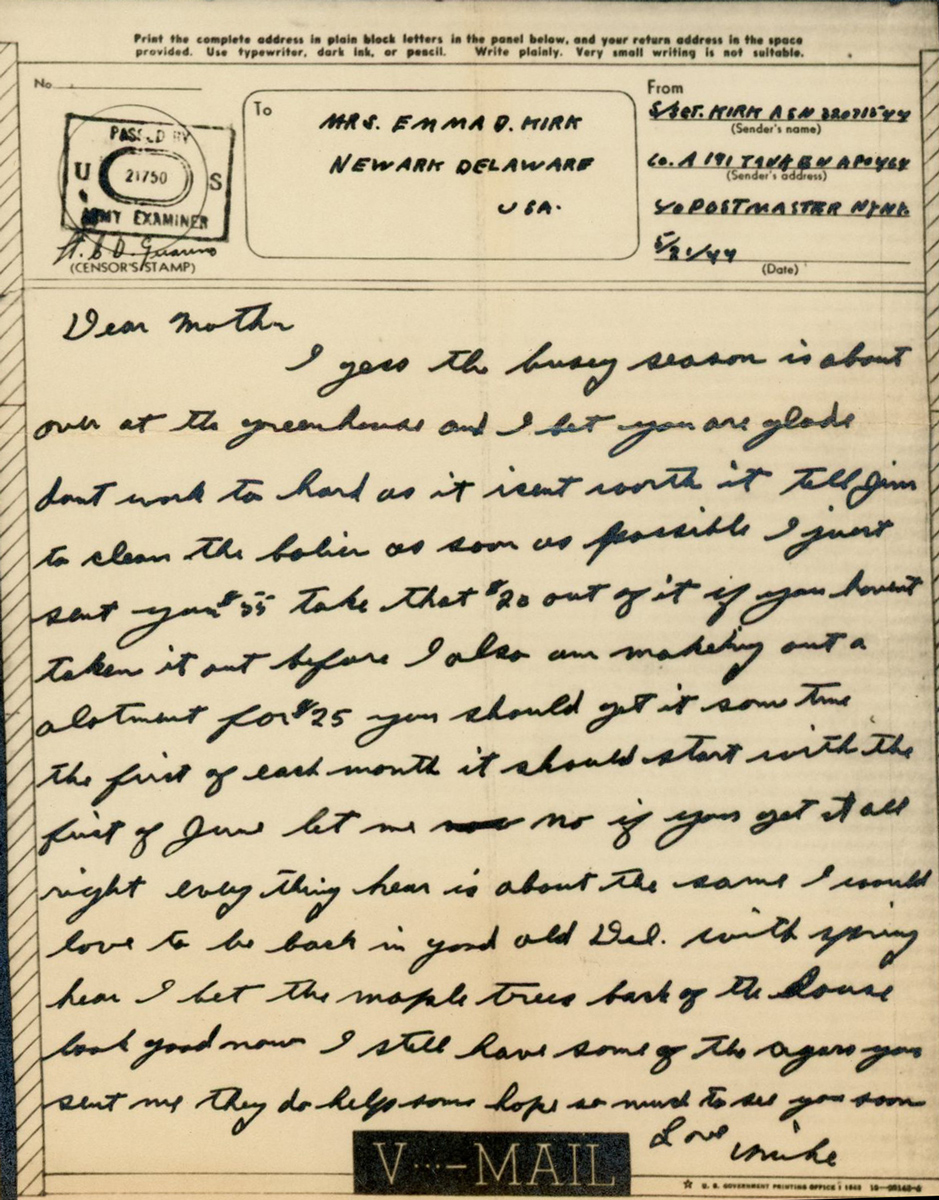
On May 21, 1944, Kirk wrote letters home to his wife and mother. The one to his mother (edited for clarity) stated:
I guess the busy season is about over at the greenhouse and I bet you are glad. Don’t work too hard as it isn’t worth it. […] Everything here is about the same. I would love to be back in good old Del. with spring here. I bet the maple trees [in the] back of the house look good now. I still have some of the cigars you sent me. They do help some. Hope so much to see you soon.
Breakout & Aftermath
The long-awaited breakout from Anzio, beginning on May 23, 1944, proved extremely costly to the 191st Tank Battalion. Harry Yeide wrote that “the outfit suffered the worst losses of all the separate [tank] battalions that participated in the breakout.” Staff Sergeant Kirk’s Company “A,” (along with the light tanks of Company “D,” as well as the 645th Tank Destroyer Battalion) supported the advance of the elite American-Canadian 1st Special Service Force.
During the offensive, the 191st suffered significant losses from enemy tanks, artillery, and mines. According to the unit history:
The tanks supported by the doughfeet [infantrymen] rumbled through one enemy position after another from Anzio until they crossed Highway 7. It was going very nicely for tank number 14 of Able Company until motor trouble forced Staff Sergeant Kirk the tank commander and Technician fourth grade Ingebretson, driver, to retrace their path over highway 7. They drove straight into the teeth of Kraut tanks coming down the highway…Sheets of flame shot from their tank. Sergeant Kirk, the loader, and gunner lay dead on the floor of the turret…..By nightfall every tank in the 3rd platoon had been destroyed, and only nine of the platoon escaped unscratched from the ring of steel[.]
Staff Sergeant Kirk’s burial report confirms that his body was located in tank A-14 and stated he was identified by his dog tags. Oddly, the report stated his body was found not in the turret, but “in seat beside driver[.]” The reason he left the turret is unclear, but may have been related to assisting with the tank’s mechanical problems.


Staff Sergeant Kirk was almost certainly killed on May 23, 1944, the first day of the breakout. An entry in the battalion S-3 journal at 1810 hours that day stated that “Lt NANGLE reported to CP [command post] (rear) that Co A had five tanks knocked out[.]” Another entry at 2120 hours stated: “Lt NANGLE reported to Capt HAYNES at rear CP [command post] that S/Sgt Kirk, Pfc [John J.] Bertram of ‘A’ Co, were killed.” Despite that, officially, per the Office of the Adjutant General, Staff Sergeant Kirk’s death occurred the following day, May 24, 1944.
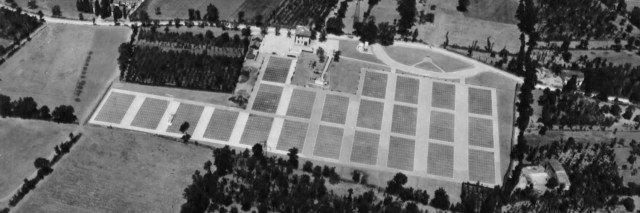
Staff Sergeant Kirk was initially buried in the U.S. military cemetery at Nettuno on June 8, 1944. After the war, he was reburied at the permanent cemetery at the same location, today known as the Sicily–Rome American Cemetery (Plot E, Row 6, Grave 49). He is also honored on Newark’s World War II memorial, at Veterans Memorial Park in New Castle, Delaware, and on a cenotaph at Ebenezer United Methodist Church Cemetery in Newark (where his parents are buried).
Staff Sergeant Kirk’s decorations include the American Defense Service Medal, the Good Conduct Medal, and the Purple Heart.
The year after Staff Sergeant Kirk’s death, his widow Eleanor went on active duty with the Army Nurse Corps at Tilton General Hospital at Fort Dix, New Jersey. She served in the U.S. Army from March 1, 1945, until July 16, 1946. By February 1948, she had remarried to a career U.S. Army officer, Paul Gross Tobin (1920–2005), with whom she raised four children.

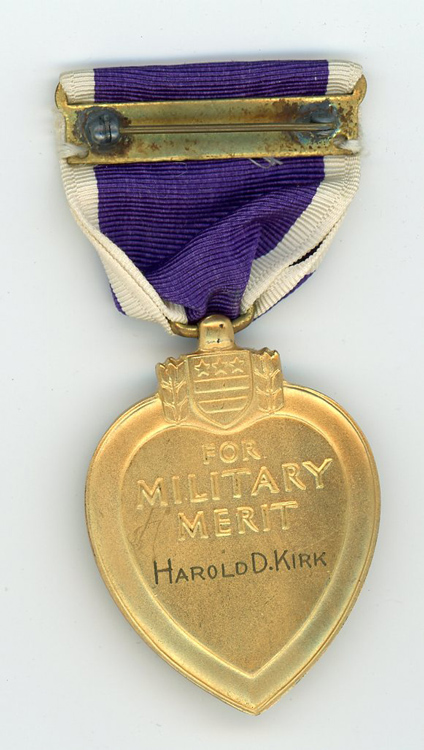
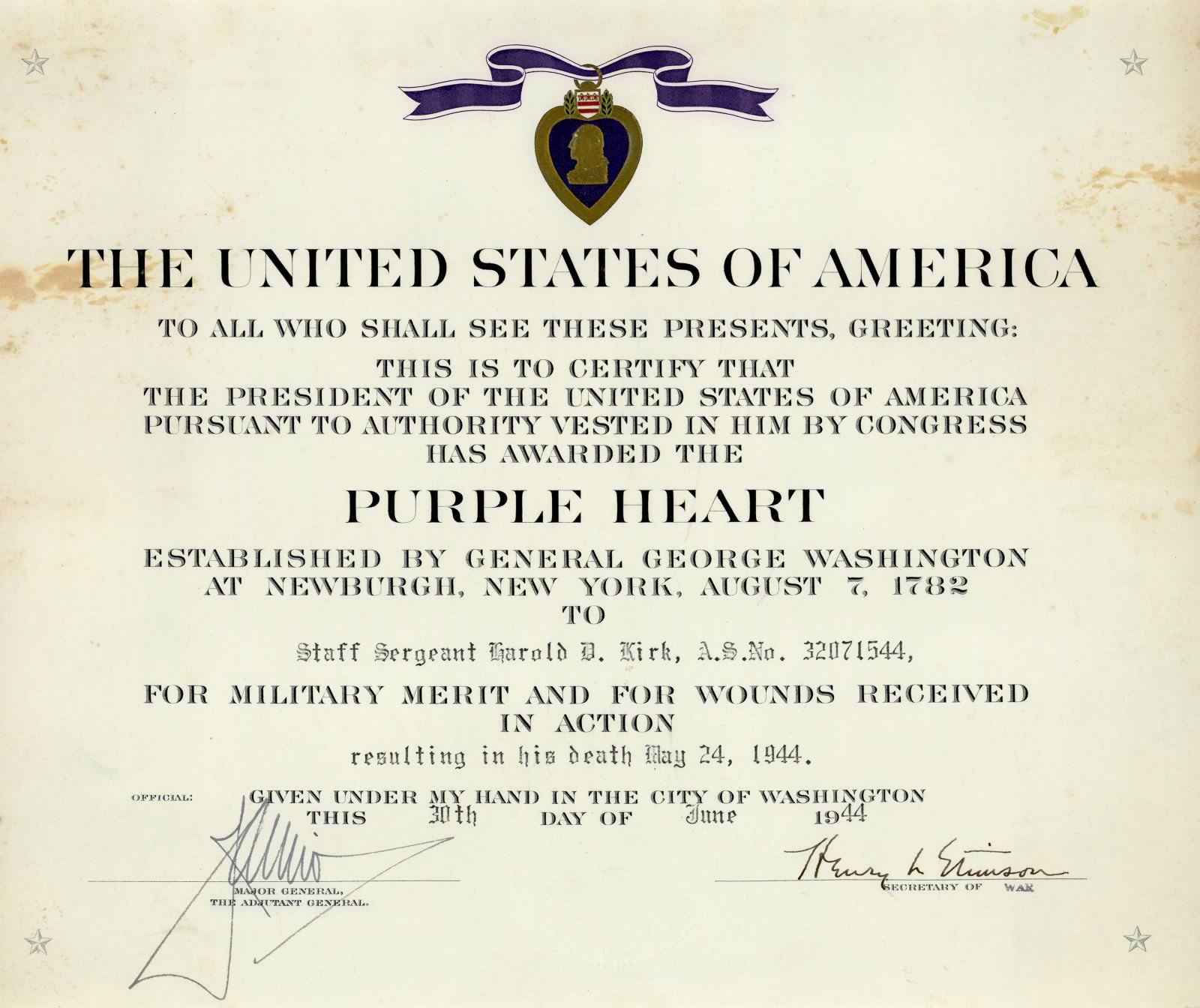
Documents
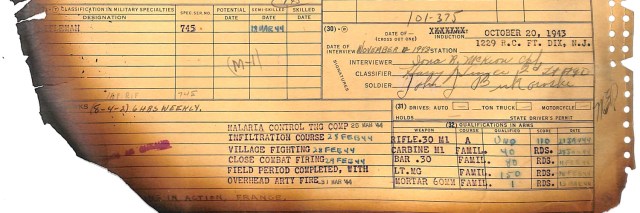
Click to any document to view a larger copy. All are courtesy of the Kirk family.
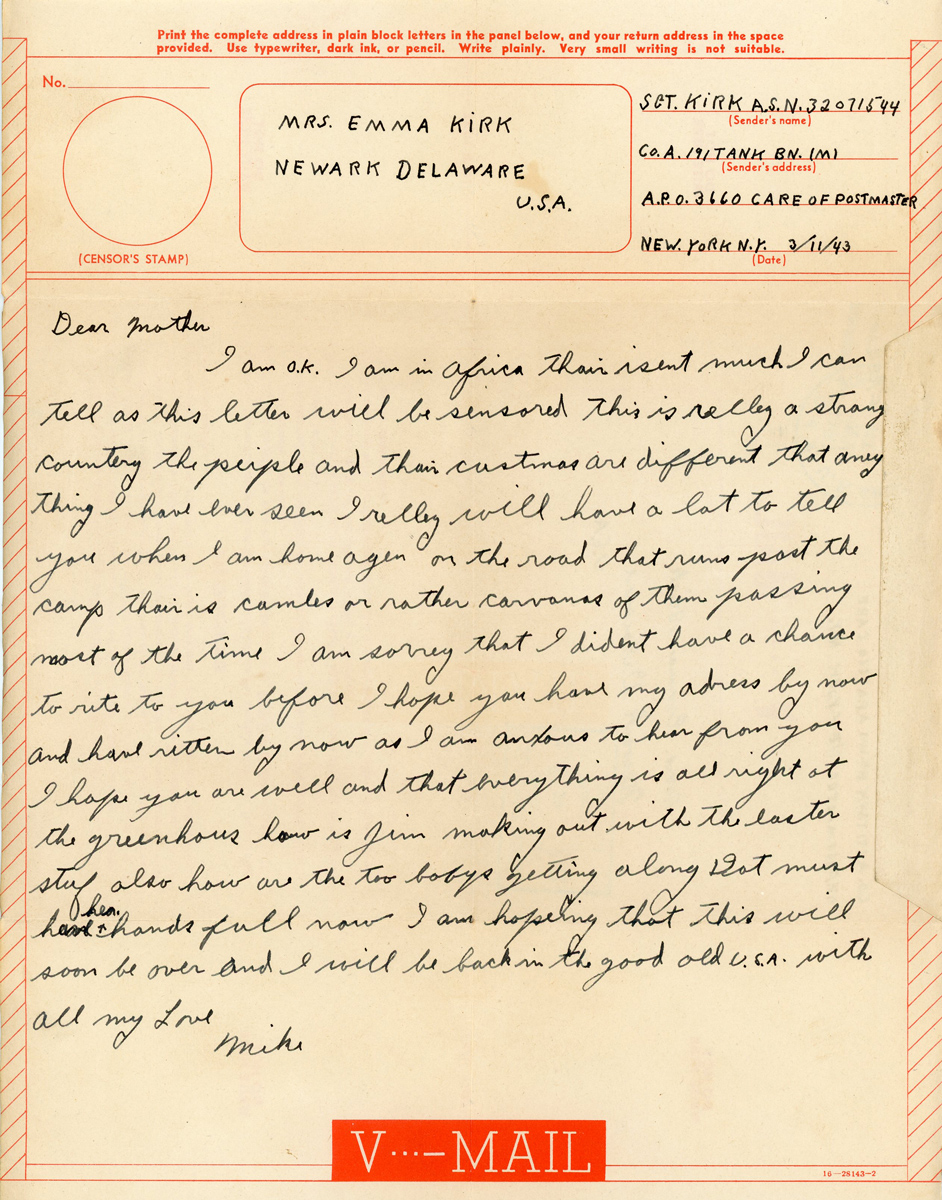
Notes
Mother’s Maiden Name
Kirk’s mother’s maiden name was Emma Rebecca Disert, although some sources listed incorrect variant spellings including Disirt and Dizert.
Foxden Farm
The 1930 census didn’t provide any address for the farm, though it indicated that it was in Mill Creek Hundred along the Paper Mill Road corridor north of Milford Crossroads (which refers to where Paper Mill Road, Possum Park Road, and Thompson Station Road come together). When I queried a Newark-area Facebook group, a woman told me that the Kirks lived on Fox Den Road. A member of the Kirk family confirmed that was correct and indeed lived on the Foxden Farm.
Original Text of Sergeant Kirk’s February 23, 1944, V-mail
I am now on the Anzio beachead. have been for some time my tank has nocked out too German tanks since we have been hear with quite a bit of other stuff This is really a hot place I have lost quite a bit of wait but think things will clear up hear soon
Original Text of Staff Sergeant Kirk’s May 21, 1944, V-mail
Dear Mother
I gess the busy season is about over at the greenhouse and I bet you are glade don’t work too hard as it isn’t worth it […] every thing hear is about the same I would love to be back in good old Del. with spring hear I bet the maple trees back of the house look good now I still have some of the cigars you sent me they do help some hope so much to see you soon.
Love
Mike
Date of Death
Discrepancies in dates of death are unfortunately rather common for World War II servicemen who died in the line of duty, since accurate recordkeeping was difficult under combat conditions. The battalion S-3 journal clearly stated that Staff Sergeant Kirk was killed on the first day of the breakout, May 23, 1944. Such journals are generally reliable since they were compiled soon after events took place, within the limitations of what the writer knew and had the opportunity to record. For that reason, I consider the May 23 date of death most likely to be accurate. In theory, an error could have occurred if the journal was later retyped from notes made at the time.
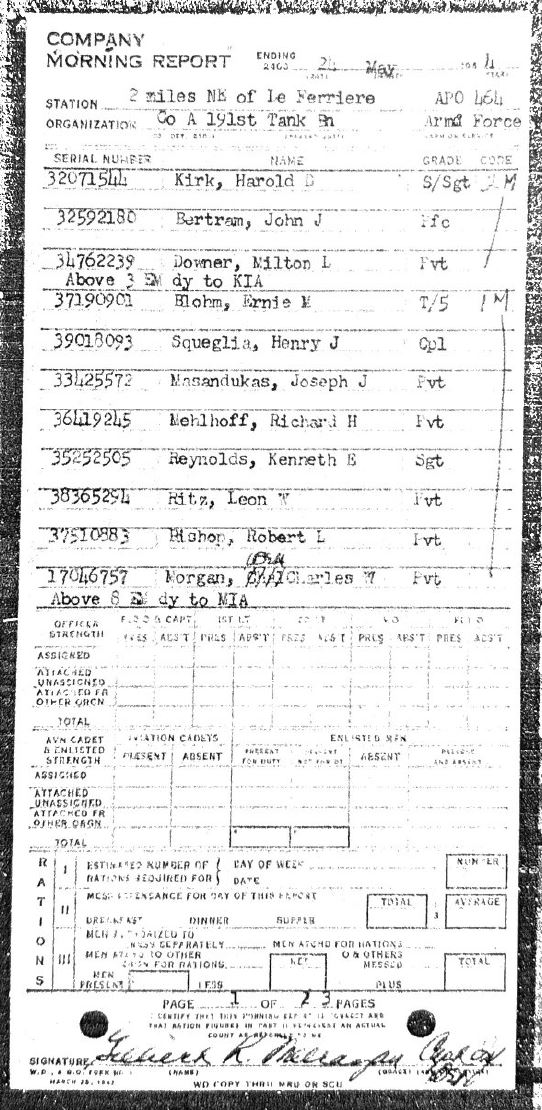
The Adjutant General’s Office report of death in Staff Sergeant Kirk’s individual deceased personnel file (I.D.P.F.) listed his date of death as May 24, 1944, presumably based on information submitted from his unit, which recorded his death on that day’s morning report. Kirk’s original burial report gave an estimated date of death of May 23, 1944, but that was later altered to May 24, 1944. Though this date was most likely in error, it effectively became his official date of death, one listed on his headstone.
Status
Oddly enough, the official casualty list compiled after the war stated that Staff Sergeant Kirk died of wounds (after reaching medical treatment) rather than being killed outright, contrary to the description of his death in the unit history and the burial report in his I.D.P.F. His status should have been listed as killed in action.
Acknowledgments
Special thanks to the Kirk family for supplying many of the photos and documents which accompany this article.
Bibliography
“25 Nurses Leave Today to Enter Military Service.” Wilmington Morning News, March 1, 1945. https://www.newspapers.com/clip/73109649/eleanor-kirk-anc/, https://www.newspapers.com/clip/73109736/eleanor-kirk-anc-2/
191 Tank Bn. 667th Engineer Topographic Company, circa 1945. 191st Tank Battalion website. https://191sttankbattalion.files.wordpress.com/2018/07/191-tank-bn.pdf
Census Record for Harold D. Kirk. April 22, 1940. Sixteenth Census of the United States, 1940. Record Group 29, Records of the Bureau of the Census. National Archives at Washington, D.C. https://www.ancestry.com/imageviewer/collections/2442/images/m-t0627-00546-00332
Census Record for Harold D. Kirk. April 24, 1930. Fifteenth Census of the United States, 1930. Record Group 29, Records of the Bureau of the Census. National Archives at Washington, D.C. https://www.ancestry.com/imageviewer/collections/6224/images/4531890_00700
Census Record for Harold Kirk. January 2, 1920. Fourteenth Census of the United States, 1920. Record Group 29, Records of the Bureau of the Census. National Archives at Washington, D.C. https://www.ancestry.com/imageviewer/collections/6061/images/4295772-00179
Certificate of Marriage for Harold D. Krik and Eleanor Rebecca Young. December 27, 1941. Delaware Marriages. Bureau of Vital Statistics, Hall of Records, Dover, Delaware. https://www.ancestry.com/imageviewer/collections/61368/images/TH-267-12375-88719-90
Draft Registration Card for John Little Kirk. September 12, 1918. World War I Selective Service System Draft Registration Cards, 1917–1918. National Archives at Washington, D.C. https://www.ancestry.com/imageviewer/collections/6482/images/005207029_04688
Draft Registration Card for Harold D. Kirk. October 16, 1940. Draft Registration Cards for Delaware, October 16, 1940 – March 31, 1947. Record Group 147, Records of the Selective Service System. National Archives at St. Louis, Missouri.https://www.ancestry.com/imageviewer/collections/2238/images/44003_13_00005-00780
Enlistment Record for Harold D. Kirk. April 14, 1941. World War II Army Enlistment Records. Record Group 64, Records of the National Archives and Records Administration. National Archives at College Park, Maryland.https://aad.archives.gov/aad/record-detail.jsp?dt=893&mtch=1&cat=all&tf=F&q=32071544&bc=&rpp=10&pg=1&rid=2740666
“General Order Number 2, Headquarters 191st Tank Battalion.” January 25, 1944. World War II Operations Reports, 1940–48. Record Group 407, Records of the Adjutant General’s Office. National Archives at College Park, Maryland. https://www.facebook.com/photo?fbid=2033124366929624&set=pcb.229787871089834
Headstone Inscription and Interment Record for Harold D. Kirk. Headstone Inscription and Interment Records for U.S. Military Cemeteries on Foreign Soil, 1942–1949. Record Group 117, Records of the American Battle Monuments Commission, 1918–ca. 1995. National Archives at Washington, D.C. https://www.ancestry.com/imageviewer/collections/9170/images/42861_1521003239_0890-00550
“Historical Record of the 191st Tank Battalion (M) August 15, 1943 – September 30, 1943.” World War II Operations Reports, 1940–48. Record Group 407, Records of the Adjutant General’s Office. National Archives at College Park, Maryland. 191st Tank Battalion website. https://191sttankbattalion.files.wordpress.com/2018/07/1943-august-15-september-30-191st-historical-record.pdf
Individual Deceased Personnel File for Harold D. Kirk. Individual Deceased Personnel Files, 1939–1953. Record Group 92, Records of the Office of the Quartermaster General, 1774–1985. National Archives at St. Louis, Missouri. Courtesy of U.S. Army Human Resources Command.
“John H. Kirk.” The News Journal, August 13, 2000. https://www.newspapers.com/clip/73108650/john-h-kirk-obituary/
“John L Kirk.” Find a Grave. https://www.findagrave.com/memorial/218397124/john-l-kirk
“Kirk-Boronski.” Evening Journal, June 7, 1975. https://www.newspapers.com/clip/73032884/bertha-kirk-wedding/
Kirk, Eleanor R. Harold D. Kirk Individual Military Service Record, February 14, 1945. Record Group 1325-003-053, Record of Delawareans Who Died in World War II. Delaware Public Archives, Dover, Delaware. https://cdm16397.contentdm.oclc.org/digital/collection/p15323coll6/id/19538
Kirk, Harold D. Unpublished correspondence, 1941–1944. Courtesy of the Kirk family.
“Kirk’s Flowers Has Fine Record.” The Newark Post, May 8, 1941. https://udspace.udel.edu/bitstream/handle/19716/18769/np_032_16.pdf?sequence=1&isAllowed=y
Morning reports for Company “A,” 191st Tank Battalion. April 1944 – May 1944. U.S. Army Morning Reports, c. 1912–1946. Record Group 64, Records of the National Archives and Records Administration. National Archives at St. Louis, Missouri.
Morning reports for Company “A,” 191st Tank Battalion. May 1941 – July 1943. U.S. Army Morning Reports, c. 1912–1946. Record Group 64, Records of the National Archives and Records Administration. National Archives at St. Louis, Missouri. https://s3.amazonaws.com/NARAprodstorage/lz/partners/st-louis/rg-064/85713825-wwii/85713825_1940-01-thru-1943-07/85713825_1940-01-thru-1943-07_Roll-2645/85713825_1940-01-thru-1943-07_Roll-2645-04.pdf, https://s3.amazonaws.com/NARAprodstorage/lz/partners/st-louis/rg-064/85713825-wwii/85713825_1940-01-thru-1943-07/85713825_1940-01-thru-1943-07_Roll-2645/85713825_1940-01-thru-1943-07_Roll-2645-05.pdf, https://s3.amazonaws.com/NARAprodstorage/lz/partners/st-louis/rg-064/85713825-wwii/85713825_1940-01-thru-1943-07/85713825_1940-01-thru-1943-07_Roll-2645/85713825_1940-01-thru-1943-07_Roll-2645-06.pdf, https://s3.amazonaws.com/NARAprodstorage/lz/partners/st-louis/rg-064/85713825-wwii/85713825_1940-01-thru-1943-07/85713825_1940-01-thru-1943-07_Roll-2645/85713825_1940-01-thru-1943-07_Roll-2645-08.pdf
Morning reports for Company “I,” 2nd Receiving Battalion, 1229th Reception Center. April 1941 – May 1941. U.S. Army Morning Reports, c. 1912–1946. Record Group 64, Records of the National Archives and Records Administration. National Archives at St. Louis, Missouri. https://s3.amazonaws.com/NARAprodstorage/lz/partners/st-louis/rg-064/85713825-wwii/85713825_1940-01-thru-1943-07/85713825_1940-01-thru-1943-07_Roll-2854/85713825_1940-01-thru-1943-07_Roll-2854-04.pdf
Morning reports for Company “L,” 2nd Receiving Battalion, 1229th Reception Center. April 1941. U.S. Army Morning Reports, c. 1912–1946. Record Group 64, Records of the National Archives and Records Administration. National Archives at St. Louis, Missouri. https://s3.amazonaws.com/NARAprodstorage/lz/partners/st-louis/rg-064/85713825-wwii/85713825_1940-01-thru-1943-07/85713825_1940-01-thru-1943-07_Roll-2856/85713825_1940-01-thru-1943-07_Roll-2856-10.pdf
“Mrs. John L. Kirk.” Wilmington Morning News, October 15, 1965. https://www.newspapers.com/clip/73033017/emma-kirk-obituary/
Perkins, Percy H., Jr. Letter of commendation to Sergeant Harold D. Kirk, January 3, 1944. https://www.fold3.com/image/704856049
Register of Retired Commissioned and Warrant Officers, Regular and Reserve, of the United States Navy, 30 September 1972. U.S. Government Printing Office, 1973. https://www.ancestry.com/imageviewer/collections/2345/images/40014_1821100517_0610-00316
Stanton, Shelby L. World War II Order of Battle: An Encyclopedic Reference to U.S. Army Ground Forces from Battalion through Division 1939–1946. Revised ed. Stackpole Books, 2006.
Social Security Applications and Claims Index Entry for Eleanor Rebecca Kirk. U.S. Social Security Applications and Claims Index, 1936–2007. https://www.ancestry.com/discoveryui-content/view/48134493:60901
“Tobin, Eleanor Young.” The Courier-Journal & Times, September 11, 1977. https://www.newspapers.com/clip/73109953/eleanor-tobin-obituary/
Waltz, Floyd R., Jr. “S-3 Journal 191st Tank Battal. From 0001 23 May 1944 To 2400 23 May 1944.” World War II Operations Reports, 1940–48. Record Group 407, Records of the Adjutant General’s Office. National Archives at College Park, Maryland.
Watson, Ernest C. “S-3 Journal, 191st Tank Bn (M).” August 15, 1943 – September 30, 1943. World War II Operations Reports, 1940–48. Record Group 407, Records of the Adjutant General’s Office. National Archives at College Park, Maryland. 191st Tank Battalion website. https://191sttankbattalion.files.wordpress.com/2019/11/1943-august-15-september-30-191st-s-3-journal.pdf
Yeide, Harry. The Infantry’s Armor: The U.S. Army’s Separate Tank Battalions in World War II. Stackpole Books, 2010.
Last updated on October 1, 2024
More stories of World War II fallen:

























To have new profiles of fallen soldiers delivered to your inbox, please subscribe below.
 Delaware's World War II Fallen