

| Home State | Civilian Occupation |
| Delaware | College student |
| Branch | Service Number |
| U.S. Army | 12100425 |
| Theater | Unit |
| European | Company “B,” 335th Infantry Regiment, 84th Infantry Division |
| Awards | Campaigns/Battles |
| Bronze Star Medal, Purple Heart, Combat Infantryman Badge | Operation Clipper, Battle of the Bulge, Operation Grenade |
Early Life & Family
Horace Carl Brown was born at his parents’ home at 1001 Tatnall Street in Wilmington, Delaware, on the morning of February 25, 1924. He was the first and apparently the only child born to D. Carl (also known as Carl Daniel Brown, 1903–1952) and Beryl Vaughn Brown (née Doughten, later Young, 1904–1968). His father was a musician and later an air conditioner mechanic.
When he was recorded on the census in April 1930, Brown was living with his parents at 706 West 9th Street in Wilmington. By April 1940, the family had moved to what the census listed as Road 385 in the 11th Reporting District. That street, located in unincorporated New Castle County on the south side of Newark, is now known as Reybold Road.
Brown graduated from Wilmington High School in 1941 and began attending the University of Delaware in Newark.
Military Training
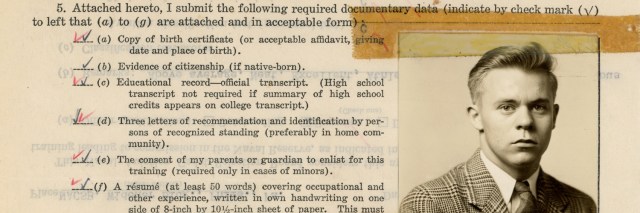
When Brown registered for the draft on June 30, 1942, he was described as standing five feet, 11 inches tall and weighing 160 lbs., with brown hair and eyes. The State of Delaware Individual Military Service Record form filled out by his father indicated that Brown joined the Enlisted Reserve Corps (E.R.C.) while he was a student at the University of Delaware.
Brown’s enlistment data indicates that he joined the U.S. Army in Newark, Delaware, on October 24, 1942. Journal-Every Evening stated: “He was called to active duty in May, 1943, and given basic training at Camp Wolters, Tex. Assigned to the Army [Specialized Training Program], he studied at Lehigh University until that program was stopped. He was assigned to the infantry and was sent to Camp Claiborne, La., last March. He went overseas in September [1944].”
Private Brown went on active duty on May 29, 1943, and was briefly attached unassigned to Company “C,” 1229th Reception Center, Fort Dix, New Jersey, along with other E.R.C. men.
Jim Sterner (1923–2024), another soldier whose military career followed a similar arc to Brown’s, provided further detail about that process in a 2021 interview. Both Sterner and Brown were in the E.R.C. at University of Delaware and were called up on the same day. He recalled that they spent about a week at Fort Dix, New Jersey (getting uniforms and other administrative matters), before traveling to Camp Wolters. Both took tests and earned scores that made them eligible for A.S.T.P., although Sterner attended Drexel University rather than Lehigh University. U.S. Army planners terminated virtually the entire A.S.T.P. in early 1944 due to projected manpower shortages.
Private Brown departed Camp Wolters on or about September 20, 1943 for Lehigh University, Pennsylvania.
On September 23, 1943, Brown was promoted to private 1st class and attached unassigned to Company “F,” 3309th Service Unit (Army Specialized Training) at Lehigh University, Pennsylvania, to study mechanical engineering. He later transferred to Company “C” in the same unit. Brown was detached on or about March 30, 1944, and transferred to the 84th Infantry Division at Camp Claiborne, Louisiana.
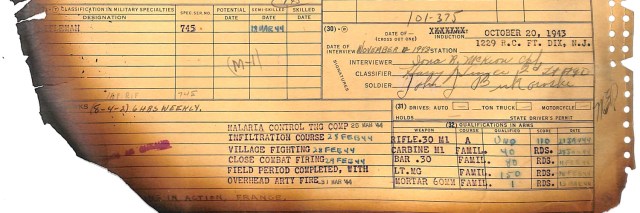
Private 1st Class Brown joined Company “B,” 335th Infantry Regiment, 84th Infantry Division on April 2, 1944. His military occupational specialty (M.O.S.) code at the time was listed as 745, rifleman. According to Theodore Draper’s 1946 book, The 84th Infantry Division in the Battle of Germany:
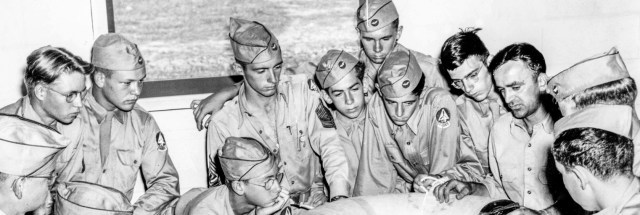
Early in April 1944 the 84th was strengthened materially by the assignment of 2800 former A.S.T.P. men. They were distributed among the three infantry regiments and given five weeks special training. As a group, their age and academic training made them welcome additions.
Jim Sterner also joined the 84th Infantry Division in April 1944 (albeit a different regiment, the 333rd Infantry). He told me that Draper’s book glossed over conflict between the older original members of the division and the younger, better educated former A.S.T.P. men. At the beginning, Sterner recalled, the 84th was “two different divisions,” though he noted that in combat, “we became a unit in a hurry.”
A morning report dated June 6, 1944, stated that Private 1st Class Brown’s M.O.S. had changed from 521, basic, to 746, automatic rifleman.
The 84th Infantry Division moved up to Camp Kilmer, New Jersey, late in the summer of 1944. Shelby L. Stanton wrote in his book World War II Order of Battle: An Encyclopedic Reference to U.S. Army Ground Forces from Battalion through Division 1939–1946 that the 335th Infantry Regiment shipped out from the New York Port of Embarkation on September 29, 1944, arriving in England on October 10.
Combat in the European Theater
The 84th Infantry Division arrived in Normandy in early November 1944 and moved quickly to the front, by that point located at the fortifications known as the Siegfried Line along the Germany border. Draper wrote that the 335th Infantry Regiment entered combat in the vicinity of Aachen, Germany on November 10, 1944. The main body of the 84th Division went into action on November 18 during Operation Clipper against the Geilenkirchen salient. A month of tough fighting followed.
On November 29, 1944, Private 1st Class Brown performed “meritorious service in connection with military operations against the enemy in Germany,” for which he received the Bronze Star Medal per Special Orders No. 84, Headquarters 84th Infantry Division, dated December 10, 1944.

By February 1944, Staff Sergeant Brown was most likely a squad leader in Company “B,” 335th Infantry Regiment. According to the 335th Infantry Regiment February 1945 after action report, as of February 1, 1945, the unit “was in a rest area in Belgium, reorganizing after completing operations in the Gouvy-Ourthe sector.” Two days later, the regiment moved to Schaesberg in the Netherlands, only about ten miles from where it first had entered combat some three months earlier.
The 84th Infantry Division’s next assignment was Operation Grenade, in which the U.S. Ninth Army crossed the Roer River and drove east to the Rhine. Originally set to begin on February 9, 1945, the operation was delayed when the Germans intentionally flooded the area by releasing water from a pair of dams upriver. The 335th Infantry Regiment used the extra time for training.
On the morning of February 23, 1945, Operation Grenade began. Advancing from the area of Linnich, Germany, the 335th Infantry successfully crossed the Roer and, along with the rest of the 84th Infantry Division, attacked north through heavy German resistance. The regiment moved rapidly, capturing Houverath on February 25, Golkrath and Hoven on the 26th, and Wegberg on the 27th.
The 335th Infantry Regiment’s after action report stated that on February 28, 1945:
The order was received at 1200 to move to an assembly area southeast of Waldniel. At 1244 the 1st [which included Staff Sergeant Brown’s company] and 3rd [Battalions] moved from positions en route to the assemble area and encountered enemy small arms, machine gun, mortar and artillery fire. After the enemy resistance was neutralized and the assembly area cleared, defensive positions were established, and preparations were made for continuing the attack without delay.
Draper wrote that it took Brown’s battalion “12 hours to clear out the whole city” of Waldniel. The specifics of his death aren’t clear, but Staff Sergeant Brown was reported as killed in action that day.
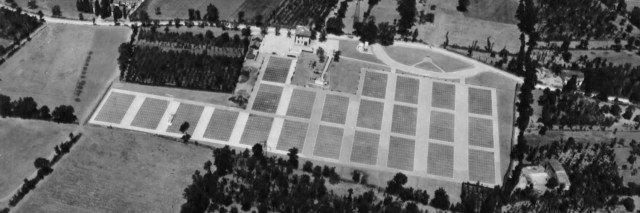
During his service, Brown earned the Bronze Star Medal and was posthumously awarded the Purple Heart. Staff Sergeant Brown was initially buried at the U.S. Military Cemetery Margraten in the Netherlands, but in 1949 his body was returned to the United States and buried at Gracelawn Memorial Park in New Castle, Delaware.
Staff Sergeant Brown’s name is honored at three memorials in Delaware: Veterans Memorial Park in New Castle, Newark’s World War II memorial, and the University of Delaware’s World War II memorial.
Notes
Promotions
Brown’s father wrote that his son was promoted from private 1st class to staff sergeant in Germany in October 1944. Beyond the fact that the 84th Infantry Division was still in transit or in England during October 1944, that date is inaccurate by at least a few months. Although the rapid expansion of the U.S. Army during World War II meant that it was not unheard of for enlisted men to jump three grades at once, it seems more likely that Staff Sergeant Brown’s father skipped over some promotions when filling out the document, which only had space to list one promotion. Jim Sterner expressed surprise at the date of Brown’s promotion. Although he was in another regiment, Sterner recalls that the former A.S.T.P. men weren’t promoted beyond private 1st class until the 84th Infantry Division began taking casualties in combat later that fall.
Indeed, as of December 10, 1944, when Brown was awarded the Bronze Star Medal for meritorious service on November 29, 1944, he was described as a private 1st class.
Date & Location of Death
The statement filled out by Staff Sergeant Brown’s father listed an erroneous date of death (March 28, 1945) and gave the location as Geilenkirchen, Germany, about 20 miles from where Brown was killed.
Acknowledgments
Special thanks to Rick Bell for providing 335th Infantry Division documentation, to the late Jim Sterner for background information, and to the Delaware Public Archives for the use of Staff Sergeant Brown’s photograph.
Bibliography
Application for Headstone or Marker for Horace C. Brown. March 25, 1949. Applications for Headstones, January 1, 1925 – June 30, 1970. Record Group 92, Records of the Office of the Quartermaster General, 1774–1985. National Archives at St. Louis, Missouri. https://catalog.archives.gov/id/105800955?objectPage=763
“Beryl Brown Young.” Find a Grave. https://www.findagrave.com/memorial/137939270/beryl-young
Brown, D. Carl. Individual Military Service Record for Horace Carl Brown. Undated, c. 1946. Record Group 1325-003-053, Record of Delawareans Who Died in World War II. Delaware Public Archives, Dover, Delaware. https://cdm16397.contentdm.oclc.org/digital/collection/p15323coll6/id/17851
Census Record for Horace Brown. April 23, 1940. Sixteenth Census of the United States, 1940. Record Group 29, Records of the Bureau of the Census. National Archives at Washington, D.C. https://www.ancestry.com/imageviewer/collections/2442/images/m-t0627-00546-00672
Census Record for Horace C. Brown. April 2, 1930. Fifteenth Census of the United States, 1930. Record Group 29, Records of the Bureau of the Census. National Archives at Washington, D.C. https://www.ancestry.com/imageviewer/collections/6224/images/4531893_00597
Certificate of Birth for Horace Carl Brown. 1924. Record Group 1500-008-094, Birth Certificates. Delaware Public Archives, Dover, Delaware. https://www.familysearch.org/ark:/61903/3:1:33SQ-GYQM-322Y
“D. Carl Brown.” Find a Grave. https://www.findagrave.com/memorial/137939271/d-carl-brown
Draft Registration Card for Horace Carl Brown. June 30, 1942. Draft Registration Cards for Delaware, October 16, 1940 – March 31, 1947. Record Group 147, Records of the Selective Service System. National Archives at St. Louis, Missouri. https://www.ancestry.com/imageviewer/collections/2238/images/44003_08_00001-00645
Draper, Theodore. The 84th Infantry Division in the Battle of Germany November 1944–May 1945. The Viking Press, 1946. https://archive.org/details/84thInfDivBattleOfGermany
Enlistment Record for Horace C. Brown. October 24, 1942. World War II Army Enlistment Records. Record Group 64, Records of the National Archives and Records Administration. National Archives at College Park, Maryland. https://aad.archives.gov/aad/record-detail.jsp?dt=929&mtch=1&cat=all&tf=F&q=12100425&bc=&rpp=10&pg=1&rid=31923
“General Orders No. 58, Headquarters 84th Infantry Division.” December 10, 1944. Army General Orders, 1940–1957. Record Group 64, Records of the National Archives and Records Administration. National Archives at St. Louis, Missouri. https://s3.amazonaws.com/NARAprodstorage/lz/st-louis/rg-064/333187305/006/333187305_0987/333187305_0987.pdf
“Horace C. Brown.” Journal-Every Evening, March 16, 1945. https://www.newspapers.com/clip/58979017/horace-c-brown/
Hospital Admission Card for 12100425. February 1945. U.S. WWII Hospital Admission Card Files, 1942–1954. Record Group 112, Records of the Office of the Surgeon General (Army), 1775–1994. National Archives at College Park, Maryland. https://www.fold3.com/record/703274641
Morning Reports for Company “B,” 335th Infantry Regiment. April 1944. U.S. Army Morning Reports, c. 1912–1946. Record Group 64, Records of the National Archives and Records Administration. National Archives at St. Louis, Missouri. https://s3.amazonaws.com/NARAprodstorage/lz/partners/st-louis/rg-064/85713825-wwii/85713825_1944-04/85713825_1944-04_Roll-0044/85713825_1944-04_Roll-0044-22.pdf
Morning Reports for Company “B,” 335th Infantry Regiment. June 1944. U.S. Army Morning Reports, c. 1912–1946. Record Group 64, Records of the National Archives and Records Administration. National Archives at St. Louis, Missouri. https://s3.amazonaws.com/NARAprodstorage/lz/partners/st-louis/rg-064/85713825-wwii/85713825_1944-06/85713825_1944-06_Roll-0115/85713825_1944-06_Roll-0115-17.pdf
Morning Reports for Company “C,” 1229th Reception Center. June 1943. U.S. Army Morning Reports, c. 1912–1946. Record Group 64, Records of the National Archives and Records Administration. National Archives at St. Louis, Missouri. https://s3.amazonaws.com/NARAprodstorage/lz/partners/st-louis/rg-064/85713825-wwii/85713825_1940-01-thru-1943-07/85713825_1940-01-thru-1943-07_Roll-2843/85713825_1940-01-thru-1943-07_Roll-2843-06.pdf, https://s3.amazonaws.com/NARAprodstorage/lz/partners/st-louis/rg-064/85713825-wwii/85713825_1940-01-thru-1943-07/85713825_1940-01-thru-1943-07_Roll-2843/85713825_1940-01-thru-1943-07_Roll-2843-07.pdf
Morning Reports for Company “C,” 3309th Service Unit. March 1944. U.S. Army Morning Reports, c. 1912–1946. Record Group 64, Records of the National Archives and Records Administration. National Archives at St. Louis, Missouri. https://s3.amazonaws.com/NARAprodstorage/lz/partners/st-louis/rg-064/85713825-wwii/85713825_1944-03/85713825_1944-03_Roll-0307/85713825_1944-03_Roll-0307-09.pdf
“Sgt Horace Carl Brown.” Find a Grave. https://www.findagrave.com/memorial/50339479/horace-carl-brown
“Sgt. Horace C. Brown Rites to Be Thursday.” Journal-Every Evening, March 22, 1949. https://www.newspapers.com/clip/58970352/staff-sergeant-horace-c-brown/
“Special Orders No. 56, Headquarters Military Training Units, Lehigh University.” September 23, 1943. U.S. Army Morning Reports, c. 1912–1946. Record Group 64, Records of the National Archives and Records Administration. National Archives at St. Louis, Missouri. https://catalog.archives.gov/id/449406314?objectPage=781
“Special Orders No. 221, HQ Infantry Replacement Tng Center, Camp Wolters, Texas.” September 15, 1943. U.S. Army Morning Reports, c. 1912–1946. Record Group 64, Records of the National Archives and Records Administration. National Archives at St. Louis, Missouri. https://catalog.archives.gov/id/449520823?objectPage=474
Stanton, Shelby L. World War II Order of Battle: An Encyclopedic Reference to U.S. Army Ground Forces from Battalion through Division 1939–1946. Revised ed. Stackpole Books, 2006.
Sterner, Jim. Interview on April 3, 2021.
Taylor, Roger K. “Action Against Enemy, Reports/After Action Reports 1 Feb – 28 Feb 1945.” Courtesy of Rick Bell.
“U. of D. Student Killed Overseas.” Journal-Every Evening, March 17, 1945. https://www.newspapers.com/clip/58970633/horace-carl-brown-kia/
Last updated on August 28, 2025
More stories of World War II fallen:


























To have new profiles of fallen soldiers delivered to your inbox, please subscribe below.
 Delaware's World War II Fallen