| Residences | Civilian Occupation |
| Rhode Island, Hawaii, Virginia, and Delaware | Unemployed (recent college graduate) |
| Branch | Service Numbers |
| U.S. Army | Enlisted 11034334 / Officer O-1057334 |
| Theater | Unit |
| European | Company “F,” 15th Infantry Regiment, 3rd Infantry Division |
| Awards | Campaigns/Battles |
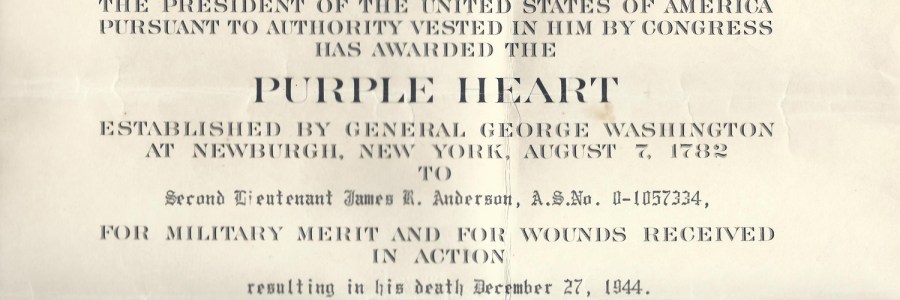
| Purple Heart, Combat Infantryman Badge | Colmar Pocket |
| Military Occupational Specialty | Entered the Service From |
| 1542 (infantry unit commander) | Newark, Delaware |
Author’s note: This article reworks some text pertaining to the Colmar Pocket previously published in my article about Private 1st Class John Frame.
Early Life & Family
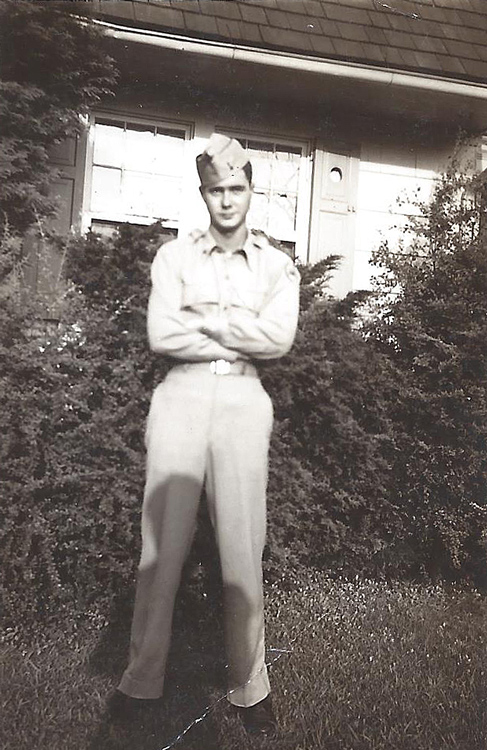
James Robert Anderson was born in Newport, Rhode Island, on November 29, 1920. He was the son of Sam Williams Anderson (1890–1958) and Willie Wray Anderson (née Robinson, 1896–1997). Both of his parents were born in South Carolina and married there on August 19, 1917, four days after Sam was commissioned as a 2nd lieutenant in the U.S. Army Coast Artillery Corps. Anderson’s father was a career U.S. Army officer who served in the 28th Division during World War I. He retired on April 30, 1943, at the grade of lieutenant colonel. Anderson had a younger sister, Mary Frances, (1927–2008). According to his Individual Deceased Personnel File (I.D.P.F.), Anderson was Protestant.
Sam Anderson was stationed at Fort Adams, Rhode Island, when James was born. Due to the elder Anderson’s military career, the family moved frequently. The Andersons were recorded again on the census on April 7, 1930, living at Fort Kamehameha, Hawaii (located near Pearl Harbor). Census records indicate that the family was living in Newark, Delaware, as of April 1, 1935. The Anderson family was recorded again on April 5, 1940, now living at Fort Monroe, Virginia. Anderson’s maternal grandmother, Alice F. Robinson, was recorded as living with the family at the time of the the 1930 and 1940 censuses.
When he registered for the draft on February 16, 1942, James R. Anderson was living at the Kappa Sigma fraternity house in Williamsburg, Virginia, and attending the College of William & Mary. (His father had also been a member of Kappa Sigma while attending Davidson College.) The registrar described him as standing five feet, nine inches tall and weighing 140 lbs., with brown hair and eyes.
After graduating from college, Anderson briefly moved back to Delaware, which his parents had also returned to that year. His address was 227 Orchard Road in Newark when he joined the U.S. Army.
Military Training & Marriage
Anderson enlisted as a private in the U.S. Army in Massachusetts on or around October 1, 1942, and began his training at Camp Edwards on Cape Cod. Like his father, he was originally a member of the Coast Artillery Corps. He was assigned to the Antiaircraft Artillery—then part of the C.A.C.—which had a training center at Camp Edwards. By mid-1943, Anderson had been promoted to corporal and was stationed at Camp Davis, North Carolina (another antiaircraft artillery training center), where he attended Officer Candidate School (O.C.S.). Anderson was commissioned as a 2nd lieutenant on July 15, 1943.

While stationed at Camp Davis, Lieutenant Anderson married Trubie Benton Weeks (1919–1992) in Conway, South Carolina, on November 21, 1943. A December 12, 1943, article in The News and Observer (Raleigh, North Carolina) stated: “The bride wore an ensemble of black and white with white accessories. Her corsage was of rosebuds […] She has been employed in defense work in Wilmington for the past year.” The couple briefly lived in Wilmington, North Carolina, before Lieutenant Anderson’s next transfer.
A newspaper clipping from his wife’s collection (date and paper unknown) stated that Anderson was an instructor at Camp Davis “but was transferred to the infantry at Camp Blanding, Fla.” According to a statement by his father for the State of Delaware Public Archives Commission, Lieutenant Anderson was also stationed at Fort Benning, Georgia, as well as Camp Blanding.
Lieutenant Anderson’s last stateside post was Fort George G. Meade, Maryland. A letter he sent his wife from Fort Meade on September 10, 1944, stated he would be shipping out shortly. According to his father, Anderson went overseas to Northern Ireland in September 1944, eventually moving to England and then France.
A V-mail to his wife dated October 2, 1944, stated:
I am safe and sound somewhere in England. We had an interesting and enjoyable trip across the pond. I have visited quite a bit of both England and Scotland. The countryside is beautiful (particular Scotland’s) and the people give the Yanks a warm welcome; they seem mighty glad to see us. I am in fine shape and continue to gain weight. It is pretty cold here, but I live in a small hut instead of a tent. The main thing bothering me is how terribly I miss you, Sweetheart. It seems ages since we parted, but you’ve been in my thoughts the whole time. Please take care of yourself and try not to work about me. Write soon, Darling, and know that
I love you,
Jimmy
The Colmar Pocket
As of October 16, 1944, 2nd Lieutenant Anderson was still in England with a unit identified only as Infantry Company “L” in the return address section of his letter. On December 2, 1944, 2nd Lieutenant Anderson transferred from the 2nd Replacement Depot to his last unit: Company “F,” 15th Infantry Regiment, 3rd Infantry Division. The 3rd Infantry Division had fought in North Africa, Sicily, and Italy before landing in Southern France on August 15, 1944, and fighting its way northward. His duty was recorded as 1542-9, platoon leader.
After taking Strasbourg in November 1944, the 3rd Infantry Division was ordered to respond to another German threat in mid-December. John C. McManus wrote in his book, American Courage, American Carnage:
To the south of Strasbourg, the Germans had forged another bulge west of the Rhine in Alsace, a concentric ring of German-held territory commonly referred to as the “Colmar Pocket,” after the Alsatian city that constituted the center of gravity, if not quite the center point, of the pocket.
McManus added that “For several days, the Germans had launched strong attacks from the Colmar Pocket” against the French First Army and U.S. 36th Infantry Division.
According to History Of The Third Infantry Division In World War II (edited by Donald G. Taggart), on “December 23, the 15th Infantry launched an attack against the two towns of Bennwihr and Sigolsheim, as the first step in securing a more stable line of defense” since they were “the last two towns of any size between that part of our line and the key city of Colmar[.]” It appears that 2nd Lieutenant Anderson’s battalion, (2nd Battalion, 15th Infantry Regiment) was in reserve for the beginning of the action, since it was not mentioned in the division history between December 23–25, 1944.
Bennwihr, France, fell on Christmas Day, but too late for the men of the 15th Infantry Regiment to enjoy “The roast turkey, creamed potatoes, and other supplementary items which the Division Quartermaster had received for the Yule dinner[.]” The regiment began attacking Sigolsheim, France, on the morning of December 26, 1944, this time including some companies from 2nd Lieutenant Anderson’s battalion. However, Company “F” was not mentioned in the account of the battle in the division history, so the extent of their participation is unclear. Sigolsheim was secured on December 27, 1944.
According to 2nd Lieutenant’s Anderson Individual Deceased Personnel File (I.D.P.F.), he was killed by a shell fragment to the back of the head while in the vicinity of Sigolsheim on December 27, 1944. A digitized copy of a hospital admission card (which also served as casualty records, since the cards were filled out even when the soldier died before reaching the hospital) also stated that Anderson was killed by an artillery shell during the month of December 1944.

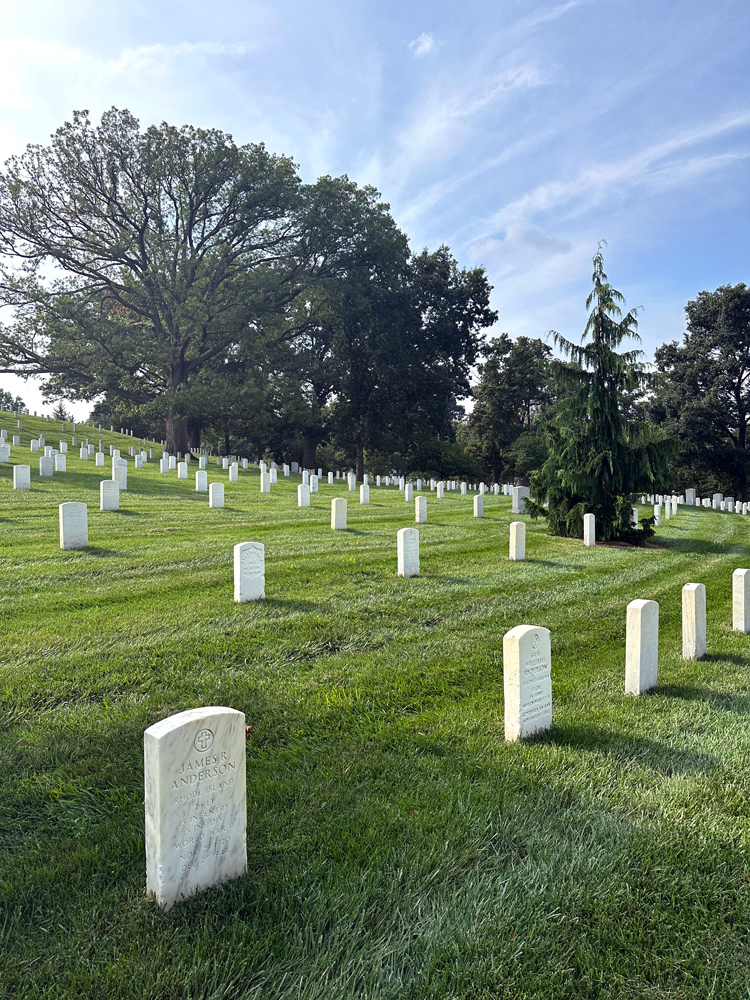
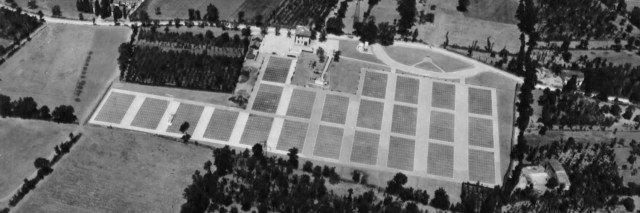
During his career, 2nd Lieutenant Anderson earned the Purple Heart and the Combat Infantryman Badge. He was initially buried at the U.S. Military Cemetery Epinal on March 9, 1945 (Plot 3C, Row 17, Grave 7468). After the war, his body was returned to the United States and buried at Arlington National Cemetery on July 25, 1949 (Section 34, Grave 1847).
On June 21, 1949, while hospitalized at Fitzsimons General Hospital in Colorado, Lieutenant Colonel Anderson wrote to the Quartermaster General requesting that space be reserved at Arlington so that parents and son would one day be buried together. Colonel R. G. Amlong of the Memorial Division replied on July 11, 1949, expressing his regret that he was unable to comply with the request due to space limitations. Remarkably, despite the request being officially turned down, when Colonel Anderson died in 1958, he was indeed buried next to his son, as was Willie Wray Anderson after her death in 1997.
Lieutenant Anderson’s widow Trubie remarried in Washington, D.C. on June 17, 1946, to Watson A. Thomas (1923–2002), with whom she raised four children. She named one of her sons James Robert Thomas, but it was only after her death that he learned of his namesake.

Notes
Enlistment Date
One minor discrepancy I came across is that Anderson’s digitized enlistment data card recorded him as joining the U.S. Army at Camp Edwards, Massachusetts on October 1, 1942. The Individual Military Service Record filled out by Lieutenant Colonel Anderson in 1949 stated that his son enlisted at Camp Devens, Massachusetts, on October 2, 1942, before training at Camp Edwards, Massachusetts.
Residences
James Anderson’s parents were still at Fort Monroe when he registered for the draft on February 16, 1942, but had moved to 227 Orchard Road in Newark by July 22, 1943, per an article in The Newark Post. According to the State of Delaware Individual Military Service Record form filled out by Lieutenant Colonel Anderson in 1949, James was living at the same address when he entered the U.S. Army, so I feel confident that the entire family relocated there sometime in 1942. Although James R. Anderson is known to have lived in Delaware in both 1935 and 1942, it is not clear how many years he spent living there in total.
Date of Death
Curiously, Lieutenant Colonel Anderson wrote that 2nd Lieutenant Anderson was killed in action at Colmar on January 4, 1945. Since hospital admission card date supported the earlier date of December 27, 1944, that I gave that as his date of death in the article. Furthermore, Lieutenant Anderson’s battalion was in combat on December 27, 1944 (although I have been unable to confirm his company’s participation), whereas the division history implied that January 4, 1945, was a quiet day. The division history only mentioned that day that “The 15th Infantry, which had occupied the extreme left of the Division front, moved to the extreme right, putting out troops deeper into the heights of the Vosges.”
Interestingly, the burial report in his I.D.P.F. originally gave his date of death as January 4, 1945, but that was crossed out and December 27, 1944, written it. That’s consistent with the place of death in the report, recorded as being the vicinity of Siglosheim, France. It also may explain why Anderson’s father supplied the later date.
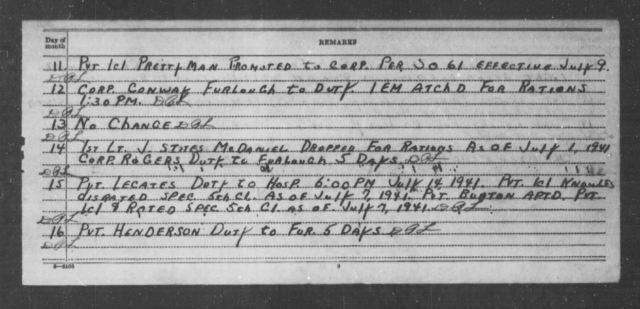
A company morning report dated December 30, 1944, stated that Lieutenant Anderson was missing in action since December 27, adding that he was “Bel[ieved] KIA but body not recovered[.]”

Photo Enhancement
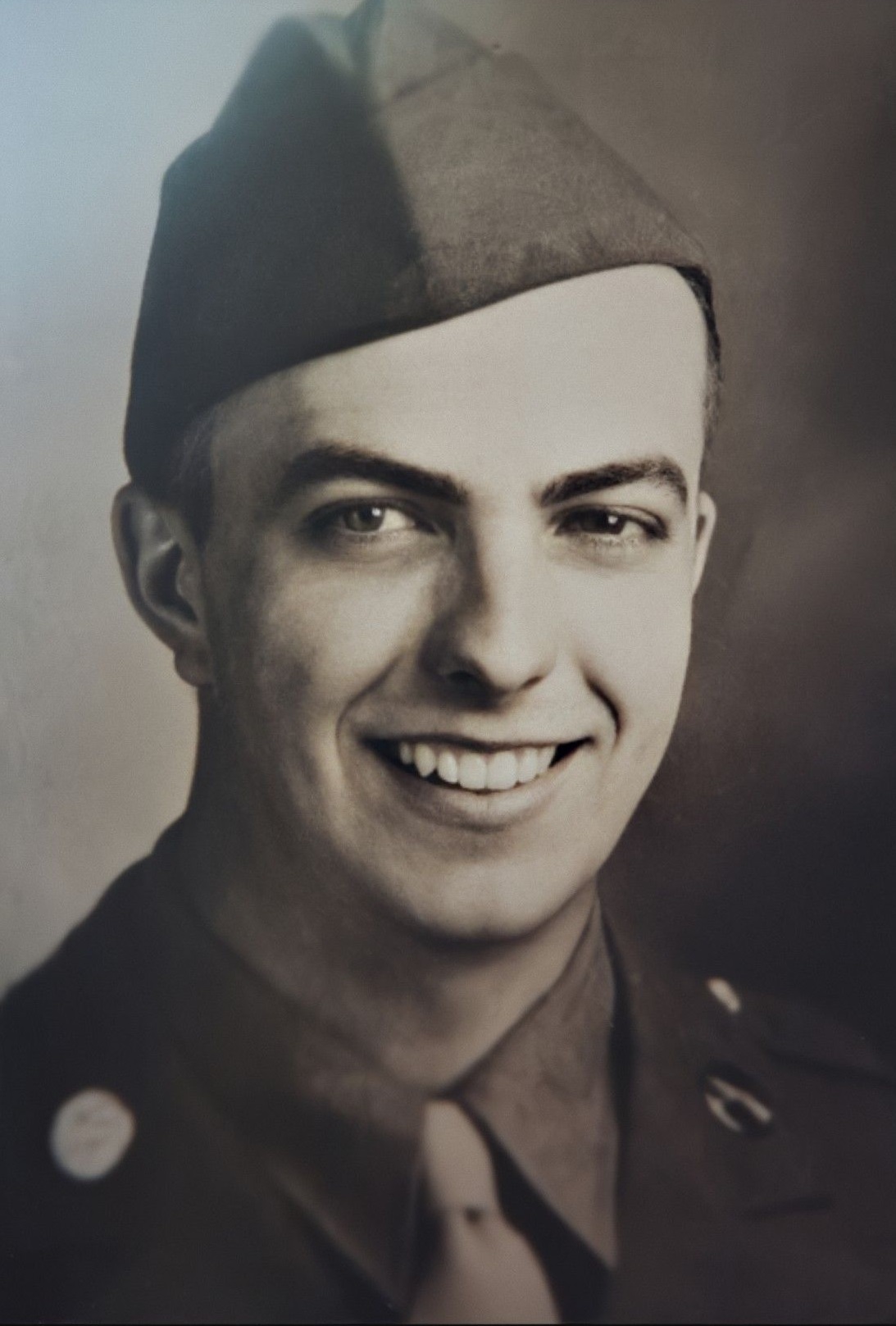

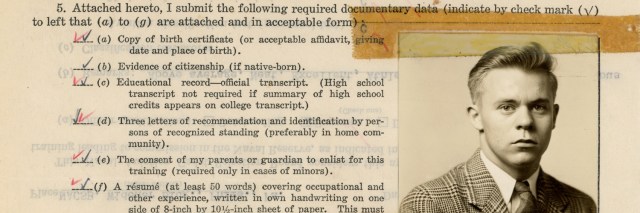
The photo at the top of this page was digitally enhanced using tools on the genealogy website MyHeritage. This software is useful in instances where the only known photograph is of limited resolution (in this case, because the original print had to be photographed through glass of a collage displayed at the Newark History Museum). I believe this to be an accurate reconstruction, but the software could potentially introduce errors by misinterpreting fuzzy details in the original photograph. A comparison of the original and enhanced versions of the photos can be viewed below.
Acknowledgments
Special thanks to the Thomas family for items from Anderson’s widow’s collection and to the Newark History Museum for the use of their photo.
Bibliography
Anderson, James R. V-mail to Trubie Anderson, October 2, 1944. Courtesy of the Thomas family.
Anderson, Sam W. James Robert Anderson Individual Military Service Record, June 5, 1949. Record Group 1325-003-053, Record of Delawareans Who Died in World War II. Delaware Public Archives, Dover, Delaware. https://cdm16397.contentdm.oclc.org/digital/collection/p15323coll6/id/17507/rec/1
“Anderson-Weeks.” The News and Observer, December 12, 1943. https://www.newspapers.com/clip/67939661/wedding-of-james-r-anderson-to-trubie/
Anderson, Willie W. Letter to the Delaware Public Archives Commission dated July 8, 1949. Record Group 1325-003-053, Record of Delawareans Who Died in World War II. Delaware Public Archives, Dover, Delaware. https://cdm16397.contentdm.oclc.org/digital/collection/p15323coll6/id/17509
County Marriage Records. South Carolina Department of Archives and History, Columbia, South Carolina. https://www.ancestry.com/imageviewer/collections/61450/images/48233_554623-00252
“Deaths.” The Evening Sentinel, November 4, 1958. https://www.newspapers.com/clip/67928610/sam-williams-anderson-obituary/
District of Columbia Marriages. Clerk of the Superior Court, Records Office, Washington D.C. https://search.ancestry.com/cgi-bin/sse.dll?indiv=1&dbid=61404&h=262414&ssrc=pt&tid=70121226&pid=42483059861&usePUB=true
Fourteenth Census of the United States, 1920. Record Group 29, Records of the Bureau of the Census. National Archives at Washington, D.C. https://www.ancestry.com/imageviewer/collections/6061/images/4384995_01170
Fifteenth Census of the United States, 1930. Record Group 29, Records of the Bureau of the Census. National Archives at Washington, D.C. https://www.ancestry.com/imageviewer/collections/6224/images/4661342_00498
Interment Control Forms, 1928–1962. Record Group 92, Records of the Office of the Quartermaster General, 1774–1985. National Archives at College Park, Maryland. https://www.ancestry.com/imageviewer/collections/2590/images/40479_2421406260_0450-00821, https://www.ancestry.com/imageviewer/collections/2590/images/40479_2421406260_0450-02766
James R. Anderson Individual Deceased Personnel File. National Archives.
“Lieut. Anderson Slain In Combat.” Newspaper clipping from unidentified paper in the collection of Trubie Thomas, c. 1945. Courtesy of the Thomas family.
“Local Boys Finish OCS.” The Newark Post, July 22, 1943. https://udspace.udel.edu/bitstream/handle/19716/18885/np_034_24b.pdf?sequence=1&isAllowed=y
“Mary F. Farrington.” The Washington Post, June 12, 2008. https://www.legacy.com/obituaries/washingtonpost/obituary.aspx?pid=111390156
Morning reports for Company “F,” 15th Infantry Regiment. December 1944. U.S. Army Morning Reports, c. 1912–1946. Record Group 64, Records of the National Archives and Records Administration. National Personnel Records Center, St. Louis, Missouri.
Official Army Register, 1 January 1944. The Adjutant General’s Office, Washington, D.C., 1944. https://www.ancestry.com/imageviewer/collections/2345/images/40014_1821100517_0651-01066
“Robinson-Anderson Marriage.” Keowee Courier, August 22, 1917. https://www.newspapers.com/clip/67929701/sam-w-andersonwillie-wray-robinson/
Silverman, Lowell. “Private 1st Class John Frame (1915–1945).” Delaware’s World War II Fallen website, May 28, 2021. https://delawarewwiifallen.com/2021/05/28/private-1st-class-john-frame/
Sixteenth Census of the United States, 1940. Record Group 29, Records of the Bureau of the Census. National Archives at Washington, D.C. https://www.ancestry.com/imageviewer/collections/2442/images/M-T0627-04259-00283
Taggart, Donald G. (Ed.). History Of The Third Infantry Division In World War II. Infantry Journal Press, Washington, D.C., 1947. https://archive.org/details/HistoryOfTheThirdID/mode/2up
U.S. Social Security Applications and Claims Index, 1936–2007. Ancestry.com. https://www.ancestry.com/discoveryui-content/view/25249440:60901?indiv=1&tid=&pid=&queryId=f223b9891a8f39aba5af2bc3e674276c&usePUB=true&_phsrc=OJf94&_phstart=successSource
U.S. WWII Hospital Admission Card Files, 1942–1954. Record Group 112, Records of the Office of the Surgeon General (Army), 1775–1994. National Archives at College Park, Maryland. https://www.fold3.com/record/703833574/u-s-wwii-hospital-admission-card-files-1942-1954-blank
World War II Army Enlistment Records. Record Group 64, Records of the National Archives and Records Administration. National Archives at College Park, Maryland. https://www.fold3.com/record/83373383/world-war-ii-army-enlistment-records-james-r-anderson
WWII Draft Registration Cards for Virginia, 10/16/1940–3/31/1947. Record Group 147, Records of the Selective Service System. National Archives at St. Louis, Missouri. https://www.ancestry.com/imageviewer/collections/2238/images/44044_05_00003-00816
Last updated on September 15, 2023
More stories of World War II fallen:

























To have new profiles of fallen soldiers delivered to your inbox, please subscribe below.
 Delaware's World War II Fallen