

| Residences | Civilian Occupation |
| Maryland, Delaware | Machine helper at the Curtis Paper Mill |
| Branch | Service Number |
| U.S. Army | 32068947 |
| Theater | Unit |
| European | Headquarters & Service Troop, 44th Cavalry Reconnaissance Squadron (Mechanized), 11th Cavalry Group (Mechanized) |
| Awards | Campaigns/Battles |
| Purple Heart | Roer River/Operation Grenade (Rhineland campaign) |
| Military Occupational Specialty | Entered the Service From |
| 813 (motor sergeant) | Newark, Delaware |
Early Life & Family
Homer Burton Wooleyhan was born on August 28, 1918, in Millington, on the Eastern Shore of Maryland. He was the son of Clinton E. Wooleyhan (a farmer, 1872–1950) and Clara M. Wooleyhan (née Boggs, 1877–1925). He had at least three brothers and five sisters. A family tree states a fourth older brother died as a child. The family was recorded on the census in January 1920, living in Dixon, Queen Anne’s County, Maryland.
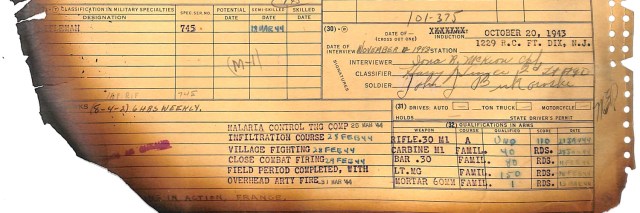
Based on his signature and the 1940 census, Wooleyhan went by his middle name, Burton. According to an article in Journal-Every Evening, after his mother’s death Wooleyhan lived in Templeville, Maryland, with his sister, Clara Belle Shelton (1909–1997). The article added that Wooleyhan graduated from Sudlersville High School and moved to Newark around 1939. On the other hand, the 1940 census stated that Wooleyhan’s highest completed level of education was eighth grade. Likewise, his enlistment data card gave his education level as grammar school. The Journal-Every Evening article stated that Wooleyhan “was known as a dancer and had won several dancing contests.”
By the time he was recorded on the census in April 1940, Wooleyhan had moved to 20 East Cleveland Avenue in Newark, Delaware. At the time, he and his older brother, Julian C. Wooleyan (1911–1999), were living as lodgers at the home of Oscar Knox (1900–1956) and his wife, Mae Knox (1901–1945). Wooleyhan was working as a machine helper at the nearby Curtis Paper Mill. Oscar Knox, a coworker, worked as an engineer at the paper mill. When Wooleyhan registered for the draft on October 16, 1940, he was described as standing five feet, 10 inches tall and weighing 140 lbs., with black hair and brown eyes.
Stateside Service
Wooleyhan was drafted before the U.S. entered World War II. He was inducted in Trenton, New Jersey, on March 4, 1941. He was initially attached to Company “C,” 1229th Reception Center, Fort Dix, New Jersey. During the World War II era, many soldiers were assigned directly to units for their basic training rather than attending it at a training center. On March 8, 1941, Wooleyhan departed Fort Dix bound for Fort Jackson, South Carolina, to join the 8th Reconnaissance Troop, a U.S. Army Cavalry unit. Although horse cavalry was obsolete by then, the branch was transitioning to a mechanized force. The troop was part of the 8th Division (known as the 8th Infantry Division from July 31, 1941, onward).
The day after he left Fort Dix, on March 9, 1941, Private Wooleyhan joined the 8th Reconnaissance Troop. Rosters and morning reports establish that Wooleyhan spent the rest of his military career with the same unit, notwithstanding that it underwent both reorganization and redesignation.
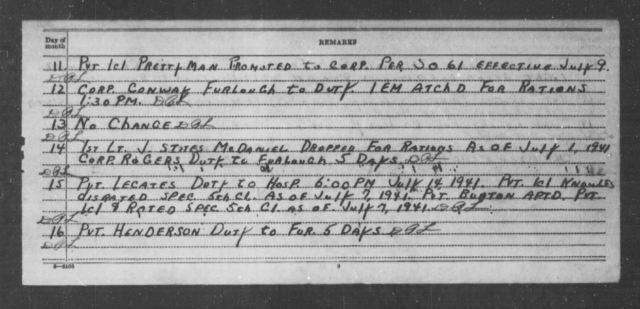
Monthly rosters from June 1941 through the end of the year listed Private Wooleyhan’s military occupational specialty (M.O.S.) and duty codes as 679, motorcycle scout. Private Wooleyhan was rated as a specialist 5th class effective July 15, 1941. On August 7, 1941, Private Wooleyhan went on detached service to Milwaukee, Wisconsin. Although the initial morning report entry appears to say it was for “Quartermaster School” the morning report recording his return to duty on September 7, 1941, stated that he had been on detached service at the Harley-Davidson Motor Company. Journal-Every Evening later reported that Wooleyhan “attended specialist schools at Milwaukee, Wis., and Kansas City, Kan.” (The paper may have been incorrect about Kansas City, but he later trained at Fort Riley, Kansas.)
On September 22, 1941, the 8th Reconnaissance Troop moved to the Carolina Maneuver Area. Perhaps as a result of his recent training at Harley-Davidson, Private Wooleyhan was rated as a specialist 4th class on October 12, 1941. His unit returned to Fort Jackson on November 30, 1941.
Private Wooleyhan was rerated as a specialist 3rd class on January 13, 1942. The roster dated January 31, 1942, reflected a change in M.O.S. and duty to 014, automobile mechanic. Beginning with the March 1942 roster, Wooleyhan’s M.O.S. and duty codes changed to 138, motorcycle mechanic. He went on furlough on May 26, 1942, returning to duty on June 5.
During the spring of 1942, the 8th Infantry Division was redesignated as the 8th Motorized Division as part of an experimental conversion to increase the U.S. Army’s mechanization. Per General Orders No. 30, 8th Motorized Division, dated June 18, 1942, the 8th Reconnaissance Troop was reorganized and expanded into the 8th Reconnaissance Squadron. Each reconnaissance squadron had several troops. When the new Headquarters & Headquarters Troop, 8th Reconnaissance Squadron was organized on June 20, 1942, Private, Specialist 3rd Class Wooleyhan became cadre for the new unit. A roster dated that day listed Wooleyhan again with the duty code of 014 (automobile mechanic), unlike both the preceding and subsequent rosters.

The expansion of his unit provided Wooleyhan with the opportunity for rapid advancement. On June 21, 1942, he was promoted four grades to staff sergeant. A roster from the end of the month listed his duty code as returning to 138, motorcycle mechanic. He went on furlough during August 22–25, 1944.
On September 7, 1942, the 8th Reconnaissance Squadron left Fort Jackson for maneuvers in Tennessee with the rest of the 8th Motorized Division before moving to Camp Forrest, Tennessee. The unit departed Camp Forrest by road on December 5, 1942, arriving two days later at Fort Leonard Wood, Missouri. On March 17, 1943, Wooleyhan and his comrades entrained for the Desert Training Center, arriving at Camp Laguna, Arizona, three days later. In late July 1943, they moved to nearby Camp Hyder, Arizona.
The U.S. Army eventually deemed the motorized division concept a failure, as its equipment requirements would have posed an extreme burden on America’s available overseas shipping capacity. The 8th Motorized Division once again became the 8th Infantry Division, effective May 15, 1943. Standard infantry divisions had only a reconnaissance troop rather than a full squadron, so that same month, some personnel from the 8th Reconnaissance Squadron were transferred to a newly reconstituted 8th Cavalry Reconnaissance Troop. The rest of the 8th Reconnaissance Squadron was detached from the 8th Infantry Division and joined the 11th Cavalry Group (Mechanized) at Camp Hyder on August 1, 1943. The 11th Cavalry Group also included the 90th Reconnaissance Squadron, later redesignated the 36th Cavalry Reconnaissance Squadron.
Staff Sergeant Wooleyhan and his unit moved to Camp Pilot Knob, California, on August 14, 1943. He went on a two-week furlough beginning on September 5, 1943. On November 9, 1943, he went on detached service to attend the Enlisted Motors Course at The Cavalry School, Fort Riley, Kansas. On November 12, 1943, he was attached as a student to the 1st Cavalry School Detachment there.
Presumably to avoid confusion between the 8th Cavalry Reconnaissance Troop and the 8th Reconnaissance Squadron, the latter was redesignated as the 44th Cavalry Reconnaissance Squadron (Mechanized), effective December 22, 1943. Though he was still on detached service, Staff Sergeant Wooleyhan’s M.O.S. was recorded again as motorcycle mechanic on a roster compiled the following day for Headquarters & Service Troop, 44th Cavalry Reconnaissance Squadron (Mechanized).
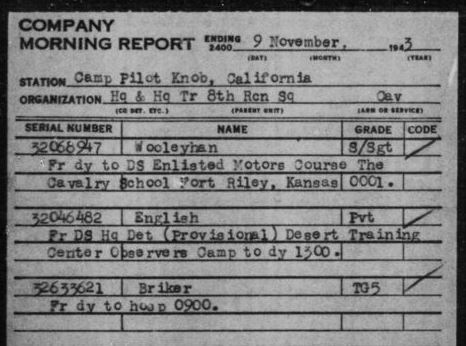
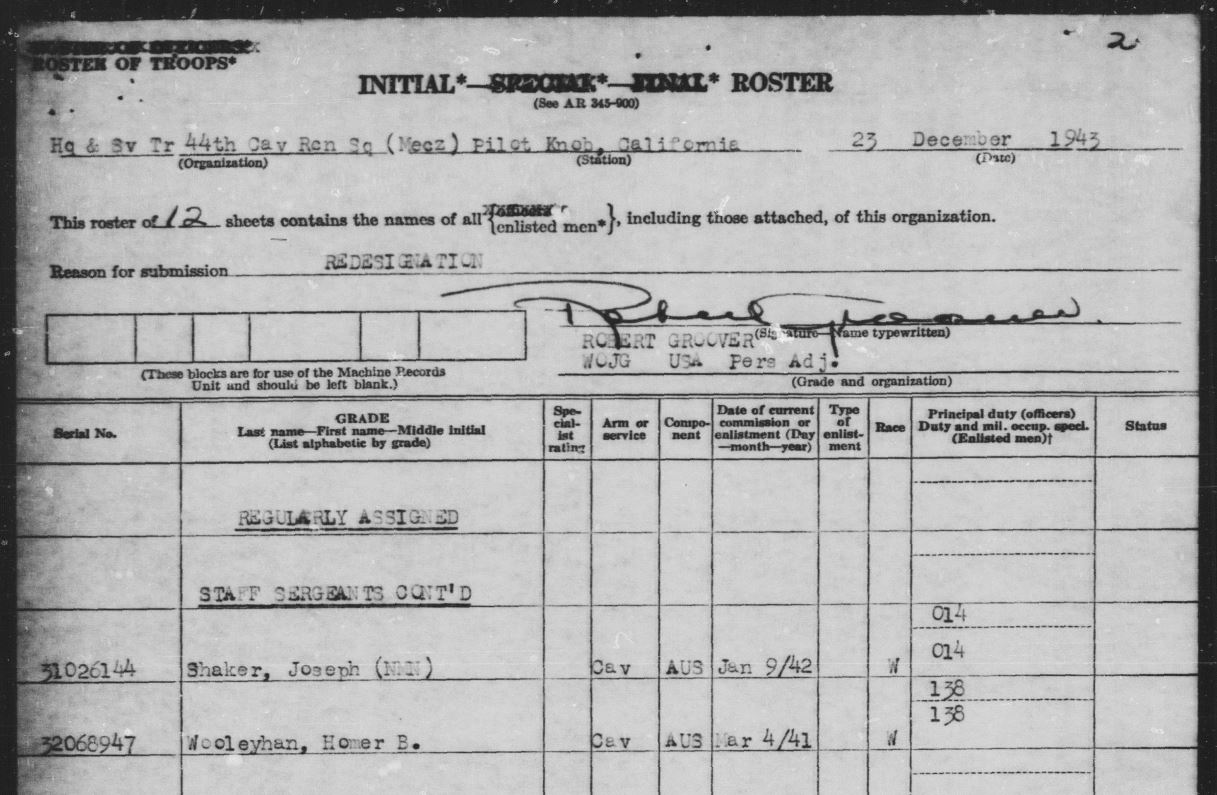
On February 29, 1944, Wooleyhan rejoined his unit, now stationed at Fort Bragg, North Carolina. The Enlisted Motors Course he took may have qualified him in the M.O.S. of 813, motor sergeant, which he held by February 1945, though there are no known rosters for his unit after December 1943 that list M.O.S.
The squadron, less Troop “A,” moved to Stoney Field in Charleston, South Carolina, on March 13, 1944. On June 1, 1944, the 44th moved to Camp Gordon, Georgia, where it rejoined the rest of the 11th Cavalry Group. The squadron left Camp Gordon on September 20, 1944, staging the following day at Camp Kilmer, New Jersey.
Combat in the European Theater
44th Cavalry Reconnaissance Squadron (Mechanized) records state that the unit shipped out from the New York Port of Embarkation on September 29, 1944, arriving in the European Theater on October 11 or 12, 1944, while group records stated that the group shipped out on September 28, 1944, and arrived in Greenock, Scotland, on October 10, 1944.
As their name implied, the U.S. Army intended cavalry reconnaissance units to perform the traditional cavalry role of reconnaissance and screening the flanks of heavier units. They were still lightly armed and highly mobile, but were equipped with jeeps, armored cars, and light tanks instead of horses. In actual combat, the cavalry reconnaissance units performed reconnaissance only occasionally: approximately 3% of their missions.
Harry Yeide argued in his book, Steeds of Steel: A History of American Mechanized Cavalry in World War II, that “The radio was arguably the main weapon of the mechanized cavalry, because with it the cavalryman could set in motion events leading to the destruction of enemy forces they observed.” The role was aptly summarized in a song about Wooleyhan’s squadron recounted by Yeide:
Oh, we’re the suicide unit of the fighting 44th
First to sight the enemy and strike with lightning force
With eyes of an eagle, we watch his every move
Report it to the proper ones; the enemy is through.

The 11th Cavalry Group crossed the English Channel on November 23, 1944, with the 44th Cavalry Reconnaissance Squadron disembarking in Rouen, Normandy. The squadron departed Normandy on December 6, 1944, and moved northeast to the front lines along the Roer River, arriving at Gereonsweiler, Germany, on December 13, 1944. Days later, to the south, the German offensive through the Ardennes that came to be known as the Battle of the Bulge began. The 11th Cavalry Group’s sector was quiet by comparison, and the troopers primarily performed patrol duties and occasionally conducted raids.
Allied forces began pushing east again in early 1945. If not before, by that time Staff Sergeant Wooleyhan’s M.O.S. was 813, motor sergeant. The 11th Cavalry Group was assigned to support the Ninth Army crossing of the Roer River known as Operation Grenade. Delayed several weeks when the Germans intentionally flooded the area by releasing water from dams, the operation began on February 23, 1945.
Harry Yeide wrote in his article, “Mechanized Cavalry Histories,” that the 44th “Operated between Ninth Army and British forces during Roer crossing and drive to Rhine beginning 27 February 1945.” Staff Sergeant Wooleyhan was reported to have been killed in action that same day. The Eleventh Cavalry from The Roer to the Elbe 1944–1945 described the day’s action (though erroneously describing it as taking place on February 28), providing flank security during the advance:
The first day of action cost the 44th Squadron considerable losses. At the break of day in Brachelen the explosion of a large shell or mine resulted in 3 enlisted men killed and 3 officers wounded, not to mention the loss and damage of several vehicles. At Golkrath a small task force under Captain Eldred C. Jones, CO Troop ‘B’, with the mission of establishing a road block, encountered an enemy roadblock, covered by small arms and antitank fire. Captain Jones’ force, due to the heroism of several of its officers and men and its cool vigorous fighting, extricated itself with the loss of only 2 killed and several wounded. 1st Lt Jimmy S. Knight was awarded the Bronze Star Medal […] for gallantry in this action. Lt Knight, who died later from a mortal wound, gallantly continued to direct his platoon until he lost consciousness.
The 44th Cavalry Reconnaissance Squadron suffered three fatalities on February 27, 1945: 1st Lieutenant Jimmie S. Knight (1920–1945), Technician 4th Grade Rudolph Zellner (1913–1945), and Staff Sergeant Wooleyhan. Wooleyhan must have been one of the victims of the explosion in Brachelen. The third fatality mentioned in connection with the explosion was almost certainly Technician 5th Grade Edgar F. Knight (1920–1945), also of Headquarters & Service Troop, who was severely wounded by an artillery shell at the same location as Wooleyhan and Zellner and died the following day.
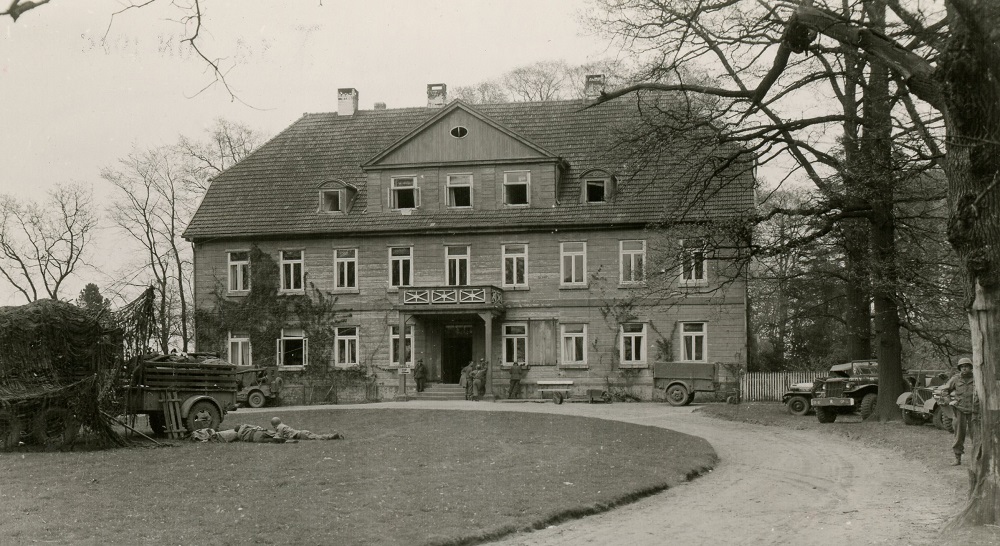
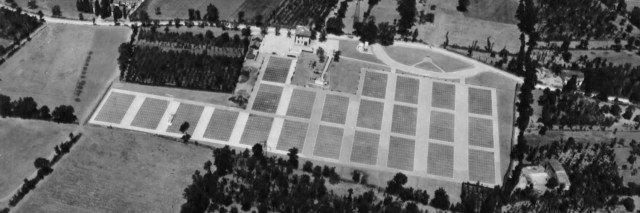
Staff Sergeant Wooleyhan was initially buried at an American cemetery in Margraten, Netherlands, on the same afternoon he was killed. After the war, Staff Sergeant Wooleyhan’s brother, Nathaniel B. Wooleyhan (1903–1976), requested that his body be repatriated to the United States. His casket was transported aboard the Liberty ship Barney Kirschbaum and then by train to where he grew up, on the Eastern Shore of Maryland. After a service at the Templeville Methodist Church on March 27, 1949, he was buried at Sudlersville Cemetery, where his mother’s body rested. His father and several siblings were also buried there after their deaths.
Notes
Delaware Memorial Volume
Apparently confused by Staff Sergeant Wooleyhan’s unit being a squadron, which was typical nomenclature for Cavalry units, the State of Delaware’s Public Archives Commission erroneously described him as being a member of the “U. S. Army Air Corps” in the 1949 memorial volume of Delaware’s World War II dead. In fairness to the commission, Oscar Knox didn’t get the full name of the unit right, listing it as “Troop 44th Reconn. Squadron,” though the fact that he was in a troop should have made it clear that Wooleyhan wasn’t an aviator.
Duty and Military Occupational Specialty (M.O.S.)
There were a greater variety of military occupational specialties in the U.S. Army during World War II than there are today. In most cases, a soldier’s duty was the same one they were trained for, meaning the M.O.S. and duty codes matched. A change to a similar duty might also have seen the M.O.S. reclassified, as when Wooleyhan changed between automobile mechanic and motorcycle mechanic. Occasionally, a soldier trained in one M.O.S. (e.g., rifleman) was assigned a completely different duty (e.g., litter bearer). One complication for researchers is that rosters and morning reports sometimes listed both duty and M.O.S. in the same entry, and sometimes just one or the other.
Specialist
Wooleyhan was first rated as a private, specialist 5th class, on July 15, 1941. He eventually worked his way up to specialist 3rd class, which he held until his promotion to staff sergeant on June 21, 1942. The specialist rating, which should not be confused with the specialist grade introduced after World War II, indicated that Wooleyhan possessed special skills. Holding the specialist rating earned him a bonus in his pay. (The lower specialist numbers were higher levels, just as a 1st lieutenant outranks a 2nd lieutenant.)
By statute, less than 30% of soldiers holding the grade of private or private 1st class could be rated as specialists. Noncommissioned officers could not hold specialist ratings. Specialist ratings were discontinued at the end of June 1942.
Place of Death
Curiously, morning reports describe Wooleyhan and the other casualties on February 27, 1945, as occurring at Gladbach, Germany. There does not appear to be any town nearby named Gladbach. Possible candidates are Mönchengladbach, Gladbeck, and Bergisch Gladbach, but none of those make much sense in the context of the 44th Cavalry Reconnaissance Squadron’s advance for the day. Regardless, Staff Sergeant Wooleyhan’s individual deceased personnel file (I.D.P.F.) confirms he was killed at Brachelen.
Headstone
Although Staff Sergeant Wooleyhan’s name appears on the official New Castle County, Delaware, casualty list because he was living there when he entered the service, his headstone lists his state as Maryland, where he lived most of his life. The headstone paperwork was filled out by his brother, Nathaniel.
Acknowledgments
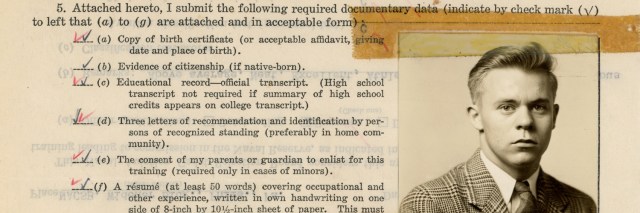
Special thanks to the Newark History Museum for the use of their photo of Wooleyhan.
Bibliography
“2 Delawareans On Carriers Die in Action.” Journal-Every Evening, April 7, 1945. https://www.newspapers.com/clip/62815892/homer-b-wooleyhan-44th-cavalry/
Application for Headstone or Marker for Homer B. Wooleyhan. October 24, 1949. Applications for Headstones, January 1, 1925 – June 30, 1970. Record Group 92, Records of the Office of the Quartermaster General, 1774–1985. National Archives at St. Louis, Missouri. https://www.ancestry.com/imageviewer/collections/2375/images/40050_2421401697_0404-00289,
Application for Headstone or Marker for Rudolph Zellner. December 8, 1948. Applications for Headstones, January 1, 1925 – June 30, 1970. Record Group 92, Records of the Office of the Quartermaster General, 1774–1985. National Archives at St. Louis, Missouri.https://www.ancestry.com/imageviewer/collections/2375/images/40050_2421406260_0411-01739
Census Record for Burton Wooleyhan. April 13, 1940. Sixteenth Census of the United States, 1940. Record Group 29, Records of the Bureau of the Census. National Archives at Washington, D.C. https://www.ancestry.com/imageviewer/collections/2442/images/m-t0627-00546-00199
Census Record for Homer Burton Wooleyhand [sic]. January 15, 1920. Fourteenth Census of the United States, 1920. Record Group 29, Records of the Bureau of the Census. National Archives at Washington, D.C. https://www.ancestry.com/imageviewer/collections/6061/images/4301041_00643
“Clara M. Wolleyhand.” Find a Grave. https://www.findagrave.com/memorial/158837864/clara-m-wolleyhand
“Clinton E. Wooleyhan.” Find a Grave. https://www.findagrave.com/memorial/119152426/clinton-e.-wooleyhan
Draft Registration Card for Homer Burton Wooleyhan. October 16, 1940. Draft Registration Cards for Delaware, October 16, 1940 – March 31, 1947. Record Group 147, Records of the Selective Service System. National Archives at St. Louis, Missouri. https://www.ancestry.com/imageviewer/collections/2238/images/44003_04_00010-01349
Enlistment Record for Homer B. Wooleyhan. March 4, 1941. World War II Army Enlistment Records. Record Group 64, Records of the National Archives and Records Administration. National Archives at College Park, Maryland. https://aad.archives.gov/aad/record-detail.jsp?dt=893&mtch=1&cat=all&tf=F&q=32068947&bc=&rpp=10&pg=1&rid=2738274
Friedman, Edward E. “Organizations History.” Headquarters 44th Cavalry Reconnaissance Squadron (Mecz). September 20, 1945. World War II Operations Reports, 1940–48. Record Group 407, Records of the Adjutant General’s Office. National Archives at College Park, Maryland.
Haynes, George L., Jr. and Williams, James C. The Eleventh Cavalry from The Roer to the Elbe 1944–1945. Unknown publisher, 1945. https://cgsc.contentdm.oclc.org/digital/collection/p4013coll8/id/3191/
“Honor Roll.” 11th Armored Cavalry’s Veterans of Vietnam & Cambodia. https://www.11thcavnam.com/fiddlersgreen/WWII%2036%20&%2044%20Recon.html
Hospital Admission Card for 38107934. U.S. WWII Hospital Admission Card Files, 1942–1954. Record Group 112, Records of the Office of the Surgeon General (Army), 1775–1994. National Archives at College Park, Maryland. https://www.fold3.com/record/701000072/blank-us-wwii-hospital-admission-card-files-1942-1954
Individual Deceased Personnel File for Homer B. Wooleyhan. Individual Deceased Personnel Files, 1939–1953. Record Group 92, Records of the Office of the Quartermaster General, 1774–1985. National Archives at St. Louis, Missouri. Courtesy of U.S. Army Human Resources Command.
“Initial Roster Hq & Hq Tr 8th Reconn Sq.” June 20, 1942. U.S. Army Muster Rolls and Rosters, November 1, 1912 – December 31, 1943. Record Group 64, Records of the National Archives and Records Administration. National Archives at St. Louis, Missouri. https://s3.amazonaws.com/NARAprodstorage/lz/st-louis/rg-064/85713803_1940-1943/85713803_1940-1943_Roll-0176/85713803_1940-1943_Roll-0176_11.pdf
“Initial Roster Hq & Sv Tr 44th Cav Rcn Sq (Mecz).” December 23, 1943. U.S. Army Muster Rolls and Rosters, November 1, 1912 – December 31, 1943. Record Group 64, Records of the National Archives and Records Administration. National Archives at St. Louis, Missouri. https://s3.amazonaws.com/NARAprodstorage/lz/st-louis/rg-064/85713803_1940-1943/85713803_1940-1943_Roll-0179/85713803_1940-1943_Roll-0179_04.pdf
Knox, Oscar. Individual Military Service Record for Homer Burton Wooleyhan. April 16, 1946. Record Group 1325-003-053, Delaware Public Archives, Dover, Delaware. https://cdm16397.contentdm.oclc.org/digital/collection/p15323coll6/id/21497/rec/6
A Memorial Volume. Public Archives Commission State of Delaware, 1949. https://archivesfiles.delaware.gov/ebooks/WWII_Memorial_Volume.pdf
“Monthly Personnel Roster Dec 31 1941 8th Recon Troop.” December 31, 1941. U.S. Army Muster Rolls and Rosters, November 1, 1912 – December 31, 1943. Record Group 64, Records of the National Archives and Records Administration. National Archives at St. Louis, Missouri. https://s3.amazonaws.com/NARAprodstorage/lz/st-louis/rg-064/85713803_1940-1943/85713803_1940-1943_Roll-0188/85713803_1940-1943_Roll-0188_02.pdf
“Monthly Personnel Roster Jan 31 1942 8th Recon Troop.” January 31, 1942. U.S. Army Muster Rolls and Rosters, November 1, 1912 – December 31, 1943. Record Group 64, Records of the National Archives and Records Administration. National Archives at St. Louis, Missouri. https://s3.amazonaws.com/NARAprodstorage/lz/st-louis/rg-064/85713803_1940-1943/85713803_1940-1943_Roll-0188/85713803_1940-1943_Roll-0188_02.pdf
“Monthly Personnel Roster Jun 30 1941 8th Recon Troop.” June 30, 1941. U.S. Army Muster Rolls and Rosters, November 1, 1912 – December 31, 1943. Record Group 64, Records of the National Archives and Records Administration. National Archives at St. Louis, Missouri. https://s3.amazonaws.com/NARAprodstorage/lz/st-louis/rg-064/85713803_1940-1943/85713803_1940-1943_Roll-0188/85713803_1940-1943_Roll-0188_02.pdf
“Monthly Personnel Roster Mar 31 1941 8th Recon Tr.” March 31, 1941. U.S. Army Muster Rolls and Rosters, November 1, 1912 – December 31, 1943. Record Group 64, Records of the National Archives and Records Administration. National Archives at St. Louis, Missouri. https://s3.amazonaws.com/NARAprodstorage/lz/st-louis/rg-064/85713803_1940-1943/85713803_1940-1943_Roll-0188/85713803_1940-1943_Roll-0188_01.pdf, https://s3.amazonaws.com/NARAprodstorage/lz/st-louis/rg-064/85713803_1940-1943/85713803_1940-1943_Roll-0188/85713803_1940-1943_Roll-0188_02.pdf
“Monthly Personnel Roster Mar 31 1942 8th Recon Troop.” March 31, 1942. U.S. Army Muster Rolls and Rosters, November 1, 1912 – December 31, 1943. Record Group 64, Records of the National Archives and Records Administration. National Archives at St. Louis, Missouri. https://s3.amazonaws.com/NARAprodstorage/lz/st-louis/rg-064/85713803_1940-1943/85713803_1940-1943_Roll-0188/85713803_1940-1943_Roll-0188_02.pdf
Morning Reports for 1st Cavalry School Detachment. November 1943. U.S. Army Morning Reports, c. 1912–1946. Record Group 64, Records of the National Archives and Records Administration. National Archives at St. Louis, Missouri. https://s3.amazonaws.com/NARAprodstorage/lz/partners/st-louis/rg-064/85713825-wwii/85713825_1943-11/85713825_1943-11_Roll-0058/85713825_1943-11_Roll-0058-14.pdf
Morning Reports for 8th Cavalry Reconnaissance Troop. March 1941 – June 1942. U.S. Army Morning Reports, c. 1912–1946. Record Group 64, Records of the National Archives and Records Administration. National Archives at St. Louis, Missouri. https://s3.amazonaws.com/NARAprodstorage/lz/partners/st-louis/rg-064/85713825-wwii/85713825_1940-01-thru-1943-07/85713825_1940-01-thru-1943-07_Roll-0673/85713825_1940-01-thru-1943-07_Roll-0673-20.pdf, https://s3.amazonaws.com/NARAprodstorage/lz/partners/st-louis/rg-064/85713825-wwii/85713825_1940-01-thru-1943-07/85713825_1940-01-thru-1943-07_Roll-0673/85713825_1940-01-thru-1943-07_Roll-0673-21.pdf, https://s3.amazonaws.com/NARAprodstorage/lz/partners/st-louis/rg-064/85713825-wwii/85713825_1940-01-thru-1943-07/85713825_1940-01-thru-1943-07_Roll-0673/85713825_1940-01-thru-1943-07_Roll-0673-22.pdf
Morning Reports for Company “C,” 1229th Reception Center. March 1942. U.S. Army Morning Reports, c. 1912–1946. Record Group 64, Records of the National Archives and Records Administration. National Archives at St. Louis, Missouri. https://s3.amazonaws.com/NARAprodstorage/lz/partners/st-louis/rg-064/85713825-wwii/85713825_1940-01-thru-1943-07/85713825_1940-01-thru-1943-07_Roll-2840/85713825_1940-01-thru-1943-07_Roll-2840-01.pdf, https://s3.amazonaws.com/NARAprodstorage/lz/partners/st-louis/rg-064/85713825-wwii/85713825_1940-01-thru-1943-07/85713825_1940-01-thru-1943-07_Roll-2840/85713825_1940-01-thru-1943-07_Roll-2840-02.pdf
Morning Reports for Headquarters & Service Troop, 8th Reconnaissance Squadron. August 1943 – September 1943. U.S. Army Morning Reports, c. 1912–1946. Record Group 64, Records of the National Archives and Records Administration. National Archives at St. Louis, Missouri. https://s3.amazonaws.com/NARAprodstorage/lz/partners/st-louis/rg-064/85713825-wwii/85713825_1943-08/85713825_1943-08_Roll-0197/85713825_1943-08_Roll-0197-38.pdf, https://s3.amazonaws.com/NARAprodstorage/lz/partners/st-louis/rg-064/85713825-wwii/85713825_1943-09/85713825_1943-09_Roll-0296/85713825_1943-09_Roll-0296-22.pdf, https://s3.amazonaws.com/NARAprodstorage/lz/partners/st-louis/rg-064/85713825-wwii/85713825_1943-09/85713825_1943-09_Roll-0296/85713825_1943-09_Roll-0296-23.pdf
Morning Reports for Headquarters & Headquarters Troop, 8th Reconnaissance Squadron. June 1942 – July 1943. U.S. Army Morning Reports, c. 1912–1946. Record Group 64, Records of the National Archives and Records Administration. National Archives at St. Louis, Missouri. https://s3.amazonaws.com/NARAprodstorage/lz/partners/st-louis/rg-064/85713825-wwii/85713825_1940-01-thru-1943-07/85713825_1940-01-thru-1943-07_Roll-0667/85713825_1940-01-thru-1943-07_Roll-0667-18.pdf, https://s3.amazonaws.com/NARAprodstorage/lz/partners/st-louis/rg-064/85713825-wwii/85713825_1940-01-thru-1943-07/85713825_1940-01-thru-1943-07_Roll-0667/85713825_1940-01-thru-1943-07_Roll-0667-19.pdf, https://s3.amazonaws.com/NARAprodstorage/lz/partners/st-louis/rg-064/85713825-wwii/85713825_1940-01-thru-1943-07/85713825_1940-01-thru-1943-07_Roll-0667/85713825_1940-01-thru-1943-07_Roll-0667-20.pdf
Morning Reports for Headquarters & Service Troop, 44th Cavalry Reconnaissance Squadron (Mechanized). February 1944. U.S. Army Morning Reports, c. 1912–1946. Record Group 64, Records of the National Archives and Records Administration. National Archives at St. Louis, Missouri. https://s3.amazonaws.com/NARAprodstorage/lz/partners/st-louis/rg-064/85713825-wwii/85713825_1944-02/85713825_1944-02_Roll-0153/85713825_1944-02_Roll-0153-14.pdf
Morning Reports for Headquarters & Service Troop, 44th Cavalry Reconnaissance Squadron (Mechanized). February 1945 – March 1945. U.S. Army Morning Reports, c. 1912–1946. Record Group 64, Records of the National Archives and Records Administration. National Archives at St. Louis, Missouri.
Morning Reports for Headquarters & Service Troop, 44th Cavalry Reconnaissance Squadron (Mechanized). November 1943. U.S. Army Morning Reports, c. 1912–1946. Record Group 64, Records of the National Archives and Records Administration. National Archives at St. Louis, Missouri. https://s3.amazonaws.com/NARAprodstorage/lz/partners/st-louis/rg-064/85713825-wwii/85713825_1943-11/85713825_1943-11_Roll-0111/85713825_1943-11_Roll-0111-28.pdf
Morrison, Neil C. “11th Armored Cavalry Regiment History.” The Blackhorse Association. https://www.blackhorse.org/11th-armored-cavalry-regiment-history/
“Oscar Knox.” Find a Grave. https://www.findagrave.com/memorial/206695547/oscar-knox
Rottman, Gordon L. World War II US Cavalry Groups: European Theater. Osprey Publishing, 2012.
Saunders, Robert Cain. Oral history interview conducted by Barbara Belt on July 8, 2005, in Castle Rock, Colorado. Robert Cain Sanders Collection
(AFC/2001/001/65002), Veterans History Project, American Folklife Center, Library of Congress. https://memory.loc.gov/diglib/vhp/bib/loc.natlib.afc2001001.65002
“Sgt. H. B. Wooleyhan Reburial Rites Sunday.” Journal-Every Evening, March 25, 1949. https://www.newspapers.com/clip/62828710/obituary-for-h-burton-wooleyhan/
“Sgt Homer Burton Wooleyhan.” Find a Grave. https://www.findagrave.com/memorial/54497484/homer-burton-wooleyhan
Stanton, Shelby L. World War II Order of Battle: An Encyclopedic Reference to U.S. Army Ground Forces from Battalion through Division 1939–1946. Revised ed. Stackpole Books, 2006.
“Table of Organization and Equipment No. 2-26: Headquarters and Headquarters and Service Troop, Cavalry Reconnaissance Squadron, Mechanized.” September 15, 1943. Military Research Service website. http://www.militaryresearch.org/2-26%2015Sep43.pdf
Yeide, Harry. “Mechanized Cavalry Histories.” http://www.yeide.net/World_War_II_History/Cavalry_Histories.html
Yeide, Harry. Steeds of Steel: A History of American Mechanized Cavalry in World War II. Zenith Press, 2008.
Last updated on December 3, 2024
More stories of World War II fallen:
























To have new profiles of fallen soldiers delivered to your inbox, please subscribe below.
 Delaware's World War II Fallen