

| Hometown | Civilian Occupation |
| Wilmington, Delaware | Machinist for the Pennsylvania Railroad |
| Branch | Service Number |
| U.S. Army | 32267437 |
| Theater | Unit |
| European | Company “A,” 116th Infantry Regiment, 29th Infantry Division |
| Military Occupational Specialty | Campaigns/Battles |
| 607 (mortar gunner) | Normandy |
Early Life & Family
Walter Stanley Brinton was born at 2225 Carter Street in Wilmington, Delaware, on the evening of December 29, 1917. He was the son of Willard Leighton Brinton (1884–1937) and Viola Brinton (née Cobb, 1893–1981). His father and grandfather were both machinists.
Brinton grew up with an older brother, Willard L. Brinton (1915– 1971) and an older half-brother from his father’s first marriage, Edward I. Brinton (1907–1975). Edward Brinton was the son of Amanda “Bessie” Brinton (née Palmer, 1885–1907), who died just one month after giving birth. Years later, he gained a younger half-sister, Audrey N. Roe (later Corrie and then Glass, 1942–2002), after Brinton’s father died and his mother remarried in 1941, to Howard Roe (1897–1960).
The Brinton family was still living at 2225 Carter Street when they were recorded on the census in January 1920. By the time of the next census in April 1930, they had moved to 7 Buena Vista Street in Wilmington.
Various sources list contradictory details about Walter’s education. According to a Journal-Every Evening article, Brinton graduated from Pierre S. duPont High School. The 1940 census stated he had completed one year of high school, while his enlistment data card and personnel file stated that he completed three years.
As of April 1940, following the death of Brinton’s father, the rest of the Brinton family was living at 12 Buena Vista Street, where they were boarders at David Roney’s house. Brinton was described as a general helper at a grocery store. However, by October 16, 1940, when he registered for the draft, Brinton was working as a machinist at the Pennsylvania Railroad’s Wilmington Shops. At the time, the registrar described Brinton as standing about five feet, nine inches tall and weighing 150 lbs., with brown hair and blue eyes.
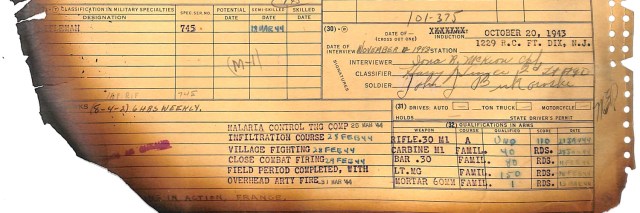
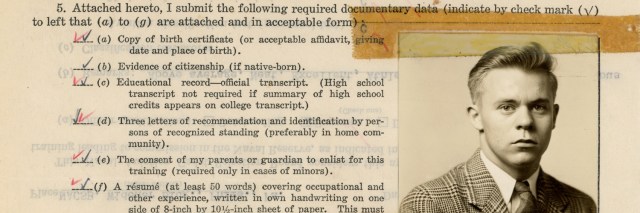
Some of Brinton’s military paperwork and his service record booklet survived the 1973 National Personnel Records Center fire that claimed most World War II-era U.S. personnel files. His induction paperwork stated that Brinton had worked as a machinist operator for one year prior, earning $35 per week. (Those figures might have been outdated if they were copied from a Selective Service questionnaire that he filled out after his initial draft registration rather than at the time he was drafted.)
Brinton’s military paperwork described him as standing five feet, 7½ inches tall and weighing 134 lbs., with brown hair and blue eyes. Although the physical examination documented 2nd degree pes planus (flat feet), a deviated septum, and a partial upper denture plate, none of these findings precluded military service. He was Protestant.
Brinton’s older brother, Willard, also served in the U.S. Army during World War II.
Stateside Training
After Brinton was drafted, he went on active duty in the U.S. Army at Fort Dix, New Jersey, on May 12, 1942. He was briefly attached unassigned to Company “D,” 1229th Reception Center there. After a brief period at Fort George G. Meade, Maryland, Private Brinton joined Company “A,” 116th Infantry Regiment, 29th Infantry Division at Fort A.P. Hill, Virginia, on May 29, 1942.
The 29th Infantry Division had originally been composed entirely of men from National Guard units (primarily those from Maryland and Virginia, but also a handful from Pennsylvania and Washington, D.C.). However, the division was federalized on February 3, 1941. Many of the original guardsmen remained even as men from other parts of the country, like Brinton, joined the division.
Brinton was first listed on the June 1942 Company “A” roster with the duty and military occupational specialty (M.O.S.) codes of 521, basic.
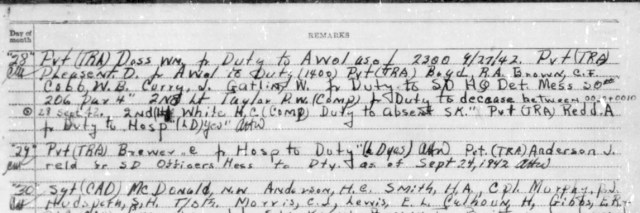
After Brinton joined the unit, the 116th Infantry went on maneuvers in the Carolinas in July 1942 and moved to Camp Blanding, Florida, in August. Brinton’s personnel file stated that as of September 1, 1942, his M.O.S. was 607, mortar gunner, with a rating of good on a four-rating scale (fair, good, very good, excellent).
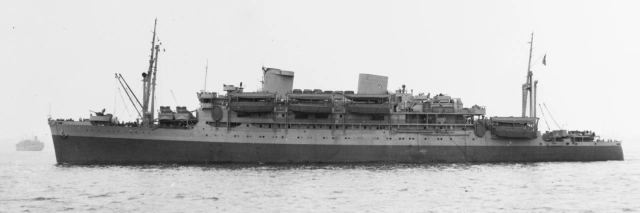
The 29th Infantry Division arrived at Camp Kilmer, New Jersey, in September 1942. The 116th Infantry Regiment boarded the ocean liner turned troopship R.M.S. Queen Mary at the New York Port of Embarkation on September 26, 1942, shipping out the following morning.
Training in the United Kingdom
The transatlantic voyage was marred by an accident on October 2, 1942, in which the Queen Mary collided with and sank an escorting cruiser—H.M.S. Curacoa—with heavy loss of life. The following day, Queen Mary arrived in Greenock, Scotland.
The 29th Infantry Division spent the next 20 months training in the United Kingdom. Initially based at Tidworth Barracks in Wiltshire, England, the division moved to southwest England in May 1943. The division was not deployed to the Mediterranean Theater and would not enter combat until the invasion of France, Operation Overlord.
According to the individual military service record filled out by Brinton’s mother for the State of Delaware Public Archives Commission, he “Went to school in England and studied communication and radio” and was a “communication man” but she did not know any other details of his military service prior to the invasion of Normandy. That implied that he was a radio operator or wireman, but Brinton’s personnel file did not mention him attending a special communications school or that his M.O.S. was ever changed to anything other than mortar gunner. Brinton was promoted to private 1st class on December 6, 1942.
The 29th Infantry Division began amphibious training in September 1943. In the months that followed, the division participated in a series of exercises including simulated landings at Slapton Sands, England. At the same time, on the other side of the English Channel, the Germans were rapidly building up fortifications, obstacles, and minefields on the coast of the countries that they occupied.
Brinton went on furlough during February 21–25, 1944. A roster microfilmed with his company’s morning reports indicates that he visited London and Shipley and stayed at the Columbia Club in London. He returned to duty on February 26.
Allied planners selected the 116th Infantry Regiment to spearhead the 29th Infantry Division landings on the western portion of Omaha Beach on D-Day, with Company “A” assigned to sector Dog Green, near Vierville-sur-Mer. Company “A” was the lead company in 1st Battalion and scheduled to land with the first wave of infantry to hit the beach.
In his book, Sand & Steel: The D-Day Invasions and the Liberation of France, Peter Caddick-Adams wrote:
The primary importance of Omaha was in the fact that it lay between Utah and Gold Beaches — fourteen miles as the crow flies to the former, sixteen to the latter. Linking up with both would be a critical phase in the success of Overlord. […] The quickest of overviews indicates just three platoon-sized resistance nests on the coast capable of interfering with the landings at Utah. The same computation for the five miles of Omaha indicates a much greater density: fourteen equivalent strongpoints, admittedly some unfinished on 6 June, which is why further postponement of D-Day would have spelled disaster.
Caddick-Adams wrote that German troop strength at Omaha Beach on June 6, 1944, was about three times as strong as Allied intelligence had estimated. He also observed that:
Utah’s defenders were largely distracted by the sudden presence of two American airborne formations dropping in their midst. The garrison behind Omaha — larger in strength, and lurking in more and better-prepared defensive positions — would have no such interference. Undoubtedly, the appearance of Allied airborne forces behind the defenders of Omaha would have made all the difference. This had been the original COSSAC [Chief of Staff to Supreme Allied Commander] plan, and there were additional trained formations (British 1st Airborne Division and the Polish Parachute Brigade) in England, but no additional airlift capacity, spare gliders or tugs, to deploy a fourth airborne formation simultaneously into battle with the existing three.
The terrain at Omaha Beach was particularly tough, due to high bluffs, with a handful of draws providing the only routes to move men and equipment inland. In his book, Beyond the Beachhead: The 29th Infantry Division in Normandy, Joseph Balkoski wrote:
The success of the Omaha invasion depended on quick seizure of these draws. The Yanks expected to be able to drive their trucks and tanks off the beach through these gaps only three hours after the first wave. The Germans, of course, also recognized the importance of the draws and were prepared to defend them resolutely.
D-Day in Normandy
1st Battalion (including Private 1st Class Brinton’s Company “A”) of the 116th Infantry Regiment sailed from England aboard the transport S.S. Empire Javelin. Early on the morning of June 6, 1944, Brinton’s company boarded a group of six L.C.A.s (Landing Craft, Assault).
The naval bombardment preceding the landing had only limited effect and heavy bombers dropped their ordnance well inland. Planners decided to begin the landings close to low tide so that engineers could eliminate obstacles that would otherwise have been underwater later in the day. Although that would make things easier for the follow-up waves, the first troops to land would have to cross a much longer stretch of beach on foot while under fire.
In Beyond the Beachhead, Joseph Balkoski wrote:
It took about an hour to load the first-wave boats and lower them into the sea. This was the moment when the 29ers most needed their seasickness pills; for in the rough seas off Normandy, the little assault boats bombed up and down on the waves like bathtub toys. […] According to the plan, the first wave of the 116th Infantry would hit the beach at exactly 6:31 A.M. The 116th’s three transports were anchored eleven miles offshore, so plenty of time had to be allowed for the nine-knot landing craft to reach the beach at their appointed times.
On the way to the beach, LCA-911 foundered, killing another Delawarean, Private 1st Class James M. Padley (1923–1944). Much of the armor and artillery earmarked to support the infantry at Omaha beach also sank offshore. Then 100 yards from the beach, another landing craft “was hit by a shell—some said it was a mine—and the boat disintegrated.”
The remaining four landing craft made it to the beach, only for their occupants to be decimated by machine gun fire from the bluffs as soon as they began struggling ashore. The only cover—ironically, the beach obstacles—provided scant protection. The Company “A” commanding officer, Captain Taylor N. Fellers (1914–1944), and every soldier aboard his landing craft were killed.
In another book, Omaha Beach: D-Day, June 6, 1944, Joseph Balkoski wrote that:
The primary source of the killing was probably an enemy pillbox camouflaged nearly perfectly in the folds of the bluff about 220 yards west of the Vierville draw. This pillbox was sited to fire only eastward, and through its firing slit, occupants had an idea view of the beach where Company A disembarked. At about 400 yards range, a German manning a fixed machine gun with a perfect flank shot could hardly miss.
Only a handful of men made it to the relative safety of the base of the bluffs (though most men from LCA-911 were rescued). Compounding the tragedy, the remainder of 1st Battalion (except Company “C,” which landed further east than planned) landed nearby in successive waves and were decimated just as Company “A” had been. The survivors of the 116th Infantry Regiment and other units eventually pushed their way up the draws and eliminated the German positions one by one.
By some casualty estimates, by the end of D-Day, over half the men in Company “A” were dead. One of them was Private 1st Class Brinton. There is no known documentation for how he died. No cause of death was recorded in the report of burial or report of death in his individual deceased personnel file (I.D.P.F.). Brinton was posthumously awarded the Purple Heart. His mother wrote that she was notified by telegram that he was missing in action followed by an August 1, 1944, letter from the War Department informing her of his death on June 6.
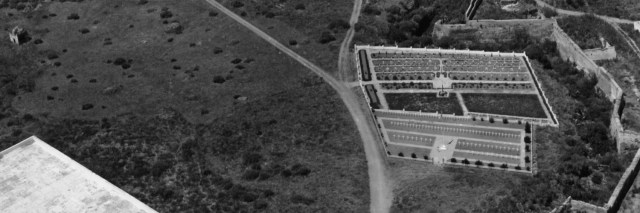
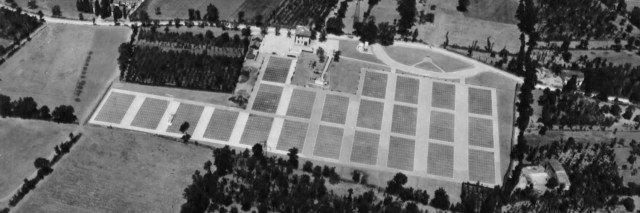
Private 1st Class Brinton was originally buried on June 10, 1944, at the U.S. Military Cemetery St. Laurent, France (Plot A, Row 10, Grave 184). After the war, Brinton’s mother requested that his body be returned to the United States. His body was disinterred on September 17, 1947, and returned to the United States aboard the U.S.A.T. Robert F. Burns. After his funeral at the Pentecostal Church of Delaware on December 6, 1947, he was buried in the Riverview Cemetery in Wilmington, where his father had been buried. His mother, brother, and half-brother were also buried there after their deaths.
Brinton’s name is honored on the Pennsylvania Railroad’s World War II memorial inside Philadelphia’s 30th Street Station, and at Veterans Memorial Park in New Castle, Delaware.
Notes
Residence
Although the Brintons initially lived there as boarders, Brinton’s mother and her second husband purchased the home at 12 Buena Vista Street on June 7, 1944, one day after Brinton’s death.
Place of Employment
The maintenance yard known as Wilmington Shops still exists, now operated by Amtrak.
Bedford, Virginia
Companies of the 116th Infantry Regiment had been located in towns across Virginia, with Company “A” based at the Bedford Armory. 35 federalized Virginia National Guardsmen from Bedford remained in the company. 23 Company “A” men from Bedford were killed in action in Normandy, including an astonishing 19 on D-Day alone.
Company “A,” 116th Infantry Regiment D-Day Strength and Casualties
The precise number of men who were about the six L.C.A.s as well as the number of Company “A” casualties is uncertain. There are no known lists of men assigned to each landing craft, which makes determining the fate of each man more difficulty, though each boat had approximately 31 soldiers aboard (totaling about 186 men in the wave).
According to a compilation of morning reports posted on the 116th Infantry Regiment Foundation website, on June 6, 1944, alone, Company “A” suffered 98 dead, 22 wounded (of whom one later died of wounds), and one captured. That includes morning reports from later dates which specified the event as having occurred on June 6, 1944. Even these figures contain errors, which is understandable considering that the company clerk had to get caught up on a vast number of casualties once information became available. For example, Private 1st Class James M. Padley was killed when his landing craft sank on D-Day but he was listed as missing in action on June 9, 1944. Similarly, 1st Lieutenant Elisha R. Nance (1914–2009) was wounded on D-Day, but the injury was recorded the following day. It is also possible that some casualties for the days following the invasion were erroneously attributed to June 6.
Caddick-Adams, citing John Robert Slaughter’s book, Omaha Beach and Beyond, stated that “of the 180 who set up in [Royal Naval Sub-lieutenant] Jimmy Green’s little flotilla of six boats, ninety-one of the landing party died within minutes from gunshot wounds or drowning.”
Although all these figures are at best estimates, it seems clear that in its first day or days in combat, the company suffered close to 50% fatalities.
Cause of Death
A hospital admission card was filled under Brinton’s service number, but like the other documents, did not record his cause of death. These cards were filled out even when a soldier did not survive long enough to reach medical treatment and there is no indication that Private 1st Class Brinton made it to an aid station or hospital.
Acknowledgments
Special thanks to the Delaware Public Archives for the use of their photo of Private 1st Class Brinton and to Lori Berdak Miller at Redbird Research for obtaining his B-file (personnel file that survived the 1973 National Personnel Records Center fire).
Bibliography
“116th Infantry Regiment, 1st Battalion, A Company – Group Critique Notes.” D-Day Overlord website. https://www.dday-overlord.com/en/battle-of-normandy/after-action-reports/29th-infantry/116th-ir-1st-bn-a-co
“Amanda Elizabeth ‘Bessie’ Palmer Brinton.” Find a Grave. https://www.findagrave.com/memorial/75020458/amanda-elizabeth-brinton
Application for Headstone or Marker for Walter S. Brinton. December 6, 1947. Applications for Headstones, January 1, 1925 – June 30, 1970. Record Group 92, Records of the Office of the Quartermaster General, 1774–1985. National Archives at St. Louis, Missouri. https://www.ancestry.com/imageviewer/collections/2375/images/40050_644066_0362-03127
Balkoski, Joseph. Beyond the Beachhead: The 29th Infantry Division in Normandy. Revised ed. Stackpole Books, 2005.
Balkoski, Joseph. Omaha Beach: D-Day, June 6, 1944. Stackpole Books, 2004.
Caddick-Adams, Peter. Sand & Steel: The D-Day Invasions and the Liberation of France. Oxford University Press, 2019.
Census Record for Walter Brinton. April 10, 1930. Fifteenth Census of the United States, 1930. Record Group 29, Records of the Bureau of the Census. National Archives at Washington, D.C. https://www.familysearch.org/ark:/61903/3:1:33SQ-GRHM-VQ9
Census Record for Walter Brinton. April 15, 1940. Sixteenth Census of the United States, 1940. Record Group 29, Records of the Bureau of the Census. National Archives at Washington, D.C. https://www.familysearch.org/ark:/61903/3:1:3QS7-L9MR-M397
Census Record for Walter Brinton. January 3, 1920. Fourteenth Census of the United States, 1920. Record Group 29, Records of the Bureau of the Census. National Archives at Washington, D.C. https://www.familysearch.org/ark:/61903/3:1:33S7-9R6W-39
Certificate of Birth for Walter Stanley Brinton. January 15, 1918. Record Group 1500-008-094, Birth Certificates. Delaware Public Archives, Dover, Delaware. https://www.familysearch.org/ark:/61903/3:1:S3HT-DTMW-Z1Y
“Death of Mrs. William Brinton.” The Morning News, March 9, 1907. https://www.newspapers.com/clip/73357242/william-brinton-first-wife-death/
Draft Registration Card for Walter Stanley Brinton. October 10, 1940. Draft Registration Cards for Delaware, October 16, 1940 – March 31, 1947. Record Group 147, Records of the Selective Service System. National Archives at St. Louis, Missouri. https://www.familysearch.org/ark:/61903/3:1:3Q9M-CSMG-D947-R
Draft Registration Card for Willard Leighton Brinton. September 12, 1918. World War I Selective Service System Draft Registration Cards, 1917-1918. National Archives at Washington, D.C. https://www.ancestry.com/imageviewer/collections/6482/images/005207038_04508
Enlistment Record for Walter S. Brinton. May 12, 1942. World War II Army Enlistment Records. Record Group 64, Records of the National Archives and Records Administration. National Archives at College Park, Maryland. https://aad.archives.gov/aad/record-detail.jsp?dt=893&mtch=1&cat=all&tf=F&q=32267437&bc=&rpp=10&pg=1&rid=2907449
Individual Deceased Personnel File for Walter S. Brinton. Individual Deceased Personnel Files, 1939–1953. Record Group 92, Records of the Office of the Quartermaster General, 1774–1985. National Archives at St. Louis, Missouri. https://catalog.archives.gov/id/330604880
“Monthly Personnel Roster June 30 1942 Company A 116th Inf.” June 30, 1942. U.S. Army Muster Rolls and Rosters, November 1, 1912 – December 31, 1943. Record Group 64, Records of the National Archives and Records Administration. National Archives at St. Louis, Missouri. https://s3.amazonaws.com/NARAprodstorage/lz/st-louis/rg-064/85713803_1940-1943/85713803_1940-1943_Roll-1670/85713803_1940-1943_Roll-1670_15.pdf
Morning Reports for Company “A,” 116th Infantry Regiment. February 1944. U.S. Army Morning Reports, c. 1912–1946. Record Group 64, Records of the National Archives and Records Administration. National Archives at St. Louis, Missouri. https://s3.amazonaws.com/NARAprodstorage/lz/partners/st-louis/rg-064/85713825-wwii/85713825_1944-02/85713825_1944-02_Roll-0596/85713825_1944-02_Roll-0596-04.pdf, https://s3.amazonaws.com/NARAprodstorage/lz/partners/st-louis/rg-064/85713825-wwii/85713825_1944-02/85713825_1944-02_Roll-0596/85713825_1944-02_Roll-0596-05.pdf
Morning Reports for Company “A,” 116th Infantry Regiment. June 1944. U.S. Army Morning Reports, c. 1912–1946. Record Group 64, Records of the National Archives and Records Administration. National Archives at St. Louis, Missouri. https://s3.amazonaws.com/NARAprodstorage/lz/partners/st-louis/rg-064/85713825-wwii/85713825_1944-06/85713825_1944-06_Roll-0733/85713825_1944-06_Roll-0733-06.pdf, https://s3.amazonaws.com/NARAprodstorage/lz/partners/st-louis/rg-064/85713825-wwii/85713825_1944-06/85713825_1944-06_Roll-0733/85713825_1944-06_Roll-0733-07.pdf
Morning Reports for Company “A,” 116th Infantry Regiment. May 1942 – December 1942. U.S. Army Morning Reports, c. 1912–1946. Record Group 64, Records of the National Archives and Records Administration. National Archives at St. Louis, Missouri. https://s3.amazonaws.com/NARAprodstorage/lz/partners/st-louis/rg-064/85713825-wwii/85713825_1940-01-thru-1943-07/85713825_1940-01-thru-1943-07_Roll-1696/85713825_1940-01-thru-1943-07_Roll-1696-21.pdf, https://s3.amazonaws.com/NARAprodstorage/lz/partners/st-louis/rg-064/85713825-wwii/85713825_1940-01-thru-1943-07/85713825_1940-01-thru-1943-07_Roll-1696/85713825_1940-01-thru-1943-07_Roll-1696-22.pdf
Official Military Personnel File for Walter S. Brinton. Official Military Personnel Files, 1912–1998. Record Group 319, Records of the Army Staff. National Archives at St. Louis, Missouri. Courtesy of Lori Berdak Miller.
Roe, Viola. Individual Military Service Record for Walter S. Brinton. December 4, 1944. Record Group 1325-003-053, Record of Delawareans Who Died in World War II. Delaware Public Archives, Dover, Delaware. https://cdm16397.contentdm.oclc.org/digital/collection/p15323coll6/id/17825/rec/4
Stanton, Shelby L. World War II Order of Battle: An Encyclopedic Reference to U.S. Army Ground Forces from Battalion through Division 1939–1946. Revised ed. Stackpole Books, 2006.
“Viola Roe.” The Morning News, August 11, 1981. https://www.newspapers.com/clip/68955853/viola-roe/
“Willard L. Brinton.” Find a Grave. https://www.findagrave.com/memorial/117252657/willard-l.-brinton
“W. S. Brinton, Slain On D-Day, to Be Buried.” Journal-Every Evening, December 4, 1947. https://www.newspapers.com/clip/73355340/walter-s-brinton-funeral/
Last updated on March 22, 2025

























To have new profiles of fallen soldiers delivered to your inbox, please subscribe below.
 Delaware's World War II Fallen